Grand dame of Vizag takes a trip down memory lane

Duvvuri Lalithamba is no ordinary woman. At 101, she has witnessed the transformation of the Port City from a sleepy town to the smart city of the future. The daughter of Sir Vepa Ramesam, who was the Chief Justice of the Madras Presidency and founder of the Neo-Malthusian Society, Lalithamba bears testimony to almost all the historical events, including the independence movement, bombing of Vizag by the Japanese and sinking of PNS Ghazi off the city’s coast in 1971.

As one of the founders of the Vizagapatam Ladies Club, Lalithamba is credited with organizing theatre and dance performances, including one by Bollywood star of yesteryears, Waheeda Rehman, in the city much before she became a star. In a tete-a-tete with Venkatesh Bayya of TOI, the grand dame of Vizag speaks about the developments that the city has seen in the last eight-and-a-half decades.

What was Vizag like back in the early 1930s?

Though a culturally advanced town blessed with a large population of educated people, Vizag was yet to find its own place on the map. Back then, it was popular with tourists, many of whom were landed gentry from Andhra, Odisha and Tamil Nadu. The locals and the wealthy also contributed to its languid grace and pace.

When and how did it evolve into a city?

It all started with the naval base coming up after the first world war. Then came Andhra University and the establishment of the Visakhapatnam Port Trust. With the city getting electrified in the mid-1930s, my husband DV Ram Murthy, who belonged to a landed family from East Godavari, was one of the first entrepreneurs to set up Lumen Electricals taking advantage of the introduction of electricity. Many people also benefitted from the setting up of the shipyard and Caltex, the present day HPCL. But all this has come at a cost. Vizag was once the summer capital of the Madras Presidency as temperatures never shot up beyond 30 degrees Celsius. But today the greenery is gone. The city has become an industrial hub and far more polluted than it ever was.

Do you remember the Japanese bombing of 1942?

We were living on the main road of the Old Town. Japanese fighter aircraft bombed the port area during the day. The city turned into a fortress, sirens were sounded all the time and the residents subjected to drills. Most of the bungalows and mansions were taken over by the military and Vizag turned into a massive military camp with soldiers from Australia, Canada and New Zealand. There were more anti-aircraft guns than people in some areas. The supply of electricity was restricted. For the first time in my life I witnessed an exodus. Most of the residents left for the neighbouring towns and villages. My husband, however, was asked to stay back to take care of the lighthouse and the electrical equipment in the port. He convinced me to move to Kakinada for a short while but I returned to Vizag and continued to stay with him.

What about the submarine attack by Pakistan in 1971?

That was totally different from the 1942 bombing. We were all taken by surprise. Those days we were living near the beach and heard a massive explosion one day. The window panes were shattered and we knew we were under attack. Later, the Navy said the Pakistani submarine Ghazi had come too close to the port and was sunk by the navy.

Have you witnessed any other cyclones like Hudhud?

We faced a cyclone in the mid-1920s when the entire town was flooded. The backwaters, which now constitute the core port area, literally flooded all of Old Town and other low lying areas. It was scary then, but Hudhud was equally scary, taking the wind speeds into account. I have also heard of an equally scary cyclone in the late 19th century.

Do you carry any baggage of being Vepa Ramesam’s daughter, Sir SV Ram Murthy’s niece and the grandniece of Sir CY Chinthamani? What was your father’s influence on you?

I do not carry any baggage and neither did my father. In fact when India gained independence, he was the first of the knights to get rid of the title. My father taught all of us to make maximum use of our mental faculties and encouraged us to take part in sports. Despite shifting to Madras to practice in the Madras High Court, he always loved Vizag. His father, Rao Sahib Vepa Lakshmi Narsimham, was a judge and the Commissioner Inams of the Madras Presidency. My grandfather’s house on the main road of Old Town originally housed the East India Company Writers. It had four courtyards with barns and stables in the backyard.

What about your contribution to the cultural scene in Visakhapatnam?

Well, I was active at a time when Vizag was undergoing a massive change. It was turning into a modern city and movies were making their presence felt. At the same time, the freedom movement was on and we were all inspired by Gandhi’s ideals and zeal. During this period, the Vizagapatam Ladies Club organised many socio-cultural events and we tried to engage women in social dialogue concerning various issues. I also set up the first self help group for women in the state and collaborated with the Andhra Mahila Sabha to ensure financial independence of women.

How do you describe your life?

Well lived!! As for my body, I have decided to donate it to the KGH for research purposes. I do not wish to be cremated.

source: http://www.timesofindia.indiatimes.com / The Times of India / Home> City> Visakhapatnam / TNN / July 06th, 2015

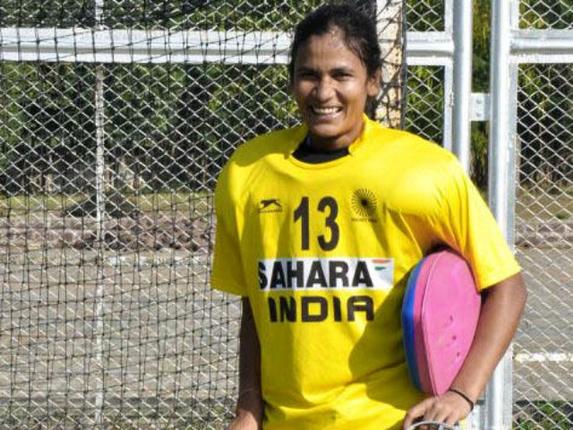
Women’s Hockey: Soundarya, Rajani script history

They are the first women hockey players from AP and TS to join the Indian team, which qualified for the 2016 Rio Olympics.

Yendala Soundarya
Yendala Soundarya

Yendala Soundarya and Etimarpu Rajani scripted history by becoming the first-ever women hockey players from Andhra Pradesh and Telangana to be members of the Indian team which qualified for the 2016 Rio Olympics.

 Etimarpu Rajani
Etimarpu Rajani

The last time India played in Olympics was in the 1980 edition when it was given a direct entry because of the boycott led by USA in the Moscow edition.

India made it to the next edition of Olympics (for the first time after 36 years) by virtue of defeating Japan 1-0 in the play-off match for the fifth place and both Ms. Soundarya and Ms. Rajani were part of the team in the World Cup semi-final league matches in Belgium.

Ms. Soundarya says she is delighted. “This is one of the finest moments in my career. We are all so happy that our biggest dream is coming true,” said both Ms.Soundarya and Ms. Rajani in a chat with The Hindu in Belgium.

For someone who took to hockey watching seniors and playing for India since 2006, the 25-year-old Ms. Soundarya was also a member of the Indian team, which won the silver in the Senior Asia Cup and the Champions Trophy.

Ms. Soundarya says that the team was confident in today’s crucial match. “Hats off to my teammate Rani Rampal; we emerged winner. And we are in celebratory mood right now,” she said in a voice choked with joy.

“I owe my success to my first coach Maqbool in Nizamabad and then to the SAI coaches, including Gloria, at the SAI Centre in Hyderabad, where I trained for five years,” the star player recalled. “Right now, no major event is scheduled and since we have qualified for the Olympics, some events may be lined up,” she said.

“I feel honoured to play for India, coming from a place like Nizamabad (she was a student of Modern Public School) which has no history of hockey players,” Ms. Soundarya exclaims.

Achievements not a surprise

SAI hockey coach P. Madhukaran, who was earlier the Indian women’s World Cup coach, recalls the abundance of talent these girls have shown in their formative years.

“Their achievements are not a surprise to me given their commitment and sincerity to keep improving,” he says.

source: http://www.thehindu.com / The Hindu / Home> National> Andhra Pradesh / by V. V. Subrahmanyam / Hyderabad – July 06th, 2015

The living legend of Chodavaram’s Karya Siddhi Vinayaka temple

Visakhapatnam :

The Karya Siddhi Vinayaka temple at Chodavaram is considered one of the two self-originating Vinayaka temples in AP, the second one being the Kanipakam temple in Chittoor district.

According to archaeological experts, both the temples were constructed roughly during the same time by the Chalukya Cholas (roughly 1200 AD).

The original Vinayaka temple and idol were discovered over 200 years ago at the spot where the present temple was built. According to the village elders, much effort was then put into shifting the idol to a nearby sivalayam. However, they were unable to do so as, according to a well-known local story that has gained mythical proportions, the snout of the Vinayaka was so long that they could not unearth it.

M Jagannadham, a local history buff, native and old timer, said, “The remains of the old temple were unearthed in 1850. However, the idol continued to remain sunk as it could not be propped up. Even today the Mula Virat, Lord Ganesh’s idol, cannot be completely seen. Only the upper portion of the torso can be properly seen and the rest lies buried.”

According to heritage conservationist Rani Sarma, not much may ever be known about the origins of the temple as the new temple built on the old premises has been repaired and reconstructed beyond recognition in the last 200 years. “One cannot go against the beliefs of the people for the Vinayaka here is said to be the Karya Siddhi Vinayaka, one who helps us achieve what we set out to do. It is people who wanted the temple to be built and rebuilt in the name of development and betterment,” she said.

Pointing out that the temple was built during the Chalukya-Chola period she said: “The Eastern Chalukya-Chola period saw a resurgence of Shaivism in the region and hence the large number of Shiva temples.”

Regarding the Swayambhu (self-originating) legend — a term generally used to describe ancient shrines that have been discovered by accident — a senior employee of the state archaeology department said, “How does one explain the remains of a temple unearthed from the ground? Though the general perception is that the shrine came out on its own, not much should be read into it from the archaeological or scientific point of view. It has more to do with the faith of the people.”

“The pity is that there is little or no scope for archaeological studies to be conducted as the temple has been rebuilt many times over the last 200 years. But the fact that the idol is located close to the old fort premises goes to prove that the temple may originally date back at least a 1,000 years,” he added.

The temple priest, Kodamanchili Ganesh, said, “We have been the priests for several generations now. It is true that the temple, which dates back to several hundred years, has been built and rebuilt over the years.” While pointing out that many people did come to research the origins of the temple, he said that keeping in view the fact that it was a live and vibrant place of worship, not much digging and excavation work could be done.

According to Jagannadham, Chodavaram came into existence as an agraharam (a Brahmin hamlet) following a grant by Chalukya Cholas to members of the Brahmin community. “It then developed into a centre of Vedic learning and Shaivite worship and went on to draw the attention of members of the trading class, who also contributed immensely to its growth, making it a major trading centre. A garrison was later built by the Chalukya Cholas to protect their trading interests,” he explained.

The legend: Legend has it that the snout of the Vinayaka is so long that the locals were unable to unearth it. The idol continues to remain sunk even today with only the upper portion of the torso visible to devotees and the rest remaining buried

source: http://www.timesofindia.indiatimes.com / The Times of India / Home> City> Visakhapatnam / by Venkatesh Bayya, TNN / July 04th, 2015

GCC re-entering coffee mart after two decades

Visakhapatnam  :

After nearly two decades, the Girijan Cooperative Corporation (GCC) is re-entering the coffee sector in the Visakha Agency again and is targeting marketing around 2,000 metric tonnes of coffee procured from small tribal farmers in the Visakha Agency this year.

According to records, there are around one lakh tribals cultivating on nearly 96,337 acres and producing around 6,500 metric tonnes of coffee every year, which fetches around Rs 65 crore. With GCC’s support, the farmers are expected to earn around Rs 91 crore.

GCC has already identified 14 godowns to store the coffee stocks in the Agency and collection of material will start from December this year. It plans to set up one procurement centre each at the village level and two big centres each at the mandal level. GCC has already initiated awareness campaigns in each hamlet in June, inviting coffee growing farmers to enroll their names.

The corporation plans to register the data such as names of farmers, bank account numbers and Aadhaar number in July and August. It is likely to recruit separate manpower for coffee-related activities in September.

“The output and price realization in the Agency areas is very low due to improper harvesting techniques and marketing. If we provide guidance to coffee growing farmers in harvesting and marketing the produce, they will surely benefit. Currently, farmers get a very low price for their produce. If we market the same stocks, their earnings will increase by nearly 40% as we will ensure that each farmer gets the maximum price for his produce. GCC will be taking care of marketing the coffee from this financial year,” GCC managing director A Ravi Prakash said.

“GCC will take care of the pruning, curing, transport and auction of coffee. GCC will bear the entire cost of this and will be reimbursed by the government later. The state government will give Rs 25 crore initially and the Coffee Board will give a subsidy too. GCC will an organized marketing platform for small farmers,” he said.

This is not the first time that GCC is involved in the coffee sector. It had floated the Girijan Plantation Cooperative Development Corporation (GPCDC) in 1986 and developed 40,000 acres of plantation. However, GPCDC wound up its activities in 1997 and the plantation area was distributed among farmers and ITDA staff, sources said.

Meanwhile, the state government has also announced that GCC will provide marketing support for the Paderu Coffee Project, under which the government will invest Rs 526.16 crore in adding another one lakh acres under coffee plantations in the next 10 years. The project was announced by chief minister Chandrababu Naidu on October 17 last year after Cyclone Hudhud and a GO was released by the tribal welfare department last month.

source: http://www.timesofindia.indiatimes.com / The Times of India / Home> City> Visakhapatnam / TNN / July 03rd, 2015

‘You win some, learn some’

Book - 'Winners in Struggle of Life...'
Book – ‘Winners in Struggle of Life…’

Palaparthy Sandhya Rani’s book ‘Winners In Struggle of Life…’ inspires all to face the challenges in life with a smile and courage writes Neeraja Murthy.

Over the last few years, suicides committed by young students have been on the rise. What is disturbing is that some of these students decide to end their lives over inconsequential, petty things. “These students commit suicide in a momentary lapse of reason leaving their parents in unfounded agony. If only they think of the challenges that disabled youth face, they will know how to face upheavals in life, one needs a smile and courage. Suicide is not the answer,” states writer Palaparthy Sandhya Rani sitting in her modest apartment in Safilguda.

Her new book Winners In Struggle of Life… tells the stories of disabled individuals who have emerged winners in different fields.

In fact Winners…’ is the English version of her Telugu book Vijetalu Jeevita Poratamlo launched in 2014.

Writer P. Sandhya Rani.

A native of Bapatla, Sandhya hails from a family of literary persons and social workers. “My father’s aunt Kanuparthi Varalakshmamma was a freedom fighter and social worker who fought against child labour and child marriages. The Stree Hiteshwari Mandali which runs even now was established by her. As a child, I was surrounded by people and relatives visiting our house,” recalls Sandhya. She adds that even her father was a helpful person. “When we moved to the north due to my father’s railway job, he would enquire about others’ wellbeing. Since it was also a new place and an alien language for other railway employees, after returning from work, he would go around the colony to check if anyone needed anything.” Her father’s cousin Anubandha Ramprasad Palaparthy, who used to write with ‘Prasad’ as his pen name was an editor and writer of historical novels. With an illustrious lineage, Sandhya says her writing skills came naturally.

As a young mother, Sandhya would write about the joy of motherhood in her personal diary. “I showed my writings to my friends, who encouraged me to write more,” she recalls with a smile. In 2006, she wrote her first poem ‘Sagatu Manishi’ which got published in a government magazine. This paved the way for her journalistic writing career and she began freelancing for Telugu newspapers and magazines like Andhra Prabha, Varta, Andhra Jyoti, Prabhata Nestam, and Teja. “Except politics, I would write on different topics and would try to bring in a new angle to the story. For the nine days of Dasara, I would write on things like which goddess to be worshipped on which day, which prasadam to make or why we should do the puja on the 10th day also…,” she explains.

Sandhya’s writings also included interviews of women television and film artistes and those who have made a mark. In 2011, she found a change in her enthusiasm levels. “I would constantly hear about educated young women committing suicides. I found it too depressing and as a parent, I understood the pain and agony of other parents. I wanted youngsters to think for a minute whether the problem is so big that you have to die,” she states with anguish and adds, “I wanted to write about the disabled youth and their success stories. They are dependent and face the challenges with a smile and positive outlook.”

For her research, Sandhya met disabled individuals from across India. The book includes profiles of these individuals whose handicap have not come in the way of their will to succeed. She also exhorts parents to be balanced in their approach. “Some parents do not support their daughters when they face a tough time. They care more for the society and ask her to adjust,” she points out.

Sandhya hopes her book will bring in a change in the mindset of youngsters. “In life, we win some, we learn some. One should think of challenges as lessons and not be scared of them. For once, think of the people who love you, and life, once gone, will not come back again.”

(The book ‘Winners in struggle of life…’ is priced at Rs. 125. For copies, contact 99853 51719)

source: http://www.thehindu.com / The Hindu / Home> Features> Friday Review / by Neeraja Murthy / July 02nd, 2015

Prowess on display

Lec dem P. Surya Rao

Vocalist Srinivasa Sarma and mridangam vidwan Sadgurucharan captivated the audience at Vijayawada.

The Swara Tarangini Sabha of Vijayawada presented its monthly programme at Sringeri Peetha Paripalita Sri Sivaramakrishna Kshetramin two parts — the first was a vocal concert by Ganduri Srinivasa Sarma and the second was an impressive and enlightening lecture demonstration on mridangam by K.Sadgurucharan, an A-grade mridangam vidwan and a staff artiste of Vijayawada Akashvani.

Srinivasa Sarma began his vocal concert with GNB’s Vara Vallabha in Hamsadhvani concluding it with kalpana swaras. Sarma’s assets were his powerful voice and sound manodharmam. After rendering a detailed delineation of Kalyani he sang Nidhi Chala Sukhama of Thyagaraja with proper feeling he sang Swathi Thirunal’s Bhogindra Sayinam in Kuntalavarali in fast tempo and then he took up Kharaharapriya for the main item of the concert. Expressive raga elaboration, neraval and kalpana swaras amply complimented the keertana Chakkani Raja Margamu of Thyagaraja. The concert came to a conclusion with a seldom-heard thillana in Basant Bahar made popular by late Maharajapuram Santanam. Srinivasa Sarma was ably accompanied on violin by his father and guru Ganduri Srinivasa Murthy. K.Aravind accompanied on mridangam showing his mettle in the tani played at the end of the main item.

The main part of the evening’s program came in the shape of an explicit, enlightening and a rare lecture demonstration by K.Sadgurucharan, a mridangam vidwan who is much sought after for his delicate feather-like touch on his instrument. Sadgurucharan, a mechanical engineer originally, took up playing the mridangam for a profession and made a success of it. His touch on mridangam is soft and soothing to the ear. He made an in-depth study of the mridangam, its mythological origin, development through the ages and how it has become the most sought-after percussion instrument in concerts.

In his informative lec-dem, Sadgurucharan explained various strokes played on the mridangam namely Natu, Chatu, Meetu and the open beat. He stated that all these and correct synchronization of the right and left sides made the mridangam the king of percussion instruments. He also mentioned that the above overtones produced on the mridangam were mentioned by Nobel Laureate scientist C. V. Raman in a paper he submitted in the early 30s to the famous magazine `Nature’. Sadgurucharan’s authoritative and interesting lecture demonstration was liked immensely by the audience.

source: http://www.thehindu.com / The Hindu / Home> Features> Friday Review>Music / by P. Surya Rao / July 02nd, 2015

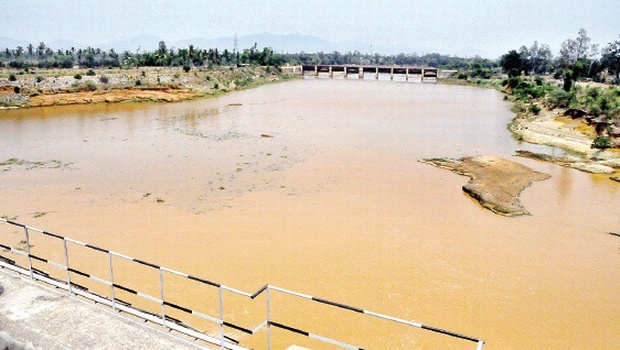
Thotapalli Reservoir Becomes a Reality after 12 Long Years

A view of the Thotapalli Reservoir in Vizianagaram district | EXPRESS PHOTO

Vizianagaram / Srikakulam : 

After more than a decade, the farmers of the ayacut area of Thotapalli reservoir are overjoyed that their dreams of irrigating their lands would be finally realised. The much-delayed Thotapalli project, except for minor works, has been completed and the Irrigation Department is making arrangements to release the waters from the reservoir in the third week of July.

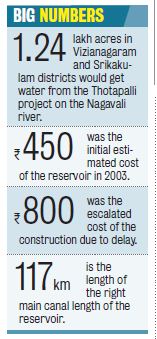
NumbersANDHRA01jul2015

Thousands of farmers and their families of Vizianagaram and Srikakulam districts are excited about prospects of receiving Thotapalli reservoir waters to kick-start the kharif season. The farmers who come under the project ayacut have been suffering as there is no irrigation water to cultivate their fields. Depending on rainwater, some of the farmers who tried to cultivate their lands faced severe financial losses as rains eluded them in the peak season.

In order to provide irrigation water to about 1.24 lakh acres in Vizianagaram and Srikakulam districts, the government had taken up the Thotapalli reservoir on the Nagavali river in 2003. The project timeline was five years and the estimated cost of the project was `450 crore. The cost later escalated to about `800 crore due to the abnormal delay in executing the project.

The district administration faced a tough time in acquiring 1,100 acres of land for the project. There were a series of agitations by land losers for relief and rehabilitation. After clearing several hurdles, the department completed all the construction works of the reservoir and its 117-km-long main canal.

According to the government’s assurance to the farmers, water from Thotapalli will be available for the 2015 kharif season. The irrigation officials, on a war-footing, completed the works to release the water in the third week of July.

“Pending minor works relating to the 29 distributary canals, four branch canals and two NH crossing works will be completed by July 2. The 117-km-long right main canal of the reservoir was completed except the tail-end 2 km. There is a railway crossing across the 2-km-long canal which will be completed next year. The department had already paid `4 crore to the Indian Railways. Under the Thotapalli project, water will be provided to 40,000 acres (original target was 62,000 acres) in Vizianagaram district and another 40,000 acres in Srikakulam district (aiming to provide 58,000 acres) this year,” said Tirumala Rao, Thotapalli project superintending engineer.

source: http://www.newindianexpress.com / The New Indian Express / Home> States> Andhra Pradesh / by VK Lakshmi Gayatri / June 30th, 2015

The guys who fix your home problems

Visakhapatnam :

Necessity is the mother of invention may be cliched statement, but it was necessity that prompted Vizagite Nilesh Korada to set up an online marketplace to cater to home-based services in the Port City.

Incubated at the Sunrise Startups in January this year, Nilesh Korada along with seven other Vizagites, started QuickPebbles, an online marketplace providing high quality electrical, plumbing, air conditioning and computer repair services that can be booked via phone call, website or their Android app.

As of now, QuickPebbles is offering its services in more than 20 areas across the city and has around 400 skilled workforce are offering their services.

“The idea to begin a startup came up actually because I was facing a problem in finding an electrician in my neighbourhood. It is a common problem that people across the city face. Even if you manage to find someone, the service is at times quite questionable. That is when I thought of a startup that can provide skilled workers across different areas of the city,” said QuickPebbles founder Nilesh Korada.

“The idea came up last year and subsequently I met other people at Sunrise Startups with a similar concept. It’s then that we decided to go ahead with this service,” he added.

Explaining the business model, he said, “We focus on quality and providing a swift service to our customers. The startup runs on a commission basis in which we take a little cut for managing the operations.”

Pointing out that the startup had invested around Rs 2 lakh till now, he said, “Once we start delivering around 300 services per month in the city, we will start actively looking for investors for a funding of around Rs 10-15 lakh for our expansion. This will mainly be for marketing and turning the service into a more professionalized set-up. We also want to tap the market potential in other cities as well – especially other tier-2 cities.”

To ensure that the skilled workforce on their lists offers quality services, operations manager Peela Raju said, “One member of our team accompanies the technician to the residence of the customer to oversee the work being done and also to get feedback from the customer on how to improve our services.”

With the development of the website as well as consolidating the database of the skilled workforce taking nearly six months, QuickPebbles launched its service on June 1 this year. “In a span of 20 days, we have done around 50-odd service calls, mainly in areas such as Seethammadhara and MVP Colony. We haven’t done much of a marketing campaign as yet and are getting calls based on word of mouth publicity” he added.

source: http://www.timesofindia.indiatimes.com / The Times of India / Home> City> Visakhapatnam / by Manish, TNN / June 24th, 2015

Anglo Indians: Vizag’s first cosmopolitans

The Port City may today be regarded as the most cosmopolitan city of Andhra Pradesh with people of various cultures and religions living together in harmony and while this is generally attributed to the mushrooming of several public sector units, industries and government establishments in the post independence era, the seeds of cosmopolitanism were sowed much before that.

For, even a century prior to independence and long before the port, steel plant or the Indian Navy dropped anchor in Vizag, a pluralistic culture thrived in the city.

It all started with the British landing on Vizag’s shores in the 19th and early 20th century, some of whom married local women when their regiments were posted in Vizag during the First and Second World War.

While most members of the city’s Anglo Indian community are descendants of British soldiers and administrative officials, some of them are also of Australian and Canadian descent. “Anglo-Indians were found from the 19th and early 20th century in Vizag and were concentrated in areas like Soldierpeta, Gnapuram, Suryabagh and Old Town. The first and second generation Anglo Indians were mostly with the armed forces or served as administrative officials. The subsequent generations mostly worked in the ports or railways and followed a fully European way of life,” said city-based historian Edward Paul.

Being literate, the community had one of the most progressive ideologies, denouncing the dowry system, forced arranged marriages and gender bias, and their women were also quite liberated. Culturally active, they influenced almost all aspects of the city, be it education, sports, music and dance, or even the social scene.

Mostly Roman Catholics and a few Protestants too by religion, the community would be found every Saturday and Sunday in churches, which served not just as a platform for religious congregation but also as a forum for socialising and cultural dos. Dressed in fashionable clothes and high-heels, they would dance, play music and exchange pleasantries in the churches. The Port Gymkhana Club, Railway Institute and Town Hall were other places for socializing and partying.

Almost all Anglo-Indians had penchant for music and thanks to them Vizag had a lively social scene, good live bands and guitarists, while most houses had pianos. Thanks to their penchant for socializing they were also instrumental in setting up many clubs. They also made good sportsperson and were into hockey, football,bicycling and athletics.

The fun-food-drink loving Anglo Indians were an industrious lot too and did not look down upon any job. An old-timer of Vizag, Sohan Hatangadi, who has seen the community at close quarters, reminisced, “My neighbour Michael Buckley would clean the streets in front of his house every day using his own brooms. He would lay the pavement in his area with tar and stone.”

One of their major contribution was towards education and saw them set up many English medium schools. “As far as education is concerned, the oldest school in Vizag, St Aloysius Anglo Indian School catered to the boys, while the girls studied in St Joseph’s Convent. Even though not too academically inclined, they preferred to be financially independent soon after turning 18 years old. Women were mostly into teaching and nursing, while men, with their knowledge of English, would get clerical jobs or work in the railways, customs or port workshops,” said Owen Perera, an old timer belonging to the community.

During Christmas, the homes and narrow by-lanes of the Old Town area (Vizag in those days was limited to the Old Town area) would come alive with decorated stars,Christmas trees and lamps. Aromas of freshly-baked cakes and melodious yuletide music would waft from every Anglo-Indian household. Easter was another important festival.

With a spurt in migration to Australia, UK and other countries since the late 1960s and 70s, when there were around 200-plus families in Vizag, today barely 15-20 families (the elderly ones) are left in Vizag with life more about nostalgia for the good-old days while for some its about waiting for the younger generation’s homecoming from abroad during Christmas.

source: http://www.timesofindia.indiatimes.com / The Times of India / Home> City> Visakhapatnam / by Sulogna Mehta, TNN / June 25th, 2015

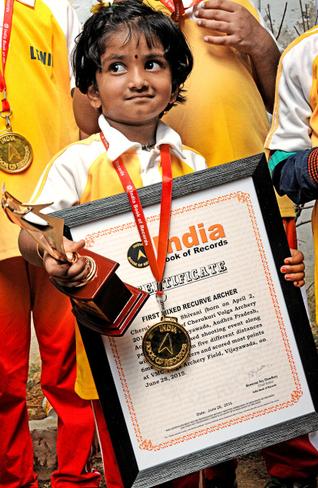
Little Shivani sets a new mark


Child prodigy:Archer Dolly Shivani who entered the India Book of Records by emerging as the country’s first mixed recurve archer in Vijayawada on Sunday.— Photo. Ch. Vijaya Bhaskar
Three-year-old kid archery Dolly Shivani entered the India Book of Records as the first mixed recurve archer of the country by performing with five archers in five different distances at the Volga Archery Academy here on Sunday.

Shivani, who made her entry into the record book as the India’s youngest archer in March, competed with V. Sai (10m), Bilwesh Dutta Sai (9m), Susanth (8m), Virat Sai (7m) and Nischal (6m) and scored more than the required points set by the adjudicator.

Shivani hauled 90 points with V. Sai in 10 metre distance, while 105 points with Bilwesh in the nine-metre.

“With Susanth, she punched 95 points in eight-metre and 85 with Virat Sai in seven. Along with Nischal she scored 110 points in the six-metre distance,” said Viswaroop Roy Chowdary, the representative of the India Book of Records.

“In total, Shivani used 40 arrows (8 X 5 rounds) while each of her fellow archers used eight each,” he added.

The archers from the academy set a new record in which 39 archers belonging to Indian, Recurve and Compound segments, using different bows took part in a group event.

“In 29 minutes and 55 seconds they scored 430 points in the 15 metre distance aiming at a 122 centimetre target face. The specified time was 60 minutes and 320 arrows. They did it in less than half time,” said Mr Chowdary.

The group event saw literally everyone from Volga Archery Academy, including chairman Cherukuri Satyanarayana to rookie archers taking part.

Machilipatnam MP K. Narayana, local corporator D. Annapurna, sports administrators Jasti Satyanarayana, K.P. Rao and others took part in the event.

The five-member film crew from United States of America, which is here to shoot a trailer on Shivani, captured the entire event.

source: http://www.thehindu.com / The Hindu / Home> News> Cities / by Special Correspondent / Vijayawada – June 29th, 2015