Innovation Society to control Sunrise village

MobMe to focus on technical side, create 1,000 student startups
In a significant development, Innovation Society, an autonomous body formed by the Andhra Pradesh Government to spread culture of innovation, will take the physical possession of Sunrise Startup Village here, the first one started in Visakhapatnam about one-and-a-half years ago.
Enquiries by The Hindu revealed that MobMe Wireless Solutions of Kochi Startup Village, which was entrusted with the job of incubating startups at Visakhapatnam on the model of technology incubators of the Silicon Valley following an MoU at the CEOs’ Conclave here on September 29, 2014, has agreed to reorient its strategies.
Sources said Innovation Society CEO Nikhil Agarwal, who is based at Tirupati, will visit the city shortly. The village housed in Technology, Research and Incubator Park (TRIP) built by the APIIC at sea-facing Rushikonda virtually took a leap in January 2015 with the organising of bootcamps for students.
Kochi Startup Village Chairman and MobMe Wireless Solutions co-founder, Sanjay Vijayakumar, denied they were exiting the Sunrise Startup Village. He told The Hindu , in an email interview, that the MoU signed with the AP Government was valid for five years to help build 1,000 student startups.
“What we are doing is changing our role from managing the physical infrastructure to going deeper into the school and college education system to build a culture of entrepreneurship. After a year of operations, we realised that the technical and entrepreneurial depth of teams is weak and needs to be strengthened from the college side to create strong founders,” he said.
Tie-up with JNTU
Mr. Vijayakumar said that to achieve it they had been working with JNTU-Anantapur and Kakinada to roll out “minors in entrepreneurship” programme for college students.
“This is exactly the same what we are doing in Kerala and Gujarat with the State technical universities here,” he claimed.
He disclosed that the Department of Science and Technology Government of India last week approved their plans to align with Startup India Action Plan and build Startup Village into a digital incubator platform (www.sv.co) for scaling up.
Physical infrastructure has limitations as students cannot come every day from all parts of Andhra Pradesh. Currently, 28 teams are in the pilot programme, including six student teams from the State. “Instead of exiting, we are going to scale this up now to 100 teams this academic year together with the two universities in AP,” he pointed out. When MobMe entered AP, the AP Innovation Society was not formed as well but now a CEO had taken charge and things had stabilised.
This allows for the Society to manage the physical infrastructure which is similar to how the physical infrastructure is managed by the Kerala Startup Mission in Kochi, Mr. Vijayakumar averred.
source: http://www.thehindu.com / The Hindu / Home> News> Cities> Visakhapatnam / by Santosh Patnaik / Visakhapatnam – June 07th, 2016
08th
07th
06th
Guizhou-Andhra Pradesh link shows rising clout of provincial power
“Love Indian culture more than Indians do. Do not impose, but align with the flow. Change only what you can.”
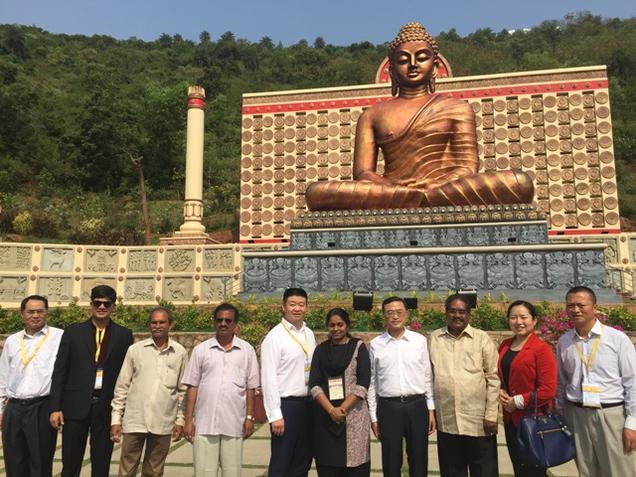
An infra company based in the southwest province of Guizhou — known for its role in Mao Zedong’s Long March — has emerged as one of the prime investors in Andhra Pradesh, showcasing the role of Chinese provinces and Indian States in driving a new phase of India-China ties.
The Guizhou International Investment Corporation (GIIC) is undertaking the Detailed Master Plan for infrastructure in Amaravati, Andhra’s new capital, and Chief Minister Chandrababu Naidu’s pet project.
Geography has played a major role in turning GIIC into an infra heavyweight. Extensive tunnelling, bridge construction and power generation was required for lifting development in coal-rich Guizhou — a province mostly known for its hills and hollows. The company became well known for building a tunnel that established Guizhou’s new link with the famed Stilwell road, which once routed military supplies to Chongqing from India during World War II. The Stilwell road is now the backbone of the proposed Bangladesh-China-India-Myanmar (BCIM) economic corridor.
In a freewheeling conversation with The Hindu, Zhang Zhao, vice-chairman of the GIIC explained how Chinese companies were teaming up for a deeper economic engagement with India. “A symbiotic relationship has indeed emerged between China and India. Chinese companies have developed capacities, out of their own reform experience, which India requires,” says the GIIC’s Chief Executive Officer (CEO). But, Mr. Zhang stressed that understanding and appreciating each other’s distinct business cultures is also an equally formidable barrier.
As a result his message to his employees and Chinese partners is to engage India with humility and respect, rooted in Confucian principles. “Love Indian culture more than Indians do. Do not impose, but align with the flow. Change only what you can,” Mr. Zhang observed. Consequently, the company and its partners are consciously aligning with New Delhi’s flagship Make-in-India campaign to channel investment flows.
Like many others in Guizhou’s business circles, Mr. Zhao draws inspiration from Wang Yangmin. The fifteenth century philosopher and practitioner stretched the Confucian tradition to emphasise that theoretical knowledge was useless without its application to resolve real-life problems. Another revered figure is Deng Xiaoping, the architect of reforms, who guided China out of the trauma of Mao’s Cultural Revolution.
The GIIC’s forays in Andhra have triggered a “collegiate approach” among Chinese businesses, wanting to invest in India. “We cannot do everything ourselves. For example we need partners in the development of ports, which Andhra requires, or real estate, which has not been our expertise. So we looked for allies within and outside Guizhou, and our effort to build teams have yielded satisfactory results,” observes Binod Singh, a senior advisor to GIIC.
The synergetic approach, pursued by local Chinese enterprises, is already making headway in India. Negotiations have reached an advanced stage between the Guizhou Kailin Group and India’s Coromandel International Limited for establishing a $1 billion fertilizer plant in the Kakinada Special Economic Zone.
Real estate investment in India could ride on the model of Garland City, a massive undertaking of “affordable housing” in Guiyang, where four lakh people reside in a dense, but neatly planned cluster of vertical structures. “This is the scale of operations that India needs and we are ready for it,” says Mr. Zhao, scanning the area, with considerable pride, from the rooftop of a 72 floor building that towers over the City. The project is the result of a partnership between the Guizhou Architecture Institute, and the China State Construction Engineering Corporation (CSCEC), the state-owned civil engineering giant.
The Chinese consortium approach could also work in the development of a building-material park in the Vijayawada airport area, which could cater to the bulk of Andhra’s construction material needs, says Mr. Singh.
Analysts point out that growing tie between Guizhou and Andhra Pradesh demonstrate the rise of Chinese provinces and Indian states as the core drivers of Sino-Indian ties. Earlier in a conversation with The Hindu, former Indian ambassador to China Ashok Kantha acknowledged that New Delhi-Beijing ties were being rapidly decentralised. “Chief Ministers are taking ownership of the relationship with China. New projects are coming up, and specific initiatives are being taken,” he observed.
source: http://www.thehindu.com / The Hindu / Home> National / by Atul Aneja / Guiyang (SouthWest China) – June 05th, 2016
Campaign in the U.S. to promote Andhra Pradesh
Andhra Pradesh Non-Resident Telugu Society (APNRT Society) CEO Ravikumar Vemuri who was kick-started his 25-day tour from Texas, US, to promote Andhra Pradesh as an apt place for investment, said Telugu people from all fields took part in the campaign.
So far Houston, Dallas in Texas and Georgia in Atlanta were covered. He said a large number of Telugu people from IT, medical fields, including CEOs of companies, are being addressed during the campaign.
The campaign will be held in all 21 cities of the United States.
source: http://www.thehindu.com / The Hindu / Home> News> Cities> Vijayawada / by Staff Reporter / Vijayawada – June 03rd, 2016
Villager builds a temple for grey langur

The love for all living creatures is the noblest attribute of man,” opined Charles Darwin.
Chennapurapu Muktheswara Rao, a farmer of Saradaipeta hamlet of Guduru mandal in Krishna, has proved this by building a temple at his house for a grey langur.
Mr. Muktheswara Rao built the temple after its death on November 6, 2015.
“I brought the grey langur from the Mylavaram forest area six years ago to keep the monkeys which were raiding my coconut plantations at bay. It became a member of my family over the years as we allowed it stay in our house,” said Mr. Muktheswara Rao.
In late 2015, the simian, which was christened as Raju, suffered an injury due to an iron chain that was tied to the neck, but it was noticed only after its condition deteriorated. The local veterinarian treated it for a few days but could not save it.
“The death of Raju came as a shock for me. We performed the last rites in accordance with our customs and buried it. As I could not bear Raju’s absence, I built a small temple for it,” said Mr. Muktheswara Rao.
Popular in village
“I am blessed with three children, including a girl. I treat the langur as one of my children. By faith I am a Christian, but I observe its death anniversary like any Hindu family does,” Mr. Muktheswara Rao said. The temple of the grey langur, the most widespread langurs of South Asia, is 10 km from Machilipatnam. The grey langur made a lasting impression on villagers with its playful antics.
source: http://www.thehindu.com / The Hindu / Home> National> Andhra Pradesh / by Staff Reporter / Machilipatnam – May 31st, 2016
V-C releases book on metaheuristic applications

Vice-Chancellor of the Jawaharlal Nehru Technological University Kakinada (JNTUK) V.S.S. Kumar released a book titled Metaheuristic applications to speech enhancement penned by Prajna Kunche in association with Professor K.V.V.S. Reddy at a programme held here on Wednesday.
Ms. Prajna did her Ph.D. from Andhra University in metaheuristic applications and Springer, international publisher of science, technology and medicine, came forward to publish her thesis for worldwide release.
Speaking on the occasion, Prof. Kumar congratulated Ms. Prajna on the venture and called upon the research scholars to focus on getting their thesis papers published so that they could be useful to future generations. “We must feel proud of Ms. Prajna as the publisher of international repute came forward to publish her thesis. This makes the book get circulated to all the technological universities worldwide and come in handy for the students who are undertaking research in the subject,” he said.
Thanking her research guides Prof. K.V.V.S. Reddy and G. Samba Siva Rao for encouraging her to complete the project work in a short period, Ms. Prajna said that the Springer international journal first published her thesis in its website and going by the response the firm decided to bring out the printed version.
“Presently, I am the technical reviewer for Springer international journal of speech technology and Springer pattern analysis and applications. I am getting invites from universities of international repute to deliver talks on speech technology,” she said.
Rector of the JNTUK B. Prabhakara Rao, senior faculty members, Ms. Prajna’s parents K.S. Vara Prasad (Principal, Andhra Polytechnic) and Krishna Kumari (lecturer in Botany, ASD Government Degree College) were present.
source: http://www.thehindu.com / The Hindu / Home> National> Andhra Pradesh / by Staff Reporter / Kakinada – June 02nd, 2016
Working up a lather

Asha Gunapati’s products are based on her belief that “what goes into your mouth should go on your skin”.
Her range of soaps is natural and handcrafted with subtle fragrances. But they stand apart in their incredible designs making them look deliciously tempting. Cupcakes, jelly bars and whipped creams, so enticingly designed are the soaps that she literally had to keep a disclaimer — ‘Do not eat. It’s a soap’ — at her recently held exhibition at a mall in the city.
An HR professional, who quit her corporate job to be with family, Asha started making handcrafted organic soaps as a hobby in 2013, and it was only last year that she decided to dive into an entrepreneurship venture to start her own line of products called ‘Sreshta Skin Essentials’. Now, she also provides employment to a team of eight underprivileged women who help her in making the organic soaps.
Asha says her soaps are devoid of chemicals as she uses natural ingredients such as essential oils like lavender, tea tree, cedar wood and rose and carrier oils like olive oil, coconut oil and almond oil to make the soaps. Before starting her venture, she did a thorough market research on handmade soap brands in India and found that most of these soaps were very expensive.
“I felt there was a big untapped market for natural organic soaps in the affordable segment. But if I had to make my products stand out, I knew I had to give equal emphasis to quality and design,” says the creative entrepreneur. With an initial investment of Rs. 6 lakh, Asha set up her home-based enterprise and started reaching out to customers through the e-commerce route.
Her soaps come in a range of flavours like lavender mint cupcake, raspberry bar, rainbow soaps and chocolate cupcake and can be ordered from the websitewww.feminineindia.comor her Facebook page ‘Sreshta Skin Essentials’.
“Initially, we were in losses since the manufacturing cost was way too high. The raw material cost itself was over Rs. 2 lakh, most of which are procured from Noida and Bengaluru. We use imported almond oil from France and Kojic acid, a natural whitening agent, from Japan,” adds Asha. She uses two methods in making the soaps — the cold process which takes about 30 to 45 days to make a batch of soap and the glycerine soaps that can be used instantly.
Describing her entrepreneurial journey so far, Asha says: “It has been a roller coaster ride. I started the enterprise when my father passed away and I had to support my mother. It was the toughest phase of my life. But it was this business of making handcrafted soaps that helped me come over it. I put in all my creative energy into it. Sometimes it is great and sometimes it is tiring and backbreaking. My day starts off with me collecting online orders, processing them, checking the stock, packing and shipping them. If the item is out of stock, I make it. Amidst all this, I also like to experiment with new things and update my product list.” To reach out to more people, Asha showcases her work at various exhibitions. Her next exhibitions will be in Vijayawada and Bengaluru.
source: http://www.thehindu.com / The Hindu / Home> News> Cities> Visakhapatnam / Nivedita Ganguly / Visakhapatnam – June 01st, 2016