Blindness not a hurdle to hyperthymestic girl

Rachika Nagamani
Rachika Nagamani

Nagamani hopes of regaining vision and fighting for women’s rights

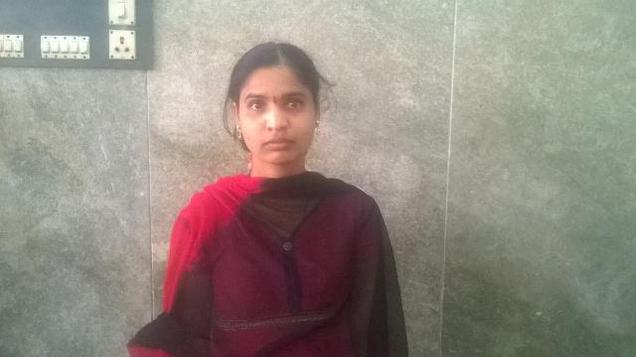
For 19-year-old Rachika Nagamani of nondescript Rallabudugu village of Shantipuram mandal of Kuppam Assembly constituency, blindness is no impediment. Having lost her vision in a road mishap at the age of 8, the girl could overcome the handicap in no time, mastering the Braille script. Now pursuing B.A. Final year, she is preparing for Lawcet-2017 also.

On a rainy evening in 2005, Nagamani was returning home from school by cycle. The cycle of her senior hit her while overtaking and Nagamani fell down and a sharp iron object pierced her forehead. Two hours later, her parents returning from field work, found her unconscious on the roadside and took her to a hospital. She was discharged after first aid and sutures on the wound. Initially, she faced problems related to vision, and gradually lost sight over two years.

Her parents – Radhakrishna and Anasuya – eking out livelihood as farm labourers took her to various hospitals in Bengaluru, Chennai and Tirupati, but in vain. Poverty also became a big hurdle to the couple to bear medical expenses. Despite penury and loss of vision, Nagamani pursued her schooling at Navajeevan School for the Blind in Tirupati and mastered the Braille script in no time.

Nerve damaged

On the advice of some teachers, the parents took the girl to Sankara Netralaya in Chennai when she was in her eighth standard. After thorough diagnosis, the doctors informed the parents that there was a possibility of her regaining her sight with surgery. As per medical opinion, the period of possible surgery was framed in 2019, by which time the girl’s tender optical nerves will gain rigidity. In the diagnosis, it was observed that some vital nerve connecting the eyeballs with brain was damaged when she met with the accident.

With hope of regaining vision, Nagamani concentrated on studies, passing X class and Intermediate with 86% and 75% respectively. In view of her condition, she opted for Arts group in B.A.

As she grew up, Nagamani’s inborn talents surged ahead. Since her childhood, Nagamani developed strong liking for singing, poetry and story-writing. She has a flawless memory. Her poetry and short stories depict various themes, including the importance of parents, social responsibility and family relationships and atrocities against women. Moreover, she learnt classical music, giving performances all over the district.

Eidetic memory

Nagamani has turned out to be a synonym for hyperthymesia. Her eidetic memory is such that she is a favorite to the teaching faculty and students as well at her degree college in Tirupati. Though a student, Nagamani is also a teacher to more than 100 blind students of her college. She remembers every detail as if she has seen it. The highlight is that she is capable of remembering phone numbers without maintaining any diary.

When contacted by The Hindu , Nagamani said that she was sick with the ever-exploding news of atrocities against women. “My ambition is to study law and to contribute my ideas to jurisprudence, particularly to protect women and their rights in society. Whether I may regain my vision or not, I feel blindness has proved a boon to me. Hellen Keller is my inspiration.”

source: http://www.thehindu.com / The Hindu / Home> National> Andhra Pradesh / by K. Umashanker / Chitoor – June 21st, 2016
Brazil keen on saving the Ongole bull

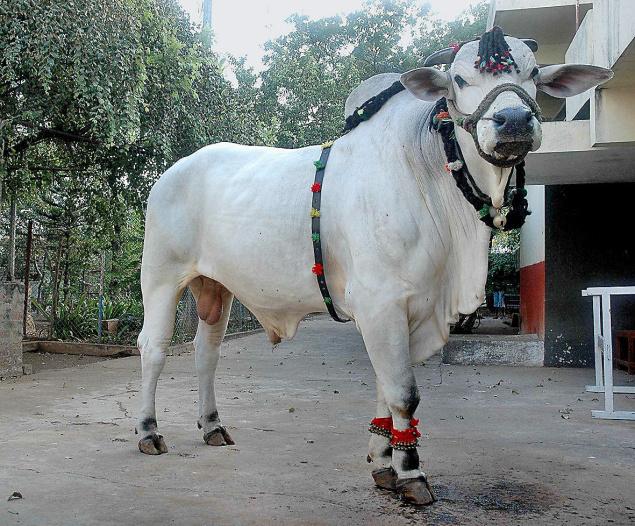
Ongole bull, the pride of Prakasam district.

The species is a favourite of farmers in the South American country

Better days are ahead for the indigenous breed of the Ongole bull, which is on the verge of extinction in the land of its origin with Brazil evincing keen interest in transferring technology for improving the productivity of the majestic cattle.

The pure breed of Ongole cattle ( Bos indicus ) is fast becoming extinct in the land of its origin, even as some of the finest Ongole cattle are reared in Brazil for dairy products.

Assembly Speaker Kodela Sivaprasada Rao, who himself led an Indian delegation to a cattle expo at Uberaba in Brazil, revealed this to The Hindu here on Sunday.

‘Sister city’

The Mayor of Uberaba city in Brazil, Paulo Piau, had offered to develop Ongole as a “sister city,” Dr. Rao said, adding: “the Mayor had promised to come with a Memorandum of Understanding to further cooperation in cattle breeding between the two prominent members of the BRICS.”

The number of the Ongole breed of cattle had dwindled to fewer than 2 lakh over a period as against 16 crore heads of Ongole cattle in that South American nation now, he said. Brazilians have a great affinity for the Ongole cattle and wanted to do their part in rearing the docile animal in the original tract between the Gundlakamma and Musi rivers, he explained, adding “one will be astonished to note that the milk yield of the Ongole cow is between 20 and 30 litres in Brazil where the farmers milk the animals thrice a day.”

“Though we are sentimentally attached to the Ongole bull, not enough has been done to exploit it economically,” he observed and exhorted the farmers to go for scientific farming for better results.

Collaborative project with U.S. varsity

Meanwhile, YSR Congress Whip in Parliament Y.V. Subba Reddy, who was also part of the delegation which visited Uberaba for the ExpoZebu recently, told The Hindu that Brazil had also nurtured the Gir cow of Gujarat and some of its features could be cross-bred for better results. The government had also embarked on the collaborative “Milk Mission Project” with the University of Pennsylvania to make dairy farming sustainable and realise the goal of stepping up growth in the agriculture sector.

The species is a favourite of farmers in the South American country, says Kodela

source: http://www.thehindu.com / The Hindu / Home> National> Andhra Pradesh / by Staff Reporter / Ongole – June 20th, 2016

APGB bags awards

Andhra Pragathi Grameena Bank has received SKOCH Order of Merit as well as Inclusive India Finance India Award during 2015-16, bank chairman D. Sampath Kumar Chary said on Friday.

The bank received SKOCH Order of Merit for successfully implementing financial inclusion and covering 1,899 villages allotted to it and bagged the Inclusive Finance India Award for use and implementation of information technology in spreading financial inclusion

Releasing the financial results for 2015-16 to the media at Kadapa, Mr. Sampath Kumar Chary said APGB transacted a total business of Rs.17,838 crore as on March 31, 2016, with a quantum jump of Rs. 2,703 crore over the corresponding period last year.

Deposit level

The deposit level reached Rs. 9,595 crore, a quantum jump of Rs. 1,782 crore over the previous year, registering a growth rate of 22.80 per cent.

source: http://www.thehindu.com / The Hindu / Home> National> Andhra Pradesh / by Special Correspondent / Kurnool – June 18th, 2016

India’s first mangrove centre to be set up in Vizag

Visakhapatnam:

Around 100 acres of land has been identified by the district administration at Yerrakonda near Simhachalam for setting up India’s first exclusive Centre for Mangroves and Coastal Ecology under the Institute of Forest Biodiversity which is under the aegis of the Indian Council of Forestry Research and Education  (ICFRE).

Vizag district collector N Yuvaraj said the foundation stone would soon be laid at the site. It would be a centre dedicated to study and research on mangroves ecosystem. “Considering that mangroves have been fast depleting due to shore-based development, the Vishakhapatnam Port Trust (VPT) would take up professional regeneration and replantation of mangroves in 50-acres of area within the port at its own expenditure,” said VPT chairman M T Krishna Babu.

Both the district collector and VPT chairman were speaking at the inaugural of the second national seminar on conservation, restoration and sustainable management of mangrove forests in India, hosted by the Institute of Forest Biodiversity (IFB), Hyderabad, being held in the Port City from June 15-16.Mangroves are trees that grow in coastal saline or brackish water in estuarine environment, where marshy soil conditions prevail.

The district collector further said, “The Kerala model of identifying, notifying and conserving mangroves should be replicated in the rest of India. As a case study, AP forest department should also study it and begin the conservation work from Vizag. The district administration would provide all support.”
VPT chairman Krishna Babu said there’s a need for a systematic action plan to improve the biodiversity index of various places, especially with respect to the native species. “Awareness generation should be through introduction about biodiversity in school curriculum, organising field trips and quiz and so on. When it comes to mangroves, around 100 years ago, Vizag was full of it. But now, most of it has been lost.

Mangroves ecosystem support many species to thrive, absorb carbon dioxide and help tackle beach erosion. As a first step towards conservation, we need to identify and notify the mangrove patches on government lands (irrespective of their being patta lands) as reserve forests and conserve them. Also, since VPT has been held responsible for disappearance of mangroves due to our shore-based development works, we will therefore regenerate 50 acres of mangroves in our land with our own expenditure and take technical support from the scientists of the forest institutes concerned.”

At his welcome address, GRS Reddy, director, Institute of Forest Biodiversity, thanked the district administration for allotment of 100-acre land to set up the mangroves research institute and said, “Considering the ecological importance of mangroves and the need for their conservation, an institute exclusively for research on mangroves is needed in Vizag. Work would begin this year and the foundation stone laying may happen by this month-end.”

D Jayaparasad, additional principal chief conservator of forests, IFB and organising secretary of the seminar stated that Vizag has been chosen for setting up the mangroves research institute as it’s situated in the middle of the eastern coast and there’s a vast stretch of mangroves (59 %) on the east coast with 44% being in the Sundarbans. An interesting talk on ‘Mission Mangroves’ was delivered by the guest of honour and district collector of Kannuar  district P Bala Kiran. He deliberated on how 600 acres of land was surveyed and notified as mangroves reserve forest and how the remaining 1225 acres are being acquired from private parties so that the mangrove lands can be conserved.

Another speaker Surendra Kumar, IFS and director of Institute of Wood Science and Technology, Bangalore said India has around 4,640 square kilometre of mangrove area and recently 112 sq km were added. “Three districts have registered good growth including Krishna district, Andaman and Nicobar Islands and Raigarh district, each adding around 15 sq kilometre mangroves. For better mangroves conservation, all stakeholders should be involved together,” he said.

The inaugural session was followed by technical session, where K Kathiresan, professor of Annamalai University delivered his keynote address on ‘Mangrove Forests in India: Conservation, Restoration and Sustainable Management’.

source: http://www.timesofindia.indiatimes.com / The Times of India / News Home> City> Visakhapatnam / Sulogna Mehta, TNN / June 16th, 2016