In Bapu’s footsteps

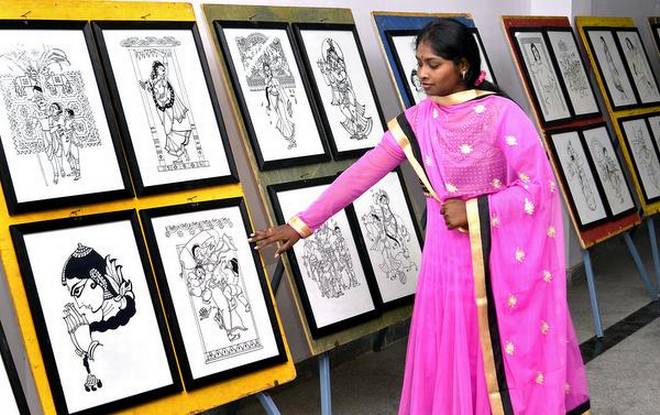
G. Nirmala Tejasri explaining her drawings exhibited at Bapu museum, in Vijayawada on Thursday. | Photo Credit: V_RAJU.

Satthiraju Lakshmi Narayana, popular as Bapu, introduced a style of painting of simple bright colours. His unique style consisted of economy of strokes, freehand drawing and a lack of background clutter.

It was this uniqueness of his art that fascinated Goddeti Nirmala Tejasri, an engineering graduate nurturing art as a passion, and she began to replicate the maestro’s illustrations using only black pen.

Replicas of Bapu bommalu dotted the auditorium on the premises of Bapu Musum on Bandar Road as part of ‘Bapu Chitra Kala Pradarsana’ on Thursday.

“Bapu focussed on Hindu mythological characters. I have done the same but without using any colour,” she explains pointing to the 300-odd illustrations exhibited in a neat row in the auditorium. “I share my birthday with Bapu, and that perhaps is the pull factor,” she says letting out a smile.

The illustrations include Radha enamoured by Krishna while he is playing the flute, Yashoda trying to put a playful Krishna to sleep, and of course myriad moods and postures of achcha Teluginti ammayi. The big eyes, a sharp nose, curvaceous waist and sensual body structure are all intact in the portrayals.

Father being an artist, Ms. Tejasri says she has inherited his talent. Besides participating in various art contests, she has achieved a unique feat and won recognition from the Limca Book of Records. When she was in 10th class, she took to calligraphy and wrote the entire Quran on a 999-ft-long single sheet of paper in a span of two months. In intermediate first year, she repeated the feat and wrote the entire Bhagawad Gita on an 899-ft single sheet and the next year, she wrote Bible on a 999-ft-long sheet of paper. “It was my small attempt to bring down religious barriers,” she explains.

Besides Limca Record Book, her feat has been acknowledged by several other record-registering organisations like India Book of Records, World Amazing Records, Telugu Book of Records and Global World Record. “Of the 16 such existing organisations, 12 have recognised my feat and I plan to apply for remaining four,” she says.

Tejasri has her next plan in place already. “I intend to visit Araku valley, spend time with the tribal people there and capture their lifestyle in my paintings,” she says.

Tejasri is not a trained artist and it is her innate talent that reflects in her works. She wants to crack civils and serve the society. “But art will always remain an important part of my life,” she declares.

source: http://www.thehindu.com / The Hindu / Home> News> States> Andhra Pradesh / Vijayawada – December 15th, 2016

Visakhapatnam doctor creates virtual patients in psychiatry

Visakhapatnam :

In an interesting development related to studies in mental health, virtual patients in psychiatry has been shaped as a new tool for teaching medical students as well as training MBBS doctors who are sent to serve in primary health centres.

City-based doctor and professor of psychiatry Dr C Radhakant has developed this innovative teaching technique through creation of virtual patients using computer graphics. The patients have typical characteristics of schizophrenia and mania and can be used as a teaching tool for identification and understanding of the symptoms and behaviour of such patients. This concept would be useful in training PHC doctors under national mental health programmes as well as medicos in psychiatry in medical colleges.

The research paper ‘Virtual Patients in Psychiatry – Mania and Schizophrenia,’ was published in the International Organization of Scientific Research (IOSR) Journal of Dental and Medical Sciences about a week ago. This study, using computer graphics- based virtual patients of mania and schizophrenia, is the first of its kind in psychiatry in India. Even across the world, there are just a couple of studies on the use of Virtual patients in Psychiatry for post-traumatic stress disorder and bipolar suicidal patient.

Speaking about  the methodology and his creation of the virtual characters, Dr Radhakanth said, “It took me several weeks. Characters created on Poser software were imported into 3d studio max software and animated, created into scenes with backgrounds and merging videos, rendered with lighting. Variables into .avi files were then laid out on a video editor software and music track was added. The product is of DVD quality which can be seen on computer, TV or multimedia projector.”

As per the research paper, in Psychiatry, virtual patients instead of live patients offer many advantages in cases of violence, suicide, complex phenomenology and where typical cases are fewer. Virtual patients have been used to teach clinical interviewing skills, bioethics, basic patient communication, history taking and clinical decision-making skills for medical students. Virtual patients offer many advantages to medical schools including: efficiency, standardization, easy accessibility, interactivity, decreased instructor workload, exposure to rare but critical cases, personalized learning, immediate and personalized instruction and feedback, efficacy, improvement of clinical skills in a non-threatening experimental environment.

Computer animation and graphics also have clear cut advantages. The idea is to develop universal norms irrespective of socio economic backgrounds, ethnic or language or regional issues especially in mania and schizophrenia, which were shown to have more or less similar manifestations and prevalence across the world. Hence these two conditions were chosen for exploring virtual patients as a teaching tool.

Of the virtual patients, manic patient called Ravi was portrayed as a fairly well-built young man who is dynamic, hyperactive, elated, confident, brash young man who is shown trying to show his prowess by taming a wild horse to ride but ultimately falling, racing by running against a Formula One racing car, displaying a style of walking and sitting grandiosely and sporting a smile when taking up challenges and showing irritability when failing in them. His lack of judgement is shown in scenes like trying to jump over a racing car and fighting with the horse.

“The study aims to study the feasibility of using computer graphics-based virtual patients as a teaching tool for medical students posted to psychiatry, to evaluate the duration of exposure to basics of psychiatry theory before exposure to virtual patients and to assess the predominantly visual models vis a vis the heavily verbalized mode of psychiatric diagnostic procedures,” averred Dr Radhakanth.

source: http://www.timesofindia.indiatimes.com / The Times of India / News> City News> Visakhapatnam News / by Sulogna Mehta / TNN / December 13th, 2016