25
24
23
22
Ancient tree-forest, antique weapons set apart this village
Kondiba (Ananthagiri) :
The tribal village of Kondiba located in Ananthagiri mandal of Visakhapatnam district is distinguished by two features — the village houses a unique banyan tree or rather a one-tree forest and the inhabitants who were tribes of the warrior and landholder class still retains many weapons such as swords and knives given to them in the colonial era by the rajas of Vizianagaram.
Kondiba Panchayat has around 180 households and a population of approximately 1,200 people, most of whom are engaged in cultivation of rice, ragi, millets and lentils. Adivasi Odia is spoken by these tribes of Bagata caste. In the pre-independence era, the village had landlords and zamindars who were given the authority to collect taxes and were entrusted with administrative works. For safety of the villagers, the Vizianagaram rajas had given them weapons including swords, knives and guns.
What is interesting is that the villagers have preserved most of these weapons and consider it a matter of pride to get these from the royal family.
Guru Gujjala, an AP Tourism Development Corporation (APTDC) employee at Tyda and resident of this village, said, “These weapons which are around 50 in number and around 100 years old has been with the Gujjala family since generations. Even though the family has split into different households, they still retain the weapons. Once a year, during Dussera, these are exhibited in the village. I have also heard that guns, copper plates and inscriptions were buried in the ground in the village few decades ago so as to prevent outsiders from taking these away.”
“Despite offers of purchase from outsiders, the villagers never parted with these weapons and keep them as treasures within the village as these were given to us by the maharajas of Vizianagram more than a century ago,” added old Bangari Gujjela, who is a descendant of the erstwhile landowners’ family.
Though a considerable big panchayat, the place suffers from water problem. Interestingly, Gujjala Ramanaidu, the first MLA from S Kota constituency post India’s independence belonged to Kondiba.
Besides, weapons, the forest-tree is another interesting feature of this village. Secluded from the village at one end stands this banyan tree and offers a picturesque view of the surroundings. Nobody knows the age of the tree but it’s surmised that the tree is at least 150 years old. The branches and aerial prop roots have spread out on around an acre of land, thus giving the impression of a forest. The temperature of the area surrounding the tree is also cooler by a few notches from outside.
Guru Gujjala said, “The tree is respected and no picnics or gatherings are encouraged near it to keep the sanctity of the place intact. However, every year, at the end of summer, some pujas are held in the hope of good rainfall in the monsoons. The tree covers nearly an acre of land and looks like a forest. During Cyclone Hudhud, there were some damage to the branches but thankfully, the tree was not uprooted and stood tall.”
source: http://www.timesofindia.indiatimes.com / The Times of India / News> CityNews> Visakhapatnam News / by Sulogna Mehta / TNN / December 18th, 2016
Chaso award to bepresented to Vemanavarsity professor
Vizianagaram :
Chaso Sphurti Sahitya Trust will present ‘Chaso Sphurti Puraskar’ to senior assistant professor in Yogi Vemana University M.M. Vinodini, a writer and critic, for projecting, through her writings, the effect of caste discrimination in society. This was announced at a press conference here on Tuesday by trust founder Chaganti Tulasi, a writer herself.
She said that the puraskar would be presented to Dr. Vinodini at a function to be organised on the occasion of the 102nd birth anniversary of Chaganti Somayajulu (Chaso) at Gurajada Zilla Gradhalayam on January 17, 2017 by B. Rama Rao, secretary of CCLA.
She said that eminent writers and critics like Dr. Ketu Viswanadha Reddy, Prof. G. Srinivas of Hyderabad Central University, Dr. Rayadurgam Vijayalakshmi (Chennai), Hrishikesh Panda, noted stage writer from Odisha and others would participate in a literary conclave to be conducted from 9.30 a.m. to 5 p.m. on that day.
She said that the trust had been presenting the award for the past 22 years to writers and critics who had been closely associated with Chaso’s writings.
source: http://www.thehindu.com / The Hindu / Home> News> States> Andhra Pradesh / by Correspondent / December 20th, 2016
Club to celebrate centenary
Troupe will conduct day-long programme on theatre
City-based theatre troupe the Young Men’s Happy Club is celebrating its centenary at the newly built Dantu Kalakshetram Auditorium here on December 20.
The troupe, in association with the State government’s Department of Culture, is conducting daylong programmes on theatre. Veteran playwright, theatre and cinema artiste Gollapudi Maruti Rao will convene a roundtable on the contributions of the club to the fields of theatre and cinema. Veteran theatre artiste Burra Subrahmanya Sastry, retired professor in theatre arts from the Hyderabad Central University, Modali Nagabhushana Sarma, playwright, director and critic Pativada Satyanarayana, writers C.S. Rao and Akella and K. Santha Rao of the Praja Natya Mandali will participate in the programme, which will be followed by quiz and elocution on theatre for college students.
Club president Dantu Surya Rao, at a press conference here on Sunday, said a good number of artistes and technicians trained by the club proved their mettle in the film world. “Prominent among them are Anjali Devi, S.V. Ranga Rao, Relangi, Suryakantham, music directors Adinarayana Rao and Satyam. Even today, artistes and technicians from the club are participating in theatre competitions and winning prizes,” he said.
The legacy would be continued and the Dantu Kalakshetram Auditorium that was built with financial support from the government and corporate firms would become the perfect stage to perform the plays and playlets.
Deputy Speaker Mandali Buddha Prasad is to be the chief guest at the public meeting to be held on the occasion of the centenary from 3 p.m.
source: http://www.thehindu.com / The Hindu / Home> News> States> Andhra Pradesh / by Staff Reporter / Kakinada – December 18th, 2016
The forgotten history of Sunkarimetta Church
Sunkarimetta :
It’s impossible to miss sighting a beautiful hilltop church around 108 kilometres from the city on the Vizag-Araku route. Tourists travelling to Araku usually get down to have a look at the scenic church of Sunkarimetta. Especially during Christmas and New Year, the otherwise tranquil church comes alive with prayer services and hundreds of visitors. But not many know the historic and geographic significance of this building that dates back to the 1930s.
The Sunkarimetta Baptist Church, located exactly 12 kilometres from Araku and Ananthagiri, is situated at an altitude of 4,236 feet above sea level. It is considered the highest point of the Eastern Ghats in Visakhapatnam District. Associated with the rajas of Jeypore, it was also from this church that Christianity first started spreading in the Agency areas in the first half of the 20th century.
The three-and-a-half-acre land for the construction of the only church in this area was given by Maharaja Vikramadeo of Jeypore, Odisha, to the Samantha rajas – the Burudi and Karthika families – who were one of the first converts in the region. Built in the backdrop of the Second World War, it was constructed between 1936 and 1939 by the British who were confident of a victory in the world war by defeating the Axis Powers. The chief engineer of Vizag-Araku Road was also instrumental in building the church. The church was designed by Canadian architect Ralph Edward Smith.
Speaking about its history, executive committee member of the church Karthik Raj Kiran said, “There’s not much recorded history about this church though it is the only church in this area catering to about 5,000 members today. In those days, it was a tax collection point. Built in the Gothic style of architecture, no sand was used for construction of the church but it was built using lime mortar and local rocks powdered by bullocks. Some of the seats in the church existing today dates back to the 1940s. The painted glass decoration inside the church is gift from retired Andhra University professor Ratna Raju. It can accommodate around 100 people at a time inside. On Sunday mornings and during Christian festivals, the church gets crowded.”
The church has remained intact in its original form for around 80 years. The bell tower is the only addition that was made nearly a decade ago. Since the hilltop church renders a beautiful view of the scenic surroundings of green valleys and cultivated fields, distant grey-blue hills and winding roads of the Eastern Ghats, shootings of Telugu films have also taken place in its premises.
source: http://www.timesofindia.indiatimes.com / The Times of India / News> City News> Visakhapatnam News / by Sulogna Mehta / December 18th, 2016
Andhra Pradesh’s marine history lies buried under the sea
Marine archaeologists hint at British era wrecks off AP coast; Some went down with treasure.
Visakhapatnam:
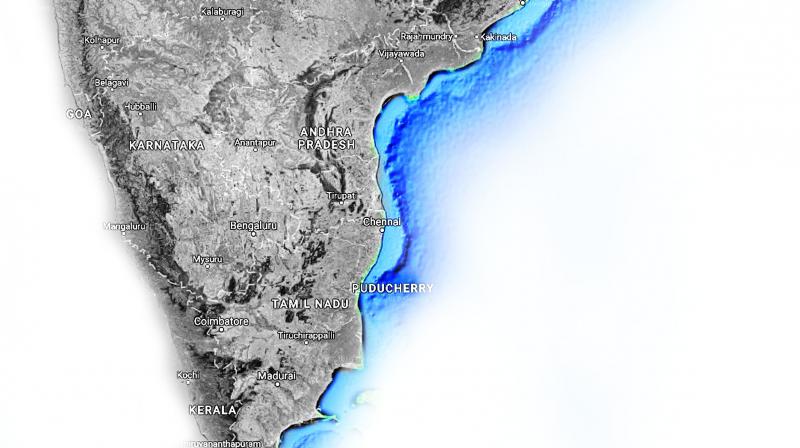
Marine archaeologists believe that the sea off the 920-km AP coastline has the wrecks of ships belonging to Britain and other nations.
Evidence collected from records and archives by marine archaeologist of the National Institute of Oceanography (NIO) suggest that 12 ships sank near Krishnapatnam, Nellore, Coringa ( Kakinada), Masulipatnam (Machilipatnam), Narasapur, Visakhapatnam, Bhimilipatnam, Kalingapatnam, and Sompeta.
These records were collected from Delhi, Kolkata, Bhubaneswar, Panaji, Mumbai, Hyderabad and Chennai. The NIO has salvaged shipwrecks off Goa, Lakshwadeep and Odisha and some places along the west coast.
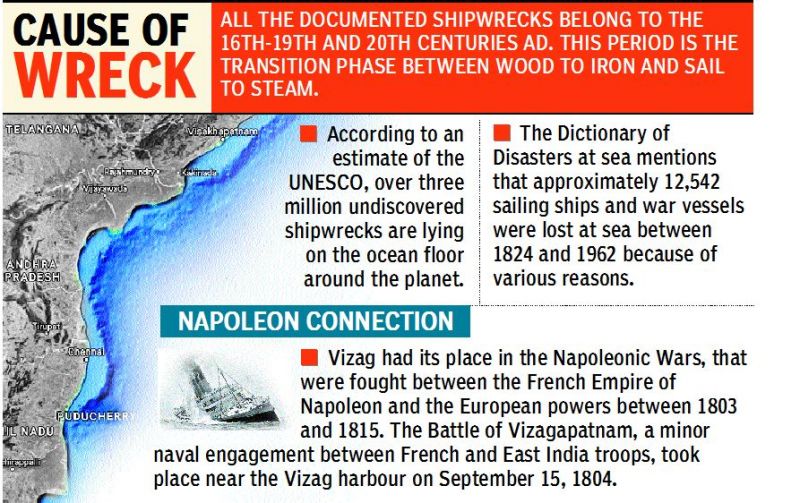
These ships sank due to cyclones, human error or during wars in the 400 year period from the 16th to the 20th century. Most notable is said to be the Dart Mouth, a British ship carrying treasure that sank off to Masulipatnam (Machilipatnam) in 1719. Marine archaeologist say the coast needs to be explored to unearth the maritime heritage of Andhra Pradesh which once thrived with many ports.
“Explorations have brought to limelight some remains of maritime activities, which are lying in the hinterland and onshore regions. The underwater remains have not been explored so far, including some important shipwrecks,” said noted marine archaeologist Sila Tripati of NIO’s Marine Archaeology Centre
The only inscriptional evidence referring to shipwrecks in the country is the Motupalli pillar inscription ‘Abhaya Sasana’ (charter of security) of King Ganapatideva (1244-45 AD) and Annapottu Reddi (1358 AD) of Andhra Pradesh.
Mr Tripati said that as the cargo of wrecked ships was taken away by local chiefs, the king in the inscription had assured the safety of the lives and cargo of both foreign and inland traders and offered them protection from piracy.
The inscription states that the lives of both foreign and Indian mariners were to be treated as that of King Ganapatideva himself. It also provides a long list of import and export items which point to the fact that it was a busy port.
source: http://www.deccanchronicle.com / Deccan Chronicle / Home> Nation> In other news / by SNV Sudhir, Deccan Chronicle / December 16th, 2016