IIFCL’s credit enhancement product may open up infra bonds market


The country’s first credit enhancement product will soon take off, thanks to India Infrastructure Finance Company Ltd (IIFCL). The first pilot transaction will be for a road project developed by GMR J Expressways, a special purpose vehicle of GMR Group, at Jadcharla, a town in Mahbubnagar district in Andhra Pradesh. Through credit enhancement, a lender is provided with reassurance that a borrower will honour the obligation through additional collateral or third party guarantee. It reduces credit/default risk of a debt, thereby, enhancing credit rating and lowering the interest rates on the debt. The launch of credit enhancement product by the Finance Minister, Mr Pranab Mukherjee, later this week will pave the way for development of infra bond market in the country, Mr S.K. Goel, Chairman and Managing Director of IIFCL, told Business Line here.

CREDIT RATING

For this first pilot, IIFCL will provide partial guarantee to the tune of 15 per cent of the bonds to be issued by the project developer. This would help enhance the credit rating of GMR J Expressways to ‘AA’ from ‘A’, thereby, helping the SPV to raise funds from insurance and pension funds besides other investors, Mr Goel said.


The state-owned infrastructure lender will charge a guarantee fee from the SPV for credit enhancement to the project bonds. Insurance companies avoid infrastructure bonds with credit rating lower than ‘AA’. This is mainly due to regulatory requirements as bonds with credit rating lower than ‘AA’ are not considered investment worthy by the insurance regulator. IIFCL will also enter into a risk sharing agreement with the Asian Development Bank, which will reinsure to the extent of 50 per cent of the guarantee provided by the state-owned infrastructure lender.


Mr Goel said that IIFCL was looking to undertake 4-5 pilot transactions of credit enhancement before end March, involving provision of partial guarantee for total bond size of Rs 2,000 crore. As many as 14 transactions are in the pipeline at various stages, he added. Under IIFCL’s credit enhancement scheme, the minimum standalone credit rating of the infrastructure project to be credit enhanced should be at least ‘BBB’ (before credit enhancement by IIFCL). The funds raised by the infrastructure project through project bonds credit enhanced by IIFCL shall be used exclusively to repay the existing debt to existing lenders of the infrastructure project. IIFCL sees strong appetite among infrastructure developers for the proposed credit enhancement product. Already, infrastructure biggies such as Larsen & Toubro, GVK Group have evinced interest in this product.

krsrivats@thehindu.co.in

source: http://www.TheHinduBusinessLine.com/ Industry & Economy> Banking/ by K.R. Srivats / New Delhi, January 02nd, 2012

Reliance Industries to invest over Rs 1,500 crore in TV18 Group

Mumbai:

Reliance Industries is embarking on a major diversification into the media and entertainment sector with the Mukesh Ambani firm agreeing to fund a transaction that will result in a sizeable stake for itself in a company controlling two of the industry’s largest businesses, the Network18 Group and the Eenadu Group of channels run by the Hyderabad-based Ramoji Rao.

People close to the transaction, which has a number of stages, told ET that an RIL subsidiary will help the promoter group of Network18 fund the rights issues of its two listed entities, Network18 Media and Investments, which runs the portal moneycontrol.com, and TV18 Broadcast Ltd, which operates a number of business and general news channels, notably CNBC TV18 and CNN-IBN.

ET was not able to independently verify the amount to be invested by RIL, but people with direct knowledge of the transaction estimated it to be more than Rs 1,500 crore. The money from RIL will help Raghav Bahl, the promoter of the TV18Group, subscribe to the rights issues of both the listed companies, Network18 and TV18. The full amount expected to be raised through the rights issues is estimated at over Rs 3,500 crore.

The boards of TV18 Broadcast and Network18 Media will meet on Tuesday to discuss plans for a rights issue. Raghav Bahl did not respond to an email questionnaire; a Reliance group spokesperson also remained silent, while B Sai Kumar, the CEO of Network18, declined comment.

Times NOW and ET NOW, owned by Bennett, Coleman & Co. Ltd, the publisher of this paper, compete with some of the television channels owned by Bahl. The strategic investment by RIL will be used by the Network18 Group to retire debt and eventually buy out RIL’s stake in Eenadu, the pan-India vernacular language channels owned by Ramoji Rao.

RIL sources said they had invested Rs 2,600 crore in the Eenadu Group through a subsidiary giving it ownership of all businesses apart from its Telugu channel, in which it owns 49%. The transaction, once complete, will result in RIL recovering most of its investments in Eenadu. Messages and an email sent after business hours to the office of Ch Kiron, the managing director of Ushodaya Enterprises, the holding company of the Eenadu Group, did not elicit any response.

By its own admission before the Andhra Pradesh High Court, Reliance Industries has said it has invested Rs 2,600 crore in entities of Nimesh Kampani-led JM Financial Group, which in turn had invested in Ushodaya Enterprises. The AP High Court is hearing a petition alleging the investment was a payoff to N Chandrababu Naidu, the former chief minister of Andhra Pradesh, an allegation RIL has denied in its affidavit. RIL’s deal with Bahl, likely to be announced on Tuesday, is expected to create a powerful national news and entertainment company spanning several regional languages as well as English and Hindi.

RIL to get Exclusive Rights to Content

RIL, people close to the transaction said, is expected to hold an economic interest equivalent to a 30% stake in the promoter group of companies, with the original promoter Bahl owning 51% and all voting rights.

Further, RIL will have exclusive rights to content from 30 channels and web properties of the two media houses, which will lend a competitive edge to its broadband services to be rolled out later this year.

RIL is laying the groundwork for national 4G broadband services expected to be launched sometime this year. Content for broadband services is generally outsourced, but RIL will have an advantage over others with this transaction which will give its subscribers a wide variety of channels ranging from general entertainment to news and movies.

Earlier on Monday, Sai Kumar, in a letter to all employees of TV18, hinted at a solution to the group’s debt problems. “Let me also take this opportunity to tell you that we are very close to addressing our debt levels and related issues which have been reported by various media in the last few weeks. We will learn the details from Raghav pretty soon,” said Sai Kumar, who took over as CEO after the sudden resignation recently of long-time CEO Haresh Chawla.

The money is likely to be invested directly in companies controlled by Raghav Bahl, such as RB Holding Pvt Ltd and RB Investments Pvt Ltd. These companies own 30.34% stake in Network18 Media while Bahl holds 9.03% in his name. Network18, in turn, is the main shareholder in TV18 Broadcast with a 49.98% stake. The two companies have suffered heavily in the downturn triggered by the financial crisis of 2008-09. While revenue growth has been strong, profits have plummeted and borrowings have soared.

At the end of March 2011, Network18 had debt of Rs 1,777.89 crore. Its profit for that year fell 87.27%. TV18’s debt stood at Rs 550.54 crore while profit fell 17.40%. The markets have punished the two companies. Network18′ s market cap is down 171.57% since January 5, 2009 while TV18’s has fallen 560.23% in the same period. Bahl’s companies also have a distribution joint venture with the Chennai-based Sun Group, called Sun18. It is not known if Sun’s channels, among the strongest in the south, are a part of this arrangement. American giant Viacom too has a joint venture with Bahl for producing movies.

source: http://www.articles.economictimes.indiatimes.com / News> News by Industry> Media/Entertainment / by R Sriram / ET Bureau / January 03rd, 2012


Birla group plans sports city

Hyderabad:

The Yash Birla group has submitted a proposal to the state government for the setting up of an international-standard sports city in the state. Group representatives met CM N Kiran Kumar Reddy and promised to bring in an investment of Rs 13,000 crore for the proposed project.

The sports city will have all kinds of sports infrastructure along with a manufacturing centre and a wellness centre. At the facility, local sporting talent will be developed to match international standards. For the project, the group wanted 450 acres of land near any international airport and another 250 acres for the wellness centre.

“The land earmarked for the Lepakshi knowledge hub near Anantapur is anyway vacant and, what’s more, it is also close to Bangalore airport. We may consider the site for the project,” said government sources. If the group agrees to this, the agreement will be signed at the Partnership Summit that starts on January 11.

source: http://www.timesofindia.indiatimes.com / Home> City> Hyderabad / TNN / January 08th, 2012

HERITAGE: Fabric of Indian handicraft

The biggest exhibition of Indian textiles and clothing in Asean offers an insight into India’s age-old textile heritage, writes Intan Maizura Ahmad Kamal

THERE’s no way anyone could’ve missed the bobbing head of Shri Badshah Mian with his striking rainbow-coloured turban. One of India’s national award winners, the 57-year-old’s expertise lies in tie and dye design, a craft that has been passed down through seven generations of his family. He’s hoping his two sons will continue the tradition.

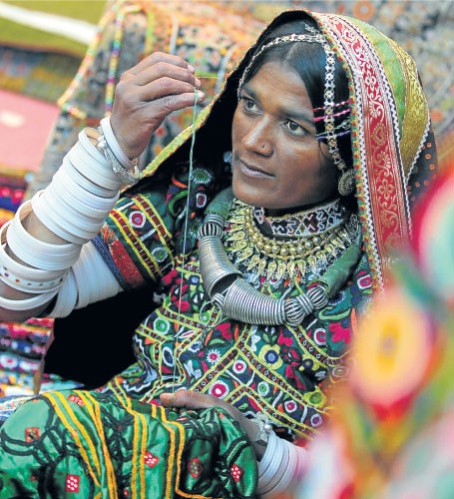
Just opposite the walkway from Shri is an equally colourful Karmabai Merubhai Goradiya, looking resplendent in her Banni embroidered traditional dress complete with neck accessories and veil. Also a national awardee, the shy Karmabai’s forte lies in Banni embroidery, one of the ethnic styles of embroidery of Kutch (Gujrat).

Shri and Karmabai were among the 10 Indian traditional textile artisans present at the recently concluded Intexpo, the biggest exposition of Indian textiles and clothing in the Asean region at the Matrade Exhibition and Convention Centre in Kuala Lumpur.

The event not only gave international buyers and visitors the opportunity to view the latest products that modern India has to offer but also gain a better insight into the country’s age-old heritage in textiles. Housed in a themed pavilion, the artisans, who came from various parts of India, were on hand to demonstrate their intricate skills.

The story of Indian handicrafts dates back to the beginning of the Indian civilisation. Indians have been creating artefacts with unimaginable designs as objects of adoration for the temples ever since the dawn of history. These objects travelled through time to assume variegated forms with unmatched functional values, embellished by some of the most inimitable aesthetics.

Beginning as temple crafts, the handicrafts slowly permeated every aspect of daily life. Today, the handicrafts come in numerous designs and materials and undergo various processes.

The industry produces one of the widest ranges of lifestyle and utility products. A workforce of more than six million forms the backbone of the Indian handicrafts industry. Armed with inherited skills, techniques and traditional craftsmanship, the industry is highly labour-intensive and decentralised and is spread out all over the country, both in rural and urban areas.

TIE AND DYE

Eyes lighting up with pride, Shri confides that his forefathers originated from the state of Rajasthan and produced exquisite works for the Maharajas.

“If you go to Rajasthan you’ll see various designs and patterns of tie and dye,” he says with a smile. “Rajasthanis love wearing various styles of this art and their costumes are more vibrant because of it.”

Tie and dye designs or bandhni are very popular, and because of its uniqueness — no two designs are the same as it’s all handmade — can be found in many exclusive boutiques in India. You can find elegant pieces of tie and dye ranging from saris, handkerchiefs, shawls, lehanga choli (long skirt and blouse), turbans, tops, bedsheets, cushion covers and pillow covers to table cloths and many more.

Rajasthan is famous for its leheriya pattern, which literally means waves. These are harmoniously-arranged diagonal stripes, originally dyed in the auspicious colours of yellow and red. The material is rolled diagonally and certain portions are resisted by lightly binding the threads a short distance from one another before the cloth is dyed. Much skill is required when the distance is shorter because you don’t want one colour to spill onto the other. The dyeing process is repeated until the desired number of colour is achieved.

The colours are derived from mixing pigments from different plants. “Every colour is organic,” explains Shri. Pointing to the ingredients, he adds: “Coffee seeds give a brown colour, while the turmeric roots give me yellow. Pomegranate and the betel nut offer different shades of brown while these madder roots give me the vibrant pink colour.”

How does he know what colours he’ll get? “There’s no science, no calculation, just judgement,” says Shri with a shrug.

The process of making bandhni (tie and dye) as well as patterns, designs and craftsmanship vary from one region to another. Rajasthan and Gujarat are the main hubs where this art flourishes. Rajasthan craftsmen, says Shri, are easily recognised because they grow a nail on their little finger to make it easy for them to lift the cloth for tying. Sometimes they wear a small metal ring with a point.

BANNI EMBROIDERY

Karmabai strikes a pose for the camera. Banni embroidery used to be the best means by which women, especially those from the rural areas, expressed their lives, dreams and desires.

Taking a small embroidered sling bag from the pile of table runners, wall decorations, handbags and handphone holders in front of Karmabai, I express my admiration for the fine handiwork. She beams but is unable to converse due to the language barrier.

Never mind — there are plenty of information boards around.

Embroidery, which is essentially meant to strengthen the fabric and to decorate it, is an important part of the household tradition of the different communities in India. The Banni embroidery is one of the ethnic styles of embroidery of the Kutch (Gujarat), which has a large number of settlers from Central Asia.

THE DESIGN

This type of embroidery is very popular because of the intricacy and richness of the design. Silk floss is used to create the pattern on the fabric. To begin, the design is first marked on the cloth either by free-hand drawing or by tracing, and then followed by the outlines of the design. The filling is done using needle and coloured silk/cotton threads.

The thread is fed from below and is pulled up with an awl and comes up like a loop. The second loop is then pulled forward. This creates the chain-stitch effect, which gives the strong linear patterns.

You can’t fail to be captivated by the delicate weaves on the fabric. The additional use of mirrors in the buttonhole, which are studded using the chain-stitch pattern on the cloth, helps to enhance the overall effect.

KALAMKARI/HAND PRINTING

Hunched over a large piece of cloth with charcoal sketches of Indian deities, his hand gripping a small brush and his face full of concentration is Shri M. Viswanath Reddy, who comes from Andhra Pradesh and is another of India’s award recipients for his Kalamkari works.

The word Kalamkari comes from the Persian words Kalam and Kari, which means drawing with a pen. While the technique has been around for centuries, the style as we know it today, actually emerged from the craft schools that sprang up under the patronage of the Mughal emperors three centuries ago.

There are two distinctive styles in India — the Srikalahasti style, and the Machalipatnam style. Viswanath practises the former, which uses a kalam or pen for free-hand drawing of the subject.

Demonstrating his handiwork, the earnest young man, who learnt his craft from his Kalam-artisan father, explains that to do this piece of art, he begins by first sketching the black outline using charcoal before filling the colours in. “I use all natural colours derived from seeds, flowers, roots — all vegetable dyes. We dip in the colours using this traditional kalam (pen). Depending on the design, it can take a couple of days or longer because it involves 17 painstaking steps.”

THE PEN

The Kalam is made from wooden pieces with arrangement for easy flow of colours. A small bamboo stick with a point is split to form a tip of about an inch. A bit of rug with wool is tied around about an inch from the point and is easily done with one finger that holds the brush. With this Kalam, the paint will run over the piece of cloth guided by the artist’s creative instincts.

This style of Kalam work flowered around temples so it’s not surprising that it has an almost religious identity. Scrolls, temple hangings, banners depict deities and scenes taken from the great Hindu epics and mythological classics.

-Textile facts

1. Indians use organic colour from substances such as coffee seeds for brown colour, turmeric roots for yellow, pomegranate and betel nut for different shades of brown and madder roots for vibrant pink.

2. Embroidery, besides forming beautiful and intricate patterns on otherwise plain fabric, is essentially meant to strengthen the fabric.

3. Kalamkari comes from the Persian words Kalam and Kari, which means drawing with a pen and is made out of 17 tedious steps.

source: http://www.nst.com.my / New Straits Times / Sunday Life & Times / by Intan Maizura Ahmad Kamal / January 08th, 2012


Telugu Association of Greater Boston (TAGB)

ENTPRENEUR MEET – 21ST October, 2011

2011 is an eventful year for Telugu Association of Greater Boston (TAGB). Under the Presidentship of Sri Koteswara Rao Kandukuri, the Executive Committee explored different options to meet the needs of the Greater Boston Telugu Community.
In addition to TAGB cultural presentations which are very popular, TAGB conducted events for Sports, Academics and Charity that were also highly appreciated. This week, TAGB organized an “ENTREPRENEUR MEET” for the first time in its history especially for Telugu community. The objective of this meet is to provide a stage for ambitious and successful entrepreneurs among local Telugu community members to meet, greet and share their entrepreneurial experiences.
In his address to the guests, the TAGB President explained the reasons for organizing the entrepreneur meet. He felt that it was essential for TAGB to play its role in these economic conditions to strengthen this group’s efforts by providing additional information and tools. This meet opens a window for networking among these individuals. Our recent survey found 40+ Telugu Entrepreneurs in Greater Boston area in the fields of IT, BioTech, Marketing, Academics, Entertainment, etc. Many young and experienced professionals and entrepreneurs showed interest and responded to the TAGB invitation. The meet took place on this Friday October 21st evening at the Conference Room of Sri Shirdi Baba Temple, 290 Littleton Road, Chelmsford, MA.
The Board Chairman of TAGB, Sri Paparao Gundavaram in his speech welcomed the attendees and greeted the successful entrepreneurs and young aspirants for their continued success in future years.
Dr. Govinda Rao Bhisetti (Vice Chair of BOT, TAGB) moderated the proceedings of the night.
In the first part of the event, the moderator invited three prominent and successful entrepreneurs to the panel of guest speakers – (1) Sri Subu Kota, Chairman/CEO, The Boston Group, (2) Sri Mohan Nannapaneni, President/CEO, Sigma Systems, Inc. (also Executive Vice President, TANA), and (3) Dr. Balaji Bhyravabhotla, CEO/COO, Xtal Biostructures
The guest speakers shared their valuable experiences in entrepreneurship and encouraged all aspiring entrepreneurs to take the plunge without fear, guided by their heart and high ethical standards. The audience participated enthusiastically in Q&A session following the speeches.
In the second part of the event, all members of the audience were given the opportunity to speak about their companies or their ideas for a new business. About 30 people came forward to share their experience of success and failure.
Though it is the first time for TAGB hosted such type of an event, their enthusiastic participation made it a grand success.
In his Vote of Thanks address, Sri Ramesh Babu Tallam, Secretary of TAGB, thanked the Guest Speakers and all attendees for their interest and valuable contribution in making the event a grand success.
press release www.tagb.org
source: http://www.bheru.com / Bheru Educational Foundation /Home> Local News / October 25th, 2011

4000 Patients Benefited With Free Health Camp in Parkal

Parkal camp was HUGE success and set a new record for one day camp: 4000 patients were treated in a single day. It was a BIG event by any standard…. 4000 patients……. Rs. 12 Lakhs Medicines distributed (3800 prescriptions filled!!)….. 45 doctors…… 40 pharmacists……100 paramedicals…. 150 NSS volunteers….5 security…. 200 guests…….. 500 people lunch……1500 people Pulihora lunch…… Planning—Coordination–Execution….EXCELLENT. Patients were very happy (that’s the key factor)– doctors are happy too. Many said that camp was like a MODEL camp. Thanks to all teams!!.
———-
Warangal (December 24, 2011). A mega general health camp, sponsored and organized by NRI Dr. Samba Reddy, attracted huge crowd of patients from rural villages in Parkal in Warangal District. The out-patient medical camp, which was conducted with help of Lions club Dr. P. Vijayapal Reddy, IMA Warangal doctors, NATA doctors and local doctors, was held on December 24, 2011 at Govt. Junior College premises, from 9 AM to 4 PM.

The camp was inaugurated by Sakku Bhai (Dy Drugs Controller), AVN Reddy (NATA President), Dr. Samba Reddy (sponsor & organizer), Dr. Vijay Chander Reddy (IMA president-elect), Dr. Samba Siva Rao (DM&HO), Lions club and NATA team members.

A record number of over 4000 patients received medical treatments for various conditions. Originally planned for 1000 patients, but there was an overwhelming crowd of rural and poor patients from surrounding 25 villages within the Parkal Mandal headquarters. The organizers accommodated up to 4000 patients!!!

Whooping Rs. 12 Lakhs medicines, arranged by Dr. Samba Reddy, were distributed to an estimated 4000 patients at this camp. “Over 3800 prescriptions were filled at the Camp Pharmacy” said the Chief sponsor & Camp Organizer Dr. Samba Reddy. He is NATA Media Chair & Conference Secretary and took charge of conducting this health camp. Professionally, he is Associate Professor (College of Medicine), Texas A&M University Health Science Center, USA (see Biography).

Over 45 doctors from MGM hospital, Rohini hospital, various private clinics within twin cities of Hanamkonda & Warangal and also Parkal area participated and provided medical services to patients. More than 20 doctors are super-specialty doctors, including Orthopedics, Cardiology, Gastroenterology, Urology, Gynecology, ENT, Ophthalmology, Dermatology, General Surgery, Psychiatry, Dental and Oncology.

Over 400 lab diagnostics were performed including 250 blood tests, 120 HIV screening and 100 malaria screening (courtesy Vijaya diagnostics & District health office).

Camp pharmacy was inaugurated by Smt. Sakkubhai, Deputy Drugs Controller, who was the Guest of Honor for this camp. Medical and orthopedics wings were inaugurated by Dr. Buchi Reddy (Chairman, Rohini hospital) and Dr. Samba Siava Rao (DM&HO, Warangal), respectively.

The leading physician Dr. P. Vijayapal Reddy served as the convener of this camp. Lions Ch. Narasimha Reddy and K. Mallesham did good job as camp chairman and Lions club president, respectively. They coordinated bus transportation to patients from their villages.

Rs. 12 Lakhs Medicines Distributed

The pharmacy list consists of over 400 high quality medicines (from all therapeutic categories), which are supplied by reputed Pharma companies Dr. Reddy’s, Natco, Veritaz Aurabindo, Dynamite, Novostart, Sunrise International, and other companies. The camp organizer Dr. Samba Reddy arranged all medicines for this camp with help from his friends and colleagues.

Lunch provided to 500 people

All patients felt very happy with free treatment and more importantly with FREE medicines. Food (pulihora) and water packets were provided to patients (at least 1000 patients). Lunch was provided to all participating doctors (50), pharmacists (40) guests (50), and paramedical staff (100) as well as NSS volunteers (total over 500 people). Thanks to Dr. Vijayapal Reddy for hosting such nice lunch at guest house in Parkal.

Over 45 Doctors Participated in Health Camp
The following doctors participated/ helped FREE and not taken any consultation Fee.
NATA Doctors USA: Dr. Sanjeeva Reddy – Physician/Gastroenterology (USA); Dr. Swaroopa Reddy – Physician/General (USA).

IMA Warangal Doctors:

Dr. P. Samba Siva Rao – Physician (DM&HO), Dr. P. Vijay Chander Reddy – Orthopedics (MGM) –IMA president-elect, Dr. Ramesh Kumar – ENT (MGM), Dr. Ram Kumar Reddy – Orthopedics (MGM), Dr. Venkateshwarlu – Orthopedics (MGM), Dr. Sreedhar Raju – Psychiatry (Warangal), Dr. Narender Reddy – General (Hyderabad), Dr. Rajendra Prasad Reddy – Gynecology (Narsampet), Dr. Ragotham Reddy (Physician) – IMA secretary, Dr. Ashok Reddy (Pediatrics), Dr. Sheshu Madhav (Pediatrics) – IMA president, Dr. Buchi Reddy, Physician, Dr. Babu Rao, Physician, Dr. Narasimha Reddy, Physician, Dr. Surender Reddy, Urologist (MGM), Dr. Dilip Kumar, Dr. Manoj Kumar, Dr. Prasad, Dr. Hanmantha Rao, Dr. Praveen, Ophthalmologist, Dr. Sudheer (Orthopedics), Dr. Anwar (IMA treasurer), Dr. M. Ramana Reddy – Ex.DM&HO (Warangal), Dr. D. Sai Chander – PG/Pediatrics, Dr. Naveen Kumar, Dr. Sudhakar Reddy, Dr. Suhakar (surgery), Dr. Mohan Rao (RMO), Dr. Chandra Sekhar (MGM), Dr. Mallikarjun (Eye), Dr. Gopi. Plus 10 medical officers from DM&HO office on camp duty.

Parkal Doctors:

Dr. P. Vijayapal Reddy – Physician, Dr. Rajeshwer Prasad – Physician, Dr. Lalitha, DGO, Dr. Sanjeevaiah (Civil hospital), Dr. Samuel, Dr. Sarojana, Dr. Rama Devi, Dr. Venkata Laxmi, Dr. Rajani Kanth, Dr. Satyanarayana, Dr. Satyanarayana Reddy, Dr. Vidyasagar Reddy, Dr. Kashaiah – Physician/Pediatrics, Dr. Naveen, Dr. Sridhar, Dr. Raja Reddy . Plus 5 other local doctors.

Medical conference bags were provided to all participating doctors. NATA mementos were distributed to them.

Over 40 Pharmacists Dispensed Medications at the Camp

The pharmacist’s team consists of over 40 pharmacists. Medication dispensing was done under the supervision of Chief pharmacists Dr. Samba Reddy, Dr. Arutla Srinivas, Dr. Raghuram Reddy, D. Narender, Dr. Aruna Devi, Dr. Sakkhu Bhai, Dr. Gopi Reddy, Mr. Ramdan, Dr. Raghunandan, and junior pharmacists from Kakatiya University pharmacy colleges and pharmacy executives from Hyderabad. Over 3800 prescriptions were filled in a single day, a record number in camp pharmacy.

Over 100 Paramedical Staff provided patient services

Five types of paramedical staff (total 100) comprising Nurses, health assistants, PHC health workers, ANM students provided patient care services at the camp. About 50 people are from District medical office and 50 are students from local health Education College.

Over 150 NSS Volunteers provided patient coordination services

Four units of NSS volunteers (total 150 students) from GDC and other colleges within the Kakatiya University area have provided volunteer services with patient coordination at the camp site. This task was headed by 10 program officers and one NSS national coordinator Dr. Suresh Lal. Camp certificates are awarded to all volunteers and paramedical staff.

A total of 150 small mementos (by NATA), 50 big plaques, 300 appreciation certificates, 50 doctors bags, and 1500 medicine bags were distributed at the camp.

NATA Team members as Guests

The following NATA seva day team members participated in the camp: AVN Reddy, Dr. Swaroopa Reddy, Dr. Sanjeeva Reddy, Bala Indurti, Jithender Reddy, Harinath Medi and Anil Jyothi.

CHARITY EVENT FOR POOR PATIENTS

This camp is meant to help local poor patients from Parkal and nearby villages, said Dr. Samba Reddy. He is doing this with a service motto to his native village Cherlapally and other surrounding villages. It is a big motivation, so that other NRI and NGOs may come forward to do many such charitable events in rural areas in Warangal, said Dr. Samba Reddy, who lost his Mother recently due to illness.

He thanked all teams for making this camp a grand success for the benefit of poor and rural patients in Parkal area.

We got more medicines stored at Lions Club for future health camps, said Dr. Samba Reddy.

————
OVERALL… It was a BIG event by any standard..for 1 DAY CAMP….. 4000 patients….. Rs. 12 Lakhs Medicines ……. 45 doctors….. 40 pharmacists……100 paramedicals…. 150 NSS volunteers…… 100 guests…… 500 people full lunch……1500 Pulihora lunch.

Despite such MEGA camp with big numbers …. camp organization was smooth without much glitches.

This is due to 1-month plan, meticulous design and execution of camp in a very professional manner.

source: http://www.nataus.org / North America Telugu Association / December 24th, 2011
 

Meeting at Indian Embassy by NATS

North America Telugu Society (NATS) NATS conducts a very Successful meeting between Trivalley University Students and US immigration officials at the Indian Embassy in Washington, DC

NATS President Mr. Ravi Madala, Immigration Attorney Ms. Sheela Murthy along with around 65 TVU Victims met the SEVP (Student Exchange Visitor Program) Director Mr. Louis M Farrell, Assistant Director Ms. K Kennedy and two other ICE (Immigration and Customs enforcement) Special Agents, in the Indian Embassy today, to discuss and resolve issues caused by the closure of the university.

This meeting was arranged by the Indian Embassy, after NATS intervening in this issue and conducting a meeting with Indian Ambassador on March 28, 2011, in which Mr. Rajagopal Lagadapati, MP from India and NATS Officials urged the Ambassador to help the students in this issue.

In addition, NATS organized a protest infront of the Whitehouse on March 29, 2011, where over 100 students gathered with placards and chanted slogans to bring these issues to President Obama’s attention. As a result US officaials are now starting to take these matters seriously and NATS hopes to have a claer resolution on this matter in the next two to three weeks

During the April 15, 2011 meeting NATS representatives submitted a memorandum with six specific  action items to the SEVP Director.

1. US officials should not issue anymore NTA’s (Notice to Appear) related Trivalley issue. ICE should withdraw all  outstanding NTA’s.

2. Return the bond money immediately.

3. Issue a policy statement declaring, students to be in status for 180 days, from the university closure date January 18, 2011.  Provide copies of the statement to USCIS, CBP (Customs and Border Petrol) and State Department

4. Return the fee money held by ICE to students, advise banks / credit card companies to return the fee to students.

5. Release all detainees immediately.

6. No more detentions of students; communicate the same to all customs & border petrol and USCIS officers across the country.

Attorney Ms. Sheela Murthy volunteered to help the affected students and asked all the students to write their case to her so that she could do the best from her end to help the case.

The US Officials were very positive in their demeanor and listened very patiently to the concerns of all students who attended the meeting. US officials conveyed they will work on a feasible solution to end this crisis immediately.

NATS is currently working on having a dialogue between Prme Minister Manmohan Singh and the President Obama. NATS will be meeting President’s office and get this issue reloved in the next few weeks.

source: http://www.GreaterAndhra.com / Home> Articles> Special Articles / April 16th, 2011


World Telugu Meet off to a colourful start

Ongole MP Magunta Srinivasulu Reddy blowing a traditional tribal musical pipe at the inauguration of World Telugu Meet. (Right) Dakshayani Reddy, Managing trustee, Ramky group, Panabaka Lakshmi, MP, Magunta Srinivasulu Reddy, MP, JD Seelam, RS member and Nerella Venumadhav at World Telugu Meet in Ongole on Thursday.

Ongole:

Ongole town attained a festive look as the World Telugu meet was inaugurated at Errapragada venue in the PVR Municipal High School on Thursday.

In fond remembrance of the great poet Errapagada, who completed the remaining part of the Aranya Parvam of the Mahabharatha, the venue was named after him. Nerella Venu Madhav inaugurated the event by lighting the ceremonial lamp at the Errapragada venue, while Cabinet Minister Panabaka Lakshmi unfurled the Telugu Mahotsava flag.

Earlier, Ongole MP Magunta Srinivasulu Reddy received the ‘Telugu Mahotsava Akhanda Jyothi’ (torch) that arrived at the Collectorate. He paid floral tributes to Tanguturi Prakasam Pantulu at the Prakasam Bhavan. The MP danced along with a group of dancers to instil enthusiasm among participants.

The torch was rallied along the main streets of the town followed by the drummers, Pothurajas and Haridasas. Several art forms were performed all along the rally.Telugu litterateurs and eminent personalities from every corner of the state participated in the event.

Three seminars on Women Empowerment, Agriculture and Media were organised at three different venues on the first day. The event is being jointly organised by the Ramky Foundation, Kendra Sahithya Akademi and State Cultural Department.

Harikatha, folk dances, Kalaripayattu, Kolatam, Sri Rama Pattabhisekham performed at the event mesmerised the audience. Dhimsa dance form performed by the tribals of the Araku enthralled the audience.

Rajya Sabha MP JD Seelam, Ramky chairman Ayodhya Rami Reddy, Ramky Foundation Managing Trustee Alla Dakshayani Reddy, Dr Garikapati Narasimha Rao, Hindi Akademi president Lakshmi Prasad and others participated in the event.

source: http://www.thehansindia.info / Home> News

Hyderabadis in Pakistan still carry mohajir tag: Karen Leonard

Hyderabad:

The Hyderabadi diaspora is either forced to shed its Hyderabadi tag due to powerful geopolitical forces or for others, it remains deeply rooted in their culture.

Professor of Anthropology at the University of California, Karen Leonard observes that Hyderabadis who moved to Pakistan at the time of the Partition still carry with them the ‘mohajir’ label, struggling to find acceptance. They have now started moving to western countries in search of a better future.

With the creation of Urdu societies in North America, Europe and the Middle East, Hyderabadis are making efforts to go back to their roots. While some are making efforts to cling to their culture, others are intermarrying and mixing with people of different races. Visiting the city after three years to attend a conference, Leonard describes the Deccani synthesis as a model for tolerant society.

Speaking to TOI on Friday Leonard, however, notes that she has seen a decline in communal harmony in the city. She is also worried about the Telangana movement. “While young Hyderabadis are busy creating a new mixed culture_ creating their own kind of plural society_ the people from Andhra have not recognised the legitimacy of the Nizam’s state and culture and are not proud of its Indo-Muslim architecture,” she observes.

She says that the populace still thinks that the previous rulers were Islamic when they were actually tolerant. The term Indo-Muslim, she explains, does not emphasize on a religious culture, but on a civilization instead.

Leonard’s association with India goes back to 1961 when the she was a student in Miranda House in Delhi. Little did she know that she would be enamoured by the composite Indo-Muslim art, culture and architecture of India. It was her contact with this multilayered, multifaceted pluralistic society which urged her to understand it better by deciding to become a historian of the Mughal era.

However, there was one hurdle: the hundreds of documents chronicling the Mughal era were either in Farsi or Urdu so she started learning the languages. Her first encounter with the city of the Nizams was when she had stopped for the night at a sarai in Nampally on her way from Delhi to Chennai. She returned five years later to complete her dissertation on the Kayasths of Hyderabad. “The number of documents in the Nizam State Archives was more than that in Delhi,” she says. “They were more recent and interesting. That’s why I chose to study the Deccan.”

source: http://www.timesofindia.indiatimes.com / Home> City> Hyderabad / TNN / January 07th, 2012

‘Hyderabad of yore cradle of ganga-jamni tehzeeb’

People now may be sharply divided on religious lines but the Hyderabad of yesteryears presented a successful example of a pluralistic society. Regardless of their religious affiliations everyone participated in the dominant public culture, especially those living in the neighbourhoods of the walled City.

American Historian Prof. Karen Leonard (University of California, Los Angeles) presenting her paper at MANUU. / The Hindu

“The Indo-Muslim practices are not evidence of a cultural synthesis, syncretism or hybridity. Rather they are evidence of a successful plural society,” remarked Karen Leonard, professor of Anthropology, University of California, Irvine.

She was delivering a lecture on ‘Indo-Muslim culture in Hyderabad – Old City neighbourhoods in the 19 century’ at the Maulana Azad National Urdu University. Prof. Leonard focused on the history of Hyderabad state in Deccan as part of the fifth biennial convention of the Association for the Study of Persianate Societies.

3 NEIGHBOURWOODS

She talked about three contrasting neighbourhoods of the old city – Shahalibanda, Chowk Maidan Khan and Hussainialam – and highlighted their differences and distinct cultural practices.

Hindus and Muslims as also Telugu, Marathi, Kanada, Hindi and Urdu speakers took part in the public culture of their place and time. The Kayasth caste, Ms. Leonard said, were characterised as ‘half Muslim’ since many of its members became prominent administrators for Muslim rulers in India and also emerged as scholars and poets in Arabic, Persian and Urdu.

Shahalibanda was essentially a site of military establishments. It was home to the leading military noble family of Paigahs and Gaur Kayasth ‘serrishtahdars’ (managers) of military and household units.

Residents here came from many cultural backgrounds and economic levels. Imposing residences of Hindu and Muslim nobles and military commanders shared space with small communities of tanners, salt makers, grain carriers and goat sellers.

ENTHUSIASTIC CELEBRATIONS

Muharram was enthusiastically observed and the Kayasths kept ‘alams’ in their homes and built Ashoorkhanas. Some Kayasth families even fasted like Shias. Hindu festivals such as Ramlila celebrations were privately sponsored in Shahalibanda.

The Malwala family was the wealthiest family in Chowk Maidan Khan locality. The family supported the neighbourhood mosques and donated money in Ramzan. During Muharram, the Malwala family displayed ‘alams’, set up ‘abdarkhanas’ to serve ‘sherbet’ to people.

Hussainialam, according to Prof. Leonard, was more crowded and its population heterogeneous. The Kayasths here were Saksenas, Bhatnagars and Srivastavas. Some Brahmin families and Bohra Muslims also lived here.

Referring to the literary front, Prof. Leonard recalled how these localities produced famous Hindi poets of Hyderabad. The literary activity revolved around Persian till the late 19 century when Urdu became a popular medium of expression. Many Kayasth poets were deeply influenced by Sufi thoughts. Prof. Leonard recited the lines of Bansi Raja of Hussainialam:

I do not put tilak,

It’s just another headache

Nor do I perform sejdah,

It makes a black spot on my face

source: http://www.thehindu.com / News> Cities> Hyderabad / by J. S. Ifthekhar / January 06th, 2012