3 Hyderabad cops to get PM Medal for bravery

Hyderabad, January 24:

Nearly two years after the Park Hospital fire, three policemen including deputy commissioner of police (west zone) Stephen Ravindra, will be presented with the Prime Minister’s Medal for Life Saving for their heroic act in rescuing scores of patients and staff who were trapped in the inferno. Stephen Ravindra, who was Punjagutta police inspector then, M Malla Reddy, currently DSP (CID) after promotion, and constable G Siva Sudhakar Rao were involved in the rescue act. Two other civilians also took part in the heroic act and won accolades.

“At a time when even the fire services personnel were finding it difficult to enter the premises with thick smoke engulfing all the floors, the police officers showed exemplary courage,’ city police commissioner AK Khan said here on Sunday. The policemen entered the second floor of the hospital by scaling the drainage pipe, broke the windowpanes and rescued patients in the Intensive Care Unit (ICU). Some of the patients were not in a condition to move while some others were in anaesthesia but they were nevertheless saved by the policemen. The only casualties were two nurses and a patient who died from suffocation.

“Recognising their act, we have sent a proposal to the Centre and it was accepted. The trio will be presented the medal at the All India Police Duty Meet to be held at Nashik in Maharashtra in February,” Khan said.
3 Hyderabad cops to get PM Medal for bravery

This is probably for the first time that policemen from the city, particularly an IPS officer, got the award. Two other policemen, constables Veeraiah of Prakasam and Shaik Mahmood of Vijayawada were also selected for the award for saving people in other incidents in their respective districts. Mahmood, however, died recently. Stephen Ravindra dedicated his achievement to the city police.

——Agencies

source: http://www.Siasat.com / Tuesday, January 24th, 2012


New aero-armrest for computer geeks

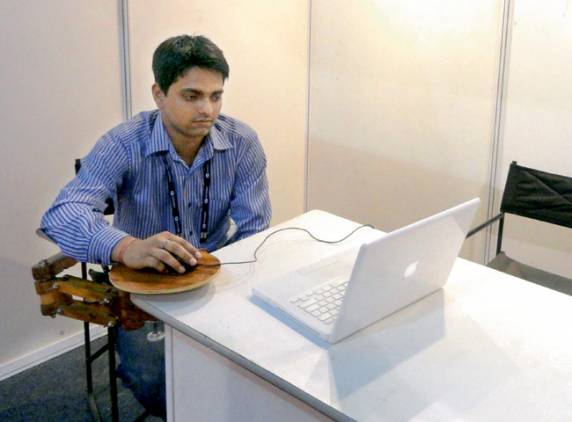
Vikas using the new aero-arm rest for computer users. He has been nominated for the top innovator of the world award (under 35 years category) for the invention.

An engineering student from Visakhapatnam has designed an innovative product — the aero-arm- rest — which reduces arm strain and backache in people working on computers for long hours.

The product is now pending patent with the National Research Development Corporation.

The inventor, 21-year-old Vikas Kumar Singh, has been nominated for the Top Innovator for World (under 35 years category) Award by the technical review panel of the Massachusetts Institute of Technology (MIT), USA. Mr Singh has based the design of his aero-armrest on cognitive ergonomics, which improve both the health and efficiency of an individual.

“The idea came from personal experience. While working on the computer, I noticed strain on the hand and on the spinal cord. Discussions were held with senior IT professionals. They told me they facedback and arm pain. This, they said, affected their productivity,” said Mr Singh who is doing final year B.Tech at Visakhapatnam’s Gitam University,

Mr Singh was one of the Indian students who participated in Nasa’s moon robot design competition held in the US last year.

“Although the market is flooded with chairs that provide rest to the back and help relax during the no-work hours, there is no attempt to develop a product that helps one work perfectly in the relaxed posture. The aero-armrest solves this problem,” Mr Singh said.

He gives credit to his teachers, Prof P. Madar Vali, Dr B. Surendra Babu and Prof P.S. Rao, for inspiring him. The aero-armrest is fitted with a height adjuster, which adjusts the height of the mouse pad.

The degree of freedom given to the arm holder is 360. The armrest can be clamped on any surface and then tightened.

source: http://www.DeccanChronicle.com / Home> Channels> SCI-TECH> Others / by Syed Akbar / DC / Hyderabad, January 22nd, 2012


Sujana gold medals presented to students

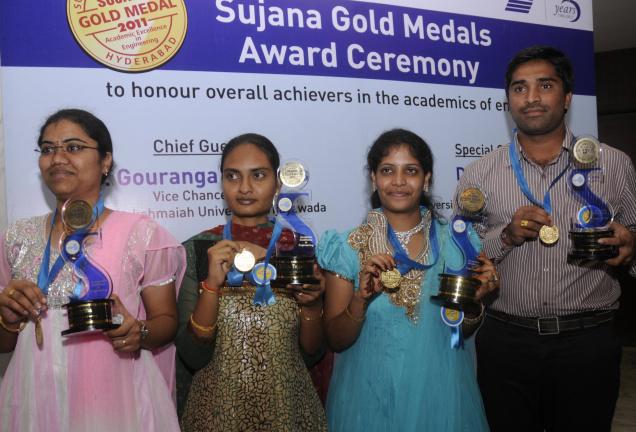
Winners proudly show their medals awarded by Sujana Foundation at a function in Vijayawada. Photo: Ch. Vijaya Bhaskar

Winners air their future plans and career options

Sujana Foundation, a CSR arm of Sujana Group of companies, has announced 50 gold medals to engineering students who excelled in their academics, etc. Of this, eight students were from Krishna, Guntur and Prakasam districts.

The Foundation gave away the medals, memento, cash prize and certificate to the winners here on Saturday.

On its sidelines, the winners aired their future plans, outlook towards society, and career options. Chalapathi Institute of Engineering and Technology student Yendluri Siva said that he would like to become a teacher. Most of the colleges do not have teachers who could meet the requirements of the students. There is a dearth of qualified teachers. I will pursue my masters and P.hD, he said, adding, “I want to teach the students in manner they expect.”

Amrita Sai Institute of Science and Technology student N. Lohitha said that she would pursue MBA after graduation. “I don’t want to depend on others. I would set up my own placement services firm.”

D. Geetha Prasanna of Prakasam Engineering College, who hails from a business family, has plans to look for a job in software industry. Everyone should give back something to the society. Many people don’t have access to proper assistance and help in health, medicare, education etc., she said, adding, “I have plans to set up a 24X7 helpline for the poor. The helpline would guide and help them in right direction.”

Parveen Sultana(DMS SVH College of Engineering), Sravanthi Pereddy (Gudlavalleru Engineering College), K. Siva Tejaswi and K. Sumanth Babu (Prakasam Engineering College), M. V. Vinay Kumar (St. Ann’s College of Engineering) were also awarded gold medals. Machilipatnam ML Konakalla Narayana Rao, MP Dr. NTR University of Health Sciences Vice-Chancellor Dr. I.V. Rao, K L University Vice-Chancellor Dr. G.L. Datta, Rajya Sabha member and Sujana Group chairman Y.S. Chowdary and others spoke. The three member panel comprising of Divyasree NSL Infrastructure Pvt. Ltd. CFO C. Narayana Rao, NLS Infrastructure Pvt. Ltd. Vice-President Luna Kumar Dacha, International School of Engineering Vice-President K. Dakshina Murthy selected the best 50 students out of 300 nominations received across the state.

source: http://www.TheHindu.com / News> Cities> Vijayawada / by Staff Reporter / January 22nd, 2012


Revolutionary road

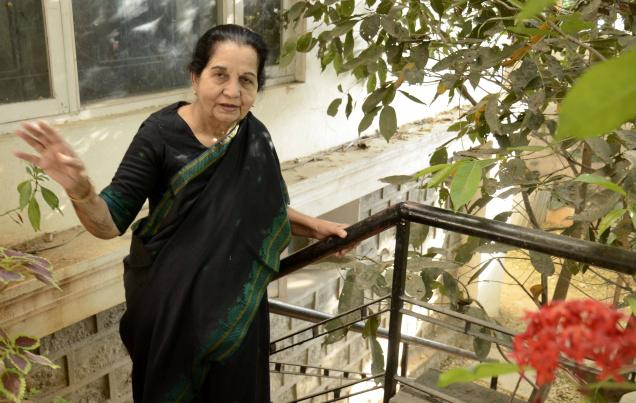
Urdu writer Jeelani Bano Photo: Nagara Gopal
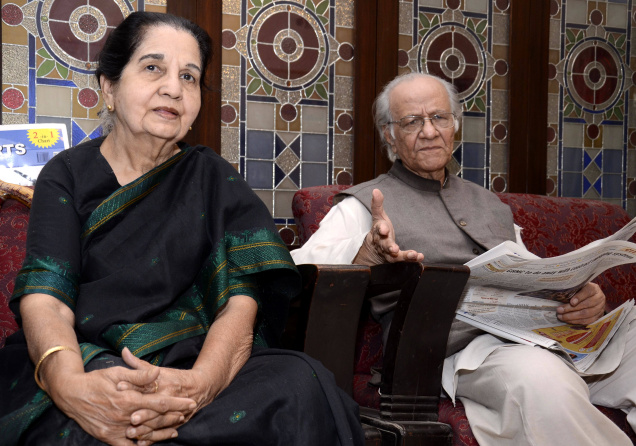
Jeelani Bano with writer husband Anwar Moazzam Photo: Nagara Gopal

The Progressive Writers Movement and a desire to fight against social injustices made her what she is, says Urdu writer Jeelani Bano. Sohini Chakravorty goes back in time with her.

It has the power to arouse patriotic fervour and to evoke love and passion, and it can be our only company in melancholy – Urdu has always been synonymous with revolution, change, love and tehzeeb. It is also a language that is fighting hard for a place in an increasingly homogenised world. One of the beacons of Urdu is Padma Shri awardee, writer and poet Jeelani Bano.

Time has stopped in her tranquil house, where words like courtesy, history and heritage still hold meaning. Originally from Badayun, Uttar Pradesh, her family made Hyderabad their home and it is in this home that she was exposed to the eclectic world of poets, writers, revolutionaries, musicians and artists. Her father, Hairat Badayuni, was also a well-known poet of his time. “We grew up in an environment of mushairas, classical music concerts, sher-o-shayari. Writers from India and Pakistan were constant visitors in our house,” says Jeelani Bano, who started writing when she was just eight years old. Early in life she was exposed to the works of Faiz Ahmed Faiz, Saadat Hasan Manto, Ismat Chugtai, Maqdoom Mohiuddin, Krishan Chander and many other writers from the Progressive Writers Movement.

Even in an ambience of art and culture, there were restrictions and the strict diktats of the purdah system. “My mother was very particular and never allowed me to read Ismat Chughtai’s novels, which I used to hide and read,” the author reminisces. “We were not allowed in the room where poetry recitations and concerts used to go on. Instead, we used to sit in the angan of our house and listen to it from a distance. Later, my brothers used to mimic the writers and poets and entertain us,” she laughs.

In such an environment, her sensibilities of a writer germinated. On a visit to her governess’s village, she got the idea for her first short story, Mom ki Mariyam, about the exploitation faced by the villagers. She then sent her story anonymously to a magazine, which later published it. “People who read the story were outraged and complained to my Abba that how he could allow me to write such a story. I was very scared when he showed my story to Maqdoom Mohiuddin, but he put a hand on my head and said he was very happy that I showed such depth at such a young age. He asked my father not to stop me again,” she says.

Jeelani Bano’s life took a turn when she got married while still studying at Intermediate. It was only after marriage that she completed her masters in Urdu Literature and came out of purdah. She attributes much of her inspiration and success to her husband Anwar Moazzam, a writer and former head of the department of Islamic Studies at Osmania University.

Her works, amounting to over 22 published books including poems, short stories, novels and a screenplay for Shyam Benegal’s film Well Done Abba, have been translated into various Indian and international languages. Her stories have mirrored the social issues and causes of her time.

Whether it is against the plight of the bonded labourers in Paththaron ki Barishor against divisive politics and power wielded by politicians in Raasta Band Hain, she feels that it is the duty of a writer to protest against the evils of society and guide its people in the right direction. She says, “I am aware of things around me and any kind of news becomes an afsana for me. I don’t sit behind closed doors and write on romance and family feuds.”

It is her sense of social awareness that made Jeelani Bano the chairperson for Youth for Action, Principal Advisor, Child and Women Human Rights, International Human Rights Association (India) and chairperson of Asmita, an NGO dealing with women’s rights.

The author feels, however, that writers or the government cannot be blamed for the fading influences of Urdu and other regional languages. “We are responsible for the fading of Urdu language. We are not teaching Urdu to our children. Urdu was never a commercial language when compared to English but to protect the language we need to teach our children at home,” she says.

The writer agrees the language has undergone change over decades with the influences of regional dialects. Like any Hyderabadi, she is passionate about Dakhini Urdu and feels the need to preserve the language for future generations. “The Urdu spoken in Delhi or Lucknow is different from what we speak here in Hyderabad. Influences of Telugu are present in Dakhini Urdu,” she explains. She has over 20 recordings of Dakhini Urdu, which represents the language spoken across various demographics.

“Changes are good and a city is bound to undergo changes with time,” says the writer. “But the common people and people on the street should not pay for it. That is why I became a writer, to speak against the injustices of society.” And she has chronicled the history of Hyderabad right from the days of Nizam in her book Aiwan-e-Ghazal.

In the age of social networks and power of electronic media, she feels that to engage young people it is imperative to narrate stories that are reflective of and relevant to contemporary society. And indeed her voice is completely in sync with the changing tides without putting any of the old tehzeeb on a guillotine.

Yesterday once more

It is not just Jeelani Bano’s captivating stories and feisty views on an ailing society that keep her conversation sparkling. She also shares anecdotes about her close association with some of the finest writers and artists of the day. Paintings by M.F. Hussain, a regular visitor to the house, adorn the walls of her living room. “Ismat aapa used to call me beti and I used to stay with her frequently. More than writing, I think I learnt cooking from her,” says the amused author. Apart from receiving constant encouragement from Rajinder Singh Bedi and Krishan Chander, Jeelani Bano sent her first published book to Faiz Ahmed Faiz when he was just out of prison in Rawalpindi. “Back then it was a tradition to send the first publication to the writers across. When I sent Faiz my book, he replied with a handwritten letter saying he appreciated my work.” Some of her correspondence with other writers appears in her book Door ki Aawaazen.

source: http://www.TheHindu.com / Life & Style> Society / by Sohini Chakravorty / January 19th, 2012
At the pinnacle

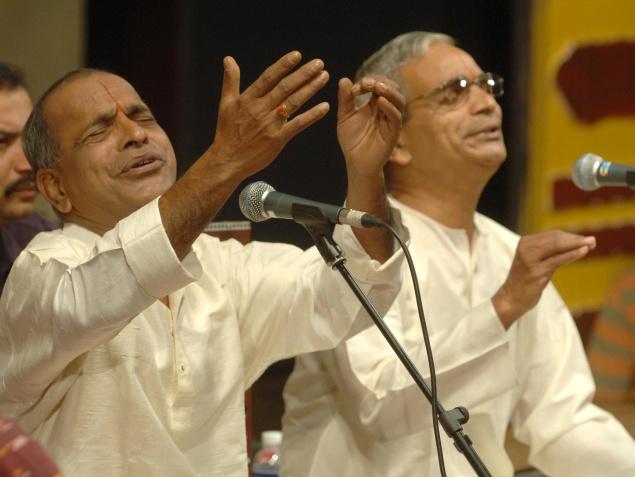
Hyderabad Brothers D. Raghavachari and D. Seshachari. File photo: Photo: V. Ganesan. / The Hindu

Hyderabad Brothers reminisce about their journey so far, as they earn yet another laurel.

They sing as a duo, yet they are poles apart. One is mild and mellow, the other is vibrant and candid. However on the stage, they merge their diverse personalities into a single entity and the output is just eloquence. It’s no surprise that awards and accolades come their way. The ‘Hyderabad Brothers’, as Daroor Raghavachary and Seshachari are fondly referred to in the Carnatic music circles, have once again been bestowed with the ‘Senior outstanding vocalists’ award by the Madras Music Academy in Chennai at the end of the Margazhi festival.

How do they feel about this? “We are blessed. It is the divine that has been operating in our lives all the time. We live by our sruti and laya, our musical parentage. The rest follows naturally,” both respond with utter humility.

Way ahead of others in this region, the Hyderabad Brothers carved a niche for themselves at the Mecca of music by sheer dint of merit and melody. When classical music is replete with rigid grammar and syntax, how do they manage to tug at the heart-strings? “By breathing music, thinking music and living music,” Seshachary quips. “I don’t do research, then I will turn into an academician. Nor do I practise all 364 days. But as I relax after the day’s work, my mind churns out new sangathis, new swara patterns, keeps delving into varied ways of presenting a raga wherein the bhava springs up as natural fountain,” he says.

“We keep the raga bhava and the lyric bhava intact while rendering it in all its variations. This is a very important aspect of singing in a concert. Nothing should be harsh to the ears of the listener. A kriti should touch his heart. That is what the great composers felt. They are our guiding stars. This is no way of tampering with tradition or classicality. It is the approach that matters,” says Raghavachary.

Working in NMDC on the secretarial side, Raghavachary manages to keep his musical prowess intact, his recitals and his music lessons going without a break. “My organisation has been very cooperative; as far as my concerts are concerned. I’ve never been denied leave on account of my job. That is a great boon and I owe it to the NMDC,” he explains. Seshachary on the other hand works in the All India Radio; and that makes things easy as far as music goes.

Seshachary goes down memory lane:“We did not struggle to learn music. The entire family was into music and my father Daroor Ratnamacharyulu was our first guru. My mother Sulochana was also my father’s pupil. He was a music teacher in a private school. As a couple they presented recitals in temples during festivals. We belong to Hayatnagar though the family shifted to Yakutpura which is our birthplace in the twin cities. My father and mother would regularly hold recitals at Yadagiri Gutta. As a kid, I had a penchant for percussions and would take up the ghatam to accompany them. And towards the end of the concert, I would be overcome by sleep! There was no other way of life we knew except music.” .

“There was no Carnatic music in Hyderabad then. My father was the first to introduce it to a select lot. In Yakutpura other boys of our age would never address us by our names. “Sarigama jaare dekho!’ was our identity,” laughs Raghavachary turning nostalgic.

While Raghavachary polished his musical skills further under Susarla Sivaram, it was after a series of failed attempts to make it as a music teacher that the guru helped him to get into a non-music career for a livelihood. Seshachary topped the AIR music competitions; there has been no looking back since then. They sang individually till one fine day, at AIR, they were asked to experiment as a duo by then flautist N.A. Srinivasan. “This was later followed by a public concert at Tiruvyaar and the duo singing clicked. Much later, we came to be called the ‘Hyderabad Brothers’,” recalls Seshachary.

source: http://www.TheHindu.com / Arts> Music / by Ranee Kumar / January 19th, 2012

Hyderabadi Literary Fest begins

Hyderabad:

Hyderabad’s tryst with arts and culture continues. This time, it is the pen that promises to claim the honours with regional and national writers converging on the serene Taramati Baradari cultural centre here on Monday for the second edition of the Hyderabad Literary Festival. The fest, a multilingual one, will see Telugu, Hindi and Urdu writings getting considerable space alongside celebrated works in English.
The aim remains to promote regional works as much as English, and this was made clear in the inaugural address by Pawan K Varma, Indian Ambassador to Bhutan, who has authored a series of books on contemporary India.
“Language is not merely a means of communication. It is a window to your culture, to the identity of who you are. Without language a person is rootless.
Literary fests such as this should actively promote regional writers too and not just English,” said Varma.
Noted lyricist Gulzar, who graced the occasion, spoke of how English had today resulted in alienating different sections of the society and the need to undo it by returning to our culture and the writings that characterised them. Secretary, Department of Tourism, Chandana Khan, who was also present at the inaugural, echoed their views.
Germany has been selected as the Featured Nation at this festival, which is being jointly organised by Muse India, an e-journal and the State Tourism Department.
The three-day event is being supported by the German Centre (Goethe Zentrum), apa r t f rom Al l i anc e Francaise, the Osmania University Centre for International Programmes and The New Indian Express among others.
There was a sizeable presence of Telugu writers too at the event.
Muse India gave away awards in two categories. The Young Writer Award 2011 for Poetry was given to Anindita Sengupta’s City of Water, Sahitya Akademi, 2010, and the Translation Award 2011 was given to Ranjit Hoskote for his translation of I,Lalla, The Poems of Lal Ded, Penguin, 2011.
Pawan Varma’s first fictional work, When Loss is Gain, was also launched at a function in the evening.

source: http://www.ibnlive.in.com / South>  Hyderabad / Express News Service / The New Indian Express / January 18th, 2012

You should get to know … Subbanna Varanasi

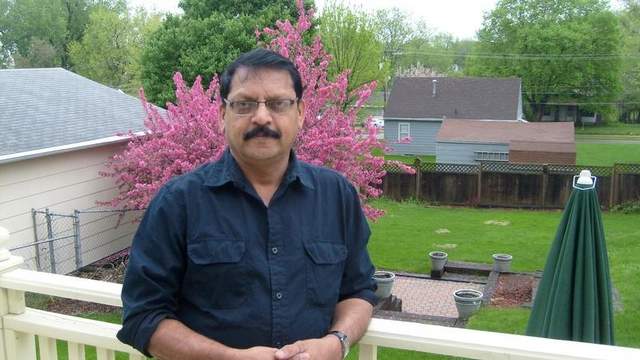
Job description or business description: Massage Par Excellence. I give a deep tissue massage and specialize in Indian head massage.

Background: I was born in Madras (now Chennai), India, and went to university in Hyderabad. I have a bachelor’s degree in commerce, and later, while working in a hotel in the Sultanate of Oman, went to school and earned an advanced diploma in French and on my return to India in 2000 earned an advanced diploma in Spanish. From working as a health club manager in a hotel in Oman, as a journalist in Hyderabad, working on oil rigs in Ajman in the United Arab Emirates, bartending on Carnival Cruise Lines sailing in Mexico and the Caribbean and driving a cab in New York City, I probably did more than a dozen jobs. Besides giving massages at my clinic and doing translation, interpretation and voiceovers, I work in the BOS restaurant, in the Renaissance Savery Hotel downtown. After returning to the U.S. in 2007 I studied massage therapy and became a licensed massage therapist.

Notable achievements: I speak five languages fluently and meet and greet in another five. Becoming a citizen of the greatest country in the world was a long-cherished dream that became a reality in September

Why I do what I do: I am a people person and love to know people wherever I travel and live. The very first year I arrived in Des Moines I sold corn Indian style, roasting them on hot coals and rubbing Indian spices on them, in the downtown farmers market. I realized Iowans are warm and friendly and quite a few of them encouraged me to start my own Indian restaurant. But since the time I started as a masseur in the Sheraton Hotel in Bombay back in 1980, I wanted to pursue massage as a profession. On my return to Des Moines from India in 2007, I went back to school and got my certificate and license and started Massage Par Excellence. There is absolutely nothing like helping people de-stress with a relaxing and rejuvenating massage. I educate people (especially women, who constitute 90 percent of my clientele) that as much as a manicure and pedicure is vital, massage does magic to stressed minds and bodies.

What I do to get away from work: I love to travel (I’ve been to 30 countries), and I believe travel does not have to be to other countries. My wife, Brenda, and I drive an hour from Des Moines and eat lunch in a small town and just totally unwind. I listen to music, and I try meeting new people and keep myself updated by talking to my friends around the world on Skype.

How I give back to the community: I volunteer, especially by participating in free chair massage clinics to aid food pantries and other worthy causes. I have been a tour guide at Terrace Hill. I actively participate in the Merle Hay Neighborhood Association activities. As stated on my website, on my massage clients’ request, a percentage of the massage fee is donated to the charity of their choice.

Words to live by: “Defeat is not the worst of failures. Not to have tried is the true failure.” — George Edward Woodberry.

Best business book I’ve read lately: “Steve Jobs” by Walter Isaacson. The story of the charismatic pioneer of the personal computer revolution is truly gripping and inspiring.

The best place in central Iowa to entertain clients or colleagues: I visit quite often the India Star at 55th and Douglas Avenue. The close proximity to my home and clinic makes it easy for me to introduce Indian cuisine to my American friends and clients.

One thing I would change about the Des Moines area: I would like to see more shops and establishments on the street level in the downtown area. Except for the East Village (and that just in the past few years), the rest of the downtown is deserted during afternoons and simply a ghost town during evenings. The skywalk system may be a great boon for office workers to reach the food courts, but it has literally killed any chance of opening a business on the street level. More people would frequent the shops and restaurants at all times of the day if they spent time on the streets.

What Iowa can do to attract more people like me: I know that Iowa has been great to immigrants, and we need to keep on opening our doors to immigrants from around the world to continue to contribute to the colorful mosaic that is Iowa.

My mentor: My mother raised five kids and she started going to school when I, the last kid, was 15. She did teacher training and went on to get a Ph.D. She taught college until she retired. By her own example she taught me that learning has no age limit.

What I would do if I could do something else: I would love to write travel guides. I would like to describe not just the tourist sites and the restaurants and shopping but the people and their way of life and culture.

Contact information: Massage Par Excellence, 3839 Merle Hay Road, suite 210. (515) 450-7052 www.subbu.com.

source: http://www.DesMoinesRegister.com / Featured / by Subbanna Varanasi / January 16th, 2012


Leggie finds traction later

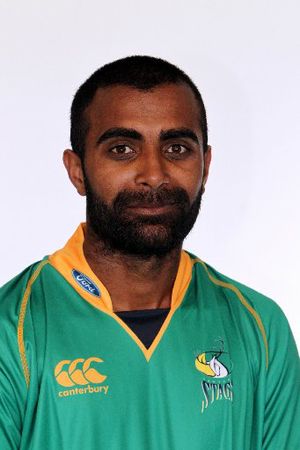
When Tarun Nethula fished his cellphone out of his cricket bag yesterday morning in New Plymouth he realised there was a message waiting for him.

What the Devon Hotel Central Districts Stags player didn’t realise was the top-up card on the phone was running on empty.


“I got into it but, before I could find out what the message was, I realised I’d run out of credit on the phone,” the 28-year-old tweaker said with a laugh yesterday, after he was named in the New Zealand XI to play Zimbabwe in the three-day international match next month.

“I had to ask Hammer [bowling coach and Stags manager] for his phone to make a call to find out what it was all about,” the legspinner said after New Zealand Cricket selection manager Kim Littlejohn failed to contact him with the news of his selection. While his voice didn’t reflect it yesterday, Nethula was quietly delighted to have the opportunity to play at an international level for New Zealand amid talk he is the most likely contender to succeed an ageing Daniel Vettori, of Northern Districts, as the No1 spinner.

Self-effacing at the best of times, the Heretaunga Building Society Cornwall Cricket Club premier player opted to give some flight in his pitch to the tune of the Stags’ team mantra.

“As long as I keep playing well for CD, that’s all. If an opportunity like this comes along then it’s all good.”

He arrived in the Bay in the summer of 2010 at the request of CD coach and fellow Aucklander Alan Hunt to gain more game time because of a glut of Auckland spinners, such as Roneel Hira, Bruce Martin, Jeet Raval and Bhupinder Singh.

Asked what he was doing different this summer that saw him consistently take wickets in the four-day Plunket Shield competition, the Andhra Pradesh-born replied: “Nothing. The only thing different is I’m going to the gym more often to keep myself fit.

“In terms of bowling, I’m a bit more patient and I’ve been working with Shrimpo [former women’s World Cup-winning coach Mike Shrimpton, of Napier] as well as Hammer [Hamilton],” says Nethula, who wants to be adept in all forms of the game.

In his debut season, he had to bide his time with two other spinners, English imports Ian Blackwell and Michael Yardy.

From a long line of academics in the family, Nethula has frozen tertiary education to pursue a cricketing career.

His mother, the late Prameela Nethula, was a professor in gynaecology and obstetrics but died in 1997 when he was 13, so he went back to Hyderabad where his grandparents raised him for a short spell. His father, Sainath Nethula, is a chemical engineer-cum-schoolteacher in Auckland.

source: http://www.hawkesbaytoday.co.nz / by Anendra Singh, Sports Editor / Tuesday, January 17th, 2012

RINL signs MoU with Andhra Pradesh Government for Rs. 42,000 Crore Investments

The Rashtriya Ispat Nigam Limited, Visakhapatnam Steel Plant has signed a Memorandum of Understanding (MOU) with the Government of Andhra Pradesh (AP) for huge investments to the tune of Rs.42, 000 crores for various projects in its current facility at Visakhapatnam and other parts of the State. With this, RINL emerged as the “Number One” Company as far as the investments are concerned in Andhra Pradesh and this will give a big boost to the industrial development of the State particularly the Visakhapatnam region.

The MoU documents were exchanged by the Chief Minister of AP, Shri N Kiran Kumar Reddy and Shri A P Choudhary, CMD, RINL-VSP on 13th January, 2012 at Hyderabad International Convention Centre (HICC) at the Partnership Summit 2012 in the presence of Dr J Geetha Reedy, Minister for Major Industries, Commerce and Exports promotion.

The MOU envisages that the Government of Andhra Pradesh would facilitate RINL to obtain necessary permissions/ registrations/ approvals/clearances etc. from the concerned departments of the State, as per the existing policies/rules and regulations of the State Government. Government of Andhra Pradesh will also facilitate allotment of iron ore mines including other raw material mines, supply of water, power, etc., to RINL on priority basis.

Under the Agreement, VSP will invest around Rs. 42,000 crores for various projects for the expansion and modernization of the plant. This MOU is made to facilitate RINL for establishment of the Projects in Andhra Pradesh in a time bound manner. The signing of the MoU with the State Government would strengthen RINL for the next phase of expansion to 11/12Mtpa.

****  NSK/DB

(Release ID :79604)

source: http://www.pibnic.in / Ministry of Steel / Press Information Bureau / January 16th, 2012

Lepakshi Kowledge Hub draws plan for hi-tech electronic city

Lepakshi Knowledge Hub (LKH), set up to promote industry clusters in Anantapur district of Andhra Pradesh will set up Hitech Electronic City in its premises.

According to its managing director S Balaji, the project will come up in about 2,650 acre within the 10,000 acre of the LKH. The project will be taken up in a joint venture with the Vittal Innovation City (VIC) and Global Emerging Markets (GEM).

The electronic hub, which will put India along the select countries that have global hi-tech innovation ecosystems, is expected to attract investments of more than Rs 11,000 crore and create employment for 75,000 in five to ten years.

GEM, a $3.4 billion alternative investment group headquartered in Geneva, will bring in the investments for the project while VIC, led by N Vittal, former secretary, union electronics and telecommunications ministry, has prepared the concept master plan and will develop the project along with the LKH.

The concept proposes a green ecosystem that includes knowledge-based services, manufacturing, research and development and incubation activities inspired by technology hubs like the Silicon Valley in the US, Hsinchu in Taiwan and Tsukuba in Japan.

“The Hi-tech Electronic City project will provide an opportunity for India to leapfrog in electronics and IT hardware manufacturing on the lines similar as IT sector,” said Balaji adding that this would be positioned into a special category for electronics. This would be in line with the focus of the Government of India to create electronics clusters in India for national competitiveness in this area.

Apart from the Electronic City, LKH will house several industry clusters that include aerospace and defence, education and innovation, agribusiness, healthcare, science and technology, media and entertainment and logistics.

“Various clusters are in different stages of progress and will be ready in five to ten years as projected,” he said.

LKH when completed will make it the largest multi industry cluster system in the country. In the next years, it is expected to bring in investments to the tune of $4 billion and create employment opportunities to 1.5 lakh people directly and to another 3,00,000 indirectly.

source: http://www.mydigitalfc.com/ MyWorld> by B. Krishna Mohan / January 15th, 2012