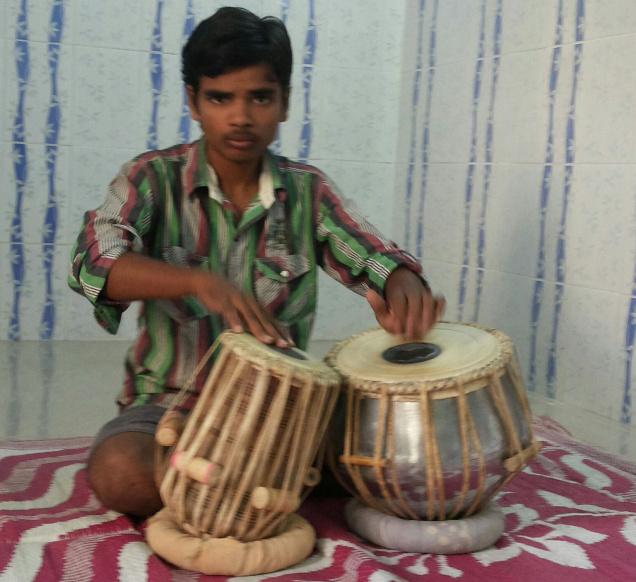
K. Harish practising on his tabla. – Photo: K.N. Murali Sankar / The Hindu
A lot can happen over a period of 12 years – the gap between two consecutive Pushkarams of the Godavari. K. Harish, who was orphaned at an age of six during the Godavari Pushkaralu-2003, is now a musician with specialization in Hindustani vocal. In all likelihood, he will perform during the Pushkaram, scheduled for next year.
Harish, who is 18-year-old now, is one among the 20 Hindustani vocalists who performed in the National Cultural Festival conducted by the Union Ministry for Human Resources Development at Guwahati recently and the lone representative from Andhra Pradesh.
The Government Railway Police spotted six-year-old Harish abandoned in a train coach during the last Pushkarams and handed him over to Parivartana Home for the Street and Destitute Children at Bhaskar Nagar in the city. Pandranki Radhakrishna, a music teacher from Chakradharpur in Jharkhand, who settled in the city spotted Harish in the Home seven years ago and found that the boy was interested in music. Since then, music classes have become a part of the daily life for the boy, who is now pursuing Bachelors degree in music from Mumbai-based Akhila Bharatiya Gandharva Mahavidyalayam.
“I don’t know anything about music before meeting my guru Radhakrishna. Beginning with vocal, he taught me Tabla and Harmonium as well,” says Harish, who spends seven hours on music practice everyday. After finishing electrical trade course from ITI, he is now looking for an apprenticeship in one of the local industries. “My plan is to pursue post-graduation in Hindustani music and to start a career as music lecturer,” he asserts in a confident tone. Harish is now getting monthly scholarship from the Mahavidyalaya.
“We made several efforts to find the address of his parents and send the boy back to them. He was able to give us the names of his parents and relatives, but he was not sure about the place where they reside. We took the help of the Bhimavaram police to trace his parents, but we could not make it,” says Vakkalanka Ramakrishna, secretary of Parivartana, the home that is providing food, shelter and education to 68 orphan boys.
source: http://www.thehindu.com / The Hindu / Home> News> National / by K.Murali Sankar / Kakinada – October 09th, 2014
Rear Admiral Ajendra Bahadur Singh at the change of guard ceremony held in Visakhapatnam on Tuesday | EXPRESS PHOTO
Visakhapatnam :
Flag Officer Commanding Eastern Fleet Rear Admiral Atul Kumar Jain has handed over the Command of the Eastern Fleet to Rear Admiral Ajendra Bahadur Singh. The change of guard took place at an impressive ceremony onboard Flagship INS Jalashwa here Tuesday. Rear Admiral AK Jain will now assume the duties of Chief of Staff, Southern Naval Command at Kochi.
Rear Admiral AB Singh is a specialist in navigation and aircraft direction, and a graduate of National Defence Academy Khadakvasla and Defence Services Staff College, Wellington. He also holds a masters’ degree from Cranfield University, UK. He commanded Indian Naval Ships Veer (Missile vessel), Vindhyagiri (Frigate), Trishul (Frigate) and Viraat (Aircraft Carrier).
He also held various prestigious staff and operational appointments and was awarded the Vishisht Seva Medal in 2011. Prior to taking over as Flag Officer Commanding Eastern Fleet, he was serving as Assistant Chief of Naval Staff (Policy and Plans) at Naval Headquarters, Delhi.
Fully Loaded
The Eastern Fleet comprises 30 ships including amphibious platform Jalashwa, destroyers, stealth frigates, anti-submarine warfare corvette Kamorta, missile corvettes, landing ship tanks, offshore patrol vessels, missile boats and tankers.
source: http://www.newindianexpress.com / The New Indian Express / Home> States> Andhra Pradesh / Express News Service / October 08th, 2014
The 21st century will be a defining one for India and her children thanks to infrastructure development and improving connectivity due to greater emphasis on science and technology, Prof S V Raghavan, scientific secretary in the office of the principal scientific advisor to the government of India, said here on Monday while exhorting the students of Andhra University to become change agents to enrich the lives of their fellow countrymen.
Delivering the 82nd Andhra University convocation address, Prof Raghavan said science can no longer be perceived as elitist and cut off from routine and mundane societal problems. Elaborating on the continuum between science and society, Prof Raghavan pointed out that a scientific approach towards an idea helps refine it and sharpen it.
He also dwelt on one of the most exciting ideas taking shape in India. “The National Knowledge Network (NKN) is a game changer for India as it has connected 1,300 institutions spread across the country, thereby bringing the collective wisdom available across the country together and making it accessible by annihilating distance.”
Providing an example of how NKN, which is touted to be the largest knowledge database, Prof Raghavan said through NKN a patient requiring critical attention can be diagnosed and treated remotely with the help of expert opinion.
The architect of NKN said while NKN was the backbone for connectivity and access to knowledge bases, it was the student community that formed the backbone of India.
Speaking on the occasion, AU vice chancellor Prof GSN Raju said the varsity had received the highest funding of Rs 320 crore from the state government as compared to other state varsities. The AU VC also pointed out that the varsity had received Rs 35.97 crore in grants from the UGC and directorate of science and technology for research projects, over and above the Rs 1 crore received by the Delta Studies Centre which has been jointly set up by AU and ONGC.
Pointing out that AU had introduced 17 new courses in various fields, conducted 75 national and eight international seminars and workshops in the 2013-2014 academic year, he said wifi and ICT facilities were being developed on the campus in collaboration with Google and a new three storied building had also been constructed with the help of Rs 90 lakh donated by AU alumni.
During the convocation, more than 225 PhD degrees were presented and 16 medals and 13 prizes given to some of the PhD recipients. More than 426 prizes and 155 medals were presented to outstanding students and research scholars on the occasion.
source: http://www.timesofindia.indiatimes.com / The Times of India / Home> City> Visakhapatnam / TNN / September 30th, 2014
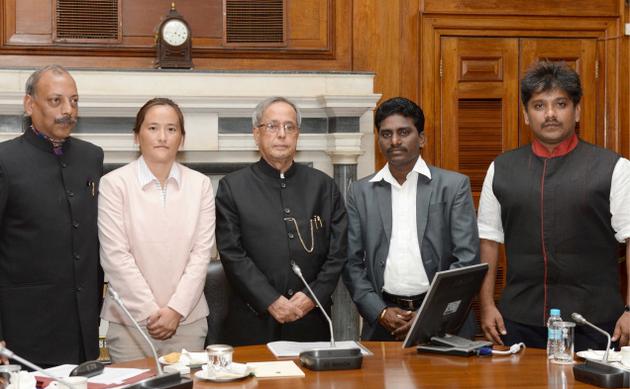
Kadapa writer Vempalli Gangadhar with President Pranab Mukherjee at Rashtrapathi Bhavan on Monday. Photo: By Arrangement / The Hindu
Kadapa writer and Central Sahitya Akademi Yuva Puraskar recipient Vempalli Gangadhar had the privilege of interacting with President Pranab Mukherjee for about an hour in Rashtrapati Bhavan at New Delhi about his literary pursuit on Monday.
Dr. Gangadhar, who has been a guest in Rashtrapati Bhavan from September 8 onwards, on being invited by the First Citizen of the country for a fortnight-long “in-residence programme”, said he explained to the President about the books written by him in Telugu portraying the social problems prevalent in drought-prone Rayalaseema region.
The young writer presented his books – Molakala Punnami, Devarasila and Greeshma Bhoomi (compilations of short stories), Pune Prayanam (on tribal women pushed into flesh trade) , Hiranya Rajyam (consequences of factionalism in Rayalaseema), Nela Digina Vaana (novel) and Tholi Telugu Sasanam (First Telugu Inscription) – to Mr. Pranab Mukherjee. The President congratulated Dr. Gangadhar for his literary efforts to portray the conditions in Rayalaseema.
Another writer Yishey Doma Bhutia of Sikkim also presented her books to the President. Two painters Rahool Saksena and Pratap Sudhir Morey were also among the invitees for the “in-residence programme”.
source: http://www.thehindu.com / The Hindu / Home> News> National> Andhra Pradesh / by M.V. Subrahmanyam / Kadapa – September 23rd, 2014
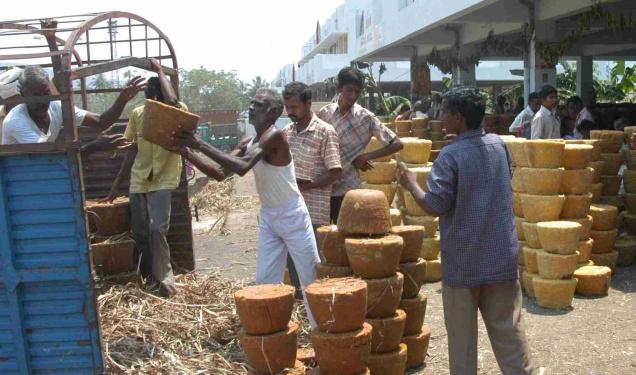
Jaggery stocks being loaded onto trucks at the Anakapalle market, in Visakhapatnam District. A file Photo: C.V. Subrahmanyam / The Hindu
Short supply of rakes and wagons forces the traders to take the decision
Around 40 lakh lumps of jaggery, each weighing 15 kg, are being exported from the second largest jaggery market in the country – Anakapalle – every year. About two decades ago, railways was the preferred mode for transportation of jaggery lumps, but the traders shifted to road transport despite high cost.
“The short supply of rakes and wagons often reaching the wrong destinations pushed the traders take the hard decision,” says Anakapalle Jaggery Merchants’ Association president Konathala Lakshminarayana (Peda Babu).
“Thousands of daily wage earners, employees and vegetable vendors shuttle from Anakapalle to Visakhapatnam every day. Trains are the preferred mode of transport in view of the convenience and also to avoid getting caught in the traffic jams on the roads.” “There is a long- pending demand for operation of a shuttle train from Tuni to Visakhapatnam. The Kakinada – Visakhapatnam passenger is overcrowded and a couple of more shuttle services are required to cater to the needs daily passengers,” says Mr. Lakshminarayana, a former member of the ZRUCC.
Anakapalle has been merged with the Greater Visakhapatnam Municipal Corporation (GVMC) making it imperative that this station be included in the list of satellite stations like Duvvada, Simhachalam and Pendurthy for stopping of all important passenger trains.
Meeting today
The meeting convened by Anakapalle MP Muttamsetti Srinivasa Rao with the Divisional Railway Managers of Waltair (Visakhapatnam) of East Coast Railway and Vijayawada of South Central Railway at Anakapalle on Wednesday against this backdrop assumes significance.
“Trains should be stopped at Anakapalle, Narsipatnam, Elamanchili and the railway stations have to be improved. We will also demand either re-routing of the AP Express via Visakhapatnam or making it start from Visakhapatnam,” Mr. Srinivasa Rao told The Hindu when contacted on Tuesday.
source: http://www.thehindu.com / The Hindu / Home> News> Cities> Visakhapatnam / by B. Madhu Gopal / Visakhapatnam – September 24th, 2014
In a bid to give prisoners a second chance to rebuild their lives and enter mainstream society after release, the Andhra Pradesh prisons department on Tuesday inked a memorandum of understanding (MoU) with The Himalaya Drug Company for cultivation of medicinal plants in the Visakhapatnam Central Prison.
Under the PPP programme, the government would provide land and labour (prisoners) for cultivation of medicinal plants in the prison premises, while the training and rehabilitation measures for enhancing skill development among inmates and monthly stipend would be provided by the drug company.
The MoU addendum was signed by B Sunil Kumar, inspector general of prisons, the AP government and Dr VU Babu, head of phytochemistry, research and development, The Himalaya Drug Company.
As per the provisions of the MoU, the drug company along with jail authorities would impart training to prisoners for cultivating medicinal plants for Himalaya’s consumption at the Visakhapatnam semi-open Central prison. Inmates would be earning a regular monthly income and acquiring essential skills in the process.
Besides training, the drug company would also supply seeds and provide technical assistance. The government would provide infrastructure, land, irrigation facilities, electricity supply and farming implements.
Speaking on the occasion, B Sunil Kumar, IG (prisons), AP, said, “The main benefit of such collaborative projects is that the prisoners can be kept engaged and get a second chance to rebuild their social lives. They would be equipped with basic skills that open up avenues for employment after they have served their sentences. In the process, the burden on the government exchequer would also come down.”
“Already, projects such as dairy unit, and petrol bunks exist in some of the central and district prisons. A telephony system would be set up in the district and sub jails from January 2015,” added the IG.
At the Vizag Central prison, which houses 930 prisoners at present, cultivation of two species, including the bitter herb Kalmegh (Andrographis paniculata) and drumstick (Moringa oleifera), would be focused upon for the time being as the prevalent climatic conditions and soil are suited to their cultivation. “The work would be taken up just after Dasara initially on three to four acres, which would be extended gradually,” said Vizag jail superintendent Dr I Srinivasa Rao.
“Earlier too, we received a very good response from our prison farm in Anantapur and the concept has now been extended to Vizag Central Prison, which would help rehabilitate prisoners and provide sustainable livelihoods. In the future we would be looking at expansion of such programmes to other parts of the state and country for a more holistic growth.
In Anantapur open prison, alfalfa is cultivated. If farmers follow the protocol while cultivation, we would provide 100% buyback guarantee as well as employment opportunities,” said Dr Babu of Himalaya Drug Company.
source: http://www.timesofindia.indiatimes.com / The Times of India / Home> City> Visakhapatnam / TNN / September 24th, 2014
IT Secretary Sanjay Jaju signing MoU with Google India Vice President & MD Rajan Anandan to promote digital literacy and develop Telugu internet as Chief Minister N. Chandrababu Naidu watches at the CEOs’ conclave in Visakhapatnam on Monday. Photo: Arranged photo
The Andhra Pradesh Government signed a historic MoU with Google here at CEOs’ conclave on Monday to develop Telugu internet and launch a series of initiatives to transform the State into digital AP in a record time.
Complimenting Google for its association, Chief Minister N. Chandrababu Naidu said digitalisation and internet literacy should be achieved in tune with the speed with which Google functions.
Google India Vice-President and Managing Director Rajan Anandan and Principal Secretary, IT Sanjay Jaju signed the agreement in the presence of Mr. Naidu, Deputy Chief Minister China Rajappa, Ministers Palle Raghunatha Reddy, Ganta Srinivasa Rao, Ch. Ayyanna Patrudu and P. Sujatha.
“We want to become first State to embrace Prime Minister Narendra Modi’s vision of Digital India and set an example to other States to follow. I will personally monitor the progress,” Mr. Naidu said.
Google, a top web property specialising innovative search technologies, which was launched by Stanford PhD students Larry Page and Sergey Brin in 1998, will also connect all women self-help groups through the internet in three years.
The initiatives will include developing Telugu font, keyboards, content and increasing access to government websites and scaling the local language web to throw window of opportunities for entrepreneurship.
As per the MoU, Google will help government make their websites mobile-ready and accessible in Telugu, promote internet safety among children and government officials, improve and get more local language content online and promote digital literacy among women and help small and medium business to gain from the internet economy.
source: http://www.thehindu.com / The Hindu / Home> News> Vijayawada / Santosh Patnaik / Visakhapatnam – September 29th, 2014
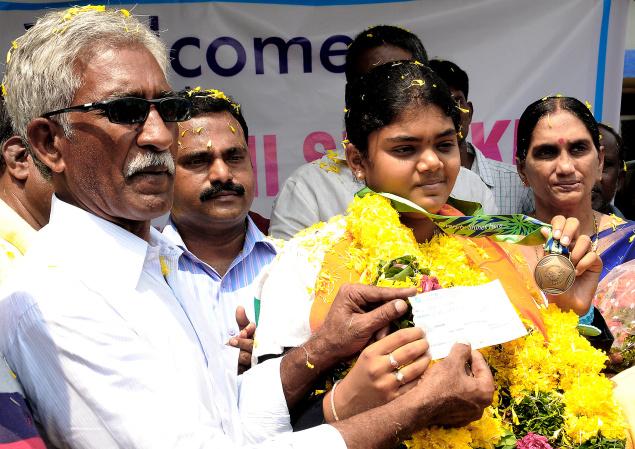
CBR Sports Academy chairman Chalasani Balaramaiah handing over a cheque for Rs. 5 lakh to Asian Games bronze medallist Jyothi Surekha on her arrival at Gannavaram Airport on Saturday. – Photo: Ch.Vijaya Bhaskar
Incheon bronze-medallist accorded a warm welcome
A warm welcome was accorded to teenage archer Vennam Jyothi Surekha on her triumphant return from Incheon after winning a bronze medal in the women’s team compound segment, at Gannavaram airport on Saturday.
On Friday, Purvasha Sudhir Shende of Volga Archery Academy, the other member of the Indian team, along with coach L. Chandrasekhar, arrived in the city.
The medal won by the archers assumes significance, as the city athletes had won an Asian Games medal after a gap of 63 years.
“In the 1951 first-ever Asian Games held in New Delhi, Krishna District’s Kamineni Eswara Rao (90kg) and Dandamudi Raja Gopala Rao (95+kg) won silver and bronze medals respectively in the weightlifting event,” said District Sports Development Officer S. Ramakrishna. Meanwhile, Kethanakonda-based CBR Sports Academy chairman Chalasani Balaramaiah alias C.B.R. Prasad handed over a cheque of Rs. 5 lakh to the eighteen-year-old archer, pledging support for her preparations for the 2016 Rio Olympics.
“This girl faced a lot of hardship to achieve the medal. She is a fine example to modern-day youngsters, as she made many sacrifices to realise her goal with a singular motto. She can make use of my academy for her future preparations,” Mr. Prasad said.
Congratulating Surekha, Gannavaram legislator Vallabhaneni Vamsi Mohan promised to take to the notice of Chief Minister Chandrababu Naidu the importance of quality sports infrastructure in Andhra Pradesh.
“Hyderabad was nurtured as an international sports hub during the Afro-Asian Games. We need such a mega event to develop a new sporting culture in Andhra Pradesh,” he said.
Amid ‘Bharat Mata ki Jai’ slogans, a visibly tired Surekha thanked Andhra Cricket Association, Laila Group of Companies chairman Gokaraju Ganga Raju, Bhima Cements, Nalanda Educational Institutes, Koneru Lakshmaiah University and Vennam Foundation for their supportin helping her realise her dream.
Surekha’s father Vennam Surendra thanked the Archery Association of India for giving his daughter direct entry.
Several coaches, sports administrators, students of K.L. University visited the airport to accord a warm welcome to the medal-winning archer.
source: http://www.thehindu.com / The Hindu / Home> News> Cities> Vijayawada / by J.R.Sridharan / Vijayawada – October 05th, 2014
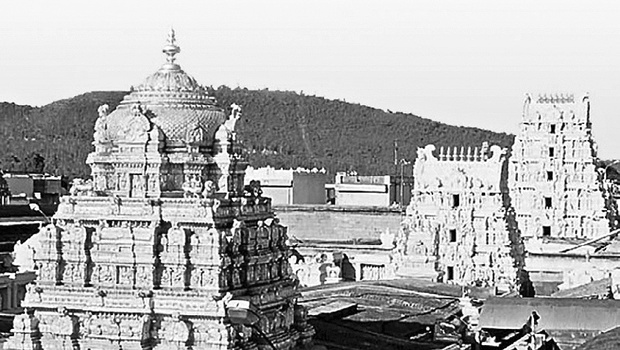
Turning a piece of stone into a beautiful sculpture – an idol or a statute — shows the unique skill and imagination of a sculptor. Sculpture is a traditional art form practiced since ancient times. Thousands of years ago, Indian seers had inscribed sculptural and temple architectural science. Even after hundreds of years of existence, the sculptures and architecture in the ancient temples are intact and exhibit the dedication and artistry of the sculptors of those days.
Coming to the present day, even though some universities are offering courses insculpture and architecture, it is considered as a modern art form only. In India, only two institutions are offering courses in traditional sculpture and architecture to students and the TTD-run Sri Venkateswara Institute of Traditional Sculpture and Architecture (SVITSA) at Tirumala is one of them. TTD’s uniqueness is that it is providing the education and training to the students free of cost apart from providing free lodging and boarding to them during the four-year course.
Another significant factor is that after successful completion of the training, the students can stand on their own legs as the TTD deposits `1 lakh in the name of the student in a bank when he gets admitted into the institution. The student is given back this amount along with the accrued interest after completion of the course. The TTD also provides job opportunities to the students on piece-rate system to the stone sculptors in its workshop for sculpting the idols of Gods and Goddesses.
According to officials of the TTD-run institute, the TTD started the Sri Venkateswara Silpakala Sikshana Kendram (SVSSK) in 1960 to preserve the ancient art of sculpture and temple architecture for future generations.
Unexpectedly, the response from students was tremendous and they made some changes in the syllabus and introduced a diploma course and developed the institute as SVITSA in 1985 and got recognition from the government of Andhra Pradesh.
About the institute:
SVITSA offers two level courses. One is the Certificate Course for eighth class- passed students and other is the Diploma Course for tenth class-passed students. The Certificate Course is offered in Kalamkari designing. This course is of two years. These students will not be getting the `1 lakh deposit.
Seven different Diploma Courses are offered in subjects such as Temple Architecture, Stone Sculpture, Sudai Sculpture, Metal Sculpture, Wood Sculpture, Traditional Painting and Traditional Kalamkari Art.
In each course, 10 students are trained. The training is given in carving of idols of God and Goddesses.
SVITSA is affiliated to the State Board of Technical Education and Training, Andhra Pradesh.
The institution is a co-educational one and the entire course of study is free of cost.
For non-local students, free lodging and boarding is being provided by the TTD. Separate hostels are being maintained for boys and girls by the institution.
Employment chances:
The TTD is maintaining a production centre for making stone idols. At this centre, the students of stone-sculpting get work on piece-rate system after successful completion of their course.
Also, the students can get employment in the Endowments Department and Archealogical Department
Demand for idols:
The TTD distributes five-foot idols of Lord Venkateswara Swamy and Goddess Padmavati Ammavaru free of cost to Lord Venkateswara temples.
For temples other than Lord Venkateswara, the idols are provided at 25 per cent of the MRP.
TTD also enjoys an international audience. It exports idols of Gods and Godesses to more than 20 countries. Hindus who reside in US, Malaysia, Singapore, Nigeria, Mauritius and other countries order these idols each year.
Every year, on an average, the TTD gets orders for carving 400 to 450 idols.
Construction of idols:
The selection of stones is the most significant part. Only Green Granite, Black
Granite and White Granite stones can be sculptured into an idol.
Green Granite stone is used for making idols of Goddesses.
For Gods, Black Granite (Krishna Sila) and White Granite are used.
There are three types of stones namely Male stone, Female stone and Neuter stone. The first two stones are suitable for making idols. The third one is used as pedestal.
The stone whether to be carved or not be decided by the ringing bell sound (‘Omkara Nadam’) it makes when it is chiseled.
The idols which are carved in red stone are not meant for worship, but only as a show-piece.
source: http://www.newindianexpress.com / The New Indian Express / Home> States> Andhra Pradesh / by T Sudhakar / October 05th, 2014
TOUCH OF CLASS:Artisans at work at the Craft Development Centre in Gollapalli.Photo: K.R. Deepak / The Hindu
As the sombre strains of the Bobbili veena fade into the sunset, Sumit Bhattacharjee takes a look at the indigenous instrument’s storied history and sad present.
Pedda Rayudu, the 15th descendant of the Rajah of Venkatgiri and the founder of the town and the kingdom of Bobbili, was a connoisseur of the arts. The royal instrument was the veena and it was the men of Bobbili who played the instrument in court. The veenas, then, were imported from Thanjavur. They were, in other words, Thanjavur veenas.
The Bobbili veena came much later, during the 19th century, and its birth is believed to hark back to a concert at the royal court, after which the king showered compliments on his highly regarded master craftsman Sarvasidhi Achanna, saying that he had the ability to create anything. This prompted a challenge from Ch. Musanana, a maker of veenas from the Vizianagaram kingdom. Would Achanna be able to craft a veena? Within two months, Achanna responded with an instrument that came to be known as the Bobbili veena.
The story now shifts to the present day, to the Sarvasidhi family in Gollapalli village, near Bobbili in Andhra Pradesh. Forty families, all from the Sarvasidhi clan, make a living by manufacturing the musical instrument. Sarvasidhi Achutanarayana, the great grandson of Achanna, says, “There is no formal training involved. The children get drawn towards it, as they grow up watching the elders carve and create the masterpieces. As in the guru-sishya tradition, each child is put under the tutelage of one senior member. The induction normally happens when they are five years old. They pick up the art by making small wooden toys, initially. There is no compulsion or restrictions. Even girls learn the art.” This is how it has been for seven generations.
Bobbili veenas are made from jackfruit wood, and a full-size veena stands out from the ones made at Thanjavur, Mysore, Kerala or Nuzvid because of the lion’s head carved at one end. The frets of Bobbili veenas are made of bell metal, while other veenas use brass. Earlier, the Bobbili veenas were known as “ekanda veena”, as they were made or carved out of one single piece of wood. But due to the paucity of good jackfruit wood, the veenas now have two joints. The other veenas have two or more joints.
Veena exponent Jayanthi Kumaresh says, “Bobbili veena is known for its quality of wood. Other veenas like the ones manufactured in Mysore are made of rose wood. I buy veenas from a maker in Bangalore who owns a jackfruit farm.”
Jackfruit wood
Achutanarayana agrees that wood is the most important ingredient. “The wood has to come from a jackfruit tree which is at least 20 years old. It should be seasoned and it should have the required kind of grain to suit the manufacturing.” For the Sarvasidhi family, procuring good jackfruit wood has become a problem and the government does not encourage jackfruit farming. “That’s the reason why we have stopped manufacturing the Ekanda veena.”
The Bobbili veena also stands out from other veenas because it is smaller in size. Jayanthi says, “The casing is much thinner compared to the others and the sound is shriller and more aristocratic. The treble is more in Bobbili veenas when compared to the others, where the bass is more. But now, many professionals tend to customise their instruments. They pick up the best from each variety and tailor-make veenas to suit their need.”
It was Chitti Babu Challapally and Dr. Emani Sankara Sastry from Andhra who gave the Bobbili veena international recognition. Jayanthi says, “The Andhra style of playing on Bobbili veena is considered attractive. The technique is different and the speed is more.”
Declining fortunes
Achutanarayana echoes the strain of concern found in older practitioners of other arts and crafts, who fear that their traditions might vanish. “The present generation is not very keen on taking up the craft. They are well educated and they intend to take up jobs in cities. Unless the government finds a way to make the trade lucrative, it will be difficult to hold them back,” says Achutanarayana.
The trade has never been lucrative. To keep the home fires burning and to save the art from sinking into oblivion, these veena makers started their own co-operative, the Sharada Veena Society, in 1959. But the orders were still dwindling, due to the declining patronage of the wealthy. Finally, with the intervention of the state government, a Craft Development Centre (CDC) was set up in 1994 at the Bobbili Fort, and it was later shifted to its present building at Gollapalli village.
Veena exponent and teacher Ramavarapu Vijaylakshmi feels that the demand is shrinking as the love and passion for classical music is dwindling. “Earlier, parents would send their children, especially the girls, to learn some form of music, be it instrumental or vocal. But today, they would like to see their children as dancers, cricketers and academic scholars. This confuses children, who are already bombarded with pop music and dance through the television.” The drop can be attributed to other reasons like academic pressure, says veena exponent Pappu Padmavathi. “Also, the veena is one of the most difficult instruments to learn. It takes at least 10 to 12 years to reach the first level of professional playing.”
At a time the craftsmen were finding it difficult, T.V.K. Sastry of Bharat Cultural Integration Committee came to their rescue. He placed orders for miniature veenas, which the Madras Telugu Academy started presenting as mementos during its cultural shows and festivals. “The tradition of gifting the instrument was initiated by the kings of Bobbili,” says Achutanarayana. “The veena was the royal gift to visitors from neighbouring states and the United Kingdom.”
Today, there are more orders for miniature veenas than for the full-size ones. The CDC manufactures 200 to 300 miniatures a month and earns to the tune of Rs. 1 lakh. The craftsmen make them in four sizes — 9 inches, 13 inches, 18 inches and 24 inches long — and the veenas are marketed by the AP Handicrafts Development Corporation (Lepakshi).
But this isn’t enough. To sustain this great tradition at Gollapalli, the Government needs to look into jackfruit plantations and add value to the CDC. More veena schools need to be started in order to increase patronage. But who, and how will you tell youngsters to take up the profession?
a full-size veena stands out because of the lion’s head carved at one end.
source: http://www.thehindu.com / The Hindu / Home> Features> Sunday Magazine / by Sumit Bhattacharjee / April 29th, 2012