Citric acid-based disinfectant to kill chikungunya

Chennai :

A team of scientists in the city, along with experts in Andhra Pradesh and Japan, has found that a citric acid-based disinfectant can destroy the chikungunya virus. The chemically synthesised citric acid developed in Japan, has earlier proved effective in killing the human influenza virus.

The team from the department of virology at Sri Venkateswara University, Tirupati; Nichi-In Centre for Regenerative Medicine, Chennai and scientists in Japan have tested the disinfectant in the form of granules on chikungunya virus. The team first collected more than 1,000 samples of chikungunya virus and developed and maintained in both human and mosquito cell line. The disinfectant was then tested on these viruses when it showed it can destroy the virus.

Scientists said the application could be on skin or fumigation to bring down the probability of infection even if bitten by a carrier mosquito. D V R Saigopal, professor of virology, SV University, said that the disinfectant, which is an ingredient in several food additives, was developed in Japan 10 years ago. “The disinfectants we get in India are detergent, phenol, foam or alcohol-based and have high toxicity and side effect. This disinfectant is solvent based and our tests showed it has low level of toxicity. It is not only safer but also cheaper,” the professor explained.

Scientists said that the disinfectant is at present approved as a mouth gargle and rinse in Japan and also used by the Japanese railways department as spray in their train coaches during flu seasons. It is also sold with a brand name ‘Clinister’ by a Japanese multinational company.

Encouraged by the positive result, the scientists have decided to approach the Union government with their research work looking for avenues to try it on other viruses. “It can kill the virus in the environment and in the mosquito as well as on the surface of the human skin where there is mosquito bite. It can be used in detergents, fumigant, mosquito repellent and hand wash,” the professor said.

Scientists have also decided to use the same methodology to test it on other viruses like foot and mouth disease virus and dengue virus.

source: http://www.timesofindia.indiatimes.com / The Times of India / Home> City> Chennai / by U. Tejonmayam, TNN / October 14th, 2014
Painting contest a big draw

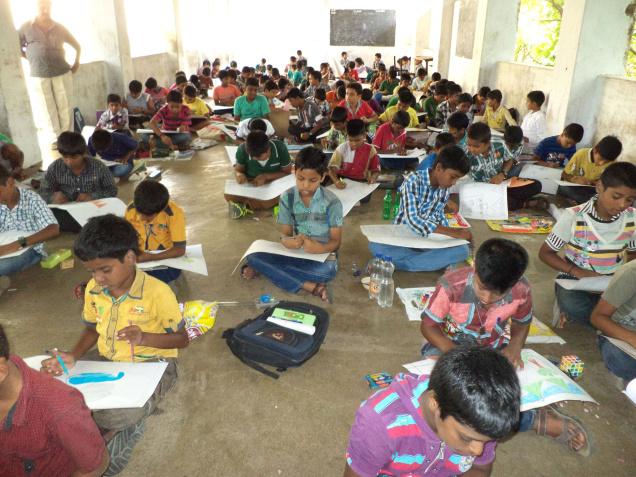
Students take part in painting competition in BZ High School, Chittoor, on Sunday. Photo: K. Umashanker / The Hindu

The alumni of the 130-year-old Bangarupalem Zamindar Government High School, have been conducting the painting competition for the schoolchildren for over two decades

At a time when fine arts are receiving a raw deal in schools and colleges, a group of friends in Chittoor, the alumni of the 130-year-old Bangarupalem Zamindar Government High School, have been conducting the painting competition year after year for the schoolchildren for more than two decades.

The 1982 Class X batch of the BZ High School embarked on the mission to promote competitive spirit among the students of various schools in the district headquarters town, when they came out with their first series of competitions in painting, essay writing, elocution and sports in 1992. Since then, it continues to be an unbroken chain of success with overwhelming response from students and parents, many of whom happen to be the alumni of the BZHS.

K. Karthikeyan and C.V. Nityananda, friends from their kindergarten days in Chittoor, are in the forefront of holding the contests. Both being sportsmen and lovers of painting say they hope to continue the tradition and make it an everlasting institution in the service of fine arts. They are elated to say that they cherish strong support from their batch mates in this regard.

On Sunday, nearly one thousand students from all over Chittoor and surrounding areas thronged the BZHS to take part in the painting competition. “We have split the categories into juniors from 6 to 9, and seniors from 8 to 10 classes. Separate prizes are created for girls and boys. In all, we will be giving nearly 100 prizes for those contesting here. Parents are coming in large numbers to support us every year. We are coming out with contemporary themes like child labour and environment protection for the young minds,” the duo said. The organisers distribute drawing sheets and pens to all the contestants, and crayons and other painting stuff to the poor. The Kannemara Library, which holds a unique collection of books for all, sponsors the contests.

“Subjects of drawing and painting are much neglected ones in the schools now. But, these aspects go a long way in moulding the children into meaningful citizens in future. We also plan to introduce more areas of fine arts and sports in our competitions for the students soon,” they said.

source: http://www.thehindu.com / The Hindu / Home> News> National> Andhra Pradesh / by K. Umashanker / Chittoor – October 13th, 2014

Fishing activity resumes at Masula coast

Barely hours after Hudhud made landfall close to Visakhapatnam, fishing operations resumed in parts of Krishna district on Monday. The fishing activity along the coast of Andhra Pradesh has come to a standstill since the weathermen alerted about the storm.

Spared by the Hudhud without any damage to crops or fishing materials, fishermen in few locations including Nagayalanka on Monday returned to the sea, via backwaters of Krishna near the latter’s confluence point.

However, the Gilakaladindi harbour authorities have announced warning number three on Monday, suspending fishing activity.

Speaking to The Hindu, Gilakaladindi fishermen said that they were gearing up for fishing from Tuesday. “Hudhud had no impact on Krishna district including the strategic coastline. We have no reports of damage of standing paddy fields or fishing material,” Hudhud In-charge of Machilipatnam coast A. Varaprasada Rao told The Hindu. However, a field level team was roped in by the government to stay in the villages to register any damage claimed by the local communities.

source: http://www.thehindu.com / The Hindu / Home> News>Cities> Vijayawada / by Staff Reporter / Gilakaladindi (Krishna) / October 13th, 2014

Vizianagaram Gears Up for Sirimanotsavam

SirimanotsavamANDHRA113oct2014

Vizianagaram :

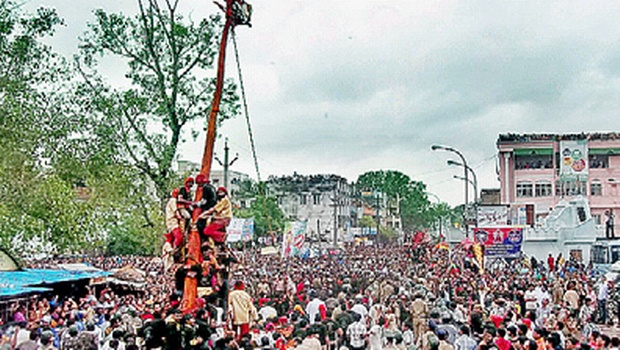
The district administration has made elaborate arrangements to meet the festive rush for the annual ‘Sirimanotsavam’ of Sri Pydithalli Ammavaru to be held at the Three Lanterns Junction in Vizianagaram town Tuesday. Following the directions of chief minister N Chandrababu Naidu, ministers K Atchannaidu and K Mrunalini are supervising the arrangements to ensure that devotees do not face any inconvenience during the festivities.

More than two lakh devotees are expected to participate in ‘Sirimanotsavam’ this year as many could not have darshan of Pydithalli Ammavaru last year, which was organised amidst tense atmosphere following the attack on the properties of former minister Botcha Satyanarayana.

Even as the entire town wore a festive look since Sunday night, devotees are arriving at the town from various parts of north Coastal Andhra districts and also from Koraput and Rayagada of Odisha state to offer prayers to the Goddess.

The procession of ‘Sirimanu’ will begin at 3 pm Tuesday and conclude by 5 pm. Sri Pydithalli Ammavaru Temple priest Thallapudi Bhaskara Rao will ride the ‘Sirimanu’ during the procession wherein the devotees will present their offerings to the “Goddess”.

Over 1,500 police personnel, including seven deputy superintendents of police, 37 circle inspectors and 70 sub-inspectors, have been deployed from neighbouring districts at all vulnerable points in the town, to avert untoward incidents. A police control room has also been set up opposite the temple at the Three Lanterns Junction. Traffic restrictions have been imposed along the roads leading to the main road between the Three Lanterns Junction and the Fort Tuesday, to ensure smooth conduct of the procession.

Iron barricades have been erected on either side of the road between the Three Lanterns Junction and the Fort. The officials also have erected pandals along the queue lines to ensure that devotees are not put to inconvenience under the heat or unexpected showers. The civic administration has set up drinking water kiosks, toilets and temporary lavatories at vantage points in the town. Additional sanitation workers from the neighbouring municipalities, including Visakhapatnam city, have been roped in.

The Endowments Department has arranged separate enclosures for devotees on both sides of the temple for having darshan of the presiding deity. A separate enclosure has also been set up for free darshan. Nearly 50,000 laddoos are being readied for sale through the prasadam counters apart from distribution of free prasadam for devotees.

source: http://www.newindianexpress.com / The New Indian Express / Home> States> Andhra Pradesh / Express News Service / October 07th, 2014

Get ready for a taste of Vizag apples!

Forget apples from Jammu & Kashmir and Himachal Pradesh, soon apples from Visakhapatnam district could give them a run for their money. Hilly areas of the district are emerging as a fertile ground for cultivation of apples, which have hitherto been restricted to orchards in the chilly climes of J&K, Uttarakhand, HP and Arunachal Pradesh.

The first seeds of apple cultivation were sown by chance by Bobbili Rambabu, a tribal from the Visakhapatnam Agency area, four years ago when he tossed a few apple seeds in the backyard of his house at Lambasingi, where temperatures are known to dip below 0 degree Celsius during winter. The trees have now borne fruit, alerting researchers to the possibility of growing this delicious fruit in Visakha Agency.

Dr. N Venugopala Rao, assistant director, Regional Agriculture Research Station (RARS) at Chintapalli, said apples generally grow in the Himalayan belt because of cold temperatures, which is why places such as Lambasingi in Chintapalli mandal are also ideal for apple cultivation. He said a team of scientists from the Hyderabad-based Centre for Cellular and Molecular Biology (CCMB) visited Lambasingi in December last year to study the feasibility of growing apples. As part of the study, they planted 100 apple saplings, shipped in from the Himalayas, over nearly one acre on the RARS premises.

Another RARS scientist, Dr. B Uma Maheswara Rao, said select varieties of apples from Shimla have been planted on an experimental basis. “While the apple trees planted by tribal Rambabu have already yielded positive results, the plants cultivated at RARS are just 10 months old. We will start studying the potential when they reach three years of age,” Rao said.

According to him, mandals like Chintapalli, Pedabayalu, G Madugula and even the tourist hotspot of Araku are suitable for apple cultivation as they are all located at high altitudes and the temperature is always below 15 degree Celsius. “After studying the apples growing on Rambabu’s tree, we feel that Vizag is suitable for apple plantation. Tribal pockets that are already cultivating coffee and pepper are viable for apple trees too because of the favourable climatic conditions. At present, coffee is being cultivated in nearly 1.5 lakh acres in the tribal pockets. If the state government pays special attention, Vizag can emerge as a fertile ground for cultivating unique commercial crops like apples,” Rao added.

A horticulture department officer, who refused to be named, said if apple cultivation takes off in a big way in the district, they might think of including apples in the list of local crops, which also includes the globally renowned Araku coffee.

While G Prabhakara Rao, assistant director (horticulture), said the department would put its weight behind the endeavour once the RARS scientists issue a no-objection certificate for apple cultivation in the district, R Lakshmanudu, joint director, agriculture marketing, said they would provide marketing support for Vizag apples.

Meanwhile, tribal farmer Biddika Kamsu said that instead of proposing projects like the Tribal University for the Agency area, the government should focus on allocating funds for growing unique plants. “Visakha Agency is one of the biggest agencies in the state and is most viable for plants like pepper, coffee, pineapple, strawberry, turmeric, rajma, broccoli, ginger and carrot,” Kamsu said.

Apples in your backyard

* Apple cultivation started by chance by Bobbili Rambabu, a tribal farmer from Lambasingi in Chintapalli mandal of Vizag Agency area, four years ago when he tossed apple seeds in his backyard. The trees have now borne fruit

* Scientists from CCMB visited Lambasingi in December last year to study the feasibility of growing apples. They planted 100 saplings shipped in from the Himalayas

* Officials say mandals like Chintapalli, Pedabayalu, G Madugula and even Araku are suitable for apple cultivation as they are all located at high altitudes, with temperature always below 15 degree Celsius

source: http://www.timesofindia.indiatimes.com / The Times of India / Home> City> Hyderabad / TNN / October 09th, 2014

Treasure hunt at ancient temples in Guntur district

Archaeological Department Assistant Director K. Chittibabu inspecting the site where a five-member gang was arrested at the Lord Shiva Temple at Kethavaram in Guntur district. - Photo: By arrangement
Archaeological Department Assistant Director K. Chittibabu inspecting the site where a five-member gang was arrested at the Lord Shiva Temple at Kethavaram in Guntur district. – Photo: By arrangement

Monuments in the submergence area of Pulichintala project have become a haven for them. The prime accused — D. Ramakrishna along with his associates — D. Venkateswar Naik, B. Somla Naik, Narasimha Naik and K. Ramesh Naik started scouting for the trove from a tribal fort and reached the ancient Lord Shiva temple at Kethavaram village.

Ancient temples located at villages that come under the submergence area of Pulichintala project in Guntur district have become a haven for treasure hunters.

Treasure hunters are thronging these temples with latest gadgets to locate “hidden” treasures. Police are on tenterhooks with the hunters making their presence felt in the district. Police intensified patrolling to keep a tab on them. In order to confirm whether any troves are present in villages at Kethavaram, Kolluru and Gollapeta that are set to submerge once Pulichintala project is completed, the district police roped in senior officials from the Archaeological and Museums department for a detailed inspection of the spot.

The police also wrote a letter to the Endowments Department seeking its intervention and allay fears of people. A few days ago, the Piduguralla police nabbed five persons for allegedly attempting to find out a treasure trove using a long-range detector brought from Bulgaria.

The prime accused — D. Ramakrishna along with his associates — D. Venkateswar Naik, B. Somla Naik, Narasimha Naik and K. Ramesh Naik started scouting for the trove from a tribal fort and reached the ancient Lord Shiva temple at Kethavaram village of Bellampally mandal in Guntur. Based on signals received from the detector, the gang members searched for the trove which they anticipated contains gold and silver coins.

Acting on a tip-off, the police rushed to the spot and nabbed the gang members. “It has become a nuisance for us for the last few months. To verify the gang’s claim, we took the help of officials from Archaeological and Museums department and confirmed that there are no traces of treasure troves,” explained Piduguralla Town Circle Inspector Y. Sridhar Reddy.

The hunt for treasure troves began when the main idols in these old temples were shifted to other places after administration declared Kethavaram, Kolluru, Gollapet and other areas as submergence villages, he said. When contacted, Archaeological and Museums Department Assistant Director K. Chittibabu, who visited the spot, confirmed that no traces of treasure troves were found.

“We advised the police to seek the assistance of Mines and Geology Department to know more about the detector used by the gang” he added.

source: http://www.thehindu.com / The Hindu / Home> News> Cities> Vijayawada / by M. Srinivas / Vijayawada – October 08th, 2014

BJP leader Ranga Mohana Rao dead


Bandaru Rangamohan
Bandaru Rangamohan

BJP State vice-president Bandaru Ranga Mohana Rao died on Friday following post-surgical complication leading to multi-organ failure at a hospital in Hyderabad. He was 55 and is survived by wife Chandrakala and daughter.

An engineering graduate, he was an assistant engineer in GVMC for four years and later became independent insurance surveyor and loss assessor.

He joined the RSS at a young age of 10 and began his career as an office in charge of BJP in 1980. Subsequently, he became party State council member, city general secretary, city president, State secretary and finally became party State vice-president.

Condolences poured in for Ranga Mohana Rao. MP K. Haribabu said the party had lost a committed worker and he, a good friend.

MLA P. Vishnu Kumar Raju said the party lost a leader who had served the entire State. City president P.V. Narayana Rao said a dedicated leader who served the party for decades all over the State had left them.

Former BJP president P. V. Chalapathi Rao mourned the death saying a leader who grew before their eyes and acted with presence of mind at crucial times passed away.

Former Mayor D.V. Subba Rao conveyed his condolences to the family members of Ranga Mohana Rao.

BMS State Legal Cell in charge K. Bhavani Shankarudu said he had served BJP since its inception in 1980 and was a sincere and principled leader.

source: http://www.thehindu.com / The Hindu / Home> News> Cities> Visakhapatnam / by Special Correspondent / Visakhapatnam – October 11th, 2014

New Kakinada Co-op Bank Branch

Visakhapatnam  : 

Since its inception in 1980, the Kakinada Co-operative Town Bank Limited has been making profits, and deposits crossed `351.94 crore by September-end, said Ch Raveendra, chairman of the bank.

Visakha Dairy chairman Adari Tulasi Rao and Daspalla Hotels Group managing director M Raghavendra Rao inaugurated the bank’s second branch at Gajuwaka here Thursday. The bank chairman told the gathering that the total advances of the bank had reached `232.82 crore.

The bank registered a net profit of `3.01 crore in the first half of the current fiscal. On the bank’s net NPA, Raveendra said that it was 1.03 per cent. The bank plans to open four more branches – two in Visakhapatnam, one in Guntur and another in Vijayawada, he added.

source: http://www.newindianexpress.com / The New Indian Express / Home> States> Andhra Pradesh / by Express News Service / October 10th, 2014

Farmers keen to practice Israeli farming methods

Nurseries at Guntur-Vijayawada national highway near Tadepalli mandal in Guntur district. (Photo: DC)

Vijayawada: 

A few farmers in Guntur district are slowly adopting the Israeli farming techniques to grow hybrid saplings, seeds and crops. The Israeli farming technique, which is gaining popularity among farmers helps to increase the productivity using less space as well as less water when compared to that of traditional farming, which is largely followed by farmers.

The techniques can be used to produce anything from seeds to final products like vegetables and fruits.

Kallam Narendra Reddy, a 51-year-old farmer in Penu-maka village of Tadepalli mandal in Guntur district, started to use Israeli farming methods putting aside his two decades experience in traditional farming.
Mr Reddy grows saplings and seeds for variety of vegetables and flowers including cauliflower, papaya, plantain, brinjal, drum sticks, cabbage, tomato and others in his 2-acre land.
“With an initial investment of `12 lakh, I started to grow saplings in the one-and-a-half acre land in two different methods. While one is under nets another is under special poly house,” said Mr Narendra.
Many of my colleagues ventured to start farming in this method but stepped back as there is no support from the government, he added.
Best advantages of growing hybrid crops in trays under the specially designed houses is that productivity could not be affected by the climate and can be grown in any season of the year.
Meanwhile, the state government has no plans to encourage such farmers and provide facilities for them. Farmers have appealed to the government authorities to provide raw materials and export facilities so that more number of farmers can adopt the Israeli technique.
“Though it is one-time investment we have to spend some lakhs to start it. If the government recognizes this method and encourage farmers we can produce more number of crops,” said Mr K. Aadi Narayana, a farmer in Yerabalem village near Magalagiri.
source: http://www.deccanchronicle.com / Deccan Chronicle / Home> Nation> Current Affairs / DC Correspondent / October 07th, 2014

Kadapa airport to be thrown open on Oct. 14

The long-abandoned air strip in Kadapa that has been given a facelift and developed into an airport will be brought into operation in a week.

Arrangements are being made for the inauguration of Kadapa airport by Chief Minister N. Chandrababu Naidu on October 14. Union Minister for Civil Aviation P. Ashok Gajapathi Raju will take part in the inauguration.

History

Kadapa aerodrome was constructed in 1953 on a 229-acre site. Vayudoot operated services from Kadapa to Hyderabad in the 1980s. The aerodrome built on a 229-acre stretch was subsequently used by Chief Ministers for making transit halt of the Government helicopters and for refuelling.

About 15 light and microlight aircraft and helicopters landed in Kadapa aerodrome and took off in Air Race India Show organised by Aeronautical Society of India in 2003, as a prelude to the first centenary of aviation history created on December 17, 1903, when the Wright Brothers flew the first-ever powered flight. It was an enthralling experience for the massive audience to watch light and microlight aircraft and helicopters land and take off over a three-hour period, 11 years ago.

The YSR government had entered into a MoU in March 2007 for developing the aerodrome into an airport and allocated an additional 440 acres, located about 10 km from Kadapa town.

In accordance with the MoU, the government had offered to supply drinking water and power free of cost for five years.

It also granted property tax exemption for land used for the airport, navigation and related purposes and the airport staff colony, besides granting exemption from Kadapa Municipal Corporation taxes.

Under the Build, Operate and Transfer (BOT) basis, a new two km. Runway was completed at a cost of Rs. 21 crore.

In addition, a 11-km long compound wall was constructed with an outlay of Rs. 24 crore. In the second phase, an Air Traffic Control (ATC) building, passenger terminal, parking bays and internal roads were built at a cost of Rs. 13 crore.

Officials are holding discussions with some air travel agencies such as Spice Jet.

source: http://www.thehindu.com / The Hindu / Home> News> National> Andhra Pradesh / by M. V. Subrahmanyam / Kadapa – October 07th, 2014