Expo on lost Kalamkari textile in city

Kolkata :

They had originated and proliferated in India, possibly in Tanjore, in the late 16th or early 17th century under the patronage of the Mughal emperors. But, with the passage of time, Kalamkari paintings on textiles faded into oblivion.

Thousands of miles away, a museum in France on the Swiss border has preserved some of the oldest specimens of Kalamkari paintings on textiles. These are very rare to find even in museums within the country.

For a fortnight starting on Wednesday, the textile gallery of the Indian Museum will showcase the world famous ‘Tapis Moghol’ — some of the most elaborate designs replete with mysterious animals, birds, foliage and flowers — that hold the key to many stories of the times. The ‘Tapis Moghol’, that dates back to the late 16th or early 17th century, has been preserved for the world at the En Musea De L’Impression Sur Etoffes De Mulhouse or the Museum of Printed Textiles at Mulhouse, France.

Kalamkari paintings in its earliest form were motifs painted on large wall hangings that were used to decorate the altar behind the deity. Kalamkari, though, is not a lost art form in the sense that it is still practised in both the painted and block printed versions. But, we have lost most of the original designs that were popular when it was used as an altar backdrop in South Indian temples.

“A gentleman called Funffrock, who was an employee of the French East India Company, was posted in Tanjore. The Frenchman was immensely interested in the traditional art form and got a cotton cloth, measuring eight feet by eight feet, done up with rich intricate designs that showcased the best motifs of that time. With time, this became the focal exhibit, around which the other collections of the period grew. The exhibition will give the city a glimpse of the Funffrock collection,” explained Ruby Palchowdhury, spokesperson of the Crafts Council of West Bengal, which is a wing of the Crafts Council of India and is funded by the Centre.

Textile and culture ministries and the Alliance Francaise have funded the expo that will have 25 panels to show off design details and the stories underneath. The exhibition has been curated by ethnic historian Lotika Varadarajan.

source: http://www.timesofindia.indiatimes.com / The Times of India / Home> City> Kolkata / by Jhumli Mukherjee Pandey, TNN / November 16th, 2014

FCI transports rice from Vizagto Agartala via Bangladesh


Rice being loaded into a ship with the help of a shore crane by Food Corporation of India for transportation to Tripura from Visakhapatnam.

Multi-modal transport being used to dispatch stocks

Andhra Pradesh region of Food Corporation of India has undertaken the challenging and novel task of dispatch of raw rice stocks from Visakhapatnam to Agartala in Tripura through multimodal transportation to meet PDS requirement.

The task involves transportation of stocks from Visakhapatnam Port to Diamond Harbour in Kolkata by a ship. At Diamond Harbour the stocks will be trans-shipped into barges and taken through river movement up to Bangladesh. Thereafter the stocks will transit Bangladesh through trucks and again from Bangladesh border to FCI depots in Agartala by trucks.

The entire movement is regulated by Protocol on Inland Water Trade and Treaty (PIWTT) signed between India and Bangladesh.

Movement of more rice consignment is likely in future through multimodal transportation due to gauge conversion work undertaken by Northeast Frontier Railways from October 1. Normalcy in train services are expected to be restored from March 2016.

Tripura Minister for Food and Civil Supplies Bhanulal Saha was quoted as saying in Agartala that they were expecting 35,000 tonnes more from Visakhapatnam in future.

FCI had awarded the multimodal transportation work for carrying initial quantity of 10,000 tonnes to Sarr Freights Corporation, a New Delhi-based firm.

Challenging task

The challenging task was achieved by FCI here by way of arranging priority berthing and loading facilities at Visakhapatnam Port and the ship m.v. Allcargo Laxmi with first consignment of 5,000 tonnes of rice sailed from the port on July 3. Subsequently, the second consignment of rice was dispatched on September 22 which was successfully delivered in Tripura, FCI Area Manager Senthil Kumar told The Hindu.

The novel venture opens up an alternate route when compared with conventional dispatch of stocks by rail-road movement hitherto done from Pubjab/Haryana to Tripura in view of frequent disruption due to various reasons.

source: http://www.thehindu.com / The Hindu / Home> News> Cities> Visakhapatnam / by Santosh Patnaik / Visakhapatnam – November 16th, 2014

A special day for milk and cheese!

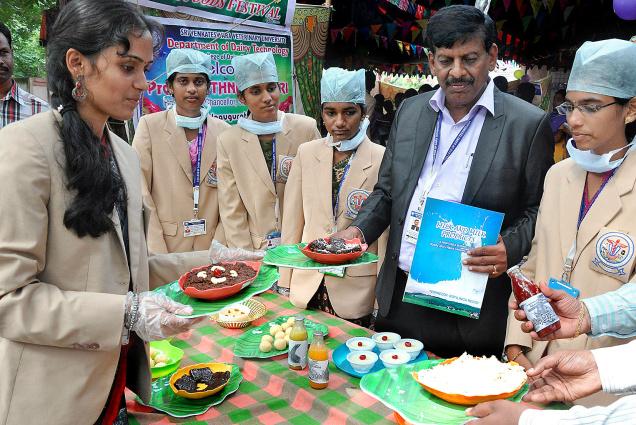
Dairy technology students display milk-based food products during the ‘Dairy Festival’ at Sri Venkateswara Veterinary University in Tirupati on Friday. — Photo: K.V. Poornachandra Kumar / The Hindu

SV Veterinary University students put on display a wide array of milk products during ‘Dairy Festival’

The ‘Dairy Festival’ held on the Sri Venkateswara Veterinary University campus here on Friday turned out to be a day of milk and cheese, ghee, curd and whey.

Inaugurating the event, Vice-Chancellor Manmohan Singh pegged the growth rate of the dairy sector at 10 per cent and foresaw a rise in career opportunities in the industry for qualified people. The array of dairy products on display contained samples of cow milk, goat milk, skimmed milk, toned milk and standardised milk.

The event also offered an opportunity to students of Dairy Technology to showcase their talent.

They prepared and put on display milk-based products such as doodh peda, rasmalai, raitha, shrikhand, basundi, jamun, rabri, dharwad peda, lassi, kalakhand, kundha, milk cake and channa jelly. They also explained the benefits of each product.

The chaddar cheese, made after fermentation for six months and kept at a moisture level of 47 to 55 per cent, drew the attention of many.

Similarly, the students also proved that whey, the residual liquid separated from the coagulated solid, could be used to prepare cool drinks and soups. As part of the ‘Earn While You Learn’ programme, the students put the products on sale.

“The products are of high quality and affordable. We make close to 50 per cent profit, which helps us meet our daily expenses,” a fourth year student said.

source: http://www.thehindu.com / The Hindu / Home> News> National> Andhra Pradesh / by A.D.Rangarajan / Tirupati – November 15th, 2014

Book exhibition at Gudivada, Bandar for the first time

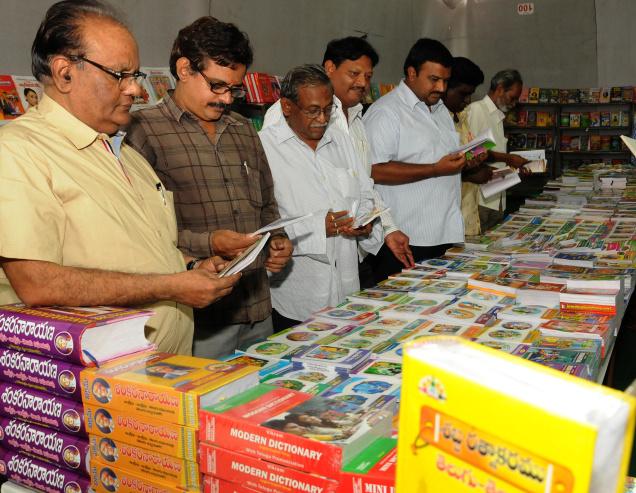
Visitors having a look at books on display at the expo in Vijayawada on Friday. — Photo: Ch. Vijaya Bhaskar / The Hindu

A week-long book expo, commemorating the National Book Festival, has begun near the Civil Rights Court here. MLA Bonda Uma Maheswara Rao inaugurated the expo on Friday. The objective of the fair is to promote reading habits among youngsters and to reduce the gap between readers and writers, according S. Venkatanarayana, secretary of the Vijayawada Book Festival Society, (VBFS), which is organising the expo.

He said the expo was being organised at Gudivada and Machilipatnam for the first time, and that its objective was to promote reading habits in the semi-rural areas of the district. “This is an effort to take publishers to the doorstep of readers. More and more readers are willing to visit festivals to purchase books, as buying books through postal mode is getting costly. Soon, we will be selecting three mandals in each district to organise such expos,” said B. Babjee, advisory committee member of the society.

source: http://www.thehindu.com / The Hindu / Home> News> Cities> Vijayawada / by Special Correspondent / Vijayawada – November 14th, 2014

Expert suggests plantation of local species

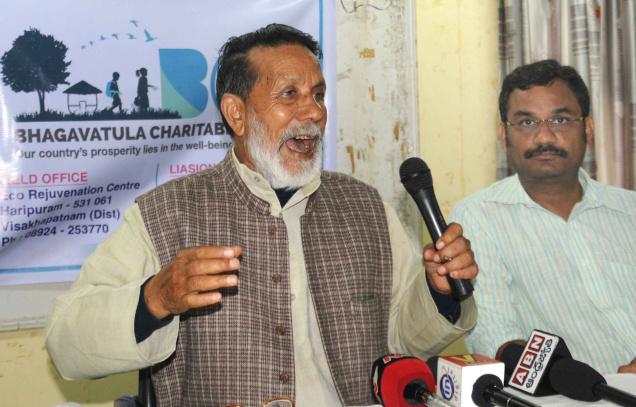
Visakhapatnam (Andhra Pradesh) 13-11-2014: Environmental activist and Magsaysay award winner Chandi Prasad Bhat addressing a press confernce along with Bhagavatula Charitable Trust secretary B. Sri Ram Murthy n Visakhapatnam on Thursday. Photo: C.V. Subrahmanyam / The Hindu

Environmental activist Chandi Prasad Bhatt visits Hudhud-affected areas. BCT secretary B. Sri Ram Murthy said instead of giving importance to numbers, the trees that withstand the gale like neem, jamun and ‘neredu’ should be given priority while restoring greenery.

Floods in the Himalayan region and recent cyclones in the coastal regions underline their vulnerability caused by climate change, noted environmental activist Chandi Prasad Bhatt has said.

Addressing a press conference after a visit to the Hudhud-affected fishermen villages, GITAM University, zoo, Kambalakonda and the Agency areas, he said while varieties like acacia and eucalyptus were felled by the gale, the tops or branches of local varieties were blown off but the trees survived.

He said during visits to Odisha after the super cyclone and to the Andamans, he found that mangroves withstand the gale without being uprooted and said growing local species along the coast would lessen the impact of the cyclone and reduce damage.

Mr. Bhatt, recipient of Magsaysay Award and Gandhi Peace Prize, said the floods at Kedarnath, the recent J&K flood and Hudhud had highlighted the affect of climate change caused by melting of glaciers and raising sea levels.

The Chipko Movement leader, who visited the State after the 1977 Diviseema tidal wave and after cyclones in 1987 and 1990, said trees survived in the Agency area owing to social forestry programmes through Vana Samrakshana Samitis wherever the growth was thick. Mr. Bhatt, who was here on an invitation from Bhagavatula Charitable Trust (BCT), saw the havoc wrought to the trees and interacted with students of the residential school there.

BCT secretary B. Sri Ram Murthy said instead of giving importance to numbers, the trees that withstand the gale like neem, jamun and ‘neredu’ should be given priority while restoring greenery. Hills should be vegetated again. Also casuarinas should be planted along the coast in various phases so that after cutting off the grown trees other layers would remain in place.

He said two BCT farms had 180 species of trees and 80 per cent of them were uprooted by the cyclone. Various sheds for students, cafeteria, dormitories etc were also damaged.

Workshop soon

Making good use of Mr. Bhatt’s association with the Ministry of Environment, BCT would organise a workshop on the species of trees to be grown.

source: http://www.thehindu.com / The Hindu / Home> News> Cities> Visakhapatnam / by Special Correspondent / Visakhapatnam – November 13th, 2014

Miryala Venkata Rao no more

Founder of Kapunadu and former Chairman of the Andhra Pradesh Mining Development Corporation and Handicrafts Development Corporation, Miryala Venkata Rao breathed his last at a corporate hospital here on Sunday afternoon.

He was ailing for a while and is survived by wife Prameela, daughter Swathi and son, Seshagiri Babu, a bureaucrat. He is known for his endeavours in getting political recognition for the ‘Kapu’ community.

The body was kept at the Kapu Sangham Hall here for a while before being flown to Visakhapatnam, where the funeral will take place on Monday.

Naidu expresses grief

Andhra Pradesh Chief Minister N. Chandrababu Naidu expressed his grief over the death of Kapunadu leader, Miriyala Venkata Rao.

The Chief Minister said Venkata Rao had brought about political enlightenment in one of the major communities in the State and rendered yeoman services to the community.

source: http://www.thehindu.com / The Hindu / Home> News> Cities> Hyderabad / by Special Correspondent / Hyderabad – November 10th, 2014

CIBA’s experiment on mullet proves a success

MulletANDHRA13nov2014

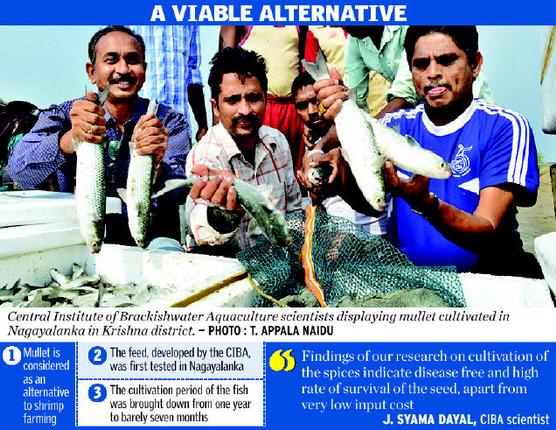
The cultivation period of the fish, which is considered an alternative variety to shrimp, was brought down from one year to barely seven months

The Central Institute of Brackishwater Aquaculture (CIBA), Chennai, in collaboration with Nagayalanka-based progressive farmer has scripted a success story by bringing down the cultivation period of Gold Mullet (Liza Parsia) and Grey Mullet (Mugil Cephalus) fish with the help of ‘formulated feed’.

The feed was developed by the CIBA and tested for the first time in Nagayalanka in Andhra Pradesh in the country. The cultivation period of the fish, which is considered an alternative variety to shrimp, was brought down from one year to barely seven months, drawing the attention of the worried shrimp farmers.

On Wednesday, CIBA Principal Scientists K. Ambasankar and J. Syama Dayal came with up their findings following harvesting of the mullet species on an acre of pond here.

The seed grown in the pond was collected from estuary and brackish water canals.

“Findings of our research on cultivation of the spices indicate disease free and high rate of survival of the seed, apart from very low input cost,” Mr. Syama Dayal told The Hindu. However, the CIBA scientists experimented on these two species in their quest to come out with alternative to the shrimp, which was driving the farmer into irreparable loss in recent years.

Experiment

“The experiment on Liza Parsia and Mugil Cephalus in abandoned ponds where earlier shrimp was cultivated is a way for those failed to reap profits in shrimp cultivation. Farmers have already begun slowly inquiring about details such as input cost,” said Mr. Ambasankar.

Beyond expectations

According to Raghu Sekhar who cultivated the fish in his pond, growth of the mullet species was beyond expectations, wooing other farmers to try their luck. “No disease is found during the seven-month cultivation period, withstanding changes in the weather and the soil of the pond,” added Mr. Sekhar.

Given the market value for value added to the Mullet Roe (egg) of the species, European countries and Japan are importing it in a large scale.

On the other hand, the CIBA was engaged in developing seed of the mullet species by the end 2016, according to scientists.

source: http://www.thehindu.com / The Hindu / Home> News> Cities> Vijayawada / by T. Appala Naidu / Nagayalanka – November 13th, 2014

Best App in Asia award to Hyderabad entrepreneur

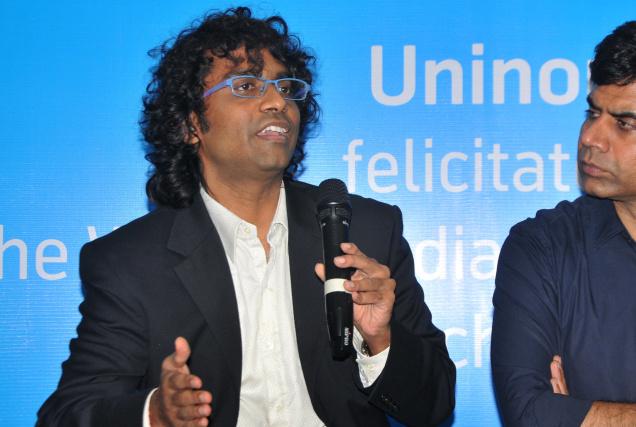
The Best App In Asia category of the digital winners 2014, Raghu Kanchustambham, explains about his application in Hyderabad on Wednesday. Photo: G. Ramakrishna / The Hindu

The app helps coffee growers to get instant returns for their produce. Livelihood 360 is also capable of estimating quantity of the produce in the fields and sell the crop at fair price.

The coffee farmers of Araku valley these days get instant returns for their produce. Gone are the days when they had to wait for nearly a month till the buyers completed the weighing process of the produce and release money through co-operative society. Thanks to a mobile application developed by Hyderabad-based entrepreneur, Raghu Kanchustambham, there is no waiting period.

The app dubbed as ‘Livelihood 360 (L360)’ was adjudged the Best App of Asia in the Telenor Digital Winners Conference, a global competition held in Oslo, Norway this month. The award came with a cash prize of Rs. 9,79,000, which will be utilised by the developer to further “scale up” the concept.

It all started when Mr. Raghu, who has a start-up ‘Concept Wave’, met the officials of Naandi Foundation, which was already working with the coffee farmers of Araku valley. “The basic premise was to utilise technology and reach to those people not having access to technology and internet. I visited Araku valley and spent time with them and learnt a lot about their lifestyle and livelihood,” he said.

Mr. Raghu said the previous system of remittance to coffee growers in Araku was taking about a month. The coffee growers would take their produce to a prescribed ‘adda’ where the truck drivers would collect and transport coffee beans to another location for weighing and valuing. “We gave the truck drivers an application that would quantify the yield and also determine the quality instantly. The drivers will immediately remit the amount on the spot to farmers,” he explained.

Livelihood 360 is also capable of estimating quantity of the produce in the fields and sell the crop at fair price. “We have already adopted this application among 12,000 coffee farmers in 650 villages of Araku. Between 40 and 50 truck drivers from Araku were given training on using the application on a feature phone and not a smart phone,” he explained.

source: http://www.thehindu.com / The Hindu / Home> News> Cities> Hyderabad / by M. Sai Gopal / Hyderabad – November 12th, 2014

NRCB shows the way for banana farmers

Farmers at the Banana market. / The Hindu

The National Research Centre for Banana (NRCB), Trichy, one of the India’s premiere research institutes in the field of agriculture, has trained farmers belonging to Krishna district in pre and post harvesting technologies in banana cultivation and processing.

A group of twenty farmers actively involved in banana cultivation in Thotlavalluru mandal was groomed in value added products of banana by the scientists last week. Inspired by a strong local banana marketing system owned and being run by the Krishna district farmers, the National Bank for Agriculture and Rural Development has ensured them the ‘scientific training cum exposure visit’ under it’s Capacity Building for Adoption of Technology Programme.

NRCB Principal Scientist Dr. Kumar had shared his scientific experience with the farmers, enabling them exposure to existing technologies meant for seed selection and post harvesting methods. “Scientists mainly focused on soil management, crop maintenance and identification of disease. They also advised the farmers to prefer drip irrigation system with fatigation tanks,” said Netham (NGO) Director Suresh Vesam who led the farmers.

BananaChartANDHRA12nov2014

On the other hand, another scientist Dr. Siva had displayed preparation methods of value added products developed from banana – banana fibre, drink, chips, wine and jam. The farmers were told the export potential of the selected value added products. The training included visit to various banana units in Trichy district of Tamil Nadu.

The success story of Solar Dryad Banana Unit in Trichy, a pilot project encouraged by a German Bank — KFW, helped the Krishna farmers to explore areas in banana cultivation and marketing to register growth in their income. The farmers also learnt how Tamil Nadu farmers tapped the overseas market for banana and its value added products, which is being exported to Philippines and other European countries.

source: http://www.thehindu.com / The Hindu / Home> News> Cities> Vijayawada / by T. Appala Naidu / Machilipatnam – November 10th, 2014

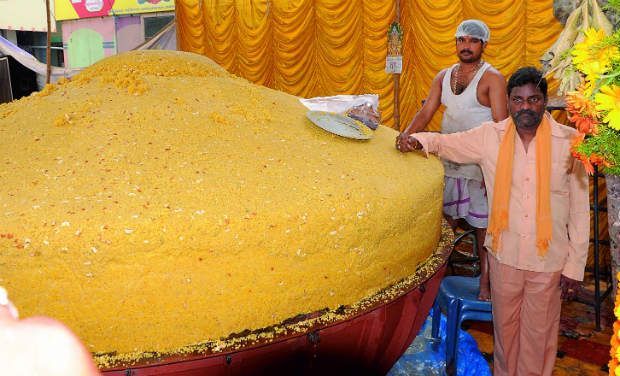
Andhra Pradesh confectioner bags new Guinness record for 7,858-kg ‘laddu’

(Photo: DC)
(Photo: DC)

Rajahmundry, Andhra Pradesh: 

A huge ‘laddu’weighing 7,858 kg, prepared by a shop owner from Tapeswaram in Andhra Pradesh, which was offered to Lord Ganesha during Ganesh Chaturthi, has found a place in the Guinness World Records.

Sri Bhaktanjaneya Sweets bagged a place in the Guinness World Records for the fourth consecutive time for preparing the biggest ‘laddu’, offered to Lord Ganesha on August 27 during the eleven-day festival this year.

Speaking to PTI today after receiving his new Guinness certificate, shop owner S Venkateswara Rao said that he could achieve this feat only with the blessings of his family and the cooperation of his 25 staff members at Bhaktanjaneya.

Rao, who is a school drop out and joined his father S Satyanaraya Murthy in running the then small hotel after completing his sixth grade studies, said that his aim is to outdo his own record every year.

Previously, in 2011 he prepared a laddu weighing 5,570 kg, and followed it up with 6,599.29 kg laddu in 2012; 7132.87 kg in 2013 and 7,858 kg this year.

“My father (Murthy), who came here in 1942 to earn a livelihood started a small hotel, which initially served coffee and tiffin items along with sweet products.

Gradually, the shop in Tapeswaram began catering to travellers en-route, after buses and other vehicles began halting there for a small snack,” Rao said.

Subsequently in 1972, they expanded the hotel into a full-fledged sweet mart and have been famous for serving their patent ‘Kaza’ sweet.

Rao now intends to open outlets of his shop in Vijayawada and Visakhapatnam, with the help of his children, who are now pursuing higher studies.

The sweet mart has earlier received State-level awards for its ‘Kaza’ preparation before entering the Guinness Records. “Our range of products start from ‘laddus’ of small size to bigger ones as huge as 60-1000 kg,” Rao said.

For bigger orders like those weighing 5,000 kg, the makers have to be intimated six months in advance although the preparation will commence only 1-2 days before the festival as the product (laddu) is kept for 14-15 days during the event.

source: http://www.deccanchronicle.com / Deccan Chronicle / Home> Nation> Current Affairs / PTI / November 12th, 2014