A farmer responds to newspaper ad, finds the fabric of his true calling

Proud moment:This is the longest Kalamkari art produced so far, says Siva Prasad Reddy

A.P. Kalamkari artist comes up with a 47×11-ft record piece for posterity

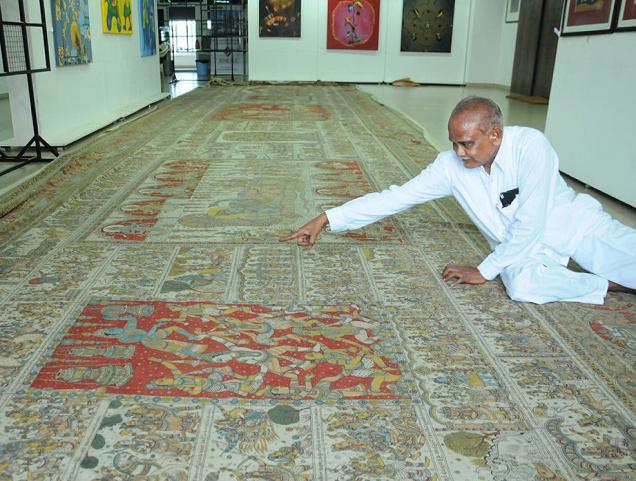
He was not aiming for a record; his eyes were set much higher. “Creating the record was a by-product. I had started out with the idea of doing something that will help me pass on this treasure of art to the next generation,” says K. Siva Prasad Reddy, a master craftsman of Kalamkari art from Tanguturu village of Banaganapalle mandal in Kurnool district.

Pointing to his 47×11-ft Kalamkari art piece, completed in 2002, which is a pictorial depiction of more than 2,000 images from Ramayana, Mahabharata and Bhagwad Geeta, he declares with a glint of pride in his eyes:

“This is the longest Kalamkari art produced so far.” Mr. Reddy is the recipient of several awards that include one from the UNESCO, the President’s award and the State award and many other laurels.

Today, the 60-year-old man is a contented soul. “I was desperately seeking a means to preserve this art for posterity. It took me two years to finish this. While I was working on it, I was hit hard by financial crisis as I had no other income. My children’s education was at stake but I was determined not to stop half-way. I sold my three-acre farm land to support the family during the two years. The decision was hard then but today, I am happy having done what I did,” he says emphatically.

Mr. Reddy comes from an agriculture background but he was a reluctant farmer. “A newspaper ad on free training in Kalamkari art was reason enough for me to leave farming and join the training programme. I soon realised that this was my calling,” he says.

Despite the hard work involved in Kalamkari, finding marketing avenues was very difficult. “Fortunately, fashion designers came to our rescue. Once they embraced this eco-friendly fabric, people from elite sections started buying it,” he recalls, pointing out that the fabric is now used in home furnishings, apparel and accessories.

“Foreigners outnumber Indian buyers as they like the fact that the dyes used in the cloth are obtained by extracting colours from parts of fruits, vegetables, roots and leaves with mineral salts of iron, tin, copper and other metals serving as mordants (that helps bind the colour to the fabric).

‘Growing awareness’

“The growing awareness among people on the harmful effects of dangerous chemical dyes has come as a boon to us. They have started developing a taste for naturally dyed fabrics and what more, Kalamkari is the best specimen of natural colour artwork,” he says.

The duplicate version of Kalamkari fabric flooding the markets worries Mr. Reddy. “These fake designs are ruining the Kalamkari industry. But then, it also makes me feel happy that only products that are in great demand in market spawn replicas,” he adds with a smile.

source: http://www.thehindu.com / The Hindu / Home> News> Cities> Vijayawada / by P. Sujatha Varma / Vijayawada – April 19th, 2016

Master plan to restore lost glory of Horsley Hills

Efforts under way to tide over water crisis; long-pending ropeway will be a reality soon, says tourism official

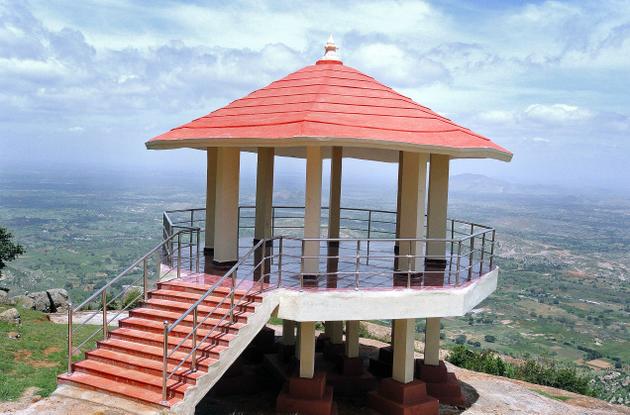
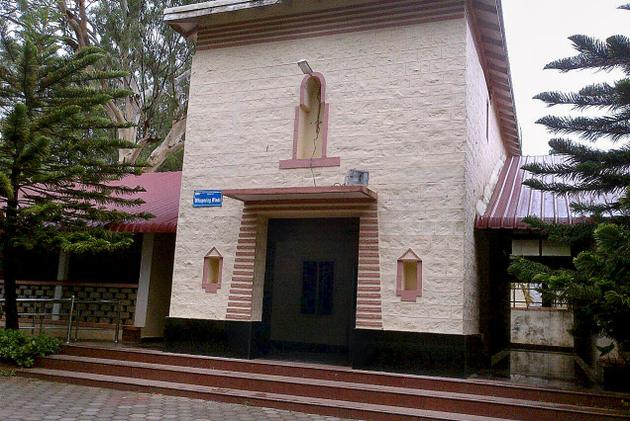
Place to be:The newly-constructed View Point atop Horsley Hills. (Right) The famous Governor’s Bungalow at the hill resort.—Photos: By Arrangement

Horsley Hills, the one and only 160-year-old hill station in Andhra Pradesh, which faced the worst-ever water crisis in 2015, has a ray of hope this year with steady inflow of tourists from all over India, particularly from Tamil Nadu and Karnataka.

The Kadapa District Collector during the British rule, W.D. Horsley, discovered the beauty of the gigantic 4,312-ft.-high hill near Madanapalle in 1857. In a record time of a couple of years, he had transformed it into a hill station. The resort gradually took the name of its discoverer.

GovernorsANDHRA19apr2016

It had served many a British officer and royal family visiting it to beat the oppressive summer heat in South India till Independence.

Later, the hill station faded into oblivion. And it is yet to regain its lost glory. In spite of this, the very mention of Horsley Hills means romance and beauty to nature-lovers and tourists. After the State’s bifurcation in 2014, the hill station has topped the list of thrust areas of the AP Tourism.

The accommodation potential has risen to over 500 tourists from half of the figure. An amount of Rs. 50 lakh was spent to construct tent-model cottages, which would be ready in the next few months.

The annual revenue suddenly shot up to Rs. 3 crore from a few lakhs before 2014.

The hill station has everything to attract tourists such as trampoline, meltdown zone, adventure combo, bull ride, canopy walk, and view points at dizzy heights overlooking steep valleys, mini-zoo park, swimming pools, and, above all, cool climate round the year, which feature has brought it the title ‘Andhra Ooty’.

The Governor’s Bungalow and Forest Bungalow are an added attraction, for they have turned historical monuments.

To meet the water needs of the tourists, the hill station completely depends on water pumped from the foothills.

At present, water is being pumped to the hilltop through pipelines up to a distance of nearly 8 km in eight stages.

The daily average consumption stands at one lakh litres. The consumption could be more in the summer months. In 2015, when groundwater totally dried up, the tourists were forced to return immediately on arrival.

District Tourism Manager D.V. Chandramouli Reddy told The Hindu that the administration was all set to execute a master plan, giving top priority to overcome the water crisis and give wide publicity to attract tourists.

“In fact, the space available on the hill is just two square km, and congestion will be another problem. In the next one decade, Horsley Hills will definitely be one of the best hill stations with global standards. The long-pending ropeway will be a reality soon,” he said.

source: http://www.thehindu.com / The Hindu / Home> National> Andhra Pradesh / byK. Umashanker / Chittoor – April 19th, 2016

Raghavendra gets a slot in athletics federation

Akula Raghavendra
Akula Raghavendra

It was red letter in the history of Andhra Pradesh Athletic Association (APAA) as its general secretary Akula Raghavendra was elected as executive member of the Athletics Federation of India (AFI) in the general elections held in New Delhi on Friday.

Mr. Raghavendra, the youngest member of the executive body, impressed the country’s athletic fraternity by hosting 2014 Junior National athletics championships in a befitting manner at Vijayawada, and later played a crucial role in Indian contingent performance at the recently-held Asian Indoor athletic meet at Doha as team Manager.

“His election to AFI will help Andhra Pradesh getting Indian camps and international athletics meets. Good days are ahead of us,” felt senior SAI athletic coach Vinayak Prasad.

APAA administrators Rayapati Sambasiva Rao, Nageswara Rao, Krishna District Athletic Association administrators Ramesh Jain, N. N. Rao, District Sports Development Officer P. Ramakrishna and others congratulated him.

source: http://www.thehindu.com / The Hindu / Home> News> Cities> Vijayawada / by Special Correspondent / Vijayawada – April 16th, 2016

Harshitha wins two silver medals in Mongolia

G. Harshitha
G. Harshitha

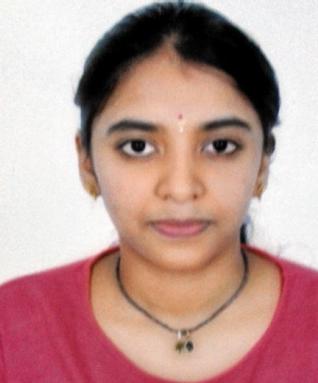
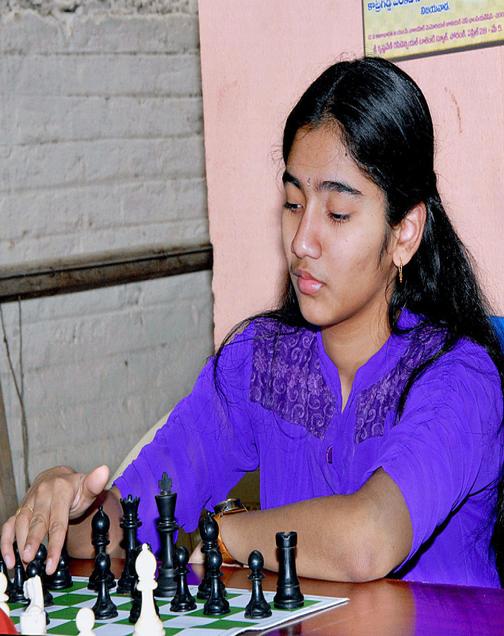
Young Rajahmundry teenager Guddanti Harshitha overcame biting cold weather and bouts of fever to add two international medals to her kitty by winning silver medals in the Asian youth chess championship that concluded in Mongolia on Thursday.

She scored seven points out of nine by winning seven and losing two to finish second in the standard under-16 girls’ category, and later she won silver in the rapid segment as well. “She finished fifth in the blitz segment,” says Andhra Pradesh Chess Association secretary D. Srihari.

“She lost the two crucial rounds owing to fever as the weather was unbearable for several youngsters,” says Harshitha’s mother Sridevi.

Harshitha, a Class X student of TRIPS International School, started playing chess six years ago. After learning the basics, she is now being trained by Grandmaster Arun Prasad of Chennai online since 2014.

Before major tournaments Harshitha visits Chennai for intensive training for 10 days with Mr. Arun Prasad. Harshitha won Asian youth silver in Korea, Commonwealth under-16 bronze, National Juniors Bronze Medal in 2015.

“Harshitha’s aim is to become a championship player like Grandmaster Koneru Humpy and Dronavalli Harika and play for the country in the premier international tournaments,” says her mother.

Harshitha wants to go aboard to train under the best of coaches and also play more competitive tourneys but the major hurdle she faces is the lack of sponsors. “We are looking are sponsors to support Harshitha‘s dream of becoming a Grandmaster. It is getting increasingly expensive to travel for training and play in fixtures,” says Dr. Sridevi.

A class X student, she finished fifth in the blitz segment, says APCA secretary D. Srihari

source: http://www.thehindu.com / The Hindu / Home> News> Cities> Vijayawada / Special Correspondent / Vijayawada – April 16th, 2016

GI Tag Soon for AP’s Signature Products

Hyderabad :

Andhra Pradesh’s signature mango variety Banginapalli is likely to get GI (geographical indication) status soon along with four other famous varieties of produce, Tella Chakkerakeli banana, Palasa cashew, Duggirala turmeric and Krishnapuram (KP) Onion.

Andhra Pradesh, which has over 22 GI-certified products so far, has sent these five unique horticulture products for GI registration through the National Skill Foundation of India (NSFI), Gurgaon, Haryana.

The government has instructed the horticulture commissioner to take up the GI registration process of these five unique horticulture products of AP, said Chiranjiv Choudhary, ex-officio secretary to the state government on Tuesday.

GI registration is valid for an initial period of 10 years, and can be renewed from time to time. Karnataka, with 32, tops the list of states which have secured the GI tag for their unique products, followed by Tamil Nadu (24), AP (22) and Kerala (20).

A geographical indication is a sign used on products that have a specific geographical origin and possess qualities or reputation that are due to that origin.

Some well-known GI products include Darjeeling tea, Tirupati laddu, Muga silk from Assam, Goa’s Feni, Kashmir’s Pashmina wool, Mysore Agarbatti, Bangalore Blue Grapes, Alleppey Coir and Malabar Pepper.

GI registration gives to the registered proprietor and its authorised users the legal right to the exclusive use of the GI tag and also the right to obtain relief in case of its infringement.

source: http://www.newindianexpress.com / The New Indian Express / Home> States> Andhra Pradesh / by Express News Service / April 13th, 2016

Scribes celebrate Sir C.Y. Chintamani’s birth anniversary

CHINTAMANI’S BIRTH ANNIVERSARY CELEBRATED

On the occasion of the 136th birthday celebrations of veteran journalist Sir C.Y. Chintamani on Saturday, print and electronic media journalists in the town paid rich tributes by garlanding his bust size statue at Ambati Satram Junction here and distributed fruits to inmates of deaf and dumb school at Perla Vaari Street.

C.Y. Chintamani, a native of the town, had enlightened people during the freedom movement with his bold and uncompromising articles in The Leader and The Spectator. APUWJ leaders B. Chakravarti, Patro, Vijaya Kumar and others were present.

source: http://www.thehindu.com / The Hindu / Home> National> Andhra Pradesh / Vizianagaram – April 10th, 2016

Asian blitz bronze for Supreetha

Potluri Supreetha
Potluri Supreetha

The city’s chess fraternity went gaga over the medal winning performance of Women Fide Master (WFM) Potluri Supreetha, who won a bronze medal in the Asian youth blitz (u-18 girls) championship that concluded in Mongolia on Saturday. The Nuzvid–born youngster hauled five points out of seven rounds to win her eighth international medal.

“Playing blitz, along with classic and rapid, increases the speed in a player and helps take quick decisions. Supreetha is playing all three formats – classic, rapid and blitz – to emerge as a overall player,” Mr. Bobba said.

The Class IX student of Viswa Bharathi Vidya Niketan, defeated players like Erdenehulug Batsaikha, Batsaikhna Ganchimeg, U. Uurtsaikh (all Mongolia), V. Toshali, V. Varshini (both India), Yakubbaeva Nilufar (Uzbekistan) and Nguyen Than Thuy Tien (Vietnam) to make it to the podium.

She will play 2 tournaments in May

Supreetha, the 14-year-old trainee of Mustabada Sports and Educational Society, will play two tournaments next month – Asian junior chess championship in New Delhi from May 2 to 12 and a Grandmaster Open tournament at Chicago (U.S.A.) from May 25 to enhance her international rating. Chess is not in the family background of Supreetha and her father takes care of agriculture in Nuzvid. What started off as a hobby went on to become an obsession for the young girl.

source: http://www.thehindu.com / The Hindu> Home> News> Cities> Vijayawada / Special Correspondent / Vijayawada – April 10th, 2016

All you need to do is ‘Simply Knock’

Joel, Durga Prasad and Naveen who launched the start-up 'simply knock' at their office in Guntur.— PHOTO: T. VIJAYA KUMAR
Joel, Durga Prasad and Naveen who launched the start-up ‘simply knock’ at their office in Guntur.— PHOTO: T. VIJAYA KUMAR

Are you vexed with the electrician who never turns up on time? Or bothered every time water taps leak in the kitchen? Home and delivery services are just a call away or by a click on your mouse.

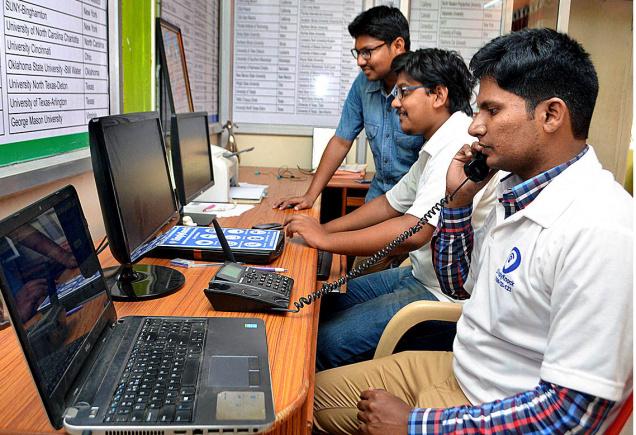
A team of Guntur-based techies has recently started a home and delivery-based services—Simply Knock—that offers home services ranging from electrical to painting and also cleaning of water tanks, bathrooms and septic tanks.

Joel Manoj, who left his job at TCS, Durga Prasad and Naveen, who have graduated from RVR & JC College of Engineering, have come up with a startup that could provide solutions to every day problems on the home front.

“We decided to launch this start up after seeing this kind of services in metro cities. Home services, we feel, should be organised. We have plumbers, carpenters, electricians on our rolls. All that customer needs to do is call us, we will forward the address details to the skilled workers who will in turn provide the service. The customer pays directly to the skilled workers and all transactions are billed,’’ Joel Manoj told The Hindu on Monday.

Security concerns

The team has designed the web site— www.simplyknock.com— on their own and set up an office in Brundavan Gardens. Customers can call on 9395-123-123 to avail a range of services including bill payments, ticket booking and repair of all household appliances. Over 250 families have already availed of the services, including senior citizens, working professionals and public enterprises.

Soon, they want to launch delivery services, including food, meat, medicine, groceries and cakes.

The young team however, is wary of issues over security. “We do a thorough background check of the workers, including their addresses. In case of any deficiency in service, we can sack them,’’ said Mr. Naveen.

The startup offers a wide range of home and delivery-based service

source: http://www.thehindu.com / The Hindu / Home> National> Andhra Pradesh / by P. Samuel Jonathan / Guntur – April 12th, 2016

IIHM celebrates Hahnemann’s birth anniversary

Father of Homoeopathy Samuel Christian Hahnemann’s 261 birth anniversary was celebrated here on Monday by the Indian Institute of Homoeo Physicians.

A meeting of all Homeopathic physicians was organised and Dr. Anuradha presided over the meeting.

Speaking on this occasion, Dr. Venna Veerabhadra Rao, Principal of Allu Ramalingaiah Government Homeopathic Medical College and Hospital, urged the government to give more funds, facilities to the local government college to produce quality doctors and also appealed to philanthropists to support the college.

After the meeting, all the physicians felicitated Dr. V. Subrahmanyam for his services.

source: http://www.thehindu.com / The Hindu / Home> National> Andhra Pradesh / by Special Correspondent / Rajamahendravaram – April 12th, 2016

Making Erra Matti Dibbalu global

Of the many natural assets that Visakhapatnam is blessed with, the most valuable and unique are the Erra Matti Dibbalu (EMDs).

EMDs of Bhimunipatnam were first reported by William King, deputy superintendent of Geological Survey of India in the year 1886.

King called the stretch of 24 miles, between Visakhapatnam and Bhimunipatnam ‘badlands,’ representing great sand banks, in a dry terrain, where sedimentary soils were extensively eroded by wind and water.

Scientists tell us that the EMD illustrate earth’s evolutionary history, including the climatic conditions that once existed at the site. Typically, such terrain has a multilayered colouring, which is both fascinating and attractive. Moreover, there are vestiges of the prehistoric man having lived in the area.

Visakhapatnam’s Red Sand Dunes are invaluable inheritance, that need to be conserved through a conscious effort, both for their scientific as well as aesthetic significance. Conservation and protection of such marvels of nature is vital for the posterity, because once lost they can never be retrieved again.

Citizen/heritage bodies of the city have worked hard to get the Geological Survey of India to recognise the EMDs as a Geo heritage site, which is no mean achievement. We must now go a step further.

Even though when William King reported them in 1886, the entire stretch of 24 miles were marked with coastal red sand mounds, over a period of time most of them have been leveled, except for a small segment, which happens to be the most spectacular part, has survived.

The beauty of the EMDs is such that tourists have been flocking to the place to admire them.

Come Karthika masam, families gather there for kartheeka vanabhojanalu. While it is good that people enjoy the beauty of the sand dunes, unbridled unregulated footfall harmed the sand dunes. Even more harmful would have been the intervention of the department of tourism had it been allowed.

Building a facility centre at the mouth of the seasonal stream that drains through the fragile eco system, a proposal for night tourism using beach buggies and camel rides are some of the spectacularly shortsited projects, which, mercifully were opposed by the heritage activists of the city. If those were allowed, EMDs would have been levelled with a year or two.

EMDs are made up of loosely stacked sand, which is easily disturbed. Any harsh activity like indiscriminate clambering up the sand dunes or using vibration-generating vehicles in their middle will disturb them and hasten the process of deterioration.

Unregulated tourist flow is neither in the interest of the tourists nor of the EMDs. As one goes deeper into the sand formations, the gully formation transforms into a veritable maze, the height of the mounds grows and if one is not careful, it is easy to lose one’s way.

A greater threat to the EMDs is the mindless digging of the dunes for laying a four lane road and building a cement mixing plant right in the middle of the sand dunes, which was brought to light by the ever vigilant public view. The latest threat appears to be a housing society.

Taking advantage of the momentum generated by Visakhapatnam’s ‘smart and clean city’ tags, we must elevate our tourism too to a global level.

We must start working towards getting UNESCO’s recognition for EMDs.

True, it would take a bit of leg work. But the benefits that will accrue make it worthwhile. To achieve that status, all the short sited and unsustainable tourist interventions proposed by the government in the EMDs must be given up forthwith, immediately. The district authorities, the state government and the heritage conservationists must work together and seriously. When the people and their governments come together, the synergy generated makes many things possible. Vizag can take a lead in the matter.

There are the four fundamental features, which are an absolute prerequisite for an area to become a member of a UNESCO Global Park and on the face of it we fulfill all the requirements.

Firstly, the area under consideration must have geological heritage of international value, which is assessed by scientific professionals, and is peer reviewed by an UNESCO Global Geopark Evaluation Team.

Do we fulfill that requirement? Certainly.

Geologists tell us that there are just three such formations in South Asia, of which we have one.

Visakhaptnam is fortunate to have one such stunningly beautiful formation so close to the city.

Earth scientists of the country and particularly of Andhra University have studied EMDs extensively and tell us that EMDs are of national as well as international value.

Scholars have used them as a living laboratory, to explain to the students the evolution of the earth’s crust. Much literature has been written about it.

The second requirement is that an aspiring Geopark must be managed by a body, which is created by a central Act.

This takes political will of the people’s representatives. It is not the first time that such an Act was passed to protect an institution of national importance.

Salarjung Museum was created by a central Act specially passed for that very purpose.

The institution thus entrusted with the task of managing EMDs must involve the local communities and the other stake holders in its management plan. In the case of EMDs the local stake holders would be the villagers of Nerellavalasa and the local fishermen, who have a direct interest in the EMDs.

For, in the year 1970 some 20 families of Nerrellavalasa were given pattas within the sand dunes by the Government of Andhra Pradesh.

The villagers planted cashew trees along the slopes of the dunes, which not only enhanced the beauty of the dunes but also helped in the prevention of soil erosion, as the root systems hold the soil together.

So, the management plan must have a two-pronged strategy of protecting the site along with the interest of those that depend on it.

The tourism interventions of the government so far have been aimed at evicting the pattadars of the EMDs and opening the EMD for the exclusive benefit of the tourists. Such interventions are violative of the United Nations’ principles of heritage conservation.

Equally important is maintaining the sanctity of the dunes and stopping all intrusive activity which disturbs their pristine integrity. The landscape includes the ravines, streams, foliage, gullies, coast line and all the other natural in features in the area, in toto.

No more building of roads in the immediate neighbourhood of the EMDs, no cement processing plants nor a housing colony in the mounds.

Then the third requirement to get UNESCO Global Geopark is a total visibility to the world. This stipulation had to be put in place as at times some geological formations might be controlled by private bodies, which might restrict entry to the public.

EMDs does not have that problem since they are located within a stretch held by the government.

What, needs to be done to make EMDs more visible is to create a dedicated website, print leaflets, publish a detailed map of the area and make available information which is required for international tourists.

Lastly, a UNESCO Global Geopark is not only about cooperation with the local people living in the UNESCO Global Geopark area, but also about cooperating with other UNESCO Global Geoparks through the Global Network. It must work together with the other global partners, across borders.

It is high time the authorities in charge of tourism and the district administration take charge of the conservation of the EMDs seriously, and plan for the overall conservation of the area, once and for all.

Getting the recognition of UNESCO will place the site on the global tourist map and bring international tourists.

At present there are 120 UNESCO Global Geoparks in 33 countries. It would be a proud moment for Vizag, if we can join that network.

(The writer is a heritage and environmental activist. She can be reached at ranisarma2010@gmail.com)

source: http://www.timesofindia.indiatimes.com / The Times of India /News Home> City> Visakhapatnam / by Rani Sarma / April 10th, 2016