Event management industry set to grow to Rs.2,300cr


K Prudhvi Raju / Prudhvi.k@postnoon.com

HYDERABAD: Event management industry is growing by leaps and bounds in the City. Be it the engagement function of Ram Charan Teja and Upasana or be it a corporate congregation in the Hyderabad International Conv­ention Centre, it’s the event managers who design the virtual screenplay to the minute detail.

Almost every business uses the services of event management industry. The event management industry is seen as a sunrise industry in the service sector.

Main reason for the growth in the industry is sudden spurt in live entertainment shows, corporate events like product launches and dealers meetings, exhibitions, conferences, and seminars. The market for event management in India is growing at 25 per cent and will reach Rs 2,300 crore by 2012. As of now, it is a Rs 1,800-crore market. It is also moving from unorganised frame work to an organised market, said Rakhi Kankaria, Director, Rachnoutsav Events. The event market size in Hyderabad is estimated to be around Rs. 250 crore to 300 crore.

Talking about the industry challenges, she said that industry was not getting trained man power. Education is unable to provide the quality human resources for the event management industry.

English language skills, practical exposure and industry knowledge are lacking in the manpower. “To fulfil the need and to address this issue, we are going to start a professional institute with three courses on event management and wedding planning.”

Event management is not just a few days’ business. It is spread throughout the year with the corporate events. Indian marriages are quite long. They start from wedding card and ends with first night. Sometimes, this all may take up to six months, sagai se badhai tak.

On the difference between middleclass wedding and high profile wedding, she said, “We take care of every detail from card design to delivery, logistics for the invitees in high profile wedding. This all comes in a package. With the middleclass marriages, we promise that everything goes smoothly at the venue. The card distribution and all other events have to be take care by the customer itself. Middleclass wedding holds 27 per cent share of the total wedding turnover.”

Technology is the key for wedding planning — LED displays to Mehndi functions and webcasting solutions for the marriages to enable guests and parents from different parts of the world to watch the event. “The corporate events generate around 70 per cent of the turnover, and the rest 30 per cent is generated by wedding planning. However, weddings are bigger in volumes,” she said.

source: http://www.postnoon.com / Home> Business / Postnoon News / December 25th, 2011


THE DECCAN TRAIL …. Mirpakaya Mango Moghuls

Hyderabad to Vijayawada, it’s a trip from tangy to the fiery-hot
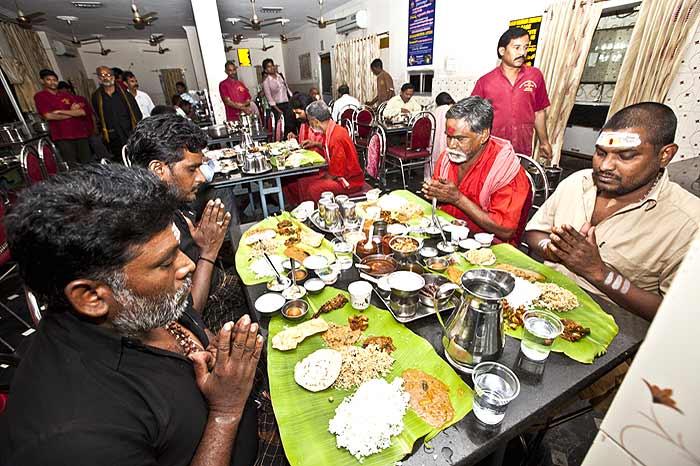
Andhra full meal . At the Viyawada Ramiah mess/ A. PRABHAKAR RAO

I am, I must confess, an accidental food writer. It all started with a one-off food story, which led to another, and another…till now I’m being asked to write culinary books and host TV shows. But, truth be told, my idea of the perfect meal is a simple, crisp dosa, accompanied by a favourite book. Hence this culinary drive from Hyderabad to Vijayawada turned out for me to be more of a journey through history and geography, with random diversions through politics and trivia.

Hyderabad is one of the important centres of Mughlai cuisine, along with Delhi, Lahore, Lucknow and, perhaps, Rampur. But there’s an important difference: by the time the 50-year-long Deccan campaign ended, the cuisine that the Mughal armies had brought with them had evolved, through its interaction with the southern climate, ingredients, peoples and cuisines. Most notably, it acquired a distinctive tangy undercurrent, thanks to a variety of sour flavourings, from tamarind to green mango. Thus, biriyanis, qormas and kababs are all very well, but the keynote of Hyderabadi cuisine is a khatta salan (sour curry)—such as baghare baigan, tamate ka kut or a simple khatti dal—which is the starting point for planning any Hyderabadi meal. Everything else, whether lamb, fowl or fish, comes later. This is something north Indian Muslims find rather strange—almost as strange, in fact, as the Hyderabadi Urdu dialect.

Khatta salan comes first in Hyderabadi cuisine, before fish or fowl, something north Indian Muslims find strange.

Because it originated as a cuisine of the elites, Hyderabadi cuisine is generally a slow-cooked labour of love. Even the humblest dish calls for a certain artistry, and presentation is as important as flavour, texture and fragrance. So where can you get good, authentic Hyderabadi food? Unfortunately, the answer is that it’s something you get only in people’s homes. Well, there are two other possibilities: Hyderabadi weddings and the Nizam Club, so you could try to wrangle an invitation, or gatecrash. Alternatively, there’s Shadaab, a little eating house in the Old City, or the slightly more upmarket Point Pleasant in Banjara Hills. But your best bet would be to order from somebody like Begum Aziza Hassan, famed for her pluperfect shikampurs, baghare baigan and biriyani.

The drive from Hyderabad to Vijayawada—the heartland of Andhra cuisine—takes only five hours, but it’s a journey into a different cultural ethos. The road heads east, through dramatic rockscapes, some of the last remnants of the famous boulders of Hyderabad, sculpted into fantastical formations by 2.5 billion years of wind and storm; the rest, sadly, have fallen prey to real estate development, and a unique national treasure has been squandered.

The road takes us through places whose names all seem to end in either ‘pally’ or ‘gudem’ (Tangallapally, Maggalapally, Yellareddigudem, Annapareddigudem). Our driver insists on driving on the wrong side of the road, at 140 kmph. Every time I admonish him, he obediently gets back into his lane—but only briefly. I think I’m going to have a cardiac arrest, as he continually swerves left at the last possible moment to dodge oncoming vehicles. Hesitantly, I ask him how long he’s been driving this route. “Seven years, sahib,” he replies, impassively. I philosophically tell myself he knows what he’s doing, and close my eyes and try to sleep. But I swear to myself there’s no way I’m going to go back this way; I shall return to Hyderabad by train.
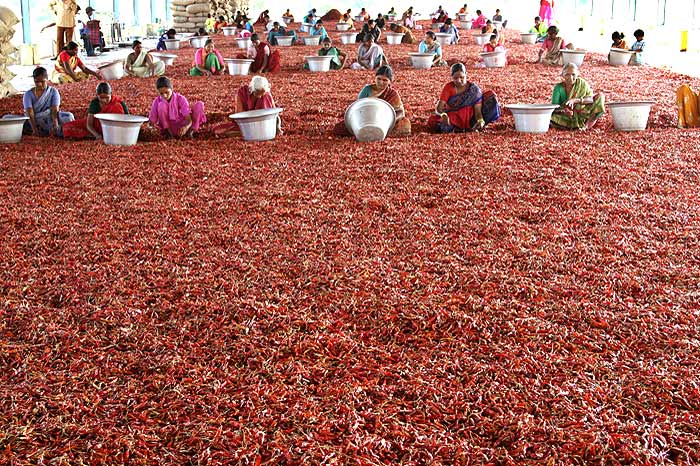
Chilli land Guntur’s firestick chilli is delectable torture. (Photograph by T. Narayan)

As we approach Nalgonda, the land flattens out, with lines of pencil-straight toddy palms. In the summer, villagers sit by the roadside, selling tadgolas, the fruit of the toddy palm—translucent, cool, luscious under their fleshy ochre skin. Apart from these, and the creamy local sitaphals, foodwise, the drive is uninteresting; it’s only near Guntur that things look up, with the nondescript dhabas giving way to stalls selling scorching chilli mirpakaya bajjis.

From Nalgonda, the road swoops south, and the landscape slowly turns a lush shade of green: this is the rice bowl of India, watered by the Krishna river. We’re now crossing the divide into coastal Andhra—the historic ‘Coromandel Coast’ where, in the 1750s, the French and British intrigued and battled so fiercely. At first, the French seemed well-entrenched here, but the English, of course, ultimately finessed them. They absorbed this strategic coastal belt into their Madras province. And so it remained, right until 1953, when it became India’s first linguistic state, Andhra. Then, three years later, the Telangana region was added on to it—a political marriage that’s been on the rocks for 40 years. All that’s left of it now is a bitter tussle over who gets to keep the dowry of Hyderabad. (So much for the logic of linguistic states.)

Apart from being India’s rice bowl, coastal Andhra also claims to produce the sweetest jaggery, the thickest curds and the best chillis. Guntur, in fact, is perhaps the chilli capital of the world: it is home to the world’s largest chilli market, and its chilli farms make the largest single contribution to India’s output of 1.1 million tonnes of chillis per year. And while its chillis may not be the world’s hottest (that distinction goes to Assam’s bhootjholokia chilli), the Guntur ‘firestick’ chilli is hot enough for the police to use, allegedly, as a means of torturing stubborn suspects. This is hard-core chilli country, and you see evidence of it everywhere, from the vivid scarlet stretches of drying chillis by the roadside to the city’s eating joints, which offer foods that run all the way up the Scoville scale, from the merely spicy to the truly incendiary. (The gunpowder-sprinkled ‘Guntur idlis’ are a speciality.)
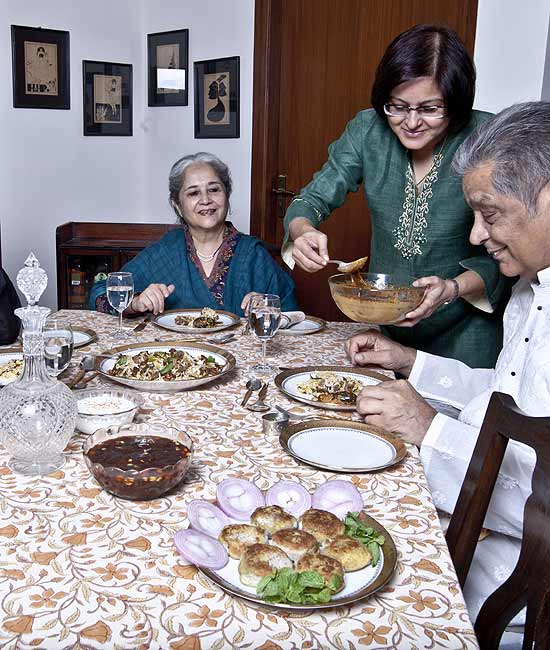
Family affair A Hyderabadi meal. (Photograph by A. Prabhakar Rao)

If Hyderabadi cuisine was largely the product of history, Andhra cuisine is a result of geography. Its themes are rice from the delta; tamarind, green mango and gongura (sour roselle leaf) that grow here in abundance; dour vegetables like brinjal, lady’s finger, drumstick and gourd; fresh seafood from the coast and, of course, the chillis of Guntur. The cuisine, unsurprisingly, is one of the world’s hottest, and so a meal always ends with a soothing dollop of curd-rice—the ancient secret for dousing the fire of the chillis (the ancients intuitively understood that chilli molecules are fat-soluble, not water-soluble, which is why cold water never helps).

A typical Andhra meal includes steaming rice, a pappu or dal, a couple of pulusus or curries and rasam. There might also be a sambar and chaaru (something roughly in between a sambar and rasam). And for extra zing, there’ll be an array of pickles, chutneys and kaaram, or spicy powders. The items are laid out on your banana leaf in an ergonomic, traditional pattern: rice in the middle; curries on the right; pickles and pachadi on the left; and special delicacies, like pulihora, in pride of place at the top right-hand corner. The thematic flavours are chilli and gongura, and given the fact that Andhra is such an intensely political state, such characteristics sometimes acquire a political undertone: during the Separate Telangana movement, for example, there was crude graffiti shouting not just ‘Andhra go back!’ but also ‘Gongura go back!’ and ‘Mirchi go back!

What if the French had trumped the English in Andhra? Would we be eating creolised fish pulusus?

Unlike Hyderabadi cuisine, Andhra cuisine never had the advantage of court patronage—which played an important role in the evolution of, for example, Telangana cuisine. It was, instead, essentially the food of the common man—which is why it remained simple, earthy and robust. It’s interesting to speculate what would have happened to Andhra cuisine if history had turned out differently. What if the intrinsically Telugu Vijayanagara empire had conquered the Cholamandal coast, and lasted a century longer? Or, what if the French—who were once well-ensconced here—had trumped the English, and wrought a Pondicherry-like influence on the region and its cuisine? Might we, perhaps, today be eating creolised fish pulusus with baguettes made of rice-flour?


From Guntur, the road turns north and crosses the Krishna river into Vijayawada. One of the city’s landmarks is Babai Hotel, originally a footpath stall set up in 1942 by Patruni Shyama Murthi, affectionately called ‘Babai’ (uncle), who invented what many consider to be the ultimate idli: a supremely fluffy creation, topped with a blob of home-made butter. Babai’s idli became so popular that his stall became a pilgrimage centre for Andhra Pradesh’s film stars, tycoons and politicians, and it’s said that the idli had no fixed price: wealthy patrons would simply hand over a sheaf of notes, based on how much they’d enjoyed their meal. Today Babai’s idli joint, now run by his nephews, may not be what it once was, but it’s still a shrine for foodies.

Our journey had ended; it was time to go back. I took one look at our driver and recalled our trip from Hyderabad, driving on the wrong side of the road, at 140 kmph. It didn’t take long to make my decision. I paid him off and caught the Narsapet-Hyderabad Express instead. Discretion, truly, is the better part of cowardice.
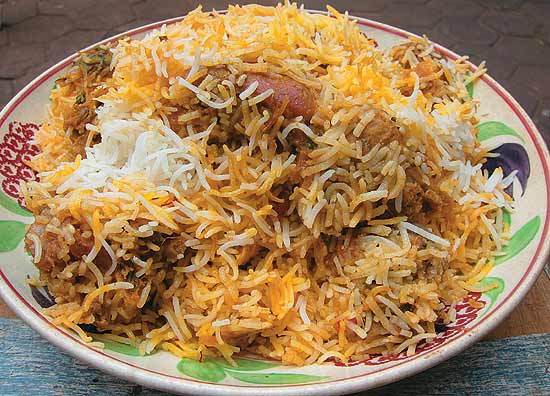
Do-Gosht Biriyani

One of the secrets of a good Hyderabadi biriyani is said to be the generosity of the proportion: it should ideally be one portion of meat for every portion of rice. And then there’s the ‘do-gosht biriyani’, or two portions of meat for every portion of rice! Two much of a good thing.
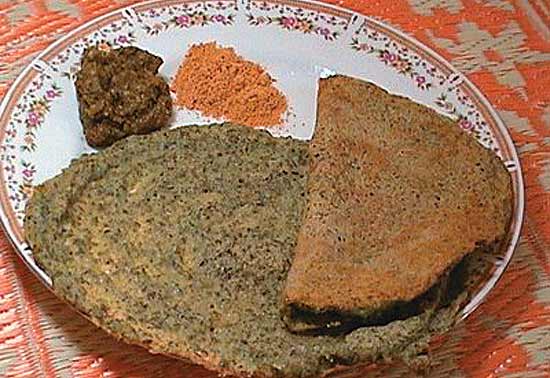
 

MLA Pesarattu

Pesarattu is the Andhra version of a dosa, but made of green gram instead of rice. A popular variant is the ‘MLA pesarattu’, stuffed with upma. It apparently got its name from the state’s MLAs, who invented this greedy snack in the MLA canteen to sneak into the assembly and eat during long, boring sessions.

___________________________________________________________

When he’s not waxing eloquent on food, Anvar Alikhan is an advertising professional

___________________________________________________________

source: http://www.OutlookIndia.com / Society / Magazine, January 07th, 2012

Special Issue: THE AROMAS OF INDIA
Karimnagar Collector, SP have lunch with Dalits

School assistant suspended for allegedly encouraging untouchability


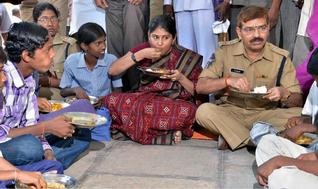
Setting an example:Collector Smita Sabharwal and SP V. Ravinder having lunch prepared by Dalits along with students at ZPHS Sundaragiri village in Karimnagar district on Friday.— Photo: Thakur Ajay Pal Singh

It was a welcome surprise for students of Zilla Parishad High school in Sundaragiri village of Chigurumamidi mandal on Friday as they had community lunch along with top officials of the district.

Collector Smita Sabharwal, Superintendent of Police V. Ravinder, Karimnagar RDO Hymavathi, Huzurabad DSP Nagalaxmi, DEO Purnanda Rao and others set an example by eating the midday meals prepared by the Dalits at the school.

Warning the officials of serious action if anyone encouraged untouchability, the Collector ordered suspension of Hindi school assistant Satyanarayana for allegedly encouraging untouchability among the students and forcing them to shun meals prepared by the Dalits due to differences with the school headmistress.

She also found fault with headmistress Vasantha for not informing higher authorities about the issue.

She said that the sensitive issue came to the administration’s notice through a report published in The Hindu on December 16.

The Collector visited the village on Friday and interacted with the students. Later, she inquired with the headmistress Vasantha about why the students were refusing to eat the meals and inspected the records.

Ms. Sabharwal and Mr. Ravinder picked up plates, had the food served by Dalit women and sat along with the school students to eat the lunch comprising potato curry and sambar.

Surprise checks

The Collector said that the food quality was good and nutritious and noted that over 200 students were eating midday meals against the school’s total strength of 260.

She said the RDOs and DSPs had been instructed to visit the schools regularly to check the practice of untouchability in the educational institutions.

source: http://www.TheHindu.com / News> National / by Staff Reporter / Karimnagar, December 24th, 2011

Premier Explosives on expansion mode

Hyderabad, DEC 23:

Premier Explosives, which produces solid propellants and critical components that power missiles, including the recent Agni-IV, has expanded its production facilities.

A new expansion project, with an investment of Rs 10 crore has been added to its existing manufacturing unit at Peddakandukuru in Nalgonda district of Andhra Pradesh. It will cater to the needs of tactical missiles like the Nag, Astra, Akash, and Pinaka.

NICHE OFFERING

Premier Explosives, the traditional private sector manufacturer of explosives for mining and commercial sectors, has specialised in meeting some of the niche demands of India’s strategic sector — defence and space. The new unit was inaugurated by Mr Avinash Chander, Chief Controller, R&D (Missiles and Strategic Systems), Defence Research and Development Organisation.

Mr A.N. Gupta, Chairman and Managing Director of Premier Explosives said the company has been producing solid propellants since 2003. The present facility for tactical missiles was an attempt to help the country reach self-reliance in defence supplies.

In the successful November launch of Agni-IV (beyond 3,500-km range intermediate range ballistic missile), Premier Explosives made the second of the two stage rocket motors along with the two igniters, he told Business Line.

Ms Tessy Thomas, Project Director of Agni-IV said the igniters and Daisy-2 motor produced by Premier met all the quality parameters in static test as well as the flight test.

Mr Avinash Chander said, “Premier has demonstrated over time that it is a reliable private partner with its consistent quality of products and technical ability in various projects undertaken by the Advanced Systems Laboratory and the DRDO.”

Premier Explosives has already supplied critical components like the ‘smoke less’ composition (which helps an aircraft avoid detection after the launch of the missile) for the Astra missile.

source://www.TheHinduBusinessLine.com / Companies / by M/ Somasekhar / December 23rd, 2011


IBM Opens New Branch Office In Visakhapatnam, India

ASIAN SCIENTIST NEWSROOM
DECEMBER 20, 2011IBM has opened a branch office in Visakhapatnam, Southeast India as part of the company’s continued geographic expansion initiative to increase its presence in key growth markets.

AsianScientist (Dec. 20, 2011):

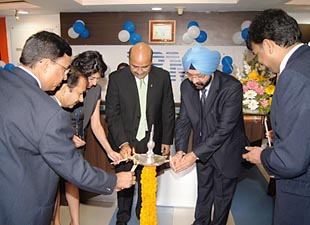
IBM announced this Monday the opening of a branch office in Visakhapatnam, Southeast India as part of the company’s continued geographic expansion initiative to increase its presence in key growth markets.

The new office was inaugurated by Mr. Sanjit Singh Lamba, Managing Director of Eisai Pharmaceuticals, one of IBM’s customers in the region.

In 2011 alone, the company opened six new branch offices in India as it expands its reach to smaller, rapidly developing cities as part of its plan to establish a presence in over 40 cities across India and South Asia by 2013.

Earlier this year IBM opened new branches in Coimbatore in the State of Tamilnadu, Indore in the State of Madhya Pradesh, Dehradun in the State of Uttarakhand, Guwahati in the State of Assam, and Raipur in the State of Chhattisgarh.

“India plays a key role in our growth market strategy and we have opened six new branches across the country this year taking us closer to our clients and partners in India’s rapidly evolving regional cities,” said Bruno Di Leo, General Manager, IBM Growth Markets Unit.

Visakhapatnam is an important port city in Southeast India, and has experienced rapid economic growth in recent years due to the development of petroleum, steel, fertilizer, and IT industries.

To support its regional expansion initiative, IBM has also been actively recruiting new business partners across the country – in 2011 over 1,000 new business partners from India/South Asia have registered via IBM’s PartnerWorld program.

Clients in Visakhapatnam include Eisai Pharmaceuticals, the Indian arm of Eisai Group, Japan; and Phoenix IT Solutions, a fast emerging software company.——

Source: IBM.
Disclaimer: This article does not necessarily reflect the views of AsianScientist or its staff.

source: http://www.asianscientist.com / Home> Tech & Pharma / December 20th, 2011

Need for long-term crude oil exploration policy: Expert

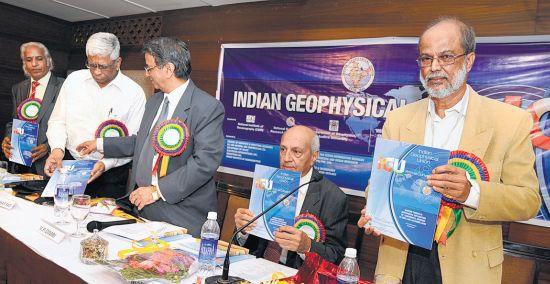
Long-term plans: The Director of National Institute of Oceanography (Goa), Mr Satish R. Shetye, releasing a brochure at the 48th annual convention of Indian Geophysical Union in Visakhapatnam on Tuesday. The Research Professor from Rice University (US), Mr Manik Talwani, (second from right) is also seen. — Photo: K.R. Deepak            (Business Line)
VISAKHAPATNAM:
There is an imperative need for India to frame a long-term policy on exploration of crude, as stocks are fast getting depleted and consumption is going up by leaps and bounds, according to Prof. Manik Talwani, of Rice University (USA).

He was speaking here on Tuesday after inaugurating the three-day Indian Geo-physical Union (IGU)’s forty-eighth annual convention, jointly organised by the National Institute of Oceanography, the National Geo-physical Research Institute and the Andhra University.

He said that soon the reserves in the country, estimated at 5.6 billion barrels, would become depleted and consumption was going up all the time.

The present consumption is 3.2 million barrels a day and the production 6,80,000 barrels a day. The per capita consumption is one barrel as against the world’s 23.6 barrels.

He said the country would have to adopt new technologies to extract more oil from its wells and it should strengthen ties with oil-rich countries. He said Venezuala, Saudi Arabia, Iran and Iraq in particular should be befriended. The normal practice was to extract only 30 per cent from the well abandon it. The exploration should become deeper.

Earlier, Prof. Talwani released a book named “Tectonics of the eastern continental margin of India” authored by NIO scientists K.S.R Murthy, A.S Subrahmanyam and V. Subrahmanyam.

vzchs@thehindu.co.in

source: http://www.thehindubusinessline.com / Home> Industry & Economy> Economy / by Our Bureau / December 20th, 2011

Pharmaceutical care should have key role in healthcare planning system: Pharm D interns

Like medical care and nursing care, the concept of pharmaceutical care should have a predominant role in the healthcare planning system as it is a part of the drug therapy assessment, opined a group of Pharm D interns of the Raghavendra Institute of Pharmaceutical Education and Research (RIPER), Anantapur district, Andhra Pradesh.

According to them this concept has originated in 1990 with the establishment of International Pharmaceutical Federation and it is known in USA as medication therapy management and in Australia as drug action plan. The students have made a research study on the emerging concept of pharmaceutical care.

“This concept has opened new ways for pharmacists to establish their presence and prove their mettle in the healthcare team. Further it has made a space for the pharmacists to get involved in taking a better clinical decision by giving better treatment options to the physicians in order to deliver better treatment outcome,” said SKR Sowmya, a Pharm D intern.

Their study reveals that pharmaceutical care planning is a systematic, comprehensive process with three primary functions such as identifying the patient’s actual and potential drug-related problems, resolving the problems and prevent the problems. It involves a stepwise approach in assessing the drug therapy given to the patient and pharmaceutical related problems emerging out of it. It is the responsible provision of drug therapy for the purpose of achieving definite outcomes that improve a patient’s quality of life. The pharmacist is responsible for achieving the desired outcomes at all levels of pharmaceutical care.

According to another intern, A Srinath, the concept of pharmaceutical care extends itself to other aspects of pharmacy practice including traditional and clinical pharmacy. It has its own uniqueness over clinical pharmacy, patient counselling and pharmaceutical services.

A standardized method for the provision of pharmaceutical care includes collecting and organizing patient-specific information, determining the presence of medication-therapy problems, summarizing patient’s health care needs, specifying pharmaco-therapeutic goals, design and develop a pharmaco-therapeutic regimen, develop a monitoring plan in collaboration with the patient and other health professionals, documentation of pharmaceutical care… etc.

The view point of N Sreelalitha, a Pharm D intern, who also associated in the study, is that the focused areas of practice where the pharmacists are being exclusively recognized are in drug monitoring, disease monitoring and drug/ disease management by protocol. The clinical skills and activities by pharmacist in pharmaceutical care include patient assessment, patient education and counselling, patient- specific pharmacist care plan and drug- treatment protocols.

source: http://www.pharmabiz.com / Home> Pharmacy & Trade / by Peethaambaran Kunnathoor, Chennai / Wednesday, December 21st, 2011

Continental Terminals to set up 18 facilities in 5 years

HYDERABAD:

Continental Multimodal Terminals Ltd, part of the logistics solutions provider NDR Group, is in the process of setting up three terminals — at Chennai, Ahmedabad and Panipet — at a cost of Rs 300 crore in the next 12 months.

The company, which set up its first terminal in Hyderabad, has plans to develop a network of 18 terminals across the country over the next five years. “The three new terminals will be immediately followed up with similar facilities in Bangalore and Tuticorin,” Mr Suresh Joseph, Managing Director and CEO of the company, told Business Line.

The Hyderabad facility, which was recently notified as a private freight terminal by the South Central Railway, will also have an Inland Container Depot by next month. The ICD, spread over 50,000 sq.ft, has been designed to handle 1,000 TEUs — this will be the company’s fourth ICD.

Having invested Rs 130 crore for setting up the facility, the company is investing another Rs 80 crore to expand the terminal capacity in the next one year. “Right now, we can handle 60 trains a month at the facility. After the expansion, the capacity will double to 120 trains,” Mr Joseph said.

LINKAGE TO GATEWAY PORTS

The facility will handle domestic cargo in railway wagons and provide linkage for container trains to gateway ports such as JNPT, Chennai, Krishnapatnam and Visakhapatnam . It is eyeing cargoes such as iron and steel, cement, granite, textile and foodgrains. Kribhco Infrastructure Ltd holds a minority stake of 10 per cent in the company.

The company is betting big on this segment of logistics business, especially expecting the market to open up further after the new GST regime is in place from next year, which will increase stocking demands. It plans to have over 90 lakh sq.ft of warehousing at 70 different locations across the country.

amitmitra@thehindu.co.in

source: http://www.thehindubusinessline.com/ Home> Industry & Economy> Logistics / by Amit Mirta/ December 21st, 2011


Next, a chain of birthing centres for the bulge bracket

The maternity ward is becoming passé, at least for those with money.

Birthplace Health, a Hyderabad-based start-up, has come up with a concept of birthing centres, as they are branded, exclusively meant for child birth.

Targeted at the premium segment, the company is looking to set up a network of such centres, which would provide ambience and several facilities for hassle-free deliveries, across the country.

The premium segment (delivery costing Rs50,000 and more) is about 30% of the Rs11,000 crore birthing market in India.

Birthplace is setting up a proof-of-concept facility in Hyderabad at an investment of about Rs20 crore, which will start in March.

“Delivering a child is an emotional moment of a woman. This is also an occasion for the entire family to celebrate unlike in any other medical need. So, a hospital, which has a variety of people including very sick people seeking treatment, is not the right place for delivering a child. Pregnancy is not a disease and is a moment of joy for the entire family. With this concept, we have been working on a business plan for the last one year,” Tarun Siripurapu, managing director of Birthplace Healthcare, said.

The company plans to open over a dozen facilities in various locations like Vizag, Chennai and Coimbatore by 2017. Each centre is expected to cost between `10 crore and `15 crore depending on the location.

The company is funding the first centre through internal resources while it is keen on tapping banks, private equity and venture capital firms for expansion.

“Everything in the birthing centre would be exclusively designed for the would-be mother. The doctors, nurses would be of her choice. We would even provide music of her choice. There is also a library with a good collection of books. Moreover, we don’t want to treat the visitors to the centres as typical attendants in a hospital. There are no visiting hours and when to allow people inside is left to the choice of the mother,” he said.

The centre also offers facilities like yoga and Lamaze classes, apart from mother and baby exercises, diet and nutrition advice. It also offers training to the fathers on simple issues like changing the baby diapers.

But, all that has a cost to it. Typically, a normal delivery at the centre would cost `80,000 and Caesarian Section would cost less. “Our attempt would be to encourage normal delivery and we would like to charge less for a C Section,” he said pointing to the popular perception that the hospitals and nursing homes perform more C Sections to charge more.

According to Siripurapu, a former McKinsey executive in New York, the first centre is expected to take a year to break even and translate into about 1,000 deliveries. “During the first year, we are expecting about 80% of deliveries to happen through referral mode from other gynaecologists in the city,” he said. The company is targeting to capture about 8-10% of the premium segment once its network is in place.

source: http://www.dnaindia.com / Home> Money> Report / by K V Ramana / Place:Hyderabad/ Agency:DNA/ Thursday, December 22nd, 2011


Schneider Electric’s Hyderabad plant won 1st prize at National Energy Conservation Awards

India has been on top of the agenda of Schneider Electric in the past ten years.

The Bureau of Energy Efficiency, the nodal central body for promoting energy efficiency in India, today awarded Schneider Electric India, a global specialist in energy management, the ‘first prize’ at the just concluded National Energy Conservation Awards 2011, which was inaugurated by the Honorable Prime Minister of India, Mr. Manmohan Singh. The award was given to Schneider Electric India for its Hyderabad plant under the ‘general category.’

The award was presented to Mr. Olivier Blum, Country President & Managing Director, Schneider Electric India, by the Union Minister of Power, Mr. Sushil Kumar Shinde on the occasion of National Energy Conservation Day. The National Energy Conservation Awards are given to organizations which have made systematic and serious attempts for efficient utilization and conservation of energy in various sectors such as industrial units, buildings, municipalities, etc.

Speaking on the occasion, Mr. Olivier Blum, Country President & Managing Director, Schneider Electric India said, “We are honoured to receive this prestigious award from the Government of India. Schneider Electric has always promoted and propagated energy efficiency through its wide range of products and solutions that cater to various sectors. We are committed to sustainable growth, and energy efficiency remains the cornerstone to enable this. This recognition by the Government of India further strengthens our resolve and commitment towards implementing energy management measures in our own 31 manufacturing facilities, which in turn enables our customers to minimize power losses and maximize the efficiency and productivity of their operations.”

India has been on top of the agenda of Schneider Electric in the past ten years. With six acquisitions in the past two years, India features as the no. 7 country in terms of Group sales with a headcount of approx 11,500 on payrolls including about 1,000 R&D engineers.

Schneider Electric’s Hyderabad global plant was set up in 2006. Over the past several years, the plant has put in place several energy conservation measures such as redesigning of the lighting systems, installation of energy efficient pumps, improving HVAC efficiency, etc. Continued efforts to improve the energy efficiency of the operations at the plant resulted in specific energy savings of 15% in 2010-11 as compared to the previous year.

source: http://www.indiainfoline.com / Indiainfoline> Markets> Sector / India Infoline News Service/ December 15th, 2011