Torch bearers for millet seed security

The National Biodiversity Authority has recognised 30 villages in Zaheerabad of Medak district of Andhra Pradesh that grow traditional and fast-disappearing millets as Agricultural Biodiversity Heritage Site (ABHS).   
 The Andhra Pradesh State Biodiversity Board (APSBB), which finally gave green signal for the rare recognition, has sent its recommendation to the National Biodiversity Board, which has approved the proposal making these villages to become first villages in India to be recognized as ABHS.“The file is now with the agricultural department. By the end of January we will announce these villages as ABHS with or without their opinion,” a determined APSBB Chairman Dr R Hampaiah says. Thus, the dryland villages in four mandals and the 5,000-strong women farmers of the Deccan Development Society (DDS) that grow only “forgotten millets” without fertilisers or pesticides will join the list of 27 such other sites around that world by February.

“Nowhere in the world 60 different varieties are cultivated in 30,000 acres and the seeds are distributed among women farmers, assuring food safety and saving the environment,” says Dr SN Jadhav, Member Secretary, APSBB.

The 500-year-old banyan tree in Pillamarri tree spread on three acres of land in Mahbubnagar district and the rare forest on Tirumala hills are the other two sites in Andhra Pradesh that have such special recognition.

In fact, a few months ago, three members from the Board—Anisetty Murthy, Ashok Kumar and Hampaiah– had visited the farms to see the amazing agricultural biodiversity that was being conserved and propagated by the women of DDS.

The announcement added vigour to the 15th edition of biodiversity festival in Algole, a small village in Zaheerabad mandal in Medak district, from where a month-long bullock cart caravan yatra begins and tours 70 villages in all the four mandals of the heritage site, encouraging people to adopt forgotten crops.

“We are now trying introduce the concept in 18 other states in the country. The DDS even had its impact in Africa, where women  are trying to take back farming from the hands of commercial organisations,” added DDS Director PV Sateesh.

While agriculture in other parts of the country was in doldrums, the sangham farmers were completely self-reliant as far as food, seeds and farming are concerned. When farmers elsewhere were facing the indignity of having to stand in long queues to access government supplied seeds, women of the DDS were staking their claim to the elusive mantle of food sovereignty.

Women of the DDS also succeeded in drawing the attention of the government to the need for including millets in government food programmes like PDS, the mid-day meal scheme and so on; the spate of orders asking for the inclusion of millets in these schemes is a testimony to the extent of success of the women of the DDS.

Some women farmers of the DDS also can handle the latest version of digital camera, the daily narrow cast of the Sangham FM radio and help save bio-diversity by cultivating forgotten millet crops with equal élan. Women camera operators of the Community Media Trust (CMT), probably the only such media house in the country, can handle, shoot, edit and produce short films without any outside help.

The initial toil and success of women was then presented to the outside world through photos and then videos. Then came the launch of the CMT, which has been winning several laurels for its amazing media work over the last decade.

The CMT runs a women’s video collective (WVC) and the first-ever community radio of India called Sangham Radio. While the WVC has been functioning since 1996, the Sangham Radio took up Narrowcasting since 1998 and has been on the air since October 2008,  broadcasting two hours every day. Both these outfits are managed entirely by women from farming communities.

Chinna Narsamma, a small farmer who made a film “Community Conquers Hunger”, said that the sanghams were the first group in India to have started 100 days of employment for the poor, which preceded MGNREGA by 20 years.

Summer employment    

Through this employment programme which they called summer employment, they brought over 5,000 acres of near fallow lands under cultivation, produced more than a million days of employment in 30 villages in 10 years and started producing over 20 million kg food every year. This was the first step in abandoning hunger in their sanghams.

Zaheerabad Punyamma added that the sanghams started leasing lands and launched collective farming groups on these leased lands and produced additional food for their families.

In two decades, the sanghams have leased more than 1,000 acres of land and produced over half a million kg of food for their groups. Dandu Swaroopamma, a community filmmaker and a member of the DDS Food Sovereignty Trust said that the sanghams have brought over 4,500 acres of cultivable fallows under cultivation and produce nearly a million kg or more food every year.

They have done poverty mapping of their villages and identified over 10,000 families as recipients of their jowar-based millet rations.  Each family has received a ration card through which they can draw between 10-25 kg of jowar every month depending on their poverty status. The jowar is sold at 25 per cent of the market price to the identified poor.

Begari Laxmamma, a community filmmaker and a community seed keeper, pointed out that all these villages have their own community seed banks from which any farmer can borrow nearly 50-80 seed varieties.   Thousands of women in these villages have their own household seed banks and never depend upon outside seeds. Thus these villages have become seed sovereign.

Thammali Manjula, filmmaker and a coordinator of the Community Food Sovereignty programme, says “Our films have nothing dramatic but depict our lives and it’s about how we conquered hunger.”

J B S Umanadh in Hyderabad

source: http://www.deccanherald.com / Deccan Herald / Home> Special Features / by JBS Umanadh in Hyderabad / January 19th, 2014

Andhra Pradesh tops in CAT

Krishna Pillutla
Krishna Pillutla

After series of good performances in the national level tests in engineering and medical courses students from the State have made a mark in the Common Admission Test (CAT) conducted for admission into IIMs and top business schools in the country.

This year, perhaps the first-time ever, three students from the State scored a perfect 100 percentile figuring among eight such students across the country. It’s an achievement in the sense that State students aren’t as crazy for management courses as they are for engineering and medical courses.

Engineering background

An interesting aspect among these toppers is that they are all from engineering backgrounds and have already proved themselves at various levels. It’s a natural progress from IITs to IIMs these days as a combination of engineering from an IIT and management from IIM is considered a potent weapon for students to market themselves in the national and international arena. These achievers are no different.

The three toppers from the State, include Krishna Pillutla, Imaneni Kumar Karthik and Siva Surya Teja. Krishna Pillutla, a final year computer science student at IIT-Bombay hails from Trimulgherry in Secunderabad. With his score, Krishna will get a call from all the IIMs, but he prefers to study at IIM-Ahmedabad.

Twenty-four year-old Siva Surya Teja, who secured a perfect 100 percentile is from a small town Samalkot near Kakinada. After graduating from JNTU Anantapur, he joined the Infosys in Hyderabad three years ago. He secured the top score in the fourth attempt. In his second and third attempts, he scored 99 and 96 percentile respectively and aimed at getting the top score this time.

Another 100 percentile, Imaneni Kumar Karthik hails from Vijayawada and secured his B.Tech and M.Tech dual degree from IIT Kharagpur. He is employed with Oracle in Hyderabad as of now.

These achievers are from the TIME group that trains IIM aspirants. In fact, one of the toppers, Krishna is the son of P. Vishwanath Director of TIME group.

Commenting on the toppers, Mr. Vishwanath says that most students from the State prefer to move abroad for MS or a job in a good company. “May be such toppers are now focussing on CAT too,” he says. “The placements at IIMs also matter in students’ preference to write CAT.”

source : http://www.thehindu.com / The Hindu / Home> Features> Education Plus / by R. Ravikanth Reddy / January 19th, 2014

National Police Academy gets first woman director

New Delhi:

Government has appointed senior police officer Aruna Bahuguna as the new chief of the Hyderabad-based National Police Academy, alma mater for IPS officers in the country.

With this appointment, Bahuguna, a 1979-batch IPS officer, will be the first woman Director of the 65-year-old institution also known as the Sardar Vallabhbhai Patel National Police Academy (SVPNPA) and is tasked with the training of police leaders after they are recruited by the UPSC through the all-India civil services exam.

Bahuguna (56), who belongs to Andhra Pradesh cadre, is at present posted as the Special Director General, CRPF, at its headquarters in the national capital.

The Appointments Committee of Cabinet (ACC) headed by Prime Minister Manmohan Singh recently issued orders in this regard.

The officer, who has served in various positions with Andhra Pradesh police, also holds the distinction of being the first woman SDG in CRPF, country’s largest paramilitary force.

She is the second-in-command of the 3 lakh strong force, after the DG.

The post of NPA Director fell vacant after incumbent Subhas Goswami was appointed as the DG of the Indo-Tibetan Border Police (ITBP) in November last year.

Reputed police officers like Sankar Sen, Trinath Mishra and K Vijay Kumar have earlier headed the NPA.

After taking over, Bahuguna will be the 28th boss of the academy and could continue upto February 2017 when she is due for retirement from service.

The high-level board of the NPA comprises senior civil servants, police officers and eminent educationists as its members and is headed by the Union Home Secretary.

PTI
source: http://www.zeenews.india.com / Z News / Home> State News> Andhra Pradesh / Monday – January 20th, 2014

19 antelopes released into Ananthagiri

Hyderabad / Vikarabad :

Picturesque Ananthagiri hill-forest, located only 5 km from Vikarabad, received 19 antelopes on Sunday. Senior officials, chief secretary P K Mohanty, DGP B Prasada Rao and principal chief conservator of forest BSS Reddy were present at the hill resort, 75 km from Hyderabad, to release the animals in the reserve forest. They let into the forest 14 spotted deer – females and 6 males – that were brought from Hyderabad’s Nehru Zoological Park. At the same time, 5 blackbucks – three females and two males – brought from Tirupati’s Sri Venkateswara Zoological Park were also released.

“There are no blackbucks in Ananthagiri reserve forest. This is the first time they are being introduced to the area which is rich in grassland and deciduous forest,” Ramana Reddy, chief conservator of forest, Hyderabad Range, told TOI.

The officials led by A Joseph, chief wildlife warden, gathered at the forest guest house atop Ananthagiri hill overseeing the Haritha Hotel of AP Tourism Development Corporation. They were later taken deep into the forest for releasing the animals.

The reserve forest block is spread over 1,505 hectares, which is chiefly grassland. Its existing wildlife mainly comprises spotted deer (chital), chowsingha, nilgai, wild boar and peacocks etc. “The nilgai had disappeared from the area about five decades ago. It was sighted a few years back again. Now, they are seen roaming in the forest in large groups,” Joseph said.

B S S Reddy said that Ananthagiri RF was chosen for releasing the animals as the department considers it to be the best area close to Hyderabad. “There is resurgence of herbivorous animals in Ananthagiri and its surroundings,” he said.

Ananthagiri forest block is one of the series of RFs in Manneguda and Vikarabad that connects up to Tandore and beyond. They cover a stretch of 20 km and are spread over 6,124 hectares. Except for the wolves and wild dogs, there are no predators in the forest.

source: http://www.articles.timesofindia.indiatimes.com / The Times of India / Home> City> Hyderabad> Animals / TNN / January 20th, 2014

Gouhar fashions Indian win

Hyderabad : 

Sri Lankan captain Shashikala Siriwardena’s ploy to bat first and pile up a big total which could put the Indians under pressure backfired terribly as her batswomen failed to contend with the guile of left-arm spinner Gouhar Sultana.

The Hyderabad spinner, who bowled in two spells and finished with astounding figures of 8-4-4-4, spun a web of deceit from which the Sri Lankans failed to extricate themselves and were bowled out for a paltry 76.

The hosts then rode on skipper Mithai Raj’s unbeaten 34 romped to a seven-wicket win with 105 balls to spare to take a 1-0 lead in the three-match ODI series at the Dr YSR ACA-VDCA Stadium in Visakhapatnam on Sunday.

Siriwardena, on the eve of the match, had said that they would like to post a 200 plus score if they batted first. The Lankan skipper won the toss and had no hesitation in batting first. But there after it turned out to be nightmare for the Lankan batswomen as they were unable to negotiate the Indian bowling.

Indian pacer and former skipper Jhulan Goswami struck the first blow when she bowled Chamari Atapattu (6) with 13 on the board. Five runs later, Goswami sent back Deepika Rasangika (4) and the Lankans never really recovered from those early blows.

Opener Yasoda Mendis and Siriwardena tried to stem the rot with a 14-run stand for the third wicket – the highest of the Lankan innings – but mediumpacer Niranjana Natarajan trapped Mendis leg before. Mendis, who made 17 off 43 balls (2×4) was the only batswoman to reach double figures.

Gouhar then ran through the middle order. The 25-year-old spinner scalped four wickets to reduce Lankans to 51 for seven. Gouhar, who has played 49 ODIs thus far, recorded her career best figures.

Debutants left-arm spinner Rajeshwari Gaikwad (2/11) and offie Sneh Rana (1/7) then ended the Lankan innings.

India, in reply, lost openers Smriti Mandhana (13) and Karuna Jain (6) with 25 on the board. However, Anagha Deshpande and Mithali added 43 for the third wicket to ensure a smooth victory for their side.

Anagha (23; 54b, 2×4) fell at 68 but vice-captain Harmanpreet Kaur (1 no) helped Mithali get the required runs without much ado. Mithali remained unbeaten on 34 off 59 balls with six hits to the fence as India reached 80 for three.

“It was a good win today. I am very happy with the performance of the girls. To begin my stint as a coach with a win is an auspicious beginning,” coach Purnima Rau said.

“Gouhar bowled beautifully and I am thrilled that she recorded her career best performance,” she added.

SCOREBOARD

Sri Lanka: C Atapattu b Goswami 6, Y Mendis lbw Niranjana 17, D Rasangika c Jain b Goswami 4, S Siriwardene c Goswami b Sultana 1, C Polgampola c Kaur b Sultana 1, E Lokusuriyage c Mithali b Sultana 9, D Manodara c Niranjana b Sultana 4, O Ranasinghe lbw Rana 6, S Weerakkody c Rana b Gayakwad 8, U Prabodhani (not out) 3, C Gunaratne c Jain b Gayakwad 6. Extras: (B2, LB1, W7, NB1) 11.

Total: (in 39.3 overs) 76.

Fall of wickets: 1-13, 2-18, 3-32, 4-34, 5-41, 6-46, 7-51, 8-65, 9-65.

Bowling: J Goswami 8-3-16-2, N Niranajana 10-0-35-1, G Sultana 8-4-4-4, RS Gayakwad 7.3-3-11-2, S Rana 6-4-7-1.

India: K Jain c Weerakkody b Gunaratne 6, S Mandhana c Weerakkody b Siriwardene 13, A Deshpande st Surangika b Ranasinghe 23, M Raj (not out) 34, H Kaur (not out) 1. Extras: (B1, W2) 3.

Total: (for 3 wickets, 32.3 overs) 80.

Fall of wickets: 1-15, 2-25, 3-68.

Bowling: U Prabodhani 2-0-7-0, C Gunaratne 10-6-16-1, S Siriwardene 10-3-20-1, C Polgampola 4.3-2-10-0, O Ranasinghe 4-1-15-1, D Rasangika 2-0-11-0.

source: http://www.articles.timesofindia.indiatimes.com / The Times of India / Home> City> Hyderabad> Jhulan Goswami / by Solomon S Kumar, TNN / January 20th, 2014

Nonagenarian keeps Gondi language alive

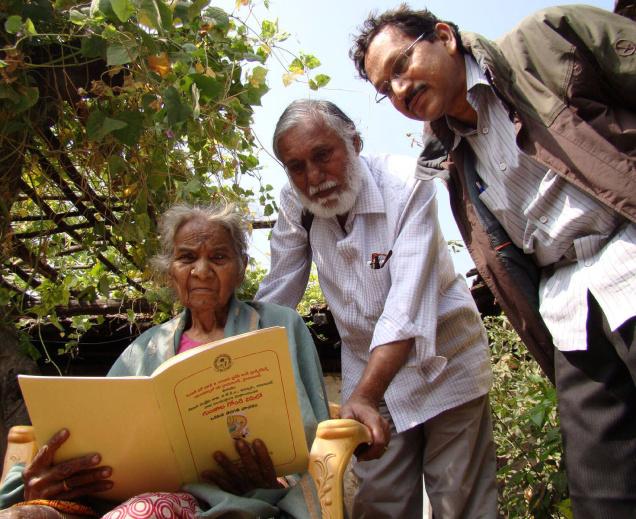
Worth preserving:Professors Jayadheer Tirumal Rao (left) and V. Krishna, University of Hyderabad, watch as Atram Kamalabai reads from a Gondi primer at Gunjala in Adilabad district on Saturday. / Photo: Harpal Singh / The Hindu

Kamakabai, the oldest woman literate in the community, has taught her son and granddaughter the language

Atram Kamalabai, the Gond from Gunjala village in Narnoor mandal of Adilabad district, has a good reason to feel elated as she has been receiving unexpected attention from her compatriots as well as people from ‘outside’ even at the ripe age of 95 years. She is perhaps the oldest woman literate, functional literate to be precise, in the adivasi community having learnt Gondi alphabet and numerals some nine decades ago.

A chance discovery of some manuscripts written in the almost-extinct Gondi script in this sleepy village in 2011 brought her all the attention needed from language aficionados. She has now become a role model as well as a driving force for those who have taken up the task of propagating the ancient script especially within Gondi community.

“My father taught me Gondi at the age of five which helped me assess correctly the quantum of produce in our farm and any transaction thereof. I used Gondi in day-to-day life,” recalls Kamalabai.

“It’s a matter of pride to know your own language,” she observes, as an afterthought. “That’s why I taught Gondi to my son Mohpat Rao and granddaughter Annapurna,” she adds.

“This is a rare occasion in adivasi ethos in the country that three generations in the same family are able to read Gondi script. Kamalabai has stuck to tradition by passing on her knowledge to the future generations,” points out Professor Jayadheer Tirumal Rao, retired Director of the A.P. Government Oriental Manuscripts Library and Research Centre and visiting Professor at the Centre for Dalit and Adivasi Studies and Translation (CDAST), University of Hyderabad, who called on the nonagenarian at her home on Saturday. He, along with CDAST coordinator Professor V. Krishna and Dr. G. Manoja of Palamuru University are currently involved in translation of the Gondi manuscripts found in Gunjala. “Research on Gondi script could lead to deciphering of proto-Dravidian languages,” Professor Jayadheer Tirumal Rao opines.

source: http://www.thehindu.com / The Hindu / Home> News> National> Andhra Pradesh / by S. Harpal Singh / Gunjala (Adilabad District) – January 19th, 2014

Vizag to house Bonsai Garden on the lines of New Delhi

Visakhapatnam :

Taking a leaf out of the National Bonsai Park in New Delhi, the Visakhapatnam Urban Development Authority (Vuda) has mooted a Bonsai Garden at Kailasagiri, one of the busiest tourist spots in the Port City, as part of its efforts to boost tourism. Vuda is presently busy preparing an action plan for the project and is likely to start on the garden by the beginning of this summer.

Confirming the proposal, Vuda vice-chairman, N Yuvaraj, said that they will be conducting a meeting with the officials concerned and Bonsai lovers, including the city-based Visakha Bonsai Society, at the Vuda office in the first week of February this year, to take a final decision on the Bonsai garden project.

Before that, the officials concerned, including Vuda’s divisional forest officer (DFO), will be given special training on Bonsai plantation and gardening in the last week of January. The garden will be the first of its kind public garden in the city, he added. People are presently seeing Bonsai plants at exhibitions only and there is no dedicated garden for these plants in the city.

“The Bonsai Garden was proposed in the Vuda board meeting. As so much of space at Kailasagiri is presently lying unused, we felt that the Bonsai garden will give a new look to the hotspot and may also serve as an attraction to lure more visitors to the spot,” Yuvaraj said.

To begin with, Vuda will invite all Bonsai lovers to extend their support to the development of the park. “Vuda will not be procuring Bonsai plants from across the globe but will depend on Bonsai lovers to come forward and voluntarily donate Bonsai plants to the garden. Vuda will spend around Rs 10 lakh in creating the initial infrastructure in the garden,” Yuvaraj added.

While P Lalitha, vice president, Visakha Bonsai Society, welcomed the Vuda’s decision to set up an exclusive Bonsai Park, she was not too happy about the location mooted by Vuda. “Kailasagiri is not a suitable place to display Bonsai plants as they cannot survive for long in sea breeze. Our society is very keen on YSR Park at Dwarakanagar for the garden and have already suggested that Vuda allocate us some space there for the Bonsai garden,” Lalitha told TOI.

According to Lalitha, Bonsai plants are mostly brought in from Kerala, Coimbatore and Kolkata in India apart from China, Japan and Singapore and their prices range from Rs 1,000 to Rs 1 lakh, depending on the size of the plant and species. “The maximum lifespan of a Bonsai plant is around 20 years. The Visakha Bonsai Society will be able to provide nearly 50 to 100 Bonsai plants to the garden and is ready to provide more if there is no space problem,” she said.

While admitting that the Visakha Bonsai Society had indeed earlier asked Vuda to allot space at the YSR Park for the Bonsai garden, Yuvaraj said, “Though the Visakha Bonsai Society had sought space at YSR Park for the Bonsai Garden, Kailasagiri was finalized as we wanted to set up the garden at the earliest. At present, Kailasagiri has adequate space for the project while YSR Park has not yet been readied and will take nearly nine months to complete. We will think about a Bonsai garden at YSR Park once it is ready.”

source: http://www.articles.timesofindia.indiatimes.com / The Times of India / Home> City> Visakhapatnam> Vudu / by V. Kamalakara Rao, TNN / January 18th, 2014

CCMB may grow apples in Araku Valley of Andhra Pradesh soon

Hyderabad :

While the Greek hero Hercules wanted to possess the fruit desperately, Adam – the first man in Abrahamic religions – apparently couldn’t resist eating it and was then desperate. Whatever the reasons, few fruits have enjoyed the clout of apple, one of the oldest cultivated trees on Earth.

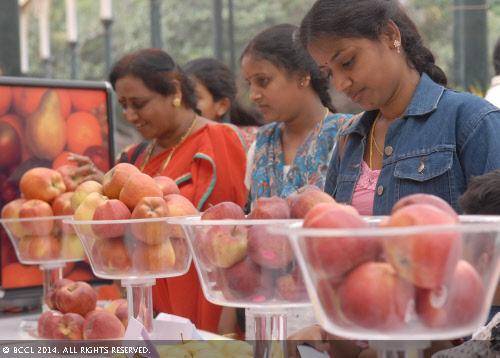
In India, its farming has so far been limited mostly to the Himalayan region – Kashmir, Himachal Pradesh and Uttarakhand as well as pockets of the North East. But if scientists at Hyderabad’s Centre for Cellular and Molecular Biology (CCMB) have their way, they could soon be grown in Araku Valley of Andhra Pradesh.

For some time now, the changing climatic conditions in the Himalayan region have been hurting apple production, forcing scientists to look for alternatives. Know as the Kashmir of Andhra Pradesh, Araku is blessed with a temperate climate and low temperatures that is suited for growing apples; at least, in theory.

(CCMB may grow apples in Araku…)

Situated at about 3,600 feet above the sea level, the Araku Valley area records temperatures of 1-5 degrees centigrade during winters. “Since apples are grown at high altitude areas with low temperatures in winters, we hope the locations in the Araku valley area that we chose for the experiment will yield positive results over the next four-five years,” said Ramesh Aggarwal, who heads a team of CCMB scientists working on the project.

GardenofEdenHF28jan2014 The CCMB scientists are exploring the prospects of growing the fruit – which originated in the Central Asian region, most likely Kazakhstan – in the Lambasingi and Chintapally regions of Araku in Andhra Pradesh’s Visakhapatnam district.

The scientists began work a few years ago to develop new breeds that are resistant to changing climatic conditions while ensuring high yields as part of a genomics sequencing project sponsored by the Department of Biotechnology. They hope to identify genes that give the plant characteristics such as disease and drought resistance. Today there are more than 7,500 varieties of apples grown worldwide, of which at least 300 are cultivated in India commercially. It is said that Alexander the Great first brought the dwarf varieties to Europe (Macedonia) in the fourth century BC, from where it found its way to the rest of the world.

Aggarwal said his team recently visited Araku valley and held discussions with local farmers, non-governmental organisations and researchers to explore growing apples there. If the Araku experiment succeeds, the scientists plan to replicate it in other hilly regions of the South, including the Nilgiris in Tamil Nadu and Coorg in Karnataka.

“To begin with, we will experiment with some 100 saplings of seven leading apple varieties by this month end and increase the number of plants to around 500 over the next one year,” said Aggarwal.

In India, the fifth-largest producer of the fruit worldwide, apples were first grown only towards the end of the 19th Century. But it was Samuel Evans Stokes, or Satyananda Stokes as he was later known, who introduced apple cultivation to Himachal Pradesh in the early part of the last century.   Today, it is the major horticultural export crop of the state.

The CCMB scientists are sourcing the saplings of apple variants from Dr YS Parmar University of Horticulture and Forestry at Solan in Himachal Pradesh.

Senior principal scientist at CCMB, A Veerabhadra Rao said studies showed that the climate of Chintapally region was identical to California and Florida in the United States, where apple is grown on a large scale.

Venugopal Rao, head of research at Acharya NG Ranga Agricultural University at Chintapally, said if the results of the experiment are positive, a memorandum of understanding with CCMB will be signed to implement the project on a larger scale.

source: http://www.articles.economictimes.indiatimes.com / The Economic Times / Home> News> Economy> Agriculture> Andhra Pradesh / by Raji Reddy Kesireddy, ET Bureau / January 18th, 2014

Millennium trauma centre inaugurated in government hospital

Andhra Pradesh Governor ESL Narasimham inaugurated the massive five-storeyed Millennium trauma centre in the 1100-bedded government Hospital premises here.

The trauma centre has been named the ‘Podili Prasad Guntur Medical College Alumni of North America (GMC ANA) Millennium Super Specialty Trauma Centre’.

The new block houses the trauma care centre and the proposed super specialty wing for economy bypass surgeries and liver transparent surgeries for which the hospital currently does not have sophisticated equipment or trained super specialist doctors.

source: http://www.business-standard.com / Business Standard / Home> PTI Stories> National> News / by Press Trust of India / Guntur (AP), January 17th, 2014

NIMS Plans Hospital Information System

Nizam’s Institute of Medical Sciences (NIMS) here is set to become the first government hospital in the state with an established Hospital Information System (HIS). Though the discussions on HIS have been going on for the last five years, the cash-strapped hospital is finally set to begin the process of HIS from January 26.

While private hospitals across the country have a well established Hospital Information System (HIS), government hospitals do not. At least, no government hospital in Andhra Pradesh is equipped with HIS. This, senior doctors say, is due to their keenness to hide corruption and make transparency difficult in administration.

The HIS is a comprehensive, integrated information system designed to manage all the aspects of a hospital operations, such as medical, administrative, financial, legal and the corresponding service processing. This, officials at NIMS say, will be a significant step towards bringing  transparency in the hospital that lacked financial and administrative discipline.

According to them, it had become extremely difficult in tracking down files regarding purchases, material management, patient management, lab investigation and online reporting, records maintenance, etc at NIMS.

A deal was recently struck with the government agency CDAC for installation of the system in the hospital. It is learnt that the same form of systems would be extended by the state government in other government hospitals too.

Speaking about the new integrated system, NIMS director Dr L Narendranath said, ‘’We plan to make it fully operational in a year. The state government will pay for the software and NIMS for the hardware and customisation of software. The process will take place department by department,” he said.

The new system, estimated at Rs 15 crore, is meant to plug all the loopholes in revenue losses, provide better monitoring and efficient healthcare. ‘’All machines will be interfaced with computers. The minute one sample goes into the machine, all the details and reports relating to that will be available on the computer which can be accessed centrally. This would save all the paper work and the manpower used in different stages of data entry could be better utilised,” said an official.

source: http://www.newindianexpress.com / The New Indian Express / Home> Cities> Hyderabad / by Rahul S. Pisharody  – Hyderabad / January 18th, 2014