Lion-headed legacy

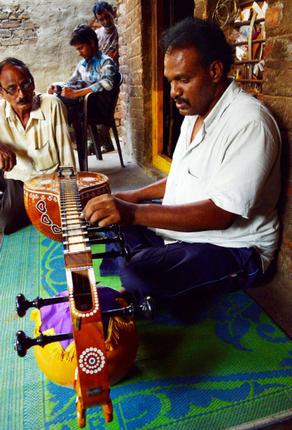
TOUCH OF CLASS:Artisans at work at the Craft Development Centre in Gollapalli.Photo: K.R. Deepak / The Hindu

As the sombre strains of the Bobbili veena fade into the sunset, Sumit Bhattacharjee takes a look at the indigenous instrument’s storied history and sad present.

Pedda Rayudu, the 15th descendant of the Rajah of Venkatgiri and the founder of the town and the kingdom of Bobbili, was a connoisseur of the arts. The royal instrument was the veena and it was the men of Bobbili who played the instrument in court. The veenas, then, were imported from Thanjavur. They were, in other words, Thanjavur veenas.

The Bobbili veena came much later, during the 19th century, and its birth is believed to hark back to a concert at the royal court, after which the king showered compliments on his highly regarded master craftsman Sarvasidhi Achanna, saying that he had the ability to create anything. This prompted a challenge from Ch. Musanana, a maker of veenas from the Vizianagaram kingdom. Would Achanna be able to craft a veena? Within two months, Achanna responded with an instrument that came to be known as the Bobbili veena.

The story now shifts to the present day, to the Sarvasidhi family in Gollapalli village, near Bobbili in Andhra Pradesh. Forty families, all from the Sarvasidhi clan, make a living by manufacturing the musical instrument. Sarvasidhi Achutanarayana, the great grandson of Achanna, says, “There is no formal training involved. The children get drawn towards it, as they grow up watching the elders carve and create the masterpieces. As in the guru-sishya tradition, each child is put under the tutelage of one senior member. The induction normally happens when they are five years old. They pick up the art by making small wooden toys, initially. There is no compulsion or restrictions. Even girls learn the art.” This is how it has been for seven generations.

Bobbili veenas are made from jackfruit wood, and a full-size veena stands out from the ones made at Thanjavur, Mysore, Kerala or Nuzvid because of the lion’s head carved at one end. The frets of Bobbili veenas are made of bell metal, while other veenas use brass. Earlier, the Bobbili veenas were known as “ekanda veena”, as they were made or carved out of one single piece of wood. But due to the paucity of good jackfruit wood, the veenas now have two joints. The other veenas have two or more joints.

Veena exponent Jayanthi Kumaresh says, “Bobbili veena is known for its quality of wood. Other veenas like the ones manufactured in Mysore are made of rose wood. I buy veenas from a maker in Bangalore who owns a jackfruit farm.”

Jackfruit wood

Achutanarayana agrees that wood is the most important ingredient. “The wood has to come from a jackfruit tree which is at least 20 years old. It should be seasoned and it should have the required kind of grain to suit the manufacturing.” For the Sarvasidhi family, procuring good jackfruit wood has become a problem and the government does not encourage jackfruit farming. “That’s the reason why we have stopped manufacturing the Ekanda veena.”

The Bobbili veena also stands out from other veenas because it is smaller in size. Jayanthi says, “The casing is much thinner compared to the others and the sound is shriller and more aristocratic. The treble is more in Bobbili veenas when compared to the others, where the bass is more. But now, many professionals tend to customise their instruments. They pick up the best from each variety and tailor-make veenas to suit their need.”

It was Chitti Babu Challapally and Dr. Emani Sankara Sastry from Andhra who gave the Bobbili veena international recognition. Jayanthi says, “The Andhra style of playing on Bobbili veena is considered attractive. The technique is different and the speed is more.”

Declining fortunes

Achutanarayana echoes the strain of concern found in older practitioners of other arts and crafts, who fear that their traditions might vanish. “The present generation is not very keen on taking up the craft. They are well educated and they intend to take up jobs in cities. Unless the government finds a way to make the trade lucrative, it will be difficult to hold them back,” says Achutanarayana.

The trade has never been lucrative. To keep the home fires burning and to save the art from sinking into oblivion, these veena makers started their own co-operative, the Sharada Veena Society, in 1959. But the orders were still dwindling, due to the declining patronage of the wealthy. Finally, with the intervention of the state government, a Craft Development Centre (CDC) was set up in 1994 at the Bobbili Fort, and it was later shifted to its present building at Gollapalli village.

Veena exponent and teacher Ramavarapu Vijaylakshmi feels that the demand is shrinking as the love and passion for classical music is dwindling. “Earlier, parents would send their children, especially the girls, to learn some form of music, be it instrumental or vocal. But today, they would like to see their children as dancers, cricketers and academic scholars. This confuses children, who are already bombarded with pop music and dance through the television.” The drop can be attributed to other reasons like academic pressure, says veena exponent Pappu Padmavathi. “Also, the veena is one of the most difficult instruments to learn. It takes at least 10 to 12 years to reach the first level of professional playing.”

At a time the craftsmen were finding it difficult, T.V.K. Sastry of Bharat Cultural Integration Committee came to their rescue. He placed orders for miniature veenas, which the Madras Telugu Academy started presenting as mementos during its cultural shows and festivals. “The tradition of gifting the instrument was initiated by the kings of Bobbili,” says Achutanarayana. “The veena was the royal gift to visitors from neighbouring states and the United Kingdom.”

Today, there are more orders for miniature veenas than for the full-size ones. The CDC manufactures 200 to 300 miniatures a month and earns to the tune of Rs. 1 lakh. The craftsmen make them in four sizes — 9 inches, 13 inches, 18 inches and 24 inches long — and the veenas are marketed by the AP Handicrafts Development Corporation (Lepakshi).

But this isn’t enough. To sustain this great tradition at Gollapalli, the Government needs to look into jackfruit plantations and add value to the CDC. More veena schools need to be started in order to increase patronage. But who, and how will you tell youngsters to take up the profession?

LionsheadANDHRA04oct2014

a full-size veena stands out because of the lion’s head carved at one end.

source: http://www.thehindu.com / The Hindu / Home> Features> Sunday Magazine / by Sumit Bhattacharjee / April 29th, 2012
Nuzvid veena maker bags best artisan award

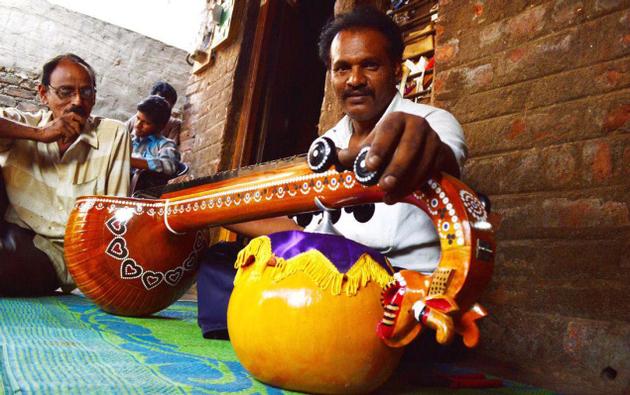
Nuzvid Veena maker Sheik Mabu Saheb training youths at his residence in Nuzvid in Krishna district. Photo: T. Appala Naidu / The Hindu

Sheik Mabu Saheb, a renowned Nuzvid veena maker of Krishna district, has received the Best Artisan Award-2013 from the Andhra Pradesh Handicrafts Development Corporation Limited for his work – Veena with peacock design.

He bagged the award in the category of Veena Making in which artisans from Bobbili were also in the competition. Mr. Saheb had stolen the hearts of the jury members with his small size veena that produces vibrations and sound like any other professional-size veena. “The award is recognition to the art rather than an individual artiste. Despite having a great demand for veena from the world of Indian classical music, shortage of veena makers is still creating problems for the industry’s growth,” Mr. Saheb told The Hindu.

Nuzvid Veena maker Sheik Mabu Saheb training youths at his residence in Nuzvid in Krishna district. Photo: T. Appala Naidu / The Hindu

Handicrafts Department Assistant Director K.N. Murali Krishna said plans were afoot to use the services of Mr. Saheb in training youth in veena making and designing. In a guru-shishya parampara, Mr. Saheb learnt that art from his father Sheik Meera Saheb, one of the first generation veena makers alive. According to Mr. Mabu Saheb, there were only nine veena makers engaged in the profession, spreading the art.

source: http://www.thehindu.com / The Hindu / Home> News> Cities> Vijayawada / by T. Appala Naidu / Nuzvid – July 10th, 2014

NEIGHBOURHOOD WATCH : A sight for sore eyes

A view of the APSEB Colony in Visakhapatnam. PHOTO: A. Manikanthakumar / The Hindu

APSEB Colony looks like a family get-together. The colony association has a separate wing for women headed by C. Sujani. She says, “A lot of planning goes behind every initiative that we undertake as a team.

The programme is set. Women keep a tab of their to-do list.

Men get busy, collecting funds and listing out the number of guests to send an invite.

The community hall at the Eastern Park is beaming with a fresh look as people at Andhra Pradesh State Electricity Board (APSEB) Colony bond over Navratri celebrations.

It looks more like a family get-together where every individual in the neighbourhood has a role to play. Residents enjoy taking ownership and contribute to the extent possible during special occasions. Women meet and decide on the delicacies offered to ‘Ammavaru’ to be installed and decked up in various avatars for all the 10 days at Sri Chelasani Narayana Rao Memorial Community Hall during the festival, commencing in a couple of days.

Though the 16-acre site of APSEB Colony charms one with its green canopy, well-built houses and better amenities, what makes the place more adorable is its people living here for decades. “Years before, the place was occupied by the employees of APSEB. Over a period of time, half of the colony residents have moved out to meet professional demands, paving the way for diverse communities. Despite a new breed of professionals seeping into the colony, what continued to stay is our unity,” says G.S.N. Murthy, chairman of APSEB Colony Welfare Association and a colony resident.

GlanceANDHRA03oct2014

Planning

The colony association has a separate wing for women headed by C. Sujani. She says, “A lot of planning goes behind every initiative that we undertake as a team. Be it birthday celebrations, special occasions or kitty parties, we coordinate with one another before drawing a conclusion.”

Reminiscing about the olden days, K. Kanakadurga, a retired lecturer, who has been residing in the neighbourhood for the past 33 years, says, “A dull day at work would transform into a different world as soon I reach home as the scenic beauty of the locality has its own charm to lift my spirits.”

source: http://www.thehindu.com / The Hindu / Home> News> Cities> Visakhapatnam / by Rani Devalla / Visakhapatnam – October 01st, 2014

City to get intellectual hub

Visakhapatnam :

Now, an ‘intellectual hub’ is being set up in the city. Headed by a neuro-psychiatrist, the hub named Virtue Centre will enable intellectuals and interested people to participate in discussions, brainstorming sessions, and idea-generating forums.

It will also nurture creativity, study social issues, give reports and encourage social entrepreneurship.

The hub also aims at facilitating growth of individuals, industries and institutions through innovation, idea generation, executive training, project consultancy, partnerships and inter-disciplinary linkages and cross cultural exchanges. Discussions will be held once a week with focus on education, innovation and implementation of ides.

Dr C Radhakanth, director of the hub, said it will be located at Zilla Parishad junction.

“As of now we will collaborate with the psychology department of Andhra University for education, IT professionals for innovations, and consultants from management institutes and IIMs for implementation.”

“Having worked with intellectually deficient and intellectually proficient, those with issues like mental retardation, Alzheimer’s, dyslexia, and autism, along with those who have no health problems but are ‘situationally distressed’, I feel it’s time to start contributing ideas for positive living, problem solving, intellectual development and creativity,” he added.

source: http://www.timesofindia.indiatimes.com / The Times of India / Home> City> Visakhapatnam / TNN / October 02nd, 2014

18-yr-old skater does Vizag proud

Visakhapatnam :

Petite Malipeddi Praneeta did her hometown proud by clinching the silver medal in the 16th Asian Roller Skating Championship held at Haining, China, from September 19 to 24. The second-year MBBS student, studying at the Andhra Medical College, won the silver in the Pair Dance Category (artistic) along with her Hyderabad-based partner Anup Kumar Yama, who is the current world champion in artistic skating.

Speaking to TOI here on Saturday, 18-year-old Praneeta however sounded a bit disappointed despite her success. “I was expecting to win a medal in the individual figure skating event, but I missed out and stood fourth. However, I’m happy that I did well in the pair event.”

Praneeta, who has been a national champion in figure skating for the last four years, both at the junior and senior levels, started skating at the Shivaji Park rink from 2005-2006 and since then has been rigorously trained by her coaches, P Satyanarayana, Chitti Babu and Mahesh.

Praneeta had earlier participated in the junior category of the World Artistic Roller Skating Championship in 2009 that was held at Freiberg, Germany, and is now ranked 18th in the world in the senior category. Talking about her immediate priorities, Praneeta said, “I wish to break into the top-10 in the figure skating event by next year.”

The daughter of a cardiologist, Dr M Bhaskar Rao, Praneeta too dreams of becoming a cardiologist like her father. However, she made it clear that she it would not be at the cost of roller skating.

source: http://www.timesofindia.indiatimes.com / The Times of India / Home> City> Visakhapatnam / TNN / September 28th, 2014

Being a postcard collector…

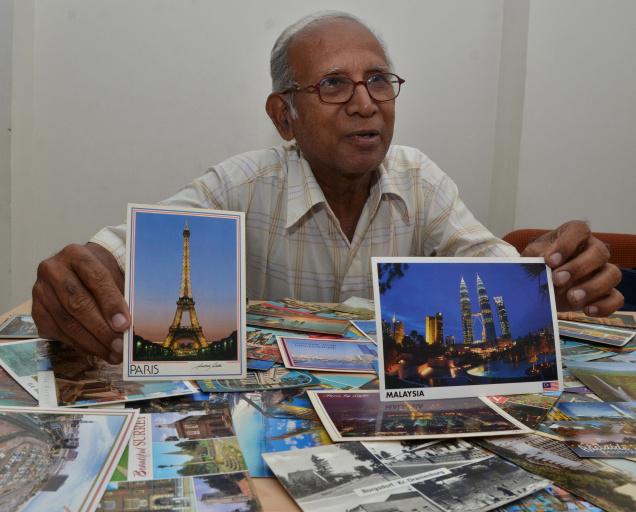
A. Babu Rao exhibiting his rare collection of postcards in Vijayawada. PHOTO: V. Raju

Name any tourist destination, Attada Babu Rao, who has collected 800-odd postcards, has a montage to show and a story to tell.

It was perhaps his keen interest in people and places; their physical environments – natural and manmade- as well as customs, pastimes and amusements that spurred Attada Babu Rao to take to deltiology (an official term for collecting and studying postcards).

At 65, he has a vast collection of postcards with images of tourist destinations across the globe that can set one on an enchanting journey through history via beautiful locales. Exhibiting his prized collection on the World Tourism Day (September 27), the sexagenarian talks endlessly about how he had managed to get these colourful post cards from every nook and cranny of the world through his several pen pals scattered across the globe. “I don’t think many people are into deltiology. Collecting postcards can be a rewarding pastime,” he says, pointing to images of historic sites, tourist attractions and resorts besides famous industries, schools, churches.

A philatelist and a numismatist, he gradually diversified to deltiology way back in 1970. “Most of these postcards are very difficult to come by now. I had nearly 130 pen friends across the world, who are now reduced to merely 10, thanks to the internet,” he says with a wry smile.

A couple of months ago, when he approached the Limca Book of Records with a collection of 800-odd postcards, the latter asked him to come back after adding a 100 more. “I have time till June next year. By then, I may even cross the 1,000-mark,” he says, imbued with enthusiasm.

Toss a query on a particular tourist place and he spreads out dozens of postcards, creating a montage of colours splashed across, with famous monuments like the Golden Gate Bridge at San Francisco, the Eiffel Tower of Paris, Malaysia’s twin towers, Australian beaches, waterfalls in Nigeria and hordes of other breath-taking scenes from Germany, Denmark, Italy, Bahrain, Japan, Singapore, Honk Kong among others narrating a historic tale.

Upset over not being able to make a hat-trick by having his name enrolled in the Record Books for third consecutive year, he says he will put a full stop after third attempt.

Ask him what next and his smile returns. “The hunt will never cease.”

source: http://www.thehindu.com / The Hindu / Home> News> Cities> Vijayawada / P. Sujatha Varma / Vijayawada – September 28th, 2014

Eco-friendly Ganesha enters Book of Records

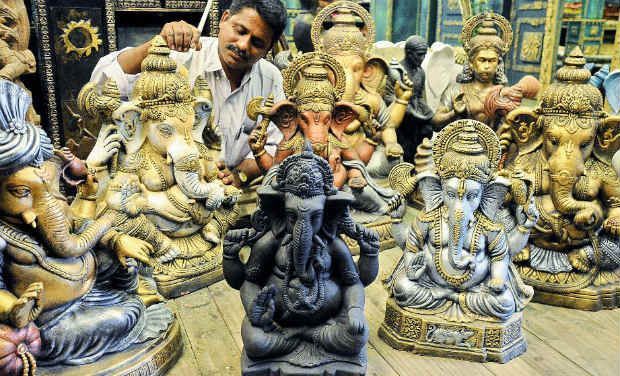
Picture for representational purpose.

Srikakulam:

Sri Balaganapathi Uddanam Youth Club members of Borivanka village got recognition from the India Book of Records for worshippinge eco-friendly Ganesh idol on the occasion of Ganesh Chathurdhi this year. The youth club members made Ganesh idol with paddy seeds which was eco-friendly and innovative. “We used 50 kgs of paddy seeds and made 10 feet high Ganesh idol and worshipped it,” said the youth club member  B. Tirupathi Rao on Monday. “We communicated our novel idea to India Book of Records and the records team of Faridabad recognised our effort and sent a communication to us for its inclusion in their coming edition,” he added.

By the time of immersion of Ganesh idol, germination of seeds started, the member explained.

source: http://www.deccanchronicle.com / Deccan Chronicle / Home> Nation> Current Affairs / DC Correspondent / September 30th, 2014

Tirumala Navaratri Brahmotsavam festival to begin on Friday

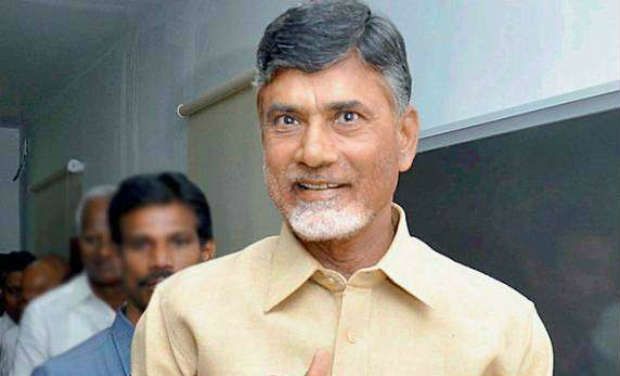
Andhra Pradesh Chief Minister N Chandrababu Naidu

Tirupati:

The nine-day annual Brahmotsavam festival at the hill shrine of Lord Venkateswara near here will begin with the hoisting of sacred Garuda flag atop the golden ‘dwajasthambham’ (flag mast) tomorrow.

Temple officials said tight security arrangements have made on the seven hills and in Tirupati for the smooth conduct of the Navaratri festival.

Andhra Pradesh Chief Minister N Chandrababu Naidu would arrive on the hills in the afternoon on a five-hour visit.

Later in the evening, observing the three and half decade old practice, Naidu, on behalf of the state government, would offer a set of new silk clothes to the shrine on the occasion of the advent of the festival, officials said.

The high priests of the hill temple would receive the clothes from Naidu.

The clothes would be adorned on the presiding deity on the ‘Garudaseva’ day on the fifth day of the Brahmotsavam on September 30, they added.

source: http://www.deccanchronicle.com / Deccan Chronicle / Home> Nation> Current Affairs / PTI / September 25th, 2014

DD to launch exclusive Telugu channel for residuary Andhra Pradesh

Doordarshan’s regional language channel for residuary Andhra Pradesh would be launched in Vijayawada, the proposed capital region of the State, on September 27.

Andhra Pradesh Chief Minister N Chandrababu Naidu would launch the channel, Doordarshan Saptagiri, in the presence of Union Ministers Prakash Javadekar (Information & Broadcasting) and M Venkaiah Naidu (Urban Development), an official release said today.

The channel is being launched in the wake of bifurcation of Andhra Pradesh. The newly-formed Telangana would have its own channel.

The release quoted Doordarshan Deputy Director General Sailaja Suman as saying the channel would have programmes blending cultural, political, economic, science and technology issues and aim at attracting the substantial population of youth.

source: http://www.dnaindia.com / DNA / Home> News> India / Place: Andhra Pradesh, Agency:PTI / Thursday – September 25th, 2014

Poet Jashuva remembered

Collector Kantilal Dande garllanding a statue of poet Gurram Jashuva on the latter's 119th birth anniversary in Guntur on Sunday. PHOTO: T. Vijaya Kumar / The Hindu
Collector Kantilal Dande garllanding a statue of poet Gurram Jashuva on the latter’s 119th birth anniversary in Guntur on Sunday. PHOTO: T. Vijaya Kumar / The Hindu

The stirring poetry written by Gurram Jashuva has mirrored the primordial prejudices and caste exploitation and it’s a matter of pride that Jashuva hailed from Vinukonda in Guntur district, Collector Kantilal Dande has said.

Paying rich tributes to the poet on his 119th birth anniversary, he said modern Telugu poet Jashuva was hailed as `Viswa Kavi,’ for his all encompassing poetry touching all aspects of society. The day saw a host of Ministers, MLAs and officials paying tributes to the bronze statue of Joshua near the District Court Complex.

Minister for Agriculture Prathipati Pulla Rao said that the State government was committed to construct a cultural auditorium in honour of Jashuva. Social Welfare Minister Ravela Kishore Babu said that the legacy of Jashuva had not been limited to a particular section of the society but was embraced by one and all.

MLC K.S Lakshmana Rao demanded that a cultural centre be built in Guntur in honour of Jashuva.

The meeting had its share of nostalgia with several poets reading out verses from Joshua’s famous works, ‘Gabbilam’ and ‘Firadausi’. P.V. Ramana too had the audience spellbound with his rendering of some verses from Joshua’s works.

Literary critics said Joshua was the first Telugu poet to give voice to the exploited and the oppressed and his use of pastoral imagery in ‘Gabbilam’ was in stark contrast to the symbolic imagery used by earlier poets.

source: http://www.thehindu.com / The Hindu / Home> News> Cities> Vijayawada / by P. Samuel Jonathan / Guntur – September 29th, 2014