City youth Naga Sravan Kilaru has been selected for the National Youth Award 2015-16 by the Union Ministry of Youth Affairs & Sports for his efforts in empowering and driving youth towards social service and strengthening democracy.
Mr. Sravan heads Vijayawada Needs U (VNU), an NGO here and has attended various international youth conventions.“I am informed by the Ministry of Youth Affairs, Government of India, that I am honoured with the National Youth Award. The award will be presented by the President of India on January 12 at the opening ceremony of the National Youth Festival,” Mr. Sravan told The Hindu.
Mr. Sravan said the award was making his responsibility towards strengthening advocacy for youth rights and democracy, more. The six-day youth festival will be held in Jaipur, Rajasthan.
Youth working in the fields of entrepreneurship, health, research and innovation, culture, human rights, art and literature and others get selected for the award.
source: http://www.thehindu.com / The Hindu / Home> News> States> Andhra Pradesh / Staff Reporter / Vijayawada – December 28th, 2017
Suresh Babu atop Mount Kilimanjaro in Tanzania. | Photo Credit: BYARRANGEMENT
Braving the cold weather, Suresh Babu, a first year B.Sc. student of Silver Jubilee Government College in Kurnoolclimbed Mount Kilimanjaro in Tanzania, the highest mountain peak in the African continent, on December 25, the college principal S. Abdul Khader said on Tuesday.
Mr. Suresh Babu climbed Mount Everest in April this year.
He scaled the Gilman’s Point at a height of 5,685 metres and displayed his college banner there. TDP MLA B. Jaya Nageswar Reddy and Maheswara Reddy of Madhu Cements at Kodumur, sponsored his mountaineering expedition.
source: http://www.thehindu.com / The Hindu / Home> States> Andhra Pradesh / by Special Correpondent / Kurnool – December 27th, 2017
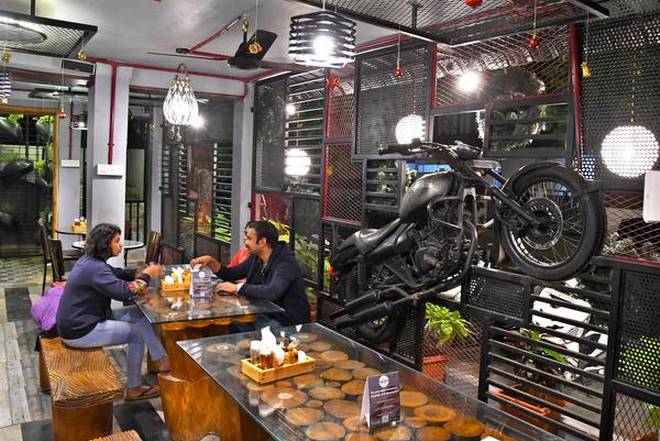
People hanging out at the newly opened Gluttons Garrage restaurant | Photo Credit: K_R_DEEPAK
A new generation of young entrepreneurs is bringing about a transformation to the nature of food business by moving away from the beaten track
From building foodie networks and experimenting with food fusion concepts to hosting the city’s first food truck festival and a drive-in restaurant concept, the year 2017 was one that saw a slow, but definite transformation in the food space of the city. Foodpreneurs didn’t shy away from exploring lesser known concepts, injecting a new excitement into a business and introducing concept eating-out places, which catapulted the city’s foodscape to a new level. If the food truck culture swelled, cafes came up with a plethora of activities to engage in innovative ways with the consumer. There were open mic events, events to bring together foodies of the city, live bands and interesting contests surrounding food – all of these kept the city’s food calendar busy.
Networking over food
Says Sumanth Behara of Plot 17, “People have become much more experimental with food. A big part of it comes from travel. As more people step out of the city and experience the food and culture elsewhere, it also opens up their mind. This has helped the city’s food scene to evolve. Cafes and restaurants have mushroomed over the past one year and it is all a great positive sign.” Experimenting with its menu and introducing sub-brands for its bakery unit were some of the initiatives done by Plot 17 over the year. It also hosted a unique event this month called ‘Communeaty’ with an aim to create a foodie network bringing together food aficionados who want to meet new people and share their passion. “The idea behind ‘Communeaty’ is to build a foodie community in Vizag where the group can collectively go and explore new eating-out options in the city. It is a common concept in Hyderabad and Bangalore. In the coming year, we want to host one ‘Communeaty’ event every month and also host similar events in other cafes and restaurants once we perfect our model,” says Sumanth. The first event saw an enthusiastic participation of over 40 people. The concept is a win-win arrangement for food lovers and cafes or restaurants in the city. The foodie networks keep the culinary scene vibrant, exploring new pairings and flavours while meeting like-minded foodies.
Fusion food
The year also saw the city’s restaurant and cafe culture evolve to offer a concept of ‘fusion’ food. One of the refreshing places to come up in the city was Gluttons Garrage, a place that seeks to symbolise the meaning of ‘fusion’ when it comes to food. Here, you can order your regular wheat base pizza with broccoli or opt for other unusual options such as pizzas with lamb curry and gongura chicken. Pastas with oats, flaxseeds and also chocolates form a part of its interesting menu. “Idea is to give a fusion of cuisines. For instance, a mix of Italian and Indian in one plate. We also want to offer two contrasting food concepts – fusion food as well as health food. The city now is willing to experiment when it comes to food and it is great to see many foodpreneurs trying out new things,” says Robert Rejoice Kumar, the mind behind Gluttons Garrage. The place has three different sections – Junktion 77 which offers a mind-boggling range of fusion food, Kaloreez – the healthy food segment and Just Not Shakes with health juices and shakes and will soon introduce cold pressed juices. Varieties in cuisines and dishes remained the highlight in the city’s new cafes and restaurants, décor played a very important role in drawing the young crowd. Several residential areas like Seethammadhara saw interestingly-themed cafes opening up like The Hungry Hippo, which gave a funky look to the décor.
If concept cafes and restaurants took the food scene forward, food festivals brought about new dimension to the eating-out culture. The recently-concluded food truck festival was one of the concepts that struck well with the people of Vizag. The festival brought the food trucks of the city on place and pepped up the festival with live music and a flea market enlivening the atmosphere at the beachside venue of MGM Grounds. Vizag also saw its first drive-in concept restaurant open at Lawsons Bay Colony when Vizag Drive-In brought together different brands under a single platform offering burgers, grills, pizzas, idlis, biryani, ice-creams and shakes. “The response has been overwhelming. We have been getting requests from several other firms to be a part of Vizag Drive-In. But as of now we are restricting to 10 brands,” P. Naga Rajesh of Vizag Drive-In.
As the year 2017 wraps up, it is bringing in many more exciting news from the food and beverage sector. The entry of micro-breweries in the city is expected to give a boost to the food and entertainment scene. In February the city will host the three-day Ground Zero Festival that will be themed around food, travel and lifestyle.
source: http://www.thehindu.com / The Hindu / Home> Life & Style> Food / by Nivedita Ganguly / December 23rd, 2017
With the help of her girl students, whom she used to teach music, Mrs. Cousins worked on the tunes for ‘Janaganamana.’
He sang something like a piece of geography… and in the second verse a list of the religions in India…
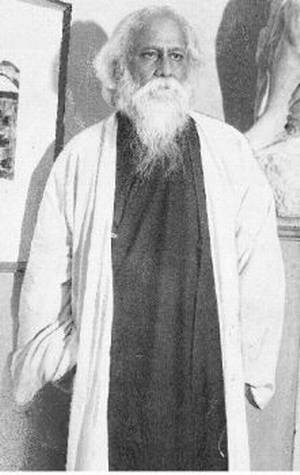
Author of the anthem: Rabindranath Tagore.
The National Anthem was written by Rabindranath Tagore as early as in 1911 and was sung at the annual session of the Indian National Congress at Calcutta on December 27 that year. But it was in Besant Theosophical College, Madanapalle, where Tagore stayed for a few days in February 1919 that the now familiar tune was set. It was Margaret Cousins, wife of educationist, James H. Cousins, who composed the tune for ‘Janaganamana.’ Dr. James Henry Cousins was then the Principal of the Madanapalle College that was established by Dr. Annie Besant.
Tagore was on a tour of South India and was much tired when he reached Bangalore in the last week of February 1919. On the advice of C.F. Andrews, he decided to rest at the Theosophical College in Madanapalle, about 120 km, south-east of Bangalore.
Besides several firsts of national importance, Madanapalle also had a first grade college started by Annie Besant in 1915. Besant’s involvement in the freedom movement prompted the Government to cancel its affiliation to Madras University. Undaunted, Dr. Besant named the college “Wood National College,” after Prof. Ernest Wood, educationist and a close follower of Dr. Besant. She got it affiliated to the National University at Madras, which was newly organised by the Society for the Promotion of National Education, (SPNE) for which Rabindranath Tagore was the Chancellor. When it was suggested that the quiet atmosphere at Madanapalle College as the right place to rest, Tagore was only happy for he felt that he would be with the staff and students of the college affiliated to the National University. Tagore also felt happy to be in the company of Dr. Cousins whose poetry in English he always admired.
Song set to tune
Rabindranath Tagore’s stay in Madanapalle College became momentous because the song ‘Janaganamana’ was given the melody of the musical tunes with which it is now sung all over the country. Till then the song never had a uniform tune. People were signing it as they liked in varied ways with great regional variations.
It was the practice with Dr. and Mrs. Cousins to hold informal meetings with the college community on every Wednesday night after dinner called “sing song fun session”. It was usually a programme of healthy hilarity and fun. Tagore, who joined the gathering asked if he might sing one of his poems.
Writing about how the song was first heard by them as sung by Tagore himself, Dr. Cousins recounted thus: “In a voice surprisingly light for so large a man, he sang something like a piece of geography giving a list of countries, mountains and rivers; and in the second verse a list of the religions in India. The refrain to the first verse made us pick up our ears. The refrain to the second verse made us clear our throats. We asked for it again and again, and before long we were singing it with gusto: Jaya hai, Jaya hai, Jaya hai, Jaya Jaya Jaya Jaya hai (Victory, victory, victory to thee).”
The large assembly gathered that night was overjoyed at listening to the song ‘Janaganamana’ from Gurudev himself who penned it. Mrs. Cousins, who was highly gratified at the rich thought content of the poem, decided to give suitable tunes to it. She was herself a musician having taken a degree in music from the University of London. The next day, she discussed with Tagore on the notations and the general theme of the song. Tagore explained the nuances of the poem and indicated broadly the “swara” for the song.
With the help of the girl students of the college, whom she used to teach music, Mrs. Cousins worked on the tunes for ‘Janaganamana.’ She carefully studied the meaning of each line of the song and composed the musical notes. When she was ready with the final version of her composition, she spoke to Gurudev and briefed him on the swara she composed. With the staff and students assembled in the same classrooms, where Tagore sang it the previous day, Mrs. Cousins with the help of her students, to the accompaniment of a few simple musical instruments and in the presence of Tagore, rendered the entire song to the tune she composed.
The assembled audience was thrilled when Tagore spoke a few words appreciating the melody of the tune and the efforts of Mrs. Cousins in composing it. Thus the poet had approved the tune making it as the final form of his popular Bengali song, ‘Janaganamana.’
About this event, Dr. Cousins in his autobiography states: “It made literary history and carried the name and thought of Tagore into the minds and hearts of millions of young in schools and colleges and outside them and ultimately gave humanity the nearest approach to an ideal national anthem. It happened, as so many great events of the spirit do, without anticipation and without collusion.”
English translation
It was during his stay in the college, that Tagore also translated ‘Janaganamana’ into English. For a few days, early in the mornings, basking in the winter sun, Tagore sat on a stone-slab under the Gulmohar tree in front of his cottage and went over his Bengali song. ‘Janaganamana,’ line by line finding the equivalent words in English. He wrote in his own beautiful handwriting and named it as the “Morning Song of India.” At the bottom of the translated version, he signed his name, dated it as February 28, 1919 and presented it to Dr. James Cousins.
Later when the College was in financial crisis due to the withdrawal of grants by the government of Madras consequent to the participation of the faculty and students of the college in the Home-Rule agitation started by Dr. Anne Besant, the “Morning Song of India” document in Tagore’s handwriting was sold to an American art collector for a fabulous but undisclosed price. The money thus collected was added to the college fund. However, a photocopy of it was made before the original left the country forever. This copy is preserved in the Madanapalle Theosophical College now.
Tagore, having fully refreshed and recouped, left Madanapalle on March 2, 1919, to continue his South Indian tour. It is said that before leaving, he called the Madanapalle College ‘Santinikethan of South.’ In 1937, when a fierce controversy raged over the selection of the National Anthem, it was James Cousins who fervently pleaded that ‘Janaganamana’ should be confirmed officially as the National Anthem of India. He wrote, “The poem would become one of the world’s precious documents… From Madanapalle, ‘Janaganamana’ spread all over India and is admired in Europe and America.”
Tagore’s ‘Janaganamana’ was declared the National Anthem, as Dr. Cousins assiduously pleaded during his lifetime, when India became a Republic on January 26, 1950.
source: http://www.thehindu.com / The Hindu / Home> Features> Friday Review / May 15th, 2009
The Andhra Pradesh Industrial Infrastructure Corporation (APIIC) Limited has won ‘Silver Skoch Technologies for Growth’ award for maintaining end-to-end transformation in allotment of industrial lands.
APIIC is exploring the industrial land through online portal and providing building permits through Auto-DCR software, which was linked to single desk portal and the entire process, would be tracked on the government’s dashboard.
APIIC Managing Director Babu A. has said the corporation has processed more than 200 applications through the portal in the last few months, and praised the officers and staff for achieving the award.
source: http://www.thehindu.com / The Hindu / Home> National> Andhra Pradesh / by Staff Reporter / Vijayawada – December 25th, 2017
Tradition on a plate:Tribal youth cooking ‘bamboo chicken’ at a tourist spot in Kollur on the banks of Godavari.G.N. RAOG_N_RAO
The traditional cuisine has a distinctive natural flavour and is healthy too, says an Adivasi activist
Cashing in on the growing fad for exotic tribal cuisines among foodies, quite a few food vendors have been making a quick buck selling “bamboo chicken”, originally a traditional delicacy among some tribes, to tourists flocking to famous tourist spots dotting the tribal belt in the erstwhile Khammam district.
The traditional method of cooking chicken in bamboo stems, an age-old culinary practice among several tribes in the Bhadrachalam Agency, is fast gaining traction from the food vendors operating in the popular tourist destinations along the Godavari in the Agency areas.
The sale of bamboo chicken, which hitherto was confined to popular tourist spots such as Kolluru in V. R. Puram mandal, now part of Andhra Pradesh, spread to several other tribal and plain areas in Telangana.
Some enterprising youths belonging to tribal and non-tribal communities have started dishing out “bamboo chicken” through their makeshift food joints in Bhadrachalam Agency en route to Bogatha waterfalls at Wajedu mandal in Jayashankar Bhoopalapalli district.
The traditional tribal cuisine is known for its distinctive natural flavour and considered healthy too, says M. Nehru, an Adivasi activist. Bamboo implements are of immense help in tapping toddy in tribal pockets, he notes.
Bamboo has been intertwined with the lives and culture of Adivasis since ages. Bamboo shoots still form a part of diet of aboriginal tribes inhabiting forests in the Agency areas of both the Telugu States.
It is a unique experience to savour delicious “bamboo chicken” in the lap of nature, along the riverbed, vouches Ravinder, a tourist from Hyderabad, while winding up his visit to the famous Papikondalu tourist spot in neighbouring A.P. However, tourists need to be careful in choosing the right vendor to relish the original taste of the traditional tribal cuisine, he insists.
An integral part
Bamboo forms an integral part of the lives of Adivasis due to its multifarious utility as an ingredient in tribal diet and a raw material for making artefacts of both utility and decorative value, says S. Subhani, secretary of ASHA, an NGO based in Chintur, Andhra Pradesh.
The scientific method – Silviculture – should be employed vigorously to regenerate bamboo, he suggests, adding that the traditional culinary practices of Adivasis should be preserved for posterity.
It is a unique experience to savour the delicacy in the lap of nature, along the riverbed
source: http://www.thehindu.com / The Hindu / Home> National>Andhra Pradesh / by P. Sridhar / Bhadradri – Kothagudem / December 25th, 2017
Ramesh Hospitals Managing Director P. Ramesh Babu and ISRO senior scientist Murthy Remilla on Saturday announced the formation of Andhra Pradesh(A.P.) chapter of the not-for-profit organization Telemedicine Society of India (TSI).
TSI-AP will work with the State government in rolling out telemedicine facilities with a specific focus on the rural areas.
Addressing mediapersons here, Dr. Ramesh Babu, who will be heading TSI State chapter as the President, said there was an estimated shortage of six lakh doctors in the country and an expansion of the telemedicine network would largely bridge that divide.
The scientist said that after successfully demonstrating the proof-of-concept technology through pilot projects, ISRO was helping the States in catching up with the revolution through multiple agencies like TSI.
Mr. Murthy added that many doctors were willing to render free service through telemedicine. Since it was practically impossible to fill the resource (scarcity of doctors) gap, the government could expand the nascent telemedicine network based on the A.P. Fibrenet as the backbone for achieving better patient outcomes.
Conference
Dr. Ramesh Babu and Dr. NTR University of Health Sciences (NTRUHS) Vice-Chancellor C.V. Rao told the media that the TSI would be organizing its annual medical techno-science conference TeleMedicon – 2018 in Amaravati tentatively from November 1 to November 3.
source: http://www.thehindu.com / The Hindu / Home> News> States> Andhra Pradesh / by Staff Reporter / Vijayawada – December 23rd, 2017
Tryst with glamour world Kamala Poojitha | Photo Credit: Special Arangement
Miss Vizag winner Kamala Poojitha shares her experiences of walking the ramp for the first time
A daily dose of yoga and eating right are the mantra that recently crowned Miss Vizag Kamala Poojitha follows. The 20-year-old who won the beauty pageant this year feels that the platform boosted her self confidence in many ways.
Not only that, it has altered her future plans as well. While academics still remains her top priority, Poojitha plans to channelize all the limelight she is getting in a positive way.
“I want to explore a career in acting and will be applying for a diploma course in theatre and acting at the Royal Academy of Dramatic Art in London,” she says.
Poojitha won the title after competing with 22 others in the finale of the contest. The contestants were given a grooming session by experts. The long journey of The Miss Vizag contest has not only grown bigger with time, it has provided a platform to many girls from middle-class families, lifting their dreams to the next level. For majority of the participants, the contest had been their first tryst with the fashion world.
“The experience was great. We had a wonderful bonhomie backstage as most of us were walking the ramp for the first time. In fact, winning the crown was a big surprise for me!” exclaims an excited Poojitha. A final year student of B.Com, Poojitha believes in leading a healthy lifestyle. “I practice yoga from my childhood. When it comes to food, I rarely eat outside and always prefer home-cooked food. Fruits are an important part of my diet,” she says.
So how did she prepare for the beauty pageant? “It was more of a mental preparation for me. Instilling the self-confidence was important for me as I knew that would reflect on stage as well. I made sure that I was on a healthy diet all along. The grooming sessions and choreography classes helped me to present myself on the ramp,” she says.
source: http://www.thehindu.com / The Hindu / Home> Life & Style> Fashion / by Nivedita Ganguly / December 16th, 2017
Telugu poet cartoonist, writer and author Devipriya has received Sahitya Akademi award for his anthology of poems, Gali Rangu.
Sahitya Akademi on Thursday announced the awards for poets and writers in different languages.
Earlier, the executive board of Sahitya Akademi headed by its president Prof Vishwanath Prasad Tiwari approved the names recommended by a jury drawn from 24 Indian languages. Seven books of novel and five each of poetry, short stories and literary criticism and one of play and essays won the awards for 2017.
According to K Sreenivasa Rao, secretary of Sahitya Akademi, the award carries a casket containing an engraved copper plaque, a shawl and a cheque of Rupees one lakh. It will be presented at a function to be held in New Delhi on February 12, 2018 coinciding with the Festival of Letters organised by the Akademi.
Devipriya’s ‘running commentary’, a daily cartoon in poetry, in Telugu dailies had won him a pride of place in journalism. He is also credited with introducing a new genre of writings in Telugu called Paigambara Kavulu in contrast to the Digambara movement of 1960s.
Devipriya was born in Guntur on August 15, 1949, and rose to fame with his verse, prose and cartoons. His real name is Khaja Hussain. Devipriya won laurels for his poetic book, Pitta Kooda Egiri Povalsinde, published in 2002. He introduced a new literary concept with his cartoons with the comment in verse. In fact, he is hailed as the father of poetic cartoon strips in Telugu. His first publication was Amma Chettu.
Some of his works are Gareebu Geetalu, Chepa Chiluka, Neeti Putta, Tuphanu Tummeda, Insha Allah, and Samajananda Svaami. Devipriya’s writings reflect the essence of life, particularly of the downtrodden and the deprived classes of society. He penned songs for a number of films. Several Telugu poets and writers including Telangana Sahitya Akademi chairman Nandini Siddha Reddy congratulated Devipriya on winning the award.
Noted Telugu poet and writer Khadar Mohiuddin said Devipriya is a multi-faceted personality with proficiency in Telugu and English. “He is a trendsetter in Telugu verse, prose as well as journalism,” he said.
source: http://www.timesofindia.indiatimes.com / The Times of India / News> City News> Hyderabad News / by Syed Akbar / TNN / December 22nd, 2017
It will start with two 100-seaters in city, Vijayawada
TemplateMonster, of the U.S., a $15 million company with specialisation in e-solutions, digital marketing and training, will soon launch its operations in Visakhapatnam and Vijayawada.
“We will start with a 100-seater facility each in both the cities and later scale up the manpower to 500,” TemplateMonster’s India partner Satish Babu told The Hindu .
He said initially the Andhra Pradesh Non-Resident Telugu (APNRT) Society promised to provide rented accommodation. In Visakhapatnam, it is likely to get space at Millennium Tower, which is on the verge of completion at Rushikonda.
On future plans, he said they would explore acquiring a site to develop a big development centre in both the cities depending on the response to their operations.
TemplateMonster CEO David Braun, who reached here to attend a two-day international startup workshop, said they were excited to invest in Andhra Pradesh, which was all set to emerge as the Silicon Valley of India.
$1 million startup support
Tech-Mark Training India in partnership with TemplateMonster is hosting the international startup workshop for which over 100 registrations had been received.
The aim of the programme is to identify startups for mentorship, grooming and funding under a programme named YuvBharat, a project of Tech-Mark India, a sister concern of Tech_Mark Pte. Ltd. (Singapore).
In support of Startup India, TemplateMonster, U.S., has partnered with YuvBharat to give $1 million worth of technology products, training and mentoring to enable startups to market their products and services globally.
“We have an ambitious programme to create young entrepreneurs in India. We will give cash awards and certificates of excellence to three best startups, three best at ideation level and mementos and certificates of excellence to best three women startup entrepreneurs,” Mr. Babu, co-founder of Tech-Mark said.
He said each startup registered with YuvBharat would get $1,000 worth of content management system, web, newsletter and business promotion to strengthen startup ecosystem.
source: http://www.thehindu.com / The Hindu / Home> National> Andhra Pradesh / by Santosh Patnaik / Visakhapatnam – December 21st, 2017