Setting an example in eco-protection

Ch. Srinivasa Rao planting saplings along with his family in a road that connects Jegurupadu and Rajavolu. | Photo Credit: S_RAMBABU

‘Planting saplings is my passion’

Chilukuri Srinivasa Rao, a government primary school teacher at Kadiyam in East Godavari district, has been tirelessly promoting greenery by planting saplings for over two decades. Mr. Srinivasa Rao is also motivating others to take up the cause. He says he is very upset when people fell trees.

This teacher bought a Tata Nano car to which he had attached a small tray to accommodate some saplings, crowbar, spade and water can. Wherever he spots a stretch without trees, he stops by and plants one. He urges people nearby to water them.

“I use to get plants with the support of Palla Venkanna nursery and the Forest Department and planted them in several schools in the district under ‘Badi Thota’ programme. I use to spend 20% of my salary to purchase saplings and for its protection every year. This became a habit for me,” he added.

Many awards

Mr. Rao got many awards and rewards from various quarters. He says receiving ‘Paryavarana Mithra’ puraskaram during the International Bio-Diversity meet in Hyderabad in 2012 from former President A.P.J. Abdul Kalam was his memorable moment. He has also received an award from the State Biodiversity Council for his unrelenting efforts to improve green cover. Chief Minister N. Chandrababu Naidu honoured him with Ugadi puruskaram.

Family support

His wife and two sons also help him. On Sundays and vacation days, his family along with pet dog ‘Mythri’ moved around in the car to plant saplings.

“We trained Mythri to dig one foot to plant a sapling,” he said. Mr. Srinivasa Rao also distributes saplings at functions. His writings on environment were made part of syllabi for IV Class students of Telangana and Andhra Pradesh. Besides penning stories and poems stressing the need for planting more saplings, he took part in many conferences, rallies and workshops. He wrote about 40 articles in A.P. government’s official magazine `Andhra Pradesh’ on biodiversity.

source: http://www.thehindu.com / The Hindu / Home> News> States> Andhra Pradesh / by B.V.S Bhaskar / Kadiyam (East Godavari) / April 26th, 2018

MITS students win laurels

A team of ten B.Tech students of Madanapalle Institute of Technology and Science (MITS), Madanapalle, secured the fourth position from among 545 teams in the ISAFE Championship 2018 held at IIT New Delhi campus recently and received a cash prize of ₹8,000 each.

T. Mohammed Babji, Y. Samyuktha, C. Srinivasulu, D. Lavanya, B. Mounika, K. Pratap Reddy, V. Mohan Krishna, L. Soujanya, A. Rajasekhar Reddy and Y. Madhan, presented their research topic and posters on ‘Road safety’ at the event organised by the Indian Road Safety Campaign and Ministry of Road Transport and Highways.

source: http://www.thehindu.com / The Hindu / Home> News> States> Andhra Pradesh / by Staff Reporter / Tirupati – April 21st, 2018

Protected monuments cry for attention in State

At nature’s mercy:A viewpoint at a Buddhist site atop Thotlakonda, near Visakhapatnam.File photo: K.R. DeepakK_R_DEEPAK

Officials cite fund and staff crunch for sorry state of affairs

The World Heritage Day was celebrated across the State with a theme — Heritage for Generations — on April 18. The celebrations offer an opportunity to create awareness about the diversity of heritage and the efforts required to protect and conserve the monuments. But, fact the remains that majority of the protected monuments in the State cry for attention.

As many as 278 monuments that were declared as protected by the government in the State. The protected monuments, include temples dating back to 10th century, early historic and buddhist sites, megalithic burials and forts. Barring a few, lack of security, basic facilities and access to public are some of the problems that are galore at these sites.

As many as 15 early historic and Buddhist sites are there in the State. Of them, Lanjakanuma Gutta in Kadapa district, Singarayakonda in Prakasam district, Thotlakonda, Bavikonda and Pavuralakonda in Visakhapatnam district are major Buddhist sites that under the State Archaeology Department supervision. Anantapur district has highest number of protected monuments-48.

Engineering marvels

With no security guard to take care of the monuments, beggars and locals use the premises for sleeping and other purposes. For instance, Campbell aqueduct-cum-road bridge constructed in 1930. The aqueduct, popularly known as Divi aqueduct or Puligadda aqueduct, is one of the engineering marvels, needs proper publicity and maintenance. In fact, there is no caretaker nor proper publicity to attract tourists, sources say.

Comprehensive heritage policy

The Archaeology and Museums Department too is aware of these issues. Pointing out that the encroachments remain a major issue, they stress on the need for a comprehensive heritage policy.

“We are not able to maintain the heritage sites effectively due to lack of funds. As far as security is concerned, proposals were prepared. The government will have to take a decision on deploying security personnel,” said an official, who did not want to be quoted.

Following the lack of interest and conservation efforts by the departments concerned, the monuments face threat of encroachments or are losing their existence. The officials claim that they were clueless on encroachments for various reasons, including shortage of staff. Unless there were regular visits to the sites it was not possible to keep a tab on encroachments, they say.

“The 13th Finance Commission has released Rs. 50 crore for protected monuments in the State. The 14th FC did not sanction any funds. The State government too hasn’t cleared Rs. 3 crore worth bills, which speak volumes of volumes of attention given to protected monuments,” said an official.

source: http://www.thehindu.com / The Hindu / Home> National>Andhra Pradesh / by G.V.R. Subba Rao / Vijayawada – April 24th, 2018

Musicologist Balantrapu Rajanikantha Rao no more

Balantrapu Rajanikantha Rao   | Photo Credit: Ch. Vijaya Bhaskar
Balantrapu Rajanikantha Rao | Photo Credit: Ch. Vijaya Bhaskar

Composer of the first Telugu song to be broadcast in Independent India dies at 99

Noted musicologist and broadcaster Balantrapu Rajanikantha Rao passed away at his residence on Sunday morning (5.30 a.m.). He was 99.

He left an indelible mark in the fields of art, music and literature with his invaluable contribution spanning over more than seven decades.

Born at Nidadavole on January 20, 1920, Mr. Rao started his career as a programme executive in All India Radio at Madras in 1941.

He wrote and composed the first ever Telugu song (Mroyimpu Jayabheri) to be broadcast in Independent India post midnight of August 14, 1947, following the famous speech of first Prime Minister the country, Pandit Jawaharlal Nehru.

As a programme executive of AIR Vijayawada, he was responsible for the programme ‘Bhakti Ranjani’. He became the station director of AIR at Ahmedabad and Vijayawada before he retired as the station director at Bangalore in 1978 after completing 36 years of service.

Mr. Rao made his name with his operas choreographed by eminent dancers such as Vempati Chinna Satyam and Shobha Naidu. Some of his works included Chandidas, Divya Jyothi, Menaka Viswamitra, Kalyana Srinivasam, Sri Krishna Saranam Mama and Namostute Nari.

Apart from music, he carved a niche for himself in the field of writing too. Some of his popular published works are Andhra Vaggeyakata Charitram, Viswaveena, Satapatra Sundari, Ksheytrayya, Ramadasu, Jeji Mamayya Paatalu, Muvvagopala Padavali, Yetiki Edurita, Chaturbhani and a collection of Annamacharya lyrics translated into English which has been published by the Dravidian University at Kuppam. Some of the films in which his songs, written in pseudonyms —Nalini and Taranath — were featured in Gruhapraveesam and Swargaseema. Among his literary works, Andhra Vaggyekara Charitam was considered as his magnum opus. It consists of biographies of lyricists, and music composers along with history and evolution of the Andhra music.

Awards galore

He was bestowed with several honours both from the State government and the literary associations for his timeless contribution to music and writing. He was one of the few who had received both the Sangeet Natak Academy and the Sahitya Academy awards. He also received laurels including Kalaprapoorna (Andhra University), Nadasudharnava (Dr Mangalampalli Balamurali Krishna), Kala Ratna Award (the Andhra Pradesh government), Telugu Basha Samiti Award and Pratibha Moorti lifetime achievement award by the U.S.-based Appajyotsula Vishnubhotla Foundation.

CM orders State funeral

Chief Minister N. Chandrababu Naidu condoled the demise of the literary giant and ordered for a State funeral.

source: http://www.thehindu.com / The Hindu / Home> News> States> Andhra Pradesh / by Special Correspondent / Vijayawada – April 23rd, 2018

Photo expo showcases city’s rich history

Peep into the past: GVMC Commissioner M. Hari Narayanan going around heritage photo exhibition organised by Visakha Camera Club in Visakhapatnam.   | Photo Credit: C.V.Subrahmanyam
Peep into the past: GVMC Commissioner M. Hari Narayanan going around heritage photo exhibition organised by Visakha Camera Club in Visakhapatnam. | Photo Credit: C.V.Subrahmanyam

Two-day exhibition being held to mark World Heritage Day

Many priceless historical gems of the Visakhapatnam region, heritage structures – each with its own slice of history, and a pictorial documentation of the changing face of the heritage sites were showcased at the photography exhibition at Visakha Museum organised by Visakha Camera Club on the eve of World Heritage Day on Tuesday.

As many as 84 photographs have been exhibited at the two-day exhibition. From changing face of the old light house from 1960s to 2016, Old Town’s heritage structures of European Cemetery, St. Alloysius School to aerial shots of the Buddhist Heritage site of Bavikonda and making of Etikopakka toys, the pictures are a reminder of the rich history of Visakhapatnam.

Inaugurating the exhibition, GVMC Commissioner M. Hari Narayanan said the exhibition showcased the archaeological, cultural and tribal heritage of the region.

Good initiative

“It is a good initiative to showcase the heritage of Visakhapatnam through such exhibitions,” he said.

Speaking on restoration of heritage structures of Old Town, he said: “Under the Smart City initiative, the Town Hall and cemetery at Jagadamba Junction. The DPR will be prepared by the end of this month.”

On the occasion, scuba diver and explorer Balaram Naidu gave a presentation on Vizag’s undersea heritage discovery. Talks by Jayshree Hatangadi and photographer B.K. Agarwal highlighted many historical facts behind the heritage structures of the city.

Dr. Shabana Saleem, a visitor at the exhibition, said, “A heritage lovers’ group must be formed and exhibitions and heritage walks must be done on a regular basis. There is so much to discover about our city and its history.”

Sunita Kona, school teacher, said detailed signage on streets and in front of heritage structures would be helpful to get an in-depth understanding of the city’s history.

Earlier in the week, heritage walks around Old Town and Bavikonda Buddhist site saw an enthusiastic participation from people.

The photography exhibition will be open on Wednesday at Visakha Museum from 10 a.m. to 7 p.m.

source: http://www.thehindu.com / The Hindu / Home> News> Cities> Visakhapatnam / by Special Correspondent / Visakhapatnam – April 18th, 2018

Girl students design solar-powered vehicle

Students of Bullayya College of Engineering for Women take a ride in the vehicle. | Photo Credit: C.V.Subrahmanyam

‘It took 45 days to complete the project’

Unlike the normal four-wheeler, this vehicle does not have a clutch or a gear but operates through a switch to move forward and backward and comes with a brushless DC motor sans any noise.

A team of 17 final year students of Dr. Bullayya College of Engineering for Women designed the solar-powered BLDC-driven electric vehicle.

With 50% of the total cost being borne by students and the rest supported by the college management, the four-seater vehicle involved a total expenditure of ₹75,000. The maximum speed of the vehicle is 40 km per hour and can carry 300 kg weight.

“We wanted to bring out cost-effective energy-saving solution and set an example for other students,” says P. Rama Lakshmi, EEE student and meber of the team.

Run by both electric charging and solar power, the eco-friendly vehicle is designed with a power rating of 1500 watts and attached with four batteries of 12 volts each which can be recharged on the go.

“There is so much fun involved in bringing the automobile project into life which was earlier considered to be men’s domain,” says D. Gayatri, another student who was part of the project.

Team work

Giving credit to teamwork, Assistant Professor and Head of the Department of EEE G. Anand says it took 45 days for the all-girl team to complete the project under his guidance.

Secretary and correspondent of the college G. Madhukumar says such designs will make students to think innovatively and apply the knowledge learnt in classrooms.

“The eco-friendly four-wheeler can be used as a golf cart or in the railway station to help commute senior citizens and differently-abled or assist patients in hospitals,” he told The Hindu, indicating that the vehicle will be kept on the campus.

source: http://www.thehindu.com / The Hindu / Home> News> Cities> Visakhapatnam / by Rani Devalla / Visakhapatnam – April 21st, 2018

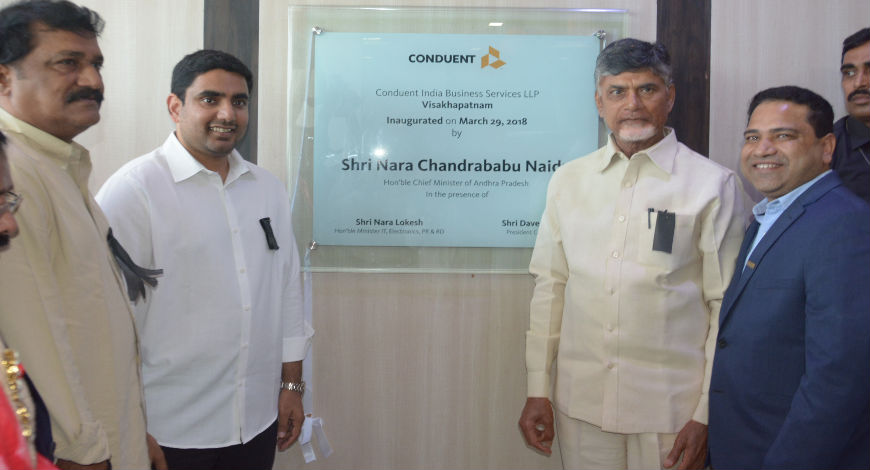
Conduent Expands in India, Aims to Create up to 5,000 Technology Jobs in Visakhapatnam

Aims to create up to 5,000 technology jobs in the city in next two years

ConduentANDHRA20apr2018

Conduent Incorporated (NYSE: CNDT), a global leader in digital interactions with operations in 35 countries, expanded its presence in India and started its new location in Visakhapatnam, Andhra Pradesh. This became the company’s ninth location in the country and is poised to create up to 5,000 jobs in the city over the next two years.

The launch comes less than six months after announcing a three-year timeline for setting up a development centre in Visakhapatnam’s Fintech Valley. The new site will become a key business location in India and will help Conduent India globally deliver innovation in technology, transportation, healthcare, public safety, human resources, process automation and operational excellence.

“My Government has proactively worked towards building the talent and providing an eco-system to attract global organisations into Visakhapatnam. The entry of global businesses like Conduent to the city is a sign of the success of these initiatives and city’s growing stature as a business hub. It is yet another example of how investing in a highly-skilled, educated workforce boosts the local economy, creates jobs for the youth and strengthens the State,” said Shri. N. Chandrababu Naidu, Hon’ble Chief Minster, Andhra Pradesh. “I congratulate Conduent on starting their operations and extend full support of my Government to their growth plans in Andhra Pradesh.”

Today, Conduent India employs almost 12,000 people across nine cities. The new office in Visakhapatnam demonstrates Conduent’s focus on India as a priority market and underlines the importance of the region in the company’s overall growth strategy.

“India is a strategic growth region for Conduent and we are convinced about the potential that the country offers. As a digital interactions business that serves Fortune 500 companies and government entities around the world, being a part of this dynamic geography is the right move for our clients and our people,” said Dave Amoriell – President, Conduent Inc. “Visakhapatnam provides access to a new professional labor market focused on technology, innovation and research. We are honored to have the support of Government and the Hon’ble Chief Minster Shri N. Chandrababu Naidu to bring even more future-looking jobs to the great state of Andhra Pradesh.”

Visakhapatnam is on track to becoming the technology, science, and knowledge hub in India,” said Shri Nara Lokesh, Hon’ble Minister – IT, Electronics, PR & RD Andhra Pradesh. “The state government is committed to support technology companies in establishing their centres in Vizag. Conduent is a perfect example as they have commenced their operations in less than 6 months and invested in the great future of the state. It is a matter of great pride for me, my team and the state to welcome Conduent to Visakhapatnam.”

“We are confident that our Visakhapatnam centre will deliver great benefits to our customers,” said Lokesh Prasad – Conduent India CEO. “Our investment in the region – with its highly skilled talent, supportive government and global business partners – strengthens our ability to succeed in continuing to develop and deliver innovative solutions for the global market.”

source: http://www.bwdisrupt.businessworld.in / BW Disrupt / Home / by BW Online Bureau / March 29th, 2018

Pre-historic rock art site unearthed in Guntur

Rare find: An engraving shows a humped bull on the eastern banks of Naguleru near Dachepalli.

Freelance archaeologist discovers it on the banks of the Naguleru

A pre-historic rock art site discovered in the vast expanse of limestone blocks on the eastern banks of Naguleru near Dachepalli has thrown light on the Neolithic civilisation that flourished in Guntur during 1500-2000 BC.

The site, unearthed by freelance archaeologist Kadiyala Venkateswara Rao at Kesanapalli village in Dachepalli mandal, has excited archaeologists and is expected to trigger further excavations.

“The rock art site on natural lime stone is the first of its kind in the country. The motifs in the form of engraving, pecking and brushing throw fascinating insights into the social and cultural practices of ancient civilisations,” Mr. Rao told The Hindu on Tuesday.

What has made archaeologists look up this latest discovery is the dexterity with which early human was able to engrave different animal motifs like fish, snake, peacock, eagle, bull and scorpion on limestone blocks.

One petroglyph shows an anthropomorphic figure with its head in between the two hands.

Another engraving shows a warrior holding a sword and a shield, indicating the practices during Iron Age.

Rock art motifs

Mr. Rao, on a trail of discovering ancient sites, also stumbled upon a series of rock art motifs in front of an old-age home located on the left side of the path leading to the river.

“It is quite interesting to find a rare and mythical oval-shaped labyrinth engraving with multi circles by the side of cultic motifs. The labyrinth is a mythical and sacred symbol of the early pre-historic times,” said Mr. Rao, who had earlier discovered a huge rock art labyrinth painting in Kolimeru cave on the top of a hill in East Godavari district.

The region in later years was also synonymous with the flourishing of Buddhism.

A stupa established on the pre-historic rock art site during during 1-2 BC, was unearthed during excavations by the Department of Archaeology  and Museums in 1969.

source: http://www.thehindu.com / The Hindu / Home> News> States> Andhra Pradesh / by P. Samuel Johnson / Guntur – April 18th, 2018

First century AD cave found in Gunadala

Vijayawada:

A rock-cut Buddhist cave dating back to 1st century AD was discovered at Gunadala , Vijayawada east assembly constituency on Wednesday.
The cave first came to the notice of local MLA Gadde Rama Mohan Rao, during his ‘gadapa gadapaku Telugu Desam,’ a door-to-door party tour. After spotting the cave, he alerted Buddhist archaeologist and CEO of Cultural Centre of Vijayawada and Amaravati Dr E Sivanagi Reddy.

Dr Reddy thoroughly explored the cave. He told TOI that the rock–cut cave has an open verandah measuring 20 feet by 12 feet, a mandapa (15x12ft) and a cell (8×6 ft). The cell is believed to the residence of the chief monk, which acted as a retreat (vassavasa) during rainy season, which lasted for about four months.

“The cave bears historical significance in the field of Buddhist cave architecture in the Deccan region. With this cave, Vijayawada will find a place in the Buddhist circuit map of India,” Dr Reddy said. Based on the plain nature of the rock–cut cave and the absence of ornamental motifs, Dr Reddy said the cave dates back to 1st century AD, which makes it part of the Satavahana period.

The Buddhist cave was chiselled from a rock of the Gunadala hill. It was appropriated by the Brahmanical faith during the 7th and 8th centuries (Vengi Chalukyan period) when Buddhism was on its decline. The cave was re-fashioned with octagonal pillars on either side and the walls were smoothened.

The locals said a small figure of goddess Kanaka Durga was installed in recent times and they called it Kanaka Durga cave.

Gadde Rama appealed the archaeology officials to declare it as a protected site and develop it as a tourist spot by erecting a sign board and directional board on the roadside in Gunadala.

source: http://www.timesofindia.indiatimes.com / The Times of India / News> City News>Vijayawada News / TNN / April 12th, 2018

A forest retreat at Mamandur away from city life

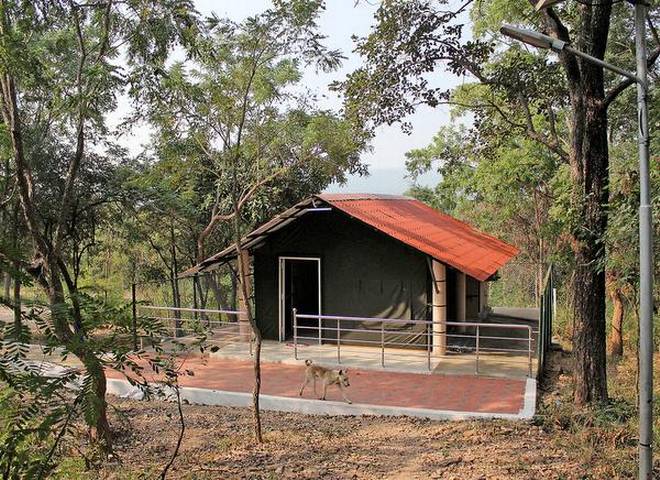
The newly built tent accommodations at Community Based Eco-Tourism project site in Mamandur. | Photo Credit: B_VenkatSandeep

Tent rooms with all basic amenities set up to woo visitors

Beyond a rustic dilapidated arch on the Chennai-Kadapa highway, a serpentine dirt trail leads to one of the most picturesque Forest Department bungalows in the thick of the Seshachalam forests. Perched atop a hillock at Mamandur village, the colonial-era structure built in 1920 stares down the vast expanse of the entire property.

Surrounded by the accommodation developed by the Forest Department as part of the Community Based Eco-Tourism (CBET) project, the location offers an ideal getaway from the regular humdrum of the urban life.

To enrich the experience of staying in a forest retreat, the officials have introduced ‘tent rooms’, much to the delight of the visitors. Unlike the regular ones, the tent accommodations introduced at the CBET, Mamandur have minor reinforcements. The rooms are extended from a brick and mortar bathroom, sloping roofs and is enveloped by a regular tent cloth.

“Owing to the rise in demand from visitors, particularly those hailing from neighbouring Tamil Nadu and Karnataka, we have set up three tented rooms, in addition to the existing ten-bed dormitory and two regular rooms,” Divisional Forest Officer D. Phani Kumar Naidu tells The Hindu.

Mr. Naidu said they have focused on all basic amenities including air conditioning facility, and have strengthened the restaurant section by employing the services of the locals, especially the Yanadi tribes.

Traditional cuisines

“As the area is located on the fringes of the temple city of Tirupati, we want the visitors to have a good access to proper food— a taste of local cuisines at the modern canteen. We are also planning to train the locals in hospitality so that they can offer better services to the visitors. We have also set up a meeting hall which can be used for both as corporate and family retreats,” he said.

Further, canopy walks, guided birdwatching trails, medicinal plantations, boating, trekking routes and much more are in the pipeline. Facilities at Talakona, among the popular getaways near Tirupati, have also received a major boost.

Animal lovers’ paradise

With a flourish of saucer pits at the entrance of the CBET, Mamandur, one can see animals, such as Spotted Deer, Sambar Deer and etc. moving in the area at the dawn and dusk, with the expected occasional sighting of Black-naped Hares or Wild Dogs along the fire lines originating from the property. The bird lovers can spot the typical scrub habitat birds and the nocturnal Indian Nightjar.

“The views from the tents were splendid as we could spot animals basking in the setting sun at the surrounding courtyard near the rooms. We also trekked along the Bavikadu Line,” said Ch. Naresh, a visitor from Visakhapatnam.

Kenneth Anderson connect

For those familiar with the works of Kenneth Anderson, an Indian-born British writer and hunter on his jungle adventures, especially his stories — The striped terror of Chamala Valley, The Mamandur man-eater, The evil one of Umbalmeru and etc, all stories originating from various regions of Seshachalam forests—the location is a treat as one can connect with the books well. Mr. Anderson is said to have spent some time at the bungalow while hunting a man-eater in the area.

As a mark of his remembrance, a dog-eared copy of his book ‘Man-eaters and jungle killers’ accompanied by his monochrome picture with his pets (including a hyena), rests in a display box at the bungalow.

source: http://www.thehindu.com / The Hindu / Home> News> States> Andhra Pradesh / by B. Venkat SandeepTirupati / April 17th, 2018