‘Chilaka’ as State bird of Andhra Pradesh: The choice of parakeet ruffles some feathers
Conservationists, culture aficionados spar over State bird
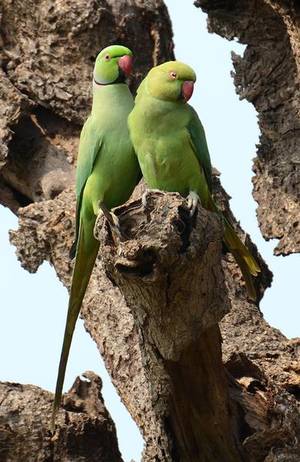
The rose-ringed parakeet (Psittacula Krameri), known as the ‘Ramachilaka’, is very popular with poets and lyricists. Ideal couples are compared to a pair of parakeets. The male is distinguished by a rose-pink collar. The quintessential female is ‘chilaka’.
‘Chilaka Joshyam’, where a parakeet foretells the stars, is also very popular in the Telugu States.
Though there was general appreciation when the State government had announced the dimorphic bird as the State bird recently, it has also triggered a debate. For ornithologists and conservationists, it is a wrong choice but a right one for those rooted in Telugu culture.
None other than birdman of India, Salim Ali, has something unpleasant to say about them. In his The Book of Indian Birds, he describes it as “highly destructive at all times to crops and orchard fruit, gnawing and wasting far more than it actually eats”. Britain officially declared it as a pest in 2009 and seriously considered culling them in 2016 for displacing the local birds.
The conservationists feel that the new State has lost a great opportunity to project Jerdon’s Courser, which is found only in the State and is highly endangered. It’s locally called ‘Adavi Uthatitti’ meaning ‘jungle empty purse’. Declared extinct in 1900, it emerged eight and half decades later in January 1986. Subsequently, the Sri Lankamalleswara Wildlife Sanctuary was created to protect it, said former Assistant Conservator or Forest P Gracious. A great message could have been sent by selecting it, he said.
On the other side, there are those like Banaras Hindu University professor Bhudathi Venkateswarlu who contends that the parakeet has a very significant place in the Telugu culture. “Chiluka is the vahana of Manmadha (Indian Cupid). Sweet and pleasant words (chiluka palukulu) are compared to the chattering of the parakeets and finally the fruit half eaten by these birds is considered very sweet,” he says. Activist of Telugu language movement G V Purnachand says though the choice is okay, rooster which ‘reflects Telugu pride’, would have been better.
source: http://www.thehindu.com / The Hindu / Home> News> States> Andhra Pradesh / by G. Venkataramana Rao / Vijayawada – June 08th, 2018
08th
She’s just one norm away from IWM title
Nutakki Priyanka desires to become a Grandmaster
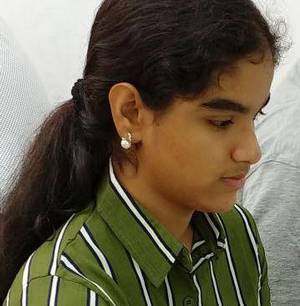
Sixteen-year-old city chess player Nutakki Priyanka is just one norm away from emerging as International Woman Master (IWM) when she clinched the second norm at the recently-concluded 3rd Kolkata Open tournament. She gathered the first at the 2nd Sharjah Masters tournament at Sharjah in April.
Speaking to The Hindu, Priyanka, whose Elo rating is 2180, said her shifting of base to Ponnur in Guntur district to train under senior coach G. Murali Krishna helped her improve leaps and bounds thus paving the way to gather the crucial norms.
“After training under Bobba Veerabhadra Rao and Rama Raju (Hyderabad) in the formative years, we decided to train under Murali sir , who resides at Ponnur. Incidentally he also coaches National champion and Grandmaster M.R. Lalith Babu,” said Priyanka’s mother Durga. Training under Murali Krishna proved productive for Priyanka, as she churned out a series of encouraging performances helping her come close to the coveted IWM title.
Big success embraced Priyanka in 2011 when she won the world U-10 girls’ title with one round to spare in Moribor, Slovenia. Priyanka wants to become a Grandmaster and dreams of emulating Koneru Humpy.
Next three months are going to be challenging for the young champion as she will be competing in Panevezys Open tournament in Lithuania in June, Najdorf memorial tournament at Warsaw and Poland-Czech Open in Czech Republic in July and RTU Open in Lativa in August.
source: http://www.thehindu.com / The Hindu / Home> News> States> Andhra Pradesh / by J.R. Sridharan / Vijayawada – June 06th, 2018
06
Two frog species discovered in Eastern and Western Ghats
They are indicators of healthy ecosystem and live in wide habitat ranges
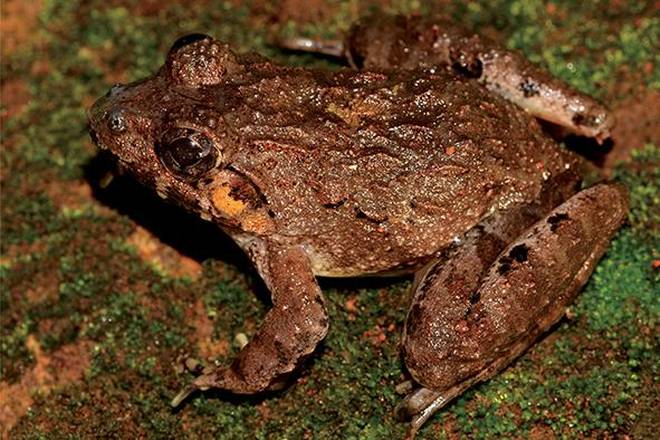
In a significant discovery, two species of frogs have been recorded in the Indian peninsular — Fejervarya kalinaga from the Eastern Ghats and Fejervarya krishnan from the Western Ghats. “The Eastern Ghats species of Fejervarya kalinga attains significance since it is endemic to moist high altitude forest of the region. Its type locality is from Mahendragiri in Odisha (west of Srikakulam). In Andhra Pradesh it is found in high elevation region of Srikakulam, Visakhapatnam (Araku, Chintapalli, Sileru) and Papikonda National Park of East Godavari district. It is one of the very few species of herpetofauna endemic to the Eastern Ghats,” said Prudhvi Raj, post doctoral research fellow of the Wildlife Institute of India and the lead author of the paper for the latest findings.
Mr. Raj has been working on various aspects of amphibians for the past five years. The discovery is a collaborative effort of institutions like the Wildlife Institute of India, the Zoological Survey of India and the North Orissa University. “These new species are habitat specialists, living in perennial hill streams and have been unnoticed due to their secretive habit and morphological similarities with similar looking species of cricket frogs,” Mr. Raj told The Hindu.
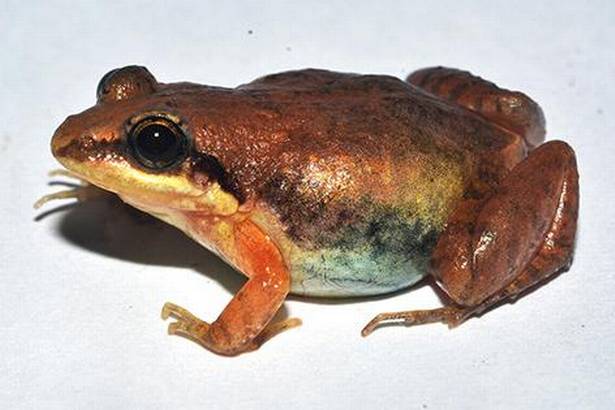
The species from the Eastern Ghats is widely distributed in the hilly mountains and named after the ancient kingdom of Kalinga — the historical region comprising Odisha and part of Andhra Pradesh that is north of River Godavari. The Fejervarya krishnan, found near the Jog Falls in Shimoga district of Karnataka, is named after the eminent biologist the late KS Krishnan for his colossal contribution in the field of biological sciences. Krishnan was professor emeritus at the National Centre for Biological Sciences, the Tata Institute of Fundamental Research (TIFR), Bangalore and was one of the key persons in embarking the School in Herpetology sponsored by the Department of Science and Technology.
The Kalinga cricket frog was first spotted from various localities of the Eastern Ghats by Prof. Sushil Kumar Dutta, a renowned herpetologist and former professor at the North Orissa University, and the Krishnan cricket frog by Mr. Raj from a single locality near the Jog Falls.
‘Largest species’
Sharing details, Mr. Raj said: “The Kalinga cricket frog is one of the largest of its group and grows up to 6.5 cm, whereas the other has an average size of 2 cm.” Cricket frogs are indicators of healthy ecosystem and live in wide habitat ranges in agricultural fields, streams, swamps and wetlands.
Others who worked on the paper include KP Dinesh (scientist at the Zoological Survey of India, Pune), Abhijit Das (scientist at the Wildlife Institute of India, Dehradun), Niladri B. Kar (post-doctoral research scholar at the North Orissa University) and Pratyush P. Mohapatra (scientist at the Zoological Survey of India, Jabalpur).
source: http://www.thehindu.com / The Hindu / Home> News> States> Andhra Pradesh / by Nivedita Ganguly / Visakhapatnam – June 06th, 2018
04
Art of weaving hangs by a thread in traditional Krishna village

Barely 100 weavers left now as meagre returns, bleak prospects force many to quit ancestral profession
Rayavaram in Guduru mandal of Krishna district has become a mute witness to the dwindling number of handloom weavers. From nearly 400 a decade ago, there are barely a 100 now. The improvisation by some progressive weavers by incorporating Pochampally flower motifs in saris and weaving fabric meant for shirting and women’s dress material has not helped the cause much, as the income prospects, which still remain meagre, have kept the young generation away from the art of weaving.
According to the Rayavaram panchayat authorities, a majority of the over 2,500 people from the weavers’ community were associated directly or indirectly with the craft, but poor access to market and low returns had reportedly forced most of them to quit the ancestral profession and go in search of other employment avenues. “It’s disheartening to see many of our fellow weavers turn into agricultural and construction workers to eke out a livelihood. Even my two children [boys] do not wish to learn our art,” Kandula Rama Krishna, a weaver, told The Hindu. In his 40s, Mr. Rama Krishna and his wife Siva Parvathi are still dependent on the art, which they have inherited from their parents.
Paltry wages
The couple manage to weave a pack of six saris a week, earning barely ₹2,000 in a system in which an investor provides yarn and other input cost. The same pack with Pochampally flower motif fetches ₹3,000 in a weavers’ co-operative society. “Neither of the two marketing systems, the master weaving and the co-operative society, offers an income that compensates the labour which goes into weaving a sari,” says Ms. Siva Parvathi.
With falling incomes and standards of living, sarpanch T. Srinivas sees no hope of a revival of the art. He had brought the plight of the weavers to the notice of a high-level State government team which visited the village during May-end.
“Our field visit to Rayavaram is a humble beginning to connect them to a better marketing chain apart from bringing in more innovation in product and skill development through the State and Central government wings,” says A.P. Bhavan Resident Commissioner Arja Srikanth.
source: http://www.thehindu.com / The Hindu / Home> News> States> Andhra Pradesh / by T. Appala Naidu / Rayavaram (Krishna) – June 04th, 2018
Bengaluru: Hearing impaired woman covers 8,300km on bike
______________________________
HIGHLIGHTS
Bengaluru :
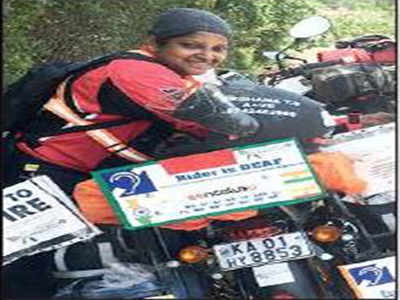
She may be hearing impaired but that hasn’t stopped her from being adventurous. Archana Timmaraju, 33, is back in the city after completing a 8,300km bike ride to Ladakh .
Hailing from Andhra Pradesh, Archana studied in St John’s School, Bengaluru, and later did her masters in metal sculpting from Karnataka Chitrakala Parishath. Other than sculpting, Archana also teaches art at Mallya Aditi International School.
“I started riding at 21 and haven’t looked back since. The aim of this tour — Journey to Inspire — was to motivate the hearing impaired and encourage more women to ride bikes,” she said.
Archana was accompanied by her friend and colleague Daniel Sundaram, a geography teacher, on the journey that began on April 29 and culminated at Freedom Park on May 29. She rode a Royal Enfield, while Daniel was on a KTM bike.
When asked about Archana’s feat, her mother Sita Mahalakshmi said: “We were not scared at all.Archana made video calls to us every day and shared her location live so we knew where she was. I am extremely proud of her.”
Born with 40% hearing ability, Archana has been facing difficulties and disabilities in her speech. She can hear to a certain extent with help of an aid. Archana, with Daniel, has also founded a community, Silent Expedition, for bikers,withspecialemphasison those with disabilities.
source: http://www.timesofindia.indiatimes.com / The Times of India / Home> News> City> Bangalore / TNN / June 02nd, 2018
Young painters bring subjects alive at art camp in Ongole
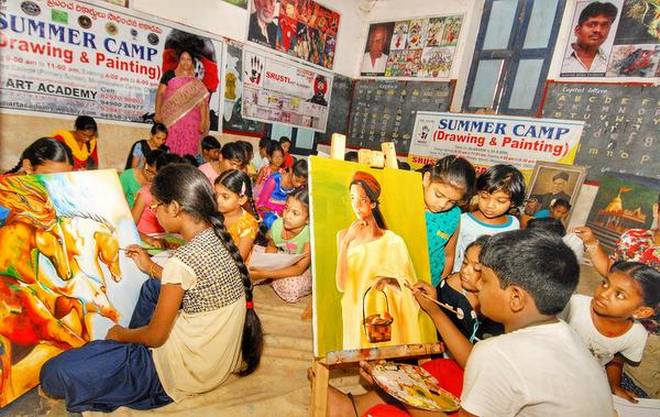
The talent of budding painters was in the limelight as the Srusti Art Academy held a special summer camp at the H. C. M. Girls High School to hone their skills.
More than 100 students breathed life into paintings under the watchful eyes of noted painter Thimmari Ravindra, who has produced many record holders in the city.
“The main aim of the camp is to kindle interest among members of GenX in painting and encourage them to create records of sorts in spray painting, thump painting, collage painting, knife painting,” said Mr. Ravindra, who hails from a family of artists and graphic and animation designers in a conversation with The Hindu.
“Some of my students have proved their worth at the State and national level,” he added.
He added that he generally encouraged his students to think out of the box to create attractive images with, among other things, waste paper, dry leaves, cones and by putting dots in a pattern.
source: http://www.thehindu.com / The Hindu / Home> News> States> Andhra Pradesh / by Special Correspondent / Ongole – June 01st, 2018