Pootharekulu: The Paperlike Sweet from Andhra

The village of Atreyapuram in the coastal district of East Godavari is an important location on the food map of Andhra Pradesh.

PootharekuluANDHRA08oct2018

Hyderabad :

The village of Atreyapuram in the coastal district of East Godavari is an important location on the food map of Andhra Pradesh. Its traditional sweet pootharekulu is quite popular in the two Telugu states and is gaining recognition nationally due to its signature looks and taste. The name of the sweet literally means “coating of sheet”. The sweet is wrapped in a wafer-thin rice starch layer resembling paper and is stuffed with sugar, dry fruits and nuts.

The traditional sweet has a history of a few centuries. It is said that a village lady first prepared the sweet by adding sugar and ghee to the leftover rice starch.

The making of the “reku” or sheet is quite interesting and provides livelihood to hundreds of women in Atreyapuram village. A special type of rice batter is used for pootharekulu. The variety of rice locally known as ‘Jaya’ is soaked for a few hours and then ground into a fine batter. An inverted earthen pot is heated before a fine cloth is dipped into the batter and quickly spread of the pot surface. It is taken away in a jiffy leaving a thin film of the starch on the pot.

This forms the paper-thin outer cover of the sweet. The sheet is then taken off and stuffed with powdered sugar, ghee, dry fruits, nuts and other ingredients and finally expertly folded into a roll. There are variations in the sweet where jaggery is used instead of sugar. The village folk of Atreyapuram are experts in making the paper-like sheet and they supply them to sweet manufacturers all over the two Telugu states.

Recently Pootharekulu was in the news, when under the patronage of AP Tourism Development Corporation a group of chefs in Vijayawada prepared a 10.5-metre long version of the dish, catapulting them in the record books. The state of Andhra Pradesh is in the process of applying for Geographic Indication (GI) tag for the sweet. The sweet is extremely popular for festivals, religious occasions and weddings.

In Hyderabad, many sweet shops prepare Pootharekulu. Almond House, the premier dessert manufacturer with multiple outlets have three versions of it – sugar, jaggery and jaggery with dry fruit. The rice paper is obtained from the locals in Athreyapuram as part of the social responsibility of the organization. According to Chaitanya Muppala of Almond House, they get frequent requirements for the paper sweet from outside Hyderabad, too.

Sabyasachi is a food enthusiast and blogs at www.foodaholix.in

source: http://www.newindianexpress.com / The New Indian Express / Home> Cities> Hyderabad / by Sabyasachi Roy Chaudhari / Express News Service / October 06th, 2018
Native flavours rule in cookery contest

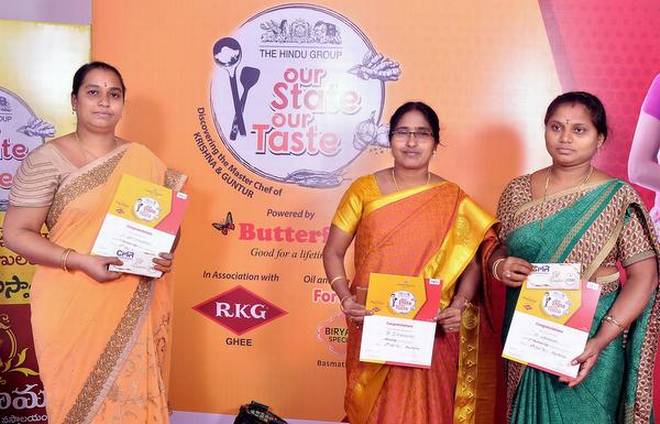
Proud moment: Winners of The Hindu -AP Heritage Cookery contest held at Kaikaluru | Photo Credit: HAND OUT

Delicacies with telagapindi, watermelon seeds draw attention

Talk of recipes of a State and only a few popular ones come to mind immediately. Most of the traditional and authentic dishes that our ancestors tasted are fast disappearing from the dining spaces in modern kitchens.

But the AP Heritage Cookery Contest, being conducted by The Hindu in association with the AP Tourism Department in every part of the State, is bringing to the fore some of the most delicious delicacies that are on the brink of oblivion.

At Kaikaluru, where the competition was held on Saturday, home-makers participated with great enthusiasm showcasing their cooking prowess that reflected in the myriad flavours that enveloped the venue.

Telagapindi-pachchi royyala curry (prawn and sesame seeds powder) emerged the best dish fetching the first place to K. Lakshmi. The first runner-up was U. Satyawathi who dished out ragi thopa, while M. Lakshmi was declared the second runner-up for her putcha ginjala pachchadi (watermelon seeds’ chutney). Other dishes that vied for attention were potato halwa, pachchi royya-kakarakayi (prawn and bittergourd), ravva gulab jamun, nethi (ghee) cake and paakam garelu. Senior Civil Judge Y. Anuradha was the chief guest for the event.

source: http://www.thehindu.com / The Hindu / Home> News> States> Andhra Pradesh / by Special Correspondent / Vijayawada – October 06th, 2018

Differently-abled youth in squad for Special Olympics

Anantapur youth make it to the Indian squad for the Special Olympics

Their determination and achievements dwarf their disabilities with which Balakrishna and Kullaiamma were born. Hailing from remote villages in Anantapur district of Andhra Pradesh, the two have won laurels for the country many times at the Special Olympics.

Four boys and two girls from Anantapur have found a place in the national badminton team to represent India at Andorra Special Olympics to be held this month. Balakrishna and Kullaiamma are part of the team that left for Barcelona on Tuesday, en route to Andorra. The team includes: Shameela Dhanekula, Assefa Pendekanti, Ganesh pasuvula, Sreenivasulu Chakali, Sivaiah Komalli, and Balakrishna Nallabothu.

Kullaiamma | Photo Credit: R_V_S_PRASAD

Player to coach

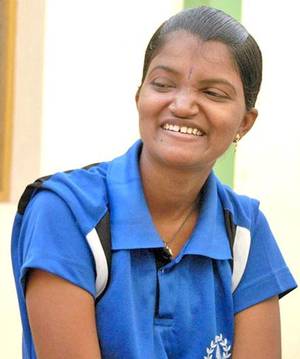
Daughter of a farm-labourer couple of Kothapalli village, Kullaiamma was born with Intellectual disability (ID), also known as general learning disability, short of hearing and visual disability with extreme squint. But has won gold medals in badminton at Los Angeles in 2013 and in Australia in 2015. Unable to afford studies, Kullaiamma began working at a juice centre and took to tailoring to supplement the family income, but the Community-Based Rehabilitation Centre of Rural Development Trust (RDT) at Bathalapalli gave her a new lease of life.

Her talent was spotted by the RDT coaches and she began training in 2011. Today, Kullaiamma has graduated to assistant coach accompanying a six-member badminton team, part of the Indian contingent at the Special Olympics at Andorra and Spain.

Balakrishna | Photo Credit: R_V_S_PRASAD

Differently-abled Balakrishna (short of hearing and needs trainer to explain in sign language) from Marrireddipalli, is the son of a farm-labourer couple. The shuttler has three gold medals so far in his kitty. Studying at Industrial Training Institute, he wants to make it big in the international badminton arena. Their cradle is the state-of-the-art indoor badminton court at Bathalapalli and stadium at Anantapur which have produced several world-class players. After its inception in 2008, it produced gold medallists in 2009 Athens Special Olympics. Baba Fakruddin won a gold and a silver in athletics, while two girls were also there in the country’s contingent. They were born different but they made a big difference.

source: http://www.thehindu.com / The Hindu / Home> News> States> Andhra Pradesh / by Ramesh Susarla / Anantapur – October 04th, 2018

Innovation to thefore at science fest

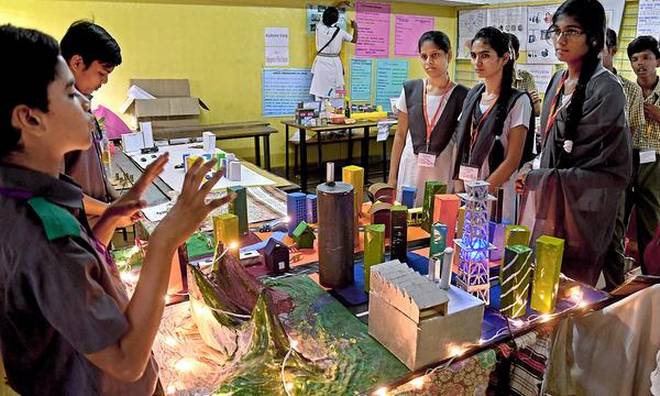
A student explaining about her model at the ‘Vidya Bharati Dakshina Madhya Kshetra Jana Vijnana Mela’, in Visakhapatnam on Monday.

180 students from three States take part in the event

Solar power can cater to the need of an entire city if the available space are utilised to harness it. This concept was well explained by a student from Vidya Bharathi School at the South-Central Zone ‘Jnana Vijnana Mela’ (Science Fest) that began here on Monday.

The programme was inaugurated by the Vice-Chancellor of Krishna University and JNTU (Kakinada), prof. S. Rama Krishna Rao, in the presence of Bharteeya Vidya Kendram Chairman A. Narayanaswamy and Vidya Bharathi Dakshina Madhya Kshetra Joint Secretary G.R. Jagadish.

Around 180 students from Andhra Pradesh, Telangana and Karnataka are participating in the science fest.

source:http://www.thehindu.com / The Hindu / Home> News> Cities> Visakhapatnam / by Special Correspondent / Visakhapatnam – October 02nd, 2018

Telugu Bible turns 200

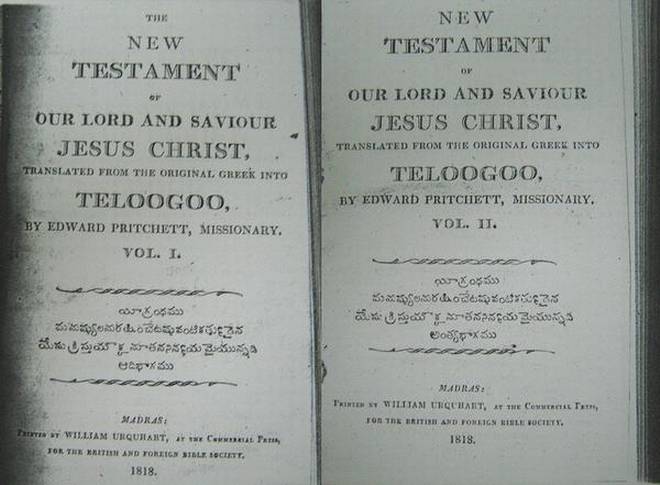
The cover page of the New Testament that was first translated and printed in Telugu in 1818. | Photo Credit: Special Arangment

It was translated in Vizag and West Bengal

On September 30, based on a resolution adopted by the United Nations, the world celebrates the International Translation Day (ITD). It is observed in honour of fifth century St. Jerome, a priest from northeastern Italy, who was the first to translate the Bible (New Testament) into Latin from Greek manuscripts. He also translated parts of the Hebrew Gospel into Greek.

The ITD has a unique connection with Visakhapatnam. The churches in the city will be celebrating this year the 200th year of the translation of Bible from original Greek to Telugu.

First attempt

The first attempt to translate the Bible (New Testament) was made by one Rev. Benjamin Schulz (1689-1760) some time in the mid-1760s, and the manuscripts were sent to Germany for printing, but it was not printed and the manuscripts were lost.

The second serious attempt was made simultaneously at Vizagapatam (as Visakhapatnam was then called) and Serampore, then unified Bengal, some time around 1805-1806.

Telugu Pandit’s role

In Serampore, the project of translation was led by Rev. William Carey of the Baptist Missionary Society. In Visakhapatnam, young Christian missionaries of London Missionary Society Rev. Augustus De Granges and Rev. George Cran took up the work of translating the Bible from original Greek to Telugu. The missionaries in Vizagapatnam were assisted by a local Telugu Pandit Anandarayar.

The untimely death of both Granges (1809) and Cran (1810), however, did not deter Anandarayar from pursuing the work of translation under the guidance of Rev. John Gordon and Rev. Edward Pritchett, said V. Edward Paul of INTACH.

“The first three gospels out of four translated in Vizagapatam were sent to Rev. Carey in Serampore and the translation work continued simultaneously at Serampore and Visakhapatnam. The full extent of translation was completed with the fourth gospel, letter and acts and sent to then Madras Presidency for expert opinion of Rev. Thompson and Mr. Campbell, a reputed Telugu scholar in the Presidency. It was certified and then printed in 1818, and that makes the translation 200 years old, as of today,” said Mr. Edward Paul. The Bible that was printed in 1818 in Madras Presidency is today considered the authentic Bible and has undergone several revisions.

source: http://www.thehindu.com / The Hindu / Home> News> States> Andhra Pradesh / by Sumit Bhattacharjee / Visakhapatnam – September 28th, 2018