Plans for trekking and boating facilities, a walking track, zoological park and colourful lightings have also been proposed in an attempt to attract more tourists to the Kondaveedu fort.
Guntur :
The State government has decided to hold the two-day Kondaveedu festival from February 2. Plans for trekking and boating facilities, a walking track, zoological park and colourful lightings have also been proposed in an attempt to attract more tourists to the Kondaveedu fort.
Keeping this in view, the government has spent Rs 60 crore on the development of the fort and Rs 35 crore for construction of the ghat road leading to it. Collector K Sasidhar said the administration would begin preservation works at the fort which was in good condition despite being centuries old.
“Temples, mosque, military camps and three tanks on the hilltop will also be renovated,” he said. Phase three works of a 670-metre road connecting historical sites in the area has also begun.
Civil Supplies Minister P Pulla Rao, who visited the fort on Tuesday, said, “Plantation of one lakh medicinal and other plants at Kondaveedu will be done on December 30,” and directed forest officials to remove wild plants before December 25.
source: http://www.newindianexpress.com / The New Indian Express / Home> States> Andhra Pradesh / by Express News Service / December 12th, 2018
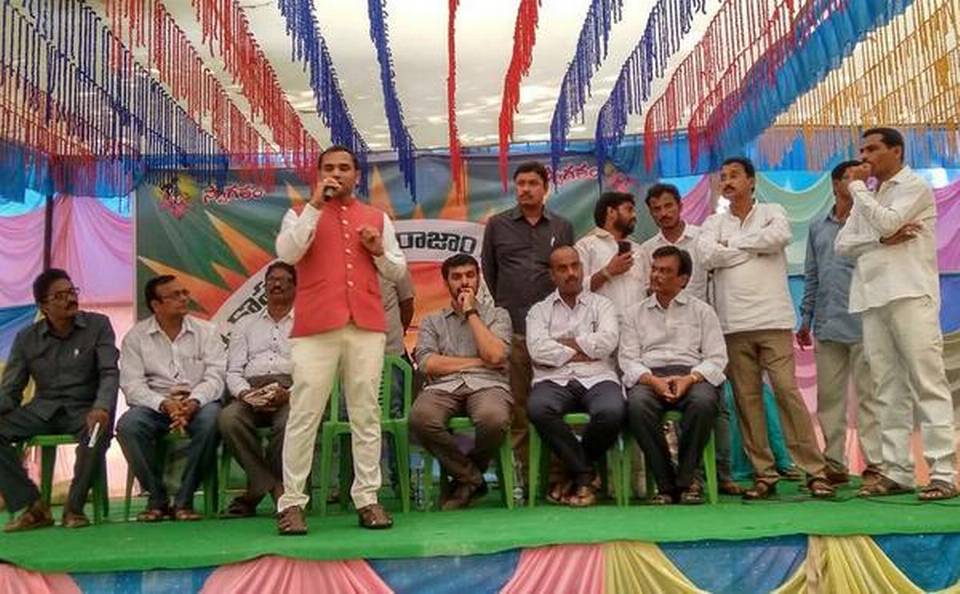
Srinubabu Gedela, NRI, addresses farmers’ awareness programme at Rajam in Srikakulam district.
Huge demand for material in paper and textile industries too, he says
A U.S.-returned NRI and PULSES CEO Srinubabu Gadela wages a war against plastic saying it is ruining the health of the people and the wealth of the farmers with the huge drop in jute production in the backward Srikakulam district. He has been organising meetings for the last few months to make farmers to go back to jute. He says sufficient availability of raw jute would lead to revival of all the closed industries.
Dr. Srinubabu, who hails from Allena village of Burja mandal, completed his post doctorate from the Stanford University and started Omics Interantional Private Limited to facilitate free access of journals for researchers. Later, he established the Pulses Group, a health informatics and health care services in Hyderabad. Dr. Srinubabu, who is not content with his achievements, is keen on enhancing the income sources of farmers by guiding them in the usage of the latest technology and information in agriculture. He has been conducting training programmes for youngsters to become entrepreneurs.
“Thousands of farmers and labourers have fallen victims with little demand for jute cultivation and closure of many industries in Rajam, Bobbili, Vizianagaram and other places. The revival of jute production and processing would certainly minimise the usage of plastic covers and bags. There is huge demand for jute material in paper and textile industries too. That is why I am suggesting the farmers to go back to jute cultivation which is sure to generate more income and employment.”
Ambedkar University Vice-Chancellor Kuna Ramjee said the University would sign an agreement with the Pulses Group in training PG students in a systematic way. “Youngsters from poor families and Telugu medium can also do wonders if they work hard and develop new ideas. That is why we requested its chairman to take up special training programmes and help the PG students to get jobs in reputed firms and start their own industries,” said Dr. Ramjee.
Felicitated
Minister for Human Resources Ganta Srinivasa Rao felicitated Dr. Srinubabu for coming forward to serve the native district. “We should do something for our native places. It will certainly make other well-settled NRIs to utilise their knowledge and wealth to benefit the backward areas,” he said.
source: http://www.thehindu.com / The Hindu / Home> News> States> Andhra Pradesh / K. Srinivasa Rao / Srikakulam – December 11th, 2018
The physics lab is maintained as it is, at Mrs. A.V.N. College in Visakhapatnam. | Photo Credit: C.V.Subrahmanyam
Physics lab, where he did his practicals, is now heritage part of the hallowed institution
Any idea how did Nobel laureate C.V. Raman get the idea of his path-breaking theory which is called the Raman Effect or Raman Scattering.
It was in this city and at Mrs. AVN College where the seed for his theory ‘Molecular Diffraction of Light’ was sown.
Dr. Raman, who spent a few of his formative years in this city, was a student of Mrs. AVN College High School, where he completed his high school from Std VIII to X and later moved to Mrs. AVN College to complete his pre-university course.
In a passage in his biography, he quoted that from his sea-facing classroom, which was located on the first floor of the Gothic-styled stone building, he would observe the changing colours of the Bay of Bengal and it would fascinate him.
“It is from this classroom in this college that I developed the urge to get into the details of this phenomenon.” This was what he (Raman) had said, when he visited his alma mater in 1930, recounted Dr. Srinivasa Rao, the present HoD of the Physics Department, from the old diaries. According to college records, Raman studied in the high school from 1902 to 1905 and PUC from 1905 to 1907 and his father Chandra Sekhara Iyer was a teacher in Mrs. AVN College High School, said principal of the college D. Vijaya Prakash.
The physics lab in the college, where Dr. Raman conducted his first experiments, is still kept as it is and has become a heritage part of the edifice.
Glorious journey
Mrs. AVN College was set up in 1860, principally as a high school, with the support of the public and the then zamindars. In 1878, it was elevated to the status of a college in the name of Hindu College. In 1892, Ankitam Venkata Narsinga Row, a landlord, bequeathed a sum of ₹1 lakh, an11-acre site, a Gothic-style building, and a building grant of ₹15,000, and since then the college is known in his wife’s name as Mrs. AVN College.
It has grown from a strength of 50 students to over 2,500 today. Apart from Dr C.V. Raman, the college boasts of alumnus that includes revolutionary Alluri Sitaramaraju, statistician CR Rao, General KV Krishna Rao, film star S.V. Ranga Rao, freedom fighter Tenneti Viswanadham and writers such as Raavi Sastry and Sri Sri. The two-day founder’s day celebrations will begin from Thursday.
source: http://www.thehindu.com / The Hindu / Home> News> States> Andhra Pradesh / by Sumit Bhattacharjee / Visakhapatnam – December 05th, 2018
This year, farmers are experimenting on developing a mother plant growing fruit, instead of getting strawberry plants from Pune.
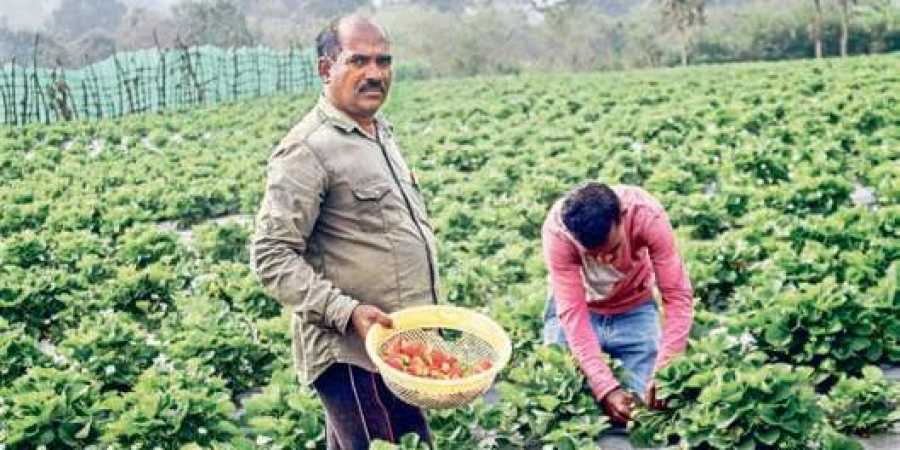
A strawberry farm at Rajapakala in Lambasingi | Express
Visakhapatnam :
As the city is getting colder with foggy mornings, the tourist season has arrived. Lambasingi in Visakha Agency with its rich strawberry fields, is beckoning tourists. On weekends, hundreds of people are thronging the fields to pluck the ripened strawberry fruits. This year, farmers are experimenting on developing a mother plant growing fruit, instead of getting strawberry plants from Pune.
Farmers in Chintapalli mandal started growing strawberries two years ago after getting plants from Pune. Buoyed by the good yield and profits, they continued cultivation of strawberries in the Agency. As the fruit plant requires a cool climate to grow, the Agency has proved to be an ideal place for strawberry cultivation.
The strawberry fields have become a major attraction for tourists. Some tourists are actually visiting Lambasingi to enjoy plucking the fruit and taking beautiful pictures. Guntapakala and Rajapakala in Lambasingi have become tourist spots. Normally, the saplings are brought from Pune in September. The plants start yielding fruits from November. The season continues till January.
“We are achieving good results in cultivation of strawberries. The average yield of fruit per plant last year was 600 grams. This year there is a slight delay in fruit ripening due to weather conditions. The plants need 5-15 degree Celsius temperature to yield quality fruit. After harvesting, the packed boxes of strawberries are sent to Vizag,” said Bhaskar Raju of Teja Organ Berries in Rajapakala.
About 25,000 saplings are raised in one acre. The plants developed using tissue culture, are priced at `15 each. “We set a target of reaping 1 kg of fruit from each plant this year. On an experimental basis, we have developed a mother plant (second generation) from old plants, which helps us save money on buying plants from Pune. As we have achieved good results, we want to expand the experiment with the present plants,” Raju told TNIE.
Tribals are also being encouraged to take up cultivation of strawberries, which needs investment. Meanwhile, the government is providing subsidy on plants and other material to tribals. The ITDA has plans to provide saplings and support to the interested tribals in cultivation of strawberries. Thousands of tourists visit Lambasingi during winter season. The tourists are allowed to pluck the fruit in strawberry fields and drop the produce in baskets. A few fruits are given to tourists to taste them. A 200 gram box of strawberries costs `50-80. The tourists are evincing interest in purchasing fresh fruit, which ensures remunerative price to farmers for their produce.
“We have come down to Lambasingi to pluck strawberries, which is quite exciting. It is good that we can taste strawberries while plucking the fruit just like being in our own farm,” said Swarna of Vizag.
Cultivation of more exotic fruits in offing
Apart from strawberries, the farm also has dragon fruit, raspberry, mulberry and passion fruit plants. As a tourist attraction, cultivation of more exotic fruits is being taken up in Visakha Agency. Farmers who want to experiment, are likely to reap the fruits by next season.
source: http://www.newindianexpress.com / The New Indian Express / Home> States> Andhra Pradesh / by Sri Lakshmi Muttevi / Express News Service / December 03rd, 2018