Lifestyle show to begin in Rajahmundry today

The Hindu ’s Lifestyle Show begins at Hotel River Bay in Rajahmundry on Friday evening.

Four-day event

The four-day show will showcase latest technologies, products and brands which are already available and a few more gadgets which will hit the market soon.

Promoting retail shopping by offering a huge variety to consumers at one place, apart from creating awareness about various brands and offerings, is the main objective of organising the Lifestyle Show, according to its organisers.

The show, which concludes on October 15, is being held under an air-conditioned hanger and 100 showrooms, companies, shops and individual sellers are participating.

The Hindu has been conducting the Lifestyle Show since 2004, the first one held in Chennai.

Later, it spread the show to other cities and the recent one held in Visakhapatnam received tremendous response.

The entry fee is Rs. 20 for a person. Adequate arrangements have been made for parking of vehicles and lightning the venue.

Timings

The Lifestyle Show is open from 10 a.m. to 8.30 p.m.

This year’s Lifestyle Show is powered by State Bank of Hyderabad with Prestige as co-sponsor. Media partner is Eenadu and Red FM is radio partner.

I Care Communications of Bangalore designed the trendy event. Rajahmundry Municipal Commissioner M. Jitendra will inaugurate the show at 5.30 p.m.

source: http://www.TheHindu.com / Home> National> Andhra Pradesh / by Special Correspondent / Visakhapatnam, October 12th, 2012


Milagrow HumanTech dedicates RedHawk robot to Saina Nehwal

Plans to give 5% of sales proceeds from the special edition product to Saina and 1% to Gopichand’s badminton academy

Milagrow HumanTech, a Gurgaon-based provider of TabTop PCs and domestic robots, has dedicated its domestic robot ‘RedHawk’ in the name of Saina Nehwal, who won the bronze medal for badminton at the recently-concluded London Olympics.

The Milagrow Redhawk, classified as a robotic vacuum cleaner, performs multiple tasks to ensure that its owner’s home is clean by the time he or she gets back from work. The bag-less model has a one-litre dust bin to store the dirt it collects. This battery-operated robot uses six different modes to clean effectively with minimal noise.

“Saina is the cause of national cheer and pride. Her story must inspire millions. We are also honouring Pullela Gopichand for his yeoman service to Indian badminton,” said Rajeev Karwal, founder and chief executive (business and knowledge solutions), Milagrow.

Milagrow plans to give 5% of the sales proceeds from the special edition product to Saina Nehwal and 1% to Gopichand’s badminton academy.

“We decided on launching the special edition products before the Olympics started, for all the medal winners and once they were back we met them to finalise the details of the special edition launches. You will hear the launches in the names of other winners soon. We are not looking for any endorsement from them but honoring them. They will inspire a billion. We feel that this initiative is a way of encouraging the athletes to give their 100% not only during Olympics but also in the future whenever they are competing,” Karwal added

source: http://www.Business-Standard.com / Home> Economy & Policy / by K Rajani Kanth / Hyderabad, October 09th, 2012

The biodiversity bargain

What will it cost to save the world’s forests and boost the life prospects of its seven billion people? From October 8-19, India is hosting a meeting in Hyderabad of the United Nations Convention on Biological Diversity. The assembled countries will consider how to raise the resources necessary to achieve the ambitious Aichi Biodiversity Targets, adopted two years ago at the last such meeting in Japan.

The Aichi targets call for cutting by half the rate of loss of the planet’s natural habitats, including forests, by 2020. In Hyderabad, governments will be presented with the likely costs of scaling up efforts to achieve that goal.

One assessment estimates that about $40 billion a year will be needed to halve rates of deforestation and ensure sustainable management of forests in developing countries by the target date. The cost may seem significant in a world of rising unemployment rates, with many countries still struggling with ongoing financial and economic crises, and others staring bankruptcy in the face.

But the cost of preserving the world’s biodiversity needs to be contrasted with the enormous economic and social value of forests in terms of the benefits that they provide locally and globally. Forests ensure water supplies, counter soil erosion, and safeguard an abundance of genetic resources that will become increasingly important in developing the new products, pharmaceuticals, and crop strains needed to support the lives and livelihoods of more than nine billion people by 2050. Moreover, investing in forest conservation and sustainable land use is one of the most cost-effective means of mitigating climate change.

The potential returns from targeted investments in forests are immense. Restoring just 15 percent of degraded forest landscapes worldwide could generate up to $85 billion worth of ecosystem services every year, mostly benefiting rural and underprivileged communities. Estimates of the value of the Mau forest complex to the Kenyan economy, for example, are $1.5 billion a year. Similar estimates are underway in Brazil, Colombia, India, and elsewhere.

The cost of inaction would be considerably higher than the required investment. The annual cost of adapting to climate change has now passed the $40 billion mark, and is expected to rise every year unless we can significantly reduce greenhouse-gas emissions.

Some countries are already stepping up to the challenge. Norway is investing $3 billion to support national and international initiatives, including the UN-REDD (Reducing Emissions from Deforestation and Forest Degradation) Program, a joint effort of three UN agencies to support developing countries’ efforts to save, sustainably manage, and restore tropical forests (a range of activities known as REDD+).

Brazil has reduced deforestation rates in the Amazon by roughly 80 percent since 2005, and Norway’s pledge of $1 billion is helping to achieve further reductions. Brazil’s efforts have led to perhaps the biggest emission reduction of any country in the world – at a time when deforestation accounts for around 15 percent of global greenhouse-gas emissions.

The UN-REDD Program, launched in 2008, currently supports 44 developing countries, with 16 countries receiving direct financial and technical support.

The funding is preparing them, for example, to develop monitoring systems and build support and awareness among local communities and indigenous peoples for a fresh start to forest management.

Some are already seizing the funding opportunities under what is essentially a climate-change initiative to pursue broader sustainability goals. For example, Indonesia is seeking to establish a Green Corridor in Kalimantan (the Indonesian portion of the island of Borneo), where deforestation is not only fueling greenhouse-gas emissions, but also diminishing river flows, making it difficult in some months to transport goods by barge. Given that transportation by barge costs about $10 a ton, compared to close to $60 a ton by road, REDD+ offers a chance to hold down greenhouse-gas emissions while preserving an economically important sector.

While Norway has made the biggest commitment to UN-REDD and other initiatives to date, other donors – including the European Commission, Denmark, Japan, and Spain – are also contributing. Enlightened businesses, which will be key to meeting the 2020 funding goals, are also investing in sustainable forest management.

Countering deforestation is not without its challenges. Governance and land-tenure systems must be improved in many countries, and the risk of corruption must be addressed rigorously. In Hyderabad, countries and experts will consider how safeguards can ensure that both people and nature benefit from REDD+ activities.

Nevertheless the challenges should not mask or deflect attention from the opportunities. The UN-REDD Program is just four years old, and the best is yet to come. Whether to combat climate change or to realize wider environmental benefits, the need for enhanced financing of forests can no longer be ignored.

And there is a final imperative: 1.4 billion people currently depend for their livelihoods on forests. Annual investments of $40 billion per year could generate five million new jobs globally.

The world is struggling to fight climate change, sustain a growing global population, and find decent jobs for millions of young people. Investing in forests and biodiversity represents a root-and-branch response to these challenges. But it requires more ambitious and wider public- and private-sector support. With a price tag of around $40 billion per year, the cost of that support is, to be frank, a bargain.

source: http://www.BusinessDayOnline.com / Home / by Achim Steiner  & Braulio Dias / Wednesday, October 10th, 2012


Culinary secrets of Hyderabad’s 7th Nizam

The niece of the 7th Nizam of Hyderabad is sharing her family’s culinary secrets, and everyone is invited.

Past a heavy wooden door flanked by trellised walls, through an arched passage that runs under a ceiling embellished with intricate patterns, moonlight sneaks in through metal bars in windows on one side of the gallery to gently light up art that adorns a parallel wall. Even more beautiful is the gentle tinkle of laughter trickling from a room at the far end.

Inside, giggling children stand around a stern ancestor as she taps an attendant with the tip of her cane, diamond bangles jingling with each movement of the bony wrist. With the end of a rope tied to his big toe, the attendant who was to fan the dining family has dozed off, and although his programmed foot successfully operates the colonial ceiling fan, his snores are unacceptable.

This memory is one of several from Kunwar Rani Kulsum Begum’s past, one that was dominated by her grandmother Buggo Begum, the force behind Reza Yar Jung Haveli in Darushafa in Hyderabad. Neither Kulsum, niece of Nawab Mir Yousuf Ali Khan Salar Jung III (former prime minister of the seventh Nizam of Hyderabad), nor her sister were allowed into the kitchen. The family’s culinary secrets would only be passed down to the dulhan ranis — women who married into their family — not those who’d secede to another.

Kulsum Begum is a shade more generous with sharing secrets, though. The food consultant with ITC hotels has opened up a treasure of royal Hyderabadi recipes for a special menu that’s being served at the hotel’s Parel property until today.

“The recipes I’ve shared are my nani’s (maternal grandmother). My dadi was tight-lipped, although I did manage to eek them out of my sister-in-law,” she smiles.

It was the same with every royal family, says Begum. “Guests would compare preparations at parties, each one trying to outdo the other. Keeping secrets fuelled healthy competition between the ladies.”

In fact, Begum reveals, young girls weren’t taught cooking. It was assumed they’d have khansamas. “Even when we travelled, our kitchen staff would accompany us, preparing a spread of safari food — pathar ke kebab prepared on heated, unpolished granite,” she says. A girl was meant to cook, keeping her husband’s preferences in mind. “She may as well learn that at her sasural then.”

Married at 16 into a Lucknow family, Begum wrote copious letters to her nani, moping about missing her food, eventually convincing her to share recipe through detailed letters. “Lucknowi food is sweeter,” she explains with a warm smile, “while in Hyderabad, we like khattan — tartness — in our food.” The ghosht ka shikampur that’s available on the menu she has designed, supports her observation. A layer of curd and chutney are ensconced in the aromatic, melt-in-the-mouth meat patty that dwarfs American portions.

“You youngsters don’t eat enough nowadays,” she says, reminded of how her family pampered her when she lost weight around her teens. “They insisted that I do nothing but sleep and eat, and my mother brought me food in bed.”

Back then, Begum recalls, people assumed that a young girl was thin only because she was ill. Or that the family had met a misfortune. And so, food was rich. “Dry phulkas only made it to the dastarkhan (dining place) when a family member was unwell.”

Naturally, a job, even as a five-star food consultant, was never on the cards. The first time Begum cooked, she put salt in the kheer and made five kilos of biryani for four guests. But her husband was supportive, and with 300 recipes now perfected over decades, she has no qualms inviting the whole city to test her culinary skills.

Kachche Gosht Ki Biriyani

Ingredients
Mutton (a mix of chops, marrow bones and cubes from the shoulder) – 1 kg
Rice – 500 gms
Inions finely sliced – 200 gms
Ginger paste – 10 tbsp
Garlic paste – 6.5 tbsp
Red chilli powder – 3.5 tbsp
Chopped coriander – 6.5 tbsp
Chopped fresh green mint – 5 tbsp
Yoghurt – 10 tbsp
Lemon juice – 1.5 tbsp
Milk – 3.5 tbsp
Pinch of saffron
Oil – 7 tbsp
Ghee – 7 tbsp
Green chillies – 4
Cardamom – 4
Cloves – 2
Cinnamon stick – 4
Caraway seeds – 3 tsp
Peppercorn – 2 tsp
Nutmeg – 1/2 tsp
Few flakes of mace
Salt to taste

Method
– Grind the chillies, cardamom, clove, cinnamon stick, caraway seeds, peppercorn, nutmeg and mace to a fine powder. Heat oil in a pan. Fry onions till golden brown. Crush in a pestle mortar when cool. Marinate the meat in ginger and garlic paste. Add yoghurt, salt, red chilli powder, coriander, mint, green chillies, ground spices, lemon juice, crushed onions and the oil in which the onions were fried. Mix well and marinate for about four hours.

– Wash the rice and mix with a cup of well-beaten yoghurt. Add saffron and half cup milk. Set aside.

– Take a heavy bottom pan with a tight lid. Transfer the marinated meat with the marinade to the pan. Spread the rice over the meat. Sprinkle the saffron milk over the rice. Dot it with a dollop of ghee. Cover and cook, first over high flame, then over medium-low heat till the meat is tender, the liquids are absorbed and the rice is cooked.

– Scoop out portions carefully so that the layering remains intact, and serve steaming hot.

mirrorfeedback@indiatimes.com

source: http://www.articles.timesofindia.indiatimes.com / Home> Life & Style> Food / by Anjana Vaswani, Mumbai Mirror / October 07th, 2012
A sweet tale of how neem trees yield money

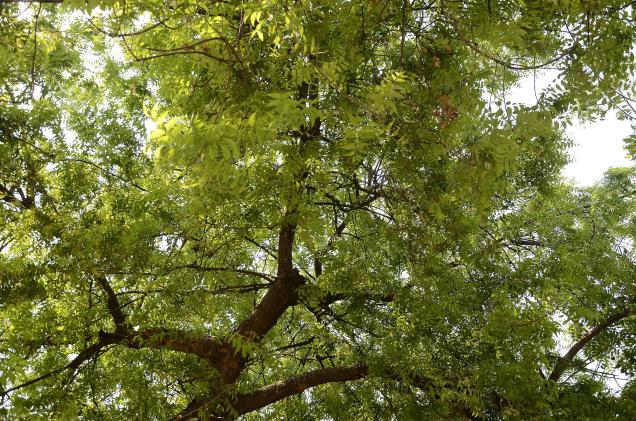
The agreed procurement price of neem leaves is Rs.100 per kg for the top quality leaf. / Photo: K.V.Srinivasan / The Hindu

Implementation of National Biodiversity Act enables people in two villages in Andhra to earn additional revenue

Some hundred neem trees have changed the lives of people in two villages, Amarchintha in Mahabubnagar district and Revalli in Nalgonda, both in the Telangana region of Andhra Pradesh.

They have helped them earn additional revenue of few thousand rupees, thanks to the implementation of access and benefit sharing (ABS) mandated under the National Biodiversity Act 2002.

SUCCESS STORY

Sharing this success story with The Hindu, Sriram Gangadhar of Bio-India Biological Corporation (BIB), Hyderabad, said that a couple of years ago, a Japanese company approached him for developing a food ingredient from neem to be mixed with water.

Generally, Japanese do not drink plain water. Instead, they prefer green tea water, energy water or medicated water. It is because of this habit that he received a proposal from the Japanese firm for developing neem-based water, which can be easily soluble and which gives a typical taste with its medicinal benefits.

Based on the Japanese inputs, BIB decided to work with local communities for collecting the neem leaves without involving any middle men, brokers or traders and under the National Biodiversity Act principles.

The company has identified two Neem rich villages and entered into an agreement with local communities, providing them five per cent on procurement price of leaves.

It is the Biodiversity Monitoring Committee in the Andhra Pradesh State Biodiversity Board that takes care of processes including signing pacts with local communities and collecting leaves.

Mr. Gangadhar says the agreed procurement price is Rs. 100 per kg for the top quality leaf. The National Biodiversity Authority (NBA), which has concluded an agreement with the BIB, gets a royalty of five per cent on the sale of the leaves.

About 2,100 kg of leaf was, so far, exported to Japan. The Indian company is keen on working with many communities on sustainable harvesting methods to meet bulk needs of Japanese firms which are for increasing the quantity of production and expanding the project to a bigger scale with a lot of investment and research.

Similarly, the Neem water has proved to be good for overall health and it is a hit. “This is one of the successful case studies on ABS,” Mr. Gangadhar says, adding that the proceeds of revenue, meant for the villagers, are immediately passed on to them.

DIFFERENT FORMS

Balakrishna Pisupati, NBA Chairman, said that in order to implement the ABS system, there are four different types of forms: Form I — application for access to biological resources and/or Associated Traditional Knowledge; Form II — transferring the results of research to foreign nationals, companies, Non-resident Indian for commercial purposes or otherwise; Form III — intellectual property rights and Form IV — third party transfer of the accessed biological resources and associated traditional knowledge.

The NBA, which till now received over 600 applications, has cleared around 100 applications, Dr. Pisupati said, adding the maximum number of applications, coming under Form III, relate to prior approval for patents.

In respect of the third party transfer of biological resources accessed and associated knowledge, the Authority has signed agreements with 17 applicants.

source: http://www.TheHindu.com / Home> News> States> Andhra Pradesh / by P. Oppili / Chennai, October 08th, 2012

Livelihoods Camp to begin today

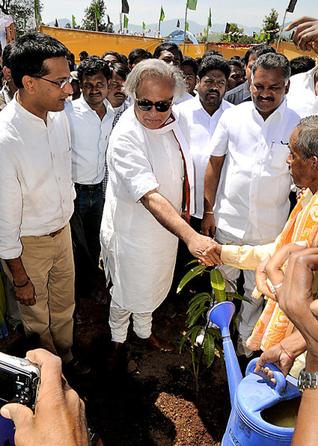
Union Minister Jairam Ramesh greeting a tribal farmer at Konthili village in Visakhapatnam district on Sunday after planting the 2 millionth fruit tree. State Minister P. Balaraju and CEO, Naandi Foundation, Manoj Kumar, are seen.  / Photo: C.V. Subrahmanyam / The Hindu

Indigenous practitioners from across the world to take part

The Naandi Foundation and Global Livelihoods Network is organising a three-day Livelihoods Camp at Araku Valley from Monday.

The camp is being organised to bring together indigenous practitioners of sustainable livelihood from across the world to learn from the experience of the tribal farmers of the Paderu Agency area. The tribal farmers here have taken up an afforestation programme in 6,000 ha in the region under which 60 lakh saplings belonging to 14 fruit and timber species will be planted under the guidance of the Naandi Foundation and Global Livelihoods Network and Mahindra & Mahindra, explains CEO, Kallam Anji Reddy Chair of Naandi Foundation, Manoj Kumar. Earlier, the network had helped the tribal farmers take up cultivation of coffee in seven mandals.

Noting that this was a monoculture, the network took up the challenge thrown by Union Rural Development Minister Jairam Ramesh to encourage biodiversity and launched the Hariyali — 60 lakh fruit tree plantation programme — in the area three years ago.

Last year, the farmers planted 10 lakh trees. This year, the number has gone up to 20 lakh saplings. In the next two years, the network is confident of achieving the target of planting 60 lakh fruit and timber saplings.

The three-day camp would enable the livelihood practitioners to participate in discussions on livelihoods themes such as carbon rhythms, agricultural sustainability, ensuring fair price for the produce, and evolving sustainable community well-being and nutritional security, president of Global Livelihood Bernard Giraud said while addressing a meeting organised to mark the plantation of the 2 millionth fruit tree as part of the Hariyali programme at Konthili village in Hukumpeta mandal of the district on Sunday.

Mr. Jairam Ramesh, Tribal Welfare Minister P. Balaraju, Paderu ITDA Project Officer Srikant Prabhakar, members of the network, and tribal farmers from the region were present.

source: http://www.TheHindu.com / Home> News> Cities> Visakhapatnam (Paderu), Visakhapatnam District / by Special Corrrespondent / October 08th, 2012

Clock, Rebecca and Salarjung

My first visit to the Salarjung Museum (SJM) was an educational tour from school. I was in Class VI and my classmates and I were seated expectantly at 12 noon in front of the famous clock to watch a figure within the clock come out and strike a bell 12 times. We were excited!

Years later, when I stood before the clock once again, this time with my daughter, Suha, there was the same feeling of complete fascination. Some of the objets d’art here — the statue of Rebecca, chandeliers, swords, paintings, porcelain and carpets — are amazing so is the children’s gallery.

The Museum consists of the largest collection of artifacts owned by a single family anywhere in the world — 47,500 artifacts displayed in 50 galleries, with 8,500 manuscripts and 60,000 books in the library. It receives 6,000 visitors a day, the largest footfall for any museum in India. Only 20 per cent of artifacts are on rotational display, the remainder being stored away for better preservation.

To stay relevant, its spaces have always laid emphasis on world-class display, and in the last three years, 1 lakh sq feet of interiors have been renovated. A gallery of Islamic art, spread over 26,000 sq feet is under construction where the world’s smallest Quran will be on display. The Museum, which is soon to be the subject of a coffee-table book, is now also becoming a cultural hub, with about 100 events staged here last year — plays, ghazal concerts and mushairas.

Reaching out to people is vital for its continued popularity, and its bus, “Culture on Wheels”, visit schools. They have also digitised the manuscripts and books, and soon, its virtual tour may be possible.

(The writer is a philanthropist, educationist and member of the board of Salarjung Museum)

source: http://www.DeccanChronicle.com / Home> Tabloid> Others / by Zakir Hussain / October 07th, 2012

Training institute for technicians to undertake dialysis

Hyderabad:

NephroPlus, a healthcare speciality chain running kidney clinics, has set up a training institute called ‘Enpidia’, here. The institute will train technicians who will be certified to undertake dialysis.

The two-year international standard, certification programme will focus on training dialysis technicians and nurses. It will be administered by US-based agency and aim to bring the much-needed standardisation to dialysis training in India and ensuring quality kidney care.

Announcing the launch Mr Kamal D. Shah, Co-Founder and Director, NephroPlus, said, “The situation today in India is very dangerous. Many dialysis technicians and nurses do not have the necessary training or qualifications to work at dialysis units. This puts the lives of patients at a huge risk.”

The contemporary programmes in the country are not rigorous enough to train people in dialysis. They do not have the necessary theoretical knowledge to effectively look after dialysis patients. Most of them are taught procedures in a very mechanical manner which is simply not enough, he said in a press release.

STIPENDS

NeproPlus will offer stipends right after the third month of training and can go up to Rs 7,500/month in the second year. The course fee is Rs 12,000 every six months. People with this certification will be eligible for jobs in countries such as the US, the UK, Canada, West Asia as well.

NephroPlus, with seven kidney clinics in South India will also be offering jobs to some of these candidates as it plans to open more centres.

source: http://www.TheHinduBusinessLine.com / Home> Industry & Economy> Economy / The Hindu’s Bureau / Hyderabad, March 08th, 2012

‘Fish’ speaks for threatened marine life

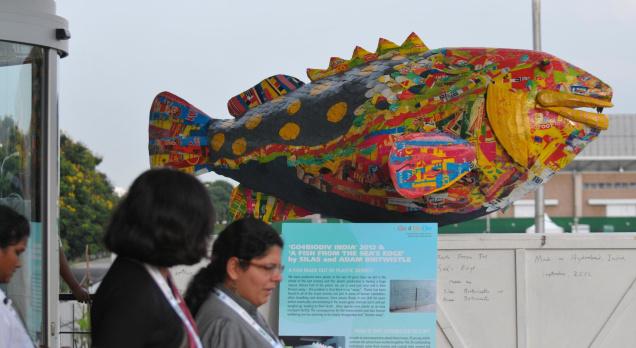
The unique fish which greets participants at the entrance to the Hyderabad CBD conference venue. /  Photo: Mohammed Yousuf / The Hindu

The sculpture made by British artist Silas Birtwistle was built with plastic trash for CoP-11

A table made out of driftwood for Nagoya, and a fish sculpture built with plastic trash for Hyderabad — that is the awareness-raising contribution of Silas Birtwistle, a British artist, to two international conferences of the Convention on Biological Diversity.

The 3 metre-long, 1.5 metre-tall fish greeting participants at the entrance to the Hyderabad CBD conference venue is a colourful mosaic of plastic waste, sporting remnants of many commercial brands. It is a symbol of the heavy impact of land-based activity on the seas, and highlights the plight of the coastal communities whose youth have collected the trash and sent it on to the artist.

Some waste from city

This piece of garbage art became possible through the involvement of about 35 young people who collected the plastic and posted it in boxes it to Silas, and his brother Adam, also an artist and collaborator. Some of the waste that helped make the fish is from Hyderabad, the venue of the XI Conference of the Parties to the CBD.

“The plastic waste that washed up on shores has come from many places, including the Philippines, Tasmania, Belize, Costa Rica and Canada,” Silas told the media on Friday at a CoP-related event. The youth who sent it to him would get their first real look at the end result only when they arrive at the venue next week.

They will carry messages for the decision-makers gathering here.

Several participants who collected the trash are fishermen. They work with their communities to stop overfishing and to encourage wider global understanding of the problems facing coastlines and seas. Silas was commissioned to produce the ‘sculpture’ by Go4BioDiv, an international youth forum that has adopted the theme of conservation of coastal and marine biodiversity to sustain lives and livelihoods, during 2012. Among the youth delegates brought together by the forum are those from marine world heritage sites.

For the previous CoP at Nagoya in Japan, Silas put together a conference table made out of driftwood and 12 chairs and the set was used at the conference. Later, it travelled to other venues and meetings.

The wood was collected from the coasts of East Africa, Borneo, Honduras and Canada. That project is now an exhibit on the web, at http://atablefromtheseasedge.com/

“Oceans look the same today, as they did hundreds of years ago, but many people are not able to appreciate the changes such as acidification. Doing things like this is to communicate, use another language to help everyone understand,” says Silas. The fish he has ‘sculpted’ is quite durable and would work like a weather vane, turning when the wind blows. The final display spot of his unusual art work is as yet unclear. “It may go to the Worldwide Fund for Nature or Wildlife Institute of India,” he says.

Threat to seas ‘unprecedented’

Silas was asked at the World Economic Forum in Davos, whether he felt responsible for the environment as an artist. “No,” he told the surprised audience, “you are responsible.”

The CBD describes the threat to the world’s seas from human activity as ‘unprecedented’. Fishing, transportation, waste disposal, agricultural nutrient run-off, and introduction of exotic species are visible threats, while higher levels of carbon dioxide in the atmosphere get absorbed by the oceans, altering their chemistry and affecting marine life.

The United Nations General Assembly has proclaimed the decade from 2011 to 2020 the ‘Decade on Biodiversity.’

source: http://www.TheHindu.com / Home> News> City> Hyderabad / by G. AnanthaKrishnan / October 06th, 2012

Autodesk acquires Pramati’s Qontext platform

US designer buys software to expand social capabilities of its cloud-based service
Autodesk says it intends to use Qontext technology to add new social capabilities to Autodesk 360, its cloud-based platform.

Hyderabad:

US-based three-dimensional, or 3D, design software maker Autodesk Inc. has acquired enterprise social collaboration software platform Qontext from Hyderabad-based Pramati Technologies Pvt. Ltd to expand the social capabilities of its Autodesk 360 cloud-based service.
Qontext comes as a ready-to-use hosted service that helps create contextual conversations with co-workers and customers using bookmarks, discussions, photos, videos, polls, documents and the like. It comes for a monthly subscription “as low as the price of a good coffee”, the company’s website said.
Autodesk said it intends to use Qontext technology to add new social capabilities to Autodesk 360, its cloud-based platform that offers users the ability to store, search and view critical design data and improve the way they design, visualize, simulate and share work with others at anytime, from anywhere.
“Mobile, cloud and social computing are dramatically changing the way engineers, designers and architects work. The addition of the Qontext technology to the Autodesk portfolio will lead to new technology innovations that help our customers embrace these disruptive technologies and leverage them for competitive
advantage,” said Amar Hanspal, senior vice-president of information modeling and platform products at Autodesk, in a statement.
Collaborative platforms that link up the cloud, social media and mobile are much sought after in the enterprise market. This is at least the fifth such purchase in the product space in recent months.
Microsoft Corp.  acquired Yammer Inc. for $1.2 billion in July,  Citrix Systems Inc. bought Podio ApS  for an undisclosed sum in April,  SAP AG  purchased Success Factors Inc.  for $3.4 billion in December and VMWare Inc. acquired SocialCast in May last year for an undisclosed amount.
Research firm Forrester Research Inc. said corporate social software will grow at a compound annual growth rate (CAGR) of 61% to become a $6.4 billion market by 2016 from $600 million in 2010.
Autodesk said the development team of Qontext, founded in 2009 and headquartered in California, will join its rolls with this acquisition. “This transaction is a significant milestone in our ongoing bid to incubate and build firms that address the rapidly changing needs of business through highly innovative technologies,” said  Vijay Pullur , president, Pramati Technologies.
Pramati Technologies was founded as a web technology firm in April 1998 by brothers Jay Raghavendra Pullur and Vijay Prasanna Pullur, who worked with information technology services provider  Wipro Ltd.   before that. The privately held firm had previously sold Pramati Studio, a platform to build developer tools, to US-based  Progress Software Corp.  in 2005.
It has incorporated two other firms for each of its products, SocialTwist, a social and referral marketing tool, and Imaginea, a software product and services firm that counts Visa Inc. and Intel Corp.  among its clients. Pramati employs 500 people across three locations globally, according to its website.
The deal size and transaction terms weren’t immediately disclosed. Jay Pullur said at a press conference in Hyderabad that the company invests sizeable amounts in its subsidiaries and expects “VC (venture capital) type returns”.
Pramati incorporates each of its business ideas as separate companies and builds them into mature products before selling them off. It typically invests $3-7 million in mature companies such as Qontext. Venture capital firms usually expect 5-10 times return on their investment. Autodesk executives said the deal was in the million-dollar range but did not elaborate, citing non-disclosure agreements.
With this acquisition, Autodesk will open a development centre in Hyderabad, its second in India after Pune.
The 25-member development team of Qontext, founded in 2009 and headquartered in California, will join its rolls after the acquisition, said  Soren Abildgaard, senior director, cloud platforms, Autodesk.
Rajiv Shivane, who led the Qontext team, will continue to lead it at Autodesk.
Abildgaard also said Qontext will be absorbed into Autodesk and not be branded separately.
Autodesk is not acquiring the existing customer base of Qontext in this transaction and will not support them,  Shanna Tellerman, the company’s product line manager, Web services, said. Pramati will continue to support them for some time, Jay Pullur said.
Pramati is also talking to prospective buyers to sell SocialTwist, Jay Pullur said but did not disclose more details citing confidentiality pacts. At the same time, it is actively considering acquiring a company by the year-end, he said. “It is a reasonably sized deal,” Jay Pullur said.
source: http://www.livemint.com / Home> Companies / by Yogendra Kalavalapalli / Friday, October 05th, 2012