Persian influence abounds in Bidri ware

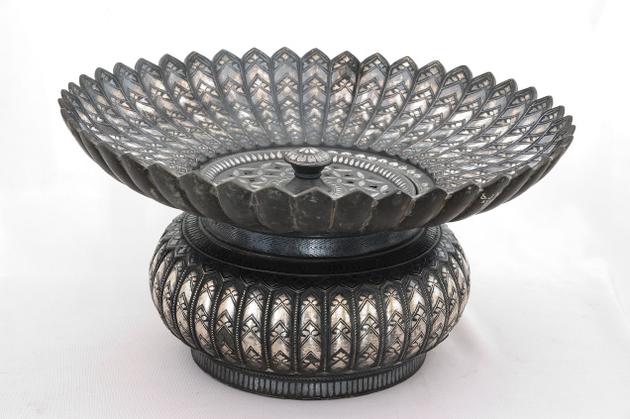
A circular basin with perforated cover inlaid in silver. / Photos: Special Arrangement / The Hindu

Their sight is brilliant: silver designs shining against the black metal base. Their variety is extraordinary: spittoons to cloth weights. Wealth of design and varied shapes – the two qualities Bidri wares are praised for – are evidenced in the many specimens of this 400-year-old craft enshrined in Salarjung Museum.

Bidri gets its name from Bidar, some 200 kilometres from Hyderabad.

The basic material of Bidri is an alloy of zinc, copper and lead. There are five stages in the production of Bidri: casting, polishing, engraving, inlaying and blackening.

The decorative methods in Bidri consist of – inlay of wire, inlay of sheet, low relief, high relief, cut-out designs in super imposed metal sheets.

Silver is chiefly used for ornamentation, and gold, very rarely.

The preference for silver is obvious: it creates better contrast when inlaid over the ebony coloured Bidri metal.

Bidri ware, like many other crafts, was a fruit of our contacts with Persia. The art of inlaying precious materials over the articles of daily use is peculiar to Persia and other Middle Eastern countries. The Iranian craftsmen who came to Bidar some 400 years back developed the crafts. It later moved to north India and Hyderabad.

The museum’s Bidri collections of huqqa bottoms, Aftabas, trinket boxes, goglets, spice boxes, contain mostly designs of wine creeper and poppy plants. Geometrical decorations also appear. Later products show Hindu lotus decoration.

A special case is a Bidri huqqa designed with a mixture of Persian and European patterns, the latter having been introduced by the French in 18th century.

B. Kotaiah, Dep. Keeper (Retd) Salarjung Museum

source: http://www.TheHindu.com / Home> News> Cities> Hyderabad / by B. Kotaiah / November 22nd, 2012

Rising Stars of Don Bosco Academy Nalgonda

Five of Don Bosco high school, Nalgonda students procured a place for themselves in the under-16 state football and basketball teams. Sports Association of Nalgonda on 7th of November 2012 selected Boyapati Bala Shravan, a student from class 9 for basketball, M. Muneer and A. Srinivas of class 7 as well as V. Madhu and P. Sriram of class 8 for football respectively.

On this occasion Fr Gopu Anand, the director of the Academy said that the importance of sports and games is being increasingly recognized at the Academy, from both the educational and social points of view. He exhorted all the students, regardless of all backgrounds and works, to participate in games, and not merely watch matches occasionally to cheer up their favourite teams or attend the prize distribution functions at the end of a sports season.

Fr Balashowry, the principal of the College and Fr Bhaskar the headmaster of Don Bosco High School commended the students for their achievements and verbalized their opinions of Don Bosco’s acclaimed pedagogy and educative system which empowers a child in his or her integral growth.

source: http://www.DonBoscoHyderabad.org / Home / by K. Suresh, Teacher, Don Bosco High School / November 20th, 2012

Two prizes for Nalgonda in State science test

Subramanyam of Prakasam district and K. Yeshwant of Nellore bagged the first prizes in Telugu and English respectively in the State-level science talent test conducted by the Jana Vignana Vedika (JVV) at Nagarjunasagar on Friday. Seventy-five students from 16 districts took part.

The other prize winners were Yesasvi (Kadapa) and Nandakumar (Nalgonda) in Telugu, and Rajesh (Nalgonda) and Vijaysai (West Godavari) in English.

K. Sripraja of Nellore and N. Ajita Reddy (Krishna) won the first and second prizes respectively in the display of science exhibits.

Dr. P. Rama Rao, State JVV president, gave away the prizes that included laptop , tablet and cell phone . Chandana Chakravarty, formerly of the CCMB, and Krishna, a professor from the University of Hyderabad, were among those present, along with JVV leaders Dr. Brahma Reddy and N. Bheemarjun Reddy.

source: http://www.TheHindu.com / Home> National> Andhra Pradesh / by Hindu’s Correspondent / Nalgonda, November 17th, 2012

Hyderabad: Pearls from China dominate pearl market

Hyderabad:

Much like the market of decorative items, toys and a lot of other goods in India, the pearl market of Hyderabad is now dominated by China. Shop owners in the city say China has overtaken other countries from where pearls are being imported. Hyderabad is known as the “city of pearls”. But the irony of its pearl story is that the city is nearly 300 km away from the ocean!

The pearls that give the city its moniker are all sourced from outside. After being imported, they are drilled in different parts of the state. In Chandanpet, just outside Hyderabad, for instance, almost the entire population is engaged in the delicate art of pearl drilling. Once they are drilled, the pearls are bleached, washed and separated in accordance with their shape and size.

Vijay Dochania, manager at the Amarsons Pearls jewellery shop, said though pearls are sourced from several countries, China dominates all. “Pearls from China have been coming here for more than 100 years now, but today they dominate the market. They are available in different price ranges, depending on their shape, size, sheen and lustre,” Dochania told IANS.

China has been the world’s biggest pearl producer for two decades, flooding the world market with small and cheap pearls of costume-jewellery quality. The pearl farming industry there is now using new techniques to push into the lower reaches of the market. Freshwater pearl farms in east-central China are reported to be producing white pearls that cost a fraction of the saltwater variety.

It was the patronage of the Nizams for pearls that attracted Arab traders from the Gulf to Hyderabad, which was also known for its diamonds — the latest being a diamond from Golconda that fetched a record price at Christie’s auction. “Long time back, pearls from Ceylon (Sri Lanka) were imported. Basra pearls which come from the Gulf countries were also very popular at one time since they are of very fine quality. You will still find them in the market today, but rarely so,” Dochania said.

Jai Prakash, another jewellery shop owner in the city, said pearls are also imported from Japan, Tahiti, Indonesia, Australia and Venezuela. South Sea pearls, which are sourced from the South China Sea, are also readily available and fall in the expensive range because of their large size and sheen. Tahitian pearls cost more than others.

“There are three kinds of pearls – natural, cultured and semi-cultured or man-made. Natural pearls come from places like Tuticorin (India) and Venezuela. Basra (Iraq) pearls are also natural pearls. Cultured pearls mostly come from Japan and China. When Japan was struck by the tsunami, the pearl trade here was affected to some extent. In any case, they come more from China than Japan,” he said. The Majorica pearl is a man-made pearl from Spain.

The city’s pearl trade is worth around Rs 500 crore annually. “Almost 40 percent of our sales are attributed to tourists. People are mostly not too bothered about where the pearl has come from, they are more concerned about the quality of the pearl, its shape, its colour,” said Naresh Agarwal of Mangatrai Pearls.

Visiting Hyderabad on work, 42-year-old Shalini Singh said the only concern that she has while shopping for pearls is their quality. “I bought a set of necklace and earrings of South Sea pearls from a reputable shop, so I am assured of the quality. I also bought a whole lot of pearl earrings, which, the shop owner mentioned, were China pearls. They look good and the price fits my budget, so I am happy,” Singh said.

Victoria Humphrey, a British tourist, however, found it surprising that the pearls that Hyderabad is so famous for are all imported. “I asked a shopkeeper what was so typically Hyderabad about the pearls here, and he replied quite honestly that they were mostly from China! I appreciated his honesty but I had bought my share of Chinese pearls when I was in Beijing; so I did not buy here,” Humphrey told IANS.

source: http://www.ibnlive.in.com / Home> South> Andhra Pradesh / Pradesh /  IANS / November 20th, 2012
The Hindu Young World Quiz on November 28

The multi-city mega quiz will be held in 16 cities, while the grand finale will be in Chennai

The 13th edition of the hugely popular The Hindu Young World Quiz Competition, a part of the The Hindu-NIE Initiative is all set to kick off in the Andhra Pradesh capital on November 28.

It will be held between 12 noon and 3 p.m. at the Hari Hara Kala Bhavan and participants should report at 11.15 a.m.

Any two students studying in classes seven to nine can form a team and a maximum of four teams from each school are permitted to participate.

ENTRY CARD FORMAT

Completed entry cards may be sent to P. Ranga Reddy, Regional General Manager, The Hindu, Hyderabad, for registration.

Once registered, the top portion of the Entry Card must be carried by participants to the venue without fail. Photocopies of the cards will not be accepted. Entry for the event is free.

Six teams for the regional finals on stage would be selected based on a preliminary, written round.

The winning team from each region will qualify for the Grand Finale at Chennai.

Certificates of participation apart, a large number of prizes await the winners at every stage.

OUTSTATION TEAMS

In the case of outstation teams that qualify for the Grand Finale at Chennai and for one accompanying parent or teacher, the cost of travel, boarding and lodging will be borne by the organisers.

The multi-city, mega quiz is being held in 16 cities – Bangalore, Hubli, Mangalore, Puducherry, Tirupati, Thiruvananthapuram, Trichy, Salem, Coimbatore, Madurai, Kochi, Kozhikode, Hyderabad, Visakhapatnam, Vijayawada and Chennai.

source: http://www.TheHindu.com / Home> News> Cities> Hyderabad / by Special Correspondent / November 19th, 2012

In Andhra Pradesh, Catholic nuns bring drinking water to 250 tribal families

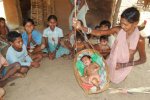
Residents in the village of Koderna (East Godavari District) drank polluted water, fighting malaria and typhoid. Five Sisters of the Cross were instrumental in getting a pump to bring water from a clean source as well as opening a school and a dispensary.

Hyderabad (AsiaNews)

Thanks to the efforts of five Sisters of the Cross of Chavanod, a tribal community in Koderna (East Godavari District, Andhra Pradesh) now can meet basic needs like safe drinking water and education for their children. Until a year ago, the 250 families that call the village home had to rely on polluted water and typhoid and malaria were widespread. Local kids did not go schools. Now villagers have a well with clean water, a dispensary for basic health needs and a school.

Last year, the Sisters of Chavanod visited the unspoilt mountains that are next to the village. During their trip, they discovered the village. “Beside the tranquil streams and sparkling atmosphere of the mountains stood the village where people drank highly polluted water,” said Sister Priyanthi Samala.

Sadly, the government has shown little interest for the fate of this village, as did other communities in the area. A school does exist in Koderna but it lies empty because the teacher comes every two months.

Outsiders do visit the village but only to buy local goods, like tamarind, wood, charcoal, ragi (finger millet), bamboo, brooms and spices at very low prices.

In view of the situation, the nuns got in touch with an engineer who looked at the ground to see how drinking water could be brought to the village from another source.

Eventually, he succeeded in his search. The nuns then approached the government for help and began to work on the villagers to have them join the project.

“After a year of assiduous efforts to motivate this community and several frequent visits, we gained the confidence of the people and established our work in their location. We were certain of their cooperation,” Sister Samala said.

“They did not hesitate to send their children to the school,” but “the few children who saw the school for the first time were terrified and perplexed.”

Now about100 of them attend the school the nuns set up and run out of a rented house. Eventually, the sisters hope to get a building of their own.

source: http://www.asianews.it / Home> India / by Santosh Digal / November 17th, 2012


Myanmar’s Suu Kyi visits Andhra villages to study socio-economic transformation

Hyderabad:

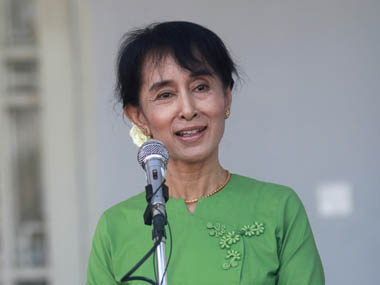
Myanmar’s pro-democracy leader Aung San Suu Kyi on Saturday arrived in Andhra Pradesh’s Anantapur district to study the socio-economic transformation of people in villages brought about by various government welfare schemes.

The Nobel laureate arrived in Kothulagutta village around 9.30 a.m. in a helicopter from Bangalore. She was accompanied by Union Minister for Rural Development Jairam Ramesh and Andhra Pradesh Chief Minister N. Kiran Kumar.

Amid tight security, three helicopters carrying the leaders and their aides landed in the village.

Suu Kyi saw a power point presentation on the rural development in the state and the impact of the welfare schemes being implemented by the central and state governments.

She later travelled by road to Govindapuram village and interacted with the people working under the Mahatma Gandhi Rural Employment Guarantee Scheme (MGREGS).

The Myanmar opposition leader will also visit Papasanipalli village and interact with women to gain first hand knowledge of how the self-help group movement has changed their lives.

After visiting the house of a member of a self-help group, she will fly back to Bangalore.

IANS

source: http://www.firstpost.com / Home> World / November 17th, 2012

Chiranjeevi regales children at IGMC fete

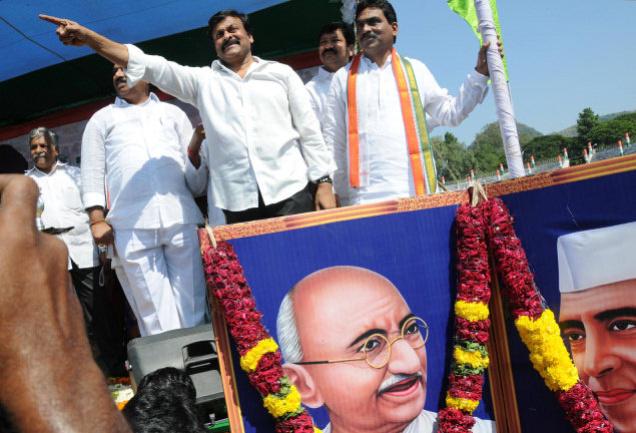
VIJAYAWADA, 14/11/2012: Union Minister of State for Tourism (Independent) K Chirangeevi waving the crowd at the children’s day function organised Rajagopal foundation in Vijayawada on Wednesday. /  Photo: Ch. Vijaya Bhaskar. / The Hindu

He asks parents to spend more time with their wards

Parents and teachers need to connect to children to understand them in order to drive home lessons or small scientific principles, said Union Minister of State for Tourism K. Chiranjeevi during a Children’s Day celebration organised by Rajagopal Foundation at Indira Gandhi Municipal Corporation Stadium on Wednesday.

The programme commenced at 9.00 a.m. After formally launching the celebrations by releasing some pigeons and colourful balloons, Mr. Chiranjeevi recounted his experience of learning from his own teachers as a seventh standard student and explained the concept of pollination, fertilisation and germination.

Advising parents to spend more time with their children to understand their needs and read their minds, Mr. Chiranjeevi gave many personal examples. In the entire jam-packed galleries of the IGMC Stadium, children showcased their talent by presenting various cultural performances and took part in various literary and cultural competitions. Not many could get a glimpse of the former megastar, but his voice blaring over the public address system regaled them.

A few prize winners had the chance to meet him and take photographs.

Mr. Chiranjeevi profusely thanked Vijayawada MP Lagadapati Rajagopal for giving him a chance to interact with children and said that this was his first such occasion.

The competitions included song, group dance, fancy dress, essay writing, elocution, quiz and drawing contests. The Union Minister was felicitated with garlands and gifts by the Secondary Education Minister Kolusu Parthasarathy and Vijayawada MLAs Malladi Vishnu and V. Srinivas. Earlier, the Union Minister came in a procession from the Gannavaram Airport that exposed differences between various groups in the Congress party in the Krishna District.

source: http://www.TheHindu.com / Home> News> Cities> Vijayawada / by Special Correspondent / November 15th, 2012

It’s a grind, every day of her life

Hyderabad:

But for a few minute changes, the daily schedule of  Saina Nehwal has hardly changed over the last decade. If anything, there is only a change in the mode of her travel. While she used to commute on her father’s scooter, she now arrives at the Pullela Gopichand Academy in a new BMW X6.

For six days in a week, Saina’s schedule remains the same. She wakes up at 6 am and after having a glass of milk she spends one hour in yoga nidra. During this period she assesses her previous day’s practice and motivates herself for the session ahead.

She arrives at the academy at about 7.30 am and after the scheduled meeting with other trainees she starts on-court practice. The first session usually comprises stroke-hitting and the various aspects of the game prescribed by coach Gopichand.

The session ends at 11 am and after a small fruitbreak, her training starts again at 11.30 am. In this session, she usually practises with her sparring partners. Coach and former All-England champion Gopichand is one of them along with India’s top singles player Parupalli Kashyap and other male international shuttlers. They even play matches and on most occasions, Gopi, who is 39 now, gives a tough time to Saina.

After lunch and a nap, the third session begins at 4.00 or 4.30 pm as per the schedule fixed by coach and physio Kiran. The lunch includes rice, chicken (she was a vegetarian earlier), vegetable curries and lowcarb-high-protein diet. The evening session in a week comprises 2-4 sessions of strength training, 3-5 sessions of endurance and about six sessions of agility, moderate running etc.

She does weight training but guards herself against acquiring an unfeminine figure. She does speed runs for about half an-hour and relaxes herself at the swimming pool.

She is back home around 7.30 pm. Though her coach has advised her against any physical exercise she sometimes hits the treadmill. She finishes her dinner by 8.30 pm which mostly includes boiled chicken and vegetables. She turns on the TV and goes to sleep watching some movie.

Saina hardly attends any functions or parties. Once in a while and mostly when she is abroad, she goes for a movie and after winning every tournament she indulges in an ice cream.

source: http://www.articles.timesofindia.indiatimes.com / Home> Sports> More Sports / by M. Ratnakar, TNN / November 11th, 2012

Hyderabad’s Rajiv Gandhi International Airport Receives Carbon Accreditation

Rajiv Gandhi International Airport (RGIA), Hyderabad, has received Airport Carbon Accreditation at Level 2 –‘Reduction’ for its efforts in managing and reducing carbon emissions.

The Airport Carbon Accreditation certification was presented to RGIA on 8 November during the 8th ACI Asia-Pacific Small Airports Seminar organized by ACI Asia-Pacific and hosted by GMR Hyderabad International Airports Ltd (GHIAL).

Mr. Vikram Jaisinghani, CEO of GHIAL, operator of RGIA, said, “This accreditation is a significant milestone in the advancement of airport’s overall sustainability strategy as it involved calculating the carbon footprint of RGIA, using internationally recognised methodology and independent verification. RGIA has compiled an independently verified carbon footprint and succeeded in reducing their overall emissions and carbon footprint over the past number of years.”

On the same occasion, Mr. P.S. Nair, CEO-Corporate, Airport Sector of GMR Airports Limited was also presented with the Airport Carbon Accreditation certificate for Delhi’s Indira Gandhi International Airport, another GMR-led airport in India, which was accredited at Level 2 – ‘Reduction’ in July this year.

Regional Director of ACI Asia-Pacific, Mrs. Patti Chau said, “It was this month last year that Airport Carbon Accreditation was introduced in Asia Pacific and I am indeed very pleased to see that 6 airports in the region have been accredited and 3 are even accredited at Level 2 – ‘Reduction’, including RGIA.”

Airport Carbon Accreditation is the institutionally endorsed program that independently assesses and recognises airports’ efforts to manage and reduce their CO2 emissions.

Participating airports can be certified at 4 progressive levels of accreditation as follows: ‘Mapping’, ‘Reduction’, ‘Optimisation’, and ‘Neutrality’.

First launched by ACI Europe in 2009, the programme received support from ICAO and was extended to the Asia Pacific region in November 2011.

Airport Carbon Accreditation is administered by WSP Environment & Energy, an international consultancy appointed to enforce the accreditation criteria for airports. The administration of the programme is overseen by an independent Advisory Board.

Airports must have carbon footprints independently verified in accordance with ISO14064 (Greenhouse Gas Accounting). Evidence of this must be provided to the administrator together with all claims regarding carbon management processes which must also be independently verified.

source: http://www.asiatraveltips.com / Home / Monday, November 12th, 2012