Unani hospital set to regain original splendour

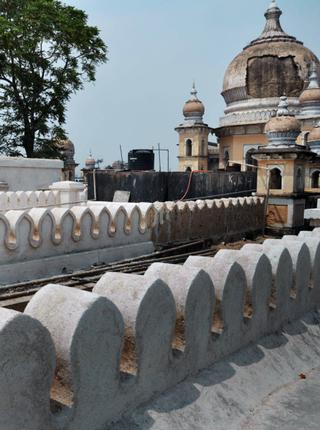
A section of the Unani Hospital that underwent renovation work using traditional building materials. - Photo: G. Ramakrishna / The Hindu
A section of the Unani Hospital that underwent renovation work using traditional building materials. – Photo: G. Ramakrishna / The Hindu

A Grade II heritage structure, the Government Nizamia Tibbi College and Hospital near the Charminar is getting a much-needed facelift after years of neglect and damage

Finally it is getting the much needed facelift.

Situated bang opposite the historic Charminar, the condition of the Government Nizamia Tibbi College and Hospital is not much different. But now this Grade II heritage structure is getting the attention it deserves. A team of skilled labours are busy trying to undo years of neglect and damage.
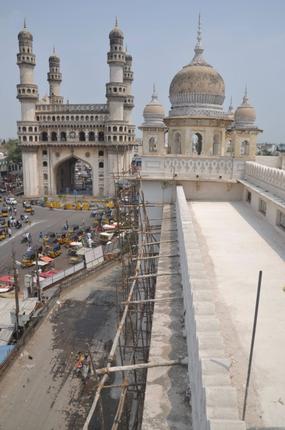
Renovation work in progress on the Unani Hospital in Old City. - Photo: G. Ramakrishna / The Hindu
Renovation work in progress on the Unani Hospital in Old City. – Photo: G. Ramakrishna / The Hindu

The A.P. Health, Medical Housing and Health Infrastructure Development Corporation has stepped in to restore the pristine glory of this stately structure built in 1938 by the seventh Nizam. Right now, exterior of the building where plaster has peeled off at several places with vegetal growth sprouting all over is being attended to. Repair of the dome, scrubbing and scrapping of the top surface and re-plastering with ‘shivara’ rendering is proposed.

Before undertaking the work, photographic, architectural and material documentation of the Unani hospital was done. The material documentation was intended to find out the original and traditional material used in construction of the building.

A chemical test carried out showed lime mortar as the basic material used in construction of the edifice, according to Suryanarayana Murthy, heritage architecture. The same material is now being used in right proportion along with jaggery liquid, gallnut, egg white and aloe vera gum. The workers have been trained in preparation of the construction material, he said.

Originally, renovation of the Unani hospital building was linked with the Charminar Pedestrianisation Project but later the Department of Heath has taken over the works. The conservation plan has been approved by the Heritage Conservation Committee and the works are expected to be completed by December end.

The other day Majlis floor leader Akbaruddin Owaisi visited the Unani Hospital and reviewed the progress of the work.

He favoured adoption of a comprehensive approach for conservation of the Unani hospital building in its totality. If necessary, funds from other departments should be tapped to improve the surroundings around the hospital. He suggested laying of pathways within and outside the hospital, remodelling of drainage line, horticulture and lighting work to be taken up.

The GHMC has a budget of Rs. 5 crore for heritage buildings and this could be tapped for the Unani hospital restoration, Mayor Majid Hussain said.

source: http://www.TheHindu.com / Home> News> Cities> Hyderabad / by Special Correspondent / April 02nd, 2013
Glory days over, ‘general’ in tatters

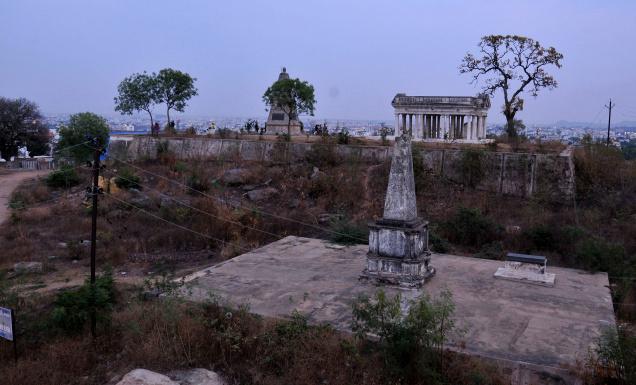
The Mons Raymond’s obelisk tomb near Malakpet. — Photo: Nagara Gopal / The Hindu

Rubble and high growth of weeds and bushes indicate lack of maintenance for Monsieur Raymond’s tomb

The towering obelisk on the Asmangadh hill has been an epitome of communal harmony in a very unique way. Even after 200-odd years of its construction, local Muslims remember to pay homage at the tombstone every Id-ul-Fitr. Hindus do it seven days after the festival by lighting camphor and offering flowers. Irony is that the tomb holds the remains of a person who belonged to neither of the two religions!

Monsieur Raymond, referred to fondly as Moosa Ram by Hindus and Moosa Rahim by Muslims, was in fact a Christian, and a French general in Nizam’s military. He was the person behind the setting up of Gunfoundry, the factory where cannon balls were produced during Nizam’s time. Needless to say, the area Moosarambagh derived its name from the general’s popularity among the local people.

No signboards

However, all that remained the glory of the bygone era, and his tomb, a site of archaeological significance, lies in utter neglect now. Visitors face difficulty in even locating the seven-acre tomb complex, as no signboard can be found on the Moosarambagh main road, to direct the tourists. The only signpost, scraped and fading, could be found at the start of the lane which ends at the rusted iron gate leading into the complex.

“There were two signboards earlier, one of them on the main road. But GHMC removed both during its road widening drive, and they have not been reinstalled,” says S. Narender, the security guard.

Once inside the complex, visitors would be greeted to rubble, and high growth of weeds and bushes, indicating lack of maintenance. Narender goes inside a small room, probably meant to be information counter, and carries out a sheet-metal plaque, where the story of Monsieur Raymond is inscribed. That is the mode adapted by the Archaeology Department for dissemination of tourist information!

The pavilion where devotees offer their homage was reconstructed ten years ago, after a portion collapsed due to heavy rain in 2001. Since its restoration, the pavilion has not been repainted even once. Plants bordering the complex have dried up, and dry leaves lay scattered everywhere around.

While the general’s pet dog and horse were buried in the same place, and mentioned in the literature about the location, the dog’s grave lies hidden behind undergrowth. Security is lax, as the solar fencing erected over the compound wall remains dysfunctional, and needs repairs.

“Every night, drunkards and anti-social elements climb over the walls from the other side, and create a ruckus in the tomb complex. Our sleep gets disturbed due to this,” a resident of the area informed.

source: http://www.TheHindu.com / Home> News>  Cities> Hyderabad / by Swathi V. /April 01st, 2013

125-feet Dhyana Buddha statue to be unveiled

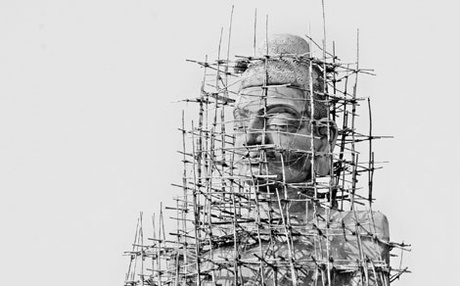
The 125-foot tall Buddha statue getting ready at Amaravathi in Guntur | Ch Narayana Rao / The New Indian Express

The tourism authorities have taken all the necessary steps to complete the much-delayed Dhyana Buddha project and unveil the 125-foot tall Buddha statute during the three-day Buddha Jayanthi celebrations to be held from May 14 at Amaravathi in Guntur district.

Of the Rs 40 lakh sanctioned by the department in this connection, Rs 10 lakh has been released recently and the works are going on at a brisk pace, said AP Tourism divisional manager (Vijayawada) Juvvadi Raghupati Rao.

The Dhyana Buddha project was conceived and executed by Social Welfare joint director Regulla Mallikarjuna Rao in 2004 with the funding of Guntur district collector. But, the tourism department took it over in 2007. More than Rs 3 crore has already been spent on the project, say sources.

Meanwhile, the Buddha statue has been designed by incorporating features from all the 50 types of Buddhist sculptures seen at 145 major heritage sites across India. The essence of the Buddhist teachings found in 24 chapters and 424 stanzas have also been carved on 200 panels in the main hall of the Dhyana Mandiram. The Dalai Lama, who visited the place during Kalachakra in 2006, donated `30 lakh and promised to provide 300 volumes of Buddhist literature to develop the place as an international Buddhist study centre. He is likely to attend the Buddha Jayanthi celebrations at Amaravathi in May for the second time. Meanwhile, the tourism officials are also taking measures for completing the roof-level restaurant, Raghupathi Rao said.

The AP Tourism is also developing other tourist and pilgrim centres including Kondaveedu Fort (at a cost of `85 lakh), Vundavally Caves, Uuppaldu Bird Sanctuary (`15 lakh each) and Karampudi Veerla Gudi (the temple of warriors at `60 lakh), he added.

source: http://www.newindianexpress.com / The New Indian Express / Home> State> Andhra Pradesh / by P Laxma  Reddy / ENS – Vijayawada / April 01st, 2013

Sachin opens cancer research centre

Prateek Sharma, Professor of Medicine, Kansas School of Medicine, in conversation with cricketers Sachin Tendulkar and V. V. S. Laxman at the launch of the Gastro Intestinal and Liver Foundation for Research and Treatment of Cancers in Hyderabad on Tuesday. At left D. Nageswara Reddy, MD, Asian Institute of Gastroenterology. –/ Photo: P V Sivakumar / The Hindu

Hyderabad : 

Cricketer Sachin Tendulkar has launched a research centre on gastrointestinal cancer. Started by the Asian Institute of Gastroenterology , the centre would study the prevalence and incidence of gastrointestinal (GI) cancers.

Addressing a gathering at the launch here on Tuesday, Dr D. Nageshwar Reddy, Chairman of AIG, said the Gastrointestinal and Liver Foundation for Research and Treatment of Cancers would collect and disseminate latest information on prevention and treatment of digestive cancers.

Besides educating lawmakers and the media on the burden of digestive cancers, the centre proposes to educate and train physicians on prevention and treatment of digestive cancers. Stating that the incidence of gastrointestinal cancers was extremely high in India, he said about 40 per cent of these cancers could be prevented if screened early. G. V. Rao, a senior gastroenterology consultant, said the foundation would start a screening programme to observe the risk factors and other parameters. Aerated drinks, food laced with preservatives and stored in fridges for long, could cause GI cancers.

With highest incidence and mortality rates among all cancers, GI cancers far outnumber lung and breast cancers in the developing countries. In 2008, 22 lakh new GI cancers were registered, with 18 lakh patients succumbing to such cancers.

Dr Prateek Sharma, Professor of Medicine (Gastroenterology and Hepatology) at the University of Kansas in the US, said deaths due to these GI cancers could cross the 1.2-crore mark by 2030.

The data on cancers in India, however, is limited. But quoting a survey done by the National Cancer Registry Programme (Bangalore), Nageshwar Reddy said India might have some of the highest cancer rates in the world.

source: http://www.thehindubusinessline.com / Home> Features / The Hindu Bureau / kurmanath.kanchi@thehindu.co.in / Hyderabad, March 05th, 2013

A modern traditionalist

Usha Raghunathan at the Singhania store in Banjara Hills | A Suresh Kumar / Express

Dressed in a mustard and pink contrast border silk sari, accompanied with a patchwork choli and traditional jewellery, Usha Raghunathan comes across as any other South Indian mother. But, hang on, there’s more to her than just the looks. Despite the most popular celebrities from Bollywood and Tollywood flaunting her creations, she is as humble as one can get. “It feels very nice, when I see them wearing something that I have designed. I believe saris are the most feminine outfits ever. Though the girls in this generation say they can’t handle saris and are more comfortable in their jeans, there is something about this six-yard or the nine-yard beauty that can bring out the best in them,” she believes. In the city for her latest Ugadi collection, she says cotton is the flavour of the season.  And, who can dispute her?

A flying start

Usha Raghunathan lost her mother at a very young age. Her father worked at the Air Force Civil Aviation, while her grandparents raised her. “It was because of my dad that I also wanted to learn flying. So, I got my license in 1956, which was quite something back then. Then, after I got married, my husband was also very supportive, so I was able to follow my dreams,” she recalls. Usha was then asked to write about her experiences of being a pilot, which was when she started writing. “I wrote a lot of radio scripts for the AIR,” she remembers. But, for the last 35 years, she has been completely involved in designing saris. “There were times when I would travel from Yercaud to Salem, sit with the weavers and get some saris custom-designed,” she reveals.

Cotton, silk and more

“I dream about saris and cholis. I have always loved Kanjeevaram, silk and cotton. I like anything that is traditional,” she admits. Being an ardent follower of  Kanchi Paramacharya, who always insisted on cotton as silk led to killing of silk worms, Usha came up with her “Ahimsa saris” which are made of poly-cot fibre, which resembles silk. “Though it is very expensive, it is just like silk. Many people prefer buying these,” she observes. Usha is known for uplifting the traditional sari and putting it in context for the present generation. Her collections are often tagged as “trendsetters with a traditional touch.” And there’s no exaggeration in that.

Challenges faced by weavers

Talking about the plight of the weavers today, she says, “They have been facing a major challenge in making their products appealing to the current market. But, if you sit with them and ask them to make a few changes, they willingly do it. We need to now focus on making their products accessible to people. There are many who want to wear traditional saris.”

Clothes do not provoke

Disturbed by the recent rape incidents in the country, Usha says, “Women were more respected a few decades back. These days, we see young boys at 17 committing these crimes. And the kind of allegations they make about clothes provoking men is all rubbish. If a woman in a small skirt can get raped, women in saris have also been raped. It is the mindset of men that has to change. Clothes do not send out a message.”

source: http://www.newindianexpress.com / Home> Cities> Hyderabad / by Kruthi Gonwar / ENS – Hyderabad / April 04th, 2013

AP Govt plans truck terminal, logistics hub in Nellore district

The three non-major ports on the AP coast, including Gangavaram and Kakinada ports, together handle a throughput of 40 million tonnes.

Hyderabad :

The Andhra Pradesh Government is planning to set up a dedicated truck terminal and logistics hub in Nellore district as part of the logistics requirement in the Bangalore-Chennai-Krishnapatnam port freight corridor.

The project, which will be taken up by the AP Industrial Infrastructure Corporation, with financial assistance from the Centre, is likely to become operational within a year. The facility will come up at Venkatachalam with an estimated investment of about Rs 40 crore.

“This corridor is experiencing increased movement of trucks and container vehicles flowing in and out of the Krishnapatnam and other non-major ports on the Andhra Pradesh coast. There is a need for a truck terminal and logistics hub,” J. Geetha Reddy, AP Minister for Major Industries, told media persons here today.

Currently, cargo-laden trucks are parked haphazardly in this region. The proposed terminal, to be set up over 51 acres, will initially provide basic logistics services and later add other services related to export and import of cargoes.

Krishnapatnam port, which has five multi-purpose berths with a draft of about 15 mts, handles a little over 16 million tonnes, as against the phase-I installed capacity of 25 mt.

The three non-major ports on the AP coast, including Gangavaram and Kakinada ports, together handle a throughput of 40 mt. A bulk of these cargoes moves down south, passing through the Bangalore-Chennai-Krishnapatnam port freight corridor.

In addition to these ports, another two are coming up at Machilipatnam, with a proposed initial capacity of 20 mt and Nizampatnam (15 mt).

“The land for the project has been acquired. The complex will be processing 300 tonnes of hides and skin per day. The Centre has released Rs 15 crore as grant, while the State Government released Rs 10 crore to start off the project,” Geetha Reddy said.

source: http://www.TheHinduBusinessLine.com / Home> Industry> Logistics / by The Hindu Bureau / amitmitra@thehindu.co.in /  Hyderabad, April 01st, 2013

Siva fest celebrated at Vemulawada

Siva Kalyanotsavam, the marriage of Lord Siva and Goddess Parvati was performed as a part of the annual Brahmotsavam at the Sri Raja Rajeshwara Swamy temple in Vemulawada on Saturday.

Hundreds of devotees thronged the temple which reverberated with the vedic chants of priests as devotees offered their akshintalu, rice mixed with vermilion and turmeric, to the deities.

Vemulawada panchayat commissioner Venumadhav offered silk clothes to the deities on the occasion of the wedding.

source: http://www.newindianexpress.com / Home> States> Andhra Pradesh / by Express News Services – Karimnagar / March 31st, 2013

CD of tele-film on environment released

Vijay Kumar of Vijay Nirman releasing a CD of a telefilm 'Kotta Bichchagadu' on environment produced by Mokkala Mohan at a function in Visakhapatnam on Sunday. / Photo: C. V. Subrahmanyam / The Hindu
Vijay Kumar of Vijay Nirman releasing a CD of a telefilm ‘Kotta Bichchagadu’ on environment produced by Mokkala Mohan at a function in Visakhapatnam on Sunday. / Photo: C. V. Subrahmanyam / The Hindu

The release of the compact disc of a tele-film on the importance of planting saplings to save the environment brought out by Ch.R.K. Mohan, popularly known as ‘Mokkala’ Mohan, provided a platform to speakers to stress the importance of safeguarding trees. CMD of Vijay Nirman Company Limited S. Vijay Kumar released the 40-minute CD “Kotta Bichhagadu” at Visakhapatnam Public Library on Sunday evening. Not only trees should be saved but the next generation should also be made aware of its responsibility, he said.

A professor of Environment Science of Andhra University, E.U.B. Reddy, described plants as carbon lockers and oxygen cylinders.

MD of Sukhibhava Real Estates G.S. Krishna Murthy presented Rs. 15,000 to help Mr. Mohan make another film on environment.

Actor “Kallu” Chidambaram, who presided, lauded the sustained efforts of Mohan to promote green cause. Besides him, 39 artistes from the city acted in it.

Former Vice-Chancellor of Acharya Nagarjuna University V. Balamohandas complimented Mohan, a recipient of Vrukshamitra Kannam Srinivasa Rao award, for spreading awareness by presenting saplings instead of bouquets. He described worshipping Lord Vinayaka as an introduction with nature. Scholar Vedula Subrahmanya Sastry detailed the affinity for ages between life in the country and nature. Even the meal contained several natural ingredients derived from various plants. Joint Chief Engineer of AP Pollution Control Board K.V. Rao spoke on the various activities carried out to spread awareness on the perils of pollution.

source: http://www.TheHindu.com / Home> News> Cities> Visakhapatnam / by Staff Reporter / April 01st, 2013

USFDA lifts import alert on Aurobindo Pharma’s Hyderabad facility

The health regulator lifts the import alert for non-sterile products manufactured at Unit VI cephalosporin facility

The US health regulator had audited the cephalosporin facility, Unit VI of Aurobindo Pharma Ltd located at Chitkul Village, Hyderabad, Andhra Pradesh, in December 2010. / Photo: Ramesh Pathania/ Mint

New Delhi:

Aurobindo Pharma Ltd  on Thursday said the US health regulator has lifted the import alert on its Hyderabad-based antibiotics facility, thereby allowing the company to export 9 products from this plant to the US market.


US Food and Drug Administration (USFDA) has lifted the import alert for non-sterile products manufactured at Unit VI cephalosporin facility based in Hyderabad, thereby, paving the way for resumption of exports of 9 products to the US market, Aurobindo Pharma Ltd said in a statement.
“Prior to import alert, the unit was having annual US sales of $33 million for the said products,” it added. In 2011, the USFDA had issued an import alert on products from the company’s Hyderabad-based cephalosporin facility, as a result of which its exports to the US market were affected.
The US health regulator had audited the cephalosporin facility, Unit VI of Aurobindo Pharma Ltd located at Chitkul Village, Hyderabad, Andhra Pradesh, in December 2010.
Subsequent to the audit findings, USFDA had imposed an import alert for detention on Aurobindo Pharma Unit VI products. Cephalosporins are a class of antibiotics which are indicated for the treatment of infections caused by bacteria.
Shares of Aurobindo Pharma were trading at Rs.141.90 on the BSE in the afternoon trade, up 8.61% from its previous close.
source: http://www.livemint.com / Live Mint & Wall Street Journal / Home> Companies / by PTI / Thursday, March 28th, 2013

This AP village has many lessons to teach

If India lives in its villages, then the model it perhaps must follow is Gangadevipalli, a hamlet in Andhra Pradesh’s Warangal district where every house has the bare necessities of life, and more.

From regular power and water supply to a scientific water filtration plant, a community owned cable TV service and concrete, well-lit roads, Gangadevipalli has been steadily gaining in prosperity thanks to a disciplined and determined community that has also managed to work in harmony towards goals set collectively.

The village, about 200 km north of the state capital Hyderabad, has won several awards, including the “Nirmal Gram Puraskar” for health and hygiene.

Now, the village headman has been invited to Nepal to recount Gangadevipalli’s success story.

“Our village has been stealing the limelight for all the right reasons. I have now been invited to Nepal to explain how we work so cohesively,” headman K Rajamouli said.
With a population of a little over 1,300, the village has 100 per cent adult literacy. The school dropout rate has been zero since 2000.

“The unity of the village and the realisation of the need for community development are at the root of the achievements of Gangadevipalli,” says S S  Reddy of Bala Vikasa Social Service Society, an NGO that has been working closely with villagers.
The village has over two dozen committees, which manage areas like health and hygiene, the provision of drinking water, cable television and literacy.

Another remarkable achievement for the village is that its married population under the age of 35 does not have more than two children.

The village now boasts 100 per cent survival of new-born babies, their inoculation and immunisation, as well as regular vaccination of children below five. The supply of nutritious food to children and pregnant and lactating women, along with regular health check-ups, is also among the unique achievements of the village. The gender ratio of women and men is almost the same. Each woman is also a member of a self-help group, making a significant contribution to the family income.

Apart from having savings of at least Rs10,000 each, every family has a life insurance policy, prompting authorities to give the village the “Beema Gram” award. The farmers’ development panel looks into improvements in agriculture; experts explore ways of increasing productivity as well as reducing farming costs.

source: http://www.DeccanHerald.com / Home> National / by Agencies / Gangadevipalli (Andhra Pradesh) / March 31st, 2013