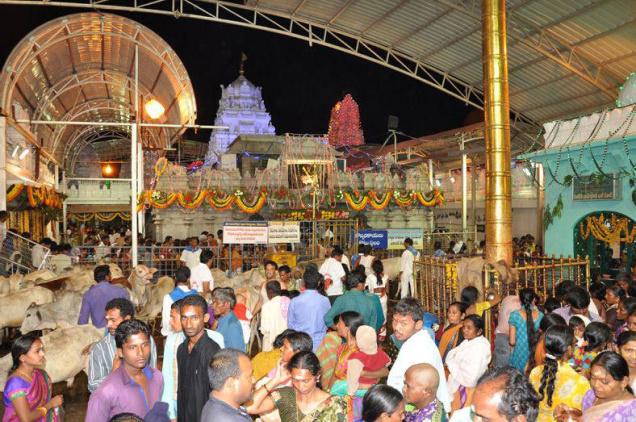
Pilgrims at Sri Raja Rajeshwara Swamy devasthanam in Vemulawada of Karimnagar town on Thursday morning on the occasion of Mahashivarathri. / Photo – by Special Arrangement / The Hindu
All the Shiva temples were reverberating with the chanting of “om namah shivaya”, hara hara mahadeva” on the occasion of Mahashivarathri celebrations in various parts of Karimnagar district on Thursday.
There was heavy surge of pilgrims at Sri Raja Rajeshwara Swamy devasthanam (also known as Dakshin Kashi) in Vemulawada of Karimnagar district since Wednesday onwards. The devotees formed serpentine queues since early hours after taking a holy dip in the ‘dharmagundam’.
Government Whip Arepalli Mohan, DCCB chairman K Ravinder Rao offered silk vastrams on behalf of the state government on Thursday early hours. Devasthanam chairman Bomma Venkateshwar and the temple authorities have accorded a traditional welcome to the dignitaries. Special prayers would be held at the temple shrine on Thursday evening.
Similarly, Sri Kaleshwara Muktheshwara Swamy devasthanam in Kaleshwaram of Mahadevpur mandal also witnessed heavy pilgrims rush. People took holy dip in the river Godavari and offered prayers at the temple shrine. Karimnagar range DIG RB Naik had offered prayers at the shrine. It is learnt thatthe general public faced several problems in having darshan following the authorities according priority for the VIPs.
Other Shiva shrines were also packed with the devotees in various parts of Karimnagar district including Karimnagar town.
source: http://www.thehindu.com / The Hindu / Home> News> National> Andhra Pradesh / by K.M. Dayashankar / Karimnagar – February 28th, 2014
In an attempt to launch the Dugarajapatnam port works even before election notification is issued, the district administration on Tuesday handed over about 170 acres of land to the Visakhapatnam port authorities.
District collector N Srikanth said that VSP would act as nodal agency to carry out the works at Dugarajapatnam port, which is the state’s second major public sector port on which the Centre is investing nearly Rs.8,000 crore. Although, 5,028 acres have been earmarked for the construction of port near Tupilipalem village near Dugarajapatnam, the district administration handed over only around 170 acres following government instructions.
“This is only the first phase of land transfer. The remaining land would be transferred in a phased manner as we have readied the blueprint for land acquisition,” said Srikanth.
According to sources, local MP Chinta Mohan is working overtime to bring either UPA chairperson Sonia Gandhi or Prime Minister Manmohan Singh to lay the foundation stone for the prestigious project before the first week of March. However, none of them have reportedly confirmed their visit to the state yet. While Sonia Gandhi wanted to visit one of the Telangana districts first, Manmohan Singh will be on a foreign tour in the first week of March.
Chinta Mohan is allegedly working hard to launch the port works before the election notification is issued and is expected to invite Union ministers and other top leaders to lay the foundation in case he fails to get the appointment of Sonia Gandhi and Manmohan Singh.
source: http://www.timesofindia.indiatimes.com / The Times of India / Home> City> Hyderabad / TNN / February 27th, 2014
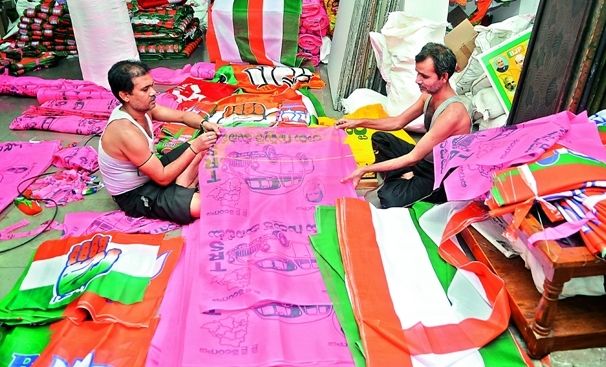
Workers at a flag-making centre in the city are busy processing the orders of various political parties on Friday | DC
Hyderabad:
With the municipal, Assembly and Parliament elections scheduled to be held in the state soon, the demand for local bands, posters, banners, pamphlets and hoardings have drastically shot up.
Twelve famous band groups have already been booked for the entire election season, hoarding manufacturers have got their hands full till March end and the prices of posters and banners have been increased by 40 per cent, especially after the creation of the Telangana state.
Famous bands like Jai Bheem Band in Khairatabad, Raj Kamal Band in Gowliguda, Pentaiah Band in Nimboliadda, Venkateshwara Band in Chintal Basti and the famous Marfa Band have all been booked in advance.
Mr Babji of Jai Bheem Band said, “A new 22 member team has been formed especially for the ensuing election season. For door-to-door canvassing, the band is charging Rs 50,000 a day while the charges for nominations and other election activities range between Rs 25,000 and Rs 30,000. Famous Hyderabadi sounds like Teen Maar, Lambadi and Marathi will be played.”
Mr Ram Singh, owner of Ram Poster & Banner Manufacture, Chapal Nagar, Mehdipatnam, said, “We are working on orders from the TRS, Congress, Telugu Desam Party, BJP, YSR Congress and even the newly introduced All India Christian Secular Party. So far the outlet has manufactured 1,200 banners for the TRS and 750 for Congress. The prices range from Rs 1,000 to Rs 10,000 depending on the size, design and quality.
Additional manpower has been brought in to complete the work on time.” Meanwhile, the demand for spray painters, car decorators and florists has shot up as well.
source: http://www.deccanchronicle.com / Deccan Chronicle / Home> Nation> Politics / by DC Correspondent / March 08th, 2014
To encourage men to come forward for vasectomy, the state government has launched an extensive awareness campaign in all the districts aiming to raise the rate of procedures from 2 to 5% by March- end. While rate of tubectomy is more than 60, barely 2 to 3% opt for vasectomy due to myths associated with it. Focus is also on non-surgical ways of population stabilisation for women by popularising IUCD (intra uterine contraceptive device) method.
At present Andhra Pradesh is emphasising on population stabilisation and spacing between children since the total fertility rate at 1.8 is below the national average of 2.7.
The government also gives incentive packages to the parents, motivators and health workers worth Rs 1,000 (tubectomy) and Rs 1,500 (vasectomy).
State joint director for family welfare Dr Ch Jayakumari informed, “Under the government’s new population stabilisation policy, we have been aggressively organising special camps and awareness campaigns for men by distributing IEC (information, education, communication) material and dispelling myths so that they come forward to get vasectomy done. Only around 2-3% men undergo this operation in the state. We want to increase the rate to 5% and our expected level of achievement this year is 50,000. We want to complete at least 20,000 vasectomies by March. It’s mainly myths that one would lose his potency if operated that deter men from opting for vasectomy after birth of two children.”
Moreover, thrust is also given on non-surgical methods of spacing and birth control after the first or second Caesarian, which is also reversible.
For this, post-partum intra uterine contraceptive devices (IUCD) are being distributed to the 23 districts. The IUCDs can be inserted non-surgically for five-10 years and the woman can avoid a tubectomy.
“Health staff, nurses and gynaecologists are being trained by the family welfare department to create awareness about the use of IUCDs among women who come for delivery. This can also help check teenage or young age pregnancies by promoting spacing between children. Around 4 lakh IUCDs have been sanctioned for 23 districts and these will be distributed depending on the eligible population of each district,” added Dr Jayakumari.
source: http://www.timesofindia.indiatimes.com / The Times of India / Home> City> Visakhapatnam / TNN / February 22nd, 2014
YWP 2014 is being held in 15 cities across south India.
This year’s edition of the popular painting competition for school students – The Hindu Young World painting – is back and the finals will be conducted on Sunday (February 23) at Swarna Bharati Indoor Auditorium here.
YWP 2014 is being held in 15 cities across south India.
The painting competition is an integral part of NIE programme of The Hindu attracts talented young minds apart from promoting healthy competition among schools.
The competition is open to students from Class IV to VII in the junior category and Class VII to Class X in the senior category. The participants in the finals are selected from the entries received and they are given topics to showcase their talent in painting.
Certificates
The winners would go home with certificates from The Hindu and prizes sponsored by Symbiosis Technologies.
Presenting sponsor is the MIOT Hospitals, snack sponsor is FoodEx and the venue sponsor is the Greater Visakhapatnam Municipal Corporation.
All the contestants are expected to reach the venue by 8.30 a.m.
The competition is scheduled to begin at 9 a.m.
source: http://www.thehindu.com / The Hindu / Home> News> Cities> Visakhapatnam / by Special Correspondent / Visakhapatnam – February 21st, 2014
The ASSOCHAM CSR Excellence Award was bagged by the infrastructure major GMR Hyderabad International Airports while Ambuja Cement was the first runner-up. The award for the SME segment for the CSR excellence was given away to Indus Health Plus. Other awardees included Chambal Fertilizer and Chemicals, JK Paper, NTPC, ONGC, Punjab National Bank and Tata Motors.
Communication Minister Mr Kapil Sibal gave away ASSOCHAM awards for the 6th Global Corporate Social Responsibilities Summit.
While addressing the summit, Mr. M J Joseph, Additional Secretary, Ministry of Corporate affairs said his ministry would soon notify section 135 of the new company act that will with CSR. These activities will qualify for CSR spend and these are likely to undergo changes in the light of suggestion received from stakeholders.
Quoting a study, ASSOCHAM President Mr Rana Kapoor said, “a minimum of 16,000 Indian companies fall under the ambit of the law and that entails approximately Rs 28,000 Crores of funds that would be pumped into the system. There emerges a huge opportunity for a tripartite partnership amongst the Government, Businesses and NGOs.
Looking at the efficacy in delivery of the last mile by the ‘third sector’ (NGOs), and their inherent capability to connect with communities and execute large projects on ground, a positive push in this sector makes for an excellent combination for accelerated social impact, said Mr. Kapoor.
The Nadipathy Centre in Kakinada of Andhra Pradesh is fast growing popular among locals as it has been curing patients suffering from various ailments (normal to chronic) using traditional Nadipathy techniques. Among the various Nadipathy treatment techniques, the Beach Sand Therapy (BeST) is gaining popularity among the locals. “We treat patients from normal to chronic diseases. The process of diagnosis is same in Nadipathy and we prescribe BeST to the patient to get rid of bodily ailments like aching joints, reducing blood pressure, relieving mental tension and providing treatment for skin and muscle problems,” says Dr Krishnam Raju, a prominent Nadipathy specialist.
According to information from Nadipathy Centre in Kakinada, in west Godavari district of Andhra Pradesh a team of researchers have conducted experiments on various patients and from their observation it is found that the BeST has given proven results. Particularly this method is found more effective in curing skin and muscles related ailments. Beach sand has a special mixture of minerals which can be used as a therapy to relieve aching bones and joints and invigorate the body, mind and soul. The BeST is the origin of many Salt therapies popularly known as Salt room therapy. Among some of the techniques used for treating patients the Nadipathy treatment procedures are being rediscovered by even modern day doctors as these techniques are found quite effective and giving fruitful results in keeping patients fit and healthy.
In fact Nadipathy is a traditional form of Indian treatment practiced in olden days. This traditional treatment method uses technique of utilizing conscious energy or techniques of consciousness along with alternative medicines such as acupressure, acupuncture, marma therapy, mudras, meditation, yoga, vedic chikitsa, nadi chikitsa, cupping therapy, moxa therapy, naturopathy, magnet therapy, seed therapy, beach sand therapy, chromo therapy, reflex therapy, sheitsu therapy, detoxification therapy, bown therapy, bach flowers therapy, Su jox, chiroprachic therapy, massage therapy and so on.
Dr Krishnam Raju, who has started a Clinic of his own in Kakinada, is rediscovered the olden treatment techniques and proving successful in the Alternative Medicine system. “Nadipathy” is a combination of more than 100 alternative therapies. It is fully integrated with the new health System. “After going through several ancient systems of Indian alternative Medicine preached in ancient scripts we experimented and found these techniques to be effective giving a stress-free, conscious cleansing and detoxifying body and mind for patients. It rejuvenates the body organs and increase longevity,” says Dr Krishnam Raju.
The techniques of “Nadipathy’ are designed to maintain cardiac, pulmonary, muscular, skeletal, Psychological fitness as well as nutritional fitness. Using Nadipathy techniques Dr Raju has cured patients suffering from paralysis, hypothyroidism, diabetes and gastric problems. The traditional treatment methods are also found effective in regaining vision in some of the patients. Dr Raju also claims that Nadipathy is subjective approach with objective adjustment. This is the way of Indian synthetic thinking or holistic approach towards the self and the universe.
source: http://www.pharmabiz.com /PharmaBiz.com / Home> Top News> Alternative Medicine / by A. Raju – Hyderabad / Thursday – February 27th, 2014
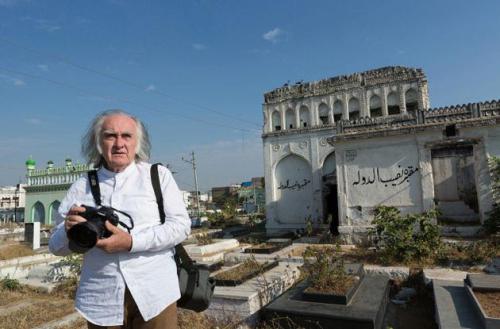
No man’s land: German photographer Thomas Luttge has been chronicling Hyderabad since 1975./ Image: Sanjay Borra / The Hindu
Following German photographer Thomas Luttge as he tramps through graveyards, in Hyderabad, looking for that munching goat and other unusual juxtapositions
“You cannot turn the cow,” says Thomas Luttge firmly. I am at an exhibition of his photographs at the Goethe Zentrum in Hyderabad. Even talented Western photographers have met their Waterloo in India. I’d asked him about his images, quite different from the usual cliché-ridden scenes. “Europeans come and look for the cows. Where are they cows? Oh here is a cow. And then they —”. Luttge shakes his head. “And there are photographers who do all kinds of tricks so the cow might turn and you can get the beautiful lines and the shape of the cow. I would never do that. I would say if the cow is like this, I have to accept it.”
Luttge, who bears an uncanny resemblance to Jeremy Bentham, moves with a spryness belying his seven decades. He has been coming to India since the 1960s. How does he avoid getting swamped by curious onlookers, I ask. “As a photographer, you are like an actor on the stage. So you have to develop something, you guide people and make them do what you want. I have trained myself in this way.”
We decide that I can tag along on one of his photographic explorations to Mir Momin ka Daira (a cemetery located in the old city).
Graveyard shift
Around us crowd thousands upon thousands of gravestones, islands in an ocean of death. At the heart lies Mir Momin Istrabadi’s tomb, who was a Persian and the original architect of Hyderabad. Luttge has been cataloguing the fate of Mir Momin’s city from his first visit here in 1975, believing that in Hyderabad the “tension of time stays open”. Like all photographers he is a scholar of the sun, a savant of the light. He approves of the morning glow around us. At this hour the necropolis is quiet. Some graves have fresh flower petals on them, the spoor of mourners.
A goat skips along munching on the flower petals, now on this grave, now on that, like a finicky guest at a buffet. Luttge, carrying both a digital camera and a medium-format camera with black-and-white film, immediately crouches down to try and frame the creature amidst a stone canopy that covers a grave. The goat suddenly grows self-conscious and leaps, even as he shoots. A quick glance at the screen. A shake of the head. “Too late,” he says. I point to more ruminants headed this way. He is not interested. Once a quarry escapes him, it escapes him forever.
Later we return to the Goethe-Zentrum. The exhibition is a distillation of half a century of work. The photographs span the globe — Morocco, China, Germany, New York. Some of the compositions are pervaded by a sense of dry humour. Humans are placed ironically. An empty Cola bottle is all that we see of humanity in a photo of a dense façade of Manhattan. Unusual juxtapositions of people and objects are a recurring motif in his work. “Life comes out of contradictions, life doesn’t come out of harmony,” says Luttge.
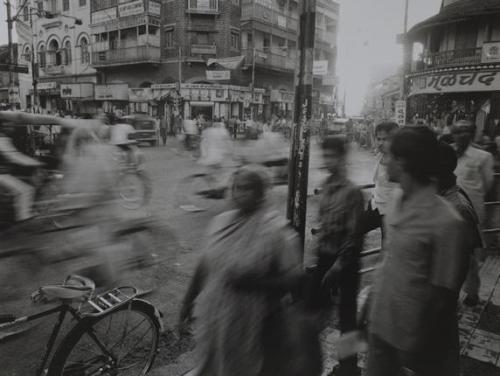
I examine the cityscapes — under louring skies, they seem like a photograph of a memory of a place rather than the place itself. They are in border zones between decay and growth, a kind of transitional space that reflects the semantic No Man’s Land that Luttge favours. This contrarian approach sometimes catches the viewer on the wrong foot. I pick up a catalogue and we leaf through his work. A nude pregnant woman on a beach. A souk in Morocco divided by brilliant shadows. A mist-shrouded river in Bangladesh. “I am asking something from the viewer. And, of course, for some viewers, this is also too much. They don’t want to be asked. They want to be served. The image should serve their feelings. Should serve their expectations. Should serve their dreams. And then they are happy. I don’t serve. I just offer.”
Savant of the light: Jesus Saves, Pune,1986 / Image: Thomas Luttge / The Hindu
Luttge picked up his first camera at age 12, shooting images of his garden in the family house outside Munich. Fifty years on he is still at it. The journey hasn’t been easy. “I sit at home and write hundreds of emails,” he says, looking for funders, looking for exhibition space. Ninety-eight per cent of them lead to nothing. Working in his darkroom, he can at most make one to three prints a day. “These are all originals,” he says. “They are all made in my own darkroom. I did them with all these chemicals, the same way as I did, 50 years ago. And here you get this quality which you can never get elsewhere.” Now even the photographic paper that he prints his work on is going extinct. “This is my life, there is never any guarantee,” he says. Now he is busy compiling his latest images of Hyderabad to be exhibited in Berlin later this year.
Savant of the light: Souk at noon, Marrakesh, 1966. / Image: Thomas Luttge / The Hindu
To Luttge, whenever you pick up the camera, as much as you turn it outwards, you are also turning it inward into the shadowy recesses of the self. The landscapes of the interior are as mysterious as those that can be found in the outer world.
Jaideep Unudurti is a writer and the founder of the Hyderabad Graphic Novel project
source: http://www.thehindubusinessline.com / Business Line / Home> Features> Blink / by Jaideep Unudurti
Visakhapatnam, Vizianagram are likely to attract incremental investment in Seemandhra.
The Associated Chambers of Commerce and Industry of India (Assocham ) said its members in Andhra Pradesh and other adjoining south Indian states feel that after the state’s bifurcation the coastal cities of Visakhapatnam, Vizianagram are likely to attract incremental investment in Seemandhra (Andhra and Rayalaseema regions) while Hyderabad will continue to retain its appeal as the global hub for business activities.
“We only hope that the political turmoil over the Telangana issue is over and the two new states will flourish even more after the creation of Telangana. The special package and status to Seemandhra will make it an attractive centre of industrial investment.
“The locational advantages of Visakhapatnam being an important port city along with a well laid-out railway network will make the area a very attractive business proposition since the new investment will be eligible for a tax holiday,” Assocham president, Rana Kapoor, stated in a press release on Friday.
He said special efforts should also be made to pump in development funds in the Rayalseema region, which remained a backward area whereas coastal Andhra is blessed with agricultural prosperity and natural advantage of rivers.
According to Kapoor, the new government should place special emphasis on development of the backward areas throughout the country, be it naxal-affected eastern India or some areas in southern and northern India, which have not been able to keep pace with the rest of the country.
source: http://www.business-standard.com / Business Standard / Home> Current Affairs> National / by BS Reporter / Hyderabad – February 21st, 2014
A joint research collaboration between University of Hyderabad (UoH), National Institute of Nutrition (NIN) and IKP Knowledge Park over the last two years has culminated in the successful completion of a pre-clinical study on the anti-cancer drug ‘Temozolomide’ in animal models.
Temozolomide is the only drug approved for brain tumour. The stability of this otherwise potent chemotherapy is compromised due to degradation in storage and shelf handling, causing dark brown discoloration of the drug powder.
The research group of Prof. Ashwini Nangia at School of Chemistry, UoH developed stable pharmaceutical co-crystal of Temozolomide which overcomes the discoloration problem to give a stable, improved crystalline form of the drug.
Then in collaboration with the laboratory of Dr. Dinesh Kumar, Coordinator, Preclinical Toxicology at NIN, they tested the stable Temozolomide co-crystal with the reference drug in animal models to establish bioequivalence and bioavailability and drug transport, it was informed in a press release.
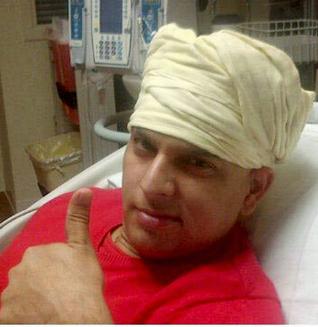
A file picture of Cricketer Yuvraj Singh while undergoing chemotherapy in US. / PTI
Temozolomide co-crystal is 100-110 per cent efficacious compared to the parent drug. Additionally, pharmacokinetic parameters and haematology and drug metabolism and half life for the stable Temozolomide co-crystal are equal to or better than the pure drug.
This collaborative project is a success story of the Knowledge-to-Equity program of the Ministry of Science and Technology as part of which academic discoveries get a platform for drug translation to the market in PPP model.
This pre clinical research project was part-funded by Department of Biotechnology to Crystalin Research, a start-up R&D venture founded by Dr. Nangia in 2010 at Technology Business Incubator on UOH campus.
source: http://www.thehindu.com / The Hindu / Home> S & T> Health> Medicine / by Staff Reporter / Hyderabad – February 19th, 2014