Twin City Theatre & Cultural Fest to be Held for Six Days from March 26

Come March 26, artistes and art enthusiasts in the city can immerse themselves in different forms of art for five days as a group of working professionals and artistes are organising a five-day-long ‘Twin City Theatre and Cultural Festival’ from March 26 to 31.

Jugalbandi of poets and musicians, theatre and dance performances, display of paintings, photographs etc. will be organised at six venues at Banjara Hills in Hyderabad and in Secunderabad.

A Flee Market will be organised every day between 5 pm and 6 pm when artists can display their work and sell it too. Close to 40 people, including the organisers, are coordinating the festival. On the final day, a documentary, ‘Kandhamal Unresolved’, will be screened at the English and Foreign Languages University (EFLU).

The schedule and other details are posted on twincityfestival.blogspot.in.

“There are not many platforms in Hyderabad where artists from different genres can come together and perform. Our attempt is to provide such a platform,” said Sneha Mukherjee (24), an employee and writer who along with Pranab Mukherjee and Krishna Shukla ideated the festival.

One of the initiators of the festival, Krishna Shukla (28), who quit his job to focus on theatre art, said that art festivals in Hyderabad are confined to a few localities and people from other parts of the city have to travel till Banjara Hills or Hitec City to watch a play. “Through this festival we want to take art forms to connoisseurs’ doorstep in various localities of the city so that people can  enjoy art in their vicinity and new performing spaces develop,” he said.

The organisers have roped in artists through word of mouth and did not charge them to display or perform. Nor will there be entry fee for people. While most of the artists are from the city, a troupe from Kolkata will also participate. “We are not charged any amount by people who are providing us space like Lamakaan or Sacred Space. Moreover, they helped us in finding artists to participate in the festival,” said Krishna.

source: http://www.newindianexpress.com / The New Indian Express / Home> Cities> Hyderabad / by Express News Service – Hyderabad / March 15th, 2014

Dutch building to be made into tourist attraction

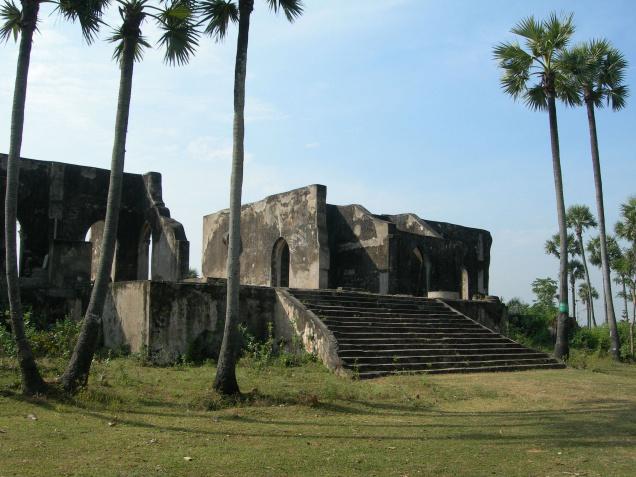
Dutch building, one of the heritage structure in Srikakulam is going to be made tourist attraction. / Photo: BASHEER / The Hindu

The elegant building was constructed about 300 years ago on the banks of the Nagavali

A Dutch building near Srikakulam Collectorate is being converted into a tourist attraction, thanks to the initiative of heritage lovers who had asked the district administration to allocate funds for its renovation. Around Rs.20 lakh will be spent for the protection of the monument. Srikakulam Collector Saurabh Gaur directed officials a few days ago to protect the monument and take suggestions from archaeological experts while renovating the structure.

The elegant building was constructed about 300 years ago on the banks of the Nagavali. Though a major portion of the building collapsed, the remaining structure reminds the viewers about the European’s dominance in semi-urban areas too in those days.

According to historians, the Dutch had a brief stay in India like the French and Portuguese. They established trading stations in several parts of Andhra Pradesh, apart from Malabar on the East Coast. Some remains of Dutch settlements can be found in Bhimili also. Though the exact history of the Dutch building of Srikakulam is not available, officials believe that the Dutch businessmen could have constructed the structure for trading and collection of taxes since many of them used to travel to Odisha via Srikakulam town.

Walls intact

The existing structure could have been used as a guesthouse too as many Dutch officials used to come to Srikakulam from Kalingapatnam port, which is some 20 km away from here. Though the roof of the structure has collapsed long ago, the walls and other structures remain intact till now.

The Indian National Trust for Art and Cultural Heritage has formulated proposals for restoration of the building. Convener of INTACH Dusi Dharmana Rao said that the restoration work should be taken without destroying the original beauty of the Dutch building. Interestingly, the existing Collector’s camp office was also constructed by Dutch rulers. However, a major portion was renovated while protecting a few structures.

source: http://www.thehindu.com / The Hindu / Home> News> National> Andhra Pradesh / by Staff Reporter / Srikakulam – March 24th, 2014

Faces out to make a difference

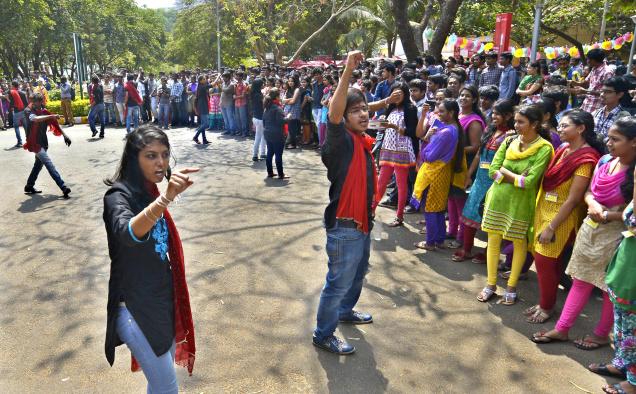
Students of GITAM University performing a street play in Visakhapatnam./  Photo: K.R. Deepak / The Hindu
Students of GITAM University performing a street play in Visakhapatnam./ Photo: K.R. Deepak / The Hindu

Drama group of GITAM students is creating awareness on issues plaguing society

On a hot sultry morning at the Beach Road, an unusual sight greeted the visitors. A team of youngsters dressed in black outfits were playing drums and clapping hands to narrate a story. It was an issue which affected everyone – the plaguing issue of corruption. Minutes after they began their performance, the large gathering of audience around them was engrossed in their stories. This was precisely what students of GITAM University had envisaged two years ago when they formed their drama group ‘Faces’. They wanted to create awareness among the public on burning social and political issues by staging street plays on college campuses and public places.

With this motive, a 25-member team was created after a series of auditions of students from all branches on the campus. Two years hence, the young energetic team of ‘Faces’ has staged more than 15 street plays on issues ranging from rising incidences of rape cases, corruption cases like the 2G scam, child trafficking and women empowerment to name a few. The team also took part in IIT-Kharagpur’s cultural fest last year. “We read newspapers and watch news shows every day to keep a tab of current issues and highlight it through the plays,” says Syed Shahed Mahmood, a student of third year Mechanical Engineering branch of the university. It takes about two to three weeks time for Shahed and his team-member Raj E. Gandhi to write the dialogues.

The team is now busy planning their next topic of street play which will be on ‘vote-bank politics’ and the provision of ‘NOTA’ (None Of The Above) option for voters. The street play will be performed in early April when the election heat is at its peak. “Very few people know about NOTA option. If you don’t have choice of good leaders, giving power to a wrong person is not the solution. We want to highlight this in our street play so that people can use NOTA effectively,” he adds.

Representation

The team has a balanced representation of students hailing from different parts of the country.

“These are issues that affect everyone notwithstanding which part of India you come from,” says Madhushree Gupta, a student of third year, Civil Engineering Department. Stage fear is something that most of the students had to deal with. But the senior students of ‘Faces’ came out with a smart solution to address it.

“Each of us was told to stay frozen for a few minutes in an awkward position at the busiest centre of our college campus. This was done to help the students adapt to public gaze and help them be comfortable with being the centre of attention in public,” says Shahed. Every year, auditions are held in the university during which fresh batch of students are selected to be a part of ‘Faces’.

source: http://www.thehindu.com / The Hindu / Home> News> Cities /by Nivedita Ganguly / Visakhapatnam – March 15th, 2014

How to go Natural this Holi

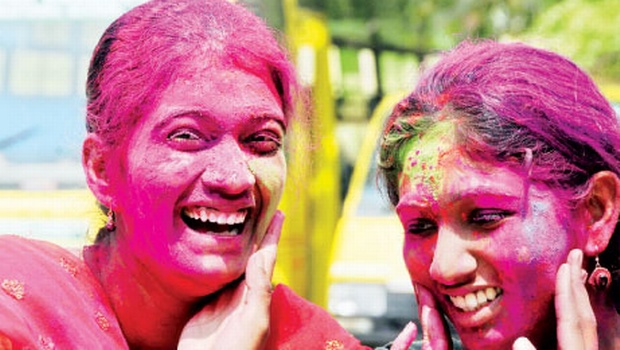
HoliHF25mar2014

Who can turn away an opportunity to frolic with colours and make a day out of it? However, it’s becoming more and more important to also be eco-conscious, not just for the environment’s sake, but also for your own. This Holi, break the chain and play with organic colours instead.

Sure, they won’t be as bright or attractive, but they will save you some major headache when it comes to washing them off and also in protecting your skin.

Why choose organic over chemical colours?

Well, the answer is obvious; all things natural are any day safer and better than chemically treated things. Chemical based colours can not only damage your skin, eyes and hair but can also be carcinogenic and cause serious health disorders. When colours containing harmful chemicals such as lead oxide, oxidized metals, industrial dyes and other toxic chemicals get into the water table, they also cause water and soil pollution, risking the lives of myriad life forms through the food chain, including our own.

The alternatives

Natural colours are very easy to source. While the market has been catering to an increasing demand for herbal colour, it’s fairly easy to make your own colours at home as well.

For instance, soaking beetroot in water overnight turns the liquid red. You can also mix sandalwood paste to get a vibrant red or even try rose powder. For yellow colour, you can mix turmeric with besan powder or even use dried marigold to create a shade of yellow.

For green, powdered henna leaves are best. You can also add some mint leaves for a cooling effect.

Brown isn’t a very popular colour, but if you’re looking for a slightly gothic tinge, try coffee powder. For coffee lovers, the aroma will make up for half the fun.

Many flowers dried and powdered can also be used, from hibiscus (red) to indigo and jacaranda (blue) and teshu/Flame of the Forest (orange).

If you don’t have the patience or the time to prepare your own, the city also has a few options.

Hyderabad Goes Green in association with Aurora Business School is selling five colours (blue, pink, orange, green and yellow) in packs of 100 gms each for `200. Besides selling at their store in Banjara Hills and Gachibowli, you can pick up the colours from Almond House (Himayath Nagar), Our Sacred Space (Secunderabad), Emerald Sweet House (Lower Tank bund) and N Convention Centre (Hi-tech city). Contact 74167 90905 / 90103 89994 / 98858 66918 for more details.

Daram is selling a box of five colours as well in packs of 50 gms each from the Rang Dular range at their outlet in Begumpet. Contact 040 2776 5503.

source: http://www.newindianexpress.com / The New Indian Express / Home> Cities> Hyderabad / by Express Features – Hyderabad / March 15th, 2014

Hyderabad, The City Of Wings As Well

“See the skies from the air on Fridays at 2 pm for `10.” Amused? This was on a famous poster of the Deccan Airways of the circa 1950’s Hyderabad. Walk into the ‘History of Civil Aviation in India’ stall at the India Aviation 2014 at Begumpet airport and you will possibly stumble upon such fascinating records, be it aviation stamps or airline schedules, of a glorious past of aviation in Hyderabad and the country.

Deccan Airways, as the company owned by the Nizam of Hyderabad was called in 1945, had chartered flights to as far as Quetta and Rangoon, and were also the first one’s to start the Haj chartered fleet from the country in 1948.

“Hyderabad had a regular air-strip even back in 1932 at Habshiguda. PM Reddy and Babar Mirza of Aero Club of Hyderabad used to regularly fly from here. In 1934, it became Hyderabad State Aero Club and started operating from Begumpet airport, which is presently one of the oldest airports in the country,” says P Anuradha Reddy, who is the author of ‘Aviation of Hyderabad State’.

According to her, PM Reddy and Babar Mirza, both of Hyderabad, were among the firsts in the country to complete their flying training in England and obtain licenses.

Hyderabad was also the first princely state to have a coordinated transport system in place. Speaking about the fleet of flights procured by the Nizam, she says that at the start of World War-II, Royal Airforce of the UK took over the Hyderabad State Aero Club to convert it into the first Elementary Flying Training School.

“After the World War-II, Dakota DC-3 aircrafts used by the US Air Force were lying out of use at Assam. It was considered no good and were being given away for throw away prices. Hyderabad state bought 21 of them and flew them down here, worked on them and later the same aircrafts became the backbone of civil aviation in India,” she informs.

The Hyderabad state had five airfields with concrete runways in Aurangabad, Warangal, Bidar, Hakimpet and Begumpet. Photographs of Hyderabad’s first licensed pilots Capt PMM Reddy and Capt PN Reddy, first trained woman pilot Aban Peston Chenoy who passed away two years ago, and some of the earliest forms of trainer and chartered aircrafts are featured in the gallery.

Surprisingly, the Nizam of Hyderabad took his first flight only in 1951 in the capacity of Rajpramukh. Quoting Captain PM Reddy, who was also Anuradha Reddy’s father-in-law, she says that the Nizam was never really interested in flying and had his own worries.

“So finally, he took a test flight around Hyderabad city. He was as excited as a child to see his own King Koti palace. And he asked if others also can see his palace from the air. Getting an answer in the affirmative, he imposed a flying restriction on top of his palace,” she says.

So how did the Deccan Airways become the backbone of civil aviation? Unlike the other flight companies, the Deccan Airways enjoyed a much wider coverage, operating from Madras-Hyderabad-Nagpur-Bhopal-Gwalior-Delhi and Bangalore. Hyderabad also had the Night Air Mail Service, something akin to the present day Speed-Post.

“Passengers and mails were carried from Chennai, Bombay, Calcutta, Delhi and Hyderabad and interchanged at Nagpur, which was a major hub. Even newspapers were airlifted to their destinations. In fact, the Indian Express was the first news publication to be delivered via air, it was taken from Chennai to Delhi on the same day through Deccan Airways,” she adds. The world’s first aerial post also took place in Allahabad in February 1911. A humber sommer biplane that flew to Naini five miles away in 13 minutes carrying 6500 letters and cards was the first aerial post.

To pay true and fitting tribute to the city’s aviation history, she suggests a civil aviation museum. “There is so much to offer about Hyderabad’s aviation history. The oldest terminal at Begumpet airport, which isn’t in use, could be turned into a museum to protect the legacy,” she opines.

Titbits of aviation’s history

The Nizam’s Government owned 71 per cent of Deccan Airways and the remaining was held by Tata Sons and others. Launched with three aircrafts, it went on to have a fleet of 13 Dakotas by the early 1950s. It merged with Indian Airlines in 1953

When the seventh Nizam Mir Osman Ali Khan took a test flight in 1951, he was initially excited to see his King Koti Palace from the air. However, paranoia set in soon after and he imposed a no-fly zone over his residence

Deccan Airways had chartered flights to as far as Quetta and Rangoon. It was also the first to start the Haj chartered fleet from Indian in 1948

Hyderabad based Deccan Airways was of the one of the premier airlines of the country, operating on Madras-Hyderabad-Nagpur- Bhopal-Gwalior-Delhi, Hyderabad-Bombay and Hyderabad-Bangalore sectors. Though founded in September 1945, the first flight took off on May 25 the following year

source: http://www.newindianexpress.com / The New Indian Express / Home> Cities> Hyderabad / by Rahul V. Pisharody / Hyderabad – March 15th, 2014

The world in an album

DJHamzaMPos24mar2014

DJ Hamza, who has travelled and lived in three different continents shares his experience in the form an his first full length album Gitano .

If you had to sum up over three decades of your life, more than half of which you spent travelling and residing in foreign countries, how would you? Some would probably write a novel, some short stories of selected experiences from here and there and for others a photo book would seem apt. But, 32-year-old DJ Hamza who grew up in Delhi (though his family is from Hyderabad and Mumbai) has travelled and lived around in South Asia, Europe and North America, summed up his story in a ten-song album called Gitano. Gitano means Gypsy in Spanish, which is what Hamza considers himself, having lived in Paris, Boston, New York among many other places.

The ten track album is more than just progressions, scratches and mixes unlike other DJ’s albums. Gitano in all true sense is an offering of new sounds and fabulous fusion. For a DJ to be incorporating elements from Latin, Celtic, Flamenco with house music as a base is something new. For him, electronic sounds are just one aspect of dance music. “Organic sounds are in fact as important as they bring out the primal instinct in us that makes us connect with our core,” he reckons. “The two always have to be in balance in order to reach out to all our sensory points in our bodies. You can always have a completely synthetic sounding track but then there is no soul in it and something having a completely organic track does not give you that punch and thump to drive you to dance.”

It took eight months for Hamza to work on the album. A challenge for sure, he first got the ten ideas in place, then started building on them, later finishing them before finally mixing and mastering the tracks. Gitano is more than just an amalgamation of sounds. In it’s own way, it also describes each place that Hamza has been to. “The title track Gitano has flamenco influences with an underlying African melody as well, which I came across in Barcelona. I have been to Senegal and Mauritania and fell in love with the local music there. It was also interesting to see that the poorest continent in the world had the happiest music, which is something to think about,” says the DJ. From guitars sounds that represent New Orleans to Latin influenced New York house sounds the album has it all.

Hamza goes to the local place in any country where traditional music thrives and he looks at it from two angles — it has to be an essential part of the history of that particular place or it must be so advanced that it automatically fits into the future. Interestingly Hamza was studying to be an investment banker but came out as a music producer. He credits three people who taught him to work at the studio, on stage and as an artist — Danish pianist Niels lan Doky, Jasbir Jassi and Taz from Stereo Nation. His experience of working with many folk helped him.

He and Jassi shared their studio with a gangster rapper back in New York, who had been shot nine times (reminds us of 50 cent) and who even stole their TV. “We then sent one of our friends from the Gurudwara who had a long white beard to get the TV back from him and he had never seen a Sikh person before so he called the police thinking our friend was a Pakistani Ninja,” he says. Hamza plans on taking his music pan India, along with collaborating with local artistes thereby sparking off a new Indian house music scene in the already existing musical revolution.

Catch DJ Hamza live on March 29 at Loft 38

source: http://www.bangaloremirror.com / Bangalore Mirror / Home> Entertainment> Lounge / by Prashanth Vidyasagar, Bangalore Mirror Bureau / March 23rd, 2014 (print mar 24th, 2014)

Biogas plants gaining acceptance in Krishna district

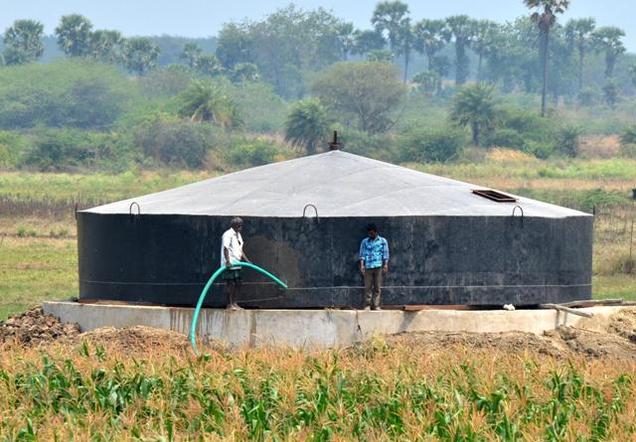
Works at a swift pace at the 200-cubic metre biogas plant being built by NREDCAP at a dairy farm in Lakshmipuram in Veerulapadu mandal of Krishna district./ Photo: V. Raju / The Hindu

An increasing number of innovative farmers in Krishna district are embracing biogas to cater to their energy needs.

Generation of biogas from animal dung has been in practice for long, but the new concept is to generate electricity from the gas, an effective way to end the woes of inflated power bills.

The Union Ministry of Non-Conventional Energy Sources, through the New and Renewable Energy Development Corporation of Andhra Pradesh (NREDCAP), is promoting bio-gas plants in a big way by offering a 40 per cent subsidy on the unit cost. A unit holder, who is usually a farmer or a dairy owner, gets back the invested money within two years of the commencement of operations at the plant.

The Corporation is building one such 200-cubic metre- plant at Lakshmipuram village under Veerulapadu mandal of Krishna district for Healthy Farm Products Ltd., a newly-developed dairy farm project gearing up to launch operations very soon.

“The Rs. 20 lakh-biogas plant can generate 300 units power per day. The Corporation has extended a 40 per cent subsidy (Rs. 8 lakh) while the remaining cost of the project is borne by the dairy owners. With the 20 kw. of power generated, the dairy can save nearly Rs. 3,000 per day, which translates roughly into Rs. 90,000 per month,” says NREDP District Manager Srinivasa Rao.

Pointing to the digester, he says water and cow dung is mixed in 1:1 ratio and pumped into the plant and biogas results from anaerobic fermentation of organic materials. He goes on to explain about the preparation of the input material, the fermentation and methanogenesis, followed by conversion of the biogas to renewable electricity and useful heat with cogeneration/combined heat and power.

“This energy release allows biogas to be used in a gas engine to convert the energy in the gas into electricity and heat,” explain Chennupati Vazeer and V. Madhav, owners of the dairy farm. The plant at Lakshmipuram is likely to commence operation by this month-end another one is fully operational at Veeranki Lockulu, informs Mr. Srinivasa Rao. The Corporation is upbeat about the increasing size of patronage for this innovative mode of fuel. “We are working on five more similar plants at different places in the district. We want apartment-dwellers also to opt for small-size digesters as an answer for their electricity needs and other energy sources,” says Mr. Srinivasa Rao.

source: http://www.thehindu.com / The Hindu / Home> News> Cities> Vijayawada / by P. Sujatha / Vijayawada – March 12th, 2014

Sahitya Puraskar for Nalimela Bhaskar

Noted poet Nalimela Bhaskar, who can write and speak in 14 Indian languages, has been selected for the Kendra Sahitya Puraskar (National Literary Award) for translating the Malayalam novel ‘Smaraka Silagal’ into Telugu as ‘Smaraka Silalu’ in 2010. It is the story of souls narrating their woes to each other at a burial ground.

The award, to be presented to Bhaskar soon, carries a citation and a cash prize of Rs 50,000. Bhaskar (58), who hails from a tiny village called Narayanpur in Karimnagar district, told Express here on Tuesday that he got interested in literature when he was studying in IX class and he used to read books in the local Srirama library. He was working as a lecturer in a dregree college, from which job he was forced to seek voluntary retirement due to ill health in 2011.

He said he would like to dedicate his award to the state and people of Telangana. He added that the award should inspire young poets and writers in the state.

Bhaskar is the second person in the state to have won the award in the translation category. In the past, former prime minister PV Narsimha Rao received the award for translating the Telugu novel ‘Veyyi Padugalu’ written by Vishwanatha Satyanarayana into Hindi as ‘Sahasraphan’. Earlier, he had also received the Telugu Academy Award  in the literature category.  Bhasker, who has got Ph.Ds in Malayalm, Telugu, Tamil and Kannada, has 17 literary works like novels, poetries and songs and ‘Telangana Padakosham’ (dictionary) to his credit.

He had translated the award-winning book ‘Smaraka Silalu’ on behalf of the ‘Kendra Sahitya Academy’, he said. His house resembles a small library, with all the shelves filled with books.

distinctions

■ Second person from the state after former PM late PV Narasimha Rao to win the award

■ Bhaskar won the award for translating Malayalam novel ‘Smaraka Silalu’ into Telugu with the same name

source: http://www.newindianexpress.com / The New Indian Express / Home> Cities> Hyderabad / by Express News Service – Karimnagar / March 12th, 2014

NATS vows to nurture Telugu children in US into world leaders

North America Telugu Society president Gangadhar Desu talking to The Hindu in Vijayawada on Tuesday. / Photo. Ch. Vijaya Bhaskar / The Hindu

We are bringing out a series of books in English on Telugu people, culture, says its president

There is no dearth of role models for them. Telugu children living in North America have success stories like Microsoft CEO Satya Nadella, Global coordinator of Lead India 2020 Hari Krishna Eppanapally, elected representatives like Upendra J.Chivukula, deputy speaker of New Jersey Assembly and Katragadda Aruna Miller, member of the Maryland House of Delegates, to look up to.

And lucky for them there is the North America Telugu Society (NATS) to nurture them into ‘world leaders’. The society has taken up career assistance programmes for Telugu youth.

NATS is now inviting not only successful Telugus, but successful Indians, to deliver talks. The society is also bringing out a series of books in English on Telugu people, their culture and history to take the initiative forward.

The person behind the initiative is none other than the Vijayawada-born Gangadhar Desu, the CEO of Neighbour Care chain of pharmacy stores who has been elected president of NATS for the next two years. Mr. Gangadhar did his schooling in SKPPV Hindu High School, One Town, and intermediate in K.B.N.College. He did his B.Pharma in Manipal College of Pharmacy and M.Pharma in Long Island, New York. “Satya Nadella is a couple of years senior to me,” he said recalling life on the campus.

Starting his career as a pharmacist Mr. Gangadhar, with a licence to work in any of the North Eastern States of the United States became the head of the Mergers and Acquisitions of Eckerds pharmacy in a short time. He then quit and started his own chain of pharmacy stores.

Diverse cultures

“The Telugu children here are exposed to diverse cultures, but it will be difficult for them to be world leaders unless they learn about their own roots,” Mr. Gangadhar said. The society took over 400 teachers from Andhra Pradesh to the United States to train children in various performance arts last year.

Mr. Gangadhar has high hopes for the Indian children of North America. “Five per cent of the Fortune 500 companies are run by Indians today. This will increase to 10 per cent by 2020. Indians were doing extremely well in politics too.

The Hindu Indians are being wooed by both the Republicans and the Democrats. Tulasi Gabbard of Samoan origin made news when she took oath on the Bhagvad Gita. Tulasi, who grew up in a multi-cultural, multi-religious household is a practising Hindu and yet another role model for the children, Mr. Gangadhar said.

source: http://www.thehindu.com / The Hindu / Home> News> Cities> Vijayawada / by Special Correspondent / Vijayawada – March 13th, 2014

Small victories over cancer

With two new simple technologies, testing for cancer within minutes could soon become a reality

 A team of researchers from the  Massachusetts Institute of Technology, or MIT,  has taken a significant step towards developing a method that can help detect cancer within minutes through a simple urine test. Far away in Hyderabad, a startup company has arrived at another uncomplicated and quick technique for diagnosis. It has developed a kit to detect breast cancer through a simple blood test. The finding is crucial, considering that breast cancer is the most common cancer in Indian women, killing one out of every two cancer patients.

The two researches, coming within a span of less than a month, are being watched closely by oncologists in India where cancer has become one of the ten topmost causes of death. The World Cancer Report 2014, published by World Health Organisation’s cancer agency, the International Agency for Research on Cancer, indicates that globally the number of cancer cases will increase by a startling 70 per cent over the next 20 years. Developing countries will be the most hit. Already about 70 per cent of the world’s cancer deaths take place in Africa, Asia, and Central and South America.

Which is why early detection, which can be made possible by the two tests, is critical.

The technology developed by MIT professor and Howard Hughes Medical Institute investigator Sangeeta Bhatia is like the pregnancy paper test. Through a urine sample test, it can reveal within minutes whether a person has cancer or not. Graduate student Andrew D Warren, the lead author of a paper on the technique published in scientific journal Proceedings of the National Academy of Sciences and co-authored by Bhatia, explains how the test works. “The test uses the intravenously injected nanoparticles called ‘synthetic biomarkers’. These nanoparticles are designed to passively hone onto sites of the disease and interact with proteases (the enzyme needed to digest protein). When disease-associated proteases cut pieces off the nanoparticles, the cut pieces (called ‘reporters’) are small enough to filter into the urine, where we can easily detect them with our low-cost paper test.” Higher concentrations of ‘reporters’ in the urine indicates the presence of the disease.

Conventional diagnostic tools for cancer such as colonoscopy or magnetic resonance imaging (MRI) are costly and require highly trained physicians and expensive equipment. The paper test is, in comparison, low cost and doesn’t require expensive equipment or training to use. The researchers who have run the paper test on mice with human-like tumours have found it to be quite accurate. “The test is 90 per cent sensitive (the likelihood that the results will be abnormal in people with the disease) and 80 per cent specific (the likelihood that results will be normal in people without the disease),” says Warren.

The research around the paper strip test, which started in the beginning of 2012, is in the early stage yet and uses mice. “There are still many difficult clinical studies necessary before our test could be used in people,” says Warren. So at this point, while it is impossible to guess the final cost of the test on humans, the researchers are determined to design it so that it is as inexpensive as possible.

As of now, the test focuses on the detection of colorectal cancer. But with slight changes in the synthetic biomarkers, it will be suitable for detecting several other kinds of cancers, the researcher adds.

The blood test for breast cancer, which claimed 70,218 lives in India in 2012, is, meanwhile, expected to be available commercially in five years from now. Developed by Hyderabad-based startup, Fournira Optime Diagnostics, the blood test would be about ten times cheaper than the currently available tests such as mammography, MRI and ultrasound. And its results would be available within an hour.

Early, accurate and affordable diagnoses are the three key factors that this test hopes to cover. A routine breast check, during which a woman might detect a suspicious lump, is what often leads to the first visit to the doctor. But it is often at a later stage that that evident symptom of breast cancer develops. The blood test makes an earlier diagnosis possible. The technology detects the cancerous biomarkers, if they are present in the blood, by lighting them up.

MAGIC BULLETS
Several laboratories in different parts of the world are also engaged in developing molecules that target the cancer cells specifically and in certain cases, serve as an alternative to chemotherapy. The doctors call them ‘magic bullets’. “The ‘magic bullet’ is nothing but target therapy,” says Ullas Batra, consultant, medical oncology, Rajiv Gandhi Cancer Institute and Research Centre. “In 20 to 30 per cent of the cancers, a single gene gets mutated. If we are able to identify and target that gene, then it is very effective.”

So while chemotherapy is like a bomb, which destroys everything around it, the ‘magic bullet’ is like a missile that hits a specific target, he explains. “Every year, two or three molecules are coming up for cancer that we call ‘magic bullets’. Many of these are for lymphoma, lung and liver cancer.”

The ‘magic bullet’ is usually used in Stage IV of the cancer and can be used in place of chemotherapy or in addition to chemotherapy. “In 20 to 25 per cent of lung cancer cases, especially in women and non-smokers, the ‘magic bullet’ is used upfront,” says Batra. Oncologists say it is found to be doubly effective than chemotherapy. It can control the disease with very good quality of life, doctors say.  “If chemotherapy gives the person another eight months to live, the ‘magic bullet’ keeps him going for another two to two-and-a-half years,” says Batra. it requires no hospitalisation and unlike chemotherapy, causes no hair loss or loss of appetite. “It is simply an oral tablet to be taken every day,” says Batra. A month’s dose can cost between Rs 1,800 to Rs 5,000.

CANCER VACCINES
The World Cancer Report points out that the population in developing countries, which have high prevalence of cancers such as those of the cervix, hardly believes in regular screening, such as going in for the pap smear test, for commonly found cancers. And, there is little focus on cancer vaccines — the Human Papilloma Virus (HPV) vaccine.

“Gardasil and Cervarix, the vaccines for cervical cancer , have been around for at least four years,” says Jai Gopal Sharma, head of the preventive oncology department at Rajiv Gandhi Cancer Institute and Research Centre. With time, these are gradually becoming popular. In India, while no data has been published to assess the effectiveness of the vaccines, clinical trials have shown a decrease in the development of HPV associated with some diseases after the vaccine, he adds.

The overall consensus is that while nine to 26 is the ideal and most effective age, “the vaccine can be given to a woman of any age before she attains menopause,” says Sharma. Vineet Talwar, senior consultant, oncology, Rajiv Gandhi Cancer Institute and Research Centre, adds that HPV strains 16 and 18 have been found to be the most prevalent strains that cause the cancer. “When a person is infected with HPV, it takes about 18 to 20 years to develop cervical cancer. And then too, all people do not develop cancer,” adds Talwar.


QUICK FACTS

  • Vaccine: Cervarix from GlaxoSmithKline and Gardasil from Merck & Co
  • Meant for: Cervical cancer
  • Cost: Cervarix, Rs 2,000 per dosage and Gardasil, Rs 2,800 per dosage
  • Dosage: Three doses within six months
  • Age group: 9 to 26 years or till the woman is not sexually active
  • Availability: Easily available in every hospital
Note: Gardasil protects against four HPV types or strains (6, 11, 16, and 18) and Cervarix targets HPV types 16 and 18. Gardasil is more recommended.
_____________________________________________________________________________________
source: http://www.business-standard.com / Business Standard / Home> Beyond Business> Features / by Veenu Sandhu / March 14th, 2014