GSLV-D6 set to fly GSAT-6 to space on Thursday

GSLVD6ANDHRA27aug2015

Countdown for launch begins

The Indian Space Research Organisation began a 29-hour pre-noon countdown on Wednesday for the launch of GSLV-D6 satellite launcher.

The launch vehicle is powered by the indigenously developed upper cryogenic stage and will be flown at 4.52 p.m. on August 27 from Sriharikota in coastal Andhra Pradesh.

It will put the 2,117-kg GSAT-6 communication satellite into space. The spacecraft will be gradually moved and finally positioned over the country at 83 degrees East longitude in the coming days.

The GSLV is a medium-lift launcher that can put two-tonne satellites into an initial or geosynchronous transfer orbit (GTO) of up to 36,000 km from Earth. The last GSLV was flown in January 2014.

ISRO Chairman A.S.Kiran Kumar, who is also Secretary, Department of Space, said the upcoming event was doubly significant. The ninth GSLV launch, for whose success he said ISRO has taken all necessary actions, would take the 20-year-old GSLV programme almost to fruition and regularise its use.

From the satellite point of view, he said GSAT-6 would try out quite a few novel technologies that very few satellite players have tried out, such as the large, unfurlable antenna of a diameter of six metres.

ISRO’s other launch vehicle, the light-lift PSLV, is a big success after 30 flights in 22 years, lifting Indian spacecraft to Moon and Mars apart from several Earth observation satellites, a national communications satellite and 45 small foreign satellites.

High hopes

ISRO officials have often said the national space programme needs the GSLV badly for launching its communication satellites; many have been put in space on European Ariane launchers at higher costs than on a GSLV.

S.Sivan, Director of Vikram Sarabhai Space Centre, the lead centre for launch vehicles in Thiruvananthapuram, recently said they had retained the configuration of the previous GSLV-D5 of 2014 so as to establish the vehicle’s reliability and robustness.

Flight D6 would fully prove the vehicle and the indigenous cryogenic technology and shift the programme into functional mode. The next GSLV could be as early as the first half of 2016, Dr. Sivan said.

When the GSLV is fully achieved, ISRO plans to have two flights of it a year. Meanwhile, a GSLV-Mark III of twice its capacity is also being developed and will be flown for the first time around December 2016.

source: http://www.thehindu.com / The Hindu / Home> National / by Madhumati D.S. / Bengaluru – August 26th, 2015

Andhra’s Vijayawada To Host World Coconut Day 2015

Kochi :

Andhra Pradesh’s Vijayawada city will be host the World Coconut Day 2015 on September 2 with the theme “Coconut for Family Nutrition, Health and Wellness”, an official release said.
The release by the Coconut Development Board (CDB) said September 2 has been designated Coconut Day by the Jakarta-headquartered Asian and Pacific Coconut Community (APCC), an intergovernmental organisation of 18 countries mandated to promote, coordinate and harmonize coconut developmental activities of the Asian Pacific region to achieve maximum economic development.
All major coconut-growing countries including India are members of APCC, whose foundation day is also on September 2.
The release said the celebration is aimed at creating awareness about the importance of coconut and its potential in alleviating poverty, encouraging investments and promoting the development of coconut industry in the member countries.
Around 500 farmers from all coconut growing states are expected to attend the function and would be a platform for the farmers to get firsthand knowledge about the new initiatives of the CDB.
An exhibition showcasing latest technologies in coconut sector and various value added coconut products including Neera.
The inaugural session will be followed by a technical session which will be attended by the who’s who of the industry.
As per the statistics of union agriculture ministry’s horticulture division for coconut production for the year 2013-14, the state of Andhra Pradesh occupies the first position in productivity (14,997 nuts/ha) though in fourth position both in area (1,21,920 ha) and production (1828.46 million nuts) among the coconut-growing southern states in India.

source: http://www.siliconindia.com / Silicon India News / Home> News>General / Wednesday – August 26th, 2015

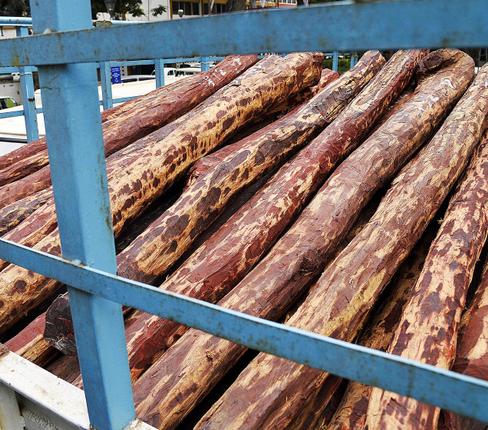
‘Red sanders can be grown like any other crop’

It is not necessary to inform the Forest Department before going in for red sanders plantation.File photo

The Forest Department has embarked on a massive plan of action to remove the “meaningless” phobia of red sanders plantation among farmers and planters.

Speaking to The Hindu , Chief Conservator of Forests (Tirupati Wildlife Circle), Mr. P.V. Chalapathi Rao said there were so many fallacies among the public about the commercial exploitation of red sanders plantations.

“They have formulated wrong opinions over the years that growing red sanders is a crime, or its trade is prohibited and involves criminal action by police and forest departments. Farmers and private planters should realise that just by paying a user charge of Rs. 10 or 20, they can grow red sanders and sell them at any price of their choice to anyone anywhere. It will be like growing any other agriculture crop,” he said.

The official said there was no need for planters to inform the Forest Department before going in for red sanders plantation. “Whenever they want to cut the trees and sell them, all they have to do is to get transit permits from the Forest Department. This is for the safety of their own material during transportation,” Mr Rao added.

The officer said though the Forest Department encouraged private plantation of red sanders, “virtually, no farmer is coming forward to openly say that he is interested.”

According to him, though there are some private plantations in Chittoor district, particularly in the western zone close to Karnataka and within the purview of the Tiruapti Wildlife Circle, no steps have been initiated yet for their assessment.

Farmers and private planters, by paying a user charge of Rs. 10 or 20, can grow red sanders and sell them at any price of their choice to anyone anywhere.P.V. Chalapathi RaoChief Conservator of ForestsTirupati Wildlife Circle

Efforts on to remove phobia among public

“Only recently, we hit upon the idea of surveying such private plantations, though their owners have not furnished details to the department so far.

“We also do not know at what price they are selling the produce and to whom and how. We will get into the details soon only to remove the public phobia about the trade and to encourage it,” Mr. Rao said.

He added that those who owned private red sanders plantations need not pay fee to the department for raising them, and they needed no official permission. However, he clarified that the government would not provide subsidy to plantations, and that planters should take care of the security of their plantations in view of the mind-blowing demand for red sanders in the international market.

Farmers and private planters, by paying a user charge of Rs. 10 or 20, can grow red sanders and sell them at any price of their choice to anyone anywhere.

P.V. Chalapathi Rao / Chief Conservator of Forests / Tirupati Wildlife Circle

source: http://www.thehindu.com / The Hindu / Home> National> Andhra Pradesh / by K. Umashanker / August 25th, 2015

Here’s a golden chance for aquaculturists to revive ponds

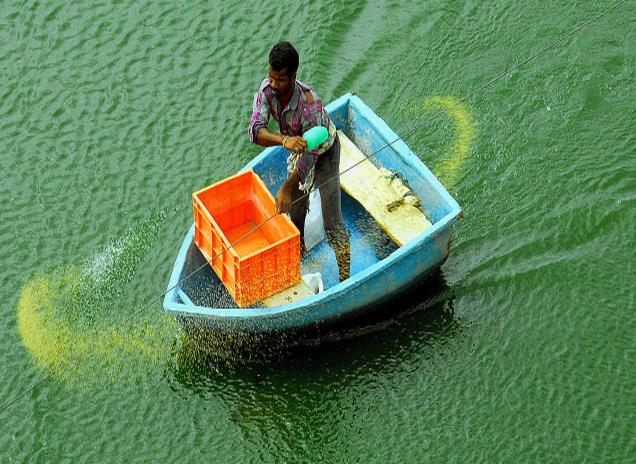
A grower sprinkling feed in an aqua pond at Ravivaripalem of Prakasam district.- PHOTO: KOMMURI SRINIVAS

Vannamei shrimp culture has come as a boon for aquaculturists in Prakasam district who were hit hard following the outbreak of the White Spot Disease in tiger shrimp farms, leading to abandoning of ponds in large tracts.

The growers are a worried lot now, with the price of Vannamei for 30-count plummeting to around Rs. 400 a kg after touching a high of Rs. 750 in 2013 in the wake of the outbreak of the Early Mortality Syndrome in China.

In this scenario, the Fisheries Department had chalked out an action plan to fully tap the potential of the district by focusing on revival of brackish water aquaculture in abandoned ponds on the one hand and cutting costs through supply of subsidised seed and feed.

Estimating that aquaculture is currently in vogue in around 3,000 hectares, the district administration has fixed an ambitious target of doubling it to 6,000 hectares in the district over a period.

Speaking to The Hindu , Fisheries Assistant Director said the State government had identified aquaculture as a growth engine and had come out with schemes for the revival of abandoned ponds, besides those for providing subsidy for inputs and mechanisation of aqua ponds to ensure sustainable shrimp farming.

Aquacutlurists, according to an estimate, have abandoned aqua-ponds in over 500 hectares in the district.

“We want to see that aquaculture is revived in at least 100 hectares during the year, he said, adding that selected players would be offered a subsidy of Rs. 2 lakh per hectare for specific pathogen-free seed, feed and chemicals.

Subsidy scheme

The department has also come out with a scheme to provide Rs. 5 lakh as subsidy for the Rs. 10-lakh mobile lab to test soil, water and shrimps right at aqua ponds for disease surveillance, Fisheries Development Officer K. Lakshminarayana said. The growers can also avail 50 per cent subsidy on purchase of solar pump-sets, iron rods, fans, paddle and aerators to ensure sustainable shrimp farming.

Farmers going for Tilapia culture in ponds are eligible for 50 per cent subsidy for a two-hectare unit costing Rs. 2 lakh to grow exotic species imported from Africa to augment their income, they add.

Growers are worried lot with the price of Vannamei for 30-count plummeting to around Rs. 400 a kg after touching a high of Rs. 750 in 2013

source: http://www.thehindu.com / The Hindu / Home> National> Andhra Pradesh / by S. Murali / Ongole – August 25th, 2015

Tata Trust Pact to Make Villages Smart

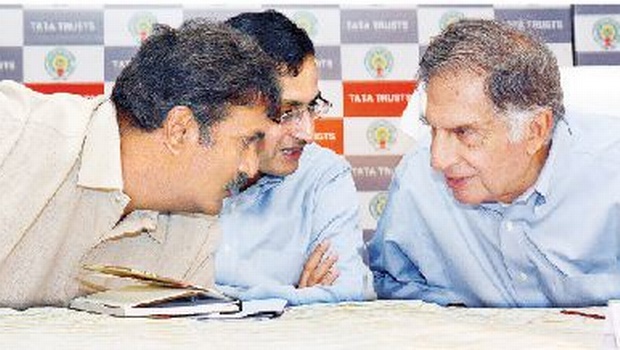
TATA Trust chairman Ratan Tata (right) interacts with Vijayawada MP Kesineni Srinivas at a press conference in Vijayawada on Monday as executive trustee R Venkataramanan looks on | Express Photo

Vijayawada : 

Taking another step in the direction of developing Andhra Pradesh as a smart state by developing villages as smart villages, the state government entered a Memorandum of Understanding (MoU) with the Tata Trust here on Sunday.

Though the MoU is for the development of 264 villages in the Vijayawada Parliamentary Constituency with focus on human resources development and employment generation avenues, the State Government sees it as a cornerstone for the development of the state as ‘the best state’ by 2029. The MoU was signed by R Venkataraman, CEO of Tata Trust, on its behalf and Shanti Priya Pandey, Additional Secretary (Planning), on behalf of the government.

Launching the Village Development Plans and the website for the Vijayawada Bamboo Mission, along with Chief Minister N Chandrababu Naidu, Tata Trust Chairman Ratan Tata said he looked forward to a great partnership between the state government and Tata Trust. He said it would be a step in the direction of helping the betterment of quality of life in villages. Recalling his past interaction with Chief Minister N Chandrababu Naidu, the Tata Trust Chairman said he held the former in great esteem. He wished the CM and the state all successes in the coming years.

Speaking on the occasion, Naidu said it was a start in the direction of Smart AP’ and called upon people of the state settled across the world to chip in with their knowledge and other contributions to make the state a smart one and help in improving the lives of people in the rural areas.

Hailing the initiative of Vijayawada MP Kesineni Srinivas, which saw the Tata Trust becoming a partner in the development of 264 villages of his constituency like never before, the CM said many companies and individuals were also coming forward to partner with the state in its development.

“However, to make such initiatives successful, people’s cooperation and active participation are of paramount importance”, he maintained.

Pointing out at the technologies like geo tagging, GAP analysis to do baseline survey of 10 lakh families in 264 villages in Vijayawada Parliamentary Constituency which was made possible with people’s cooperation, the CM said the government would be launching Pulse Smart Survey in the state to get details of all the people in the state and that the job had been entrusted to Special Chief Secretary S P Tucker.

Stating that technology had become cost-effective, the CM said that using the tablets being provided by the government, VROs and sarpanches in the villages could identify the needs of the people and the gaps in implementation of schemes / programmes and initiate corrective measures. He cited ePOS in the PDS, distribution of pensions using hand-held tabs at the doorsteps of the beneficiaries to emphasis that usage of technology not only ensured transparency but also saved lots of money.

Assuring the villages of the government’s help with regard to matching grants and gap solutions for different programmes to be taken up at the village level, he said the villages doing well in development and the implementation of welfare schemes would be given ‘Best Village’ awards and their sarpanches and officials would be felicitated during Sankranti.

On the occasion, he cited the government initiatives like seven missions and five grids for the overall development of the state.

Earlier, Venkataraman and Vijayawada MP Kesineni Srinivas (Nani) explained the objectives of the Village Development Plans, which were basically focused at nutrition, health, fisheries,  skill development and related aspects.

On the occasion, the students of the city-based Siddharta Mahila Kalasala presented a cultural programme and the same was appreciated by one and all.

source : http://www.newindianexpress.com / The New Indian Express / Home> States> Andhra Pradesh / by Express News Service / August 25th, 2015

GB Syndrome clinic opened at Apollo Hospitals

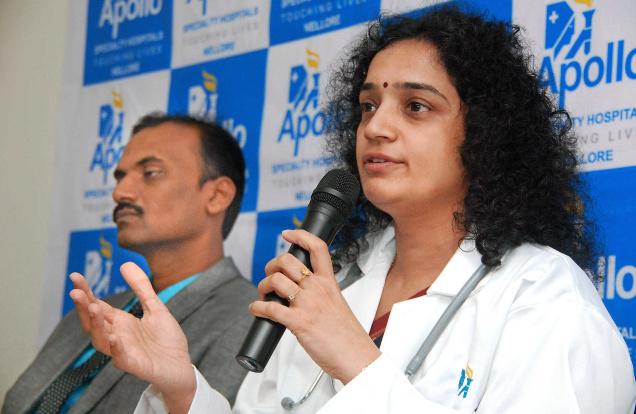
Neuro physician Bindu Menon says moments after a paralytic stroke, immediate treatment should be given so as to bring the patient back to normalcy. —Photo: K. Ravikumar

The treatment for the Guillain Barre Syndrome, a muscle weakening neurological disorder, was started for the first time at the Apollo Specialty Hospitals here in Nellore city on Wednesday.

The GB syndrome is a disorder which occurs when the body’s immune system starts attacking the healthy cells of peripheral systems. It often leads to paralysis and even death at times.

“With some awareness on the part of the patients, the disease can be controlled. It can be prevented from causing severe illness,” said neuro physician Dr. Bindu Menon. To effectively handle neuro disorders, preventive measures should be taken much ahead, she said. Speaking on the awareness aspects on the occasion, Dr. Menon said that moments after a paralytic stroke, immediate treatment should be given so as to bring the patient back to normalcy. This would yield better results or else this would cause serious side effects, she added.

The neurology wing in the hospitals has been sufficiently strengthened with special clinics opened to treat Parkinson’s disease, memory disorders and back pain related complaints.

To provide advanced neuro care, a neuro physician, neuro surgeon, neuro physiotherapist, intensive neuro trained nurses, dieticians and other technicians are made available at the Apollo Specialty Hospitals.

source: http: //www.thehindu.com /  Home> National> Andhra Pradesh / by Staff Reporter / Nellore – August 27th, 2015

A.P. major contributor to marine exports

A major player in the aquaculture sector, Andhra Pradesh contributed 46 per cent of marine exports, valued at around Rs. 35,000 crore, during 2014-15.

The contribution of the fisheries sector to the country’s Gross State Domestic Product (GSDP) is 6.04 per cent, and the total fish and prawn production in brackish and fresh water in the State was 19.78 lakh tonnes, and it was worth around Rs. 21,325 crore.

However, aqua farmers fear a dip in production owing to the prevailing drought situation.

Price fluctuations

“Aqua farmers invest Rs. 5 lakh on an average in an acre of pond for raising shrimp. But, the benefit is marginal, thanks to price fluctuation in the international market and adverse weather,” said V. Sathibabu, a farmer from Gudivada.

Another aqua farmer, G. Venkanna from Undi in West Godavari district, said canals, which were the principal sources of water for aquaculture, had dried up, and that a few tanks were dependent on bore wells.

“Aqua farmers spend lakhs of rupees every season on procurement of seed strock, feed and medicine, not to mention labour and power charges.

Apart from that the lease value is between Rs. 40,000 and Rs. 50,000 per acre a year,” he added.

source: http://www.thehindu.com / The Hindu / Home> National> Andhra Pradesh / by Staff Reporter / Gudivada (Krishna) – August 24th, 2015

Sweet-jelly a hit

There is an increasing demand for palm-based products. Keeping this in view, we experimented with an innovative sweet-jelly made of palm fruit and the product is really catching up, explains Y. Surya Kumari, an entrepreneur displaying food products manufactured under Krushi Products, West Godavari, at one of the stalls.

Another entrepreneur D. Gayathri Devi, who runs Gayathri Papads, says, “It has been two years since I availed subsidy under PMEGP. Today, my unit employs more than 15 persons. The business is fast growing and gives an annual turnover of not less than Rs.7 lakh.”

source: http://www.thehindu.com / The Hindu / Home> National> Andhra Pradesh / August 23rd, 2015

472 tribal youth clear physical tests for paramilitary wings

Visakhapatnam :

As many as 472 of the 538 tribal youths trained by the Visakha Rural and CRPF cops passed the rigorous physical tests during the recruitment camp conducted for the paramilitary wings in July. The police bosses in the district are now planning to train the youth for written tests as well. The Visakha Rural cops consider this achievement to be a milestone in their ongoing efforts to prevent tribal youth from joining the Maoists.

The men’s selection tests were conducted in Hyderabad, while the women underwent the tests at the Visakha Steel Plant in the city. As many as 378 out of the 422 men and 94 of the 116 women qualified for the written test.

The Union ministry of home affairs has reportedly asked the Visakha Rural cops to furnish the details of the training programme to extend the same to various other Maoist-infested areas in the country, sources said.

According to sources, the cops, in an attempt to stop recruitments by naxals from tribal areas, began training the youth for various paramilitary posts. “The police bosses analysed the situation and found that a majority of the youth were attracted towards the Maoist ideology due to unemployment,” a senior police officer said, adding that Rural SP Koya Praveen, in coordination with Paderu ASP Attada Bapuji, started the ‘Spoorthy’ programme to check naxal recruitments in tribal areas.

Around 1,000 youth were screened as part of the final selection for physical training by the cops at Paderu in April, of which nearly 538 candidates were selected for the fitness training. More than 75 security personnel from the District Training Centre, CRPF and Rural Police were assigned the responsibility to provide training.

“The programme is aimed at extending a helping hand to tribal youth as they don’t have the resources to get trained like their urban counterparts. The programme will help the youth get jobs in various central government wings. I had conducted one such session in Parvathipuram with cooperation from the ITDA when I was the officer on special duty there. Some of the youth were selected for the state police wing, but some failed due to height,” the Rural SP told TOI.

The Paderu ASP said that all the youth were trained at the Youth Training Centre at Paderu and the ITDA provided them with a nutritious diet. “We divided the candidates into three batches and trained them for 15 days each,” he added.

The Rural SP said they are now planning to provide a four-week training for the written tests with the help of the faculty members of various coaching centres. The material for the training has also been prepared, he said, adding that such training programmes will be continued in the future as well.

source: http://www.timesofindia.indiatimes.com / The Times of India / News Home> City> Visakhapatnam / by Siva G / August 20th, 2015

A mission for coastal resource conservation

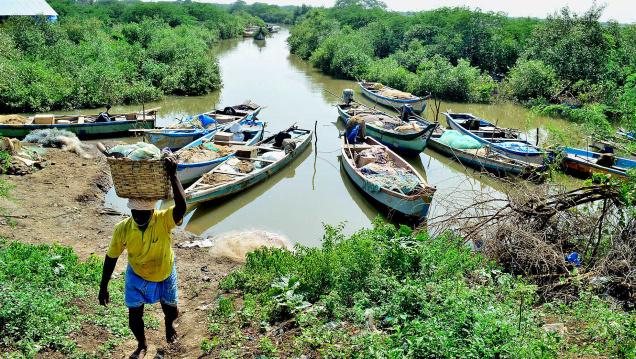
The Sorlagondi Reserve Forest in Nagayalanka mandal of Krishna district.- Photo: T. Appala Naidu

UN body joins Swaminathan Foundation to restore Sorlagondi mangrove forest. The UNFCCC will release the adaptation fund through the National Bank for Agriculture and Rural Development (Nabard).

The United Nations Framework Convention on Climate Change (UNFCCC) and the Chennai-based M.S. Swaminathan Research Foundation (MSSRF) will work together for the conservation of coastal resources, with focus on the restoration of the Sorlagondi mangrove forest cover in Krishna district.

“The UNFCCC has sanctioned Rs. 3.8 crore for the potential adaptation strategy of MSSRF in Krishna district through an ‘adaptation fund’. A roadmap to improve the mangrove forest cover in 200 acres and fish cultivation in around 50 acres of mangrove forest has been prepared, and it will be executed in August,” MSRRF Project Co-ordinator Rama Subrahmanyam said.

“The abandoned land will be brought under fish cultivation, while landless families will be involved in cage cultivation in three villages – Sorlagondi and Nali in Nagayalanka mandal and Basavanipalem in Koduru mandal,” he added.

Mr. Subrahmanyam said cage cultivation would be encouraged in brackish water by setting up as many as 10 cages in the three villages, which had been adopted by MSSRF.

The UNFCCC will release the adaptation fund through the National Bank for Agriculture and Rural Development (Nabard). According to NABARD sources, the objective of the adaptation initiative is to overcome the consequences of sea level rise and seawater inundation following cyclonic storms.

An official release by Nabard reads: “Restoration of degraded mangroves will be undertaken with native multiple mangrove species, which in turn would avoid ingression of seawater”.

The conservation of the mangrove forest becomes significant, as a portion of it has been spared for the proposed Missile Test Launch Facility project of the Defence Research and Development Organisation.

source: http://www.thehindu.com / The Hindu / Home> National> Andhra Pradesh / by T. Appala Naidu / Sorlagondi (Krishna) – August 21st, 2015