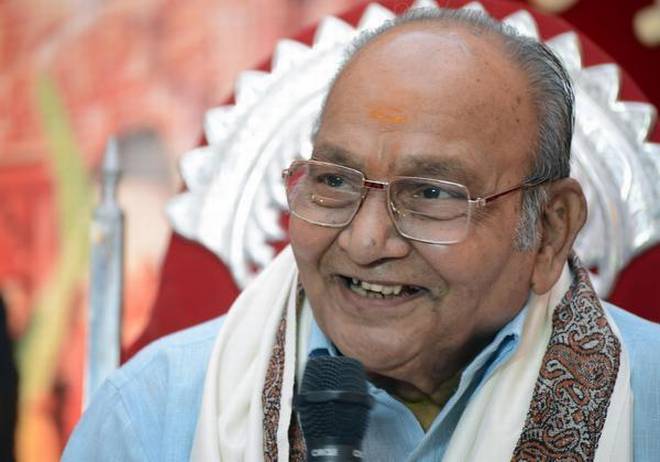
In the late 1970s and early 80s, Telugu cinema was witnessing a phase that wasn’t really earning it plaudits. Outlandish costumes and a pop of colour bombs in song sequences were becoming markers of popular cinema. The 80s were characterised by bell bottoms, oversized sunglasses and floral prints in other film industries as well.
K Viswanath’s films stood out like a breath of fresh air. The characters in his films spoke like real people; they had concerns that mirrored real-life situations. Over the decades, any Telugu film aficionado would have heard and recounted tales of how Sankarabharanam (1979) opened to near-empty halls before it became a rage and ran to packed shows for over a year and its key actors Somayajulu and Manju Bhargavi enjoyed the popularity reserved for stars.
Viswanath’s films cannot be slotted into what was then called ‘art’ or ‘parallel’ cinema, through he steered clear of mainstream excesses. His films drew audiences in droves, the music percolated well into popular realm and the stories and characters would be cherished for decades.
When Viswanath chose stars like Kamal Haasan, Chiranjeevi, Jayaprada, Bhanupriya, Radhika, Venkatesh or Vijayashanti, he gave them a chance to better their craft and have the satisfaction of looking back at these films fondly years later. It’s befitting when an actor like Venkatesh today recollects how Swarnakamalam allowed him to be real and not resort to exaggerated expressions, or, when Kamal Haasan takes to Twitter to thank Viswanath for making him a part of Sagara Sangamam.
Kamal Haasan was no stranger to films depicting realistic stories, thanks to working with directors like K Balachander and Bharatiraja in Tamil. Yet, Sagara Sangamam was a landmark film. It showed that the protagonist needn’t be young and charming through the film. He could be flawed and yet be revered.
The best part of Viswanath’s films, as director Nandini Reddy points out, is that they remain rooted and effortless. “It didn’t look like he was setting out to make great cinema. He was just trying to tell a story in the best possible way he knew and it all seemed so organic and real,” she says. We nod in agreement.
Nandini Reddy
Writer/director
“One of my earliest memories of Telugu cinema is watching Sankarabharanam. It was our Sound of Music. Everyone, age no barrier, loved that film. I was in school and when Manju Bhargavi made a visit, it was no less than a star visiting. Sankarabharanam is a beautiful amalgamation of story, music and performance. The narrative is fluid, which is a hallmark of Viswanath’s work. When we write a film, we mull over the placement of different segments and how it should build up to a climax. In Viswanath’s stories, it all seems to emerge naturally. His was a Zen method of filmmaking. Every musical note, every expression seems so well thought out and beautiful. The close-up shots of Jayaprada, Kamal Haasan or Radhika conveyed so much without words. He believed in brevity of dialogues. Actors lived their parts. I think Viswanath brought dignity and grace to Telugu cinema.”
(Nandini Reddy is known for her rom-coms and family dramas like Ala Modalaindi and Kalyana Vaibhogame)
Tharun Bhascker
Writer/director
One of Tharun’s childhood friends is K Viswanath’s grandson Mukund. Tharun remembers discussing cinema with Mukund and his friends, much before he knew Mukund’s lineage. For Tharun, the vivid childhood image of cinema stems from watching Sagara Sangamam.
“The film showcased the aesthetics of dance in a non-commercial format. It was offbeat, yet created tremors in the industry and among the audience. In the beginning of the film, we see the protagonist, the hero, as an alcoholic and someone who had given up on his career. That flawed character, to me, announced that it wasn’t a usual film. It was courageous of Viswanath sir as a writer and filmmaker to do that. That kind of writing stuck with me when I grew interested in screenwriting. I have revisited the film on several occasions and with friends, have eagerly watched the song where Kamal Haasan stands on the well, inebriated. We have watched and discussed how an entire song can be choreographed thus and the shot constructions.”
(Tharun Bhascker directed Pelli Choopulu, which won the National Award for Best Feature Film in Telugu in 2016; he’s now working in his next — a coming-of-age buddy comedy with four youngsters, which he describes as “Dil Chahta Hai meets Hangover”.)
Srinivas Avasarala
Writer/director/actor
“Viswanath’s films gave me insights into on-screen dynamism, particularly the movement of people and the camera. Remember the scene where Kamal Haasan dances in a newspaper office in Sagara Sangamam? We see Sailaja on the right to begin with and as the scene progresses, she moves left to where her boyfriend is standing. It’s a scene where she needs psychological support and we see her moving to him. Similarly, in Swanakamalam when the father is against the son’s wishes to marry a girl of his choice, we see the mother entering and the son swiftly moves to stand near her. Again, it’s an example of psychological support. As a writer and filmmaker I’ve often asked myself if I would be able to write or make a film like he has. Deep within I know I cannot make a film on classical music or dance, because that requires a deep understanding of the art form and conviction. As a child, when I watched Sankarabharanam I was absorbed by what I saw on screen. This despite the fact that like most children, I wasn’t keen on classical music.”
(Srinivas Avasarala wrote and directed Oogalu Gusagusalade and Jo Achyutananda)
Nag Ashwin
Writer/director
“We all grew up watching K Viswanath’s films and most filmmakers of today aspire to make films that are commercially viable, socially relevant and with a blend of humour, which came so easily to him. On a few occasions when I met him at film events and spoke about cinema, he would mention that a story or a movie came to him naturally and he was just a conduit to make it happen. That’s an approach I relate to. My favourites among his films are Swarnakamalam (1988) and Swatikiranam (1992). I’ve lost count of how many times I would have watched them for the nuances of filmmaking and fresh approach to storytelling. Until I watched Swatikiranam, I didn’t know it was possible to make such an impactful film about a guru getting jealous over a student’s success. As a child, I remember watching Aapadbandhavudu (1992). I was stunned at how it moved me emotionally. I remembered hearing that the film didn’t do well. I kept wondering how such a film didn’t find enough takers. Every few years I revisit this film to see if it was ahead of its time. The music is evergreen, as is the case with every film of Viswanath.”
(Nag Ashwin debuted as a director with Yevade Subramanyam and is now making a biopic on late actress Savitri, titled Mahanati)
source: http://www.thehindu.com / The Hindu / Home> Entertainment> Movies> Personality Movies / by Sangeetha Devi Dundoo / April 25th, 2017