Proof of Kakatiya-era Shaivism school comes to light

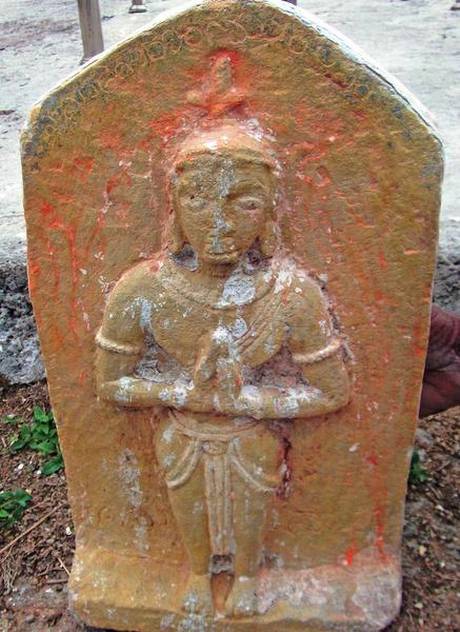
Lamudigalam sect worshipper sculpted on a granite slab during Kakatiya regime in Abbayapalem village of Telangana.

A slab depicts a person with Shivalinga and pitha on his head

Proof of existence of a sect of Shaivism during the Kakatiya rule came to light during a survey and exploratory work conducted by the Archaeological Survey of India in a temple in Mahabubabad district of Telangana recently.

A sculptural slab carved on granite stone illustrating a life-size portrait of a dedicated worshipper of Lord Shiva was discovered in a corner of Sri Agastisvaraswamy temple complex at Abbayapalem village in Maripeda Mandal of the district.

Superintending Archaeologist in Temple Survey Project (Southern Region, ASI) D. Kanna Babu, who is on a mission to explore, ascertain the antiquity and architectural pre-eminence of ancient shrines in Andhra Pradesh and Telangana chanced upon this proof of Lamudigalam — a school of Shaivism prevalent from the 11th C AD to 13th C AD.

The man on the granite slab is seen in vertical position with dignified features and folded hands in worship. The facial features are oval distinguished by wide open eyes and an elongated nose. He wears a dhoti fastened with a broad waist band having a central medallion.

Mr. Kanna Babu says the worshipper sports a beaded necklace, sacred thread, prominent ear rings, arm bands, bracelets and his hair is tied in a circular bun. A small Shivalinga with pitha is adorned by him on his head.

Mr. Kanna Babu told The Hindu, “The discovery of this spectacular portrait sculpture is the first of its kind in the two Telugu States. Unfortunately, a thick coat of colour painted by locals on it during the recent temple festivals had turned it unrecognisable.”

A new school

The uniqueness of the image is that a label inscription in Telugu (from 12th Century AD) is engraved on the top of the sculptural frame and ends at the bottom. The script is self-explanatory: ‘I affectionately adore the linga and placed on my head by tying with my hair.’

The spiritual significance of wearing a Shivalinga on head was considered the most pious act of an ardent devotee of Lord Shiva in the contemporary society of the Kakatiya regime. “The religious connotation of this thematic sculpture is for magnifying the beliefs of the Lamudigalam sect,” the ASI official says.

The prime principle was that one should achieve the state of advaita (non-separation) i.e. there is no difference between Paramatma (Supreme Being) and Jivatma (human being) by practising divine doctrines like Lingadharanam — bearing Shivalinga on his head.

The Agastisvaraswamy temple on the hillock served in those days as the place of worship and the principal seat of this sect finally emerged into Virashaiva aphorism,’ says Kanna Babu who deciphered the inscription.

source: http://www.thehindu.com / The Hindu / Home> News> States> Andhra Pradesh / by Ramesh Susarla Anantapur / November 17th, 2018
For her, sweet memory over a bitter dish

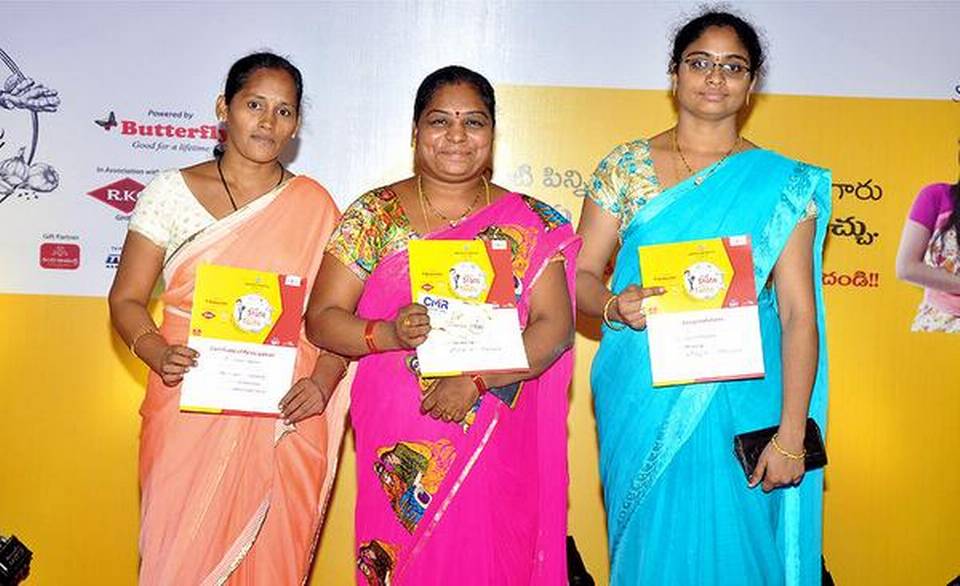
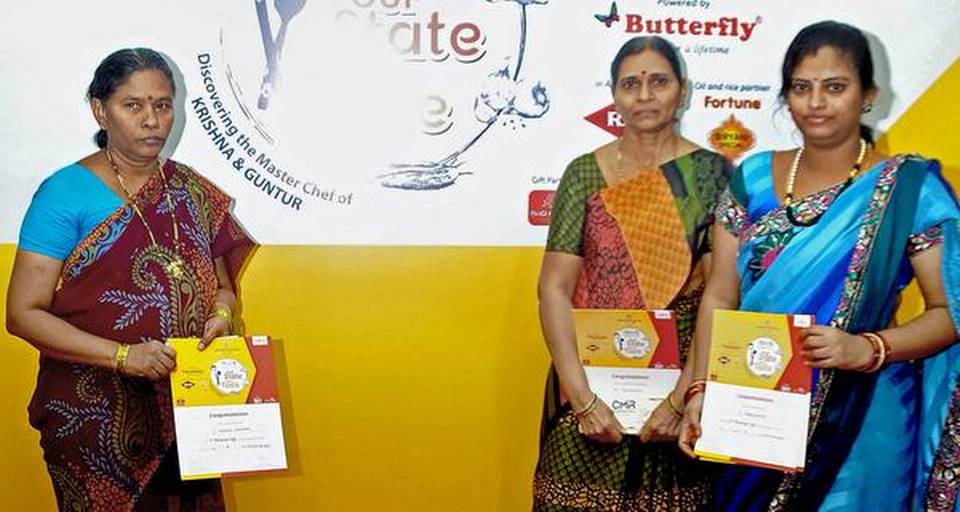
Delectable delight: Winners of the The Hindu Our State Our Taste contest at Chilakaluripet on Wednesday.

An array of delicious recipes at cookery event

People who eat this vegetable either love it or hate it; there doesn’t seem to be an in-between.

A winning recipe of bitter gourd would remain a sweet memory for a long time to come for M. Prasanna of Chilakaluripet city in Guntur district where The Hindu’s ‘Our State Our Taste’ cookery contest attracted close to 200 enthusiastic participants. The event was organised in association with the Andhra Pradesh Tourism.

Women of all age groups descended on the Prathipati Gardens at Chilakaluripet on Wednesday to showcase their amazing kitchen skills. The kakarakaya-ulli kaaram (stuffed karela) won hands down.

The dish won a cash prize of ₹50,000 for Ms. Prasanna. Korameenu chepala pulusu, a dish prepared by J. Dhana Lakshmi, was adjudged the second best by the jury, fetching a cash prize of ₹30,000 and biryani made with kanda (elephant yam) got the third prize (₹20,000) for N. Prasanna.

Prathipati Venkata Kumari, wife of Minister P. Pullarao, was the chief guest. She went around the tables laden with an array of delicious recipes and tasted some of them. Later, she told the participants it was heart-warming to see such good response in the small town.

The event was powered by Butterfly in association with RKG Ghee and oil and rice partner Fortune. Gift hampers were sponsored by CMR Shopping Mall, Guntur.

source: http://www.thehindu.com / the Hindu / Home> News>Cities> Vijayawada  / by Special Correspondent / November 15th, 2018

Literary award for police officer

.SunilKumarANDHRA15nov2018

V Sunil Kumar, Additional DG and Managing Director of AP Police Housing Corporation, was conferred the Sahiti Puraskaram by the Potti Sriramulu University, Hyderabad, for the year 2017.

Mr. Kumar is a prolific writer who has written novels, short stories and poems.

His anthology of short stories Neelaveni , published in 2016 was a run away success.

source: http://www.thehindu.com / The Hindu / Home> National> Andhra Pradesh / Guntur – November 15th, 2018

Four young engineers turn innovators, develop solar electric auto

The vehicle which can travel at a speed of 55 kmph,  is on par with commercial autos in the market in many aspects. The maintenance cost of the zero-emission auto is bare minimum.

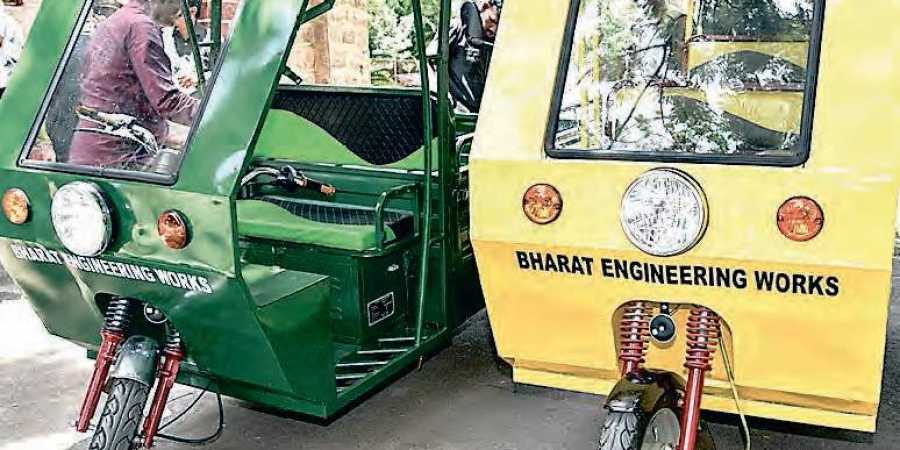
Image used for representational purpose only.

Srikakulam :

Four mechanical engineering graduates have developed a solar electric auto-rickshaw. Instead of opting for jobs in automobile industries after completion of their engineering course, the quartet decided to set up their own automobile unit to be self-reliant. Vavilapalli Uday Kiran, Sasapu Vasudeva Rao, Majji Chanti Babu and Karanam Parthasaradhi launched their pilot project in the name of Vajra Motor Works in Srikakulam a few months ago.

They designed the solar-cum-battery operated auto in just 15 days and launched it in the district on a pilot basis. The quartet claimed that it took only three days for them to make the solar electric auto.
The dual-mode auto runs on solar power in daytime and battery power is used at night. The auto can travel a distance ranging from 110 to 160 km with three-hour charging of battery.  It can carry a load of up to one tonne and accommodate seven persons.

The vehicle which can travel at a speed of 55 kmph,  is on par with commercial autos in the market in many aspects. The maintenance cost of the zero-emission auto is bare minimum.

Highlighting the salient features of the eco-friendly solar electric auto, Uday Kiran says, “It costs Rs 440 on an average to run a diesel auto for a distance ranging from 110 to 160 km. The operation cost of the solar electric auto for the same distance is not more than Rs 40. If the government extends support to our innovative project, employment can be generated for mechanical engineering graduates in the district. We have already explained our innovative project to the officials concerned seeking the support of the government to expand it.”

source: http://www.newindianexpress.com / The New Indian Express / Home> States> Andhra Pradesh / by G. Ramesh Babu / Express News Service / November 13th, 2018

Ryots get access to ‘dry chain’, a cost-effective technology

It helps in getting seed moisture at desired level

Dry chain, a sustainable farm production model, offering simple and cost-effective technology to ensure safe, dry and high-quality staple food, is now available to the farmers of Chittoor district. The technology helps reduce aflatoxin levels in groundnut, which is one of the major crops in the district.

Vivia Foundation, a Netherlands-based public benefit organisation, launched the ‘Dry chain for groundnuts’ post-harvest programme during the current kharif season at Renuka Bio Farms unit in Routhusuramala village near Srikalahasti recently, where the solar drying chambers were inaugurated. The technology was co-developed at the University of California, Davis. Grameena Vikas Samithi (GVS), a voluntary organisation accredited with the United Nations Conventions, extended support in establishing the ‘Clean works’ rural pilot project.

Dry chain is a technology aimed at getting seed moisture at the desired level, which is 9% for groundnut. “While solar drying is the optimal option for groundnut, using zeolite beads is suggested for absorbing moisture in high-value seeds”, says Rajendranath Reddy, founder of Renuka Bio Farms.

Field-tested

Kent J. Bradford, Director of Seed Biotechnology Centre at University of California, Davis, who inaugurated the facility, dubs it the first comprehensive field-tested ‘dry chain’ system in India, applied to pre-harvest and post-harvest crop processing. Future demonstrations and training programmes are being planned to showcase dry chain technologies at the farm.

“The research study for groundnuts will continue till the next rabi season ending next spring, in which farmers from across the State will be involved”, explains GVS director L. Suryanarayana Reddy. The pilot project utilised ‘Kalgudi’, a mobile application as the platform for farmer training, data collection, transactions and supply chain traceability. The technology will be passed on to local farmers so as to improve yield quality and increase overall farm revenue.

source: http://www.thehindu.com / The Hindu / Home> News> States> Andhra Pradesh / by A.D. Rangarajan / Tirupati – November 12th, 2018

Tribal farmer reaps it rich in ‘sama’ cultivation

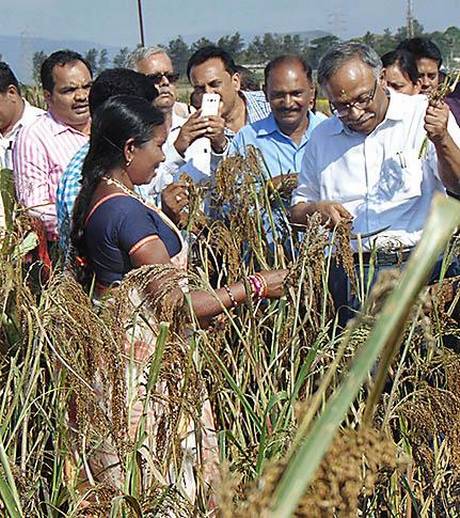
Adviser and Co-Vice Chairman of Andhra Pradesh Ryhtu Sadhikara Samstha T. Vijaya Kumar having a look at the sama crop cultivated under ZBNF at Baliyaguda in Araku mandal in Visakhapatnam district on Friday. | Photo Credit: Special Arrangment

Sonnu gets yield of 6.5 quintals an acre

Following zero budget natural farming, Pangi Sonnu of Araku Valley mandal cultivated sama (little millet) got a yield of 6.5 quintals an acre.

The crop-cutting experiment in a 5×5 square metre plot was conducted at the ZBNF Sama festival at Baliyaguda village on Friday.

The festival was organised by Agriculture Department, Andhra Pradesh  Rythu Sadhikara Samstha, Azim Premji Philanthropic Initiatives, Sanjeevini Rural Development Society, National Bureau of Plant Genetic Resources and Watershed Support Services and Activity Network (WASSAN).

The yield in broadcast farming was only between 2 and 2.5 quintals. Because of transplantation, weeding twice and using ‘jeevamrutham’ (bio fertilizer) following ZBNF the yield has gone up, a press release said.

‘Grow pulses’

Adviser and Co-Vice Chairman of Andhra Pradesh Ryhtu Sadhikara Samstha T. Vijaya Kumar suggested that farmers should grow pulses like red gram and cow pea between rows of millets to enhance soil fertility.

Programme Manager from WASSSAN Sanyasi Rao said sama productivity could go up to six quintals in ZBNF.

State Resource Person (ZBNF) for promoting System of Millet Intensification (SMI) P. Devullu said plans were ready to convert 5 % of sama farmers into SMI. In the tribal region of Visakhapatnam, sama is cultivated in 5,319 hectares.

At a farmers interactive session organised as a part of the event farmers who had grown ragi under ‘Guli’ system shared their experiences.

source: http://www.thehindu.com / The Hindu / Home> News> States> Andhra Pradesh / by Special Correspondent / Visakhapatnam – November 10th, 2018

Healthy dishes tickle the taste buds in The Hindu cookery contest

Winners of the Our State- Our Taste at Macharla in Guntur district on Sunday. | Photo Credit: HANDOUT_E_MAIL

‘Varigala annam’ preparation tops the jury’s list

More and more people are realising the need to include in their daily menu nutritious millets that have more health benefits than the current food ingredients in our kitchens today.

Sources of fibre are hugely in demand, especially by people wanting to cut down on their weight and millets are loaded with it.

That precisely was the reason why the varigala annam (rice substituted with proso millets) cooked by V. Divya Bharathi, elbowed out many other delicious dishes, to emerge as the winner of the ‘Our State, Our Taste’ cookery contest being organised by The Hindu, in collaboration with Andhra Pradesh Tourism, in Macherla of Guntur district on Sunday.

The bran of proso millet contains vital nutrients that are essential for a healthy diet and is also an excellent source of fiber. It is gluten-free and has a significant amount of carbohydrates, protein, niacin (Vitamin B3) and fatty acids.

138 participants

Ms. Bharathi served ‘varigala annam’ preparation with ‘thotakura’ (amaranthus leaves) pulusu and ‘pappucharu’ and won the jury’s hearts.

A total of 138 participants showcased their recipes. A 10-year-old participant grabbed everybody’s attention at the venue.

A large part of the dishes comprised desserts like ‘kharjuram barfi,’ Apple-dry fruit kheer, ‘korra laddu’, ‘paala thaalika-paayasam’, ‘Nuuvulu-raagi laddu’, ‘mokkajana halwa’.

K. Prameela was the first runner-up, who made the traditional ‘sajja thappela chekkalu’ while B. Vijaya Lakshmi, the second runner-up, cooked ‘mulakkaya-endu royyala’ (drumstick-dry fish) curry. Two consolation prizes were also given to Parvathi and Veera Raghavamma. RKG, Fortune, Butterfly and Kanchi Kamakshi were the main sponsors of the event while CMR Group sponsored the gifts.

source: http://www.thehindu.com / The Hindu / Home> States> Andhra Pradesh / by Medha Sreya  / Vijayawada – November 05th, 2018