Bandar’s sure-shot connection with military history

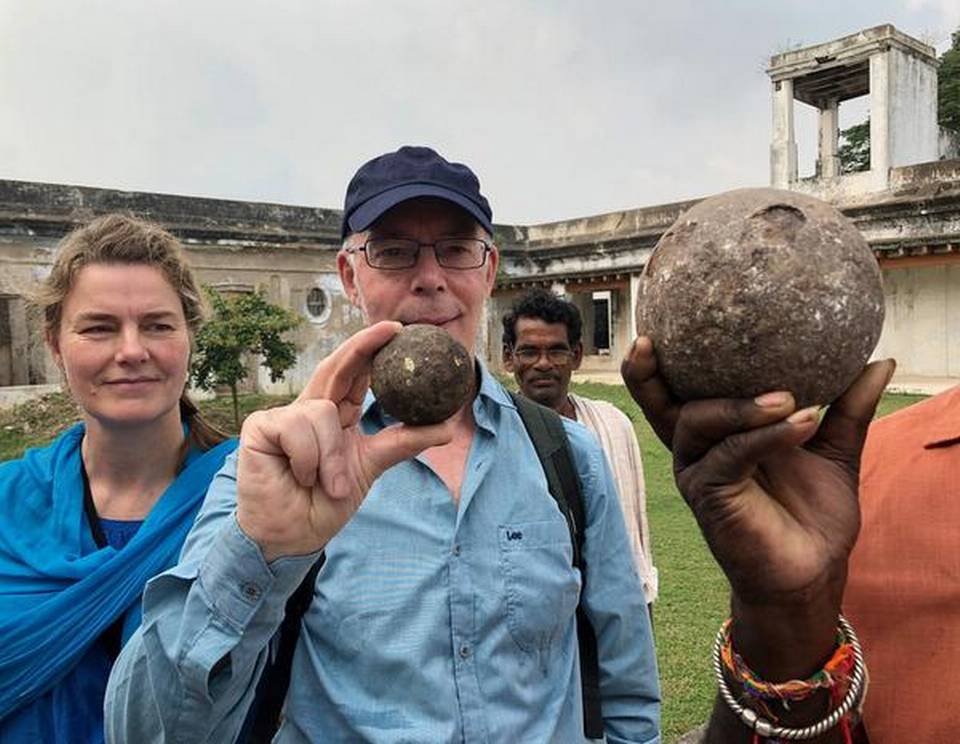
Visitors from the Rijksmuseum in Amsterdam displaying cannonballs in Bandarkota. | Photo Credit: T. Appalanaidu

Cannonball relics from a Dutch armoury unearthed in Machilipatnam turn treasures

Most people are highly possessive of artefacts unearthed in their backyard, but residents of Machilipatnam’s Bandarkota area treasure something unusual: cannonballs. These solid metal shots from a past era of warfare have been turning up periodically in housing sites in the old parts of the town when they are excavated for construction.

Many households preserve the cannonballs, although a few simply dispose of them as scrap, unaware of their heritage value. “Unearthing old, used cannonballs is common in our area. I have one, and it is an echo of military history,” says local resident P. Hanumath Rao.

Machilipatnam, in Andhra Pradesh, houses an old armoury dating back to the Dutch era, which is protected by the Archaeological Survey of India (ASI).

Famine and storm

Part of the structure collapsed in heavy rain in 2016. The fortunes of Bandarkota changed decisively after a storm in the 19th century. Tracing the history of the fort, the Manual of Kistna District by Gordon Mackenzie says: “The pestilence that followed on the famine of 1832-3 induced the authorities to station no more European troops at Bandar and the storm wave of 1864 caused the withdrawal of the last sepoy regiment and ended the history of Masulipatam as a military station.”

ASI monument assistant at the Dutch fort Subba Rao said his team had collected a cannonball from the local residents and put it on display.

A cannon was also kept on display at the entrance to the District Police grounds, after it was shifted from the railway station area.

“Until the 1960s, a cannon was operated by the local authorities without the use of cannonballs to avoid any untoward incident, producing just a deafening sound,” a local resident Mohammad Silar said.

Many families do not disclose their cannonball find, fearing that the ASI might recover them.

source: http://www.thehindu.com / The Hindu / Home> News> States> Andhra Pradesh / by T. Appala Naidu / Bandarkota – February 18th, 2019

High Court returns to Guntur after 62 years

Former Union Minister Kailash Nath Katju inaugurated the high court.

The high courst of erstwhile Andhra State functioned from the Collectorate in Guntur for three years from 1954

Guntur :

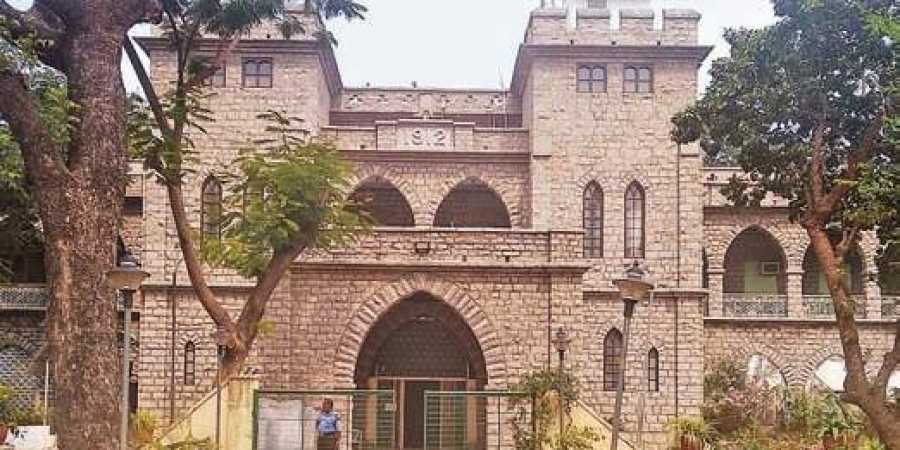
The high court returned to Guntur district after a gap of 62 years.

Andhra high court was first established in Guntur in 1953 when a separate State for Telugu-speaking people was carved out of Madras State with its capital in Kurnool. The high court of erstwhile Andhra State functioned from the Collectorate in Guntur for three years from 1954.

Former Union Minister Kailash Nath Katju inaugurated the high court. The then Chief Minister Tanguturi Prakasam, Deputy Chief Minister Neelam Sanjiva Reddy, Law Minister Tenneti Vishwanadham, Madras High Court Chief Justice Justice Pakala Venkata Rajamannar and others participated in the inaugural ceremony.

Justice Koka Subba Rao served as the first chief justice of Andhra high court.

Senior advocate Jupudi Ranga Raju recalled that his father and former MLC Jupudi Yagnanarayana served as a civil lawyer at the high court in Guntur.

The high court of Andhra State at Guntur was shifted to Hyderabad and merged with the Hyderabad state high court to form Andhra Pradesh high court on November 1, 1956. The demand for a high court bench in Vijayawada-Guntur has been pending all these years and now the dream of people has been realised.

source: http://www.newindianexpress.com / The New Indian Express / Home> States> Andhra Pradesh / by Express News Service / February 04th, 2019

Budding archer needs aid to attend IFAA World Archery Competition

Just into ninth year, this child prodigy from Kadapa has won 33 medals in various State and national level archery tournaments.

PV Sai Srinivas
PV Sai Srinivas

Kadapa :

Just into ninth year, this child prodigy from Kadapa has won 33 medals in various State and national level archery tournaments. PV Sai Srinivas is all set to represent India in an international tournament as he has been selected for IFAA World Indoor Archery Competition to be held at Wellington in New Zealand from April 8 to 12.  RK Siddharth Reddy and G Arun Teja are the two other boys selected from Kadapa district for the IFAA competition.

Srinivas, who is studying Class V in a private school in Kadapa, is the son of Gopinath and Keerthi. He developed keen interest in archery after seeing some of his classmates getting training in the sport. He also started taking coaching at Vijaya Archery Academy. He won several medals in various archery tournaments held from February 2016  to December 2018. He has also entered the Asia Book of Records by shooting most number of arrows in 15 minutes.

His father Gopinath who runs an internet centre, can hardly manage the house with his meagre earnings.
“Srinivas has got an opportunity to showcase his talent in the international arena. But we are worried that he may not make it as our financial condition does not allow us to send him abroad,” Gopinath told TNIE.
“We have to procure necessary travel documents and get other clearances before February 20 to send him to the World Indoor Archery Competition. It costs us around `4.5 lakh and we are not in a position to spend such a huge amount,’’ said Gopinath, who is looking for sponsors.

Aid sought

Gopinath has sought financial help from philanthropists and sports lovers to send his son Srinivas to New Zealand. Donations can be sent to the SBI account of Srinivas’ mother B Keerthi, A/c No 62455702738, IFSC Code SBIN 0020948, RTC branch, Kadapa, he said.

source: http://www.newindianexpress.com / The New Indian Express / Home> States> Andhra Pradesh / by S. Nagaraja Rao / Express News Service / February 16th, 2019

Health warrior expands contours of yeoman service

Doctor made chief of APTS, which carries info on clinics and schemes to rural lives

Bottles of intravenous (IV) fluid dangle from tree branches at the hospital of Manne Ravindra in Yerragondapalem in Prakasam district, from where patients, mostly tribals, throng the facility whenever in need of treatment.

In recognition of his services to rural lives for five decades, the State Government has appointed Dr. Ravindra, a product of the Guntur Medical College, the Chairman of the Andhra Pradesh Technology Services (APTS).

Thanking Chief Minister N.Chandrababu Naidu for reposing faith in him, Dr. Ravindra told The Hindu that information and communication technology would be effectively used to the improve living condition of tribals cenchus and sugalis in western Prakasam as their health status continued to be a cause of concern.

The APTS would help relay information on public health centres, special schemes and bridge the gap between health providers and rural communities, he said.

Dr.Ravindra, a Zilla Parishad member, saidAPTS would turn rural youth into rural techno-entrepreneurs.

source: http://www.thehindu.com / The Hindu / Home> News> States> Andhra Pradesh / by Special Correspondent / Ongole – February 15th, 2019

VVIT prof gets award for research

Several other awards were also given to people researching further in their fields after obtaining a Doctorate.

Guntur :

Professor Sangu Ravindra, Electrical and Electronics Engineering department, Vasireddy Venkatadri Institute of Technology (VVIT), has got the Young Scientist Award, said VVIT chairperson Vasireddy Vidyasagar.

The award was announced by International Organization of Scientific Research and Development (IOSRD) at Nambur of Guntur district on Thursday, and Dr Ravindra received it at an international conference organised in Chennai on Tuesday.

Several other awards were also given to people researching further in their fields after obtaining a Doctorate. Four researchers have been selected from across the country and awarded based on their research done on ‘Power Control and Conservation’.

source: http://www.newindianexpress.com / The New Indian Express / Home> States> Andhra Pradesh / by Express News Service / February 15th, 2019

An enthralling voyage back in time

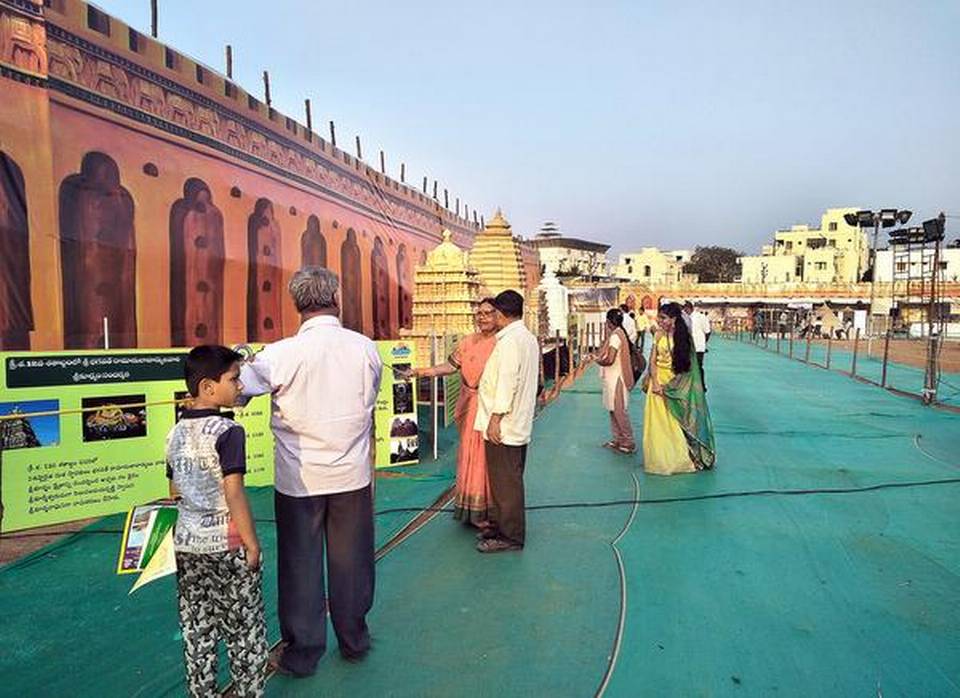
Visitors taking a look at an exhibit at the Kalingandhra Utsavam in Srikakulam on Wednesday. | Photo Credit: ARRANGEMENT

Replicas of structures from motley periods displayed at Kalingandhra Utsavam

The Kalingandhra Utsavam from February 8 to 14 is depicting history of Srikakulam in the form of replicas of temples and artefacts at the K.R. Stadium.

As many as 1.2 lakh people, including youngsters and schoolchildren, were enthralled by replicated inscriptions and rock edicts of the Kalingandhra history that goes as far as the 4th Century BC, said the festival in-charge and Sithampet Integrated Tribal Development Agency Project Officer L. Shiva Sankar.

Srikakulam was part of the Kalinga dynasty, which was conquered by Mauryan king Ashoka in 261 B.C. Exhibits from the Salihundam and the Dantapuri heritage sites near Srikakulam shows the Buddhist influence on the region.

Other replicas include that of the Sri Kurmam temple, built in 7th Century A.D. by King Chola Ganga, and the Someswara Alayam, the Madhukeshwara Alayam and the Bhimeswara Alayam temples constructed between 7th and 9th centuries AD. The famous sun temple at Arasavalli, said to be built by Devendra Varma of the Kalinga dynasty in 7th Century A.D., is also on display, as is the Umarudra Koteswara temple of Srikakulam, constructed in 1774 and the Radhaswamy temple near Meliyaputti, constructed in 1810.

Religious tourism

“The State government is keen on promoting religious tourism in the district. That is why we have displayed replicas of the temples in the exhibition,” Mr. Sankar said.

According to him, the Mandasa fort, built in 1779, had been attracting a number of visitors.

From the modern era, a Dutch building, built on the banks of the Nagavali river in the 18th Century, is on display.

The exhibition features structures like the Nagavali Bridge, constructed in 1854, and the Srikakulam Municipal Office, which started functioning in 1856. A replica of the Dusi Railway, built in 1921, is also displayed.

A replica of the Gotta barrage, which irrigates more than 1 lakh acres and was built across the Vamsadhara river in 1979, has been attracting youngsters. History of personalities such as Kodi Ramamurthy, Garimella Satyanarayana, Adibhatla Kailasam, and Vempatapu China Satyam has been depicted.

“It is difficult to take history lessons for students. Moreover, local history is not part of our syllabus. Therefore, the festival has helped students know the history of Srikakulam, its culture and heritage,” said P.Srikanth, correspondent of the New Central School.

source: http://www.thehindu.com / The Hindu / Home> News> States> Andhra Pradesh / by K. Srinivasa Rao / Srikakulam – February 14th, 2019

This crude oil cavern is an engineering marvel

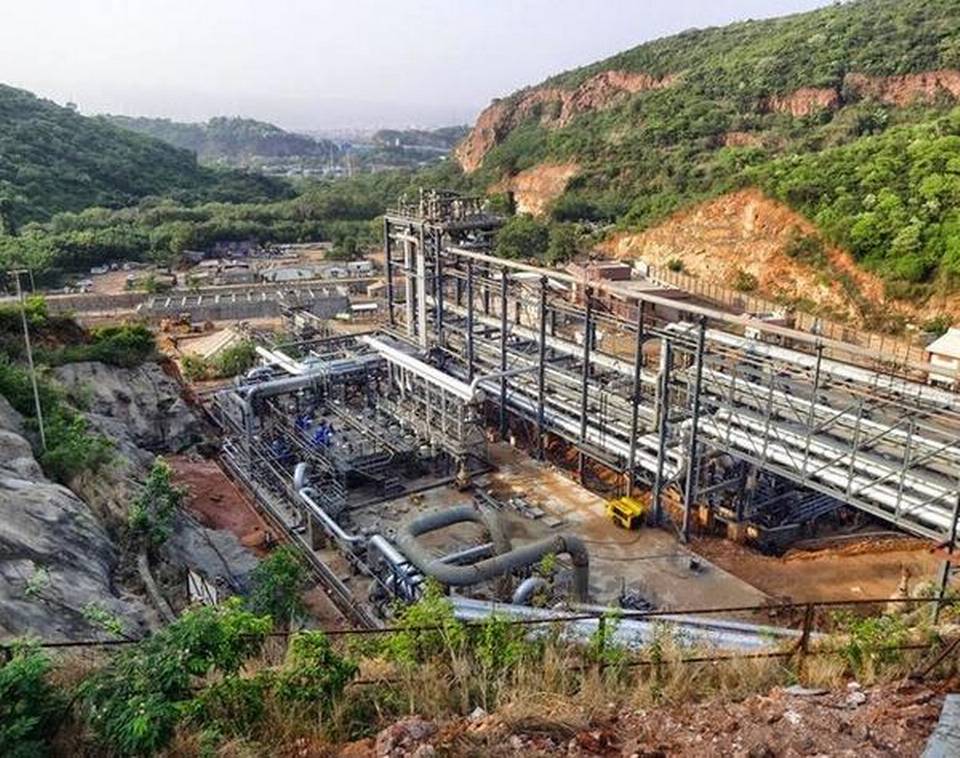
A file photo of the crude cavern at Lova Gardens in Visakhapatnam. | Photo Credit: arranged

The 1.33 million tonne facility in Vizag is the first in the country to receive consignment

India’s first underground rock cavern to store crude oil in the city, which was dedicated to the nation by Prime Minister Narendra Modi in Guntur on Sunday almost three-and-a- half years after it launched its operations, is considered a man-made engineering marvel.

After lot of difficulties in digging the cavern at Lova Gardens near the Hindustan Shipyard Limited, it was made suitable for storage of crude oil. At present, India has three caverns — in Mangalore, Padur and Visakhapatnam — with a total storage capacity of 5.03 million tonne. The total cost of the three projects was over ₹4,000 crore.

Long overdue

Though the cavern in Visakhapatnam was slated to be dedicated to the nation by the Prime Minister in 2015 itself, it could not take off due to his preoccupation.

The first consignment of crude was received in July 2015 by Very Large Crude Carrier Pioneer at the HPCL’s Single Point Mooring, heralding a new chapter for the oil industry as India joined the elite club of a few countries that had such rock caverns.

The Indian Strategic Petroleum Reserves Ltd (ISPRL), a special purpose vehicle wholly owned by the Oil Industry Development Board, was set up by the Ministry of Petroleum and Natural Gas, with the mandate to create caverns to store crude so as to use it as a cushion in the event of disruption in supply from the Middle East.

The Engineers India Ltd was the project management consultant for the cavern project.

The Government of India also has plans to construct two more caverns with a capacity of 6.5 million tonne each in Karnataka and Odisha.

The idea of the cavern project was conceived after severe shortage of petroleum products experienced due to dislocation in supplies following the Gulf War in 1990s. “My association with the building of caverns was a challenging task as well as a thrilling experience,” Rajan Pillai, former Chairman and Managing Director of ISPRL, during whose tenure the first cavern became operational, told The Hindu on Sunday.

The crude oil cavern in the city has a capacity of 1.33 million tonne in which HPCL has a separate compartment with a storage capacity of 0.3 million tonne.

LPG cavern

Visakhapatnam also can boast of having South and South East Asia’s first- of-its-kind LPG cavern with a capacity of 60,000-tonne in the close vicinity of the crude oil cavern.

The LPG cavern is run by South Asia LPG Company Pvt. Ltd, a joint venture of the HPCL and Total Gas and Power India, a wholly-owned subsidiary of TOTAL of France.

The bottommost point is 196 metres below mean sea level and considered one of the deepest caverns in the world.

source: http://www.thehindu.com/ The Hindu / Home> News> States> Andhra Pradesh / by Santosh Patnaik / Visakhapatnam – February 11th, 2019

Proud moment for ‘village singer’

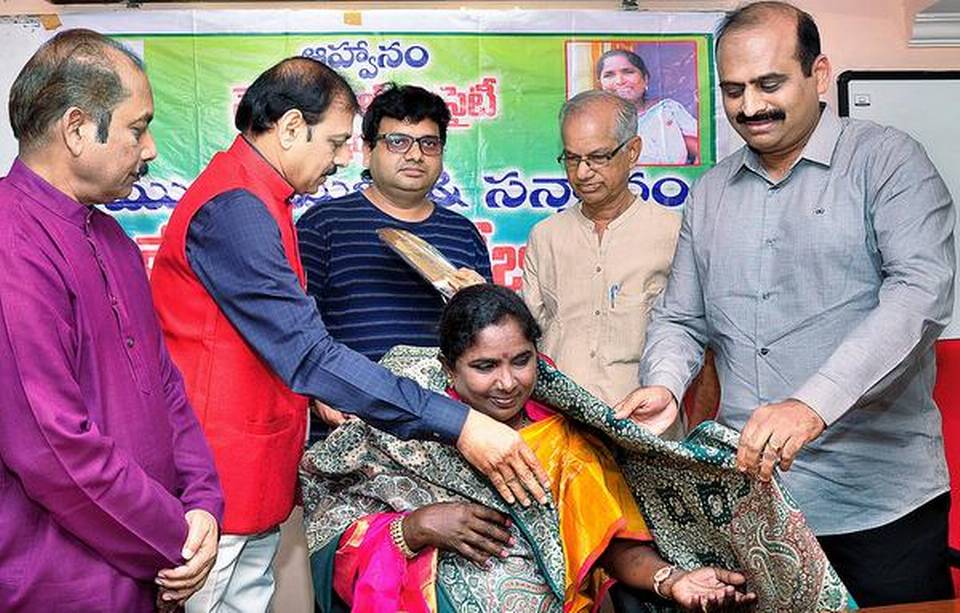
Singer Baby being felicitated by members of Vizag Film Society and Andhra University Vice-Chancellor G. Nageswara Rao in Visakhapatnam on Sunday.

Internet sensation Baby narrates her journey to fame

Pasala Baby, who took the internet by storm with her song ‘O Cheliya Naa Priya Sakhiya’ last year, is the latest singing sensation.

From an ordinary housewife at Vadisaleru village near Rajahmahendravaram to being a special guest to the house of actor Chiranjeevi, the journey of the 40-year-old unread woman is full of miracles.

“A month after the video was uploaded to the Internet by my relative, I was sitting in hospital where my daughter was admitted for delivery. A number of media channels had surrounded the hospital requesting for an interview,” said the singer explaining how she came to know about the video going viral. She was speaking as the chief guest at a programme organised by Vizag Film Society at Andhra University here on Sunday.

A mother of two, Baby said she just used to sing lullabies for her brother during her childhood. Sometimes, she used to sing while working in agricultural fields, but she had no music knowledge. “It was music director Raghu Kunche, who, for the first time, gave me an opportunity to sing a song ‘Matti Manishinamma Nenu’. However, it is music director Koti who encourages and helps me make strides in the field,” said Ms. Baby.

Known as ‘village singer’, Baby said: “I am a big fan of singers S.P. Balasubrahmanyam and Janaki.”

“I never visited a city till two months ago. Now, I have been to Hyderabad, Dubai and Muscat. With my first remuneration, I bought sarees for my daughters. Watching me on TV, they are proud and overjoyed. I never imagined that my life takes this colourful turn,” said the singer. Andhra University Vice-Chancellor G. Nageswara Rao, VFS secretary Narava Prakasa Rao and a few others felicitated Baby.

source: http://www.thehindu.com / The Hindu / Home> News> States> Andhra Pradesh / by Harish Gilai / Visakhapatnam – February 11th, 2019

Cage culture of Tilapia on pilot basis

With an objective to boost the cage culture of Tilapia farming in the State, the Water Resources department has agreed in-principle to accord permission to take up the project in the reservoirs in AP.

Vijayawada :

With an objective to boost the cage culture of Tilapia farming in the State, the Water Resources department has agreed in-principle to accord permission to take up the project in the reservoirs in AP. The officials from the fisheries department said the project will initially be rolled out on a pilot basis at Madduvalasa Reservoir in Srikakulam district and later would be scaled up to other areas.

The project was undertaken as part of a MoU signed with the USA-based Fishin’ Company, which had entered into a pact with the State government in September last year to produce the targeted 1.7 metric tonnes of Tilapia annually, the officials added.

Tilapia, also known as Genetically Improved Farmed Tilapia (GIFT), is a fast-growing, high-yielding and value buy variety of fish across the globe. “We received an in-principle approval from the Water Resources department to take up the project in Madduvalasa Reservoir,” an official said.

source: http://www.newindianexpress.com / The New Indian Express / Home> Cities> Vijayawada / by Express News Service / February 09th, 2019

Timeless Tupolev: Soviet-era naval aircraft

The Soviet-era naval aircraft is not just a museum piece, but remains a stellar example of a sturdy flying machine

 Tupolov01ANDHRA10feb2019

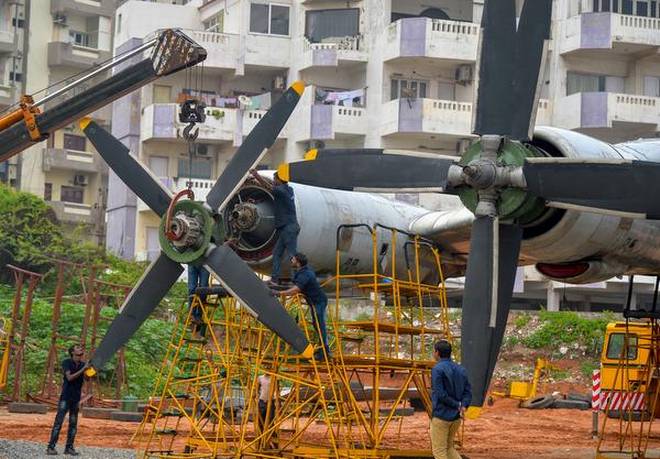
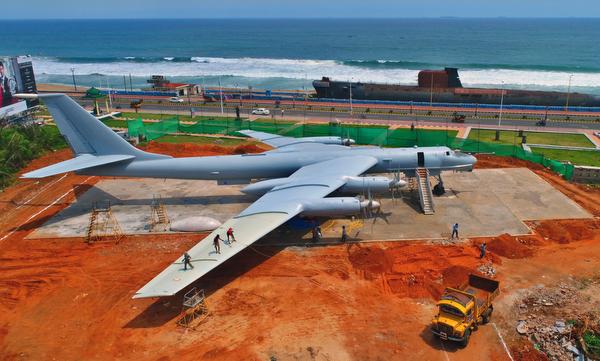
The TU 142 Aircraft Museum in Visakhapatnam narrates a tale of resilience, keeping the accolades earned by the Soviet-era flying machine fresh in memory. The long-range maritime patrol aircraft served the Navy for 29 years with a rare feat of 30,000 hours of accident-free flying at a time when the MiG-21s were earning the dubious distinction of flying coffins. Once the world’s heaviest and fastest flying turboprop aircraft, the Tupolev was part of major naval exercises and operations since its induction into the force in 1988.

Tupolov02ANDHRA10feb2019

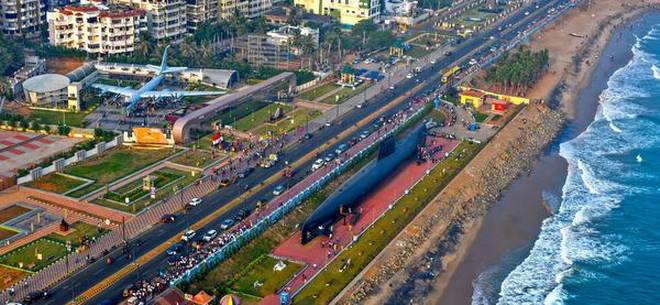
President Ram Nath Kovind opened the walk-through museum opposite the Kursura Submarine Museum — the irony that TU 142 once specialised in helping detect and destroy submarines is not lost on the naval personnel — on Beach Road in the city on December 7, 2017. It was thrown open to the public on December 28 that year.

Visakhapatnam , Andhra Pradesh : 16/09/2017: The Indian Navy's long range maritime patrol aircraft TU 142M getting finishing touches opposite to the Kursura Submarine museum on the Beach Road in Visakhapatnam on September 16, 2017. The anti-submarine warfare plane is being converted into a museum at a cost of Rs 10 crore and will be thrown open to the public on World Tourism Day on September 27. Photo: K.R. Deepak
Visakhapatnam , Andhra Pradesh : 16/09/2017: The Indian Navy’s long range maritime patrol aircraft TU 142M getting finishing touches opposite to the Kursura Submarine museum on the Beach Road in Visakhapatnam on September 16, 2017. The anti-submarine warfare plane is being converted into a museum at a cost of Rs 10 crore and will be thrown open to the public on World Tourism Day on September 27. Photo: K.R. Deepak

The making of the museum was a year-long process. The decommissioned aircraft was flown in from INS Rajali, the naval air station in Arakkonam, Tamil Nadu. After landing at the INS Dega airport, the aircraft was dismantled and its parts were transported by road on trailers and reassembled. A fibreglass wall was installed on the beach side to withstand windspeeds of up to 250 km. An audiovisual experience through an L-shaped tunnel takes the visitors to the aerobridge leading to the walk-through museum.

The museum has been drawing a sea of tourists. Curator Dileep Kumar says the highest number of visitors on a single day was 5,500 on January 15 this year. Over 6.81 lakh people visited it in 2018. Last December, there were 83,722 visitors.

(Text and Images by K.R. Deepak)

source: http://www.thehindu.com / The Hindu / Home> News> States> Andhra Pradesh / February 10th, 2019