Monthly Archives: November 2014

Expert suggests plantation of local species

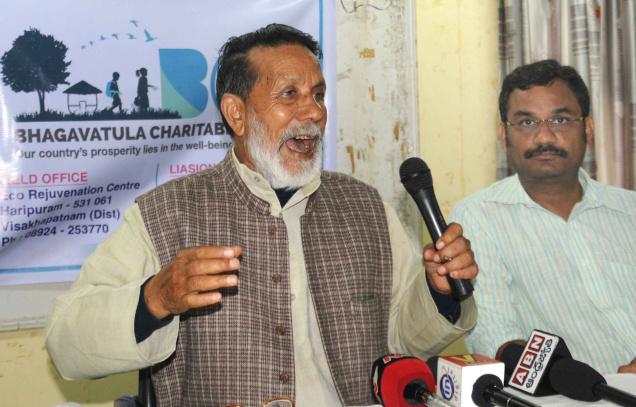
Visakhapatnam (Andhra Pradesh) 13-11-2014: Environmental activist and Magsaysay award winner Chandi Prasad Bhat addressing a press confernce along with Bhagavatula Charitable Trust secretary B. Sri Ram Murthy n Visakhapatnam on Thursday. Photo: C.V. Subrahmanyam / The Hindu

Environmental activist Chandi Prasad Bhatt visits Hudhud-affected areas. BCT secretary B. Sri Ram Murthy said instead of giving importance to numbers, the trees that withstand the gale like neem, jamun and ‘neredu’ should be given priority while restoring greenery.

Floods in the Himalayan region and recent cyclones in the coastal regions underline their vulnerability caused by climate change, noted environmental activist Chandi Prasad Bhatt has said.

Addressing a press conference after a visit to the Hudhud-affected fishermen villages, GITAM University, zoo, Kambalakonda and the Agency areas, he said while varieties like acacia and eucalyptus were felled by the gale, the tops or branches of local varieties were blown off but the trees survived.

He said during visits to Odisha after the super cyclone and to the Andamans, he found that mangroves withstand the gale without being uprooted and said growing local species along the coast would lessen the impact of the cyclone and reduce damage.

Mr. Bhatt, recipient of Magsaysay Award and Gandhi Peace Prize, said the floods at Kedarnath, the recent J&K flood and Hudhud had highlighted the affect of climate change caused by melting of glaciers and raising sea levels.

The Chipko Movement leader, who visited the State after the 1977 Diviseema tidal wave and after cyclones in 1987 and 1990, said trees survived in the Agency area owing to social forestry programmes through Vana Samrakshana Samitis wherever the growth was thick. Mr. Bhatt, who was here on an invitation from Bhagavatula Charitable Trust (BCT), saw the havoc wrought to the trees and interacted with students of the residential school there.

BCT secretary B. Sri Ram Murthy said instead of giving importance to numbers, the trees that withstand the gale like neem, jamun and ‘neredu’ should be given priority while restoring greenery. Hills should be vegetated again. Also casuarinas should be planted along the coast in various phases so that after cutting off the grown trees other layers would remain in place.

He said two BCT farms had 180 species of trees and 80 per cent of them were uprooted by the cyclone. Various sheds for students, cafeteria, dormitories etc were also damaged.

Workshop soon

Making good use of Mr. Bhatt’s association with the Ministry of Environment, BCT would organise a workshop on the species of trees to be grown.

source: http://www.thehindu.com / The Hindu / Home> News> Cities> Visakhapatnam / by Special Correspondent / Visakhapatnam – November 13th, 2014
Miryala Venkata Rao no more

Founder of Kapunadu and former Chairman of the Andhra Pradesh Mining Development Corporation and Handicrafts Development Corporation, Miryala Venkata Rao breathed his last at a corporate hospital here on Sunday afternoon.

He was ailing for a while and is survived by wife Prameela, daughter Swathi and son, Seshagiri Babu, a bureaucrat. He is known for his endeavours in getting political recognition for the ‘Kapu’ community.

The body was kept at the Kapu Sangham Hall here for a while before being flown to Visakhapatnam, where the funeral will take place on Monday.

Naidu expresses grief

Andhra Pradesh Chief Minister N. Chandrababu Naidu expressed his grief over the death of Kapunadu leader, Miriyala Venkata Rao.

The Chief Minister said Venkata Rao had brought about political enlightenment in one of the major communities in the State and rendered yeoman services to the community.

source: http://www.thehindu.com / The Hindu / Home> News> Cities> Hyderabad / by Special Correspondent / Hyderabad – November 10th, 2014

CIBA’s experiment on mullet proves a success

MulletANDHRA13nov2014

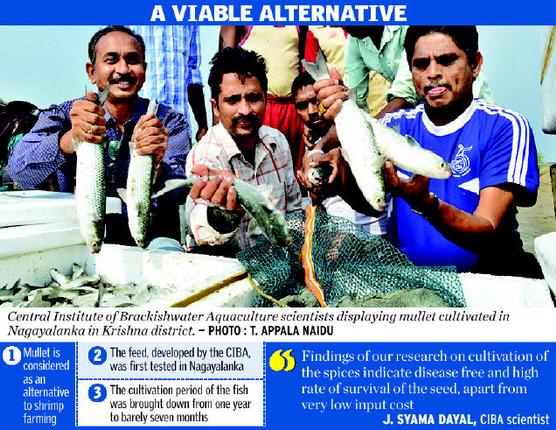
The cultivation period of the fish, which is considered an alternative variety to shrimp, was brought down from one year to barely seven months

The Central Institute of Brackishwater Aquaculture (CIBA), Chennai, in collaboration with Nagayalanka-based progressive farmer has scripted a success story by bringing down the cultivation period of Gold Mullet (Liza Parsia) and Grey Mullet (Mugil Cephalus) fish with the help of ‘formulated feed’.

The feed was developed by the CIBA and tested for the first time in Nagayalanka in Andhra Pradesh in the country. The cultivation period of the fish, which is considered an alternative variety to shrimp, was brought down from one year to barely seven months, drawing the attention of the worried shrimp farmers.

On Wednesday, CIBA Principal Scientists K. Ambasankar and J. Syama Dayal came with up their findings following harvesting of the mullet species on an acre of pond here.

The seed grown in the pond was collected from estuary and brackish water canals.

“Findings of our research on cultivation of the spices indicate disease free and high rate of survival of the seed, apart from very low input cost,” Mr. Syama Dayal told The Hindu. However, the CIBA scientists experimented on these two species in their quest to come out with alternative to the shrimp, which was driving the farmer into irreparable loss in recent years.

Experiment

“The experiment on Liza Parsia and Mugil Cephalus in abandoned ponds where earlier shrimp was cultivated is a way for those failed to reap profits in shrimp cultivation. Farmers have already begun slowly inquiring about details such as input cost,” said Mr. Ambasankar.

Beyond expectations

According to Raghu Sekhar who cultivated the fish in his pond, growth of the mullet species was beyond expectations, wooing other farmers to try their luck. “No disease is found during the seven-month cultivation period, withstanding changes in the weather and the soil of the pond,” added Mr. Sekhar.

Given the market value for value added to the Mullet Roe (egg) of the species, European countries and Japan are importing it in a large scale.

On the other hand, the CIBA was engaged in developing seed of the mullet species by the end 2016, according to scientists.

source: http://www.thehindu.com / The Hindu / Home> News> Cities> Vijayawada / by T. Appala Naidu / Nagayalanka – November 13th, 2014

Best App in Asia award to Hyderabad entrepreneur

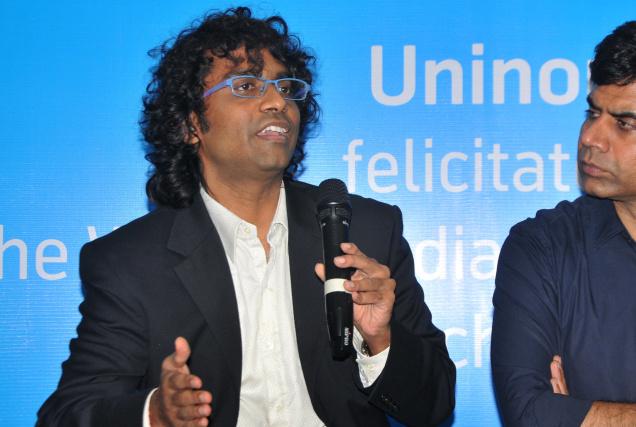
The Best App In Asia category of the digital winners 2014, Raghu Kanchustambham, explains about his application in Hyderabad on Wednesday. Photo: G. Ramakrishna / The Hindu

The app helps coffee growers to get instant returns for their produce. Livelihood 360 is also capable of estimating quantity of the produce in the fields and sell the crop at fair price.

The coffee farmers of Araku valley these days get instant returns for their produce. Gone are the days when they had to wait for nearly a month till the buyers completed the weighing process of the produce and release money through co-operative society. Thanks to a mobile application developed by Hyderabad-based entrepreneur, Raghu Kanchustambham, there is no waiting period.

The app dubbed as ‘Livelihood 360 (L360)’ was adjudged the Best App of Asia in the Telenor Digital Winners Conference, a global competition held in Oslo, Norway this month. The award came with a cash prize of Rs. 9,79,000, which will be utilised by the developer to further “scale up” the concept.

It all started when Mr. Raghu, who has a start-up ‘Concept Wave’, met the officials of Naandi Foundation, which was already working with the coffee farmers of Araku valley. “The basic premise was to utilise technology and reach to those people not having access to technology and internet. I visited Araku valley and spent time with them and learnt a lot about their lifestyle and livelihood,” he said.

Mr. Raghu said the previous system of remittance to coffee growers in Araku was taking about a month. The coffee growers would take their produce to a prescribed ‘adda’ where the truck drivers would collect and transport coffee beans to another location for weighing and valuing. “We gave the truck drivers an application that would quantify the yield and also determine the quality instantly. The drivers will immediately remit the amount on the spot to farmers,” he explained.

Livelihood 360 is also capable of estimating quantity of the produce in the fields and sell the crop at fair price. “We have already adopted this application among 12,000 coffee farmers in 650 villages of Araku. Between 40 and 50 truck drivers from Araku were given training on using the application on a feature phone and not a smart phone,” he explained.

source: http://www.thehindu.com / The Hindu / Home> News> Cities> Hyderabad / by M. Sai Gopal / Hyderabad – November 12th, 2014

NRCB shows the way for banana farmers

Farmers at the Banana market. / The Hindu

The National Research Centre for Banana (NRCB), Trichy, one of the India’s premiere research institutes in the field of agriculture, has trained farmers belonging to Krishna district in pre and post harvesting technologies in banana cultivation and processing.

A group of twenty farmers actively involved in banana cultivation in Thotlavalluru mandal was groomed in value added products of banana by the scientists last week. Inspired by a strong local banana marketing system owned and being run by the Krishna district farmers, the National Bank for Agriculture and Rural Development has ensured them the ‘scientific training cum exposure visit’ under it’s Capacity Building for Adoption of Technology Programme.

NRCB Principal Scientist Dr. Kumar had shared his scientific experience with the farmers, enabling them exposure to existing technologies meant for seed selection and post harvesting methods. “Scientists mainly focused on soil management, crop maintenance and identification of disease. They also advised the farmers to prefer drip irrigation system with fatigation tanks,” said Netham (NGO) Director Suresh Vesam who led the farmers.

BananaChartANDHRA12nov2014

On the other hand, another scientist Dr. Siva had displayed preparation methods of value added products developed from banana – banana fibre, drink, chips, wine and jam. The farmers were told the export potential of the selected value added products. The training included visit to various banana units in Trichy district of Tamil Nadu.

The success story of Solar Dryad Banana Unit in Trichy, a pilot project encouraged by a German Bank — KFW, helped the Krishna farmers to explore areas in banana cultivation and marketing to register growth in their income. The farmers also learnt how Tamil Nadu farmers tapped the overseas market for banana and its value added products, which is being exported to Philippines and other European countries.

source: http://www.thehindu.com / The Hindu / Home> News> Cities> Vijayawada / by T. Appala Naidu / Machilipatnam – November 10th, 2014

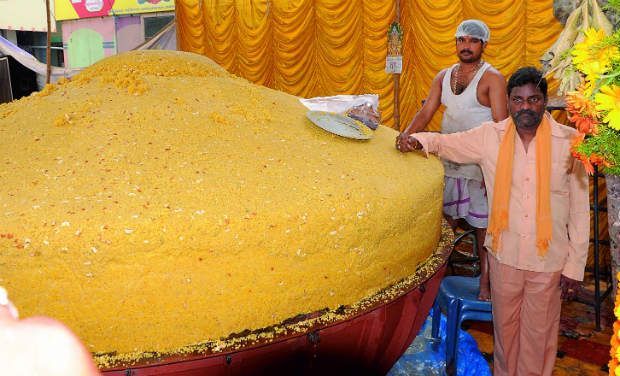
Andhra Pradesh confectioner bags new Guinness record for 7,858-kg ‘laddu’

(Photo: DC)
(Photo: DC)

Rajahmundry, Andhra Pradesh: 

A huge ‘laddu’weighing 7,858 kg, prepared by a shop owner from Tapeswaram in Andhra Pradesh, which was offered to Lord Ganesha during Ganesh Chaturthi, has found a place in the Guinness World Records.

Sri Bhaktanjaneya Sweets bagged a place in the Guinness World Records for the fourth consecutive time for preparing the biggest ‘laddu’, offered to Lord Ganesha on August 27 during the eleven-day festival this year.

Speaking to PTI today after receiving his new Guinness certificate, shop owner S Venkateswara Rao said that he could achieve this feat only with the blessings of his family and the cooperation of his 25 staff members at Bhaktanjaneya.

Rao, who is a school drop out and joined his father S Satyanaraya Murthy in running the then small hotel after completing his sixth grade studies, said that his aim is to outdo his own record every year.

Previously, in 2011 he prepared a laddu weighing 5,570 kg, and followed it up with 6,599.29 kg laddu in 2012; 7132.87 kg in 2013 and 7,858 kg this year.

“My father (Murthy), who came here in 1942 to earn a livelihood started a small hotel, which initially served coffee and tiffin items along with sweet products.

Gradually, the shop in Tapeswaram began catering to travellers en-route, after buses and other vehicles began halting there for a small snack,” Rao said.

Subsequently in 1972, they expanded the hotel into a full-fledged sweet mart and have been famous for serving their patent ‘Kaza’ sweet.

Rao now intends to open outlets of his shop in Vijayawada and Visakhapatnam, with the help of his children, who are now pursuing higher studies.

The sweet mart has earlier received State-level awards for its ‘Kaza’ preparation before entering the Guinness Records. “Our range of products start from ‘laddus’ of small size to bigger ones as huge as 60-1000 kg,” Rao said.

For bigger orders like those weighing 5,000 kg, the makers have to be intimated six months in advance although the preparation will commence only 1-2 days before the festival as the product (laddu) is kept for 14-15 days during the event.

source: http://www.deccanchronicle.com / Deccan Chronicle / Home> Nation> Current Affairs / PTI / November 12th, 2014

Services of Abul Kalam Azad recalled

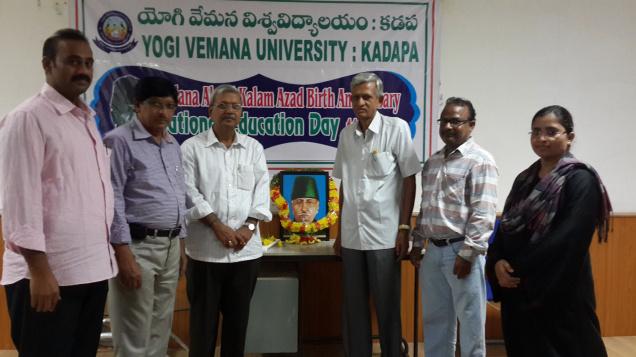
Yogi Vemana University Vice-Chancellor B. Syamasundar and faculty members paying tributes to Abul Kalam Azad in Kadapa on Tuesday. / Photo: By Arrangement / The Hindu

The invaluable contribution of India’s first Education Minister Maulana Abul Kalam Azad for expansion of reach of education to masses and improvement of its quality was recalled on the occasion of his birth anniversary on Tuesday.

Participating in the National Education Day observed in this connection, educationists and other dignitaries paid rich tributes to the man who played an instrumental role in the establishment of the University Grants Commission and the Indian Institutes of Technology. Addressing the faculty and students of Sri Padmavati Mahila Viswa Vidyalayam (SPMVV) at Tirupati, School Guru Eduserve’s Project Manager Prabhakaran predicted a rise in number of courses offered online and said that the online mode of education would facilitate expansion of learning to the grass-root level rather than the face-to-face mode of instruction. The programme was held by SPMVV’s Department of Communication and Journalism.

In a separate event, the members of Muslim Joint Action Committee (MJAC) paid homage to Maulana Abul Kalam Mr. Azad and recollected his contributions to the country. Yogi Vemana University (YVU) Vice-Chancellor B. Syamasundar garlanded Mr. Azad’s portrait in a function held at Kadapa. On the occasion, Mr. Syamasundar pointed out that Azad had rightly accorded more priority to education policy than the industrial policy. YVU Registrar C. Sambasiva Reddy said Azad had strove for national integration and tolerance to all religions. Coordinator of History and Archaeology Ramabrahmam explained Mr. Azad’s role in the independence movement and his support to reservations.

Paying tributes to Mr. Azad at the Congress office, District Congress Committee president Shaik Nazeer Ahmed said Azad had strived for the poor, weaker and downtrodden sections.

At Chittoor, the district administration celebrated the birth anniversary of Azad in a grand manner with the participation of a big number of students, teachers and officials. Mayor Katari Anuradha flagged off the rally with about one thousand students at Gandhi Circle and it passed through arterial junctions culminating at Ambedkar Bhavan.

source: http://www.thehindu.com / The Hindu / Home> News> National> Andhra Pradesh / by Andhra Pradesh Bureau / Tirupati-Kadapa-Chittoor, November 12th, 2014

Andhra Pradesh government introduces online booking system for sand purchase

The doorstep delivery system is a major positive change after the AP government handed over sale of sand to women-run self-help groups in villages.

Hyderabad :

Consumers in Andhra Pradesh can now get sand at their doorsteps with the state government introducing an online booking system for it.

As per the new system, consumers could either go to the nearest ‘Meeseva’ citizen services centre or order sand online through ‘www.sandbyshg.ap.gov.in’ website, an official statement issued today said.
An SMS would be sent to the consumers about delivery of sand and a receipt would also be issued to them. Consumers would be able to find out the status of sand delivery online by using a transaction ID, it said.
The doorstep delivery system is a major positive change after the AP government handed over sale of sand to women-run self-help groups in villages, the release said, adding that gone are those days when the “sand mafia” called the shots in the sale of sand.
Sand sales to the tune of 1.55 lakh cubic metres have taken place after the state government entrusted the system to these self-help groups, it said.
Another 3.27 lakh cubic metres of sand is ready for sale and consumers could register complaints, if any, to a toll-free number mentioned in the release as ‘20201211800’.

source: http://www.economictimes.indiatimes.com / The Economic Times / Home> Industry> Ind’l Goods & SVCS> Metals & Mining / by PTI / November 10th, 2014

A heavenly dish that rings in Christmas spirit

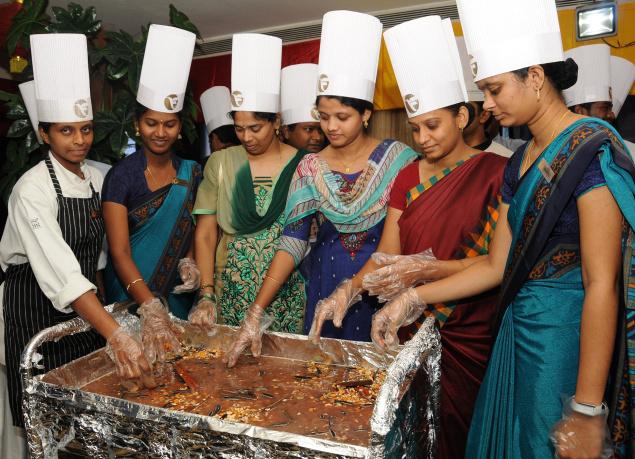
VIJAYAWADA, ANDHRA PRADESH, 10/11/2014: Women participating in cake mixing festival at a hotel in Vijayawada on Monday. Photo: Ch. Vijaya Bhaskar

Capturing the spirit of Christmas and New Year, the traditional ceremony of cake mixing began at Fortune Murali Park here on Monday. And the entire lounge smelled of spirits and dry fruits and other ingredients that go into cake mixing.

To start the ceremony, all guests, chefs and staff were handed gloves, aprons and chef hats. The ingredients along with spirits were mixed thoroughly. Before this the fruits have been placed in casks to soak in all liquid and mature beautifully by Christmas. It will then be used by the hotel to make plum cakes, puddings and other delicacies.

“The cake mixing ritual has now acquired social face. But it has not diluted its religious importance and remains to be one of the most awaited events in the Christian households,” said hotel general manager P.K. Venkatesh. Huge quantity of dry fruit and nuts with wine were soaked. The mixture would be allowed to settle for a period of forty days from which plum pudding with brandy sauce, exotic cakes, fudges would be made, he explained.

source: http://www.thehindu.com / The Hindu / Home> News> Cities> Vijayawada / by Staff Reporter / Vijayawada – November 10th, 2014

Naidu marks boundaries in Guntur for AP’s new capital

Asserts that farmers will greatly benefit by parting with their land

NaiduANDHRA09nov2014

Andhra Pradesh Chief Minister N Chandrababu Naidu on Saturday defined the boundaries for the state’s new capital on the Krishna Riverfront in Guntur district and sought to allay the fears of farmers whose land falls in the area.
With the common capital of Hyderabad set to go to Telangana in ten years, Naidu held a meeting with members of his Cabinet subcommittee at his Banajara Hills residence to discuss land acquisition for the construction of Andhra Pradesh’s new capital.

The chief minister addressed a press conference later, where he asserted that villages that fall under the boundaries of the future capital will benefit greatly by volunteering their land.

“I will see to it that farmers who part with their land for the construction of this world class capital benefit in many ways,” Naidu said, and added that opposition partiers were misguiding people.

Putting and end to speculation by defining the boundaries, he said: “The new capital will extend 10.5 km from Guntur Autonagar in the east to Prakasam barrage, from Borupalem in the west to Prakasam barrage and in the south from Autonagar Y Junction to the 75 km Ring road, covering almost 16 kilometers.”

The chief minister also promised that he would stop unscrupulous realtors from cheating farmers in the villages around the Mangalagiri and Tullur mandals, which form the core of the capital.

The cabinet subcommittee, comprising Municipal Minister P Narayana, Agriculture Minister P Pulla Rao, Irrigation Minister Devineni Umamaheswar Rao and Tadikonda MLA Shravan Kumar, will begin their tour to the two mandals on Tuesday.

They will explain to farmers the mode of land acquisition and try to convince those in five villages, including Venkatayapalem and Rayapudi on the river front, who have decided not to contribute, to part with their land for the development of the capital.
For each acre of their land, farmers of these five villages are demanding 1,200 square yards of residential land, 200 square yards in the commercial zone and employment for one eligible person.

Other demands were complete liquidity and legal sanctity in transfer documents, alternative sources of revenue for temples in case of endowment land, higher price for land near highways and village-wise meetings before a final decision is taken.

source: http://www.deccanherald.com / Deccan Herald / Home> National / DHNS – Hyderabad, November 09th, 2014