Cadbury India signed a memorandum of understanding with the Andhra Pradesh government on Wednesday (November 27) to set up a chocolate manufacturing facility at Sri City Special Economic Zone in Chittoor district of Andhra Pradesh.
“Spread across 134 acre, it will be the company’s largest manufacturing facility in Asia-Pacific region,” said Manu Anand, Managing Director, Cadbury India.
He expects the first phase of the project to be completed by mid-2015. Cadbury India will invest Rs 1,000 crore and produce around 100,000 tonne of Cadbury chocolates annually.
Though Anand did not provide details of the total investment on the entire project, expected to be completed in four phases by 2020.
“The plant will ultimately have an annual capacity of 250,000 tonnes and directly employ 1600 people,” he added.
Andhra Pradesh Chief Minister N Kiran Kumar Reddy, who spoke at the MoU signing ceremony, said the project would also benefit some 400,000 farmers in the region as it will need about 500,000 litre of milk and 100 tonne of sugar per day.
The signatories to the MoU were Anand on behalf of Cadbury India and the state’s Principal Secretary, Industries, K. Pradeep Chandra. Major Industries Minister J. Geeta Reddy and a number of other ministers also attended. Sri City lies about 55 kms north of Chennai.
The Andhra Pradesh unit will be Cadbury India’s seventh manufacturing facility in India. Some other global chocolate manufacturers in India are also eyeing opportunities for setting up manufacturing. Cadbury India is part of Mondelez International group of companies. Some of its key brands are Cadbury Dairy Milk, Bournvita, 5 Star, Perk, Bourneville, Halls, Tang and Oreo.
source: http://www.businesstoday.intoday.in / Business Today / Home> Biz Wrap> Corporate> Story / by E. Kumar Sharma / November 27th, 2013
In-principle agreement has been reached with the two international firms for the FSRU at Kakinada Deepwater Port
An in-principle agreement has been reached to resolve the peculiar situation where two reputed international companies are interested in constructing the first Floating LNG Storage Regasification Unit (FSRU) in the East Coast at Kakinada Deepwater Port.
The AP Gas Distribution Company had tied up with the GDF Suez LNG UK Ltd., as its strategic partner through international bidding and signed an MoU with Kakinada Seaport Ltd., the concessionaire of the Kakinada Deepwater Port for the execution of the Rs.5,000-crore project in May this year.
However, the State government later realised that the Royal Dutch Shell, Europe’s largest oil company, had also been working on building a floating LNG of up to five million tonne per annum capacity off Kakinada. Since two projects in the same location were not viable, a meeting was held in New Delhi recently where it was tentatively agreed to involve both the multinationals.
Minister for Infrastructure Ganta Srinivasa Rao said the issue was cleared by Chief Minister N. Kiran Kumar Reddy who ordered a Special Purpose Vehicle to be constituted for executing the unit.
Stakes
Meanwhile, sources said that it had been agreed that the public sector APGDC would have 44 per cent stake in the floating terminal project, Shell and GDF Suez would have 30 per cent and 26 per cent stake respectively and the Kakinada Seaport Ltd., three per cent.
The meeting also reviewed pending issues related to Petronet LNG project at Gangavaram port, a joint venture project between Petronet and the Gangavaram Port Ltd. The Rs. 5,000-crore project would have initial capacity of five million tonnes per year. The gas to be supplied by the floating terminals to power and fertilizer plants would generate Rs.5,000 crore revenue annually to the State through VAT, Mr. Srinivasa Rao said.
The Chief Minister asked the officials to convene a coordination meeting within 10 days to resolve all the pending issues for the key I&I projects including Machilipatnam port and Chittoor drinking water project.
source: http://www.thehindu.com / The Hindu / Home> News> National> Andhra Pradesh / by Special Correspondent / Hyderabad – November 28th, 2013
Sources privy to talks said Shell, GAIL and the AP government are talking about the possible equity structure
Royal Dutch Shell, Europe’s largest oil company, is likely to take a 30% stake in state-owned GAIL India Ltd’s proposed floating liquefied natural gas import terminal project at Kakinada in Andhra Pradesh.
Shell last year had announced plans to build a floating LNG of up to 5 million tonnes per annum capacity off Kakinada coast in a JV with Anil Ambani Group firm Reliance Power .
But Reliance Power earlier this year exited the project and now Shell has decided to join the GAIL-led project which was announced in 2011.
Sources privy to talks said Shell, GAIL and the AP government are talking about the possible equity structure.
Shell, they said, may take 30% stake. Europe’s largest LNG importer GDF Suex UK with whom GAIL originally planned the Kakinada terminal will take 26%.
The remaining 44% will be held by Andhra Pradesh Gas Distribution Corp Ltd a company jointly promoted by GAIL Gas Ltd and Andhra Pradesh Gas Infrastructure Corp Pvt Ltd.
GAIL Gas is wholly-owned subsidiary of GAIL India.
When contacted, a Shell India spokesperson said: “Shell can confirm that the company is in exploratory discussions with GAIL and other potential partners on the Kakinada LNG project. As the discussions are still preliminary, we cannot comment on any specifics at the moment.”
Sources said the Floating Storage and Regasification Unit in offshore Andhra Pradesh will be commissioned by 2015.
The import terminal would have a 3.5-5 million tonnes per annum capacity and will be used to cater to gas demand in Andhra Pradesh and neighbouring states.
While Shell already operates a 5 million tonne LNG import facility at Hazira in Gujarat, GDF Suez is present in India in the natural gas business since 1997, with a 10% stake in Petronet, the owner of LNG import terminals in Dahej and Kochi.
FSRU is a faster and low-cost solution for LNG importation. This is the first of its kind in India.
Kakinada is also the landfall point of billionaire Mukesh Ambani-led Reliance Industries’ flagging KG-D6 gas fields in the Bay of Bengal, and a near 1,400-km line carries the fuel from to consumption centres in the west.
The continuing fall in KG-D6 output has triggered a rush for setting up of LNG import facilities to meet the growing energy demands.
Petronet LNG – the nation’s largest importer of gas in its liquid form in ships– too is building a 5 million tonne facility at Gangavaram in Andhra Pradesh by 2016.
In intervening period to the construction of the Rs 4,000 crore Gangavaram terminal, Petronet plans to hire a floating LNG terminal to begin imports of fuel immediately.
State refiner Indian Oil Corp also is doing a front-end engineering and design study for a terminal at Ennore in Tamil Nadu.
source: http://www.business-standard.com / Business Standard / Home> Companies> News / by Press Trust of India / New Delhi – November 24th, 2013
The fourth Startup Weekend event in the city saw hearty participation from first-time entrepreneurs who slogged it out to turn an idea into a prototype within 54 hours.
Startup Weekend is a Seattle based non-profit organization which conducts this event once every year. Participants pitch business ideas on Friday and develop a working prototype or a presentation over the weekend. Besides Hyderabad, the event takes places in Delhi, Mumbai and Bangalore.
This year, the event saw nearly 50 ideas being floated by the 60 people who attended it. Of these, 11 ideas were selected for further development. The teams were mentored by venture capitalists and successful entrepreneurs in their bid to prepare a prototype for a presentation before the panel of judges on Sunday.
A few ideas that were selected for implementation include Teleport – a product that helps share environment with others through Google Glass, ThenWat – a web platform that can provide the sentiment of a text, Green Shopping – that avoids paper bills by making a digital bill, and Panic Controller – a device that can broadcast panic messages meant for safety of children and women.
Evan Luthra, whose team is working on Teleport, said that there are only five applications for Glass available and their idea taps a huge market potential. “Our application can capture pictures through Glass when the eye winks and also capture a degree panorama to share the environment of the wearer with rest of the world,” Luthra said
Though most paranoramaticipants were in the 20-25 age bracket, the event also saw younger people pitch their ideas. Sixteen-year-old B Vivek Kiran, who pitched two ideas, said the event “is an ideal platform to start out early”. His ideas included a banking application and a website that would help school and college students procure electronic components in a short time.
One of the organizers, Rahul Sanghi, said that the event has witnessed better participation this time. “We are seeing more participants hang around to develop a prototype and convince the judges. This is positive for the spirit of entrepreneurship ,” he said.
source: http://www.articles.timesofindia.indiatimes.com / The Times of India / Home> City> Hyderabad> Google Glass / TNN / November 24th, 2013
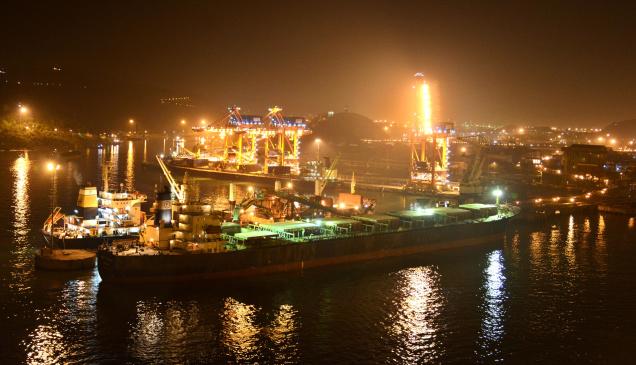
A cargo handling at night at Visakhapatnam Port./ Photo: K.R. Deepak / The Hindu
‘We are gearing up to overcome its shortcomings’
Admitting that there was delay in initiating measures to face challenges posed by ultra modern ports coming in its neighbourhood during pre-2008, Visakhapatnam Port Trust Deputy Chairman G.V.L. Satya Kumar said massive mechanisation was under way to put the port back on the track.
In an exclusive interview to The Hindu on Saturday, he said two deep draft private ports – Gangavaram, 10 km. south of Visakhapatnam and Krishnapatnam, between Chennai and Kakinada with Cape class vessel handling facilities were commissioned during late 2008.
This threatened the hitherto sway of Visakhapatnam Port in the vast hinterland, he pointed out.
The single buoy mooring (SBM) by IOC at Paradip and augmentation of deep sea port at Kakinada ensured faster discharge of cargo making a dent on the performance of Visakhapatnam Port.
The commissioning of Dhamra and impending start of Gopalpur has aggravated the challenge ahead for VPT.
Mr. Satya Kumar said with already lost time, with superior capability ports having sprung up in the vicinity, Visakhapatnam Port pursued the modernisation initiatives with utmost vigour using the instruments of Public Private Partnership Policy Guidelines of 2008.
With seven awarded and two in the process of finalisation under PPP, the port will increase its current capacity from 62 to 112 million tonne by 2014-15, he said.
Coal handling facility
He said the commissioning of 10 million tonne mechanised coal handling facility in the Outer Harbour in April was the first in the port sector under the new PPP guidelines.
Other projects awarded so far include EQ-10 for liquid cargo other than POL, EQ-1 for imported coal, EQ-1A for export of coastal coal, EQ-7 for fertilizer, WQ-6 for other bulk and Ore Handling Plant (OHP) for iron ore. Essar Ports has been selected for Rs.845-crore modernisation of OHP and the price bid of Visakha Container Terminal for Rs.633-crore extension of container terminal is at present under evaluation.
VPT is taking up construction of new berths at WQ-7/8 with internal accruals. Except EQ-7 fertilizer mechanisation awarded to Alba and OHP to Essar, all other PPP projects are in advanced stage of completion. Mr. Satya Kumar said by December-end, they were confident of all three coal streams would be fully mechanised viz. Visakhapatnam General Cargo Berth Private Ltd (Vedanta berth), EQ-1 and EQ-1A along with EQ-10 for liquid cargo and WQ-6 for other dry bulk.
To a question, he admitted that the decommissioning of three existing berths in the Inner Harbour had caused some dislocation and pointed out that it was being compensated to some extent through monitoring and optimisation of existing resources.
source: http://www.thehindu.com / The Hindu / Home> News> Cities> Visakhapatnam / by Santosh Patnaik / Visakhapatnam – November 25th, 2013
Tata Advanced Systems Ltd (TASL), which has a chopper cabin manufacturing facility in an SEZ owned by Andhra Pradesh Industrial Infrastructure Corporation Ltd here, sought government’s approval to expand its facility to manufacture additional defence-related products.
The Board of Approvals under the Ministry of Commerce which has gone through the request made by the Tatas advised the Department of Commerce to obtain the views of the Ministries of Home and Defence before granting the permission for product expansion.
“The Board noted that the unit has sought approval for additional products relating to defence. The Board, after deliberations decided that the views of M/o Defence and M/o Home Affairs be obtained by DoC and the matter be processed further on file by DoC after taking into account the comments so received,” the minutes of the BoA meeting held on November 8, said.
TASL, a fully-owned subsidiary of TATA Sons, has been set to address the business areas of Defence, Aerospace, Aero- Structures and Homeland Security.
In June 2009, Sikorsky and TASL entered into an agreement for production of S-92 helicopter cabins in India, and in November of the same year, Sikorsky and TASL entered into a joint-venture for production of more than 5,000 detailed aerospace components in India.
TASL requested the BoA for manufacturing and export of additional products with regard of aerostructures, equipment, systems and propulsion systems, for military aircraft (both fixed with and rotary aircraft) and military helicopters.TASL, a fully-owned subsidiary of Tata Sons, has been set to address the business areas of Defence, Aerospace, Aero- Structures and Homeland Security.
In June 2009, Sikorsky and TASL entered into an agreement for production of S-92 helicopter cabins in India, and in November of the same year, Sikorsky and TASL entered into a joint-venture for production of more than 5,000 detailed aerospace components in India.
TASL requested the BoA for manufacturing and export of additional products with regard of aerostructures, equipment, systems and propulsion systems, for military aircraft (both fixed with and rotary aircraft) and military helicopters.
The JV of TASL and Sikorsky recently announced that its S-92 helicopter cabin production has become 100 per cent indigenous. The JV also said it completed another significant milestone in October by producing its 50th S-92 helicopter cabin. The TASL facility now has the capacity to produce up to four cabins a month and is responsible for future design modifications.
source: http://www.zeenews.india.com / ZEEBIZ.com / Home> Business> Companies / by PTI / November 19th, 2013
Testa Rossa Caffe, which has two outlets in Hyderabad (at Banjara Hills and Jubilee Hills) and a third in its twin city, Secunderabad, introduced Tuesday Pasta Mania. Patrons can walk in every Tuesday and sample an array of vegetarian pastas (priced at Rs 199 each) and non-vegetarian ones (priced at Rs 249).
The vegetarian pastas include Penne Arabiatta; Penne Panna e Funghi; Spaghetti Aglio e Olio Perperonicino; Fusilli Alfredo; Fusilli Panna e Noci, and Fusilli Marinara. The non-vegetarian ones include Penne Arabiatta e Pollo; Farfalle Polo e Funghi; Fusilli Alfredo e Pollo; Spaghetti Al Ajo Agnelo; Lasagna Pascalino, and Penne Alfredo e Pollo.
source: http://www.fnbnews.com / FnBnews.com / Home> WorldView> Top News / by FnB Bureau, Mumbai / Saturday – November 16th, 2013
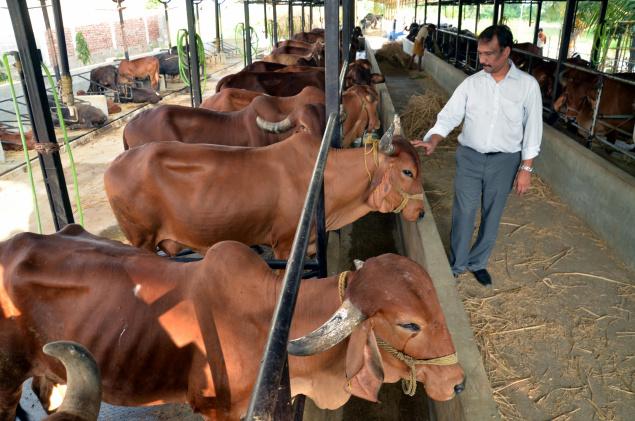
G. Sudarshana Rao at his farm with Gir breed cows at Veerankilakulu in Krishna district./ Photo:V. Raju / The Hindu
‘Gir cow fed with a special feed can produce milk that has medicinal values’
Milk from Gir breed of cows that originally inhabited the Gir Forest in Saurashtra region of Gujarat, are here in Krishna District, thanks to the entrepreneur-turned-medico G. Sudarsana Rao, who has set up a dairy at Veerankilakulu village in Vuyyuru mandal.
In an exclusive chat with The Hindu, he said that the Gir breed of cows give milk that contains conjugated lineolic acid, which has been proved to be an anti-cancer compound.
The claim that Gir cow milk not only prevents but controls diabetes is not yet settled. As per ongoing research by Sai Butcha Rao, a research associate at International Livestock Research Institute, ICRISAT, Patancheru, if the Gir cow is fed with a special feed it could produce milk that has medicinal values to stimulate the pancreas to produce insulin and thereby control diabetes.
According to him, the mention of this breed was made in the Vedas and the Brazilians had taken thousands of cows of this breed to their country centuries ago from Gujarat.
Today, the breed is called Girolando in Brazil, he said. The breed is on the verge of extinction in its native country, he claims. “Today, there are about 15,000 of these cows left in Gujarat. And to save the breed the Gujarat Government has embarked on an ambitious breeding project at a cost of Rs.1,400 crore,” he added.
Dr. Sudarsana Rao said that the Gir cow milk was lighter compared to others, has high concentration of calcium, proteins and vitamins D and C and is sweet and tasteful.
To begin with, he has imported about 34 animals and aims to have a stock of 400 in a year. Terming the milk as ‘organic milk’ under the brand Ayush Organic Product, he said: “No milk is organic, but it becomes organic based on the organic feed that is fed to the cattle.”
No chemical used
The farm has a hydroponic machine that produces tailor-made green organic fodder. The imported machine can generate fodder from seeds such as barley or horseshoe gram in a controlled environment. For every 1.25 kg. of seed we can get green and highly nutrient organic fodder up to 8 to 10 kg. and the facility can be easily expanded depending on the requirement, he observed.
Dr Rao also pointed out that no chemical is used in the processing. “The milk that is extracted goes directly to the chilling machine and is chilled at 2 degrees and immediately packed and transported in insulated boxes, where the temperature is maintained at 3 degree Celsius,” he said.
According to him, the yield of the native breed is much less compared to the Holstein Friesian (HF) breed. Initially, the milk will be marketed in half and one-litre packets in Hyderabad and later sold at other major cities such as Vijayawada and Guntur through select outlets. The farm will be inaugurated by Animal Husbandry Director D. Venkateswarulu on Wednesday.
source: http://www.thehindu.com / The Hindu / Home> News> Cities> Vijayawada / by Sumit Bharracharjee / Vuyyuru – November 13th, 2013
“There is a pride in dressing traditionally”, says Hyderabad’s very own Gaurang Shah known for his traditional weaves and handloom sarees. Showcasing his latest collection Paanchali in the city on Tuesday, Gaurang treated his patrons to a colourful melange of pinks, blues, yellows and whites, going against the typical sobre shades of nude and grey that usually feature this season. His first solo show in the city, the fashion parade was a treat indeed.
Paachali brings the best of five states into one exotic collection that echo designs from the 15-16 century, with an elephant motif here, mango motif there, and plenty of flora.
As many as 50 hand-woven traditional sarees were presented, bringing together tradition and modern themes in perfect harmony. Inspired from Jamdani (fabric made out of cotton), the label Gaurang kept reiterating the beauty and elegance of Indian designs as double shades, geometric motifs of diamonds and zari came together. Sarees like Kanjeevaram, Paithani, Kota, Uppada, Venkatagiri that were woven in soft shades of purple, green and pink and contrasted by stronger shades of oranges and reds alluded to Gaurang’s trademark.
While models sashayed in shimmery fabric, a live rendition of classical music accompanied them, courtesy students of Arabhi School of Performing Arts. Present along with their guru Ashok Gurjale, the ensemble of the violin, ghatam and mridangam left the show with an almost ethereal mood.
The show was presented by Sanskruti, an organisation dedicated to promoting Indian traditional art, in association with Gaurang at Hotel Marigold Greenlands to create an awareness about the art. As many as 500 weavers from across the country worked along with the designer at the grassroot level to bring out the collection.
source: http://www.newindianexpress.com / The New Indian Express / Home> Cities> Hyderabad / by Sameera Jonnalagadda / ENS – Hyderabad / November 13th, 2013
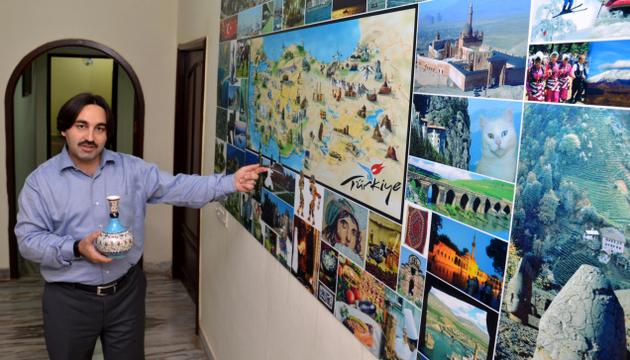
Indialogue Foundation director Osman Kayaoglu talks about the places to see in Turkey as he holds a traditional Turkish vase. / Photo: Nagara Gopal / The Hindu
As the Turkish Consulate gets ready to set up office in Hyderabad, Neeraja Murthy finds a Turkey-Hyderabad connect
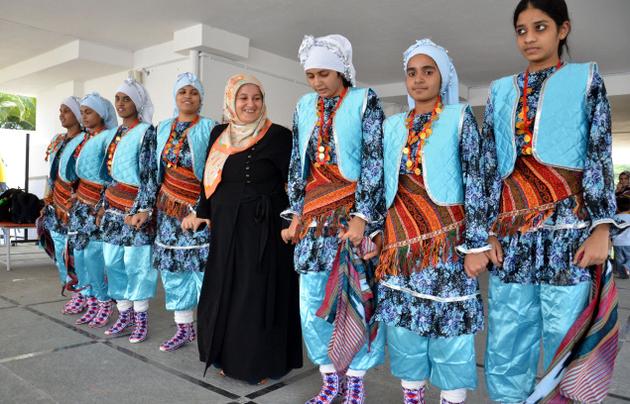
Enter the first floor of Learnium School on Road No. 44, Jubilee Hills and you’ll find a slice of Turkey in Hyderabad. On the walls is a Turkish Corner that displays photographs of ‘Turk folklor’, a Turkish bride, ‘Turk Lokumu’ among other things. Move around and there is a Indo-Turk Corner and photographs of famous Turkish palaces. As we soak in the pictures, we hear the booming voice of Sevim Kayaogolu calling out “Bir, iki, uch, dort… “(one, two, three four… in Turkish). She is teaching a Turkish dance to a group of young girls who are dancing to the beats of Yeni bir dunya, dressed in their traditional Turkish dresses.
Sevim (in the centre) joins a group of girls dancing to the tune of Turkish song ‘Yeni bir dunya’./ Photo: Nagara Gopal / The Hindu
“The students are presenting this Turkish dance for the Parents Day meeting,” informs Sevim. The school (will be called Iqbalia International School) run by a Trust (which also includes Turkish people) teaches Turkish language art, dance and culture to its students, in addition to its regular CBSE syllabus. Osman Kayaogolu, director of Indialogue Foundation’s second year in Hyderabad, calls the city ‘historical’. “Among the different cities in India, Hyderabad has a beautiful history,” he says and adds, “Turkey and Hyderabad share a lot in common in culture. We have given our daughters here in marriage – Princess Durru Shehvar who married Azam Jah, Princesses Esin and Esra have also come to Hyderabad after marriage.”
Osman talks about the ‘royal’ similarity between the two regions. “The Chowmahalla Palace looks like a replica of Dolmabahche palace, only the former is smaller. It is said that the Chowmahalla was built for Durru Shehvar so that she would feel at home in a place that reminds her of Turkey,” he smiles.
Indialogue Foundation, the Turkish cultural centre acts as a hub for the 15 Turkish families living in Hyderabad. “We get together here during religious ceremonies like Eid and we organise inter-faith seminars, talks, conferences and cultural programmes. We arrange business meetings between Turkish and Indian businessmen and also organise Turkish celebrations.”
Osman says the Turks enjoy their stay in the city. “The climate is nice and we enjoy eating biryani which is like our not-so-spicy Osmani pulao. We have made many friends here and people are affectionate too.”
What baffles Osman however is the way friendly Hyderabadis behave while driving on roads. “During busy traffic, they are not at all friendly and act differently,” he says with a smile. The Turkish women volunteers try to spread their art and culture in the city. Osman and his group of friends also play football every Sunday. “We don’t know about cricket, but now our children are picking up the game in Hyderabad.”
There is also good news for the Turkish families in the city with the Turkish Consulate coming up here. “The Turkish Consulate General Murat Omeroglu is in Hyderabad with his family and the work to establish the Consulate has begun. The process might take six months,” says Osman.
Osman says Turkish people in the city do miss their family and friends back home as well as Turkish food; but they have found a home away from home here.
“Hyderabad is our second home. Merhaba Hydarabad (Salaam Hyderabad),” he signs off.
Short film contest
Indialogue Foundation and Sarojini Naidu School of Arts and Communication, University of Hyderabad had organised a Indialogue Short Film Contest 2013on the theme ‘Peaceful Coexistence” which aimed to foster universally shared values among public .
The contest had two categories – YouTube award and Jury award. Emrah Alpaslan from Saritha Vidya Niketan with his short film titled Dedicated Life won the YouTube award with 2100+ views. Jhilam Chattaraj, from University of Hyderabad with her movie In Search of History was selected for the Jury award.
Both the awards carried a prize money of Rs. 35,000 each.
source: http://www.thehindu.com / The Hindu / Home> Features> MetroPlus / by Neeraja Murthy / November 19th, 2013