Category Archives: Business & Economy

Workshop on Women Entrepreneurship

Vijayawada :

Kakaraparti Bhavanarayana college is going to organise a two-day international workshop on ‘Women entrepreneurship- A global perspective’ from Aug 6 to 7.

Speaking to the reporters at the college here Saturday, KBN president Uppala Sambhasiva Rao said that Irrigation minister Devineni Umamaheswara Rao and Krishna university vice chancellor V Venkaiah would be the chief guest and  guest of honor respectively at the inauguration.

Secretary and correspondent S Razith Kumar said that industrialists and educationalists across the world are going to attend the workshop to discuss about women entrepreneurship in various fields.

“In association with University grants commission (UGC) and Krishna University, the department of commerce and management is organising this workshop as part of 50 years celebrations of the college,” he added.  Principal P Krishna Murthy, vice principal V Narayana Raoand others were present.

source: http://www.newindianexpress.com / The New Indian Express / Home> States> Andhra Pradeh / by  Express News Service / August 03rd, 2014

Vijayawada firms dominate cylinder liner market

Apart from being dominant players in the domestic market, Liners India Limited and Kusalava International Limited (KIL) supply products to international automobile manufacturers

Despite various industries leaving no stone unturned to tap the potential of Vijayawada to the fullest, by taming the ‘bottlenecks’, two metal casting companies here have made their presence felt in the global arena.

Liners India Limited (LIL) and Kusalava International Limited (KIL) have emerged as two dominant players in the domestic market for cylinder liners (cylindrical parts in engine blocks containing pistons and rings) used in truck and tractor engines, besides being sole suppliers of the products to some leading international automobile manufacturers.

Their combined share of cylinder liner market in India is between 70 and 80 per cent and they are poised to grow bigger in coming years.

Advanced technology

The LIL is doing well in meeting the worldwide requirement of cylinder liners (or sleeves) used in Euro-II engines of the John Deere and is a major supplier to the manufacturers of the Royal Enfield and Triumph motorcycles. The company is now bracing up to manufacture cylinder liners compatible with the Euro-III emission norms and those made up of Bainite (strongest form of composite steel).

Speaking to The Hindu, LIL Chairman & Managing Director S. Ganesh narrated how he had set up the industry in 1974 and developed it into a global player. The company in its formative years used to manufacture 36,000 liners a year and it has now become a medium-scale industry making 25 lakh pieces a year. “It has become possible due to adoption of latest technologies and the hard-work of its skilled manpower,” he says, adding that the LIL would have been a much larger entity, had it not faced the perennial problem of power shortage, which affected production by crippling the function of electric furnaces.

Mr. Ganesh said that the city would become an automobile component manufacturing hub, provided the Industries and other departments concerned gave faster clearances and played facilitative role.

source: http://www.thehindu.com / The Hindu / Home> News> Cities> Vijayawada / by V. Raghavendra / Vijayawada – August 01st, 2014

Memorable journey back in time

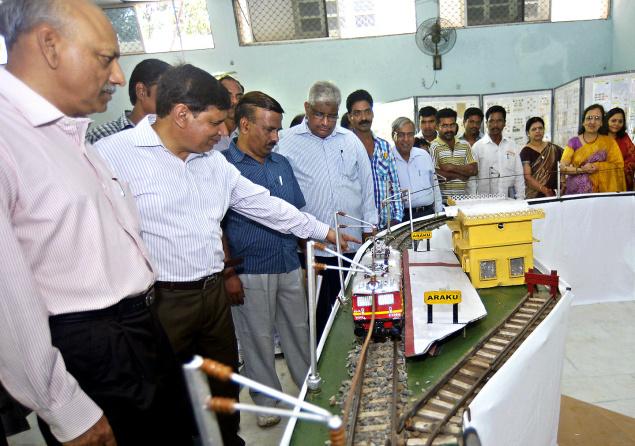
ECoR General Manager Rajiv Vishnoi along with DRM Anil Kumar admiring the working model of the Araku train, at the photo exhibition that began in Visakhapatnam on Friday. - Photo: K.R. Deepak / The Hindu
ECoR General Manager Rajiv Vishnoi along with DRM Anil Kumar admiring the working model of the Araku train, at the photo exhibition that began in Visakhapatnam on Friday. – Photo: K.R. Deepak / The Hindu

Good response to railway photo exhibition. The working model of a diesel locomotive going on Araku line and the model of a locomotive by egg shell artiste K. Durga Shankar were a big draw at the exhibition. A model of a bio-toilet was also put up at the event.

A photo exhibition of rare pictures, being organised by the Ministry of Railways to commemorate completion of 161 glorious years of Indian Railways, was inaugurated by General Manager of East Coast Railway Rajiv Vishnoi at Sri Srinivasa Kalyana Mandapam on the Station Road here on Friday.

The rare photographs of early steam locomotives, old coaches, Mahatma Gandhi, and other leaders in trains, and a wagon carrying a helicopter are sure to bring back nostalgic memories of who had seen them during their childhood.

The working model of a diesel locomotive going on Araku line and the model of a locomotive by egg shell artiste K. Durga Shankar were a big draw at the exhibition. A model of a bio-toilet was also put up at the event.

Children from various schools evinced keen interest in the photographs as they went round the exhibition.

Divisional Railway Manager Anil Kumar and Senior Divisional Commercial Manager M. Yelvender Yadav were among those who accompanied the General Manager.

The exhibition, which is open to all, will be on till August 4. It will be open from 10 a.m. to 6 p.m. on all days.

source: http://www.thehindu.com / The Hindu / Home> News> Cities> Visakhapatnam / B. Madhu Gopal / Visakhapatnam – August 01st, 2014

Naidu showers boons on Anantapur

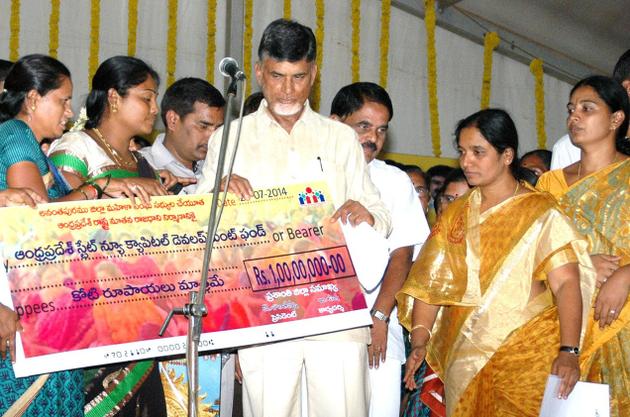
DWCRA women handing a cheque for Rs. 1 crore to Chief Minister N.Chandrababu Naidu for development of Andhra pradesh, at Puttaparthy in Anantapur district on Thursday. PHOTO: R.V.S. PRASAD / The Hindu

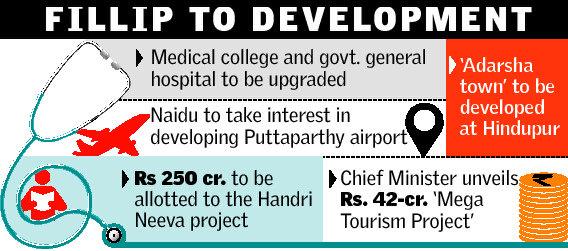
Chief Minister Nara Chandrababu Naidu on Thursday promised upgradation of the existing medical college and government general hospital at Anantapur into a super speciality hospital at a cost of Rs. 150 crore, with Central assistance.

Mr Naidu, who arrived at Puttaparthy airport in a private aircraft at around 10:30 a.m., one and a half hours behind schedule, drove straight to Prasanthi Nilayam to pay his respects at the ‘ Maha Samadhi’ of Sathya Sai Baba, following which he held a meeting with the trust members of the Sathya Sai Central Trust.

Later, an interactive meeting with the self-help group (SHG) women, he said the government had kept its promise to waive their loans.

“In the next five years, the drought prone Anantapur district, which has given us the maximum seats after West Godavari, would be developed in such a way that drought and poverty would fear to set foot in the district,” said Mr Naidu even as SHG women, on behalf of all the SHG’s in the district, handed him over a cheque for Rs 1 crore towards the building of ‘Navyandhra Pradesh’.

DevelopmentANDHRA31jul2014

Speaking on the occasion, Mr Naidu said he would take special interest on development of the district and said an ‘Adarsha township’ would be created out of Hindupur while Rs 250 crore would be allotted to the Ananta Venkata Reddy Handri Neeva Sujala Sravanthi (AVRHNSS) project forthwith.

Mr Naidu also promised to take special interest in upgrading the existing airport at Puttaparthy and increase the connectivity with Bangalore to turn Puttaparthy into a famous pilgrim town in the next few years.

On the occasion, he also unveiled a Rs 42-crore ‘Mega Tourism Project’ to develop tourism infrastructure at 30 tourist places in the district which include forts, temples and a bird sanctuary, besides increasing the connectivity between these places of tourist interest.

However, throughout the tour of Mr Naidu, accompanied by all the TDP legislators and the two MPs from the district, the actual interaction of Mr Naidu was limited to a few children at the Vengalamma Cheruvu while the actual proposed interactive session with women at Puttaparthy turned out to be a session dominated by the speech of Mr Naidu himself..

source: http://www.thehindu.com / The Hindu / Home> News> National> Andhra Pradesh / Staff Reporter / Anantapur – July 24th, 2014

Cotton Corporation to set up ginning mill in Seemandhra

CCI plans to acquire 7.17 hectares of barren land of NTC on lease for which a formal proposal has already been submitted to BIFR

CottonANDHRA31jul2014

The public sector the Cotton Corporation of India (CCI), which carries out market intervention activities to support cotton farmers, has signed a memorandum of understanding (MoU) National Textile Corporation (NTC) to set up a ginning cum pressing (GNP) mill in Seemandhra, the newly formed Talangana state.

CCI plans to acquire 7.17 hectares (ha) of barren land of NTC on lease for which a formal proposal has already been submitted to the Bureau of Indian Financial Reconstruction (BIFR), being the land a part of NTC’s closed unit.

“We procure around 100,000 tonnes of cotton in this area out of its total production of around 400,000 tonnes. Hence, cotton would adequatly be supplied to our forward integration unit. Initially, we are looking at 60,000 tonnes of pressing and ginning capacity of this plant,” said B K Mishra, chairman cum managing director of CCI.

Apart from that, the company plans to set up a warehouse to store cotton with 100,000 tonnes of storage capacity.

The company has earmarked investment of Rs 20 crore for these projects from its current networth of Rs 250 crore.

CCI is looking to set up this plant initially on pilot basis which, on being successful, will be expanded for commercial basis and other neighbouring states also provided the state government allocates free land.

The company which also executes commercial cotton trade, has urged the government seeking expansion in procurement area including jute and other agricultural commodities similar to Nafed.

CCI procured 441,000 tonnes of cotton so far this year of which around 90 per cent was for commercial operation. The remaining 10 per cent to the tune of 40,000 tonne of cotton was procured under market intervention scheme.

“We get an opportunity to procure huge quantity of cotton at the minimum support price (MSP) once in four years. In the remaining period, therefore, we execute commercial cotton procurement. Forward integration would certainly help us taste the market and set a benchmark for yarn and fabric industry in India,” said Mishra.

source: http://www.business-standard.com / Business Standard / Home> Company> News / by BS Reporter / Mumbai – July 24th, 2014

West Godavari Set to Become Tourist Spot

Narsapur :

West Godavari district administration has been taking measures to make the district a tourist destination by developing the tourist spots in the district.

As part of it, a proposal with Rs 3 crore estimate was sent to the government to develop Perupalem beach. After getting the government’s approval, the development works will commence. Tourism information centre and guest houses will also be arranged for the tourists. Collector Katamaneni Bhaskar inspected the beach along with officials of the tourism and other departments. Later, the collector said necessary land was identified near Biyyaputippa village for the proposed fishing harbour. Officials were directed to prepare a project report in this regard.

Measures were taken to combat drinking water problem in the district and also medical and health department officials were directed to take preventive steps against spread of diseases during the monsoon.

source: http://www.newindianexpress.com / The New Indian Express / Home> States> Andhra Pradesh / by Express News Service / July 21st, 2014

After 40 years, Master Plan for Kakinada being readied

Hyderabad-based R.V. Consultants will draw the plan, keeping population projection in the next 20 years

After a gap of nearly 40 years, a Master Plan is being prepared for Kakinada city. The Kakinada Municipal Corporation has appointed Hyderabad-based R.V. Consultants for the job.

Keeping in view the rising population and requirements of the city in the next 20 years, the firm is preparing the plan. A power-point presentation on the draft plan was held during a meeting held in the municipal corporation office here on Wednesday.

Speaking on the occasion, East Godavari Collector and Special Officer of the corporation Neetu Prasad said that Kakinada was emerging as the eight biggest city next to Visakhapatnam in the coastal region. She said that opinions from various quarters would be taken into consideration while finalising the plan. At present, the city’s population was 3.2 lakh and it was expected to cross 10 lakh in the next 20 years, the Collector informed.

Rapid industrialisation

“The city will witness rapid industrialisation in the wake of the PCPIR project. Since the Union Government announced the port’s development this budget, it will boost the industrial growth along the coast further,” she said.

Municipal Commissioner S. Govinda Swamy said that the first master plan for the city was chalked out in 1975. “The plan will focus on improving amenities for the increased population. Infrastructure like roads and bridges will find a special mention in the plan,” he said.

Deputy Superintendent of Police R. Vijay Bhaskar Reddy highlighted the need for a special focus on city’s traffic and importance had to be given to widening of roads, developing traffic islands and arranging zebra crossings. Officials of various departments were also present.

source: http://www.thehindu.com / The Hindu / Home> News> National> Andhra Pradesh / by  K. N. Murali Sankar / Kakinada – July 16th, 2014

A power couple whom AP looks up to

Taking up big responsibilities around the same time, these two have become the new power couple in the country. If Nirmala Sitharaman, the wife, is busy running the country in her capacity as union minister of state for commerce and industry, Parakala Prabhakar, her husband, has been entrusted the responsibility of furthering the development of Andhra Pradesh in his latest avatar as communications advisor to chief minister Chandrababu Naidu.

It was a meeting of the minds when the two encountered each other in Jawaharlal Nehru University in the early eighties. A Tamil Iyengar Brahmin from Trichirapalli, Nirmala is the daughter of Narayanan Sitaraman, a railway employee, and Savitri. She graduated in economics from Seethalakshmi Ramaswami college in Trichi before she headed to JNU to do her master’s and doctorate in economics. Parakala, a Telugu Brahmin from Narsapur in coastal Andhra, is the son of Seshavataram, a veteran communist who later gravitated to the Congress and served as a five time minister in AP. Parakala could not pursue politics successfully in the footsteps of his father and joined JNU to study economics.

As members of Freethinkers, a JNU forum that discussed right-wing and left-wing politics among many things, the two got close and ended up getting married. They then left for London where Parakala Nirmala went on to do his PhD from the London School of Economics, while Nirmala worked for some time as sales woman in a decor shop and later as a researcher on East-European economies for Price Waterhouse Cooper.

The early nineties saw them return to Hyderabad and Narsapur after the birth of their daughter, the only child. Parakala set up a marketing research agency in Hyderabad, a trust in memory of his father, and along with Nirmala, started a school Pranava.

Parakala contested unsuccessfully from Narsapur on the Congress ticket in 1994 but went on to develop close ties with former Prime Minister P V Narasimha Rao. From the Congress, Parakala joined the BJP and finally, in 2008, went on to became a founding member of the Prajarajyam party along with actor-turned politician Chiranjeevi, before leaving in disillusionment.

Chandrababu Naidu is believed to have invited Parakala to join the TDP and after the party’s victory, he joined the government as its communications advisor.

Nirmala was nominated to the National Commission for Women during the NDA regime under Atal Behari Vajpayee, but her term ended abruptly when the UPA took over in Delhi. She returned to Hyderabad to start a policy research centre and then a school for the underprivileged in a village. In between, she got involved with the Swadeshi Jagran Manch.

Nirmala finally joined the BJP in 2006.

Andhra Pradesh and Naidu are expecting a lot from this power couple. While Niramala’s help is needed to get investments and SEZs in Andhra Pradesh, Parakala has to play a key role in shaping Naidu’s developmental politics at a critical juncture. It is in the expectation that Nirmala will do something for AP that Naidu went out of his way to offer the Rajya Sabha seat from Andhra Pradesh to her. As for Parakala, sources said he has been given the responsibility of defending the party’s policies on various forum as the TDP has limited speakers who can effectively communicate in both English and Hindi also.

At least for the next five years both at the centre and in Andhra Pradesh, all eyes will be on this power couple who could play a key role in the growth of the country and state of AP.

source: http://www.timesofindia.indiatimes.com / The Times of India / Home> City> Hyderabad / TNN / July 21st, 2014

Yanadis sensitised on crab fattening technology

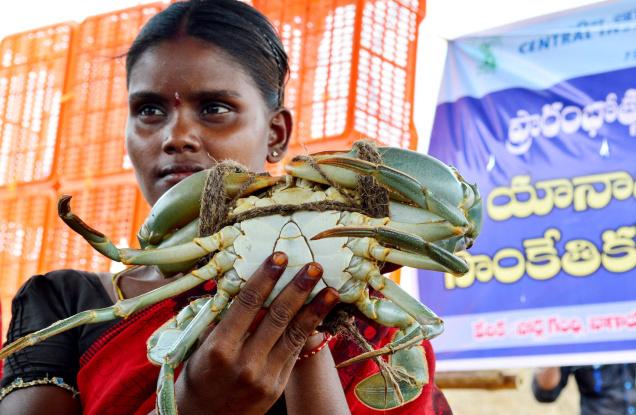
A Yanadi tribal woman displays a mangroove crab during a demonstration on crab fattening technology organised by the Central Institute of Brakishwater Aquaculture at Sorlagondi in Krishna district. - Photo: T. APPALA NAIDU
A Yanadi tribal woman displays a mangroove crab during a demonstration on crab fattening technology organised by the Central Institute of Brakishwater Aquaculture at Sorlagondi in Krishna district. – Photo: T. APPALA NAIDU

Under the ST sub-plan, the CIBA takes up a pilot project to provide technology support to tribal families in Sorlagondi

A team of scientists of the Central Institute of Brakishwater Aquaculture (CIBA), Chennai, on Saturday introduced the ‘crab fattening technology’ through floating cages to the Yanadi tribal families to help the latter grow Mangrove Crab (Sylla serrata) in Sorlagondi Reserve Forest area in Krishna District.

As a part of the ST Sub-Plan, the CIBA has taken up a pilot project to provide the technology support to the selected ten Yanadi tribal families in Sorlagondi village. The project will be expand it to the other eligible beneficiaries in the State, later. As a part of the programme, scientists– K. Ambasankar, J. Syam Dayal, C.P. Balasubramanyam and M. Kailasan–demonstrated the use of cages to Yanadi tribal families who are engaged in hunting of the crab in the estuary. The scientists also provided them 1,000 seed of Asian Seabass that would be cultivated in the ponds in the tribal area.

“Crab fattening technology helps the hunters raise young and soft crabs until they grow to a certain hardness at which it would fetch remunerative price in the market. However, barely two to three weeks are required for a soft crab to become hard one,” Mr. Bala Subrahmanyam told The Hindu.

According to experts, crab is being sold at Rs. 1,200 a kg in the India’s biggest crab market Chindradripet in Chennai. From Chennai, it is being exported to South East Asian countries. “The CIBA aims at promising better livelihood option to tribal families by moulding them into entrepreneurs,” said the scientists.

New technology

Yanadi tribal families of Sorlagondi Reserve Forest hunt mangrove crab in estuary, backwaters and brackish water, largely in mangrove forests. They completely rely on local market in Nagayalanka. The CIBA scientists also began a detailed study on the catch of the crab in a bid to estimate its population roughly before introducing next stages of technology in crab fattening.

source: http://www.thehindu.com / The Hindu / Home> News> Cities> Vijayawada / by T. Appala Naidu / Sorlagondi (Krishna) – July 21st, 2014

Cage fish farming at sea catching up in coastal AP

Visakhapatnam :

At a time when fish stocks are declining globally due to various factors like climatic change and pollution, cage farming of fish on sea, an aquaculture technique, has thrown up an encouraging alternative that yields 10 times the fish catch as compared to fish reared in ponds or wild harvest in the sea.

This technique has also been taken up to great success in Vizag and other coastal districts of AP on an experimental basis by scientists of the Visakhapatnam Regional Centre of the Central Marine Fisheries Research Institute (CMFRI).

In Krishna district (Nagailanka) and Narsapuram (West Godavari), cage farming has been taken up in collaboration with fishermen, while in Vizag the cages in the sea along RK Beach are controlled by the CMFRI. There are six cages in Krishna, 10 in West Godavari and eight in Vizag district of AP. Plans are afoot to double the number of cages in Vizag soon given the good prospects, said CMFRI scientists.

Though open sea cage culture technology is a relatively recent activity in India, it is prevalent in other Asian countries. While lobster, Asian seabass, mullets, Cobia and Pearl Spot have been successfully harvested by CMFRI in various coastal waters in India, at present the Vizag centre of CMFRI is maintaining brood stocks of Orange Spotted Grouper, Indian Pompano, Snappers and Golden Trevally in cages that have all shown good growth and maturation, said scientists.

Under this procedure, fish rearing is done in an enclosed area in a natural aquatic environment where the water continuously flows and debris doesn’t accumulate, which is why there is no pollution or ammonia deposition as in the case of stagnant and low density water ponds. The young ones of fish and other aquatic species are kept, fed and grown to marketable size in these cages, which are of six metre diameter and made of high density polyethylene.

“Cage farming is in an infancy stage now, but the prospects for commercial exploitation are so good that we are planning to double the number of cages soon as well as expand to other neighbouring areas. At the end of the culture period, which ranges from six to eight months, three to five tonnes of fish are produced just from one cage,” said Subhadeep Ghosh, senior scientist and scientist-in-charge at CMFRI.

The biggest advantage of cage farming, according to Prof K Sujatha, chairperson, board of studies, department of marine living resources at AU, is that despite being a fish culture technique there is no need to change the waters as sea water continuously flows through the cages, there is some natural food easily available for the fish to feed on and there’s no need to put up any time or space-consuming infrastructure except the cages.

However, she pointed out that not all areas are suitable for cage farming. “There needs to be optimum depth of at least 10 metres from the shore, the sea should be more or less calm without high waves and currents where the cages are located. The salinity, pH, ammonia, nitrate should be all within permissible limits,” she explained.

source: http://www.timesofindia.indiatimes.com / The Times of India / Home> City> Visakhapatnam / TNN / July 17th, 2014