Category Archives: Business & Economy

Get ready for a taste of Vizag apples!

Forget apples from Jammu & Kashmir and Himachal Pradesh, soon apples from Visakhapatnam district could give them a run for their money. Hilly areas of the district are emerging as a fertile ground for cultivation of apples, which have hitherto been restricted to orchards in the chilly climes of J&K, Uttarakhand, HP and Arunachal Pradesh.

The first seeds of apple cultivation were sown by chance by Bobbili Rambabu, a tribal from the Visakhapatnam Agency area, four years ago when he tossed a few apple seeds in the backyard of his house at Lambasingi, where temperatures are known to dip below 0 degree Celsius during winter. The trees have now borne fruit, alerting researchers to the possibility of growing this delicious fruit in Visakha Agency.

Dr. N Venugopala Rao, assistant director, Regional Agriculture Research Station (RARS) at Chintapalli, said apples generally grow in the Himalayan belt because of cold temperatures, which is why places such as Lambasingi in Chintapalli mandal are also ideal for apple cultivation. He said a team of scientists from the Hyderabad-based Centre for Cellular and Molecular Biology (CCMB) visited Lambasingi in December last year to study the feasibility of growing apples. As part of the study, they planted 100 apple saplings, shipped in from the Himalayas, over nearly one acre on the RARS premises.

Another RARS scientist, Dr. B Uma Maheswara Rao, said select varieties of apples from Shimla have been planted on an experimental basis. “While the apple trees planted by tribal Rambabu have already yielded positive results, the plants cultivated at RARS are just 10 months old. We will start studying the potential when they reach three years of age,” Rao said.

According to him, mandals like Chintapalli, Pedabayalu, G Madugula and even the tourist hotspot of Araku are suitable for apple cultivation as they are all located at high altitudes and the temperature is always below 15 degree Celsius. “After studying the apples growing on Rambabu’s tree, we feel that Vizag is suitable for apple plantation. Tribal pockets that are already cultivating coffee and pepper are viable for apple trees too because of the favourable climatic conditions. At present, coffee is being cultivated in nearly 1.5 lakh acres in the tribal pockets. If the state government pays special attention, Vizag can emerge as a fertile ground for cultivating unique commercial crops like apples,” Rao added.

A horticulture department officer, who refused to be named, said if apple cultivation takes off in a big way in the district, they might think of including apples in the list of local crops, which also includes the globally renowned Araku coffee.

While G Prabhakara Rao, assistant director (horticulture), said the department would put its weight behind the endeavour once the RARS scientists issue a no-objection certificate for apple cultivation in the district, R Lakshmanudu, joint director, agriculture marketing, said they would provide marketing support for Vizag apples.

Meanwhile, tribal farmer Biddika Kamsu said that instead of proposing projects like the Tribal University for the Agency area, the government should focus on allocating funds for growing unique plants. “Visakha Agency is one of the biggest agencies in the state and is most viable for plants like pepper, coffee, pineapple, strawberry, turmeric, rajma, broccoli, ginger and carrot,” Kamsu said.

Apples in your backyard

* Apple cultivation started by chance by Bobbili Rambabu, a tribal farmer from Lambasingi in Chintapalli mandal of Vizag Agency area, four years ago when he tossed apple seeds in his backyard. The trees have now borne fruit

* Scientists from CCMB visited Lambasingi in December last year to study the feasibility of growing apples. They planted 100 saplings shipped in from the Himalayas

* Officials say mandals like Chintapalli, Pedabayalu, G Madugula and even Araku are suitable for apple cultivation as they are all located at high altitudes, with temperature always below 15 degree Celsius

source: http://www.timesofindia.indiatimes.com / The Times of India / Home> City> Hyderabad / TNN / October 09th, 2014

New Kakinada Co-op Bank Branch

Visakhapatnam  : 

Since its inception in 1980, the Kakinada Co-operative Town Bank Limited has been making profits, and deposits crossed `351.94 crore by September-end, said Ch Raveendra, chairman of the bank.

Visakha Dairy chairman Adari Tulasi Rao and Daspalla Hotels Group managing director M Raghavendra Rao inaugurated the bank’s second branch at Gajuwaka here Thursday. The bank chairman told the gathering that the total advances of the bank had reached `232.82 crore.

The bank registered a net profit of `3.01 crore in the first half of the current fiscal. On the bank’s net NPA, Raveendra said that it was 1.03 per cent. The bank plans to open four more branches – two in Visakhapatnam, one in Guntur and another in Vijayawada, he added.

source: http://www.newindianexpress.com / The New Indian Express / Home> States> Andhra Pradesh / by Express News Service / October 10th, 2014

Kadapa airport to be thrown open on Oct. 14

The long-abandoned air strip in Kadapa that has been given a facelift and developed into an airport will be brought into operation in a week.

Arrangements are being made for the inauguration of Kadapa airport by Chief Minister N. Chandrababu Naidu on October 14. Union Minister for Civil Aviation P. Ashok Gajapathi Raju will take part in the inauguration.

History

Kadapa aerodrome was constructed in 1953 on a 229-acre site. Vayudoot operated services from Kadapa to Hyderabad in the 1980s. The aerodrome built on a 229-acre stretch was subsequently used by Chief Ministers for making transit halt of the Government helicopters and for refuelling.

About 15 light and microlight aircraft and helicopters landed in Kadapa aerodrome and took off in Air Race India Show organised by Aeronautical Society of India in 2003, as a prelude to the first centenary of aviation history created on December 17, 1903, when the Wright Brothers flew the first-ever powered flight. It was an enthralling experience for the massive audience to watch light and microlight aircraft and helicopters land and take off over a three-hour period, 11 years ago.

The YSR government had entered into a MoU in March 2007 for developing the aerodrome into an airport and allocated an additional 440 acres, located about 10 km from Kadapa town.

In accordance with the MoU, the government had offered to supply drinking water and power free of cost for five years.

It also granted property tax exemption for land used for the airport, navigation and related purposes and the airport staff colony, besides granting exemption from Kadapa Municipal Corporation taxes.

Under the Build, Operate and Transfer (BOT) basis, a new two km. Runway was completed at a cost of Rs. 21 crore.

In addition, a 11-km long compound wall was constructed with an outlay of Rs. 24 crore. In the second phase, an Air Traffic Control (ATC) building, passenger terminal, parking bays and internal roads were built at a cost of Rs. 13 crore.

Officials are holding discussions with some air travel agencies such as Spice Jet.

source: http://www.thehindu.com / The Hindu / Home> News> National> Andhra Pradesh / by M. V. Subrahmanyam / Kadapa – October 07th, 2014

Visakhapatnam jailbirds to cultivate medicinal plants for Himalaya Drug Co

Visakhapatnam :

In a bid to give prisoners a second chance to rebuild their lives and enter mainstream society after release, the Andhra Pradesh prisons department on Tuesday inked a memorandum of understanding (MoU) with The Himalaya Drug Company for cultivation of medicinal plants in the Visakhapatnam Central Prison.

Under the PPP programme, the government would provide land and labour (prisoners) for cultivation of medicinal plants in the prison premises, while the training and rehabilitation measures for enhancing skill development among inmates and monthly stipend would be provided by the drug company.

The MoU addendum was signed by B Sunil Kumar, inspector general of prisons, the AP government and Dr VU Babu, head of phytochemistry, research and development, The Himalaya Drug Company.

As per the provisions of the MoU, the drug company along with jail authorities would impart training to prisoners for cultivating medicinal plants for Himalaya’s consumption at the Visakhapatnam semi-open Central prison. Inmates would be earning a regular monthly income and acquiring essential skills in the process.

Besides training, the drug company would also supply seeds and provide technical assistance. The government would provide infrastructure, land, irrigation facilities, electricity supply and farming implements.

Speaking on the occasion, B Sunil Kumar, IG (prisons), AP, said, “The main benefit of such collaborative projects is that the prisoners can be kept engaged and get a second chance to rebuild their social lives. They would be equipped with basic skills that open up avenues for employment after they have served their sentences. In the process, the burden on the government exchequer would also come down.”

“Already, projects such as dairy unit, and petrol bunks exist in some of the central and district prisons. A telephony system would be set up in the district and sub jails from January 2015,” added the IG.

At the Vizag Central prison, which houses 930 prisoners at present, cultivation of two species, including the bitter herb Kalmegh (Andrographis paniculata) and drumstick (Moringa oleifera), would be focused upon for the time being as the prevalent climatic conditions and soil are suited to their cultivation. “The work would be taken up just after Dasara initially on three to four acres, which would be extended gradually,” said Vizag jail superintendent Dr I Srinivasa Rao.

“Earlier too, we received a very good response from our prison farm in Anantapur and the concept has now been extended to Vizag Central Prison, which would help rehabilitate prisoners and provide sustainable livelihoods. In the future we would be looking at expansion of such programmes to other parts of the state and country for a more holistic growth.

In Anantapur open prison, alfalfa is cultivated. If farmers follow the protocol while cultivation, we would provide 100% buyback guarantee as well as employment opportunities,” said Dr Babu of Himalaya Drug Company.

source: http://www.timesofindia.indiatimes.com / The Times of India / Home> City> Visakhapatnam / TNN / September 24th, 2014

Google partners with AP to develop Telugu internet

IT Secretary Sanjay Jaju signing MoU with Google India Vice President & MD Rajan Anandan to promote digital literacy and develop Telugu internet as Chief Minister N. Chandrababu Naidu watches at the CEOs' conclave in Visakhapatnam on Monday. Photo: Arranged photo
IT Secretary Sanjay Jaju signing MoU with Google India Vice President & MD Rajan Anandan to promote digital literacy and develop Telugu internet as Chief Minister N. Chandrababu Naidu watches at the CEOs’ conclave in Visakhapatnam on Monday. Photo: Arranged photo

The Andhra Pradesh Government signed a historic MoU with Google here at CEOs’ conclave on Monday to develop Telugu internet and launch a series of initiatives to transform the State into digital AP in a record time.

Complimenting Google for its association, Chief Minister N. Chandrababu Naidu said digitalisation and internet literacy should be achieved in tune with the speed with which Google functions.

Google India Vice-President and Managing Director Rajan Anandan and Principal Secretary, IT Sanjay Jaju signed the agreement in the presence of Mr. Naidu, Deputy Chief Minister China Rajappa, Ministers Palle Raghunatha Reddy, Ganta Srinivasa Rao, Ch. Ayyanna Patrudu and P. Sujatha.

“We want to become first State to embrace Prime Minister Narendra Modi’s vision of Digital India and set an example to other States to follow. I will personally monitor the progress,” Mr. Naidu said.

Google, a top web property specialising innovative search technologies, which was launched by Stanford PhD students Larry Page and Sergey Brin in 1998, will also connect all women self-help groups through the internet in three years.

The initiatives will include developing Telugu font, keyboards, content and increasing access to government websites and scaling the local language web to throw window of opportunities for entrepreneurship.

As per the MoU, Google will help government make their websites mobile-ready and accessible in Telugu, promote internet safety among children and government officials, improve and get more local language content online and promote digital literacy among women and help small and medium business to gain from the internet economy.

source: http://www.thehindu.com / The Hindu / Home> News> Vijayawada / Santosh Patnaik / Visakhapatnam – September 29th, 2014

Lion-headed legacy

TOUCH OF CLASS:Artisans at work at the Craft Development Centre in Gollapalli.Photo: K.R. Deepak / The Hindu

As the sombre strains of the Bobbili veena fade into the sunset, Sumit Bhattacharjee takes a look at the indigenous instrument’s storied history and sad present.

Pedda Rayudu, the 15th descendant of the Rajah of Venkatgiri and the founder of the town and the kingdom of Bobbili, was a connoisseur of the arts. The royal instrument was the veena and it was the men of Bobbili who played the instrument in court. The veenas, then, were imported from Thanjavur. They were, in other words, Thanjavur veenas.

The Bobbili veena came much later, during the 19th century, and its birth is believed to hark back to a concert at the royal court, after which the king showered compliments on his highly regarded master craftsman Sarvasidhi Achanna, saying that he had the ability to create anything. This prompted a challenge from Ch. Musanana, a maker of veenas from the Vizianagaram kingdom. Would Achanna be able to craft a veena? Within two months, Achanna responded with an instrument that came to be known as the Bobbili veena.

The story now shifts to the present day, to the Sarvasidhi family in Gollapalli village, near Bobbili in Andhra Pradesh. Forty families, all from the Sarvasidhi clan, make a living by manufacturing the musical instrument. Sarvasidhi Achutanarayana, the great grandson of Achanna, says, “There is no formal training involved. The children get drawn towards it, as they grow up watching the elders carve and create the masterpieces. As in the guru-sishya tradition, each child is put under the tutelage of one senior member. The induction normally happens when they are five years old. They pick up the art by making small wooden toys, initially. There is no compulsion or restrictions. Even girls learn the art.” This is how it has been for seven generations.

Bobbili veenas are made from jackfruit wood, and a full-size veena stands out from the ones made at Thanjavur, Mysore, Kerala or Nuzvid because of the lion’s head carved at one end. The frets of Bobbili veenas are made of bell metal, while other veenas use brass. Earlier, the Bobbili veenas were known as “ekanda veena”, as they were made or carved out of one single piece of wood. But due to the paucity of good jackfruit wood, the veenas now have two joints. The other veenas have two or more joints.

Veena exponent Jayanthi Kumaresh says, “Bobbili veena is known for its quality of wood. Other veenas like the ones manufactured in Mysore are made of rose wood. I buy veenas from a maker in Bangalore who owns a jackfruit farm.”

Jackfruit wood

Achutanarayana agrees that wood is the most important ingredient. “The wood has to come from a jackfruit tree which is at least 20 years old. It should be seasoned and it should have the required kind of grain to suit the manufacturing.” For the Sarvasidhi family, procuring good jackfruit wood has become a problem and the government does not encourage jackfruit farming. “That’s the reason why we have stopped manufacturing the Ekanda veena.”

The Bobbili veena also stands out from other veenas because it is smaller in size. Jayanthi says, “The casing is much thinner compared to the others and the sound is shriller and more aristocratic. The treble is more in Bobbili veenas when compared to the others, where the bass is more. But now, many professionals tend to customise their instruments. They pick up the best from each variety and tailor-make veenas to suit their need.”

It was Chitti Babu Challapally and Dr. Emani Sankara Sastry from Andhra who gave the Bobbili veena international recognition. Jayanthi says, “The Andhra style of playing on Bobbili veena is considered attractive. The technique is different and the speed is more.”

Declining fortunes

Achutanarayana echoes the strain of concern found in older practitioners of other arts and crafts, who fear that their traditions might vanish. “The present generation is not very keen on taking up the craft. They are well educated and they intend to take up jobs in cities. Unless the government finds a way to make the trade lucrative, it will be difficult to hold them back,” says Achutanarayana.

The trade has never been lucrative. To keep the home fires burning and to save the art from sinking into oblivion, these veena makers started their own co-operative, the Sharada Veena Society, in 1959. But the orders were still dwindling, due to the declining patronage of the wealthy. Finally, with the intervention of the state government, a Craft Development Centre (CDC) was set up in 1994 at the Bobbili Fort, and it was later shifted to its present building at Gollapalli village.

Veena exponent and teacher Ramavarapu Vijaylakshmi feels that the demand is shrinking as the love and passion for classical music is dwindling. “Earlier, parents would send their children, especially the girls, to learn some form of music, be it instrumental or vocal. But today, they would like to see their children as dancers, cricketers and academic scholars. This confuses children, who are already bombarded with pop music and dance through the television.” The drop can be attributed to other reasons like academic pressure, says veena exponent Pappu Padmavathi. “Also, the veena is one of the most difficult instruments to learn. It takes at least 10 to 12 years to reach the first level of professional playing.”

At a time the craftsmen were finding it difficult, T.V.K. Sastry of Bharat Cultural Integration Committee came to their rescue. He placed orders for miniature veenas, which the Madras Telugu Academy started presenting as mementos during its cultural shows and festivals. “The tradition of gifting the instrument was initiated by the kings of Bobbili,” says Achutanarayana. “The veena was the royal gift to visitors from neighbouring states and the United Kingdom.”

Today, there are more orders for miniature veenas than for the full-size ones. The CDC manufactures 200 to 300 miniatures a month and earns to the tune of Rs. 1 lakh. The craftsmen make them in four sizes — 9 inches, 13 inches, 18 inches and 24 inches long — and the veenas are marketed by the AP Handicrafts Development Corporation (Lepakshi).

But this isn’t enough. To sustain this great tradition at Gollapalli, the Government needs to look into jackfruit plantations and add value to the CDC. More veena schools need to be started in order to increase patronage. But who, and how will you tell youngsters to take up the profession?

LionsheadANDHRA04oct2014

a full-size veena stands out because of the lion’s head carved at one end.

source: http://www.thehindu.com / The Hindu / Home> Features> Sunday Magazine / by Sumit Bhattacharjee / April 29th, 2012

Have an Idea? Let it Take Wings at Startup Village

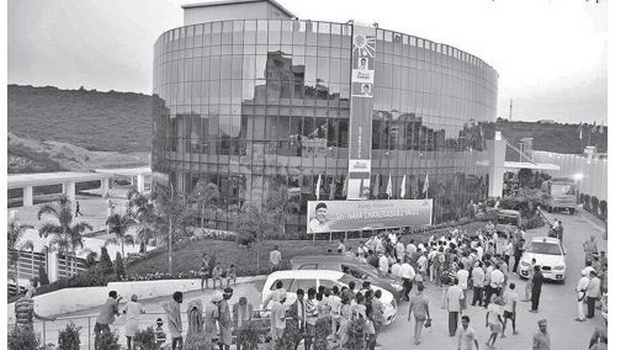
Arrangements being made for the Monday inaugural of the Startup Village by chief minister Chandrababu Naidu at the Technology Research and Innovation Park in Visakhapatnam on Sunday | EXPRESS PHOTO

Visakhapatnam : 

Techies who have a product idea but do not have the tools to execute it, can breathe a sigh of relief for they can now just walk into the Startup Village to be inaugurated Monday at Technology Research and Innovation Park (TRIP) at Madhurawada Hill-3 where they would not only get all the equipment required to execute their idea but also get funding for their business venture.

Chief minister N Chandrababu Naidu will formally inaugurate the Startup Village project which is designed in public-private-partnership (PPP) mode on the lines of the one in Kochi. The facility would be spread over 17,000 sft of fully furnished and air-conditioned startup space at Rushikonda in Visakhapatnam. Startup Village CEO Pranav Suresh and chief mentor Kris Gopalakrishnan, who is the co-founder of Infosys, will attend the event.

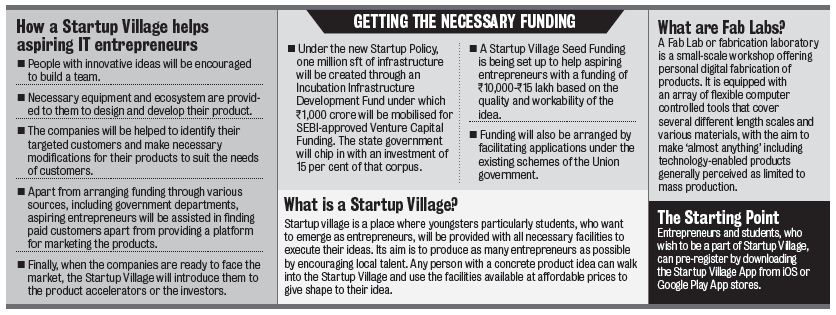
It will commence operations within two weeks in an area of 17,000 sft. The facility will have all the necessary plug-and-play equipment including computers and internet access allowing people with innovative ideas to start their companies overnight.

“To produce world-class swimmers, you need a world-class swimming pool and a world-class coach. The Startup Village at Madhurawada will provide these world-class equipment which would be otherwise not affordable for any small or startup company. The idea is to encourage youngsters particularly students who are aspiring to become entrepreneurs,” said Sanjay Vijaya Kumar, chairman of Kochi-based Startup Village, which is collaborating with Andhra Pradesh government to operationalise the Startup Village in Vizag. Thirty-year-old Sanjay Vijayakumar who is also CEO of MobME Wireless, will sign a memorandum of understanding with the state government, modelled on the Kochi-based Startup Village.

Startup Village has the stated goal of finding a billion dollar campus startup from India within the next 10 years.

“We believe that if Google, Microsoft, Apple and Facebook can be founded by young founders below the age of 24, there is talent in India to replicate the same success story,” he said, adding that the Startup Village at Visakhapatnam aims to create an ecosystem to find and nurture such visionary young entrepreneurs.

The Startup Village in Kochi attracted over 5,000 applications within two years and incubated more than 800 startups of which 256 are student startups. Nearly 46 companies are currently working from an office space of just 15,000 sft.

With an initial space of 17,000 sft, fully furnished offices and the plug-and-play system provided by Andhra Pradesh, the TRIP premises in Madhurawada can easily house 50 startup companies. Though the Startup Village will initially act as an incubator for the startup companies offering mobile and internet products, people with ideas in electronic hardware manufacture also now have a scope to realise their innovative ideas after the equipment is established. “We are bringing the Fab Lab including 3D Printers which are otherwise available only in the Western countries,” he said.

Terming Andhra Pradesh government proactive in terms of executing ideas, Sanjay feels that Vizag has the potential to become a major hub for the next phase of IT revolution in India. “Andhra Pradesh is the only state to have the Startup Policy designed to encourage startup companies which would revolutionise the IT and hardware sector in the country,” Sanjay stated.

FundingANDHRA29Sept2014

source: http://www.newindianexpress.com / The New Indian Express / Home> States> Andhra Pradesh / by P S Dileep / November 29th, 2014

NRI startup village mooted

Chief minister Chandrababu Naidu will be attending conclave of CEO in Vizag

Visakhapatnam:

Chief executive officers of IT and ITES companies from Vizag are gearing up for the conclave of CEOs on September 29 which will be attended by Chief Minister N. Chandrababu Naidu, as a host of issues are expected to be raised at the conclave. A list of the issues which will be presented at the conclave has already been sent to the Chief Minister and J. Satyanarayana, advisor to the state government on matters of IT and e -governance by the Rushikonda Infor-mation Technology Park Association (RITPA).

The policy of allotment of land on lease for a period of 33 years combined with various conditions like employing 500 people per acre will feature at the conclave. Many IT company heads complain that this condition is proving difficult for conducting the business of information technology in the city as many banks are not ready to fund as lease might be cancelled due to non-fulfillment of employment conditions.

A much-touted innovative policy, which would be one of its kind in the country will be proposed at the conclave by the RITPA. The idea consists of an NRI Startup Village which aims to provide employment to 20,000 people on 200 acres of land. According to RITPA vice-president O. Nar-esh, the plan will aim at reducing red-tapism and increasing ease of business for NRIs who wish to conduct IT business in the city.

According to the proposal, 200 acres of land at various stretches in the city, every NRI entrepreneur will be provided one acre of land which will be pre-approved by all governmental authorities. An entrepreneur will have to just select a building plan from a set of 12 designs, designed by top three architects in the country and invest phase-wise in his acre of land and provide employment to 100 people per acre.

source: http://www.deccanchronicle.com / Deccan Chronicle / Home> Nation> Current Affairs / DC Correspondent / September 28th, 2014

NRI businessmen join Andhra Pradesh’s efforts to develop Visakhapatnam as IT hub

Hyderabad :

The Andhra Pradesh government  is wooing expat Indian businessmen to give the initial push to its plan of developing Visakhapatnam into an information technology hub.

Nearly 16 US-based small and medium enterprises in the IT and IT enabled services sectors are planning to begin operations in the region by the end of 2014. These companies, which mostly run their offshore operations in cities across India and have revenue ranging from $20 million to $100 million, are banking on government incentives to return the favour.

“This goes beyond the purview of business” and “has an emotional connect to the state” as the US has a large number of entrepreneurs from Andhra Pradesh, says B Sriram, tax partner at Ernst & Young. “Though that is the significant pull factor, the fact that Vizag is the only city with some infrastructure in the state makes it a favoured destination.” Though an appeal has been made to the NRI audience, according to him the bigger players are yet to make a move. “Once the tier-1 players move, it will attract tier-2 players as well.”

Around half a dozen companies from the US have agreed to be a part of the 50,000-square-foot incubation centre at the Madhurawada IT Layout to mentor and seed-fund promising ventures from a combined pool of $250,000. “These SMEs will create the critical mass for bigger players to come in,” said JA Chowdary, chairman of the Industrial Development Forum, which has been conducting roadshows to garner investment for the state.

“We are looking at adding Vizag operations for software development with a focus on enterprise services as well as that on mobile-cloud in six-eight months’ time,” said Satish Manduva, chief executive of Texasbased IntelliSoft Technologies, an IT-consulting and software development company. “We plan to set up a 200-member team at Vizag over the next three years generating around $15 million.” IntelliSoft, with a turnover of $50 million, currently has operations in Hyderabad, Chennai and Pune.

The SMEs making the move are focused on training and recruiting talent in emerging technologies such as mobile, cloud and big-data analytics. “Our main source of recruiting the fresh talent is through references, walk-ins and approaching institutions,” said Brahma Gupta, founder of Indrasol, a oneyear-old mobile and analytics company incorporated in California.

The blueprint issued by the AP government on its Information and Communication Technology Policy 2014-2020 promises land at rebated costs for development by companies, sops including 100% reimbursement of stamp duty for IT industry and 25% power subsidy for three years for IT companies identified as micro, small and medium enterprises. Beginning with a plug and play model for setting up operations, the SMEs are looking at owning office space as an additional asset to their operations.

“We would lease the space initially but would like to set up an office in a year and half ‘s time, given the land allocation by the government. Also, the cost arbitrage in terms of salaries will work out to be 25% cheaper than expanding in Bangalore or Hyderabad where we presently have operations,” said Sunil Kilaru, chairman and chief executive of PrimusGlobal, an IT solutions company registered in Texas with an annual turnover of $20 million.

“Visakhapatnam is the only possible destination with infrastructure – both social and regular in the state of AP. It will emerge as an IT destination in AP state,” said Sandeep Patnaik, managing director of real-estate consultancy Jones Lang LaSalle, Hyderabad. “Other cities such as Ananthapur and Tirupati will take another five years to develop for senior-level employees to move in.These cities lack a minimum captive audience.”

In order to overcome the gap in filling senior managerial positions, the companies are looking at bringing employees from other centres.”Initially two members from our senior management will be brought in to anchor the operations for six months,” says Satish Manduva of IntelliSoft Technologies.

source: http://www.timesofindia.indiatimes.com / The Times of India / Home> Business> India Business / Payal Ganguly, ET Bureau / September 24th, 2014

Wal-Mart Extends E-Commerce Platform to Vijayawada, Guntur

Wal-Mart (File photo/Reuters)

Hyderabad :

Wal-Mart India, the fully owned subsidiary of Wal-Mart Stores Inc., the world’s leading retailer, is extending its B2B platform to its customers in Guntur and Vijayawada towns of Andhra Pradesh.

Members of Best Price wholesale stores in the two towns can shop and book orders online from Oct 1, the firm announced Saturday.

As a virtual store, the e-commerce platform will provide a similar assortment of products as the brick and mortar Best Price Modern Wholesale stores including a select variety of fresh fruits and vegetables.

This will take the tally of e-commerce platforms to four stores in India. The This was launched from July this year for members of Lucknow and Hyderabad Best Price stores.

Members can navigate the virtual store and place orders on 24/7 interactive site www.bestprice.in. In addition to the delivery at their doorsteps, convenient payment solutions will help them make faster business decisions.

“Given the tremendous support from our members for this initiative, we will continue to extend this in a phased manner to our other stores as well. Members have particularly appreciated our transparency and consistency of prices, availability of products and assortment besides the convenient payment options and efficient delivery solutions,” said Wal-Mart India president and CEO Krish Iyer.

Wal-Mart India owns and operates 20 Best Price Modern Wholesale stores in nine states across India. The company plans to open 50 more stores by 2020.

source: http://www.newindianexpress.com / The New Indian Express / Home> Business> News / by IANS / September 20th, 2014