Category Archives: Business & Economy

City startup wins award

Genius Edulabs bags the award under social impact category

Genius Edulabs, a city-based startup which was incubated at Startup Moksha, Rushikonda, has received an award from Hyderabad Software Exporters Association (HYSEA) for its innovation.

The award was presented by Telangana IT Minister K.T. Rama Rao at a function organised recently at Hyderabad.

Genius Edulabs got the award under social impact category for their innovation — Nano Science Lab — which is a 3ftx3ft modular cabinet with wheels that can store 415 varieties of lab apparatus and chemicals to perform 250 science experiments for the Classes VI to X under CBSE/ICSE/State syllabus.

“A science teacher can walk into the classroom with Nano Science Lab and create lot of excitement among students ,” Startup Moksha CEO Thumati Vasudeva told The Hindu .

source: http://www.thehindu.com / The Hindu / Home> Cities> Visakhapatnam / by Special Correspondent / Visakhapatnam –  April 05th, 2016

Entrepreneurs must tap into cloud computing

In spite of being a country with a huge market capital, we are not controlling it, says expert
Kiranmai Dutt Pendyala

People of Andhra Pradesh are extremely entrepreneurship-savvy. It is for the Government to tap into this resource pool and gain maximum leverage, says Kiranmai Dutt Pendyala, AMD Greater Asia & EMEA Corporate Vice-President (HR).

Speaking to The Hindu on the sidelines of a conference on entrepreneurship, she says small start-ups can think of tapping into cloud computing and Internet of Things (IoT), the two most happening things currently.

“For instance in Anantapur district, look at the good work done by the Satya Sai Trust in the areas of education, health and drinking water.”

Ms. Kiranmai straddles diverse roles of designing strategic plans on talent acquisition, talent management and talent development and partners with the Human Resources leaders besides teaching, training and consulting.

Referring to the capital buzz in A.P., she says the aim is to make this place a manufacturing hub “but we need a different set of skills for it which none of the engineering colleges here impart. With the Government planning development of infrastructure on a large scale, there’ll be need for civil engineers and other ancillary units,” she said.

“Development of the ports and the five airports will create jobs. Youth here is technically very smart. But, articulation of speech, exposure and ability to speak up is what they lack.

It’s a typical small-town phenomenon and you find a similar thing happening even in the US; small cities vs. big cities,” points out Ms. Kiranmai.

Gap in demand and supply

Speaking about the wide gap between demand and supply of engineers in the industry, she says “it is because engineering education here is in lecture mode which imparts only passive skills. Students listen and write notes. Their productive skills are not put to use. This way, we are making followers, not leaders,” she rues, and goes on to add: “The need is to challenge the status quo”.

A lot of people here are entrepreneurial, but it is different from the global arena. “Ours’ is a large country with a huge market capital. But are we leveraging that?”

Talking about the new capital, she says it’s a 10-year play. “Vast infrastructure like good hospitals, schools, residential colonies and good roads are what we need to put in place and ask the bureaucracy to move in if we want the industry to develop here,” she says.

The authorities, she opines, should create a consortium and we need to tap into SMEs to have the growth engines started and once that happens, the larger players will automatically enter, she says.

Reiterating the need to make the best of the prevailing climate, she says the industry is very hungry. “After Gujarat, people are looking at Andhra Pradesh and Telangana States in the country. It is for us to find out ways and means to translate the attention into investments,” she adds.

source: http://www.thehindu.com / The Hindu / Home> National> Andhra Pradesh / by P. Sujatha Varma / March 30th, 2016

From a tiled shed to a stunning edifice

 BezwadaRailwaysANDHRA28mar2016

From the days of meter gauge, semaphore signals, manual hand-operated levers, and steam engines, Vijayawada Railway Station has come a long way

Any vintage picture, with black and white shades, is close to the heart, for it acts as a heart-warming reminder of those wonderful days spent in a leisurely and qualitative manner.

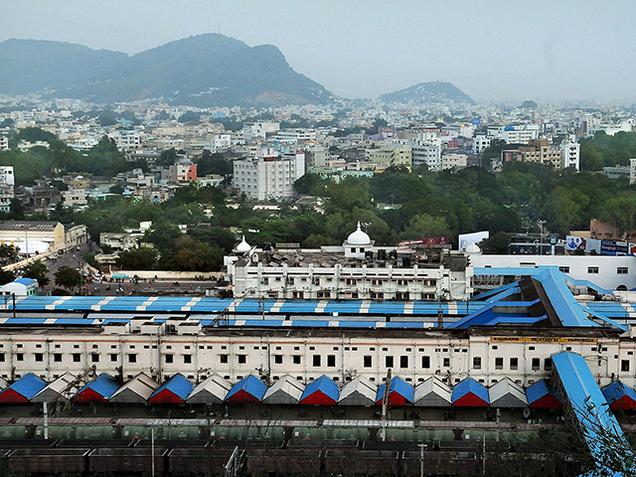
This bird’s eye view of the Bezwada Railway Station of the past era captured by the city’s septuagenarian photographer M.A. Mohan Rao, will make the old-timers turn nostalgic.

This picture, taken from Gandhi Hill (erstwhile Orr Hills) of the 50s, portrays the pristine clean-air-no-pollution Bezwada.

“We don’t see the DRM Office and the Railway Institute. We also don’t see any high-rise buildings,” exclaimed a youngster after taking a look at the photograph.

For the geeks (read digital kids), the nondescript small-town station look of today’s ultra modern railway junction is a pointer that nothing remains constant and change is the spice of life.

“The sound of the trains moving on the Krishna bridge was clearly heard when I was sleeping on the terrace in the 40s at Governorpet,” says octogenarian Turlapati Kutumba Rao, recalling his days when the present railway station was just a small shed.

He remembers the Tongas (horse-pulled carts) and rickshaws pulled by humans waiting for the travellers who alighted from the trains hauled by steam engines.

“Those days, the fare between Bezwada and Gudivada was 25 paise.”

Asked G. Phani, a cricket administrator and a city chronicler, after admiring this period picture: “Do you remember the days when we used to lean out of the train window even though coal particles emanating from the steam locomotive chimney caused discomfort?”

This railway station saw several talented natives leaving to the land of fortune — Chennai — in search of glory, and topping the list was Nandamuri Taraka Rama Rao (NTR), Akkineni Nageswara Rao (ANR), Savitri, Waheeda Rehman, Chandra Mohan, and Murali Mohan.

ANR, who was returning from Tenali to Gudivada after performing a playlet, was spotted by Ghantasala Balaramaiah, a film producer, at the Bezwada Railway Station in 1944 for the role of Lord Rama in his film Sri Sita Rama Jananam.

NTR resigned his well-paid sub-registrar job at Bezwada and boarded a train at this very station to try his luck in the tinsel world.

Rest, as the clichéd adage goes, is history.

From the days of meter gauge, semaphore signals, manual hand-operated levers, and steam engines, the Vijayawada Railway Station has come a long way.

Bezwada – the connecting link 

The Bezwada Railway Station came into being in 1888 when the British wanted to extend the incoming traffic of Southern Mahratta Railways (SMR) towards the East.

The station, with two platforms, was operated from a small shed, and later came under Mangalore tiles in the 20s. The late seventies (1978-79) saw the station moving into a huge building.

In 1889, the Nizam Guaranteed State Railways Company (NGSRC), based at Secunderabad, extended its railway connection up to Bezwada owing to the commercial and trading importance of the coastal town.

Southern Mahratta Railways was merged with Madras Railways, and Madras and Southern Mahratta Railways (MSMR) was opened to the public in 1908 with headquarters at Madras. The Bezwada District, spread from Tondiyarpet to Waltair (Now Visakhapatnam), was part of it and the district transportation superintendent was in-charge of it.

Later, MSMR was amalgamated with Southern Railway in 1951, and South Central Railway was formed in 1966 when Hubli and Vijayawada Divisions of Southern Railway and Sholapur and Secunderabad Divisions of Central Railway were carved out and merged into a new zone.

In 1969, Golconda Express was introduced with an average speed of 58 kmph between Vijayawada and Secunderabad.

The train was considered one of the fastest steam hauled trains in the country those days.

Vijayawada is the pivotal point in the Golden Quadrilateral, connecting the South to the North and East of India.

The 80s saw steady growth of the railway station into a major junction under the stewardship of rail managers like M. Raja Rao (Andhra Loyola alumni) and Nandigama-born J.N. Jagannath.

For want of more area for the expanding station, Mr. Raja Rao took a decision to dismantle the traffic colony and created more open space and also railway mini-stadium.

Last Pushkarams (2004) saw the laying of more platforms and shifting of Tarapet goods shed.

The number of trains (both passenger and freight) that pass through Vijayawada in a day stands at 300-plus, and around two lakh passengers commute daily.

Vijayawada station was accorded A1 status in 2008.

True facts

The first Route Relay Inter-locking (RRI) system of SCR was commissioned at Vijayawada station in 1976

Electric loco shed was inaugurated in 1980 with a capacity to maintain over 100 electric locomotives

The station has 10 platforms, 5 entrance gates with booking counters and two escalators

The seventh platform is the longest one

source: http://www.thehindu.com / The Hindu / Home> News> Cities> Vijayawada / by J.R. Shridharan / March 28th, 2016
APSRTC Bags 4 National Awards

Vijayawada :

APSRTC bagged four prestigious national awards instituted by ASRTU (Association of State Road Transport Undertakings) for 2014-15 in four different categories.

N Sambasiva Rao, vice-chairman and managing director of APSRTC received the awards from Sanjay Mitra, Union joint secretary for Road Transport and National Highways, in Bengaluru on Tuesday during the 60th anniversary of ASRTU.

APSRTC had bagged the award for a better growth rate in mileage in both rural and urban areas. The distance covered by RTC bus on an average had increased from 320.59 km to 381.19 km. per day.

The other awards were for the lowest operational cost, better KMPL (5.23) and for better secretarial services.

source: http://www.newindianexpress.com / The New Indian Express / Home> States> Andhra Pradesh / by Express News Service / March 23rd, 2016

Greenhorns at Their Innovative Best

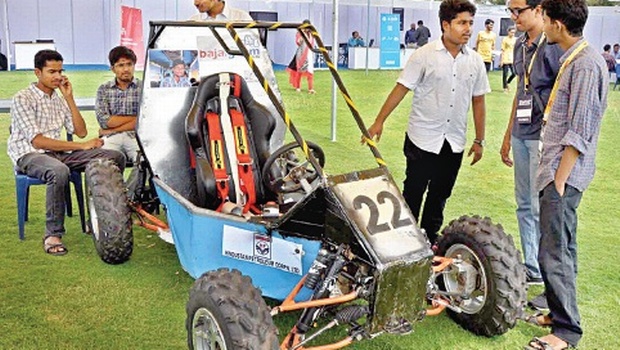
Students of Gitam varsity showing their all-terrain vehicle during the ‘StartAP fest’ in Visakhapantam on Saturday. | Express Photo

Visakhapatnam :

While young entrepreneurs Dhananjayan and VNV Srikanth from Vijayawada were seen erecting their stall by putting up a large flexi of their startup ‘Isthriwala’, a team of youngsters from the city were busy promoting their  “Jagoo”, the first time in Vizag.

One can hire bikes on daily basis. GITAM students interacted with the delegates on their 300cc ‘All Terrain Vehicle’, and some   entrepreneurs from Hyderabad were showcasing their apps.

The ‘StartAP Fest’ is a platform for budding entrepreneurs in and around the state to showcase their innovative ideas here. Students have set up many stalls of their companies and are busy in giving wide publicity to their  products.

Isthriwala with a difference

“We have come from Vijayawada. We came up with Isthriwala just four months ago, and this fest is a great opportunity for us to showcase our startup. Generally in other laundry services, they just wash and deliver, but we, in Isthriwala, will deliver clothes in sealed packing, like new clothes bought from a shop. Customers will feel that he has got new clothes each and every time, and their satisfaction is our priority,” said Dhananjayan, a member of Isthriwala, while giving details about the startup.

Organisers of the fest said it’s all about entrepreneurs showcasing their products, and get them promoted. “There is a chance of delegates lapping up their idea and they might enquire about other innovations too. We have suggested to student entrepreneurs to talk to as many delegates as they can during the two-day fest,” said Nikhil Agarwal, CEO of Innovations Society.

There are eminent personalities from India,  Dubai, Singapore, the USA, the UK and many other nations. Moreover, their experience during initial stages of setting up startups and their success stories will  surely stimulate the youngsters, he added.

The stalls set up by entrepreneurs from Hyderabad, Benguluru, Chennai, Warangal, Tirupati and the stalls of locals drew many eyeballs.

Jagoo: Bikes on hire

“We have a website as well as contact number. People can call us anytime and can book bikes,” said SR Brahmananda Reddy, the managing director of another startup Jagoo.

He said there are six types of bikes – Royal Enfield, Apache, Duke, Activa, Pulsar and Scooty Pep– available. One can hire a bike for `250 a day.

He also said that one should have a driving licence to hire bikes. “We launched the company last month and it needs much promotion now, and this StartAP Fest is really helping us,” he added.

source: http://www.newindianexpress.com / The New Indian Express / Home> States> Andhra Pradesh / by Harish Gilai / March 06th, 2016

NALCO CMD Elected AAI President

Visakhapatnam  :

CMD of Navratna CPSE National Aluminium Company Limited (Nalco) Tapan  Kumar Chand has been unanimously elected as president of Aluminium  Association of India (AAI) in its National Governing Council Meeting, held here  Wednesday.

AAI is a body that represents the entire spectrum of Indian  aluminium industry. General secretary of AAI  KSS Murthy said that with the election of Chand, the AAI would have a more assertive and affirmative approach in promoting the consumption of aluminium and  boosting the growth of the industry.

source: http://www.newindianexpress.com / The New Indian Express / Home> States> Andhra Pradesh / by Express News Service / March 03rd, 2016

Over 1,000 IFR delegates to be accommodated in star hotels

Visakhapatnam :

Around 1,000 outstation delegates (both Indian and foreigners), who are set to make the City of Destiny their ‘home’ during the International Fleet Review (IFR) slated to be held from February 4 to 8, would be put up at around a dozen hotels in the city.

The delegates would also be treated to traditional Indian dishes wherever the Indian Navy hosts official banquets. They would also get a taste of international cuisines in the star hotels.

According to highly-placed sources in the Indian Navy, almost all star hotels (three-star and above) have been booked for the IFR delegates. All the senior naval officers of the admiral and vice-admiral ranks would be accommodated in the five-star hotels, especially those dotting the Beach Road while other delegates would be kept in three and four star hotels.

As for the cuisine, traditional Indian food from different states would be served during the official banquets including the opening and closing ceremonies as well as presidential and prime ministerial banquets. “Hyderabadi biryani, nawabi and Punjabi dishes, besides Andhra and other South Indian food are on the menu. Some of the Indian cuisines would be available at IFR villages too,” said the source, adding that Araku coffee and ‘khadi’ as a traditional fabric would also be promoted during the mega event.

A district tourism official also revealed that a special traditional lunch would be dished out to 300 delegates at an APTDC resort while they tour the tribal belt at Tyda-Ananthagiri and Borra Caves. Tribal dance would also be showcased to them at lunch time.

As of now, more than 50 countries would be participating and more than 25 chief of naval operations (CNOs) would be arriving in the city for IFR. The International Maritime Conference would have more than 85 delegates while more than 25 foreign ships are also arriving. Delegates from all major nations such as UK, USA, Australia, New Zealand, Russia, China and Japan, besides all neighbouring countries (except Pakistan) are participating in the event.
source: http://www.timesofindia.indiatimes.com / The Times of India / News Home> City> Visakhapatnam / by Sulogna Mehta, TNN / January 31st, 2016

Asian Seabass a ray of hope for aqua farmers

A Scientist from the Central Institute of Brackishwater Aquaculture, Chennai, holding an Asian Seabass at Nagayalanka in Krishna district.- Photo: T. Appala Naidu

Private enterprises to be allowed to import the rare fish seed

The Ministry of Agriculture and Farmers’ Welfare has issued its final guidelines, allowing private entrepreneurs and enterprises to import Asian Seabass fish (Lates Calcarifer) seed and fingerlings.

The Union government has so far been not entertaining requests from Andhra Pradesh-based aqua enterprises to import the fish variety, fearing diseases and possible loss of native species. Primarily, aqua enterprises are keen on importing Asian Seabass from Australia, a leading country that has developed fifth generation seed of the fish. In Australia, the fish is known as ‘Barramundi’.

The guidelines are expected to bring in rapid changes in terms of fish production and economic activity.

Scarcity of seed

The supply of Asian Seabass seed by the Tamil Nadu-based Central Institute of Brackishwater Aquaculture (CIBA) and the Rajiv Gandhi Centre for Aquaculture was insufficient, given the demand for the fish in Andhra Pradesh.

“The guidelines to import Asian Seabass seed and fingerlings will enable interested aqua farmers and enterprises in Andhra Pradesh. So far, farmers in Krishna district and hatchery operators have been collecting wild Asian Seabass seed from mangrove forests and coastal belts for cultivation,” said T. Raghu Sekhar, an aqua farmer.

“Asian Seabass is arguably an alternative to shrimp cultivation in Andhra Pradesh. Allowing import of the fish seed will improve fish production. Given the high market value of the fish, farmers in the State will immediately shift from shrimp to Asian Seabass cultivation,” an expert in brackishwater aquaculture at CIBA told The Hindu .

The natural seed of Asian Seabass is found in coastal areas and brackishwater sources in Krishna district, where local communities collect it to supply to hatcheries. Asian Seabass is one of the fish species which survives in pond, river and sea.

The guidelines issued recently by the Department of Animal Husbandry, Dairying and Fisheries under the Ministry of Agriculture and Farmers’ Welfare provide for responsible fisheries with due consideration of necessary biological, technical, economical, social, environmental and commercial aspects.

The guidelines also made it mandatory that hatchery / fish farms intending to breed Asian Seabass should be registered with the Coastal Aquaculture Authority (CAA). Cultivation will be allowed based on the recommendations of the CAA. However, direct sale of imported fingerlings should not be allowed for domestic or international market.

source: http://www.thehindu.com / The Hindu / Home> National> Andhra Pradesh / by T. Appala Naidu / Machilipatnam – January 23rd, 2016

After honey, it’s cashew’s turn to go organic

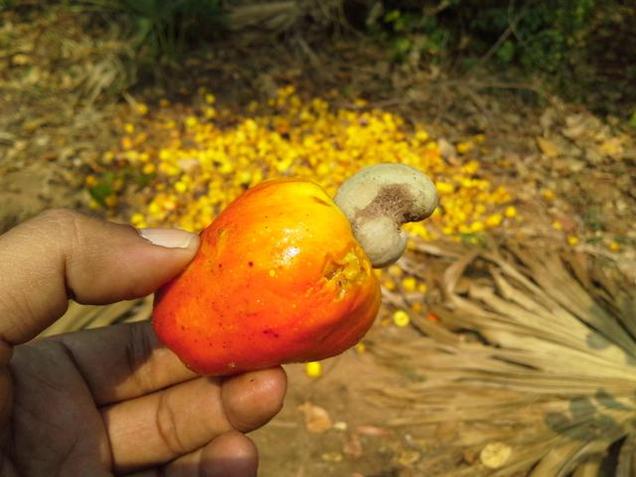
A ripe cashew nut from which organic cashew will be extracted by the tribal people of Rampachodavaram. —PHOTO: B.V.S. BHASKAR / The Hindu

A.P. tribals to get loans and help to grow the crop in big way.

The Girijan Co-operative Corporation (GCC), leader in marketing organic honey, is now venturing into organic cashew with the support of the Integrated Tribal Development Corporation (ITDA), Rampachodavaram, in East Godavari district of Andhra Pradesh.

K.V. Chakradhar Babu, who took charge as Project Officer of ITDA, gathered statistics on cashew farming in the agency area. Cashew farming is the major source of income in the region. He also met tribal farmers during Sunday shandies.

The ITDA is making efforts to set up Organic Agriculture Producers’ Societies at the village level and develop them like Dwacra groups at the mandal level.

Payments will be made in bio-metric system and technological partners will be set up.

Loans will be sanctioned by the GCC and ITDA will also extend support for to societies.

“Farmers can store their produce in godowns. Purchasing centres will be set up in villages apart from existing sales points. Tribal farmers can make use of organic certificates to avoid problems in transporting products from procurement centres to clusters,” said Mr. Babu.

MoU signed

The GCC has signed an MoU with the Kerala-based Olam Company, which will give organic certificates to tribals and it will pay a premium of Rs.2 per each kg of organic product for the farmers who are having the certificate.

Mr. Babu said cashew crop was cultivated by tribals in Rampachodavaram on about 40,000 acres and they were not getting profitable price owing to lack of proper marketing. In 4-5 mandals the cashew cultivation was high.

Initially, area would be earmarked for cultivating 10,000 tonnes of organic cashew.

Businessmen’s view

However, businessmen are differing with the idea of ‘organic cashew’.

“We support the idea of eliminating middlemen between tribals and industries. However, there is no such thing called organic or inorganic in cashew as cashew gardens will not need more pesticides. Organic tag is only to create brand image,” said Appareddy, a businessman at Rajanagaram in the Rajahmundry rural area.

source: http://www.thehindu.com / The Hindu / Home> National> Andhra Pradesh / by B.V.S. Bhaskar / Rampachodavaram (A.P.) / January 11th, 2016

A.P. foodies find substitute for ‘pulasa’ in salmon

‘Pulasa’ is very special for connoisseurs of food in the Godavari region. This fish variety is available only when the Godavari is in spate but food lovers wait for the monsoon season and don’t mind spending a huge amount on the fish variety.Pulasa Chepa Pulusu is the most sought after delicacy for those who relish seafood; the dish is sent as a gift to many places by the natives of this region.

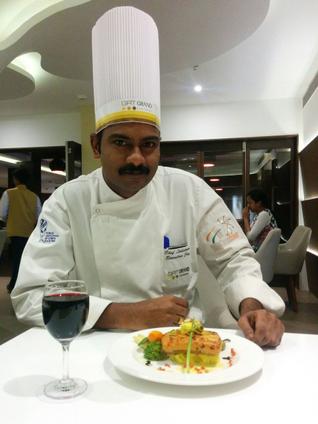
A chef with grilled Salmon dish at a hotel in Kakinada. Photo: K.N. Murali Sankar

In taste and texture, there can be no substitute to ‘pulasa’ but a city hotel is making an attempt to win hearts by serving something that tastes close to the rare fish variety. It is serving ‘salmon,’ a Norwegian version of this anadromous fish imported from Norwegian countries in frozen condition. The exotic fish variety has foodies compare its flavour with that of ‘pulasa.’ Weighing about 2.5 kg to 3 kg each, salmon is chopped into slices and grilled in Italian style before it is served to the guests.

“We use citrus risotto, unsalted butter, virgin olive oil and Italian rice to make ‘grilled salmon.’ Since it is an exotic dish, we retain the flavour and serve it to the guests with wine,” says Ch. Laxman, executive chef at the GRT Grand.

Both salmon and ‘pulasa’ are anadromous fish that are born in the sea and swim against the current to reach the freshwater source for breeding. While salmon lost its life in the process of breeding, pulasa can swim back to the sea, provided it is not caught in the fishing net.

“The lifecycle remains more or less the same for pulasa and salmon, but ‘pulasa’ has a unique taste when compared to salmon. We also find similarities between salmon and our Himalayan Trout, a fish variety available only in the Himalayan region,” says T. Rajyalakshmi, senior scientist and former director of the Central Institute for Brackish Water Aquaculture.

“Some of our guests recalled the taste of ‘pulasa’, while tasting the salmon. In fact, salmon is not suitable for gravy, whereas we cannot imagine ‘pulasa’ without gravy,” observes Mr. Laxman. Not just the foreigners who often check into the hotel, the local foodies also taste the salmon served in grilled and sauté form. “Response to the exotic fish variety salmon is quite good here and we are serving 12-15 orders a week,” says M. Uma Maheswari, general manger of the hotel.

source: http://www.thehindu.com / The Hindu / Home> National> Andhra Pradesh / by K.N. Murali Sankar / Kakinada – December 16th, 2015