Category Archives: Arts, Culture & Entertainment

Lifestyle show to begin in Rajahmundry today

The Hindu ’s Lifestyle Show begins at Hotel River Bay in Rajahmundry on Friday evening.

Four-day event

The four-day show will showcase latest technologies, products and brands which are already available and a few more gadgets which will hit the market soon.

Promoting retail shopping by offering a huge variety to consumers at one place, apart from creating awareness about various brands and offerings, is the main objective of organising the Lifestyle Show, according to its organisers.

The show, which concludes on October 15, is being held under an air-conditioned hanger and 100 showrooms, companies, shops and individual sellers are participating.

The Hindu has been conducting the Lifestyle Show since 2004, the first one held in Chennai.

Later, it spread the show to other cities and the recent one held in Visakhapatnam received tremendous response.

The entry fee is Rs. 20 for a person. Adequate arrangements have been made for parking of vehicles and lightning the venue.

Timings

The Lifestyle Show is open from 10 a.m. to 8.30 p.m.

This year’s Lifestyle Show is powered by State Bank of Hyderabad with Prestige as co-sponsor. Media partner is Eenadu and Red FM is radio partner.

I Care Communications of Bangalore designed the trendy event. Rajahmundry Municipal Commissioner M. Jitendra will inaugurate the show at 5.30 p.m.

source: http://www.TheHindu.com / Home> National> Andhra Pradesh / by Special Correspondent / Visakhapatnam, October 12th, 2012


Culinary secrets of Hyderabad’s 7th Nizam

The niece of the 7th Nizam of Hyderabad is sharing her family’s culinary secrets, and everyone is invited.

Past a heavy wooden door flanked by trellised walls, through an arched passage that runs under a ceiling embellished with intricate patterns, moonlight sneaks in through metal bars in windows on one side of the gallery to gently light up art that adorns a parallel wall. Even more beautiful is the gentle tinkle of laughter trickling from a room at the far end.
Inside, giggling children stand around a stern ancestor as she taps an attendant with the tip of her cane, diamond bangles jingling with each movement of the bony wrist. With the end of a rope tied to his big toe, the attendant who was to fan the dining family has dozed off, and although his programmed foot successfully operates the colonial ceiling fan, his snores are unacceptable.

This memory is one of several from Kunwar Rani Kulsum Begum’s past, one that was dominated by her grandmother Buggo Begum, the force behind Reza Yar Jung Haveli in Darushafa in Hyderabad. Neither Kulsum, niece of Nawab Mir Yousuf Ali Khan Salar Jung III (former prime minister of the seventh Nizam of Hyderabad), nor her sister were allowed into the kitchen. The family’s culinary secrets would only be passed down to the dulhan ranis — women who married into their family — not those who’d secede to another.

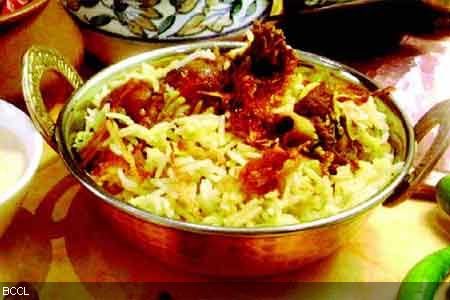
Kulsum Begum is a shade more generous with sharing secrets, though. The food consultant with ITC hotels has opened up a treasure of royal Hyderabadi recipes for a special menu that’s being served at the hotel’s Parel property until today.

“The recipes I’ve shared are my nani’s (maternal grandmother). My dadi was tight-lipped, although I did manage to eek them out of my sister-in-law,” she smiles.

It was the same with every royal family, says Begum. “Guests would compare preparations at parties, each one trying to outdo the other. Keeping secrets fuelled healthy competition between the ladies.”

In fact, Begum reveals, young girls weren’t taught cooking. It was assumed they’d have khansamas. “Even when we travelled, our kitchen staff would accompany us, preparing a spread of safari food — pathar ke kebab prepared on heated, unpolished granite,” she says. A girl was meant to cook, keeping her husband’s preferences in mind. “She may as well learn that at her sasural then.”

Married at 16 into a Lucknow family, Begum wrote copious letters to her nani, moping about missing her food, eventually convincing her to share recipe through detailed letters. “Lucknowi food is sweeter,” she explains with a warm smile, “while in Hyderabad, we like khattan — tartness — in our food.” The ghosht ka shikampur that’s available on the menu she has designed, supports her observation. A layer of curd and chutney are ensconced in the aromatic, melt-in-the-mouth meat patty that dwarfs American portions.

“You youngsters don’t eat enough nowadays,” she says, reminded of how her family pampered her when she lost weight around her teens. “They insisted that I do nothing but sleep and eat, and my mother brought me food in bed.”

Back then, Begum recalls, people assumed that a young girl was thin only because she was ill. Or that the family had met a misfortune. And so, food was rich. “Dry phulkas only made it to the dastarkhan (dining place) when a family member was unwell.”

Naturally, a job, even as a five-star food consultant, was never on the cards. The first time Begum cooked, she put salt in the kheer and made five kilos of biryani for four guests. But her husband was supportive, and with 300 recipes now perfected over decades, she has no qualms inviting the whole city to test her culinary skills.

Kachche Gosht Ki Biriyani

Ingredients
Mutton (a mix of chops, marrow bones and cubes from the shoulder) – 1 kg
Rice – 500 gms
Inions finely sliced – 200 gms
Ginger paste – 10 tbsp
Garlic paste – 6.5 tbsp
Red chilli powder – 3.5 tbsp
Chopped coriander – 6.5 tbsp
Chopped fresh green mint – 5 tbsp
Yoghurt – 10 tbsp
Lemon juice – 1.5 tbsp
Milk – 3.5 tbsp
Pinch of saffron
Oil – 7 tbsp
Ghee – 7 tbsp
Green chillies – 4
Cardamom – 4
Cloves – 2
Cinnamon stick – 4
Caraway seeds – 3 tsp
Peppercorn – 2 tsp
Nutmeg – 1/2 tsp
Few flakes of mace
Salt to taste

Method
– Grind the chillies, cardamom, clove, cinnamon stick, caraway seeds, peppercorn, nutmeg and mace to a fine powder. Heat oil in a pan. Fry onions till golden brown. Crush in a pestle mortar when cool. Marinate the meat in ginger and garlic paste. Add yoghurt, salt, red chilli powder, coriander, mint, green chillies, ground spices, lemon juice, crushed onions and the oil in which the onions were fried. Mix well and marinate for about four hours.

– Wash the rice and mix with a cup of well-beaten yoghurt. Add saffron and half cup milk. Set aside.

– Take a heavy bottom pan with a tight lid. Transfer the marinated meat with the marinade to the pan. Spread the rice over the meat. Sprinkle the saffron milk over the rice. Dot it with a dollop of ghee. Cover and cook, first over high flame, then over medium-low heat till the meat is tender, the liquids are absorbed and the rice is cooked.

– Scoop out portions carefully so that the layering remains intact, and serve steaming hot.

mirrorfeedback@indiatimes.com

source: http://www.articles.timesofindia.indiatimes.com / Home> Life & Style> Food / by Anjana Vaswani, Mumbai Mirror / October 07th, 2012
Clock, Rebecca and Salarjung

My first visit to the Salarjung Museum (SJM) was an educational tour from school. I was in Class VI and my classmates and I were seated expectantly at 12 noon in front of the famous clock to watch a figure within the clock come out and strike a bell 12 times. We were excited!

Years later, when I stood before the clock once again, this time with my daughter, Suha, there was the same feeling of complete fascination. Some of the objets d’art here — the statue of Rebecca, chandeliers, swords, paintings, porcelain and carpets — are amazing so is the children’s gallery.

The Museum consists of the largest collection of artifacts owned by a single family anywhere in the world — 47,500 artifacts displayed in 50 galleries, with 8,500 manuscripts and 60,000 books in the library. It receives 6,000 visitors a day, the largest footfall for any museum in India. Only 20 per cent of artifacts are on rotational display, the remainder being stored away for better preservation.

To stay relevant, its spaces have always laid emphasis on world-class display, and in the last three years, 1 lakh sq feet of interiors have been renovated. A gallery of Islamic art, spread over 26,000 sq feet is under construction where the world’s smallest Quran will be on display. The Museum, which is soon to be the subject of a coffee-table book, is now also becoming a cultural hub, with about 100 events staged here last year — plays, ghazal concerts and mushairas.

Reaching out to people is vital for its continued popularity, and its bus, “Culture on Wheels”, visit schools. They have also digitised the manuscripts and books, and soon, its virtual tour may be possible.

(The writer is a philanthropist, educationist and member of the board of Salarjung Museum)

source: http://www.DeccanChronicle.com / Home> Tabloid> Others / by Zakir Hussain / October 07th, 2012

‘Fish’ speaks for threatened marine life

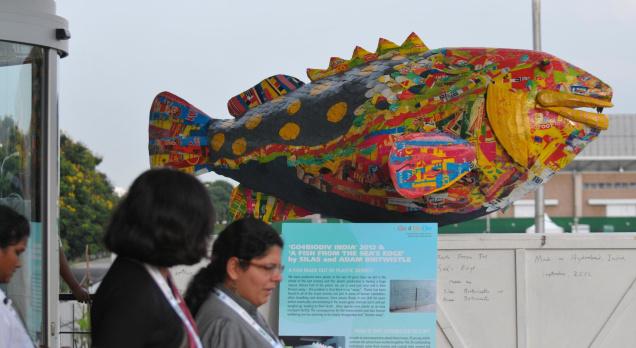
The unique fish which greets participants at the entrance to the Hyderabad CBD conference venue. /  Photo: Mohammed Yousuf / The Hindu

The sculpture made by British artist Silas Birtwistle was built with plastic trash for CoP-11

A table made out of driftwood for Nagoya, and a fish sculpture built with plastic trash for Hyderabad — that is the awareness-raising contribution of Silas Birtwistle, a British artist, to two international conferences of the Convention on Biological Diversity.

The 3 metre-long, 1.5 metre-tall fish greeting participants at the entrance to the Hyderabad CBD conference venue is a colourful mosaic of plastic waste, sporting remnants of many commercial brands. It is a symbol of the heavy impact of land-based activity on the seas, and highlights the plight of the coastal communities whose youth have collected the trash and sent it on to the artist.

Some waste from city

This piece of garbage art became possible through the involvement of about 35 young people who collected the plastic and posted it in boxes it to Silas, and his brother Adam, also an artist and collaborator. Some of the waste that helped make the fish is from Hyderabad, the venue of the XI Conference of the Parties to the CBD.

“The plastic waste that washed up on shores has come from many places, including the Philippines, Tasmania, Belize, Costa Rica and Canada,” Silas told the media on Friday at a CoP-related event. The youth who sent it to him would get their first real look at the end result only when they arrive at the venue next week.

They will carry messages for the decision-makers gathering here.

Several participants who collected the trash are fishermen. They work with their communities to stop overfishing and to encourage wider global understanding of the problems facing coastlines and seas. Silas was commissioned to produce the ‘sculpture’ by Go4BioDiv, an international youth forum that has adopted the theme of conservation of coastal and marine biodiversity to sustain lives and livelihoods, during 2012. Among the youth delegates brought together by the forum are those from marine world heritage sites.

For the previous CoP at Nagoya in Japan, Silas put together a conference table made out of driftwood and 12 chairs and the set was used at the conference. Later, it travelled to other venues and meetings.

The wood was collected from the coasts of East Africa, Borneo, Honduras and Canada. That project is now an exhibit on the web, at http://atablefromtheseasedge.com/

“Oceans look the same today, as they did hundreds of years ago, but many people are not able to appreciate the changes such as acidification. Doing things like this is to communicate, use another language to help everyone understand,” says Silas. The fish he has ‘sculpted’ is quite durable and would work like a weather vane, turning when the wind blows. The final display spot of his unusual art work is as yet unclear. “It may go to the Worldwide Fund for Nature or Wildlife Institute of India,” he says.

Threat to seas ‘unprecedented’

Silas was asked at the World Economic Forum in Davos, whether he felt responsible for the environment as an artist. “No,” he told the surprised audience, “you are responsible.”

The CBD describes the threat to the world’s seas from human activity as ‘unprecedented’. Fishing, transportation, waste disposal, agricultural nutrient run-off, and introduction of exotic species are visible threats, while higher levels of carbon dioxide in the atmosphere get absorbed by the oceans, altering their chemistry and affecting marine life.

The United Nations General Assembly has proclaimed the decade from 2011 to 2020 the ‘Decade on Biodiversity.’

source: http://www.TheHindu.com / Home> News> City> Hyderabad / by G. AnanthaKrishnan / October 06th, 2012

Hyderabad US Consulate joins hands with breast cancer foundation

Hyderabad, Oct 4 (IANS)

The United States consulate general in Hyderabad has joined hands with the Ushalakshmi Breast Cancer Foundation for greater breast cancer awareness.

The Pink Ribbon Campaign will be organised Oct 7 to mark the beginning of the International Breast Cancer Awareness Month.

Actor John Abraham and cricketer V.V.S. Laxman will be the star campaigners at the Pink Ribbon Walk to be held at the Kasu Brahmananda Reddy Park here Oct 7, in honour of women who have fought the illness with determination. The aim of the walkers is to raise awareness about the need for early detection of the disease.

Some prominent buildings in the city, like Charminar, the Buddha statue, the US consulate and Hyderabad Public School will be illuminated to demonstrate the strength of pink, a colour that represents breast cancer awareness.

“Our participation salutes women cancer survivors and encourages those fighting the disease not to give up. We walk together to show our solidarity and commitment to spread the word about early detection,” Consul General Katherine Dhanani told reporters here Wednesday.

Ushalakshmi Breast Cancer Foundation (UBF) has trained 1,200 healthcare workers to perform clinical breast examinations (CBE), used to detect breast cancer in its early stages.

Director of UBF Raghu Ram said trained healthcare workers would perform CBE on 50,000 poor women in Hyderabad.

“Women with signs of breast cancer will be referred to the nearest primary health centre. Women with no abnormalities will be examined again in two years. Data will be maintained by UBF with the help of TCS,” said Ram.

In India 1,00,000 women are newly diagnosed with breast cancer every year, a number that has overtaken cervical cancer. This figure is expected to increase to 1,30,000 by 2020.

Around 50,000 women die from breast cancer every year in India and it has become the leading cause for death among women in metropolitan cities.

More than one million women worldwide are diagnosed with breast cancer annually.

source: http://www.newstrackindia.com / Home> Others / IANS / Andhra Pradesh> Health/Medicine , Thursday, October 04th, 2012

Course introduced for fashion entrepreneurs in Vijaywada

Fashion Designer Shravan Kumar gives tips at a seminar organised by Samana Institute of Fashion Technology in Vijayawada on Wednesday. /  Photo: V.Raju / The Hindu

The homemakers in the City can now have an option of doing something creative with the introduction of a new “Entrepreneurship Development Programme” (EDP) course in fashion designing.

At the inception of the programme at Samana Institute of Fashion Technology (SIFT), it was introduced in a special seminar by celebrity designer Shravan Kumar from Hyderabad.

The specially targeted course for women will train them in production and marketing of fashionable garments.

“My main intention behind starting this course is to increase the economic standards of women in Vijayawada”, said SIFT CEO Samana Moosavi.

Many women already do some sort of clothes designing from their homes, but they lack proper knowledge about the whole process, she observed.

The course, in 116 sessions over a period of three months, will train them in all the aspects of production house, she added.

The course planned in collaboration with the management of National Institute of Fashion Technology will have classes from renowned designers like Shravan Kumar, P.L. Panda, Krishna Mehta and Zubin Vakil.

Students will be required to spend a minimum of six hours daily for the course but the timings are flexible if a group of people come together, said the CEO.

Admissions

Admissions have already begun for the course and the Institute also provides the facility of getting interested students banking support on their guarantee.

Designer Shravan Kumar gave a special presentation to the students on the changing fashion trends over the world like the Japanese asymmetry. Later, he checked out designs of the students for their upcoming show and gave personal inputs.

“Give a surprise element which your city people are unaware of”, was the advice he gave to the students.

source: http://www.TheHindu.com / Home> News> Cities> Vijayawada / by Staff Reporter / Vijayawada, October 04th, 2012

‘I enjoy a sense of achievement’

Christine Lazarus, who is serving as a nominated MLA for the third consecutive term, says she enjoys a sense of achievement for tirelessly working for the welfare of the Anglo Indian Community (AIC) in particular and the Christian community in general.

Addressing a press conference in Vishakhapatnam on Sunday, Ms. Lazarus said she could facilitate construction of community centres in several districts, arrange scholarship for Anglo Indian students up to secondary education, establish training centres, and achieve reservations in education.

She said 185 seats in professional courses were reserved for the community, including medical, engineering, dental, architecture, and pharmacy. Ms. Lazarus said she was instrumental in issuing of AIC identity certificates for claiming government benefits.

Plea to Collector

She said the district Collector was requested to utilise the services of the community members in teaching spoken English to teachers in government schools. The Collector was also requested to allot land for building a community centre in the city.

JNNURM houses

She also urged MLA Dronamraju Srinivas to sanction 130 JNNURM houses to the community members.

Ms. Lazarus appealed to the Divisional Railway Manager to hand over the Railway Institute to the Anglo Indian Association so that they could organise several cultural programmes and properly utilise and maintain the same for public purposes.

She said the community members had been using the institute since the days of the British and they had a sense of attachment with it.

She congratulated the ‘Anglo Indian Jaguar’ team for winning the national hockey trophy conducted at Bangalore and Chennai.

Anglo Indian Women’s Association president Yolander was present.

source: http://www.TheHindu.com / Home> News> Cities> Visakhapatnam / by Staff Reporter / october 01st, 2012

Harvest food

Mooncakes at Golden Dragon

Indulge in a variety of delights at Golden Dragon

Get practising on chopsticks; it’s that time of year when you can treat yourself to spicy, sweet and tangy tastes of China. The on-going August Moon Festival at Golden Dragon in Taj Krishna has got a host of items on offer. A harvest festival of China, it is considered an epicure’s delight. For starters, dig into the Macadamian nuts with stir fried onions and their mushrooms and water chestnut in barbeque glaze. You wouldn’t go wrong in opting for the soft shell crab in butter chilly garlic or the wok tossed rock lobster chilli coriander. Move over to the soups and you have the appetising spicy mushroom, corn and zucchini broth and the sea-food coriander soup.

The August Moon Festival menu is exciting, with extensive sea-food options like stir fried squids served along with Chinese greens, or their east-coast prawns with sweet peppers and shitake in spicy hoisin sauce. If you’re looking for something simple, opt for the sliced fish in tangy yellow bean sauce. Coming to poultry and meats, try the diced duck in star anise flavoured orange sauce. Chef Ajai Rawat and Chef Hung Fong Ng vouch for the home style tenderloin. Its World Vegetarian Day today, so we askabout what’s in store for vegetarians. Ajai quickly says, “You have to try the crunchy water chestnuts and Tofu in wild pepper sauce.” Those who don’t like Tofu can opt for the wok tossed zucchini and broccoli in tangy plum glaze. Pick the broccoli and egg white fried rice or the spicy chilli bean flat noodles.

The August Moon Festival is nothing without the moon cakes. Chef Ajai reveals that the cakes are baked with fillings. One of the varieties has a red bean (sweetened) pastry roll, which is baked. This cake is best served hot. The white coloured moon cakes are served cold and made with glutinous rice with a sweet stuffing. Besides, one can end the meal on a sweeter note with a pineapple and coconut pancake, which fills your mouth with an exotic taste of sour and sweet.

source: http://www.TheHindu.com / Home> Life & Style> Food / by Vishnupriya Bhandaram / Hyderabad, September 30th, 2012

Murals to revive Andhra tradition for Biodiversity Meet

The mural art works that started off at the Greenlands flyover was a sight of amusement for passersby in the city on Saturday. The huge panels were seen kept beside the flyover walls, and one would be surprised to know that the entire stretch of about 5,000 sq ft across the Greenlands and Punjagutta flyovers is expected to be framed within 48 hours.

As the United Nation’s Biodiversity Meet is just a day away, sculptors and artistes are working on a war footing. The figures of cavemen, lion, birds and horses were all depicted in the ‘fibre glass panels’, which is to be fixed onto the walls. The murals will represent concepts like evolution of humans and nature, national integrity and village atmosphere.

Sridhar Patnala, who has been contracted the 5,000 sq ft stretch to finish the mural works, claims that the murals will be one of its kinds in the state different from usual murals carved out of cement, broken tiles or pebbles. He says that the murals have been prepared at his fibre cast workshop in Rajamundry.

Sridhar Patnala, a guest faculty of sculpture at the Yogi Vemana University in Kadapa, explains, “These murals have a life span of over 50 years. Once the POP moulds are ready, it is very easy to make the panels. These are plastic like material and spray-painted with colours that do not fade away.”

The design is inspired by terracotta seals and the concepts from the Indus Valley Civilisation, and it took only 40 days to prepare the entire panels, Patnala says.

The crafting work of the material is done at his workshop and the panels are brought to the flyovers and then nailed onto the walls. Further, the edges are cut to give a finishing touch before it is painted, Patnala adds.

Simplified designs, contour lines and multiple perspectives with a poetic touch is what I have tried to bring out, he observes.

source: http://www.ibnlive.in.com / Home> Andhra Pradesh / by Rahul V Pisharody,  ENS / The New Indian Express / October 01st. 2012

At Rs 12.15 lakh, Ameerpet laddu takes auction cake

Hyderabad:

Despite little signs of the recession easing, sentiment seems to have played a major role at  Ganesh laddu auctions this year.

A laddu weighing about 36kg set the record this year with organisers raking in Rs 12.15 lakh in an open auction in Ameerpet. The chief executive officer of a private real estate firm (Viswas Real Estates & Infrastructures India Ltd, Habsiguda crossroads), G Eswar Rao, bagged the laddu at the auction held on Saturday evening, just before the Ganesh idol was taken for immersion.

The Ameerpet laddu has thus fetched Rs 3.05 lakh more than what it did last year. Another real estate firm, VVR Housing Pvt Ltd, had bought the laddu for Rs 9.10 lakh last year. “The increase in the auction amount will allow us to give scholarships to meritorious students through the VVR Foundation (Mee Kosam) in the state,” Eswar Rao told TOI.

Meanwhile, the famous Balapur Ganesh laddu also set a new record at this year’s auction. The laddu, weighing 21kg, has fetched the organisers Rs 7.50 lakh at the auction held in the village which lies in the neighbouring Rangareddy district. The successful bidder here was P Govardhan Reddy, who hails from the same village. This year the auction fetched Rs 2.05 lakh more than last year. In 2011, Kolan brothers of Balapur village had cornered the laddu for Rs 5.45 lakh.

The auction started at around 9.45am with 23 persons participating in the bidding for the prized laddu. Given the number of participants, the bids crossed last year’s mark within a few minutes. After a keen contest, 45-year-old Govardhan Reddy, a realtor, quoted Rs 7.50 lakh and became the successful bidder. Incidentally, he is former Balapur sarpanch P Narasimha Reddy’s eldest son.

“Today, I fulfilled my father’s last wish. My father passed away two years back. His last wish was had been to get the Balapur Ganesh laddu home,” Goverdhan Reddy, who worked in Ireland before returning to the city two years back, told the media.

An almirah maker, G Narasimha, bought the Badangpet Ganesh laddu for Rs 6.55 lakh. This is the fourth time that Narasimha has bagged the laddu in the auction. This year, he bought the laddu after paying Rs 35,000 over last year’s successful bid. “It is my sentiment to buy the Badangpet laddu as I believe that it is Lord Ganesh’s blessings which have made my business prosper,” he said.

source: http://www.timesofindia.indiatimes.com / Home> City> Hyderabad / TNN, September 30th, 2012