Category Archives: Arts, Culture & Entertainment

Abijeet’s Charminar connect

He is a qualified aeronautical engineer, and if it were not for Sekhar Kammula’s Life is Beautiful, Abijeet Duddala’s life would have taken off on a different tangent all together. Talking about his entry into films, Abijeet says, “I had finished college and wanted to take a year off. That was when I heard about Sekhar’s talent hunt and sent my application. I did not talk about it to anyone. In fact, my parents got to know that I was acting in the movie only after I got the contract and my friends  and well-wishers got to know after the movie was launched.”

Breaking eggs!
The pucca Hyderabadi that he is, Abijeet reveals that his family does have a Charminar connect. Giving insights as to what went into the making of Hyderabad’s famous landmark, he says, “The Charminar got its pale yellow colour because the plaster was made of a mixture of bhindi, egg yolk, ghee, gawar ka patta (a sticky, juicy plant) and seepi (sea shells) that was left to ferment in deep water pits, before being crushed and mixed again along with the lime mortar,” shares Abijeet. Ask him how he knows it and he says, “My forefathers moved to Hyderabad in the late 1500’s as construction labourers who worked on the monument. Their job was to break the eggs and mix the yolk in the construction mixture.”

A fitness freak
Well, Abijeet is an actor today, but he still does what his forefathers did — breaks eggs — albeit for completely different reasons. “I have about 12 egg whites in a day as a part of my zero fat diet. But would have nothing to do with the yolk though,” he says joking. And the actor seems to be in a real hurry to take his shirt off. “Oh, I always had this ripped look even before getting into films. I had to lose 10 kilos to get into the look of the typical boy next door for Sekhar’s film,” he says. Admitting that he is a fitness enthusiast, he says, “I  work out religiously for six days a week and I love it. As far as taking my shirt off goes, well, that might happen soon.”

Films in the pipeline
Abijeet, who is one-film old, says he has got some interesting films lined up. “I have got three films lined up. All I can say is that one is going to be a total commercial entertainer, the other a romantic comedy and another mainstream potboiler. They are all with debutant directors,” he explains.
The actor, who is keen on not getting typecast as the-boy-next-door, says, “Well I have a very massy side to me as well and would like to explore that on screen. In fact, I refused a lot of flicks that offered me typical good boy roles.”

Social side
Apart from films, Abijeet works for a city- based NGO that works to spread  awareness about traffic regulations and pedestrian safety. “It’s something I am very passionate about. We work in tandem with the Greater Hyderabad Municipal Corporation in identifying high traffic density areas and coming up with innovative solutions. We were instrumental in getting a pedestrian island constructed at Jubilee Hills check post recently. In fact, last year on New Year’s eve I was at Jubilee Hills check post regulating traffic!”

source:   http://www.articles.timesofindia.indiatimes.com / Home> Entertainment> Regional> Telugu  / TNN / November 25th, 2012

Private players eye tourism in East Godavari

Union Territory Yanam to have more attractions

The private investors are now concentrating on tourism development in East Godavari district. Their main concentration is on Union Territory Yanam, Kakinada, Rajahmundry,and Rampachodavaram. .

Most of the tourists visit Rajahmundry for boat cruise to Papikondalu and now they are slowly moving to other places such as Koringa, Mada wildlife forests, Antarvedi beach where Godavari joins Bay of Bengal, Kotipalli Revu, Didi Resorts, Maredumilli forest eco-tourism and other places. However, the State Tourism Department has been concentrating on Dindi resorts and Papi Hills and the rest of the tourist spots are neglected for long time.

Now, the Anand Toursim has taken lead in tourism development. As, Yanam is a developing city with regard to tourism and due to location of a number of petro chemical projects in and around Yanam, many foreign tourists are regularly visiting the place.

They prefer to stay in star hotels in Rajahmundry or Kakinada. “Keeping this in mind, we formally launched a three-star hotel in Yanam and would declare it open officially during Yanam Praja festival on January 5 and 6,” said P. Ramakrishna Kumar, vice-president of Anand Regency Hotels.

According to him, the two specially-designed boats for cruise across Godavari river between Rajahmundry and Papikondalu and from Rajahmundry to Bhadrachalam are getting good response with people from different parts of the State and also from West Bengal Orissa, Karnataka, and Tamil Nadu making advance bookings for the cruise. Anand Regency, Yanam has well in advance had planned a big bash on the eve of New Year in an island off Yanam coast. “We have just started cleaning the island and applied for permissions from the forest and other departments,” said Bhaskar, business manager of the hotel.

source: http://www.TheHindu.com / Home> National> Andhra Pradesh / by B.K.S. Bhaskar / Rajahmundry, November 24th, 2012

Persian influence abounds in Bidri ware

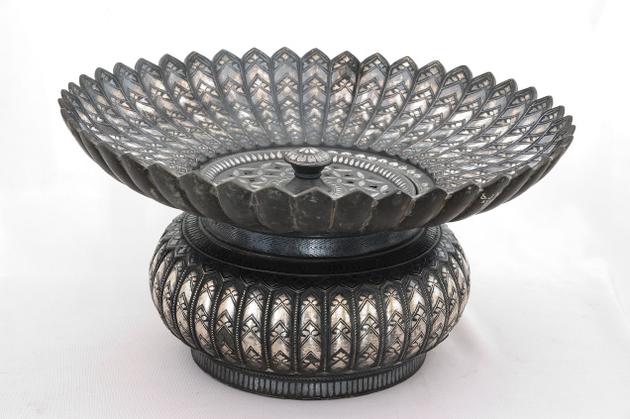
A circular basin with perforated cover inlaid in silver. / Photos: Special Arrangement / The Hindu

Their sight is brilliant: silver designs shining against the black metal base. Their variety is extraordinary: spittoons to cloth weights. Wealth of design and varied shapes – the two qualities Bidri wares are praised for – are evidenced in the many specimens of this 400-year-old craft enshrined in Salarjung Museum.

Bidri gets its name from Bidar, some 200 kilometres from Hyderabad.

The basic material of Bidri is an alloy of zinc, copper and lead. There are five stages in the production of Bidri: casting, polishing, engraving, inlaying and blackening.

The decorative methods in Bidri consist of – inlay of wire, inlay of sheet, low relief, high relief, cut-out designs in super imposed metal sheets.

Silver is chiefly used for ornamentation, and gold, very rarely.

The preference for silver is obvious: it creates better contrast when inlaid over the ebony coloured Bidri metal.

Bidri ware, like many other crafts, was a fruit of our contacts with Persia. The art of inlaying precious materials over the articles of daily use is peculiar to Persia and other Middle Eastern countries. The Iranian craftsmen who came to Bidar some 400 years back developed the crafts. It later moved to north India and Hyderabad.

The museum’s Bidri collections of huqqa bottoms, Aftabas, trinket boxes, goglets, spice boxes, contain mostly designs of wine creeper and poppy plants. Geometrical decorations also appear. Later products show Hindu lotus decoration.

A special case is a Bidri huqqa designed with a mixture of Persian and European patterns, the latter having been introduced by the French in 18th century.

B. Kotaiah, Dep. Keeper (Retd) Salarjung Museum

source: http://www.TheHindu.com / Home> News> Cities> Hyderabad / by B. Kotaiah / November 22nd, 2012

The Hindu Young World Quiz on November 28

The multi-city mega quiz will be held in 16 cities, while the grand finale will be in Chennai

The 13th edition of the hugely popular The Hindu Young World Quiz Competition, a part of the The Hindu-NIE Initiative is all set to kick off in the Andhra Pradesh capital on November 28.

It will be held between 12 noon and 3 p.m. at the Hari Hara Kala Bhavan and participants should report at 11.15 a.m.

Any two students studying in classes seven to nine can form a team and a maximum of four teams from each school are permitted to participate.

ENTRY CARD FORMAT

Completed entry cards may be sent to P. Ranga Reddy, Regional General Manager, The Hindu, Hyderabad, for registration.

Once registered, the top portion of the Entry Card must be carried by participants to the venue without fail. Photocopies of the cards will not be accepted. Entry for the event is free.

Six teams for the regional finals on stage would be selected based on a preliminary, written round.

The winning team from each region will qualify for the Grand Finale at Chennai.

Certificates of participation apart, a large number of prizes await the winners at every stage.

OUTSTATION TEAMS

In the case of outstation teams that qualify for the Grand Finale at Chennai and for one accompanying parent or teacher, the cost of travel, boarding and lodging will be borne by the organisers.

The multi-city, mega quiz is being held in 16 cities – Bangalore, Hubli, Mangalore, Puducherry, Tirupati, Thiruvananthapuram, Trichy, Salem, Coimbatore, Madurai, Kochi, Kozhikode, Hyderabad, Visakhapatnam, Vijayawada and Chennai.

source: http://www.TheHindu.com / Home> News> Cities> Hyderabad / by Special Correspondent / November 19th, 2012

In Andhra Pradesh, Catholic nuns bring drinking water to 250 tribal families

Residents in the village of Koderna (East Godavari District) drank polluted water, fighting malaria and typhoid. Five Sisters of the Cross were instrumental in getting a pump to bring water from a clean source as well as opening a school and a dispensary.

Hyderabad (AsiaNews)

Thanks to the efforts of five Sisters of the Cross of Chavanod, a tribal community in Koderna (East Godavari District, Andhra Pradesh) now can meet basic needs like safe drinking water and education for their children. Until a year ago, the 250 families that call the village home had to rely on polluted water and typhoid and malaria were widespread. Local kids did not go schools. Now villagers have a well with clean water, a dispensary for basic health needs and a school.

Last year, the Sisters of Chavanod visited the unspoilt mountains that are next to the village. During their trip, they discovered the village. “Beside the tranquil streams and sparkling atmosphere of the mountains stood the village where people drank highly polluted water,” said Sister Priyanthi Samala.

Sadly, the government has shown little interest for the fate of this village, as did other communities in the area. A school does exist in Koderna but it lies empty because the teacher comes every two months.

Outsiders do visit the village but only to buy local goods, like tamarind, wood, charcoal, ragi (finger millet), bamboo, brooms and spices at very low prices.

In view of the situation, the nuns got in touch with an engineer who looked at the ground to see how drinking water could be brought to the village from another source.

Eventually, he succeeded in his search. The nuns then approached the government for help and began to work on the villagers to have them join the project.

“After a year of assiduous efforts to motivate this community and several frequent visits, we gained the confidence of the people and established our work in their location. We were certain of their cooperation,” Sister Samala said.

“They did not hesitate to send their children to the school,” but “the few children who saw the school for the first time were terrified and perplexed.”

Now about100 of them attend the school the nuns set up and run out of a rented house. Eventually, the sisters hope to get a building of their own.

source: http://www.asianews.it / Home> India / by Santosh Digal / November 17th, 2012


Myanmar’s Suu Kyi visits Andhra villages to study socio-economic transformation

Hyderabad:

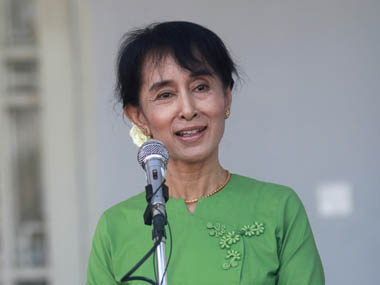
Myanmar’s pro-democracy leader Aung San Suu Kyi on Saturday arrived in Andhra Pradesh’s Anantapur district to study the socio-economic transformation of people in villages brought about by various government welfare schemes.

The Nobel laureate arrived in Kothulagutta village around 9.30 a.m. in a helicopter from Bangalore. She was accompanied by Union Minister for Rural Development Jairam Ramesh and Andhra Pradesh Chief Minister N. Kiran Kumar.

Amid tight security, three helicopters carrying the leaders and their aides landed in the village.

Suu Kyi saw a power point presentation on the rural development in the state and the impact of the welfare schemes being implemented by the central and state governments.

She later travelled by road to Govindapuram village and interacted with the people working under the Mahatma Gandhi Rural Employment Guarantee Scheme (MGREGS).

The Myanmar opposition leader will also visit Papasanipalli village and interact with women to gain first hand knowledge of how the self-help group movement has changed their lives.

After visiting the house of a member of a self-help group, she will fly back to Bangalore.

IANS

source: http://www.firstpost.com / Home> World / November 17th, 2012

Chiranjeevi regales children at IGMC fete

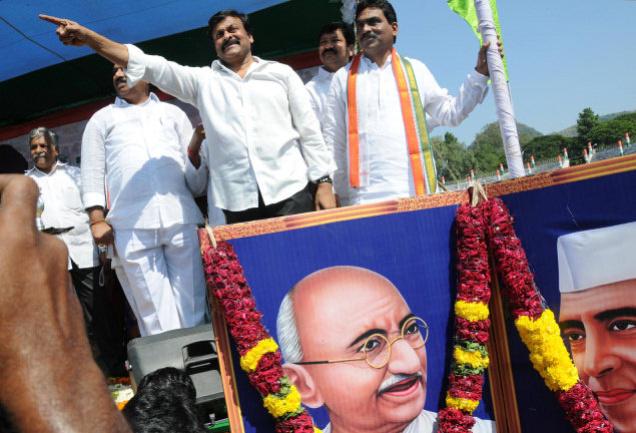
VIJAYAWADA, 14/11/2012: Union Minister of State for Tourism (Independent) K Chirangeevi waving the crowd at the children’s day function organised Rajagopal foundation in Vijayawada on Wednesday. /  Photo: Ch. Vijaya Bhaskar. / The Hindu

He asks parents to spend more time with their wards

Parents and teachers need to connect to children to understand them in order to drive home lessons or small scientific principles, said Union Minister of State for Tourism K. Chiranjeevi during a Children’s Day celebration organised by Rajagopal Foundation at Indira Gandhi Municipal Corporation Stadium on Wednesday.

The programme commenced at 9.00 a.m. After formally launching the celebrations by releasing some pigeons and colourful balloons, Mr. Chiranjeevi recounted his experience of learning from his own teachers as a seventh standard student and explained the concept of pollination, fertilisation and germination.

Advising parents to spend more time with their children to understand their needs and read their minds, Mr. Chiranjeevi gave many personal examples. In the entire jam-packed galleries of the IGMC Stadium, children showcased their talent by presenting various cultural performances and took part in various literary and cultural competitions. Not many could get a glimpse of the former megastar, but his voice blaring over the public address system regaled them.

A few prize winners had the chance to meet him and take photographs.

Mr. Chiranjeevi profusely thanked Vijayawada MP Lagadapati Rajagopal for giving him a chance to interact with children and said that this was his first such occasion.

The competitions included song, group dance, fancy dress, essay writing, elocution, quiz and drawing contests. The Union Minister was felicitated with garlands and gifts by the Secondary Education Minister Kolusu Parthasarathy and Vijayawada MLAs Malladi Vishnu and V. Srinivas. Earlier, the Union Minister came in a procession from the Gannavaram Airport that exposed differences between various groups in the Congress party in the Krishna District.

source: http://www.TheHindu.com / Home> News> Cities> Vijayawada / by Special Correspondent / November 15th, 2012

Prehistoric site found near Srikakulam

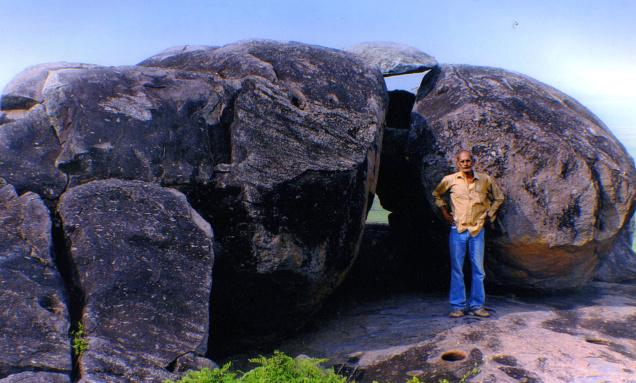
Archaeologist K. Venkateswara Rao who found the prehistoric rock shelter on the top of the Saidala Hill near Srikakulam.

Several rock shelters found on Sailada hill-top and Chittivalsa are significant, says archaeologists

Did the prehistoric man straddle the hillocks near Srikakulam town in Andhra Pradesh much like the Bhimbetka in Madhya Pradesh, UNESCO’s World Heritage Site ?

The rocky landscape near Srikakulam may not boast of the richness and the depth of the rock paintings of Bhimbetka that fetched it international recognition but several prehistoric rock shelters found on Sailada hill-top and Chittivalsa area in the recent past are equally significant, contend archaeologists here.

They are excited by the finding of a set of four 3.8 metre high rocks leaning inwards and forming a polygonal chamber on Saidala hill-top as it comes close on the heels of discovery of a cluster of druidical rocks at Chittivalsa and of dolmen and menhirs resembling those in Europe and Africa. Both these findings that indicate existence of a reasonably big habitation of prehistoric people in the area, were by free-lance archaeologist, K. Venkateswara Rao.

The recently found round-shaped dolmen like formation with a stone roof, stands on a circular rock bed of 13 metre radius on the top of the Saidala hill. Like others, this rock shelter too has post holes around it in two rows meant for installing wooden posts that served as props to supported a canopy. “The place appears to have been used for performing some rituals and ceremonies by the prehistoric people”, Mr. Rao said.

There are many caves, caverns and shelters of different shapes in the hillocks in the region but not as huge as this one that too with a rock bed inside.

Even now the place continues to be known as “Pandiri Rallu” a shelter made of rocks. The rock shelter has enough place to accommodate 10 to 15 people inside. A petroglyph of serpent was found on the western side of the shelter, a common feature on prehistoric dolmens in Europe.

Another name given by the locals to this unique rock formation is “Bunti Vanda”, virtually a den of bears. Burrows formed by flow of rain water from the top of the hill to the foot, have turned them into safe sanctuary for the bears. “Even now villagers dread to tread the bushy path to the top of the hill scared of the bears and feel the sacred place is visited by Gods and Goddesses. This in a way is blessing in disguise as the rock formation remains protected with no major damage”, Mr. Rao says.

Further evidence of the man living on the hills was the finding of a 6 x 4 ft depression in the rock perhaps used as a water storage pit. Mr. Rao says the prehistoric rock shelters on sacred hills of Sailada and Sangamaya and the nearby Pandavulametta at Chittivalsa and the later period’s historic fort of early Kalingas could be projected as unique site with continuous history for UNESCO”s recognition.

source: http://www.TheHindu.com / Home> News> States> Andhra Pradesh / by K. Venkateshwarlu / Hyderabad, November 12th, 2012

10 lakh sanctioned for Ashoor Khana restoration

Hyderabad:

Funds for restoration and renovation of the Badeshahi Ashoor Khana have been going back and forth between the Department of Archeology and Museums (DAM) and the government with precious little work being done. It was in early September that Dam was sanctioned Rs 21 lakh for restoring the Shiite place of worship to former glory but only Rs 6 lakh was used and the rest returned. With the month of Muharram round the corner, the Dam has now been sanctioned another Rs 10 lakh for restoration work of the structure.

It was during the Conference of Parties in September that the state government had sanctioned Rs 21 lakh for sprucing up the place in view of visits by delegates. Describing the sanctioning of funds as a result of ‘urgency’, Dam officials said that they had acted on orders from the government and hadn’t called tenders due to unavailability of time and awarded contacts only on nomination basis. “Around Rs 1.29 crore was sanctioned for Paigah Tombs, Saidanima’s Tomb and the State Museum a chunk of which has been returned. We were asked to submit bills and return the remainder of the sanctioned amount,” said a Dam official requesting anonymity. With Muharram scheduled to be observed from November 16, around Rs 10 lakh has been sanctioned for renovation of the Ashoor Khana Khurd, popularly known as the mini-Ashoor khana, where the alam (standard) will be kept. The wooden roof is being restored with teak wood beams. A team of four carpenters and four masons has already started work.

“The roof is being restored to what it was when the Ashoor Khana was built more than 400 years ago. Work will be completed before Muharram,” said GV Rama Krishna Rao, director, Dam.However, Ashoor khana officials were quick to point out that Icomos team member Chehryar Adil had expressed displeasure at the decaying place of worship and questioned why the structure wasn’t renovated. They said that around 2 lakh devotees cutting across faiths and sects visit the Ashoor Khana in the first ten 10 days of Muharram.

source: http://www.articles.timesofindia.indiatimes.com / Home> City> Hyderabad / TNN / November 09th, 2012

The sound of music

Commodore TMJ Champion is single-handedly responsible for restoring pipe organs in the country

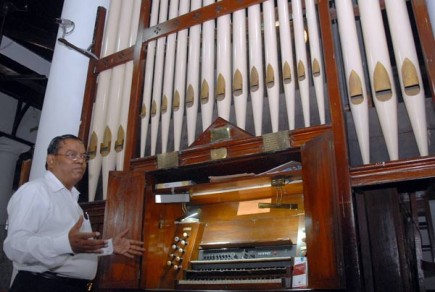
Enthroned on a wooden bench in St Johns, Secunderabad, tapping pedals and tabbing on keys, Ex-Naval Commodore TMJ Champion does his rendition of Toccata and Fugue by JS Bach on an 104 year-old pipe organ. The instrument is completely mechanical with no external speakers or electronics, he explains. The hundreds of pipes that form its anatomy produce when air is released, like whistles. Behind its piano like facade of the instrument lies its body. He turns a key into a small wooden door and directs me to climb narrow wooden steps that lead inside the instrument. While one can walk inside the St John’s Organ, there are organs that are as big as three stories, he explains. I wait in the isle surrounded by sets of countless pipes that varying in size from tiny flutes to considerable tree trunks. He plays the instrument so I know exactly which pipe the air is released from.

It’s not very common for one to be passionate about such an instrument. He reminisces how in his hometown of Nagapattinam, the church congregation would have to wait for British musicians to come and play it each Sunday. No one knew how to play it, is what my father told me, he says. Not only did he learn to play it, he became an expert at its mechanics. With no one knowing anything on the subject in India, he wasn’t left with much of a choice. “When the British left India, there was not a single organisation in India that had any expertise in building or restoring organs,” he says. If you get on the Internet you’ll find sites of organ builders in Europe, the US and Australia, but there’s not a single one in India.

Self taught through experience, books and visits to organ makers in the UK, Commodore Champion over the years has helped breathe air into lifeless organs across the country. The first organ he repaired was in Wesley Church, Mumbai. Since then he’s been acting as a consultant and facilitator for restoring organs in India. The organ in St Johns Secunderabad, that was unused for two decades was restored by him in 2003 at the cost of `1.5 lakh.

Not only is lack of expertise a problem, but restoration is an expensive affair. The quotation for restoration work can span from a few lakhs to even over a crore. Some work on the bellows and woodwork is done by Tapan Das from Kolkata under Champion’s guidance, who is the only such remaining craftsman in India. But repairing and re-tuning old pipes can only be done by experts from the UK and many parts are just not available here.

Of the five pipe organs in and around Hyderabad only one is in working condition (St Johns). The city is cold about western classical music compared to Chennai and Bangalore, where music lovers have made efforts to raise money for repair works, he says. But, historically the Nizam VIII of Hyderabad is known to have been passionate about western music. He brought down Tamil musicians from Chennai for his symphony orchestra and cavalry bands, the land denoted to these musicians is the area of Bandlines in the City.

While reviving western music in the City might take many more years, Commodore Champion continues to play the pipe organ each Sunday making sure its sound is alive.

source: http://www/.postnoon.com / Home> Arts & Entertainment> Music / by Elizabeth Soumya / November 09th, 2012