Category Archives: Arts, Culture & Entertainment

Meeting at Indian Embassy by NATS

North America Telugu Society (NATS) NATS conducts a very Successful meeting between Trivalley University Students and US immigration officials at the Indian Embassy in Washington, DC

NATS President Mr. Ravi Madala, Immigration Attorney Ms. Sheela Murthy along with around 65 TVU Victims met the SEVP (Student Exchange Visitor Program) Director Mr. Louis M Farrell, Assistant Director Ms. K Kennedy and two other ICE (Immigration and Customs enforcement) Special Agents, in the Indian Embassy today, to discuss and resolve issues caused by the closure of the university.

This meeting was arranged by the Indian Embassy, after NATS intervening in this issue and conducting a meeting with Indian Ambassador on March 28, 2011, in which Mr. Rajagopal Lagadapati, MP from India and NATS Officials urged the Ambassador to help the students in this issue.

In addition, NATS organized a protest infront of the Whitehouse on March 29, 2011, where over 100 students gathered with placards and chanted slogans to bring these issues to President Obama’s attention. As a result US officaials are now starting to take these matters seriously and NATS hopes to have a claer resolution on this matter in the next two to three weeks

During the April 15, 2011 meeting NATS representatives submitted a memorandum with six specific  action items to the SEVP Director.

1. US officials should not issue anymore NTA’s (Notice to Appear) related Trivalley issue. ICE should withdraw all  outstanding NTA’s.

2. Return the bond money immediately.

3. Issue a policy statement declaring, students to be in status for 180 days, from the university closure date January 18, 2011.  Provide copies of the statement to USCIS, CBP (Customs and Border Petrol) and State Department

4. Return the fee money held by ICE to students, advise banks / credit card companies to return the fee to students.

5. Release all detainees immediately.

6. No more detentions of students; communicate the same to all customs & border petrol and USCIS officers across the country.

Attorney Ms. Sheela Murthy volunteered to help the affected students and asked all the students to write their case to her so that she could do the best from her end to help the case.

The US Officials were very positive in their demeanor and listened very patiently to the concerns of all students who attended the meeting. US officials conveyed they will work on a feasible solution to end this crisis immediately.

NATS is currently working on having a dialogue between Prme Minister Manmohan Singh and the President Obama. NATS will be meeting President’s office and get this issue reloved in the next few weeks.

source: http://www.GreaterAndhra.com / Home> Articles> Special Articles / April 16th, 2011


World Telugu Meet off to a colourful start

Ongole MP Magunta Srinivasulu Reddy blowing a traditional tribal musical pipe at the inauguration of World Telugu Meet. (Right) Dakshayani Reddy, Managing trustee, Ramky group, Panabaka Lakshmi, MP, Magunta Srinivasulu Reddy, MP, JD Seelam, RS member and Nerella Venumadhav at World Telugu Meet in Ongole on Thursday.

Ongole:

Ongole town attained a festive look as the World Telugu meet was inaugurated at Errapragada venue in the PVR Municipal High School on Thursday.

In fond remembrance of the great poet Errapagada, who completed the remaining part of the Aranya Parvam of the Mahabharatha, the venue was named after him. Nerella Venu Madhav inaugurated the event by lighting the ceremonial lamp at the Errapragada venue, while Cabinet Minister Panabaka Lakshmi unfurled the Telugu Mahotsava flag.

Earlier, Ongole MP Magunta Srinivasulu Reddy received the ‘Telugu Mahotsava Akhanda Jyothi’ (torch) that arrived at the Collectorate. He paid floral tributes to Tanguturi Prakasam Pantulu at the Prakasam Bhavan. The MP danced along with a group of dancers to instil enthusiasm among participants.

The torch was rallied along the main streets of the town followed by the drummers, Pothurajas and Haridasas. Several art forms were performed all along the rally.Telugu litterateurs and eminent personalities from every corner of the state participated in the event.

Three seminars on Women Empowerment, Agriculture and Media were organised at three different venues on the first day. The event is being jointly organised by the Ramky Foundation, Kendra Sahithya Akademi and State Cultural Department.

Harikatha, folk dances, Kalaripayattu, Kolatam, Sri Rama Pattabhisekham performed at the event mesmerised the audience. Dhimsa dance form performed by the tribals of the Araku enthralled the audience.

Rajya Sabha MP JD Seelam, Ramky chairman Ayodhya Rami Reddy, Ramky Foundation Managing Trustee Alla Dakshayani Reddy, Dr Garikapati Narasimha Rao, Hindi Akademi president Lakshmi Prasad and others participated in the event.

source: http://www.thehansindia.info / Home> News

Hyderabadis in Pakistan still carry mohajir tag: Karen Leonard

Hyderabad:

The Hyderabadi diaspora is either forced to shed its Hyderabadi tag due to powerful geopolitical forces or for others, it remains deeply rooted in their culture.

Professor of Anthropology at the University of California, Karen Leonard observes that Hyderabadis who moved to Pakistan at the time of the Partition still carry with them the ‘mohajir’ label, struggling to find acceptance. They have now started moving to western countries in search of a better future.

With the creation of Urdu societies in North America, Europe and the Middle East, Hyderabadis are making efforts to go back to their roots. While some are making efforts to cling to their culture, others are intermarrying and mixing with people of different races. Visiting the city after three years to attend a conference, Leonard describes the Deccani synthesis as a model for tolerant society.

Speaking to TOI on Friday Leonard, however, notes that she has seen a decline in communal harmony in the city. She is also worried about the Telangana movement. “While young Hyderabadis are busy creating a new mixed culture_ creating their own kind of plural society_ the people from Andhra have not recognised the legitimacy of the Nizam’s state and culture and are not proud of its Indo-Muslim architecture,” she observes.

She says that the populace still thinks that the previous rulers were Islamic when they were actually tolerant. The term Indo-Muslim, she explains, does not emphasize on a religious culture, but on a civilization instead.

Leonard’s association with India goes back to 1961 when the she was a student in Miranda House in Delhi. Little did she know that she would be enamoured by the composite Indo-Muslim art, culture and architecture of India. It was her contact with this multilayered, multifaceted pluralistic society which urged her to understand it better by deciding to become a historian of the Mughal era.

However, there was one hurdle: the hundreds of documents chronicling the Mughal era were either in Farsi or Urdu so she started learning the languages. Her first encounter with the city of the Nizams was when she had stopped for the night at a sarai in Nampally on her way from Delhi to Chennai. She returned five years later to complete her dissertation on the Kayasths of Hyderabad. “The number of documents in the Nizam State Archives was more than that in Delhi,” she says. “They were more recent and interesting. That’s why I chose to study the Deccan.”

source: http://www.timesofindia.indiatimes.com / Home> City> Hyderabad / TNN / January 07th, 2012

‘Hyderabad of yore cradle of ganga-jamni tehzeeb’

People now may be sharply divided on religious lines but the Hyderabad of yesteryears presented a successful example of a pluralistic society. Regardless of their religious affiliations everyone participated in the dominant public culture, especially those living in the neighbourhoods of the walled City.

American Historian Prof. Karen Leonard (University of California, Los Angeles) presenting her paper at MANUU. / The Hindu

“The Indo-Muslim practices are not evidence of a cultural synthesis, syncretism or hybridity. Rather they are evidence of a successful plural society,” remarked Karen Leonard, professor of Anthropology, University of California, Irvine.

She was delivering a lecture on ‘Indo-Muslim culture in Hyderabad – Old City neighbourhoods in the 19 century’ at the Maulana Azad National Urdu University. Prof. Leonard focused on the history of Hyderabad state in Deccan as part of the fifth biennial convention of the Association for the Study of Persianate Societies.

3 NEIGHBOURWOODS

She talked about three contrasting neighbourhoods of the old city – Shahalibanda, Chowk Maidan Khan and Hussainialam – and highlighted their differences and distinct cultural practices.

Hindus and Muslims as also Telugu, Marathi, Kanada, Hindi and Urdu speakers took part in the public culture of their place and time. The Kayasth caste, Ms. Leonard said, were characterised as ‘half Muslim’ since many of its members became prominent administrators for Muslim rulers in India and also emerged as scholars and poets in Arabic, Persian and Urdu.

Shahalibanda was essentially a site of military establishments. It was home to the leading military noble family of Paigahs and Gaur Kayasth ‘serrishtahdars’ (managers) of military and household units.

Residents here came from many cultural backgrounds and economic levels. Imposing residences of Hindu and Muslim nobles and military commanders shared space with small communities of tanners, salt makers, grain carriers and goat sellers.

ENTHUSIASTIC CELEBRATIONS

Muharram was enthusiastically observed and the Kayasths kept ‘alams’ in their homes and built Ashoorkhanas. Some Kayasth families even fasted like Shias. Hindu festivals such as Ramlila celebrations were privately sponsored in Shahalibanda.

The Malwala family was the wealthiest family in Chowk Maidan Khan locality. The family supported the neighbourhood mosques and donated money in Ramzan. During Muharram, the Malwala family displayed ‘alams’, set up ‘abdarkhanas’ to serve ‘sherbet’ to people.

Hussainialam, according to Prof. Leonard, was more crowded and its population heterogeneous. The Kayasths here were Saksenas, Bhatnagars and Srivastavas. Some Brahmin families and Bohra Muslims also lived here.

Referring to the literary front, Prof. Leonard recalled how these localities produced famous Hindi poets of Hyderabad. The literary activity revolved around Persian till the late 19 century when Urdu became a popular medium of expression. Many Kayasth poets were deeply influenced by Sufi thoughts. Prof. Leonard recited the lines of Bansi Raja of Hussainialam:

I do not put tilak,

It’s just another headache

Nor do I perform sejdah,

It makes a black spot on my face

source: http://www.thehindu.com / News> Cities> Hyderabad / by J. S. Ifthekhar / January 06th, 2012

Call to protect Telugu language

The three-day Prapancha Telugu Mahotsavam (Wor-ld Telugu meet) began at Ongole on Thursday.

The three-day Prapancha Telugu Mahotsavam (Wor-ld Telugu meet) began at Ongole on Thursday.

Union minister for textiles and handlooms Ms Panabaka Lakshmi lamented during the inaugural meet that Telugu people were adopting English as their native language and shunning their mother tongue. Ms Lakshmi asked parents to teach Telugu to their children and speak the sweet language at home.

President of the AP Hindi Academy, Mr Yarlagadda Lakshmiprasad lamented that no one protested the negligence of the state Governor for his absence in the Potti Sriramulu Telugu University convocation last year. He alleged that the government was not interested to protect Telugu as it had not appointed a chairman for the Adhikhara Bhasha Sangham.

Ongole MP, Mr Magunta Srinivasulu Reddy and Rajya Sabha member Mr J.D. Seelam said they would take the issue of the Governor to the notice of the government and assured action for protection of Telugu.

Telugu Association of North America president Mr Thotakura Prasad and Ramky Foundation Europe coordinator Mr B. Ramanaidu sought government cooperation to protect Telugu in foreign countries.

Leaders of several Telugu organisations expressed fear that Telugu would disappear by 2020 and demanded action by the government to save the language. They demanded making Telugu the second official language of India by the Union government.

Earlier, Mr Srinivasulu Reddy inaugurated the Telugu Jyothi rally which toured the town with cultural troupes.

Telugu people from all over the country and other nations participated in the meet.

source: http://www.DeccanChronicle.com / Home> Channels> Cities> Region> Nellore / by DC Correspondent, Nellore / January 06th, 2012


Rashtrapati Nilayam to be opened for Public Viewing from January 07th to 12th

03-01-2012 : Rashtrapati Bhavan, New Delhi

The garden of Rashtrpati Nilayam, Bollaram, Secunderabad, will be opened for public viewing from January 7th to 12th this year. The garden will be open to the public from 1000 hrs to 1700 hrs. and visitors at the entry point will be allowed upto 1600 hrs. Entry will be through Gate No. 2

The premises of Rashtrapati Nilayam have been developed as an eco-friendly complex, which mainly comprises a landscaped garden, beautiful road scaping, different seasonal flowering plants and display of potted plants around the main building, a natural cascading water fall and seven different types of Nutrition Gardens of Mango, Sapota, Pomegranate, Guava, Amla, Coconut and Cheeku. In addition to this, a Herbal Garden has been developed which is intended to bring in awareness about our rich heritage and diversity of Medicinal Plants. This is also to preserve and promote the medicinal values of various plants that grow widely in our surroundings, whose properties are beneficial to human beings and maintain a balance between man and nature.

The Herbal Garden has 116 species of medicinal and aromatic plants like Sarpgandha, Kalabandha, Citronella, Lemon Grass, Khus, Geranium, Coriander, Sandalwood, Tuber Rose, Jasmine, Kalmegh, Tulsi, Isbgol, etc. These plants can be used for natural home remedial cure for a variety of diseases. The Garden is located in an area of about 7000 sq. mtrs. The Garden has also developed annuals, perennials, creepers and shrubs.

In addition to this, several measures have been taken for conservation of rain water in Rashtrapati Nilayam during the last two years to improve ground water sustainability. A percolation pond, made with the available stones, has been developed where the rain water is collected and then gets percolated into the subsoil.

Three rainwater harvesting pits have also been made for storage and percolation to the ground via filter media. Earlier, the rainwater was used to flow out of the Nilayam premises, which is now collected and conserved, resulting in substantial rise in ground water level. New water sources like borewells have been developed and existing open wells have been developed for efficient water irrigation and drip irrigation system in the complex.

The Premises of Rashtrapati Nilayam were opened for the common people for the first time in 2011.

source: http://www.PresidentofIndia.nic.in / Home> Press Releases / January 03rd, 2012

This release issued at 1710 hrs.


A gazab keeps ghazals alive

Hyderabad:

In a narrow lane of Goshamahal, behind a Durga temple, flows the dhun of ageless ghazals from the doors of Sangeet Sadhna, a hall dedicated to music by Pandit Vithal Rao Shivpurkar, one of the last court musicians of the Nizams. Hyderabadi classical ghazal tradition can be traced to Vithal Rao, who at 81 is still hail and hearty or `gazab’ as the last Nizam Mir Osman Ali Khan called him. A heart attack that he suffered has failed to dampen his spirit as he sits straight on a carpet with his legs crossed, dressed in his trademark white kurta pajama, with pictures of  Md Rafi and Bade Ghulam Ali Khan saab adorning the walls, giving a glimpse into a glorious past he has lived.

With the mere mention of his huzoor, Osman Ali Khan, his eyes brighten up and a 13-year-old Vithal leaps out of his persona. He narrates, “I had taught the boys from Goshamahal School one of Huzoor’s nazms which they used to sing every morning before entering their classes,” and thus flows from his mellifluous voice__ “shahe deccan zindabaad, zindabaad-pa-hindabaad”. In no time, the Nizam heard of this little boy, whose father was a pehelwan, and called for him. “I did not know what to sing and was very nervous,” recalls Vithal. He sought the help of Shankiri Bai from Nizambaag who taught him the perfect song for the occasion. On the first day of his visit, huzoor sat on a rocking chair tapping his leg to keep with the beat. As Vithal reached the lines, “Khabar-e-tahayyur-e-ishq sun, na junootrahi na parii rahi/ na to tu rahaa na to main rahaa, jo rahii so bekhabarii rahi,” the Nizam stopped him and asked him to repeat it. Then he asked, “Naam kya hai?”(What is your name?). On hearing his Hindu name Rao, huzoor retorted “yeh gazab hain!” (It’s a wonder!) And this continued for the next ten days when Vithal was called over and over again to sing the same couplets which elicited the same response each time__ “Gazab hain!” Soon after, a gift of Rs 1,000 was sent to his house, in case the little boy lost it if handed over to him directly.

There was no looking back for Vithal Rao after this. He became a regular at the mehfils of the Nizam’s sons Taki Jah Bahadur, Hasm Jah Bahadur and he became a favourite of his daughter Shahazadi Pasha. Eventually, then prince Moazzam Jah Bahadur, who used to reside at Hillfort Palace took him under his wings. “The prince called a huge party where the creme-de-la-creme of Hyderabad was invited. He declared me as his son and renamed me Vithal Jah,” recounts Vithal. This was a moment of ultimate pride and happiness for him, says the singer who has been the lead in the military orchestra of the Nizams. In fact, the original orchestra of the Nizams used to play western instruments, but it was after hearing Vithal that a new orchestra was created to promote Indian music and he was made in charge of it.

Speaking of the change in music trends in Hyderabad, Vithal Rao says, “Pehle ghazal the, ab gazal hai.” He rues the end of a generation who knew and sang in correct Urdu. Sitting beside him, his nephews Sunil Rao and Deepak Rao, who are carrying forward his tradition of ghazals, nod in agreement. “The programmes today are mostly corporate sponsored. Artistes are treated as workmen whose work is to perform in return for fees, keeping in mind the changing taste of the audience,” says Sunil. “The element of respect is missing and art has become a commodity,” adds Vithal citing how in a recent show a lot of people came to watch him only to test his knowledge. “They went on giving various farmaish, from Mehdi Hassan to Ghulam Ali, but I managed to exhaust their requests,” Vithal says with a cynical laugh.

With pressures from all corners of the music world demanding an amendment in the classical format, does he think that ghazals can survive the changing taste? Vithal says till he is alive he will ensure that ghazals are alive. He has trained enough youngsters to carry forward his tradition and he has full confidence in them. But then nothing is certain. “Pakki baat zindagi, pakki baat maut, us beech kuch aisa kaam kar lena ki log bole__ achhe the,” the ghazal maestro signs off.

source: http://www.timesofindia.indiatimes.com / Home> City> Hyderabad / by Pritha Chakrabarti / TNN / December 21st, 2011


Kalamkari in a designer avataar soon

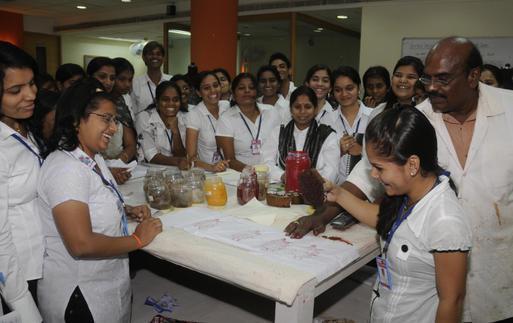
Pulleswara Rao, trainer from weaver’s society of Vijayawada, demonstrating Kalamkari block printing at a workshop organised by Samana Institute of Fashion Technology in Vijayawada on October 18, 2011. Photo: Ch. Vijaya Bhaskar

The traditional Kalamkari block prints may soon acquire a designer avataar if the plans of the city-based Samana Institute of Fashion Technology (SIFT) bear fruits.

Fashion junkies have always wanted innovation with a traditional streak and the SIFT is game to set the ball rolling for the process to unwind. Giving shape to its long-term plans which include setting up a local Kalamkari block print unit to spare the local crowd of the pain of travelling all the way to Pedana to buy the stuff, the SIFT organised a day-long workshop on its premises on Sunday for its second semester students.

A group of 35-odd students attended the workshop where G. Pulleswara Rao, senior trainer from the dyeing department of the Weavers’ Society of Vijayawada, explained to the girls the nitty-gritty of the block printing.

Fascinated by the mechanism of using the blocks with detailed and elaborate designs carved on them, the girls later tried their hand at the traditional art.

Besides explaining to the young learners about the fastness of the colours which is ensured by washing, bleaching and sunning on cloth using vegetable dyes, Mr. Rao threw light on the right mix of colours.

“How to choose and make the base colour is important. Selection of appropriate print, the right colour scheme and use of single or double blocks and a plethora of other issues are to be kept in mind while creating a design,” he said.

“I intend to add Kalamkari block printing in the fashion designing course. The Pedana prints attract people. We can start a local unit and provide work to housewives from middle class households,” Institute CEO Samana Moosavi toldThe Hindu.

“Unlike the artisans, our young designers can play with colours and use their innovative streak to give the print a contemporary look,” she said.

source: http://www.TheHindu.com / News> Cities> Vijaywada / by P. Sujatha Varma / December 19th, 2011

Remit2India gives NRIs and their families in Hyderabad a reason to celebrate

Hyderabad:

Remit2India, that serves over a million NRIs worldwide with its online money transfer service, recently gave 800 of its NRI families and friends in Hyderabad a true royal treatment.

Aptly timed with the festive season when NRIs visit their families back home, the NRI Family Day was organized as part of an ongoing celebration of Remit2India completing 10 years of service. This event follows the success of other similar events held around the country this year.

The Park Hyderabad played host to the evening that witnessed breathtaking live performances, music, games and entertainment which enthralled the audiences. The event presented a variety of treats ranging from entertainment to sumptuous food.

There were interactive fun sessions with the host; engagement stalls like tattoo, tarot card, photo corner, kids zone, health & wellness zone and plenty of freebies tallied the entire checklist of a fun filled day anyone could have asked for.

Speaking on this occasion, Mr. Avijit Nanda- President, TimesofMoney said, “We are delighted with the overwhelming response we have received for the Remit2India NRI Family Day in Hyderabad. This event allowed us to thank our customers and their families and we hope to continue taking this across to more cities throughout India.”

Key partners for the event included DCB Bank, LIC,  Renault Hyderabad, S&S Green Projects Pvt. Ltd., Aditya Housing & Infrastructure Development Corporation Pvt. Ltd., Yashoda Hospital, VLCC and Clear Vision.

source: http://www.economictimes.indiatimes.com / Home>  News>  NRI>  Forex and Remittance  / December 22nd, 2011

THE DECCAN TRAIL …. Mirpakaya Mango Moghuls

Hyderabad to Vijayawada, it’s a trip from tangy to the fiery-hot
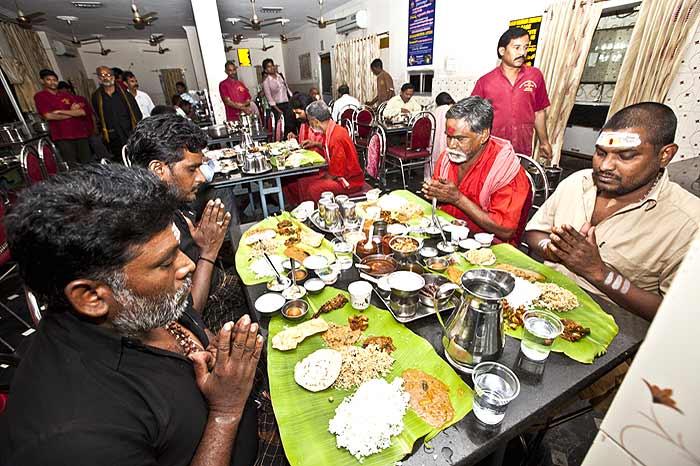
Andhra full meal . At the Viyawada Ramiah mess/ A. PRABHAKAR RAO

I am, I must confess, an accidental food writer. It all started with a one-off food story, which led to another, and another…till now I’m being asked to write culinary books and host TV shows. But, truth be told, my idea of the perfect meal is a simple, crisp dosa, accompanied by a favourite book. Hence this culinary drive from Hyderabad to Vijayawada turned out for me to be more of a journey through history and geography, with random diversions through politics and trivia.

Hyderabad is one of the important centres of Mughlai cuisine, along with Delhi, Lahore, Lucknow and, perhaps, Rampur. But there’s an important difference: by the time the 50-year-long Deccan campaign ended, the cuisine that the Mughal armies had brought with them had evolved, through its interaction with the southern climate, ingredients, peoples and cuisines. Most notably, it acquired a distinctive tangy undercurrent, thanks to a variety of sour flavourings, from tamarind to green mango. Thus, biriyanis, qormas and kababs are all very well, but the keynote of Hyderabadi cuisine is a khatta salan (sour curry)—such as baghare baigan, tamate ka kut or a simple khatti dal—which is the starting point for planning any Hyderabadi meal. Everything else, whether lamb, fowl or fish, comes later. This is something north Indian Muslims find rather strange—almost as strange, in fact, as the Hyderabadi Urdu dialect.

Khatta salan comes first in Hyderabadi cuisine, before fish or fowl, something north Indian Muslims find strange.

Because it originated as a cuisine of the elites, Hyderabadi cuisine is generally a slow-cooked labour of love. Even the humblest dish calls for a certain artistry, and presentation is as important as flavour, texture and fragrance. So where can you get good, authentic Hyderabadi food? Unfortunately, the answer is that it’s something you get only in people’s homes. Well, there are two other possibilities: Hyderabadi weddings and the Nizam Club, so you could try to wrangle an invitation, or gatecrash. Alternatively, there’s Shadaab, a little eating house in the Old City, or the slightly more upmarket Point Pleasant in Banjara Hills. But your best bet would be to order from somebody like Begum Aziza Hassan, famed for her pluperfect shikampurs, baghare baigan and biriyani.

The drive from Hyderabad to Vijayawada—the heartland of Andhra cuisine—takes only five hours, but it’s a journey into a different cultural ethos. The road heads east, through dramatic rockscapes, some of the last remnants of the famous boulders of Hyderabad, sculpted into fantastical formations by 2.5 billion years of wind and storm; the rest, sadly, have fallen prey to real estate development, and a unique national treasure has been squandered.

The road takes us through places whose names all seem to end in either ‘pally’ or ‘gudem’ (Tangallapally, Maggalapally, Yellareddigudem, Annapareddigudem). Our driver insists on driving on the wrong side of the road, at 140 kmph. Every time I admonish him, he obediently gets back into his lane—but only briefly. I think I’m going to have a cardiac arrest, as he continually swerves left at the last possible moment to dodge oncoming vehicles. Hesitantly, I ask him how long he’s been driving this route. “Seven years, sahib,” he replies, impassively. I philosophically tell myself he knows what he’s doing, and close my eyes and try to sleep. But I swear to myself there’s no way I’m going to go back this way; I shall return to Hyderabad by train.
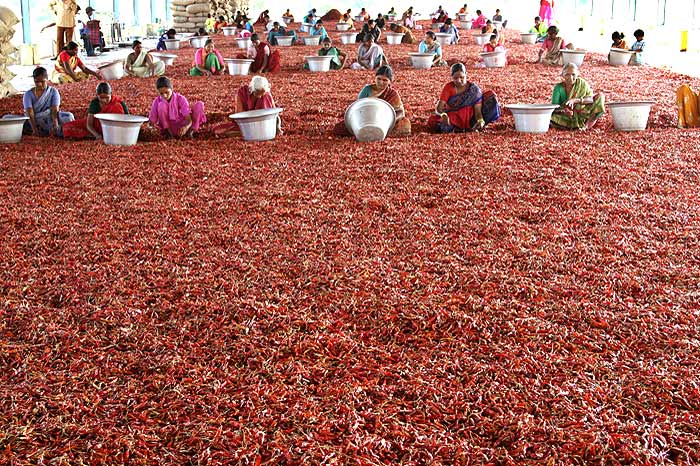
Chilli land Guntur’s firestick chilli is delectable torture. (Photograph by T. Narayan)

As we approach Nalgonda, the land flattens out, with lines of pencil-straight toddy palms. In the summer, villagers sit by the roadside, selling tadgolas, the fruit of the toddy palm—translucent, cool, luscious under their fleshy ochre skin. Apart from these, and the creamy local sitaphals, foodwise, the drive is uninteresting; it’s only near Guntur that things look up, with the nondescript dhabas giving way to stalls selling scorching chilli mirpakaya bajjis.

From Nalgonda, the road swoops south, and the landscape slowly turns a lush shade of green: this is the rice bowl of India, watered by the Krishna river. We’re now crossing the divide into coastal Andhra—the historic ‘Coromandel Coast’ where, in the 1750s, the French and British intrigued and battled so fiercely. At first, the French seemed well-entrenched here, but the English, of course, ultimately finessed them. They absorbed this strategic coastal belt into their Madras province. And so it remained, right until 1953, when it became India’s first linguistic state, Andhra. Then, three years later, the Telangana region was added on to it—a political marriage that’s been on the rocks for 40 years. All that’s left of it now is a bitter tussle over who gets to keep the dowry of Hyderabad. (So much for the logic of linguistic states.)

Apart from being India’s rice bowl, coastal Andhra also claims to produce the sweetest jaggery, the thickest curds and the best chillis. Guntur, in fact, is perhaps the chilli capital of the world: it is home to the world’s largest chilli market, and its chilli farms make the largest single contribution to India’s output of 1.1 million tonnes of chillis per year. And while its chillis may not be the world’s hottest (that distinction goes to Assam’s bhootjholokia chilli), the Guntur ‘firestick’ chilli is hot enough for the police to use, allegedly, as a means of torturing stubborn suspects. This is hard-core chilli country, and you see evidence of it everywhere, from the vivid scarlet stretches of drying chillis by the roadside to the city’s eating joints, which offer foods that run all the way up the Scoville scale, from the merely spicy to the truly incendiary. (The gunpowder-sprinkled ‘Guntur idlis’ are a speciality.)
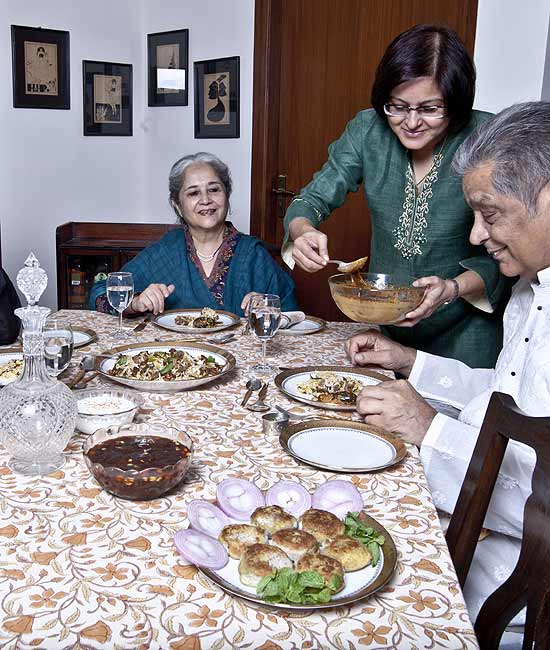
Family affair A Hyderabadi meal. (Photograph by A. Prabhakar Rao)

If Hyderabadi cuisine was largely the product of history, Andhra cuisine is a result of geography. Its themes are rice from the delta; tamarind, green mango and gongura (sour roselle leaf) that grow here in abundance; dour vegetables like brinjal, lady’s finger, drumstick and gourd; fresh seafood from the coast and, of course, the chillis of Guntur. The cuisine, unsurprisingly, is one of the world’s hottest, and so a meal always ends with a soothing dollop of curd-rice—the ancient secret for dousing the fire of the chillis (the ancients intuitively understood that chilli molecules are fat-soluble, not water-soluble, which is why cold water never helps).

A typical Andhra meal includes steaming rice, a pappu or dal, a couple of pulusus or curries and rasam. There might also be a sambar and chaaru (something roughly in between a sambar and rasam). And for extra zing, there’ll be an array of pickles, chutneys and kaaram, or spicy powders. The items are laid out on your banana leaf in an ergonomic, traditional pattern: rice in the middle; curries on the right; pickles and pachadi on the left; and special delicacies, like pulihora, in pride of place at the top right-hand corner. The thematic flavours are chilli and gongura, and given the fact that Andhra is such an intensely political state, such characteristics sometimes acquire a political undertone: during the Separate Telangana movement, for example, there was crude graffiti shouting not just ‘Andhra go back!’ but also ‘Gongura go back!’ and ‘Mirchi go back!

What if the French had trumped the English in Andhra? Would we be eating creolised fish pulusus?

Unlike Hyderabadi cuisine, Andhra cuisine never had the advantage of court patronage—which played an important role in the evolution of, for example, Telangana cuisine. It was, instead, essentially the food of the common man—which is why it remained simple, earthy and robust. It’s interesting to speculate what would have happened to Andhra cuisine if history had turned out differently. What if the intrinsically Telugu Vijayanagara empire had conquered the Cholamandal coast, and lasted a century longer? Or, what if the French—who were once well-ensconced here—had trumped the English, and wrought a Pondicherry-like influence on the region and its cuisine? Might we, perhaps, today be eating creolised fish pulusus with baguettes made of rice-flour?


From Guntur, the road turns north and crosses the Krishna river into Vijayawada. One of the city’s landmarks is Babai Hotel, originally a footpath stall set up in 1942 by Patruni Shyama Murthi, affectionately called ‘Babai’ (uncle), who invented what many consider to be the ultimate idli: a supremely fluffy creation, topped with a blob of home-made butter. Babai’s idli became so popular that his stall became a pilgrimage centre for Andhra Pradesh’s film stars, tycoons and politicians, and it’s said that the idli had no fixed price: wealthy patrons would simply hand over a sheaf of notes, based on how much they’d enjoyed their meal. Today Babai’s idli joint, now run by his nephews, may not be what it once was, but it’s still a shrine for foodies.

Our journey had ended; it was time to go back. I took one look at our driver and recalled our trip from Hyderabad, driving on the wrong side of the road, at 140 kmph. It didn’t take long to make my decision. I paid him off and caught the Narsapet-Hyderabad Express instead. Discretion, truly, is the better part of cowardice.
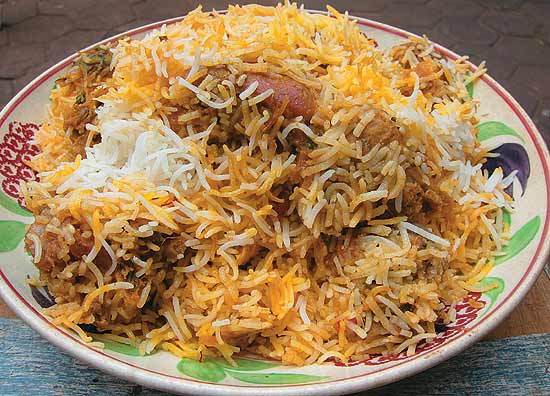
Do-Gosht Biriyani

One of the secrets of a good Hyderabadi biriyani is said to be the generosity of the proportion: it should ideally be one portion of meat for every portion of rice. And then there’s the ‘do-gosht biriyani’, or two portions of meat for every portion of rice! Two much of a good thing.
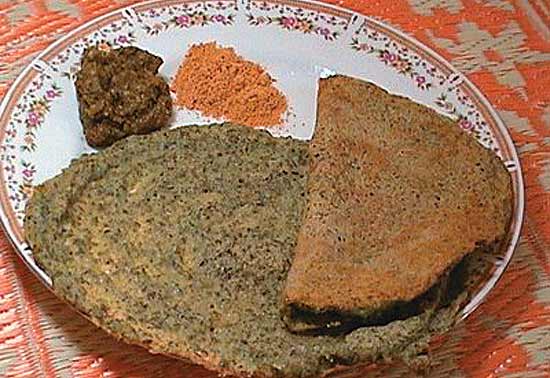
 

MLA Pesarattu

Pesarattu is the Andhra version of a dosa, but made of green gram instead of rice. A popular variant is the ‘MLA pesarattu’, stuffed with upma. It apparently got its name from the state’s MLAs, who invented this greedy snack in the MLA canteen to sneak into the assembly and eat during long, boring sessions.

___________________________________________________________

When he’s not waxing eloquent on food, Anvar Alikhan is an advertising professional

___________________________________________________________

source: http://www.OutlookIndia.com / Society / Magazine, January 07th, 2012

Special Issue: THE AROMAS OF INDIA