Category Archives: Arts, Culture & Entertainment

At the pinnacle

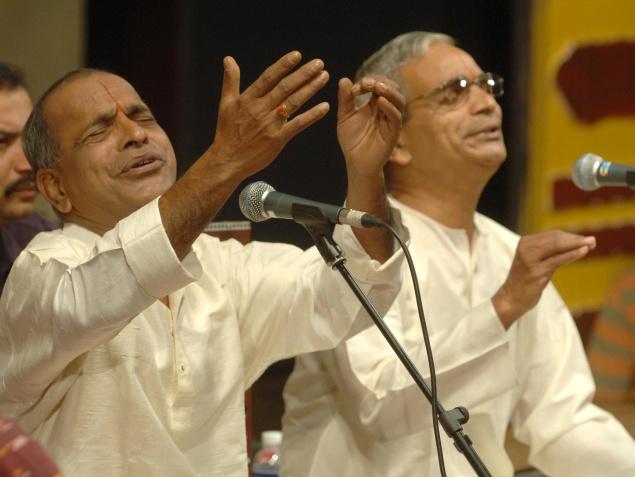
Hyderabad Brothers D. Raghavachari and D. Seshachari. File photo: Photo: V. Ganesan. / The Hindu

Hyderabad Brothers reminisce about their journey so far, as they earn yet another laurel.

They sing as a duo, yet they are poles apart. One is mild and mellow, the other is vibrant and candid. However on the stage, they merge their diverse personalities into a single entity and the output is just eloquence. It’s no surprise that awards and accolades come their way. The ‘Hyderabad Brothers’, as Daroor Raghavachary and Seshachari are fondly referred to in the Carnatic music circles, have once again been bestowed with the ‘Senior outstanding vocalists’ award by the Madras Music Academy in Chennai at the end of the Margazhi festival.

How do they feel about this? “We are blessed. It is the divine that has been operating in our lives all the time. We live by our sruti and laya, our musical parentage. The rest follows naturally,” both respond with utter humility.

Way ahead of others in this region, the Hyderabad Brothers carved a niche for themselves at the Mecca of music by sheer dint of merit and melody. When classical music is replete with rigid grammar and syntax, how do they manage to tug at the heart-strings? “By breathing music, thinking music and living music,” Seshachary quips. “I don’t do research, then I will turn into an academician. Nor do I practise all 364 days. But as I relax after the day’s work, my mind churns out new sangathis, new swara patterns, keeps delving into varied ways of presenting a raga wherein the bhava springs up as natural fountain,” he says.

“We keep the raga bhava and the lyric bhava intact while rendering it in all its variations. This is a very important aspect of singing in a concert. Nothing should be harsh to the ears of the listener. A kriti should touch his heart. That is what the great composers felt. They are our guiding stars. This is no way of tampering with tradition or classicality. It is the approach that matters,” says Raghavachary.

Working in NMDC on the secretarial side, Raghavachary manages to keep his musical prowess intact, his recitals and his music lessons going without a break. “My organisation has been very cooperative; as far as my concerts are concerned. I’ve never been denied leave on account of my job. That is a great boon and I owe it to the NMDC,” he explains. Seshachary on the other hand works in the All India Radio; and that makes things easy as far as music goes.

Seshachary goes down memory lane:“We did not struggle to learn music. The entire family was into music and my father Daroor Ratnamacharyulu was our first guru. My mother Sulochana was also my father’s pupil. He was a music teacher in a private school. As a couple they presented recitals in temples during festivals. We belong to Hayatnagar though the family shifted to Yakutpura which is our birthplace in the twin cities. My father and mother would regularly hold recitals at Yadagiri Gutta. As a kid, I had a penchant for percussions and would take up the ghatam to accompany them. And towards the end of the concert, I would be overcome by sleep! There was no other way of life we knew except music.” .

“There was no Carnatic music in Hyderabad then. My father was the first to introduce it to a select lot. In Yakutpura other boys of our age would never address us by our names. “Sarigama jaare dekho!’ was our identity,” laughs Raghavachary turning nostalgic.

While Raghavachary polished his musical skills further under Susarla Sivaram, it was after a series of failed attempts to make it as a music teacher that the guru helped him to get into a non-music career for a livelihood. Seshachary topped the AIR music competitions; there has been no looking back since then. They sang individually till one fine day, at AIR, they were asked to experiment as a duo by then flautist N.A. Srinivasan. “This was later followed by a public concert at Tiruvyaar and the duo singing clicked. Much later, we came to be called the ‘Hyderabad Brothers’,” recalls Seshachary.

source: http://www.TheHindu.com / Arts> Music / by Ranee Kumar / January 19th, 2012

Hyderabadi Literary Fest begins

Hyderabad:

Hyderabad’s tryst with arts and culture continues. This time, it is the pen that promises to claim the honours with regional and national writers converging on the serene Taramati Baradari cultural centre here on Monday for the second edition of the Hyderabad Literary Festival. The fest, a multilingual one, will see Telugu, Hindi and Urdu writings getting considerable space alongside celebrated works in English.
The aim remains to promote regional works as much as English, and this was made clear in the inaugural address by Pawan K Varma, Indian Ambassador to Bhutan, who has authored a series of books on contemporary India.
“Language is not merely a means of communication. It is a window to your culture, to the identity of who you are. Without language a person is rootless.
Literary fests such as this should actively promote regional writers too and not just English,” said Varma.
Noted lyricist Gulzar, who graced the occasion, spoke of how English had today resulted in alienating different sections of the society and the need to undo it by returning to our culture and the writings that characterised them. Secretary, Department of Tourism, Chandana Khan, who was also present at the inaugural, echoed their views.
Germany has been selected as the Featured Nation at this festival, which is being jointly organised by Muse India, an e-journal and the State Tourism Department.
The three-day event is being supported by the German Centre (Goethe Zentrum), apa r t f rom Al l i anc e Francaise, the Osmania University Centre for International Programmes and The New Indian Express among others.
There was a sizeable presence of Telugu writers too at the event.
Muse India gave away awards in two categories. The Young Writer Award 2011 for Poetry was given to Anindita Sengupta’s City of Water, Sahitya Akademi, 2010, and the Translation Award 2011 was given to Ranjit Hoskote for his translation of I,Lalla, The Poems of Lal Ded, Penguin, 2011.
Pawan Varma’s first fictional work, When Loss is Gain, was also launched at a function in the evening.

source: http://www.ibnlive.in.com / South>  Hyderabad / Express News Service / The New Indian Express / January 18th, 2012

Rashtrapati Nilayam to get facelift

Next time when you visit Rashtrapati Nilayam in Bolarum, look forward to spend sometime in a new garden with indigenous plants and a duck pond on the sprawling premises.

In an effort to provide more enjoyment to people visiting the place, authorities are planning to develop more landscaping in an area of about four acres, opposite Herbal Garden.

Plans are afoot to develop a new garden in the Nakshatra (star) design with some rare and indigenous plants. The objective is to create awareness among people about a few rare plants that are on the verge being extinct and some indigenous plants that represent nativity, says an authority.

Presently, Rashtrapati Nilayam has fruit gardens spread over 35 acres and lawns with ornamental plants in an area of about six acres.

Bio-diversity

Besides, education to people, the move to have a garden with indigenous plants and trees would also help in preserving in the bio-diversity of the area. Unlike indigenous plants, which usually have long life, ornamental plants have short lifespan and require lot of maintenance, he explains.

“We would appeal to the higher authorities in New Delhi to approve the plan and once it is accepted, works would commence. We want to develop it by next year,” he says. The idea to develop the duck pond is to add a new amusement theme on the premises. It was operational until a few years ago and former President A.P.J Abdul Kalam liked it a lot

source: http://www.thehindu.com / National> Andhra Pradesh> Hyderabad/ January 15th, 2012

‘Garam Hamam’ at Unani Hospital being revived

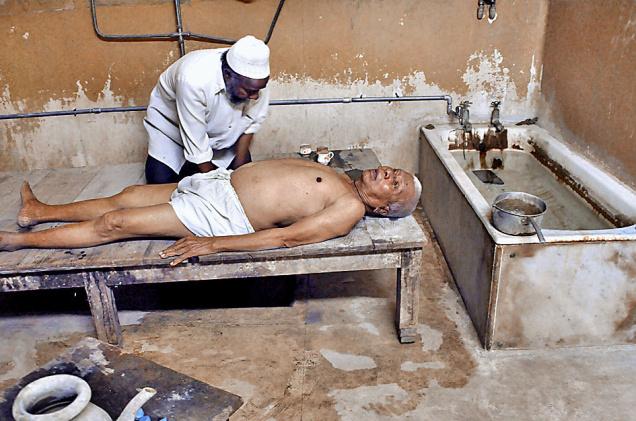
A patient being massaged before undergoing the hot water treatment at the ‘Garam Hamam’ in the Government Nizamia Unani Hospital in Charminar. The Turkish bath has been revived recently after being in disuse for several years. Photo: G. Ramakrishna

The Turkish bath facility helps cure disorders such as cervical and lumbar spondylosis

Hot bath in cold storage. That’s exactly the case with the hoary Turkish bath in the city. For more than a decade the only ‘garam hamam’ at the Government Nizamia General Hospital in Charminar is lying unused. For want of funds and initiative, patients are deprived of this ancient mode of treatment.

Hot favourite

Now serious efforts are on to revive the Turkish bath.

As part of the regimental therapy unorthodox methods like cupping, steam bath, cauterisation, emesis, diuresis and purgation are employed for treatment of various disorders like cervical and lumbar spondylosis .

The Turkish bath is another sure-fire way of curing patients affected with paralysis, obesity, rheumatism and Parkinson disease .

The ‘Garam Hamam’ used to be a hot favourite with patients. But over the years it fell in disuse for want of minor repairs.

All that it required was supply of hot and cold water, repair of the hot water tub and the steam bath chamber. But this simple matter was not attended to.

Thanks to the hospital superintendent, Dr. Mohd Rafi Ahmed’s initiative things are looking up now.

The other such Turkish bath in Hyderabad is situated at Puranapul. It is attached to the 17th century Mian Mishk mosque. This ‘Garam Hamam’ was built in tune with the Islamic principles of hygiene and purification.

But today it lies in a state of utter decay and unapproachable.

The facility at the Unani hospital is much better. The steam bath chamber still remains out of order and the ‘Garam Hamam’ can do with some renovation. The peeling plaster and the seedy look sure gives the creeps.

EFFECTIVE

The ‘hamam’ is a square chamber with a wooden cot and a shower. Using medicated oils the masseur works on the patients.

Thereafter the patients are made to lie in the rectangular hot water tub.

“The therapy sounds strange but it does wonders,” says Mohd Saleem, a lecturer at the Hospital.

Once the Turkish bath becomes fully operational, patients will have yet another effective therapy to avail.

source: http://www.TheHindu.com / News> Cities> Hyderabad / by J. S. Ifthekhar / January 14th, 2012


Mythological theme park to come up near Tirupati

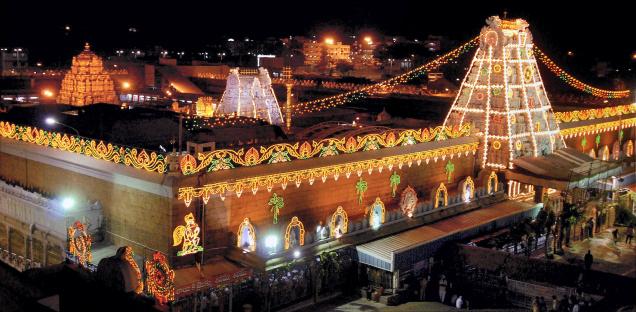
Lord Venkateswara Temple in Tirupati.
Hyderabad: JAN 14:

Sri Vaishnovi Infra Ventures and Resorts Pvt Ltd has signed an agreement with the Tourism Department, Government of Andhra Pradesh, during the CII Partnership Summit to establish the Temples of India and Mythological Theme Park near Alipiri on the foothills of Tirumala.

The Rs 300-crore project will be established in 38 acres encompassing the Temples of India, Mythological Theme Park, Sri Venkateswara Museum, a three-star hotel, amphi theatre, shopping mall, cultural centre, and entertainment zone including restaurants to cater to the needs of the devotees coming to Tirumala.

The project has been designed by architect Nitish Roy.

Through the Temples of India and Mythological Theme Park, it is proposed to display mythological themes such as “Sri Venkateswara Mahatyam” and replicas of famous temples such as Puri, Annavaram, Simhachalam, Ahobilam and Guruvayoor.

According to a company statement, the theme park would provide direct employment to 2,000 people.

A memorandum of understanding was inked during the CII Partnership Summit on Friday.


source: http://www.TheHinduBusinessLine.com / Industry & Economy> Government & Policy / by V Rishi Kumar / January 14th, 2012

Treats of Sankranti

YUMMY TUMMY Try homemade goodies for Sankranti

Celebrate the first festival of this year with traditional treats

The wind is making way for the kites to soar high in the city. As kite makers and kite flyers get busy with their patangmanja and chakhri in the open, there is something traditional cooking even in the most modern kitchens. With the city boasting of residents from all regions, every household will have some special festival dish. Though most Telugus from the districts are headed to their home towns, resident Hyderabadis also enjoy varied festival flavours in their own traditional way.

Each festival is marked by at least one special dish, which may differ from one household to another, depending on the taste and preference of the family and the customs followed. But you can be sure that every home will have something made of either rice or millet, and jaggery to celebrate the harvest season.

Pournima Surve, a media consultant, waits for Sankranti to relish the bajari rotiand mixed vegetable curry. “Bajari is millet and the combo with the sabji differs with every household. The mix vegetable sabji at home has vegetables like carrot, drumstick, papdi and tomato,” explains Pournima.

On the first day of Sankranti, called Bhogi, til and gud (jaggery) is used, so gud-poli is what everyone looks forward to. In a narrow lane in Shah-ali-banda while the kids are flying kites the women are busy making a gud-pol or the puran poli. “The polis are soft as cotton and served with a generous drip of ghee, with a tangy mango pickle to go with it,” says Meenal Vyas, a research scholar. She has timed her visit from US to ensure she celebrates Sankranti with the family in their ancestral home.

Prateek Shah, a Gujarati and a consultant cum trainer says, their family is all forghar mein banaya khana, “Bajre Ki Khichdi. Actually undhhiyu (mix vegetable) is more famous as well as puri kadhi.”

If you happen to visit a city-based Bihari’s home during Sankranti, you can expect Chura, Gur laddoo, sweets made of til such as Tilkut, Tilwa, Maska, etc. “It is convenient to make these anywhere as the ingredients are easily available,” says homemaker Dipti Verma.

Sankranti is also the best time to visit a Tamilian household and eat the variety they cook — Pongal with new harvest rice, kozhambu and the seven curry kootuare not to be missed.

A typical Assamese household in the city misses kath-alu. “Breakfast consists ofkoni-pitha (fried dumplings made of rice flour and eggs), kath alu fry and the traditional pithas made from sticky rice and til and jaggery. It is absolutely difficult to find the ingredients here, so the best option is to get some couriered,” says Dr David Bordoloi.

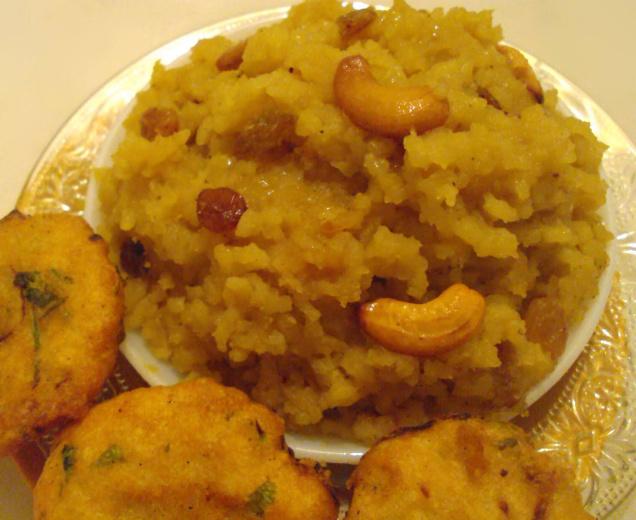
Those who miss their families and crave for festive food will receive a warm welcome in most native Telugu homes. Want to know what really cooks in a traditional Telugu household? Traditional Pongali, a sweet rice and jaggery, and Gummadikaya koora (pumpkin curry) are a must. The feast is usually elaborate. “We will have Ravva LadooBellam Pulusu, Pulihora, Avadalu(Andhra version of dahi vada), Garelu and Gutti Vankaya koora for lunch. We cook the new rice of the year for the first time on this day, and offer it asnaivedyam (offering to God),” says Nalini Vidmahe, a retired government official.

However, to make life and celebrations easier shops are also making a special Sankranti sweet box which comes with a baby kite and a kite wheel. So come Sankranti, the city will be abuzz with fun, frolic, films and festive food.

source: http://www.TheHindu.com / Life&Style> Food / by Prabalika M. Borah / January 12th, 2012


Cassettes and CDs

Masterworks NCPA archives: Balamuralikrishna

A treasure trove

The digitally mastered CD has vintage Mangalampalli Balamuralikrishna in his heyday.

The inimitable genius has a voice to match his masterstrokes! And the ten pieces on this CD which runs for an hour plus, mirror his style of rendition and are like a treasure trove for Balamurali fans. Right from the varnam in Nattai (Nata ragam) Ee naadamu… to his trademark tillana in Kuntalavarali, the tone and tenor are a steady flow of the classical, the Balamurali way. More than the traditional kritis in ragas Ananda Bhairavi, Hindolam and Sri, it is the Punnagavarali, Chenchuruti and Chandrajyoti that stand out in melody, rhythm with tilting cadence inherent in the raga itself. It is such ragas that get an exceptional treatment by Dr. Balamurali and bear out his brand of rendition. So too the Madhyamavathi Nagumomu gala vaani…which is associated with many a concert of his. The improvisations and alapana (prefacing) are far and few and hardly allow us a glimpse into his creative output. That is, if the listener is also a learner! The brief on each raga in the jacket of this CD by Mahadevan R is like a ready-reckoner to the uninitiated. The attempt to capsulate a cross section of ragas that were treated by this maestro by Sony Music is laudable. The output is clarity personified with the nuances of the mridangam by legendary late Dandamudi and violin by Annavarapu Ramaswami, also a maestro in his field, well captured. Kudos to NCPA for bringing out the archives collection with latest technology. The CD is priced at a reasonable Rs. 199.

source: http://www.TheHindu.com / Arts> Music / January 12th, 2012


After GM title Babu aims to become world champion

Hyderabad:


Having achieved the Grandmaster title at the age of 19, M R Lalith Babu is now aiming to improve his ranking and be a world chess champion.

Babu, who earned his third GM norm at the Hastings International Chess Congress in London last week, became the 26th Grandmaster from India and fourth from Andhra Pradesh.

Interestingly, the other GMs from the state – Koneru Humpy, P Harikrishna and D Harika — also belong to Vijayawada, the coastal Andhra city.

Crediting both his mother for spotting the talent in him and striving hard to make him the player he is, as well as coach Murali Krishna for sharpening his skills, Babu said, “It was definitely not a cakewalk for me. We need to work hard to be GM. My mother and my coach encouraged me a lot.”

“My goal is to improve my world ranking, to be a super Grandmaster and to prepare for World Championship,” Babu said.

The teenager came into reckoning with a win at the 46th AP State Chess Championship held at Nellore when he was 15. The prodigy also went on to win the National Under-17 Championship at Calicut in 2007.

He subsequently secured the International Master title after winning a silver medal at the Asian Junior Championship in Chennai.

Babu emerged as the strongest player at the Leiden Championship in the Netherlands, overcoming some of the big names like GMs Van den Doel and Savchenko during the tournament.

He got his first GM and final IM norm in 2009 in Spain and the second GM norm at the Chennai Open in 2010.

The journey of Babu getting his Grandmaster title was not easy as it also involved securing funds, Babu`s mother Padma said.

“Though we faced rejections at times for sponsorships, we took it in a positive way. We thought we should work more to be eligible for securing sponsorships. After all, there was no compulsion for someone to sponsor us.

“Lalith Babu had three IM and three GM norms. He never drew with anyone for a draw. Instead of drawing the game, he always wanted to win the game and obtain the norm. It is a matter of pride for me,” she said.

Padma also said that some well-wishers in Vijayawada and the Andhra Cricket Association (ACA) helped her with finances to send Babu for foreign events.

“We cannot relax now. I feel his life actually starts now. I want him to reach the level of Viswanathan Anand. We need to plan his career in a different way. I hope some sponsors or the government would help us. He need to play foreign events now,” she said.

source: http://www.ZeeNews.India.com / Wednesday, January 11th, 2012

HERITAGE: Fabric of Indian handicraft

The biggest exhibition of Indian textiles and clothing in Asean offers an insight into India’s age-old textile heritage, writes Intan Maizura Ahmad Kamal

THERE’s no way anyone could’ve missed the bobbing head of Shri Badshah Mian with his striking rainbow-coloured turban. One of India’s national award winners, the 57-year-old’s expertise lies in tie and dye design, a craft that has been passed down through seven generations of his family. He’s hoping his two sons will continue the tradition.

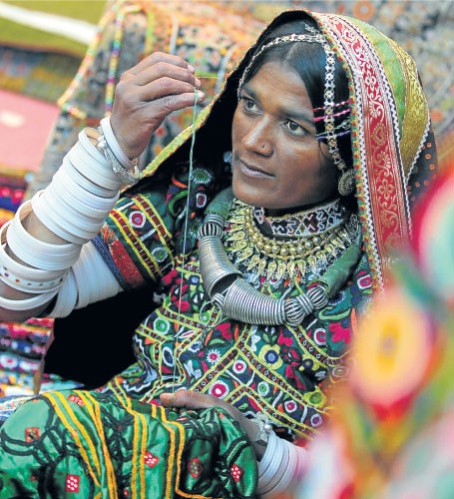
Just opposite the walkway from Shri is an equally colourful Karmabai Merubhai Goradiya, looking resplendent in her Banni embroidered traditional dress complete with neck accessories and veil. Also a national awardee, the shy Karmabai’s forte lies in Banni embroidery, one of the ethnic styles of embroidery of Kutch (Gujrat).

Shri and Karmabai were among the 10 Indian traditional textile artisans present at the recently concluded Intexpo, the biggest exposition of Indian textiles and clothing in the Asean region at the Matrade Exhibition and Convention Centre in Kuala Lumpur.

The event not only gave international buyers and visitors the opportunity to view the latest products that modern India has to offer but also gain a better insight into the country’s age-old heritage in textiles. Housed in a themed pavilion, the artisans, who came from various parts of India, were on hand to demonstrate their intricate skills.

The story of Indian handicrafts dates back to the beginning of the Indian civilisation. Indians have been creating artefacts with unimaginable designs as objects of adoration for the temples ever since the dawn of history. These objects travelled through time to assume variegated forms with unmatched functional values, embellished by some of the most inimitable aesthetics.

Beginning as temple crafts, the handicrafts slowly permeated every aspect of daily life. Today, the handicrafts come in numerous designs and materials and undergo various processes.

The industry produces one of the widest ranges of lifestyle and utility products. A workforce of more than six million forms the backbone of the Indian handicrafts industry. Armed with inherited skills, techniques and traditional craftsmanship, the industry is highly labour-intensive and decentralised and is spread out all over the country, both in rural and urban areas.

TIE AND DYE

Eyes lighting up with pride, Shri confides that his forefathers originated from the state of Rajasthan and produced exquisite works for the Maharajas.

“If you go to Rajasthan you’ll see various designs and patterns of tie and dye,” he says with a smile. “Rajasthanis love wearing various styles of this art and their costumes are more vibrant because of it.”

Tie and dye designs or bandhni are very popular, and because of its uniqueness — no two designs are the same as it’s all handmade — can be found in many exclusive boutiques in India. You can find elegant pieces of tie and dye ranging from saris, handkerchiefs, shawls, lehanga choli (long skirt and blouse), turbans, tops, bedsheets, cushion covers and pillow covers to table cloths and many more.

Rajasthan is famous for its leheriya pattern, which literally means waves. These are harmoniously-arranged diagonal stripes, originally dyed in the auspicious colours of yellow and red. The material is rolled diagonally and certain portions are resisted by lightly binding the threads a short distance from one another before the cloth is dyed. Much skill is required when the distance is shorter because you don’t want one colour to spill onto the other. The dyeing process is repeated until the desired number of colour is achieved.

The colours are derived from mixing pigments from different plants. “Every colour is organic,” explains Shri. Pointing to the ingredients, he adds: “Coffee seeds give a brown colour, while the turmeric roots give me yellow. Pomegranate and the betel nut offer different shades of brown while these madder roots give me the vibrant pink colour.”

How does he know what colours he’ll get? “There’s no science, no calculation, just judgement,” says Shri with a shrug.

The process of making bandhni (tie and dye) as well as patterns, designs and craftsmanship vary from one region to another. Rajasthan and Gujarat are the main hubs where this art flourishes. Rajasthan craftsmen, says Shri, are easily recognised because they grow a nail on their little finger to make it easy for them to lift the cloth for tying. Sometimes they wear a small metal ring with a point.

BANNI EMBROIDERY

Karmabai strikes a pose for the camera. Banni embroidery used to be the best means by which women, especially those from the rural areas, expressed their lives, dreams and desires.

Taking a small embroidered sling bag from the pile of table runners, wall decorations, handbags and handphone holders in front of Karmabai, I express my admiration for the fine handiwork. She beams but is unable to converse due to the language barrier.

Never mind — there are plenty of information boards around.

Embroidery, which is essentially meant to strengthen the fabric and to decorate it, is an important part of the household tradition of the different communities in India. The Banni embroidery is one of the ethnic styles of embroidery of the Kutch (Gujarat), which has a large number of settlers from Central Asia.

THE DESIGN

This type of embroidery is very popular because of the intricacy and richness of the design. Silk floss is used to create the pattern on the fabric. To begin, the design is first marked on the cloth either by free-hand drawing or by tracing, and then followed by the outlines of the design. The filling is done using needle and coloured silk/cotton threads.

The thread is fed from below and is pulled up with an awl and comes up like a loop. The second loop is then pulled forward. This creates the chain-stitch effect, which gives the strong linear patterns.

You can’t fail to be captivated by the delicate weaves on the fabric. The additional use of mirrors in the buttonhole, which are studded using the chain-stitch pattern on the cloth, helps to enhance the overall effect.

KALAMKARI/HAND PRINTING

Hunched over a large piece of cloth with charcoal sketches of Indian deities, his hand gripping a small brush and his face full of concentration is Shri M. Viswanath Reddy, who comes from Andhra Pradesh and is another of India’s award recipients for his Kalamkari works.

The word Kalamkari comes from the Persian words Kalam and Kari, which means drawing with a pen. While the technique has been around for centuries, the style as we know it today, actually emerged from the craft schools that sprang up under the patronage of the Mughal emperors three centuries ago.

There are two distinctive styles in India — the Srikalahasti style, and the Machalipatnam style. Viswanath practises the former, which uses a kalam or pen for free-hand drawing of the subject.

Demonstrating his handiwork, the earnest young man, who learnt his craft from his Kalam-artisan father, explains that to do this piece of art, he begins by first sketching the black outline using charcoal before filling the colours in. “I use all natural colours derived from seeds, flowers, roots — all vegetable dyes. We dip in the colours using this traditional kalam (pen). Depending on the design, it can take a couple of days or longer because it involves 17 painstaking steps.”

THE PEN

The Kalam is made from wooden pieces with arrangement for easy flow of colours. A small bamboo stick with a point is split to form a tip of about an inch. A bit of rug with wool is tied around about an inch from the point and is easily done with one finger that holds the brush. With this Kalam, the paint will run over the piece of cloth guided by the artist’s creative instincts.

This style of Kalam work flowered around temples so it’s not surprising that it has an almost religious identity. Scrolls, temple hangings, banners depict deities and scenes taken from the great Hindu epics and mythological classics.

-Textile facts

1. Indians use organic colour from substances such as coffee seeds for brown colour, turmeric roots for yellow, pomegranate and betel nut for different shades of brown and madder roots for vibrant pink.

2. Embroidery, besides forming beautiful and intricate patterns on otherwise plain fabric, is essentially meant to strengthen the fabric.

3. Kalamkari comes from the Persian words Kalam and Kari, which means drawing with a pen and is made out of 17 tedious steps.

source: http://www.nst.com.my / New Straits Times / Sunday Life & Times / by Intan Maizura Ahmad Kamal / January 08th, 2012


4000 Patients Benefited With Free Health Camp in Parkal

Parkal camp was HUGE success and set a new record for one day camp: 4000 patients were treated in a single day. It was a BIG event by any standard…. 4000 patients……. Rs. 12 Lakhs Medicines distributed (3800 prescriptions filled!!)….. 45 doctors…… 40 pharmacists……100 paramedicals…. 150 NSS volunteers….5 security…. 200 guests…….. 500 people lunch……1500 people Pulihora lunch…… Planning—Coordination–Execution….EXCELLENT. Patients were very happy (that’s the key factor)– doctors are happy too. Many said that camp was like a MODEL camp. Thanks to all teams!!.
———-
Warangal (December 24, 2011). A mega general health camp, sponsored and organized by NRI Dr. Samba Reddy, attracted huge crowd of patients from rural villages in Parkal in Warangal District. The out-patient medical camp, which was conducted with help of Lions club Dr. P. Vijayapal Reddy, IMA Warangal doctors, NATA doctors and local doctors, was held on December 24, 2011 at Govt. Junior College premises, from 9 AM to 4 PM.

The camp was inaugurated by Sakku Bhai (Dy Drugs Controller), AVN Reddy (NATA President), Dr. Samba Reddy (sponsor & organizer), Dr. Vijay Chander Reddy (IMA president-elect), Dr. Samba Siva Rao (DM&HO), Lions club and NATA team members.

A record number of over 4000 patients received medical treatments for various conditions. Originally planned for 1000 patients, but there was an overwhelming crowd of rural and poor patients from surrounding 25 villages within the Parkal Mandal headquarters. The organizers accommodated up to 4000 patients!!!

Whooping Rs. 12 Lakhs medicines, arranged by Dr. Samba Reddy, were distributed to an estimated 4000 patients at this camp. “Over 3800 prescriptions were filled at the Camp Pharmacy” said the Chief sponsor & Camp Organizer Dr. Samba Reddy. He is NATA Media Chair & Conference Secretary and took charge of conducting this health camp. Professionally, he is Associate Professor (College of Medicine), Texas A&M University Health Science Center, USA (see Biography).

Over 45 doctors from MGM hospital, Rohini hospital, various private clinics within twin cities of Hanamkonda & Warangal and also Parkal area participated and provided medical services to patients. More than 20 doctors are super-specialty doctors, including Orthopedics, Cardiology, Gastroenterology, Urology, Gynecology, ENT, Ophthalmology, Dermatology, General Surgery, Psychiatry, Dental and Oncology.

Over 400 lab diagnostics were performed including 250 blood tests, 120 HIV screening and 100 malaria screening (courtesy Vijaya diagnostics & District health office).

Camp pharmacy was inaugurated by Smt. Sakkubhai, Deputy Drugs Controller, who was the Guest of Honor for this camp. Medical and orthopedics wings were inaugurated by Dr. Buchi Reddy (Chairman, Rohini hospital) and Dr. Samba Siava Rao (DM&HO, Warangal), respectively.

The leading physician Dr. P. Vijayapal Reddy served as the convener of this camp. Lions Ch. Narasimha Reddy and K. Mallesham did good job as camp chairman and Lions club president, respectively. They coordinated bus transportation to patients from their villages.

Rs. 12 Lakhs Medicines Distributed

The pharmacy list consists of over 400 high quality medicines (from all therapeutic categories), which are supplied by reputed Pharma companies Dr. Reddy’s, Natco, Veritaz Aurabindo, Dynamite, Novostart, Sunrise International, and other companies. The camp organizer Dr. Samba Reddy arranged all medicines for this camp with help from his friends and colleagues.

Lunch provided to 500 people

All patients felt very happy with free treatment and more importantly with FREE medicines. Food (pulihora) and water packets were provided to patients (at least 1000 patients). Lunch was provided to all participating doctors (50), pharmacists (40) guests (50), and paramedical staff (100) as well as NSS volunteers (total over 500 people). Thanks to Dr. Vijayapal Reddy for hosting such nice lunch at guest house in Parkal.

Over 45 Doctors Participated in Health Camp
The following doctors participated/ helped FREE and not taken any consultation Fee.
NATA Doctors USA: Dr. Sanjeeva Reddy – Physician/Gastroenterology (USA); Dr. Swaroopa Reddy – Physician/General (USA).

IMA Warangal Doctors:

Dr. P. Samba Siva Rao – Physician (DM&HO), Dr. P. Vijay Chander Reddy – Orthopedics (MGM) –IMA president-elect, Dr. Ramesh Kumar – ENT (MGM), Dr. Ram Kumar Reddy – Orthopedics (MGM), Dr. Venkateshwarlu – Orthopedics (MGM), Dr. Sreedhar Raju – Psychiatry (Warangal), Dr. Narender Reddy – General (Hyderabad), Dr. Rajendra Prasad Reddy – Gynecology (Narsampet), Dr. Ragotham Reddy (Physician) – IMA secretary, Dr. Ashok Reddy (Pediatrics), Dr. Sheshu Madhav (Pediatrics) – IMA president, Dr. Buchi Reddy, Physician, Dr. Babu Rao, Physician, Dr. Narasimha Reddy, Physician, Dr. Surender Reddy, Urologist (MGM), Dr. Dilip Kumar, Dr. Manoj Kumar, Dr. Prasad, Dr. Hanmantha Rao, Dr. Praveen, Ophthalmologist, Dr. Sudheer (Orthopedics), Dr. Anwar (IMA treasurer), Dr. M. Ramana Reddy – Ex.DM&HO (Warangal), Dr. D. Sai Chander – PG/Pediatrics, Dr. Naveen Kumar, Dr. Sudhakar Reddy, Dr. Suhakar (surgery), Dr. Mohan Rao (RMO), Dr. Chandra Sekhar (MGM), Dr. Mallikarjun (Eye), Dr. Gopi. Plus 10 medical officers from DM&HO office on camp duty.

Parkal Doctors:

Dr. P. Vijayapal Reddy – Physician, Dr. Rajeshwer Prasad – Physician, Dr. Lalitha, DGO, Dr. Sanjeevaiah (Civil hospital), Dr. Samuel, Dr. Sarojana, Dr. Rama Devi, Dr. Venkata Laxmi, Dr. Rajani Kanth, Dr. Satyanarayana, Dr. Satyanarayana Reddy, Dr. Vidyasagar Reddy, Dr. Kashaiah – Physician/Pediatrics, Dr. Naveen, Dr. Sridhar, Dr. Raja Reddy . Plus 5 other local doctors.

Medical conference bags were provided to all participating doctors. NATA mementos were distributed to them.

Over 40 Pharmacists Dispensed Medications at the Camp

The pharmacist’s team consists of over 40 pharmacists. Medication dispensing was done under the supervision of Chief pharmacists Dr. Samba Reddy, Dr. Arutla Srinivas, Dr. Raghuram Reddy, D. Narender, Dr. Aruna Devi, Dr. Sakkhu Bhai, Dr. Gopi Reddy, Mr. Ramdan, Dr. Raghunandan, and junior pharmacists from Kakatiya University pharmacy colleges and pharmacy executives from Hyderabad. Over 3800 prescriptions were filled in a single day, a record number in camp pharmacy.

Over 100 Paramedical Staff provided patient services

Five types of paramedical staff (total 100) comprising Nurses, health assistants, PHC health workers, ANM students provided patient care services at the camp. About 50 people are from District medical office and 50 are students from local health Education College.

Over 150 NSS Volunteers provided patient coordination services

Four units of NSS volunteers (total 150 students) from GDC and other colleges within the Kakatiya University area have provided volunteer services with patient coordination at the camp site. This task was headed by 10 program officers and one NSS national coordinator Dr. Suresh Lal. Camp certificates are awarded to all volunteers and paramedical staff.

A total of 150 small mementos (by NATA), 50 big plaques, 300 appreciation certificates, 50 doctors bags, and 1500 medicine bags were distributed at the camp.

NATA Team members as Guests

The following NATA seva day team members participated in the camp: AVN Reddy, Dr. Swaroopa Reddy, Dr. Sanjeeva Reddy, Bala Indurti, Jithender Reddy, Harinath Medi and Anil Jyothi.

CHARITY EVENT FOR POOR PATIENTS

This camp is meant to help local poor patients from Parkal and nearby villages, said Dr. Samba Reddy. He is doing this with a service motto to his native village Cherlapally and other surrounding villages. It is a big motivation, so that other NRI and NGOs may come forward to do many such charitable events in rural areas in Warangal, said Dr. Samba Reddy, who lost his Mother recently due to illness.

He thanked all teams for making this camp a grand success for the benefit of poor and rural patients in Parkal area.

We got more medicines stored at Lions Club for future health camps, said Dr. Samba Reddy.

————
OVERALL… It was a BIG event by any standard..for 1 DAY CAMP….. 4000 patients….. Rs. 12 Lakhs Medicines ……. 45 doctors….. 40 pharmacists……100 paramedicals…. 150 NSS volunteers…… 100 guests…… 500 people full lunch……1500 Pulihora lunch.

Despite such MEGA camp with big numbers …. camp organization was smooth without much glitches.

This is due to 1-month plan, meticulous design and execution of camp in a very professional manner.

source: http://www.nataus.org / North America Telugu Association / December 24th, 2011