Category Archives: Arts, Culture & Entertainment

AP identifies more sites for tourism

Hyderabad, MARCH 1:

The Andhra Pradesh Government has identified 21 new tourist destinations for development, including five in East Godavari district and Koringa forest area as an eco-tourist spot.

Answering queries during the question hour, the Minister for Culture and Tourism, Mr Vatti Vasanta Kumar, said that the State Government has identified Koringa forest area as a priority project. The Andhra Pradesh Tourism Development Corporation has proposed developing an eco-tourism spot there with an investment of Rs 6.25 crore, wherein the Central Government is likely to provide Rs 5.20 crore.

Replying to a query raised by Mr K. Kannababu, with regard to new locations identified for development and the number of people employed with APTDC, the Minister said that APTDC employed 1,910 people and 1,600 through public-private partnership projects in the State.

He said that there was a proposal to develop the beach along the coast in port town of Kakinada. The district Collector has identified land for development.

RESERVOIRS AS SITES

Further, APTDC has identified seven reservoirs for development as tourist destinations. Dindi reservoir, Gundlakamma, Yeleru, Brahmasagar, Sriramsagar, Kadem and Jurala have been identified and expression of interest invited for developing them into tourist sites.

The EoI received overwhelming response with 162 applications and the selection of developer is at advanced stage.

source: http://www.TheHinduBusinessLine.com / Industry & Economy> Government and Policy / Hindu Bureau / March 01st, 2012


Torque’12, Mechanical Fest at JNTU College of Engineering, Kakinada

JNTU College of Engineering, Kakinada will organize Torque’12, national level mechanical fest from March 16 to March 17, 2012.

Torque’12 is a national level technical symposium organised by the department of mechanical engineering, JNTU. Torque is a moment to couple your innovation.

At present the whole world is about engineers and their technology, and the dictum is proved by the “TORQUE” in JNTU. For this the national level fest Torque’12 is back again.

With guest lectures that will explore new vistas and technical events, both fun filled and sober, that are designed to make your mind race, the two day national level symposium will be an arena for exchanging ideas and showcasing brilliance.

The dimensions of the events are being enlarged with the progress of the Torque and the accommodation will be provided for free of cost for all the participants.

Events:

  • Technodox – Paper Presentation
  • Posterite
  • Action Replay – Movie Making
  • Contraption
  • Machine Impossible – Innovative Design
  • Step Up
  • Death Race – Robo Wars
  • Spot Events

Registrations are opened for all the events.

Last Date for registrations is 10th march.

Venue: JNTU College of Engineering, Kakinada

For more details, please contact:

For Registrations:

M.V.Ravi Kishore, 9701579416

A.V.S.Ranga Rao, 9493333245

Website: www.torque2k12.com

Event Face book page:

www.facebook.com/pages/Torque12/218908128206906

source: http://www.Minglebox.com / Home> Campus> Articles / February 27th, 2012


Vulture egg ‘breaks’ all hopes

Hyderabad:

Dashing long-awaited hopes of breeding, the egg laid by a white-backed vulture a fortnight ago at the Nehru Zoological Park fell from the nest and smashed to the ground. The male vulture, in a bid to readjust the nest pulled out a few twigs which led to the egg falling down, zoo officials said. This was captured by the CCTV cameras installed at the breeding centre.

The egg was crucial for the centre that became operational about a year-andhalf ago, four years after it was announced, to initiate captive breeding of the endangered birds. The scavenging birds have been almost wiped out in India in the past 10-15 years due to a drug called Diclofenac, used as a pain-killer in humans and animals.

The Parsi community that places its dead in the `Tower of Silence’ to be consumed by these scavenging birds has been the worst effected. Zoo officials said the egg fell down within a couple of days after it was laid. “Both were incubating it but on the day of the incident, the female went a few metres away to have its feed and in the meantime, the male vulture pulled out some twigs from the nest and the egg fell down,” said Shekhar Reddy, curator (in-charge) of the zoo park.

Though experts said that once the first egg is lost, the birds usually lay a second one but zoo officials said that another egg was not laid.

The captive breeding centre in zoo park is among the two such establishments set up by the Centre, including the one at Pinjore in Haryana.

The centre in Hyderabad, currently operating in collaboration with the Centre for Cellular and Micro Biology (CCMB), has two male and three female vultures aged over 20 years. Officials said the breeding is likely to begin again in the next season starting October. They said that this was the first time the egg was laid in the centre.

source: http://www.articles.timesofindia.indiatimes.com / City> Hyderabad / Home> Collections> Centre / TNN / February 23rd, 2012

Direct flight to benefit Telugus in UAE

Dubai flight is the first step in providing international connectivity to city’

People from the Visakhapatnam region living in the United Arab Emirates (UAE) are in a jubilant mood with the announcement of a direct flight to Visakhapatnam from Dubai via Hyderabad, according to Sarat of Sharjah-based All Andhra Association of UAE.

At a media conference organised by the Air Travellers Association of India (ATA-I) here on Saturday, he said there were 2.5 lakh Telugus residing in Dubai, of whom 30 per cent were from the Visakhapatnam region. They had been representing to the Government of India for a long time seeking introduction of a direct flight to Visakhapatnam.

Holiday season

The association has been spreading the message of international connectivity through Facebook and has got 5,000 responses so far.

Mr. Sarat said that April being the holiday season, there would be a huge demand for direct flights from Visakhapatnam to Dubai and back. The direct flight would be advantageous to all sections of people living in the UAE, as Air India was also planning to provide transportation to other cities.

Sriram Ravichander, vice-president (logistics) of ATA (I), described the Dubai flight as the first step in the direction of providing international connectivity to Visakhapatnam. The ATA (I) would prepare a roadmap for getting more flights to international destinations such as Singapore, Malaysia, and the U.S. He recalled the efforts made by Union Minister of State for Human Resource Development D. Purandeswari and Rajya Sahba Member T. Subbarami Reddy in getting the direct flight.

Export potential

Capt. Ravichander said every flight could carry four tonnes of cargo and help in boosting exports.

ATA (I) president D. Varada Reddy said it was unfortunate that it took 10 years to get an international flight after the Government of India had declared way back in 2002 that Visakhapatnam could serve as a ‘Gateway to the East’ under the ‘Look East Policy’ due to its proximity to countries in the east.

ATA (I) secretary-general Rajgopal Reddy spoke.


  • Out of 2.5 lakh Telugus residing in Dubai, 30 per cent are from the Visakhapatnam region
  • ATA (I) to prepare a roadmap for getting more flights to international destinations

  • source: http://www.TheHindu.com / National> Andhra Pradesh / by Staff Reporter / Visakhapatnam, February 12th, 2012

    Glory to be restored: Plans afoot to draw tourists to Ashoor Khana

    Hyderabad:

    Having been freed of encroachments, the 400-year-old Badeshahi Ashoor Khana is now all set to woo tourists. If proposals put forth by the state department of tourism materialize, the Qutub Shahi era monument may start undergoing renovation by next month.

    The Badeshahi Ashoor Khana, built in 1594 by Mohammed Quli Qutub Shahthree years after the construction of the iconic Charminar, has been at the receiving end of official neglect and vagaries of nature for long. Collapsed roofs prevented Shia devotes from optimally using it during Muharram months, while encroachers deprived tourists and visitors from enjoying its heritage value. Finally at the behest of a high court order, a drive against encroachers was initiated in 2009. But it was not until December last year that the monument was completely rid of encroachments. Now the authorities are pondering over the task of turning it into one of the best tourist destination in the city.

    Requesting anonymity, an official in the tourism department, said that an elaborate plan to the tune of Rs 4.36 cr for restoration of the Ashoor Khana and the adjoining buildings was presented to central tourism secretary Rajan Habeeb Khaja when he visited Hyderabad last week. The plan depicts structural restoration works to the roof lime plates of Ashoor Khana, major restoration works in the Niyaz Khana and Naqaar Khana, besides other auxiliary buildings. The roofs of both these edifices had collapsed in 2007, warranting extensive repairs. The official said that the plan envisages not just structural restorations but also restoration of the function of the buildings.

    “The Naqaar Khana was used as a communication centre where drums were beaten to inform public about installation of Alams. After restoration, we may contemplate having an exhibition here to showcase the Muharram highlights of Hyderabad,” said the official.

    Chandana Khan, in-charge secretary of tourism department confirmed that there are plans in pipeline for the Ashoor Khana. “During our discussions with the central tourism secretary issues pertaining to city and rural heritage were discussed. The Badeshahi Ashoor Khana is an important part of the city’s heritage and needs to be spruced up,” she said, declining to give more details.

    The Ashoor Khana’s caretakers said that the Union tourism secretary had heard their complaints and conducted a detailed inspection of the monument.

    “During the last eviction drive, part of the caretaker’s house was destroyed. We brought this to the notice of the union secretary. Taking notice of the dilapidated state of the auxiliary buildings, the secretary also commented on the proximity of neighboring buildings. He also directed the state tourism and archeology officials to ensure smooth development of the Ashoor Khana into a tourist destination,” Abbas Mousvi, a member of the caretaker’s family said.

    Heritage activist however caution that the restoration should be done in accordance with the historical nature and usage of the building.

    “The officials had constructed a restaurant in the Qutub Shahi tomb which did not go with the historical and architectural ambience. Restorations at the Badehshahi Ashoorkhana should happen keeping in view its sanctity, as it is primarily a place of mourning. This should not be forgotten when works are planned,” said activist Sajjad Shahid.

    source: http://www.TimesofIndia.indiatimes.com / Home> City> Hyderabad / TNN / February 06th, 2012

    Fusion 2012, Rise Group of Institutions, Ongole, Andhra Pradesh

    A much awaited annual tech-fest conducted by the Faculty & Students of RISE GROUPS to celebrate technology at its zenith. A platform where we can challenge the unchallenged. The outcome of this concept can be very lucrative and one realizes it in Fusion-2012. This technical extravaganza put together by the students of RISE GROUPS is scheduled to kick off in February 2012.

    Event Name

    Fusion 2012

    Event Start Date

    24th February 2012

    Event End Date
    25th February 2012
    Event Website

    http://www.risegroup.edu.in/events/

    Event Institute

    Rise Group of Institutions, Ongole, Andhra Pradesh

    Event List
    Paper Presentation
    Poster Presentation
    Movie Making
    Quiz
    Spot Events
    Event Contact Details

    M.Vinod Babu ( 94902 48582)
    V. Hari Kishore ( 97031 44778)

    source: http://www.fests.engineer.com / February 07th, 2012

    Mahesh Babu is 5th most desirable man in India

    New Delhi, Feb 6 (TruthDive):

    Mahesh Babu has been voted as the 5th Most Desirable Man in India in a nationwide poll conducted by Times of India. Keep going Mahesh!

    Mahesh Babu was the only Star from Tollywood who found the place in this National list which is majorly populated by Bollywood and Kollywood Stars.

    India’s well reputed Times Network has conducted an opinion poll in India to find the Times Fabulous 50 Most Desirable Men & 50 Most Desirable Women of 2010.

    This list will be decided based on the most desired, beautiful, sexy, successful and popular personalities in India through Online voting to set the DQ (Desirability Quotient) which ended on December 31 on which nearly 3 Lakhs people voted for their Fab.

    Mahesh Babu was one among the three Telugu actors who were short-listed among the Top 50 list. The other two were Rana Daggubati and Siddharth.

    Mahesh Babu is on a new high post two blockbusters – Dookudu and Businessman. Moreover, his brand value has increased manifold over the past couple of years. Now with him being ranked among the most popular actors in the country, it is yet another proof of his charismatic appeal and massive fan following. He has scaled the ladder from 12th position last year to fifth spot this year. Great going Mahesh!

    With seeing a good improvement in the most desirable man status, the prince of Tollywood has set a new goal and has begun.

    Well, it is heard that Mahesh’s next target is to bag the National Award. Apparently, he has seen enough with the likes of ‘Pokiri’ and ‘Businessman’. While the commercial string of flicks still continues, reports say Mahesh wants to get into the league of performers and prove his mettle as an actor.

    Indian skipper Mahendra Singh Dhoni is next to Mahesh Babu in the placing.

    New entrant Daggupati Rana of Tollywood is in the 20th place,

    source: http://www.TruthDive.com / Entertainment> Exclusive> News / by Kanchana Devi / February 06th, 2012


    Dance is beyond male and female

    Bhubaneswar:

    How often does one get to see a male dancer presenting a traditional temple dance performed for centuries by women? Not often.

    But when Kala Krishna performed Andhra Natyam in the city last week during the 5th Debaprasad Samman cultural festival, he did set the stage on fire. Such grace and feminity marked the performance that not for a moment the audience felt the difference. And when they realised, they were so overpowered by the performance that they could only ask for more in approbation.

    A line for the uninitiated, Andhra Natyam is a temple dance of Andhra Pradesh. The dance form has a beauty of its own which comes with some of the earthiness, the ruggedness of the traditional folk forms.

    Kala Krishna began his performance with ‘pushpanjali’ in the style of temple rituals. This item was usually performed by Deva Nartakeeda or Devadasis in front of Gods. This was followed by ‘Kaivaram’ in praise of Lord Madhava. The dancer followed it with ‘Navajanardhana Parijatham’ in which he gave an insight into the feminine contradictions of Satyabhama, all melting love one moment for her beloved Lord Krishna and the next an avenging angel brandishing her plait as a whip to beat him with.

    So spontaneous were the presentations of this 60-year-old artiste that the audience refused to believe that a man was staging the character of a woman. Andhra Pradesh-based Kala Krishna is one of the very few dancers in the Andhra Natyam tradition who specialises in stree vesham (female impersonation), particularly performing as Satyabhama.

    A native of Kallepalli, a village in the district of Karimnagar, Kala Krishna was born to a simple farmer couple. While pursuing studies in Bejadanki, Kala Krishna also took part in cultural programmes and always showed a keen interest towards other art forms. An exposure to classical dance came when young Kala Krishna was taken to see Kuchipudi veteran Vedantam Satyanarayana (1967) while on a school trip. Following elder brother’s suggestion, he decided to support his family as a school teacher in Hyderabad where he also shaped the school’s cultural shows.

    At the suggestion of a colleague, 22-year old Kala Krishna began to learn Kuchipudi from Vedantam Jagannatha Sharma, who soon left the city, but not before introducing the youngster to scholar and dance revivalist late Nataraj Ramakrishna who was instrumental in reviving the near-forgotten Andhra Natyam dance form. “My training in Andhra Natyam began at the age of 22. It was difficult for both me and my Guru who gave me intensive training of 12 to 15 hours every day to mould my body to the dance form,” he says.

    Under Ramakrishna, he specialised in ‘Navajanardana Parijatam’, traditionally performed over nine nights in the temples of East Godavari district, based on the life of Lord Krishna and his consort Satyabhama. Made up as the young, beautiful Satyabhama, Kala Krishna began to enthral the audience by dancing the ‘Navajanardana Parijatam’ in 1979. “My debut performance was in the age of 24. The journey since then has been difficult yet amazing,” says Kala Krishna.

    Today, Kala Krishna does perform in male attire as well but is best known for his female impersonation. Did he feel odd about donning a woman’s costume for Andhra Natyam? “Dance is beyond male and female. I simply followed my guru’s orders. Yes, I did feel uncomfortable in a sari. It took me sometime to respond, for my blood to support me in feeling like a woman. Today, I see it more like an acting,” he says.

    With research grants from the Ministry of Culture and the Sangeet Natak Akademi, Kala Krishna has also undertaken a comparative analysis of Andhra Natyam and Bharatanatyam, and studied Abhinaya techniques in female impersonation. The recipient of many awards, he teaches the dance form at the Telugu University and the University of Hyderabad.

    source: http://www.ibnlive.in.com / South> Southern News> Orissa / Express News Service / The New Indian Express / January 31st, 2012

    The 150-yr-old Naan makers of Hyderabad’s Charminar

    Hyderabad:

    It was a dish synonymous with the common Hyderabadi’s palate for the last two centuries — soft baked maida with an earthen smell of the tandoor, best accompanied with gracious servings of lamb chops and rich gravy. Any wonder then that 150 years on, the makers of Mughal Naan continue to do brisk business. Their new age patrons who make this possible come from all walks of life – businessmen, corporates and the ubiquitous tourists of Charminar-all eager to buy the naan in bulk.

    And lined up in a row along the Purani Haveli Road, the shops from where these naans come alive have undergone very little interior changes, even as the exteriors spot bright display boards, calling attention to the recipe being prepared inside. “My forefathers had set up shop first near the Charminar Chowk around 200 years ago. But we shifted to this lane some 150 years ago. We are the sixth generation of naan makers in our family,” says Abbas whose Abbasi Naan Shop spots the byline ‘Heritage Shop’ outside.

    A day in the life of these naan makers starts at six in the morning or much earlier, depending on the order for the day and goes up to nine at night. “A major part of our sales is through orders for corporates, or marriage functions. So work timing is irregular, though on an average we work for 2-3 hours at a stretch before taking a break of equal duration,” he explains.

    Each of the half-a-dozen shops here sell close to 3000 naan every day, of which the square variety costing Rs 8 per piece is the favourite among buyers. That’s equal to a cool Rs 24,000 in sales per day, for the staff comprising four workers who handle the tandoor, two men for packaging and two family members who help oversee the delivery and tandoor.

    “We also have five other different shapes such as star, heart, flower etc. The rate depends on which shape the customer prefers,” chips in a worker at the nearby Hussaini Naan Shop.  The tandoor, which occupies place of pride at these shops, can accommodate 42 rotis at any given point of time, and according to Abbas, “It takes just 3-4 minutes for one batch to be made.”

    The Mughal roti is made with maida, oil and a dash of salt, and the recipe has passed on without change over years. Ask them the reason for the same and the response is as heritage as the naan itself, “We haven’t improvised or brought in our own additions yet. Our customers want us to retain the authentic taste of the naan. And we give them just that.”

    source: http://www.ibnlive.in.com / South> Andhra Pradesh> Hyderabad / Express News Service / The New Indian Express / January 31st, 2012


    Revolutionary road

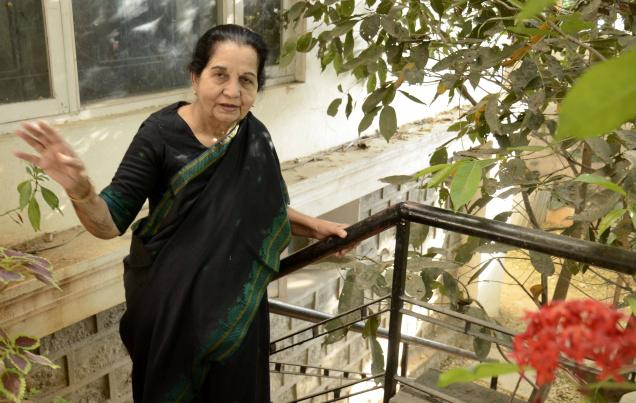
    Urdu writer Jeelani Bano Photo: Nagara Gopal
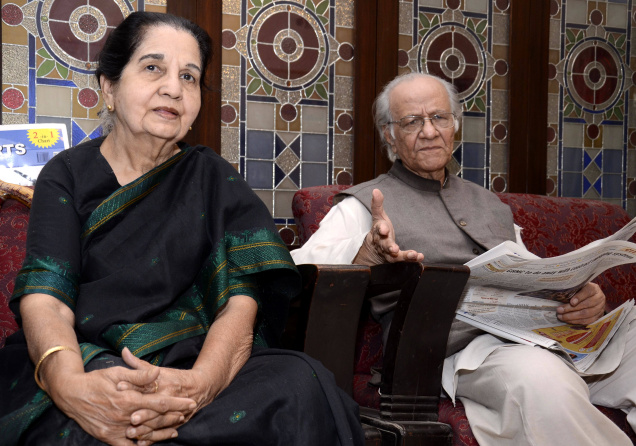
    Jeelani Bano with writer husband Anwar Moazzam Photo: Nagara Gopal

    The Progressive Writers Movement and a desire to fight against social injustices made her what she is, says Urdu writer Jeelani Bano. Sohini Chakravorty goes back in time with her.

    It has the power to arouse patriotic fervour and to evoke love and passion, and it can be our only company in melancholy – Urdu has always been synonymous with revolution, change, love and tehzeeb. It is also a language that is fighting hard for a place in an increasingly homogenised world. One of the beacons of Urdu is Padma Shri awardee, writer and poet Jeelani Bano.

    Time has stopped in her tranquil house, where words like courtesy, history and heritage still hold meaning. Originally from Badayun, Uttar Pradesh, her family made Hyderabad their home and it is in this home that she was exposed to the eclectic world of poets, writers, revolutionaries, musicians and artists. Her father, Hairat Badayuni, was also a well-known poet of his time. “We grew up in an environment of mushairas, classical music concerts, sher-o-shayari. Writers from India and Pakistan were constant visitors in our house,” says Jeelani Bano, who started writing when she was just eight years old. Early in life she was exposed to the works of Faiz Ahmed Faiz, Saadat Hasan Manto, Ismat Chugtai, Maqdoom Mohiuddin, Krishan Chander and many other writers from the Progressive Writers Movement.

    Even in an ambience of art and culture, there were restrictions and the strict diktats of the purdah system. “My mother was very particular and never allowed me to read Ismat Chughtai’s novels, which I used to hide and read,” the author reminisces. “We were not allowed in the room where poetry recitations and concerts used to go on. Instead, we used to sit in the angan of our house and listen to it from a distance. Later, my brothers used to mimic the writers and poets and entertain us,” she laughs.

    In such an environment, her sensibilities of a writer germinated. On a visit to her governess’s village, she got the idea for her first short story, Mom ki Mariyam, about the exploitation faced by the villagers. She then sent her story anonymously to a magazine, which later published it. “People who read the story were outraged and complained to my Abba that how he could allow me to write such a story. I was very scared when he showed my story to Maqdoom Mohiuddin, but he put a hand on my head and said he was very happy that I showed such depth at such a young age. He asked my father not to stop me again,” she says.

    Jeelani Bano’s life took a turn when she got married while still studying at Intermediate. It was only after marriage that she completed her masters in Urdu Literature and came out of purdah. She attributes much of her inspiration and success to her husband Anwar Moazzam, a writer and former head of the department of Islamic Studies at Osmania University.

    Her works, amounting to over 22 published books including poems, short stories, novels and a screenplay for Shyam Benegal’s film Well Done Abba, have been translated into various Indian and international languages. Her stories have mirrored the social issues and causes of her time.

    Whether it is against the plight of the bonded labourers in Paththaron ki Barishor against divisive politics and power wielded by politicians in Raasta Band Hain, she feels that it is the duty of a writer to protest against the evils of society and guide its people in the right direction. She says, “I am aware of things around me and any kind of news becomes an afsana for me. I don’t sit behind closed doors and write on romance and family feuds.”

    It is her sense of social awareness that made Jeelani Bano the chairperson for Youth for Action, Principal Advisor, Child and Women Human Rights, International Human Rights Association (India) and chairperson of Asmita, an NGO dealing with women’s rights.

    The author feels, however, that writers or the government cannot be blamed for the fading influences of Urdu and other regional languages. “We are responsible for the fading of Urdu language. We are not teaching Urdu to our children. Urdu was never a commercial language when compared to English but to protect the language we need to teach our children at home,” she says.

    The writer agrees the language has undergone change over decades with the influences of regional dialects. Like any Hyderabadi, she is passionate about Dakhini Urdu and feels the need to preserve the language for future generations. “The Urdu spoken in Delhi or Lucknow is different from what we speak here in Hyderabad. Influences of Telugu are present in Dakhini Urdu,” she explains. She has over 20 recordings of Dakhini Urdu, which represents the language spoken across various demographics.

    “Changes are good and a city is bound to undergo changes with time,” says the writer. “But the common people and people on the street should not pay for it. That is why I became a writer, to speak against the injustices of society.” And she has chronicled the history of Hyderabad right from the days of Nizam in her book Aiwan-e-Ghazal.

    In the age of social networks and power of electronic media, she feels that to engage young people it is imperative to narrate stories that are reflective of and relevant to contemporary society. And indeed her voice is completely in sync with the changing tides without putting any of the old tehzeeb on a guillotine.

    Yesterday once more

    It is not just Jeelani Bano’s captivating stories and feisty views on an ailing society that keep her conversation sparkling. She also shares anecdotes about her close association with some of the finest writers and artists of the day. Paintings by M.F. Hussain, a regular visitor to the house, adorn the walls of her living room. “Ismat aapa used to call me beti and I used to stay with her frequently. More than writing, I think I learnt cooking from her,” says the amused author. Apart from receiving constant encouragement from Rajinder Singh Bedi and Krishan Chander, Jeelani Bano sent her first published book to Faiz Ahmed Faiz when he was just out of prison in Rawalpindi. “Back then it was a tradition to send the first publication to the writers across. When I sent Faiz my book, he replied with a handwritten letter saying he appreciated my work.” Some of her correspondence with other writers appears in her book Door ki Aawaazen.

    source: http://www.TheHindu.com / Life & Style> Society / by Sohini Chakravorty / January 19th, 2012