Category Archives: About Seemandhra / Andhra Pradesh

Picture-perfect history

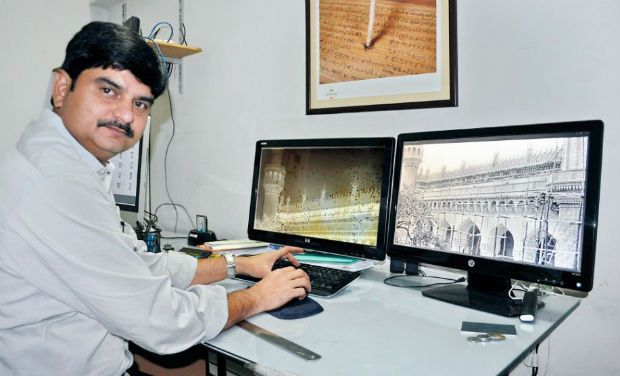
Paulus Raveendra Eduri shows how the photographs are digitised.

Hyderabad: 

Bruno Jehle arrived in India in 1983, “when India was still taking shape”. Soon after his arrival in Mumbai, the tall Swiss hopped on a train and embarked on a very long, 30-hour trip to what was then, the grand city of Madras.

“I remember the slums around Adyar. People looked at me and immediately assumed that I had lots of money and that I could help them out of their many problems. But I didn’t have a penny and yes, life in the slums was tough, demanding and challenging.”

But Jehle soon started helping out in a business selling eggs, dealt with thugs and made life-long friends. It is that very link with “that true India” that left an indelible mark, which was clearly evident during his meeting with the DC, where he explained what the Switzerland-based BJ Institute is doing in the bylanes of West Marredpally.

The Nizam’s photos

One of the founders of the institute, Jehle, a lithographer by trade, has over the past seven years, managed to train a small team of Hyderabadi photo specialists to restore and digitise some of the first photos taken of the city and beyond.

These photographs, dating back at least a 100 years, were taken by the Hyderabad Department of Archeology — a rag-tag bunch of photographers commissioned by the erstwhile Nizam’s government to shoot and document historical structures, artifacts and excavations across the dominion and the neighbouring regions. What the photographers did then, was the first ever photo survey of the region, taking over 60,000 photographs of structures ranging from the 1,000-pillar temple at Hanamkonda to the Ajanta Elora caves of Maharashtra.

The  photographs were stored as negatives, inside crates that piled from floor to roof. When the state of Andhra Pradesh was formed in 1956, the photos moved into the hands of the newly-designated Department of Archae-ology of Museums and the officials then moved the precious photos into a room, where they rested for 99 years, subject to heat, dust and the elements.

That’s until Jehle’s and his Indian partner Paulus Rave-endra Eduri pitched to the government that they had the means and motivation to restore and preserve the photographs, with a 300-year warranty.

Paint and polish

So in the October of 2012 began the task of sorting and cataloguing the thousands of photo negatives. An entire ‘clean room’ was built from the ground up, equipment was brought in, personnel were hired, documents were signed and a small, tight team, along with representatives from the government, went to work.

“We had to guard the room against natural light, clean it up and then take photos of the negatives. But then we knew what the challenges were and this was not the job where we could’ve cut corners,” said Eduri.

The final product is stunning. Printed on the choicest of paper, the collection of restored photographs offer a never-seen-before insight of the monuments and people from an era that’s mandatory study for several experts. The photographs show clothing, modes of transport, trade, layouts of towns and much more.

“This is what I want people to see. Our small team in Hyderabad has managed to bring out the life and times of a forgotten people,” adds Jehle.

And in that little house in West Marredpally is also where the Indo-Swiss collaboration has come full circle. In 1948, just after India’s Indepen-dence, the nation’s leading lights had sent out a sort of SOS to the Swiss government, asking for help in infrastructure development. Jehle and Eduri’s work then is the coming together of a 65-year-old idea, an initiative… that is finally taking form in Hyderabad.

source: http://www.deccanchronicle.com / Deccan Chronicle / Home> Nation> Current Affairs / DC /  by Govind Vijaykumar / December 15th, 2014

Of passion and pure thrill of flying high

Hyderabad :

The Air Force Station at Begumpet was one of six heritages of the city to be acknowledged with an award by the Indian National Trust for Art and Cultural Heritage (Intach) on the occasion of World Heritage Day 2014. The event brought into focus little known facts about Hyderabad’s history, including the city’s pioneering efforts in the field of aviation which commenced in 1911 when a Belgian aviator, Baron de Caters, along with his assistant Jules Tyck, arrived with a fleet of planes to give demonstration at the Secunderabad Parade Ground.

The three-day affair received wide publicity and drew large crowds of onlookers including quite a few women. A newspaper report preceding the event announced that “a popular society lady will be taken up by the Baron on the first day”. Unfortunately the identity of this enigmatic passenger remains unknown and it is believed that it must have been a member of the European community then living in the cantonment.

The first direct association of Hyderabad with aviation was established a few years later when during World War I, a British pilot challenged the enemy while flying an aircraft bearing the name of ‘Hyderabad’ over the skies of Germany in 1917. In recognition of contributions to the Imperial war effort, the names of native states had been inscribed on the aircraft of ‘Gift Squadrons’ raised and maintained with funds donated by the Indian rulers. Subsequently, the British formed two more Hyderabad Squadrons during World War II with public contributions raised at Hyderabad, and the Spitfires and Hurricanes of these units had the legend “Presented by His Exalted Highness, the Nizam of Hyderabad” emblazoned on their fuselage. Among the three Hyderabad Squadrons of the Royal Air Force, the 152nd had the Nizam’s crown, the distinctive ‘dastar’, displayed prominently on its insignia.

The credit of introducing Hyderabad to flying as a hobby goes to two adventurous youngsters, Babar Mirza and Pingle Madhusudhan Reddy, who developed a keen interest in flying while pursuing their studies in England. While Reddy managed to keep his passion for flying in check long enough to obtain a degree in mechanical engineering from Leeds, Mirza concentrated more on developing an expertise in handling aircraft. Reckless by nature, he purchased a Simmonds Spartan and set out from Croydon in late 1932 with the sole obsession of reaching Hyderabad within the shortest possible time despite his father having explicitly banned him from undertaking such a “perilous and foolish adventure”. Without giving a second thought to the logistics involved in undertaking such an arduous journey and despite refusal of permission to transit Turkey, Mirza successfully bluffed his way out of tricky situations including some perilous moments at Konya where he inadvertently landed on a military parade ground and was promptly marched off at gunpoint! Unable to take the punishment of the “Air Mad” Hyderabadi anymore, the plane’s engine gave way over the Iraqi desert. Rescued by Bedouins, he was packed off to India along with the wreckage of his aircraft.

Within a year of the mishap, Babar Mirza had somehow convinced his father Manzoor Jung to support his plans of establishing an Aero Club at Hyderabad. Laying out a landing strip on the polo ground of the family estate at Habsiguda, he flew in the now restored Spartan from Karachi and applied to the Nizam’s government for permission to start a private Flying Club and ordered another aircraft from London. Meanwhile Reddy, having purchased an Avro Avian in England in 1933, flew it to Hyderabad and touched down at Habsiguda to join the Deccan Aero Club. Official permission still pending, Babar Mirza took it upon himself to garner support and went about it in a unique way. Inviting the then Prime Minister of Hyderabad Maharaja Kishen Pershad and other elite to Habsiguda for an evening of flight demonstrations, he put on a show that they would never forget. After his colleagues had shown their skills in performing ‘loops’ and ‘rolls’, Mirza swooped down low over the heads of the visiting dignitaries creating ‘quite a sensation’! The dare seems to have had little effect on the administration as it was another three years before the Hyderabad State Aero Club was formally inaugurated in 1936. Mirza’s antics though, seem to have set a precedent for disgruntled aviators. Old-timers of the city narrate the exploits of another pioneer, a scion of the Bilgrami family who, jilted by his beloved because of a stubborn refusal to give up his ‘dangerous’ passion for flying, made repeated low passes over her wedding venue; blowing away the shamiana, scattering the guests and turning a lavish spread inedible with a coating of dust!

(This is the first of a two-part series on Hyderabad’s aviation. The writer is a heritage activist)

source: http://www.timesofindia.indiatimes.com / The Times of India / Home> City> Hyderabad / by Sajjad Shahid, TNN / April 27th, 2014

____________________________________________________________________________________


PM Reddy: An aviator and engineer par excellence

The founding of the Hyderabad State Aero Club ushered in an era of relative decorum and the unchecked exploits of buccaneering aviation pioneers of the city were finally tamed to a large extent. Over succeeding years Babar Mirza and P M Reddy, matured into serious aviators who took on the task of ensuring that aviation in the Deccan kept pace with international trends. Their enthusiasm for flying inspired others to take up the hobby and also hastened the plans of the Nizam’s government to establish an airline. Aban Pestonji Chenoy, the teenaged daughter of the Nizam’s Mint Master, became the first woman member of the Hyderabad State Aero Club to qualify for an aviator’s license in 1938, a year in which 55 of the club’s 70 members were Indians.

The club’s operations were suspended during World War II and its pilots, aircraft and facilities were commandeered for use by a training squadron. The association of Begumpet with the Air Force has continued ever since. The acute need for pilots during the war resulted in the establishment of a center of the Indian Air Training Corps on the Osmania University campus in 1945. Trained by Hyderabad’s own pilots along with British officers, cadets of the very first batch passing out from the Osmania University made such a strong impression on the recruiting board that a majority of them were recommended for a commission in the Air Force.

Princess Durru Shehwar laid the foundation stone for the passenger terminal at Begumpet in 1936 as part of the Nizam’s Silver Jubilee celebrations and Deccan Airways Limited was incorporated in 1945, becoming the first airline to be promoted by a native State. A joint venture of Hyderabad State and Tata Airlines, Deccan Airways had a fleet of a dozen Douglas DC-3 ‘Dakota’ aircraft when Hyderabad was absorbed into the Indian Union in 1948.

It was with Pingle Madhusudhan Reddy’s encouragement that the last Nizam, Mir Osman Ali Khan, first boarded an aircraft for a sortie over the city intended to check out his reactions to flying. Initially thrilled at being able to view from the skies, the Nizam is said to have later issued orders prohibiting any aircraft from flying over his palace. On one of his later flights in a twin engine aircraft, he enquired from PM as to what would happen if an engine conked off during flight. “Not a problem Your Exalted Highness”, PM replied, “We can safely carry on with the remaining engine”.

Years later when boarding a flight for Delhi, he pointed to the four engines of the Super Constellation and exclaimed; “Now that is what I call a safe aero-plane!”

By 1947 Deccan Airways had a fleet of sturdy Douglas DC-3 ‘Dakota’ aircraft which connected Hyderabad with key cities through regular services. Apart from scheduled flights, the airline also took on charters and diplomatic sorties on behalf of the Nizam and his government. The airline continued to serve the ruler of Hyderabad in his capacity as the Rajparmukh subsequent to merger and one of the tasks personally supervised by PM was to ensure a daily supply of fresh water for the Nizam during his sojourns away from Hyderabad. Drawn from a protected source which had supplied his ancestors, the waters of the Bam Rukn-ud Dowlah, a spring near the Mir Alam Tank, were shipped under guard in special sealed containers for the Nizam and his family.

Pingle Madhusudhan Reddy saw the airline through its most difficult phases of existence including a ban imposed by the Indian government just prior to the Police Action and later when Deccan Airways along with all other private airlines of the country, was nationalized in 1953 becoming part of the Indian Airlines Corporation. Having been appointed the first Operations Manager of Deccan Airways in 1945, he rose to become its General Manager and later Managing Director. Under his dynamic leadership Deccan Airways gained the reputation of being one of the best and the most efficient airlines in the country. Despite being named Regional Director of Indian Airlines, PM resigned and opted to revert to Hyderabad State service in 1954 and was put in charge of the Industrial Trust Fund and its operations; Praga Tools and Hyderabad Asbestos which was eventually handed over to the Birlas. At the request of the defense ministry, PM was released from state service and took charge of HAL Bangalore in 1957 to set up the jet engine factory from where he retired in 1967. After a long and eventful life PM passed away in Hyderabad in 1986.

(This is the second and concluding part of the column on pioneers of aviation in Hyderabad. The writer is a well known heritage activist)

source: http://www.timesofindia.indiatimes.com / The Times of India / Home> City> Hyderabad / by Sajjad Shahid, TNN / May 04th, 2014

T-movement 60 Years Old. Hence, the Division: Sonia

Unlike the TDP and the YSRC, the AICC chief Sonia Gandhi has not indulged in blame game for bifurcation of Andhra Pradesh while addressing her maiden public meeting in Seemandhra post-division on Friday. Moreover, she has humbly tried to take the responsibility for the Centre’s decision.

In her rally held at the Andhra Muslim College here, the AICC supremo tried to defend her decision to bifurcate Andhra  Pradesh, saying, “You all know the fact that Telangana movement was 60 years old. That is why we took this difficult decision after a lot of brainstorming.”

Hitting out at the opposition for picking holes in the decision on Telangana, the UPA chairperson said the Congress decided to divide AP only after all other political parties, except the CPM, had demanded the same.

Though her speech was not inspiring and she failed to make any new promise to the Seemandhra people  on reconstruction of their new state, she made all-out attempts to placate them, saying, “For the first time in the history of the country we have tried to safeguard the interests of the people of a residuary state (Seemandhra) during reorganisation. We have accorded special status to Semandhra for its over-all development.”

Sonia said she had concern for Seemandhra development and assured that she would take care of its people. “I am aware of your feelings and concerns due to bifurcation. But Telangana was a long-pending promise and it had to be fulfilled.”

She also listed out the central government educational institutions and a railway zone that were promised to Seemandhra besides helping the new state develop its cities like Visakhapatnam, Vijayawada, Tirupati, Kurnool, Nellore, Kakinada and Rajahmundry compete with Hyderabad.

Local Congress leaders mobilised a fairly good number of Muslims and Kapus for the meeting which was organised in the Muslim-dominated Guntur-1 town.

Seeing a good number of Muslims in the crowd, the UPA chairperson tried to win them over by using the social justice card.

“The Congress is the only party committed to the cause of social justice as it believes that the keys of political power must be with the weaker sections of society like SCs, tribals, BCs, minorities and women who have been, for long, deprived and neglected.”

Later, she assured Kapus and Balijas of inclusion among BCs if the Congress retained power. Her promise was cheered by  Union minister K Chiranjeevi and former minister Kanna Lakshminarayana, who were on the dais, and by the crowd as well.

Turning her attack on the TDP-BJP combine, Sonia said, “TDP and BJP are the two sides of the same coin. Both are old friends. The TDP had not left the BJP even at the time of horrific happenings in Godhra in 2002. Many parties walked away from the NDA but not the TDP. A vote for the TDP-BJP combine will be a vote for communal forces. A vote for the Congress will be for a new and resurgent Seemandhra and for a secular government,” she said.

Sonia Gandhi claimed that the Congress was the only party that always stood for secular values and principles and never compromised with communal forces. “It is these very values and principles that kept our country together and for these values and principles Indira Gandhi and Rajiv Gandhi became martyrs.”

Not giving any concession to the YSRC, Sonia fired a broadside at the fledgling party, saying, “YSRC is exploiting the name of the late chief minister YS Rajasekhara Reddy who was a valued and loyal member of our party. The Congress had given him an opportunity to serve the people and he worked hard and implemented the policies of the party. People who exploit his name choose to ignore the fact that YSR had dedicated his entire career to the Congress.”

Union ministers Chiranjeevi, Kanna Lakshminarayana, JD Seelam and Panabaka Lakshmi, and APCC chief N Raghuveera Reddy were present.

source: http://www.newindianexpress.com / The New Indian Express / Home> States> Andhra Pradesh / by J R Prasad – Guntur / May 03rd, 2014

Over 3,000 students roped in for webcasting

A file photo of a student webcasting the poll proceedings during the panchayat elections held in Krishna district. / The Hindu

The students will cover nearly 5,000 polling booths in Telangana and Seemandhra region during the general elections

As many as 3,000 students of the Rajiv Gandhi University of Knowledge Technologies (RGUKT) have been roped in for the Assembly and Lok Sabha polls due on April 30 and May 7, in Telangana and Seemandhra region respectively.

The students will be at the polling booths to webcast or live stream the poll proceedings in various districts. Students deputed to Telangana districts moved for poll duty on April 29.

Students of the Nuzvid International Institute of Information Technology (IIIT) have been webcasting the election proceedings in sensitive polling stations for the last few years. They were roped in for the by-elections and the panchayat polls last year.

Speaking to The Hindu on Tuesday, Nuzvid IIIT Director Ibrahim Khan said that Collectors of Krishna, Guntur, West Godavari, Nalgonda and Khammam districts had sent requisitions asking to depute students for webcasting of the general elections. “Election officers of other districts too asked to send our students webcasting, but we will depute the students as per the availability of strength,” he said, adding that the students would cover nearly 5,000 booths in Telangana and Seemandhra region.

“We are deputing students to Khammam, Guntur, Krishna and West Godavari districts. This will certainly be a good experience for them,” said Prof. Khan.

Strict vigil

“In addition to the IIIT students, we asked some private universities and institutions to depute their students for webcasting so that the poll officials can observe the election proceedings from the district collectorates and State Election Commission in Hyderabad live,” said the election officers.

“I took part in the webcasting for panchayat elections last year. It is a good system to keep a close watch on trouble mongers, arrest rigging and conduct elections peacefully,” said a third year engineering student P. Sharat.

source: http://www.thehindu.com / The Hindu / Home> News> Cities / by Rajulapudi Srinivas / Vijayawada – April 30th, 2014

MELANGE : Royal treat for bibliophiles

Books restored from different Asaf Jahi dynasties are in the Chowmahallah Palace library./  Photos: Nagara Gopal / The Hindu
Books restored from different Asaf Jahi dynasties are in the Chowmahallah Palace library./ Photos: Nagara Gopal / The Hindu

The Mehtab Mahal library at Chowmahalla Palace throws open a treasure trove from the Nizam’s era

The Nizams, it turns out, had an eye for everything exquisite. From the jewellery they wore to the silks that adorned their wardrobe, the cars they rode in, and the cuisine they partook, everything simply spelt royalty. While these indicate their lavish lifestyle, their interest in books and literature is less known.

Throwing light on their urge to discover and relate to the world around is the Royal Library in Chowmahalla Palace; its collection of books includes The Life of Samuel JohnsonHistory of Don QuixoteJohn F Kennedy – Portrait of a PresidentGlimpses of India,The Princes of India and an array of Encyclopaedias and much more .

Situated in the Mehtab Mahal of the Chowmahalla, the Royal Library houses more than 10,000 books and “is a haven for researchers and book lovers.”

The library that was thrown open to book lovers last year has been digitized recently, not only to help book lovers but also ensure safety of the royal treasure.

The idea of the library is to protect and preserve the valuable collection of the Asaf Jahi kings. The collection mostly belonged to the Mir Mahboob Ali Khan (VI Nizam), Mir Osman Ali Khan (VII Nizam) and Nizam Mukarram Jah. The books have been sourced from different Asaf Jahi palaces like the Nazri Bagh, Chiran Palace and Chowmahalla to be housed in the Royal Library here.

The books thus collected were sorted and segregated into various categories.

Books restored from different Asaf Jahi dynasties are in the Chowmahallah Palace library. / The Hindu

“A lot of work went into making them ready to be put in the cases for readers to read them in the library. Various professionals worked to clean, bind and make the books fit for reading. We have applied all preservation techniques, including fumigation, to protect the books,” informs G. Kishan Rao. He adds, “The collection of books range from history, literature, poetry, philosophy, geography, culture and religion. This library also houses the exclusive collection of Qurans by the Nizams which was inaugurated recently.” A few books also hint at the Nizam’s passion to learn languages. The number of English books is close to 3000, followed by Urdu, Persian and Arabic.

“There is also a good number of Persian manuscripts containing the firmans issued by the Asaf Jahis as well as several volumes of Mir Osman Ali Khan’s poetry,” informs the librarian. Qurans of different sizes are in the process of being restored and will find place in the library after that.

source: http://www.thehindu.com / The Hindu / Home> Features> MetroPlus / by Prabalika M. Borah / Hyderabad – April 25th, 2014

Both states will flourish after bifurcation: Assocham

Visakhapatnam, Vizianagram are likely to attract incremental investment in Seemandhra.

AndhraHF07mar2014

The Associated Chambers of Commerce and Industry of India (Assocham ) said its members in Andhra Pradesh and other adjoining south Indian states feel that after the state’s bifurcation the coastal cities of Visakhapatnam, Vizianagram are likely to attract incremental investment in Seemandhra (Andhra and Rayalaseema regions) while Hyderabad will continue to retain its appeal as the global hub for business activities.

“We only hope that the political turmoil over the Telangana issue is over and the two new states will flourish even more after the creation of Telangana. The special package and status to Seemandhra will make it an attractive centre of industrial investment.

“The locational advantages of Visakhapatnam being an important port city along with a well laid-out railway network will make the area a very attractive business proposition since the new investment will be eligible for a tax holiday,” Assocham president, Rana Kapoor, stated in a press release on Friday.

He said special efforts should also be made to pump in development funds in the Rayalseema region, which remained a backward area whereas coastal Andhra is blessed with agricultural prosperity and natural advantage of rivers.

According to Kapoor, the new government should place special emphasis on development of the backward areas throughout the country, be it naxal-affected eastern India or some areas in southern and northern India, which have not been able to keep pace with the rest of the country.

source: http://www.business-standard.com / Business Standard / Home> Current Affairs> National / by BS Reporter / Hyderabad – February 21st, 2014

A brief history of Telangana and Andhra Pradesh

Ratnakar Sadaysula writes about the history of Andhra Pradesh, and how the foundations of the Telangana movement were laid.

TelenganaHF06mar2014

Honestly speaking, it was quite a tough task for me, to write about the formation of Telangana – and the bifurcation of Andhra Pradesh – without being emotionally affected. It was, after all, a place I called home. Tirupati in Rayalaseema was where I was born, Visakhapatnam in Coastal Andhra was where I grew up, studied, and got married, and Hyderabad in Telangana is where I am settled now.

In a sense, I belonged to all three regions. I had relatives from Telangana, from Seema region and of course from Coastal Andhra. But then I never saw them as being from Telangana or Seema or Kosta; for me they were just my relatives, period. It was the same at engineering college. My classmates came from all parts of the state, but we never really saw ourselves as being from Telangana or Seema or Coastal Andhra. Yes, we used to often rib and joke about where we came from, but at end of the day, we were all basically Telugu people.

When the bifurcation finally happened, it was as if a part of me was lost somewhere, a sort of confused identity. Until then, I could tell people I was from Andhra Pradesh. But now, where exactly do I say I am from? Do I belong to Coastal Andhra since Vizag is my hometown? Do I belong to Telangana since I live in Hyderabad? Or am I from Rayalaseema, since I was born in Tirupati?

Of course, apart from the “are you from Seemandhra or Telangana?” question, people also asked me, “Why Telangana state, what was the need for it to be formed?”

It is not easy to cover the entire Telangana-Andhra issue in a single article, as it has multiple dimensions, social, political, economic and historical. So, this is an attempt to explain it to people outside Andhra Pradesh, who wonder what the fuss is all about.

A brief history
The name Telangana is believed to have been derived from the word Trilinga Desa, the ancient name for Andhra Pradesh, so called because it is believed that it was flanked by three ancient Shiva Temples at Srisailam, Kaleswaram and Draksharama. A more historical explanation is that during the reign of the Nizams, the region was called Telugu Angana (where Telugu was spoken) to differentiate it from the Marathi speaking areas of their kingdom.

In historical times, the region was one of the 16 early janapadas, and Kotilingala in Karimnagar district was the main city. The region between the Krishna and the Godavari rivers was under the reign of the Satavahanas for close to 400 years from 230 BC to 220 CE. After a series of dynasties like Vakataka, Vishnu Kundina, Chalukya, Rashtrakuta and the Western Chalukyas, the region experienced a golden age during the Kakatiya Empire. From 1083 to 1203 CE, the Kakatiyas established a huge empire here, that at its peak stretched from the Godavari delta in the east to Raichur (Karnataka) in the west, and from Bastar (now in Chattisgarh) in the north to Srisailam in the south. With their capital at Warangal, the Kakatiyas built outstanding monuments and temples, and were known for their patronage of literature. With the attack by Allaudin Khilji’s general, Malik Kafur, in 1309, and the defeat of Prataparudra at the hands of Mohammad bin Tughlaq’s forces in 1310, the Kakatiya Empire fell into decline.

For some time, the region was under the Delhi Sultanate, and later the Bahmani Sultanate, before Quli Qutub Shah established the Qutub Shahi dynasty with its capital at Golkonda (near Hyderabad). In 1687, Golkonda fell to Aurangzeb after a year-long siege, and a bloody battle.

Qamaruddin Khan was appointed Viceroy of Deccan in 1712, and in 1724, he established his independence, taking the name Asif Jah and also starting the Asif Jahi dynasty. That dynasty was also called the Asif Jahi Nizams after the title Nizam-ul-Mulk (Administrator of the Realm), conferred on Asif Jah earlier. They were more popularly known as the Nizams of Hyderabad, when the city became the capital of the empire in 1769.

When the Nizam had to sign a subsidiary alliance with the British in 1799, he lost control over the state’s defence and external affairs. The Nizam also had to cede the Coastal Andhra and Rayalaseema regions of his kingdom to the British, as he could not pay monetarily for the assistance they rendered in his wars against Tipu Sultan. Coastal and Rayalaseema became part of the British Presidency of Madras under the names Circar and Ceded, while Telangana effectively became part of the princely state of Hyderabad.

For a long time, the Nizam of Hyderabad led a privileged and charmed life. He was one of the world’s richest men of his time, and lived opulently while the ordinary masses suffered in dire poverty and oppression.

During the Nizam’s rule, the rural areas were effectively controlled by what were called the Samsthanams, a group of villages that were in turn ruled by feudal lords known as Doras, mostly hailing from the Reddy and Velama community. These local Doras ran a brutal and oppressive reign, mercilessly extracting taxes from the hapless peasantry, and keeping the Nizam happy with their tribute. The Nizam had little or no control over the Doras, who were the masters of all they surveyed.

It was under such oppressive circumstances that the Telangana Rebellion began, when peasants from the backward castes and the rural poor rose against the Doras and were supported by communist leaders. The communist-led agitation started in 1946 and succeeded in liberating many villages.

Thus, the Telangana revolt, which was basically started to secure a better deal for the peasants, soon became a full-fledged struggle against the Nizam himself.

The Nizam retaliated by unleashing his private army, the Razakars, on the peasants. This army inflicted horrible atrocities on them. Villages were burnt, Hindus and moderate Muslims who did not agree with the Razakars’ extremist ideology were massacred, women were kidnapped and raped. The Razakars were the Nizam’s own storm troopers, attacking both, the peasants as well as those who were in favour of merging the Hyderabad State with the Indian Union.

The last Nizam of Hyderabad, Osman Ali Khan, who wanted to establish an independent Muslim state in India, refused to join the Indian Union despite repeated requests from Jawaharlal Nehru and Sardar Patel. Left with no option, Sardar Patel, sent in the military to annex Hyderabad in September 1948 under Operation Polo. The Nizam’s army was no match for the Indian Army, and in just five days, they were totally routed. The Nizam surrendered to Sardar Patel, and on 17th September, 1948, Operation Polo ended with Hyderabad State acceding to the Indian Union. By 1951, the leftist backed Telangana rebellion too was put down by the Indian Union.

Formation of Andhra Pradesh
At the same time, down south in the then Madras State, another rebellion of sorts was brewing too, albeit of a more peaceful nature. Potti Sreeramulu, a freedom fighter, hailing from Nellore district, led the agitation to carve out a separate state for the Telugu speaking people of that state. The prevailing feeling was that Telugu-speaking people in Madras State would be discriminated against on basis of language, and also not get proper representation in government jobs.

Sreeramulu demanded a state exclusively for the Telugu speaking people of Madras State, who resided mostly in the Circars and Ceded areas. A devout Gandhian, Sreeramulu went on a fast for his demand, and gave it up when Prime Minister Jawaharlal Nehru assured him the matter would be looked into. However with no progress on the issue, Sreeramulu went on fast again from October 1952, and while the Andhra Pradesh Congress Committee disapproved of it, the fast began to gradually catch the public’s attention.

Strikes and demonstrations broke out throughout the Telugu speaking regions, supporting Sreeramulu and demanding a new state. With the government of the day still dilly-dallying over the issue, Sreeramulu continued his fast, and passed away in the early hours of December 16, 1952.

Sreeramulu’s death was the spark needed to light the fire, and the protests became much more strident. Riots broke out in Chennai, there were violent protests from Visakhapatnam to Nellore and Rajahmundry to Guntur, there was police firing in Vijayawada and Anakapalle. Faced with no other option, Nehru announced the formation of a separate state for the Telugu people on December 19, 1952, and the central government appointed the Wanchoo committee to look into the matter. The Andhra State act was passed by Parliament in September, 1953.

The new Andhra state thus came into being on October 1, 1953, comprising seven districts of the Coastal region (Nellore, Srikakulam, Visakhapatnam, East and West Godavari, Guntur, and Krishna) and four districts of the Rayalaseema region (Chittoor, Kadapa, Anantpur and Kurnool). As per the Sribagh Agreement between Coastal Andhra and Rayalaseema, Kurnool became the capital of Andhra State, with Tanguturi Prakasam Pantulu as the first chief minister. However when Prakasam had to resign, after strident opposition from Communist leaders, Bezawada Gopal Reddy, became the next chief minister.

While Kurnool was the capital of Andhra State, it faced major issues due to lack of proper infrastructure. Government officials had to literally camp in tents, and the state government faced such a major crunch of funds, it couldn’t even pay salaries.

The States Reorganization Committee (SRC), which had Fazal Ali, KM Panniker and HN Kunzru among others, recommended the formation of Visalanadhra, which would merge the Telugu speaking areas of the existing Hyderabad State with Andhra State. The recommendation was made on the basis that having Hyderabad as a permanent capital would be more suited for Visalandhra, while also giving access to mineral resources, and the large Godavari-Krishna basin under unified control.

The Committee also noted the apprehensions of the people of Telangana, one of whose main factors was that people from the Coastal Andhra districts would dominate in employment owing to the better educational opportunities they had. Barring Hyderabad, education was not developed well in Telangana, and unlike the Rajahs and zamindars of Coastal Andhra, who set up educational institutions, the Doras in Telangana were more interested in perpetuating their brutal, feudal rule.

One more factor was that while Andhra State suffered from a serious cash crunch, Telangana on the other hand had a surplus, owing to Hyderabad, and of course a higher collection of land revenue. There was fear that unification could see Telangana facing loss in revenue, as it would have to be distributed across the state now.

Gentleman’s Agreement
The SRC had stated that Telangana could not remain a separate state on its own, and that it could unify with the existing Andhra State after the 1961 general elections provided there was a two-third majority backing the proposal if a referendum was to be conducted.

Burgula Ramakrishna Rao, the first chief minister of Hyderabad State, opposed the merger, saying only Leftist parties were supporting it for their own political calculations. He stated that a majority of the people in Telangana had apprehensions over the merger, and the assembly rulings did not accurately reflect the people’s views.

In between there occurred the Mulkhi Agitation in Telangana in 1952, led by students against non-locals taking jobs, with slogans of “Ghair Mulki, go back!”. Finally, on December 3, 1955, when the assembly voted, 147 of the 174 MLAs in Hyderabad voted on the issue of merger. 103 MLAs, including those from the Marathi and Kannada areas of Hyderabad State voted in favor, while 29 opposed, and 16 were neutral. Among those MLAs from Telangana, 59 supported the merger while only 25 voted against it. If one looks at the figures closely, out of the 94 MLAs from Telangana, 36 were Leftists, 40 were from the Congress, and the remaining were from the Socialist party and independents. So the proposal to merge Hyderabad State with Andhra State, had more support from the communists than the Congress rulers.

It was then that the Gentleman’s Agreement was signed between the leaders of Hyderabad State and Andhra State, to address the concerns of the leaders opposed to the merger and which eventually led to the formation of Andhra Pradesh in 1956.

While it is not possible to list out all the features of the Gentleman’s Agreement, here are some of the key issues it covered:
* A Regional Standing Committee for Telangana would be set up, which would look into the issues of the region, consisting of MLAs from there
* Any advice from this Regional Standing Committee, would be accepted by the government and the legislature, and in case of any difference, the Governor would have a say
* The cadre for government jobs and services in Telangana would be reserved for those who satisfied the domicile requirements, which was any person residing in Telangana for the last 12 years
* Students from Telangana would get preference in educational institutions there, even in professional colleges.
* The cabinet would be in a 60-40 ratio, with 60% of ministers from Andhra, and 40% from Telangana. And if the chief minister was from Andhra, the Deputy CM would be from Telangana, and vice versa.

Bezawada Gopal Reddy, the chief minister of Andhra State and Burgula Ramakrishna Rao, chief minister of Hyderabad State, were signatories to this agreement. The others included Neelam Sanjeeva Reddy, Gouthu Latchanna and Alluri Satyanarayana Raju from Andhra and KV Ranga Reddy, M Chenna Reddy and JV Narsing Rao from Telangana region. The agreement finally led to formation of Andhra Pradesh on November 1, 1956.

This article is basically to give a background of the formation of Andhra Pradesh, and of the historical roots of the demand for Telangana. In my next article, I will look into the Telangana and Jai Andhra movements, which broke out in 1969 and 1972 respectively, and how they laid the genesis for the Telangana movement we witnessed later on.

Ratnakar Sadasyula is an IT professional who writes code for a living, and writes during his time off to keep his sanity intact. A movie maniac and a music lover, he is a bibliophile with a love for history, the world around us and the Mahabharat. 

source: http://www.dnaindia.com / DNA / Home> Analysis / by Ratnakar Sadasyula / Agency:DNA / Tuesday – March 04th, 2014
Who coined ‘Jai Hind’ ?

Many believe that Subhash Chandra Bose coined the slogan ‘Jai Hind’ but a book on legends and anecdotes of Hyderabad  says it was first used by a man from that city who gave up his engineering studies in Germany to become Netaji’s secretary and interpreter.

In his book “Lengendotes of Hyderabad”, former civil servant Narendra  Luther presents a number of interesting articles, based on documentary evidence, interviews and personal experiences, on the city that is much celebrated for its romantic origin and composite culture.

One interesting titbit is on the origin of the slogan ‘Jai Hind’. According to the author, it was coined by Zain-ul Abideen Hasan, son of a collector from Hyderabad, who went to Germany to study engineering.

During World War II, Netaji had escaped to Germany to canvass support for an armed struggle to liberate India , Luther says.

“He addressed meetings of Indian prisoners of war and other Indians exhorting them to join him in his struggle. Hasan met him and inspired by his patriotism and spirit of sacrifice, he told him that he would join him after finishing his studies.

“Netaji taunted him that if he was worried about small things like these, he could not take up big causes. Stung by that rebuke, Hasan gave up his studies and became Netaji’s secretary and interpreter,” the book, published by Niyogi, says.

Hasan became a major in the INA and participated in the march from Burma (now Myanmar) across the Indian frontier. The army reached Imphal. It was severely handicapped in supplies and armaments and so had to retreat, the author says.

source: http://www.business-standard.com / Business Standard / Home> PTI Stories> National> News / Press Trust of India / New Delhi – February 24th, 2014

A link to the long-lost glory

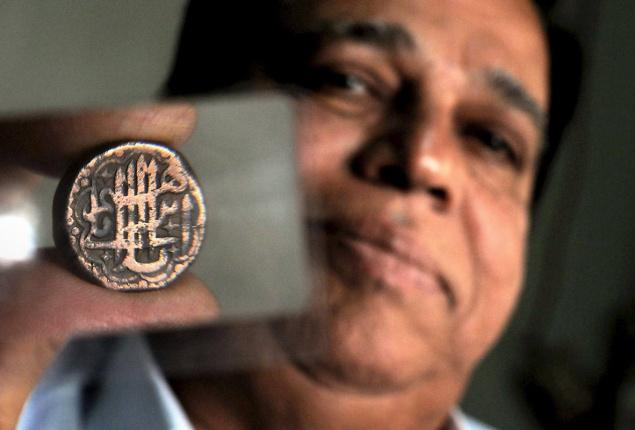
Historian M.A. Qaiyum with the coin minted during the Ibrahim Quli Qutub Shah rule that he chanced upon on a pavement in Old City. - / Photo: Mohammed Yousuf / The Hindu
Historian M.A. Qaiyum with the coin minted during the Ibrahim Quli Qutub Shah rule that he chanced upon on a pavement in Old City. – / Photo: Mohammed Yousuf / The Hindu

450-year-old copper coin of 3 Qutb Shahi ruler found

The missing link is finally here. M.A. Qaiyum, noted historian, could not hold back his surprise when he recently came across the 450-year-old copper coin minted during the rule of Ibrahim Qutb Shah. Curiously, the historian stumbled upon the rare coin on an Old City pavement.

Coins of the third Qutb Shahi king, Sultan Ibrahim Quli Qutb Shah, had been conspicuous by their absence. Even the A.P State Museum, which boasts thousands of copper coins of the erstwhile rulers, drew a blank when it came to those dating back to 1550-80 when Ibrahim Qutb Shah ruled.

“It’s a rare find, as coins of that period are not available in the museum,” says Mr. Qaiyum, who got it for a song.

Inscription

What adds substance to the coin is the legible inscription on it. The obverse side has the name, ‘Sultan Ibrahim Quli’, inscribed, and the reverse sports the legend, ‘Ghulam-e-Murtuza Ali’.

The coin, which weighs about 12 gm, represents an excellent piece of calligraphy. The style is quite similar to the Arabic inscriptions seen on the Qutb Shahi tombs.

According to numismatists, only six coins of the Ibrahim Qutb Shah period are available as of now.

But, it is not known as to what legend they bear and when they were issued.

The 6 coin, published by Hurmuz Kaus, an ancient coin collector, is of small size and bears the legend, ‘Juloose Jaiz Ibrahim Quli’, on the obverse and ‘Sadatmand-e-Ali’on the reverse . The coin was issued from the Golconda Mint in 1565 A.D.

The recently discovered coin bears the distinct legend of the ruler, Ibrahim Qutb Shah, in Arabic style. Scholars believe him to be the first Sultan to issue coins in his own name in the Qutb Shahi dynasty.

But, many do not subscribe to this view, as only one coin of Subhan Quli and four coins of Jamsheed Quli, the immediate predecessors of Ibrahim Qutb Shah, are available.

source: http://www.thehindu.com / The Hindu / Home> News> Cities> Hyderabad / by J. S. Ifthekhar / Hyderabad – February 09th, 2014

Secunderabad – the prodigal twin

It all began in 1798 when the Nizam entered into a Subsidiary Alliance with the British. As part of the treaty the Nizam was to foot the bill for a contingent of Imperial troops who arrived shortly thereafter along with a motley assortment of camp followers and encamped in the vicinity of Bolarum, north of the Hussain Sagar. Within no time the makeshift city of tents transformed into a well defined settlement.

The rapid pace of development bears testimony to British ingenuity for the crafty ‘shopkeepers’ made the Nizam pay, not just for upkeep of the Subsidiary Force but also for the infrastructure. Alternatively coercing and appeasing the Nizam and his government, the British spent lavishly on the emerging city and according to some accounts, enriched themselves individually too, by fudging accounts and claiming inflated payments with the resultant burden on the exchequer eventually leading to financial ruin of an otherwise affluent state.

To curb growing resentment against such nefarious activities, the Resident sought permission to name the new settlement after Sikandar Jah when he succeeded as the third Nizam in 1803. The ploy, clearly designed to satiate eastern vanity, ensured that Hyderabad kept honouring dubious and exorbitant claims. So brazen was the conduct of the British and so lax the accountability that ‘poor Nizzy pays for all’ became an accepted axiom in condoning financial irregularities of dishonorable officers who were caught lining their pockets at the Nizam’s expense. The fact that the cantonment at Secunderabad enriched Hyderabadi culture is indisputable as also the verity that the two share a common history. It is therefore a travesty that the cantonment, a large and culturally significant quarter of Secunderabad, has been kept isolated from the administrative protocols governing the rest of the city.

Amongst the multitude of structures with a rich history is the Rashtrapati Nilayam, the old Bolarum Residency of the British which now serves as the southern retreat for the President of India. Although well maintained, the sprawling complex consisting of buildings and exquisite gardens has lost one of its most significant elements – the monumental Flagstaff on which the national flag was first hoisted when Hyderabad merged with the Indian Union. To their credit, the engineers in charge did commission a miniature model of the steeple before knocking it down but a competent conservationist would have insisted and saved such an important cultural asset.

Though many in the city are familiar with a some examples of built heritage within the cantonment limits, few are aware about the existence of structures like Deccan House, The Abbey and numerous other monumental buildings which have survived despite the passing of two centuries. Amongst buildings with high associational value is ‘The Retreat’, one of several quaint colonial bungalows, which served as Sir Winston Churchill’s residence in 1896. It was during his sojourn at Secunderabad that the redoubtable statesman first met his early flame Pamela Chichele-Plowden, daughter of the then British Resident at Hyderabad, at a polo match. Churchill, then a subaltern in the British army was the star performer of the meet and is said to have swept the lady off her feet. Their courtship, which lasted till 1902, was amicably terminated in England. The traumatic change from the warm and romantic climes of Hyderabad to damp and frigid London seems to have brought the lady to her senses, for Churchill, who had by then barely advanced in rank to captain, paled in comparison to her new suitor Victor, the 2nd Earl of Lytton, who had already succeeded to the peerage upon the death of his father Lord Lytton, the Viceroy of India. A practical choice if one considers the fact that in later years Victor lorded over Bengal as Governor while Winston offered little other than ‘blood, toil and tears’!

Though administrative control of a large part of Secunderabad was returned to the Nizam’s government towards the close of British rule, public perceptions of the twin city as being a parasitic appendage to Hyderabad has lingered. This is largely due to core cantonment areas being kept insulated from planning and development controls, especially those which safeguard the city’s built heritage. It is time that the Cantonment Board accepts established criteria for listing of heritage buildings and brings unique specimens of architectural and cultural value within the gambit of the HMDA protection programme. Only then will the people of Hyderabad consider that the prodigal twin has truly returned to the family fold.

(The writer is a well known heritage activist)

source: http://www.articles.timesofindia.indiatimes.com / The Times of India / Home> City> Hyderabad> Nizam /by Sajjad Shahid / January 12th, 2014