Category Archives: Science & Technology

Two new paddy varieties developed

Machilipatnam Agricultural Research Station scientists T. Anuradha and K. Nagendra Rao displaying new paddy seed varieties./  Photo: T. Appala Naidu / The Hindu
Machilipatnam Agricultural Research Station scientists T. Anuradha and K. Nagendra Rao displaying new paddy seed varieties./ Photo: T. Appala Naidu / The Hindu

Two scientists of Acharya N.G. Ranga Agricultural University Research Station (ARS) here have developed two paddy seed varieties, MCM 100 and MCM 101, which can grow in saline soil. The 12-year research of the experts in developing these seed varieties has revived the hopes of farmers having saline soils.

In 2011, the Directorate of Rice Research, Hyderabad, tagged MCM-101, a rabi season seed, as the second best variety among the 33 paddy seed varieties developed by the other scientists in India, ARS Principal Scientist T. Anuradha told The Hindu. As a part of testing for the second consecutive year, the seed with 125-day duration (MCM-101 variety) was sown in five locations in Andhra Pradesh in saline fields.

“We noticed that the fine quality variety withstood the ‘blast’ disease and reported better quality yield than MTU-1010, a leading rabi seed variety in Andhra Pradesh”, said Ms. Anuradha. The kharif seed MCM-100 was tested in ten locations including West Godavari, Krishna and East Godavari, in 2012 kharif. When compared with the leading MTU kharif variety seed, the MCM-100 yield was five per cent higher.

“About 6,075 kg yield per hectare was recorded from this variety as against 5,850 kg for MTU variety. The average yield of our seed in all the ten locations was 5,539 kg as against 5,269 kg of MTU,” said Ms. Anuradha. The crop duration was 140-145 days.

“The response from the farmers, who are growing and have tested the mini kits of the seed, is the real certification for our work and a Himalayan achievement,” said scientist K. Nagendra Rao, another scientist in the research on ‘Development of Saline-Tolerant Rice Varieties for Coastal Andhra Pradesh.’

The MCM-100 and 101 seed varieties are exclusive seeds that were developed for saline soil, which is plentiful in the State and is not suitable for existing paddy varieties.

“The scientists aimed at developing seeds meant for saline soils, but these two varieties will also give yield much higher than present leading varieties – MTU 1061 and BPT 5201 – if farmers grow in normal soils,” claims the scientist duo.

source: http://www.thehindu.com / The Hindu / Home> News> Cities> Vijayawada / by T. Appala Naidu / Machilipatnam (A.P.) – May 10th, 2013
‘Wonder toys’ from a TV mechanic

ToysHF12may2013

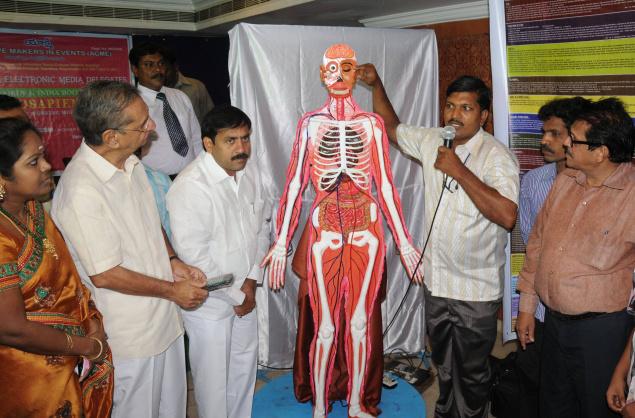
MLA Malla Vijay Prasad and film personality Gollapudi Maruti Rao being shown the working model of a human being at a function in Visakhapatnam on Tuesday. / Photo: C.V. Subrahmanyam. / The Hindu

What started off as a hobby, five years ago, has now earned fame for Pentakota Rajesh who continues to work as a television mechanic. A six-foot homo sapien, created by him, hopes to enter Guinness Book of World Records soon. The clay craft combined with rubber mould represents how each and every part of human body functions with inbuilt electronic and electrical mechanism.

Rajesh had created many clay moulds under the name of ‘wonder toys’ that blinks, speaks and plays cricket. His creations ‘Ayyappa makara jyothi’ and ‘cricket Ganesha’ have already entered Limca Book of Records, India Book of Records and Book of State Records. Spending almost two years understanding the mechanism of Homo sapien, he now intends to enter Guinness Book of World of Records. “I did a lot of research to design the concept. After working for almost two years, I was able to create a homo sapien. I hope my work not only helps me get recognition worldwide but also helps schoolchildren,” he said. Appreciating the creative thoughts of Rajesh, founder president of Creative Makers in Events Vincent Pratap Kumar said:

“Rajesh works hard for his living and his innovative thoughts made him design 56 toys so far using printed circuits, and electronic and electrical mechanism. With his latest invention, he hopes to reach schoolchildren and help them understand the structure of human body.”

Dedication, hard work and perseverance can make a man achieve greater heights, MLA Malla Vijaya Prasad said. “Being a commerce student and working as a television mechanic, Rajesh has created wonders in the world of science. His creations are innovative and has a message to deliver,” he said.

Actor and writer Gollapudi Maruti Rao appreciated Rajesh and added that his designs should not be just restricted to entering a record books but should reach a generation.

source: http://www.thehindu.com / The Hindu / Home> News> Cities> Visakhapatnam / by Staff Reporter / May 01st, 2013

New project to save Great Indian Bustard in Kurnool

The Great Indian Bustard in flight at the Rollapadu Sanctuary in Kurnool district. / Photo: Rakesh Narala / The Hindu

The rare giant bird, Great Indian Bustard, is currently facing deep trouble due to ecological changes. According to an estimate, the endangered species has shrunk to just 300 in the entire globe. The birds at the Rollapadu Great Indian Bustard Sanctuary in Kurnool district have also dwindled to five from 10.

As the alarm bells are ringing, the Union Ministry of Environment and Forests (MoEF), the Bombay Natural History Society (BNHS), World Wide Fund for Nature (WWF) and State Forest Department have launched a unique Species Recovery Programme to save the Great Indian Bustard, which will continue for a decade.

Majestic bird

The project will be implemented at the Rollapadu Great Indian Bird Sanctuary set up in 1987 in an area of 6.14 square km near Nandikotkur in Kurnool district.

The BNHS will spare a principal investigator and two researchers who will lead the project to improve the breeding, habitat development and help increase the numbers. Over a dozen staff members will assist the scientists.

The Great Indian Bustard is a majestic bird with an average height of up to 120 cm, long neck and legs and a brownish plumage. A mature bird weighs up to 14.5 kg, while female birds are 15 to 20 per cent less in height and weight.

The GIB feeds on locusts, beetles, butterflies, snakes, scorpions, lizards, mustard, pulses like Bengalgram and groundnut seed. The bird spends most of the time on the ground and flies only when it intends to undertake long flights to migrate to other areas. A bird lays one or two eggs in a breeding season, which is the August-December period in Rollapadu.

Detailed study

Farmers in Rollapadu area recall that the busty birds would flock around them during harvest time to pick up insects that got exposed from the ground. These scenes have disappeared completely now and even a decade ago the GIB population was estimated at 40-50.

Divisional Forest Officer at Atmakur, Mohammad Moiddin Nawab, who is incharge of the sanctuary, told The Hindu that in the first stage of the recovery programme, a detailed study would be undertaken to pinpoint the causes of the falling numbers.

According to a view, the characteristics of the habitat are changing rapidly after construction of the Alaganur Balancing Reservoir close to the sanctuary. Initially, everyone thought that improvement in water availability would help the sanctuary. But this was not so. The improved irrigation facilities around the sanctuary have transformed the ecosystem from grassland to wetland. Farmers have now shifted from dryland crops to paddy and other commercial crops, which consume large amounts of chemicals and pesticides.

Within the sanctuary, the number of co-species hostile to the GIB such as wolf and the blackbuck have increased rapidly.

The blackbuck population rose from 17 in 1982 to 1,000 now. Wolves relished GIB eggs and chicks. Last year gloom descended on the sanctuary when a wolf devoured a precious chick. Currently, two forest watchers are guarding an egg laid by a bird. Sometimes, stray cattle also trample on the eggs.

source: http://www.thehindu.com / The Hindu / Home> News> National> Andhra Pradesh / by D. Sreenivasulu / Kurnool – May 07th, 2013

Kollur village near Gachibowli : Rural attraction for high-end techies

Hyderabad:

Kollur, a tiny village in the outskirts of Hyderabad, is slowly carving out as a satellite hamlet for fast developing Cyberabad. Located about 13 kms from Financial District, Kollur is easily accessible from Gachibowli, Kokapet and Narsingi and it is the second village along the Outer Ring Road (ORR), after Kokapet.

Interestingly, the village is under the restricted zone under government order banning organised residential and commercial development in order to protect the Osman Sagar and Himayat Sagar lakes. Thus the village has turned as home for several high end villa projects costing between Rs 2 to 3.5 crore.

A drive from Kokapet, the new buzzing location for corporate and commercial activity, would lead to villages – Vattinagulapalli, Khanapur, Janwada, Mirjaguda etc. on the Mumbai highway. On northern side of ORR there is Tallapur village. Apart from Kollur, the villages like Velimala, Edulunagulapalli, Padi, all facing the ORR, command similar opportunity and lands are available for medium to long term investments.

KolurHF10may2013

Apart from Financial District and Kokapet, these under-dog villages have easy and quick access to Gachibowli signal, Nanakramguda, Narsingi etc, some of the fast developing locations on ORR.

Here, the land is generally flat and offers vegetation, thus extends clean and pollution free environment. On the connectivity side, besides the ORR, the village is also connected with railway line. About two kilometers from Kollur, there is Edulunagulapalli Railway Station on Hyderabad-Mumbai line. And with MMTS being extended up to Shankarpalli village, Edulunagulapalli station will have access to MMTS.

While driving from airport, we can get on to service road at Puppalguda intersection and drive to Kollur past Kokapet. The intersection at Kollur (called Edulunagaluapalli intersection), gives access to the ORR itself, instead of using service road.

Besides, the village has excellent education facilities set up by industry majors like NCC runs Samsthi International School and Open Minds established by Birlas. Having just 15 minutes access from Gachibowli Financial District, the parents, who are working here can reach their wards very quickly.

Further, being close to Gachibowli, the villages have attracted new-age development by providing comfortable residential location for high-end IT employees in the Cyberabad.

Several residential developers are working on various villa projects in Kollur and neighbouring villages like Edulunagulapalli, Velimala and Pati. With the presence of over 50,000 employees working in the Financial District area, and many more are expected to join, the location has high potential for property investment, as the prices are now at low.

source: http://www.thehansindia.com / The Hans India / Home> Headlines / May 04th, 2013

Aurobindo Pharma gets USFDA nod for two drugs

Hyderabad : 

Homegrown pharma player Aurobindo Pharma Limited on Saturday informed the bourses that the company had received USFDA’s (United States Food and Drug Administration) final nod to manufacture and market tamsulosin hydrochloride capsules and clindamycin palmitate hyderochloride  for oral solution in the US market.

The Hyderabad-headquartered company did not disclose the timeline but said that the products would be launched soon.

Tamsulosin hydrochloride capsule is the generic version of Boehringer Ingelheim Pharmaceuticals’ Flomax capsules and is indicated for the treatment of symptoms of enlarged prostate in men. According to industry estimates, the market size of the product is estimated to be $244 million for the twelve months ending September 2012.

Clindamycin Palmitate Hydrochloride for oral solution is the copycat version of Pharmacia  & Upjohn’s Cleocin Pediatric for oral solution and is indicated for the treatment of serious infections caused by susceptible anaerobic bacteria in infants.

Industry estimates state that the market size of the product is $57 million for the twelve months ending September 2012.

According to the company, Aurobindo now has a total of 190 Abbreviated New Drug Application (ANDA) approvals from the US regulator USFDA .

source: http://www.timesofindia.indiatimes.com / The Times of India / Home> Business> India Business / TNN / May 04th, 2013

Eye bank opened at government hospital in Warangal

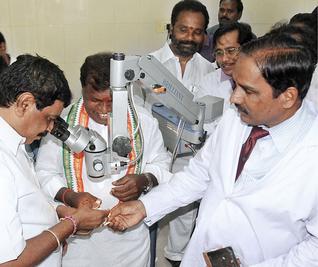
Backward Classes Welfare Minister B. Saraiah inaugurating the eye bank at the regional eye hospital in Hanamkonda on Saturday.– Photo: M. Murali / The Hindu

BC Welfare Minister B. Saraiah inaugurates the new facility

For the first time in government sector, an eye bank was set up here at the Regional Eye Hospital on Saturday with an estimate of Rs. 2 crore.

Backward Classes Welfare Minister B. Saraiah inaugurated the new facility and said this would help give eyesight to many people. The facility will enable the doctors collect the cornea of dead within six hours and store in the bank. This could be given to those whose lost sight due to damage to the cornea.

The Minister said all the referral hospitals in the State were being added new facilities and it was decided to sanction more funds to the regional eye hospital in Warangal to create further facilities.

Warangal MP S. Rajaiah, Joint Collector P.S. Pradyumna, hospital superintendent Panduranga, district medical and health officer Sambasiva Rao and others were present.

source: http://www.thehindu.com / The Hindu / Home> National> Andhra Pradesh /  by Special Correspondent / Warangal – May 05th, 2013

Urban agriculture booms in Hyderabad

Hyderabad :

Urban agriculture is the new culture that is catching up in the city. More than 4000 households in the outskirts of the city currently are self reliant for the vegetable needs of the family. This time Horticulture department for a change is giving subsidy directly to the citizens instead of farmers who want to grow of complete nutrients set of vegetables.

Officials say according to the Food and Agriculture Organisation (FAO) estimates, by 2050, global food demand will grow by 70 per cent to cater to the needs of the global population of 9.3 billion. As the natural resource to feed this population is going to be difficult task urban agriculture is seen as big solution to the problem.

Speaking to TOI horticulture department director K Devamuni Reddy said that the initiative as part of urban farming is met with good response since it was initiated two months back. “We give the citizens who are ready to grow a cluster of vegetables at their home a subsidy of Rs 360 and they have to spend another Rs 1200 from their pockets” he added.

This subsidy kit involves four silatin round beds, red earth, farmyard manures, 14 bags and other essential things to grow a garden at home. Officials said though the citizens have to spend additional Rs 400 to 500 for transporting ,response has been more than good. Mostly people in Uppal, Dilsukhnagar, LB nagar, Vanastalipuram who have own houses have shown good interest with more than 4000 subsidy kits being distributed so far. Officials plan to increase this number to another 1000 in next few months.

The growers will be able to get Ladies finger, Tomato, Brinjal, Pallak, coriander, Amarathis, Ridge guard, Bottle guard, Beans, cucumber, and Cluster beans. The subsidised kit will have the required seeds and the kit will be sufficient for two seasons to grow. “The programme is designed in a way that Indian Council of Medical Research ( ICMR) recommendation for nutritional needs are fulfilled. With each kit there would be a yield of 450 KG yield which would be covered in a span for three to four months” K Devamuni Reddy said. It would cover nearly one hand half KGs a day for a family of four members.

Official sources said that in Hyderabad, it was found that households that produce vegetables saved 20 per cent of their total food expenditures by retaining part of the produce for household consumption. “I find this programme interesting because we can get the guidance from them directly. Costs can be brought down too” V Venkatalakshmi of LB Nagar said. Soon the officials are planning to do visits of as many as households possible and monitor their practices.

source: http://www.articles.timesofindia.indiatimes.com / The Times of India / Home> City> Hyderabad> Vegetables / by Sribaala Vadlapatla, TNN / May 04th, 2013

Asian Seabass seed production unit to be set up in Krishna district

National Fisheries Development Board (NFDB) has sanctioned Asian Seabass seed production unit — the first in Andhra Pradesh — in Krishna District. With brackish water aquaculture activity gaining ground in the district, demand for huge quantity of Asian Seabass (Lates Calcarifer) species has also gone up.

Brackish water aquaculture is taken up in more than 5,000 acres across the district, but the farmers depend only on Seabass seed provided by Central Institute of Brackish water Aquaculture (CIBA), Tamil Nadu. The CIBA officials said that the variety survives in freshwater aquaculture ponds also, hence very popular.

The yield of Asian Seabass is much higher compared to other species. This led to the demand increasing manifold. Getting entire requirement from Tamil Nadu is turning out to be a Herculean task.

Many farmers had to withdraw their plan of growing the variety due to non-availability of seed in the district. “The NFDB has sanctioned a seed production unit worth Rs.72 lakh, which is proposed at Urlagonditippa village. It will be set up by T. Sankara Rao, a farmer,” Fisheries Deputy Director T. Kalyanam told The Hindu.

source: http://www.thehindu.com  / The Hindu / Home> News> Cities> Vijayawada / by T. Appala Naidu / Machilipatnam – May 05th, 2013

Ongole students win national-level contest

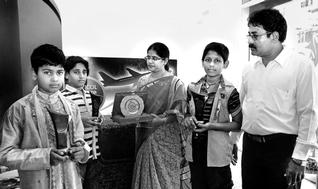
Proud moment:Budding scientists from Gowtham Model School along with school correspodent M.Kondiah and Principal M. Padmaja at Ongole on Wednesday. —Photo: Kommuri Srinivas / The Hindu

 They win trophy, tablet PC and trip to Singapore

The Gowtham Model School (GMS) here has won the national-level Fevicol Science project challenge 2013 held in Mumbai.

Three sixth class students from GMS did Prakasam district and the State proud by projecting innovative water conservation methods during the three-day contest that concluded on April 29,

School correspondent M.Kondaiah told reporters here on Wednesday. ”It is a great achievement by Ongole lads as 1.85 lakh students from 737 schools have taken part in the contest,” he added.

Scientists from the Navi Mumbai Science Foundation acted as judges and spotted the budding scientists in GMS students – M. Guna Snehith, P. Sasi Preetham, and Ch. Karthik, GMS Principal M.Padmaja said.

The students were bubbling with enthusiasm having won a trophy, tablet PC and a foreign trip to Singapore worth Rs. 5 lakh from the Pidilite Industries, makers of Fevicol.

The students’ guide Valli Devasena with a sense of fulfilment said the students were given the topic on the first day. They were allowed to do research on different water conservation techniques and develop working models on the second day. The judges put a barrage of questions to the scientists in the making and adjudged the GMS team as the winners, she added.

The GMS students had made it to the finals by developing a project ‘sustainable village for a population of 10,000’in the junior-level category drawing inspiration from former President A.P.J. Abdul Kalam who had advocated Provision of Urban facilities in Rural Areas (PURA) to find a permanent solution to migration to urban areas and turn villages into engine of growth.

source: http://www.thehindu.com / The Hindu / Home> National> Andhra Pradesh / by Staff Reporter / Ongole, May 02nd, 2013

Solar power to light up 20 tribal ashram schools

It is seen as a panacea to the power-cut problem

The Energy and Resources Institute (TERI) a global NGO in collaboration with the Integrated Tribal Development Agency (ITDA) is setting up 1 KV solar power generation plants in 20 tribal ashram schools in the Agency area in the district as a panacea to the power cut problem which is adversely affecting the studies of tribal students.

This has taken up it as a pilot project by spending Rs. 2.75 lakh on each 1 KV plant and TERI expects to complete the project around August. The district administration would eventually cover all the Ashram schools depending on availability of funds.

TERI State Coordinator V.V.K.B.N. Murthy told The Hindu that solar energy based lighting will be a boon to the students in tribal areas and would solve the problem of frequent interruption to power supply. He says that solar power would be a success story in the rural and tribal areas if SHG groups are involved in the implementation of solar projects.

The NGO is introducing solar appliances including home lighting systems, individual lanterns and task lights, etc. in the villages which are under darkness most part of the evening and night, due to long hours of power cuts and also to the hamlets which do not have access to regular power supply. It is engaged in setting of Solar Charging Stations (SCS) in the rural and Agency areas to re-charge solar appliances. So far 100 SSS have been set up and 200 more will be read soon in the State.

TERI is imparting training to entrepreneurs and technicians selected by NGO’s through which the solar lights project is being implemented. The training involves supply, installation and re-charging of solar lights and the operation of solar charging stations. The entrepreneurs are supported by the village residents who pay Rs.10 each per month to the former which takes care of several charging stations and in turn earns his salary.

The objective of SCS is mainly to recharge the batteries which can be used for 4 to 6 hours every day. The stations can charge 50 lights at a time. Solar lamp not only tackles power shortage but also replaces kerosene lamps which are eco-friendly. Every village will have a local entrepreneur who will supply and maintain the solar lamps. Every nine villages will have a technical resource person who will oversee the smooth functioning of the solar charging stations. As many as 43 stations are operating in the district. NGO’s Samskruti, Vikas and Kovel Foundation are in partnership with TERI. Besides, 30 in Srikakulam, 44 in East Godavari district, 9 in Guntur, 12 in Karimnagar and 2 stations in Adilabad are running.

source: http://www.thehindu.com / The Hindu / Home> News> Cities> Visakhapatnam / by Ravi  P. Benjamin / April 14th, 2013