Category Archives: Science & Technology

Young minds have a go at robotics

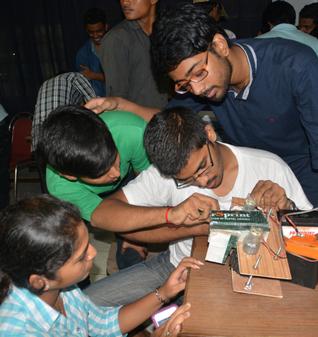
Students participating in the preliminary round of the national-level robotic competition, 'Escalade III', organised by IIT-Guwahati at Andhra University in Visakhapatnam on Sunday. - Photo: C.V. SUBRAHMANYAM
Students participating in the preliminary round of the national-level robotic competition, ‘Escalade III’, organised by IIT-Guwahati at Andhra University in Visakhapatnam on Sunday. – Photo: C.V. SUBRAHMANYAM

More than 30 teams from across Andhra Pradesh showcase their technical expertise at ‘Escalade -III’. More than 30 teams from across Andhra Pradesh, including East Godavari, West Godavari, Srikakulam, Vizianagaram, and Visakhapatnam showcased their technical expertise.

A team of four from Sir C.R. Reddy College of Engineering, Eluru, has designed a robot based on micro controller programming that follows automatic predefined module.

Final year students of Raghu Engineering College, Vizianagaram, have come up with another robot that applies electro mechanical technique.

While engineering students of ANITS have made a basic model using tyre-and-arm mechanisms, second year students of GITAM Institute of Technology are eager to explain their hassle-free creation crafted by using manual operation.

These and many more were designed by contestants who were part of the preliminary round of robotics competition, ‘Escalade -III’, organised by IIT-Guwahati at Dr. B.R. Ambedkar Auditorium, Andhra University, on Sunday. The robot has to climb, collect the ball placed on top of the poll, and drop it in any of the four slots provided at the bottom of the 70-cm- long poll.

More than 30 teams from across Andhra Pradesh, including East Godavari, West Godavari, Srikakulam, Vizianagaram, and Visakhapatnam showcased their technical expertise.

Based on the accuracy level, motor movements, application of innovative methods, and time management, a team of six from each centre (spread across 11 cities) will be heading to the finals. All the participants will receive participation certificates and the final champions will walk away with prizes worth Rs.1 lakh.

Finals

The final round of the All India Robotics Competition is slated to be held on September 1 at IIT-Guwahati as part of its annual ‘Techno-Management Festival’ called ‘Techniche 2014’.

“The prelims are conducted on the same day across 11 centres across the country. Out of which 66 teams will get to the next level. The idea is to foster the spirit of science and technology among the student community and help them gain practical exposure,” says Tarun, one of the organisers from IIT-Guwahati.

source: http://www.thehindu.com / The Hindu / Home> News> Cities> Visakhapatnam / by Staff Reporter / Visakhapatnam – July 21st, 2014
A power couple whom AP looks up to

Taking up big responsibilities around the same time, these two have become the new power couple in the country. If Nirmala Sitharaman, the wife, is busy running the country in her capacity as union minister of state for commerce and industry, Parakala Prabhakar, her husband, has been entrusted the responsibility of furthering the development of Andhra Pradesh in his latest avatar as communications advisor to chief minister Chandrababu Naidu.

It was a meeting of the minds when the two encountered each other in Jawaharlal Nehru University in the early eighties. A Tamil Iyengar Brahmin from Trichirapalli, Nirmala is the daughter of Narayanan Sitaraman, a railway employee, and Savitri. She graduated in economics from Seethalakshmi Ramaswami college in Trichi before she headed to JNU to do her master’s and doctorate in economics. Parakala, a Telugu Brahmin from Narsapur in coastal Andhra, is the son of Seshavataram, a veteran communist who later gravitated to the Congress and served as a five time minister in AP. Parakala could not pursue politics successfully in the footsteps of his father and joined JNU to study economics.

As members of Freethinkers, a JNU forum that discussed right-wing and left-wing politics among many things, the two got close and ended up getting married. They then left for London where Parakala Nirmala went on to do his PhD from the London School of Economics, while Nirmala worked for some time as sales woman in a decor shop and later as a researcher on East-European economies for Price Waterhouse Cooper.

The early nineties saw them return to Hyderabad and Narsapur after the birth of their daughter, the only child. Parakala set up a marketing research agency in Hyderabad, a trust in memory of his father, and along with Nirmala, started a school Pranava.

Parakala contested unsuccessfully from Narsapur on the Congress ticket in 1994 but went on to develop close ties with former Prime Minister P V Narasimha Rao. From the Congress, Parakala joined the BJP and finally, in 2008, went on to became a founding member of the Prajarajyam party along with actor-turned politician Chiranjeevi, before leaving in disillusionment.

Chandrababu Naidu is believed to have invited Parakala to join the TDP and after the party’s victory, he joined the government as its communications advisor.

Nirmala was nominated to the National Commission for Women during the NDA regime under Atal Behari Vajpayee, but her term ended abruptly when the UPA took over in Delhi. She returned to Hyderabad to start a policy research centre and then a school for the underprivileged in a village. In between, she got involved with the Swadeshi Jagran Manch.

Nirmala finally joined the BJP in 2006.

Andhra Pradesh and Naidu are expecting a lot from this power couple. While Niramala’s help is needed to get investments and SEZs in Andhra Pradesh, Parakala has to play a key role in shaping Naidu’s developmental politics at a critical juncture. It is in the expectation that Nirmala will do something for AP that Naidu went out of his way to offer the Rajya Sabha seat from Andhra Pradesh to her. As for Parakala, sources said he has been given the responsibility of defending the party’s policies on various forum as the TDP has limited speakers who can effectively communicate in both English and Hindi also.

At least for the next five years both at the centre and in Andhra Pradesh, all eyes will be on this power couple who could play a key role in the growth of the country and state of AP.

source: http://www.timesofindia.indiatimes.com / The Times of India / Home> City> Hyderabad / TNN / July 21st, 2014

Yanadis sensitised on crab fattening technology

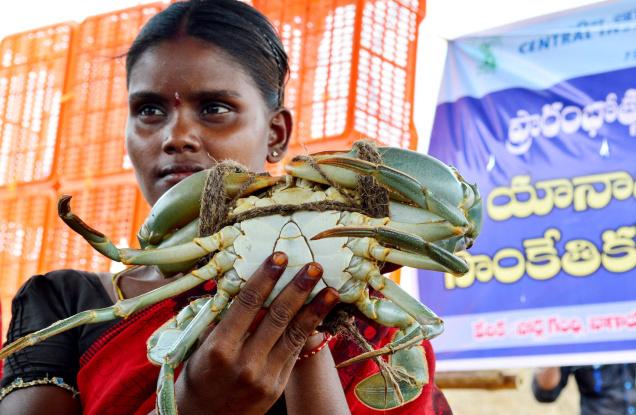
A Yanadi tribal woman displays a mangroove crab during a demonstration on crab fattening technology organised by the Central Institute of Brakishwater Aquaculture at Sorlagondi in Krishna district. - Photo: T. APPALA NAIDU
A Yanadi tribal woman displays a mangroove crab during a demonstration on crab fattening technology organised by the Central Institute of Brakishwater Aquaculture at Sorlagondi in Krishna district. – Photo: T. APPALA NAIDU

Under the ST sub-plan, the CIBA takes up a pilot project to provide technology support to tribal families in Sorlagondi

A team of scientists of the Central Institute of Brakishwater Aquaculture (CIBA), Chennai, on Saturday introduced the ‘crab fattening technology’ through floating cages to the Yanadi tribal families to help the latter grow Mangrove Crab (Sylla serrata) in Sorlagondi Reserve Forest area in Krishna District.

As a part of the ST Sub-Plan, the CIBA has taken up a pilot project to provide the technology support to the selected ten Yanadi tribal families in Sorlagondi village. The project will be expand it to the other eligible beneficiaries in the State, later. As a part of the programme, scientists– K. Ambasankar, J. Syam Dayal, C.P. Balasubramanyam and M. Kailasan–demonstrated the use of cages to Yanadi tribal families who are engaged in hunting of the crab in the estuary. The scientists also provided them 1,000 seed of Asian Seabass that would be cultivated in the ponds in the tribal area.

“Crab fattening technology helps the hunters raise young and soft crabs until they grow to a certain hardness at which it would fetch remunerative price in the market. However, barely two to three weeks are required for a soft crab to become hard one,” Mr. Bala Subrahmanyam told The Hindu.

According to experts, crab is being sold at Rs. 1,200 a kg in the India’s biggest crab market Chindradripet in Chennai. From Chennai, it is being exported to South East Asian countries. “The CIBA aims at promising better livelihood option to tribal families by moulding them into entrepreneurs,” said the scientists.

New technology

Yanadi tribal families of Sorlagondi Reserve Forest hunt mangrove crab in estuary, backwaters and brackish water, largely in mangrove forests. They completely rely on local market in Nagayalanka. The CIBA scientists also began a detailed study on the catch of the crab in a bid to estimate its population roughly before introducing next stages of technology in crab fattening.

source: http://www.thehindu.com / The Hindu / Home> News> Cities> Vijayawada / by T. Appala Naidu / Sorlagondi (Krishna) – July 21st, 2014

Cage fish farming at sea catching up in coastal AP

Visakhapatnam :

At a time when fish stocks are declining globally due to various factors like climatic change and pollution, cage farming of fish on sea, an aquaculture technique, has thrown up an encouraging alternative that yields 10 times the fish catch as compared to fish reared in ponds or wild harvest in the sea.

This technique has also been taken up to great success in Vizag and other coastal districts of AP on an experimental basis by scientists of the Visakhapatnam Regional Centre of the Central Marine Fisheries Research Institute (CMFRI).

In Krishna district (Nagailanka) and Narsapuram (West Godavari), cage farming has been taken up in collaboration with fishermen, while in Vizag the cages in the sea along RK Beach are controlled by the CMFRI. There are six cages in Krishna, 10 in West Godavari and eight in Vizag district of AP. Plans are afoot to double the number of cages in Vizag soon given the good prospects, said CMFRI scientists.

Though open sea cage culture technology is a relatively recent activity in India, it is prevalent in other Asian countries. While lobster, Asian seabass, mullets, Cobia and Pearl Spot have been successfully harvested by CMFRI in various coastal waters in India, at present the Vizag centre of CMFRI is maintaining brood stocks of Orange Spotted Grouper, Indian Pompano, Snappers and Golden Trevally in cages that have all shown good growth and maturation, said scientists.

Under this procedure, fish rearing is done in an enclosed area in a natural aquatic environment where the water continuously flows and debris doesn’t accumulate, which is why there is no pollution or ammonia deposition as in the case of stagnant and low density water ponds. The young ones of fish and other aquatic species are kept, fed and grown to marketable size in these cages, which are of six metre diameter and made of high density polyethylene.

“Cage farming is in an infancy stage now, but the prospects for commercial exploitation are so good that we are planning to double the number of cages soon as well as expand to other neighbouring areas. At the end of the culture period, which ranges from six to eight months, three to five tonnes of fish are produced just from one cage,” said Subhadeep Ghosh, senior scientist and scientist-in-charge at CMFRI.

The biggest advantage of cage farming, according to Prof K Sujatha, chairperson, board of studies, department of marine living resources at AU, is that despite being a fish culture technique there is no need to change the waters as sea water continuously flows through the cages, there is some natural food easily available for the fish to feed on and there’s no need to put up any time or space-consuming infrastructure except the cages.

However, she pointed out that not all areas are suitable for cage farming. “There needs to be optimum depth of at least 10 metres from the shore, the sea should be more or less calm without high waves and currents where the cages are located. The salinity, pH, ammonia, nitrate should be all within permissible limits,” she explained.

source: http://www.timesofindia.indiatimes.com / The Times of India / Home> City> Visakhapatnam / TNN / July 17th, 2014

Classrooms getting smart

The concept of digital classrooms to make learning experience more interactive is fast gaining acceptance

In a small classroom of Vizianagaram, students sit together learning how to carry out the heart dissection of a frog. But there are no messy hands or students feeling uncomfortable due to the elaborate process and strong chemical odour. They watch the entire procedure on the screen in their digital classrooms.

The concept of learning is fast going through a metamorphosis with schools adopting the latest technologies to make the learning experience more interactive.

Cashing in on this trend, digital classroom service providers like Educomp Solutions, Pearson Education Service, and Tata Interactive Systems (TIS) are expanding their presence in Tier-2 and Tier-3 cities of India to provide such services.

City schools too have embraced the evolving learning methods by introducing learning modules for digital classroom aids.

At a conference here organised by Educomp, many school representatives turned up to know more about the offerings, and inculcate the digital methods of learning.

According to the digital classroom service providers, nearly 10 schools in the city have already adopted technologies for e-learning.

With a market size of digital classrooms estimated to be over Rs. 3,000 crore, service providers are looking at this segment with added vigour and tapping into southern cities such as Visakhapatnam and Vijayawada to widen their reach.

Recently, Educomp launched its ‘SmartSchool’ concept in the region, going a step forward from their ‘Smartclass’ product.

“The idea of ‘SmartSchool’ is to transform the whole school by providing digital contents, laboratories, and learning modules, and also digital assessment tools and other digitised procedural elements like report card generation and attendance monitoring through advanced technology,” said Rohit Malik, Regional CEO, Educomp.

The company has tied-up with five schools in the city for its SmartSchool product.

The digital classroom aids allow teachers to use interactive multimedia content to supplement the standard textbook-and-blackboard approach.

The schools normally pay a monthly fee per class over a contract period to the digital classroom service providers. In turn, the school passes on the cost as a monthly fee increase of Rs. 150 to Rs. 200 per student.

source: http://www.thehindu.com / The Hindu / Home> News> Cities> Visakhapatnam / by Nivedita Ganguly / Visakhapatnam – July 15th, 2014

Girl Cured of Rare Disorder

Vijayawada :

Doctors at VIMHANS (Vijayawada Institute of Mental Health, Neuro & Allied Sciences) cured a 10-year-old girl suffering from a rare psychological disorder.

At a press conference, director of Vimhans Indla Rama Subba Reddy said that Gayatri, a native of Thotagudem, West Godavari district, suffered from a rare disorder where she felt stones coming out of her eyes.

“No medical journal has ever mentioned about this problem. We observed the girl for four days and treated her with psychological counselling. She is fine now,” he said.

He added that there is no name for this kind of disorder in medical terms, and said that they treated the girl for free as she came from a poor financial background.

source: http://www.newindianexpress.com / The New Indian Express / Home> States> Andhra Pradesh / by Express News Service / July 12th, 2014

Palle Raghunatha Reddy to showcase Seemandhra in UK, US

Picture for representational purpose only (Photo: DC online)

Hyderabad:

Chief Minister N. Chandrababu Naidu is planning an investor-friendly policy to woo information technology and other industries to invest in Andhra Pradesh.

IT minister Palle Raghunatha Reddy will lead a high-level delegation to the United States of America and United Kingdom to invite NRIs, IT and other companies to set up companies in AP.

The delegation will explain the benefits, tax concessions and other incentives the Centre  and the state will offer to investors.

“Every day, nearly 15 to 20 NRIs have been  showing interest in  investing here. They are requesting us to post details of incentives and special category status  that will be offered to investors on the Website. After finalising the new policy, we will upload all the details on our Website,” said  minister Mr Reddy.

Stating that he is likely to visit the US and UK shortly, the minister said he has already conducted  meetings  with nearly 250 national and international companies  eager to invest in residuary AP.

“As many as 17 companies have confirmed to invest. IT firms like Wipro, Tech Mahindra and Infosys are also  interest,” he said.

The state government has plans to develop an ITIR in Visakhapatnam, mega IT hubs in Vijayawada, Tirupati and Anantapur.

As decided so far, AP government will  provide a single-window facility for investors where in they can get  all relevant permissions for setting up industries, environmental clearances, building permissions, power and water connectivity and others.

source: http://www.deccanchronicle.com / Deccan Chronicle / Home> Nation> Current Affairs / DC / by M. Roushan Ali / July 09th, 2014

Shipping veteran for augmenting Indian flag vessels

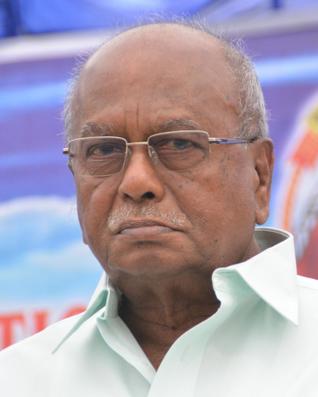
Garuda Pattabhiramayya / Photo: CV. Subrahmanyam  / The Hindu
Garuda Pattabhiramayya / Photo: CV. Subrahmanyam / The Hindu

‘India is in need of more very large crude carriers’

Veteran stevedore from the city G. Pattabhi Ramayya has sought intervention from the Centre to unveil an action plan to increase the number of various types of ships carrying Indian flags.

Stating that almost 90 per cent of Indian trade is handled by vessels carrying foreign flags, he said “we are still primitive in carriage of containers.” Asking the Narendra Modi Government to draw a cue from the United States and Japan on how they were encouraging their national flag both financially and by providing cargo, he said the people of India had pinned a lot of hopes on the new government.

“We hope we can become self-reliant if right patronage is given by encouraging construction of own vessels as well as extending desired support to our national carrier Shipping Corporation of India,” Mr. Ramayya told The Hindu on Monday.

He also wanted relaxation of cabotage law for transportation of domestic cargo and funding and other incentives to SCI to augment its fleet. He said SCI fleet, which comprised 125, had now come down to around 75 as acquisition had slowed down.

Mr. Ramayya, who is the director of Federation of Steamer Agents of India and chairman emeritus of Visakhapatnam Steamer Agents’ Association, said still 80 per cent of bulk raw material and finished products like coal, iron ore and fertilizers were carried by foreign flag vessels for want of government support and required tonnage to be acquired.

He also wrote a letter to Union Minister for Road Transport, Highways and Shipping Nitin J. Gadkari asking him to enable SCI to acquire tonnage especially for carriage of larger volume of cargoes like oil, containerised cargo and bulk cargoes like coal, iron ore and fertilizers.

Mr. Ramayya said India was in need of more very large crude carriers (VLCC), cape size and Panamax vessels for faster handling of cargo in mechanised environment at various ports in the country.

source: http://www.thehindu.com / The Hindu / Home> News> Cities / by  Santosh Patnaik / Visakhapatnam – July 07th, 2014

Visakhapatnam lad makes it to the list of top 10 innovators in India

Visakhapatnam :

Krishna Sai Inkoolu, an industrial engineering student of Gitam University, has been selected as one of the ‘Top 10 innovators of India’ in the India Innovation Growth Programme. The programme is a joint initiative of the Department of Science and Technology, Lockheed Martin Corporation, Indo-US Science and Technology Forum, Federation of Indian Chambers of Commerce and Industry, Stanford Graduate School of Business and the IC2 Institute at the University of Texas. Speaking to TOI, the engineering student said that the organisors of the programme have arranged business meetings with major footwear companies across the globe later this year in USA.

He has also been invited to visit Silicon Valley, California in September. In September last year TOI had reported about Inkoolu’s feat of designing a shoe for the blind equipped with an embedded electronic circuit that senses the existence of obstacles in its path and alerts the wearer.

The shoe was designed in such that an electrical signal transmits an impulse to the ankle of the visually impaired person if he or she is about to face an obstacle.

Also, the circuit, which is run by a small motor, gets recharged automatically when the person starts walking, ensuring that there is no need to change batteries to keep the motor going.

source: http://www.timesofindia.indiatimes.com / The Times of India / Home> City> Visakhapatnam / TNN / June 3th, 2014

AU to host global meet on electromagnetics

Andhra University, in association with Society of Electromagnetic Compatibility Engineers, is hosting the 13th international conference on electromagnetic interference and compatibility (INCEMIC 2015) on February 27 and 28, Vice-Chancellor and conference chair G.S.N. Raju and Vice-Chancellor of BITS, Ranchi, and technical chair Ajoy Chakrabarthy announced here on Monday.

The conference, to be attended by international experts in the field of electromagnetic studies, would cover the entire scope of electromagnetic compatibility like design, circuits, chip level, power systems, signal integrity and high frequency, high power electromagnetics, antennas, radiation hazards, environment, satellite communications, biomedical systems, and other advances, Prof. Raju said. It was designed to give a new dimension so as to implement electromagnetic compatibility techniques in military and civilian radar and communications right from the design, development and production states.

A two-day workshop-cum-tutorials on the latest trends in the field of electromagnetic interference and compatibility would be conducted by experts on February 25 and 26. Last date for submission of abstracts was August 30 and the deadline for submission of full papers was October 30, Prof. Chakrabarthy said.

Rector E.A. Narayana, Principal in-charge of AU College of Engineering P.S. Avadhanri, HoD of Electronics and Communication Engineering and convenor of the conference P. Rajesh Kumar, technical co-chair V. Vallikumari, treasurer P.V. Sridevi and Registrar K. Rama Mohana Rao were also present.

source: http://www.thehindu.com / The Hindu / Home> News> Cities> Visakhapatnam / by Special Correspondent / Visakhapatnam – July 01st, 2014