Category Archives: Leaders

Shobha Nagi Reddy’s eyes donated

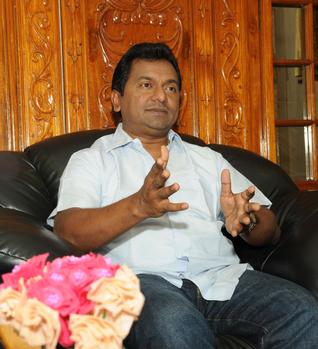
Bhuma Nagi Reddy, along with his elder daughter Akhila, mourns the loss of his wife Shobha Nagi Reddy (Photo: DC)

Hyderabad:

Shobha Nagi Reddy, the 46-year-old official spokesperson of the YSRC, was returning from Nandyal after attending a political rally with party leader Y.S. Sharmila. She was given first aid treatment in a private hospital and then rushed to Hyderabad early on Thursday morning. She was in the Intensive Care Unit of Care Hospital for more than four hours before doctors declared her dead at 11.05 am.

“We are sad to inform that Shobha Nagi Reddy, who was brought to Care Hospital on April 24 following a major road accident, is no more,” a medical bulletin issued by Care Hospital said.

The MLA’s vehicle, a Mitsubishi Outlander, was moving at high speed, and the driver lost control when he tried to slow down to evade the paddy husk.

“We suspect that the driver could not see the husk heap from a reasonable distance. When he applied the brakes suddenly, the tyres slipped and the vehicle toppled over several times to the road side farm land. The MLA’s head hit the roof of the car and she was then thrown down,” said Kurnool superintendent of police K. Raghuram Reddy.

The SP said that Shobha was not wearing a seat belt though she was sitting in the front seat. He added that the injuries of the two gunmen sitting in the back, and the driver, were less serious comparatively.

Passers-by informed emergency services and the police about the accident. The victims were shifted to a private hospital in Nandyal, and later to Care Hospital in Hyderabad at around 7 am on Thursday.

In keeping with her wishes, Shobha’s eyes were donated to the Sarojini Devi Eye Hospital in the city. Her body was taken to Kurnool on Thursday afternoon. Sources said that her last rites will be performed at Allagadda on Friday.

Kurnool police said that a case has been registered against the car’s driver following a complaint received from one of the MLA’s gunmen. “We have booked a case against the driver under IPC Section 304 A for causing death due to negligence,” said the Kurnool SP.

Shobha Nagi Reddy is survived by her husband former Nandyal MP Bhuma Nagi Reddy, two daughters and a son.

source: http://www.deccanchronicle.com / Deccan Chronicle / Home> Nation> Current Affairs / by DC Correspondent / April 25th, 2014

MELANGE : Royal treat for bibliophiles

Books restored from different Asaf Jahi dynasties are in the Chowmahallah Palace library./  Photos: Nagara Gopal / The Hindu
Books restored from different Asaf Jahi dynasties are in the Chowmahallah Palace library./ Photos: Nagara Gopal / The Hindu

The Mehtab Mahal library at Chowmahalla Palace throws open a treasure trove from the Nizam’s era

The Nizams, it turns out, had an eye for everything exquisite. From the jewellery they wore to the silks that adorned their wardrobe, the cars they rode in, and the cuisine they partook, everything simply spelt royalty. While these indicate their lavish lifestyle, their interest in books and literature is less known.

Throwing light on their urge to discover and relate to the world around is the Royal Library in Chowmahalla Palace; its collection of books includes The Life of Samuel JohnsonHistory of Don QuixoteJohn F Kennedy – Portrait of a PresidentGlimpses of India,The Princes of India and an array of Encyclopaedias and much more .

Situated in the Mehtab Mahal of the Chowmahalla, the Royal Library houses more than 10,000 books and “is a haven for researchers and book lovers.”

The library that was thrown open to book lovers last year has been digitized recently, not only to help book lovers but also ensure safety of the royal treasure.

The idea of the library is to protect and preserve the valuable collection of the Asaf Jahi kings. The collection mostly belonged to the Mir Mahboob Ali Khan (VI Nizam), Mir Osman Ali Khan (VII Nizam) and Nizam Mukarram Jah. The books have been sourced from different Asaf Jahi palaces like the Nazri Bagh, Chiran Palace and Chowmahalla to be housed in the Royal Library here.

The books thus collected were sorted and segregated into various categories.

Books restored from different Asaf Jahi dynasties are in the Chowmahallah Palace library. / The Hindu

“A lot of work went into making them ready to be put in the cases for readers to read them in the library. Various professionals worked to clean, bind and make the books fit for reading. We have applied all preservation techniques, including fumigation, to protect the books,” informs G. Kishan Rao. He adds, “The collection of books range from history, literature, poetry, philosophy, geography, culture and religion. This library also houses the exclusive collection of Qurans by the Nizams which was inaugurated recently.” A few books also hint at the Nizam’s passion to learn languages. The number of English books is close to 3000, followed by Urdu, Persian and Arabic.

“There is also a good number of Persian manuscripts containing the firmans issued by the Asaf Jahis as well as several volumes of Mir Osman Ali Khan’s poetry,” informs the librarian. Qurans of different sizes are in the process of being restored and will find place in the library after that.

source: http://www.thehindu.com / The Hindu / Home> Features> MetroPlus / by Prabalika M. Borah / Hyderabad – April 25th, 2014

ROCKSCAPE : The many uses of stone!

Burgula Narsing Rao. / Photo: G. Ramakrishna / The Hindu

From pelting stones at the cops to hiding under Nayapul bridge, rocks were an integral part of Hyderabad’s history, says Burgula Narsing Rao

“In all Indian agitations, stones are very important!” laughs Burgula Narsing Rao. In one of the most riveting conversations we have had in our research for the documentary on the rocks and Hyderabad, he describes why he, an eminent Hyderabadi senior citizen, once threw stones!

His ancestral village is Burgula, 68km from Hyderabad. He served as its Sarpanch from 1976 to 1995. A student leader and freedom fighter himself, he has the regions’ political movements committed to a memory that is razor-sharp even at 84. I will recount here just one part of a dense, personally annotated account of the region.

To transition from the Nizam’s government, during the gap between joining the Indian Union in 1948 and the democratically elected state government of 1952, a parallel bureaucracy with officers from outside the state was brought into Hyderabad. Andhra was still a part of Madras presidency then, so Andhra officers came from there. There was simmering discontent with this Andhra bureaucracy that, in September 1952, broke out on the streets in the form of the Mulki/Non-Mulki agitation.

“It started from Warangal. I was President of Nizam College Students Union. We also called for agitation. We were not parochial and did not favour slogans like “Andhras go back”. We wanted Mulkis to be given preference in employment. We wanted officers who came after Police Action to be repatriated to their native states. We wanted education and employment opportunities.”

On September 3rd, students of City College came out agitating, were fired upon and 3 persons were killed. Students added the immediate demand, that the government hand over the bodies, to earlier demands.

On 3rd evening when Narsing Rao went home, there were summons from the Chief Minister. “I woke up Bharat Vajpayee (Secretary of Arts College Union) and took him along. Almost the entire cabinet was there and very disturbed. I reiterated that they had to hand over the bodies. My uncle, Chief Minister Burgula Ramakrishna Rao, became very emotional and promised to do so.”

Next day, September 4th about 20,000 people gathered at Osmania Hospital. “There were emotional speeches. Trouble erupted. I saw armed police all over: at the hospital, across the Nayapul Bridge (made of stone masonry, after the terrible 1908 Musi flood, under Mehboob Ali Khan’s rule). Police started firing and people scattered. We went under the bridge for protection, emerged to throw stones we found there at the police, went back under it for protection.”

“All schools, colleges were closed for one month curfew. We regrouped and demanded an inquiry into firing. The Government responded with an inquiry and the outsiders being repatriated.”

“But the one month turmoil shook the government. Nehru and Maulana Azad came to Hyderabad. At the Fateh Maidan public meeting, Nehru assured us about our demands. Next day he addressed students at Nizam College grounds: a 45-minute class on the meaning of democracy. As Chairman of the Action Committee and President of the Students Union, I was on the dais and began a vote of thanks, ‘Thanks Panditji for your advice and guidance, we will try and restore normalcy…’, when I suddenly found myself being lifted up high. It was Nehru! There are many Hyderabadis around the world, who were there that day, who still remind me of that! My mike had failed, the audience could not hear and was restive. Nehru simply lifted me and put me onto the other mike! It was one of the most exciting moments of my life.”

“Seriously though, the Telangana agitation against denial of opportunity to the Telangana people began there: in the 1952 student movement.”

Narsing Rao had a book-worthy amount of invaluable information to share. There is space here for just so much. Clearly though, those were times of passionate action for socio- political justice. Inspiring times! Somewhere in all this excitement, the stone masonry of Naya-Pul culled from our rocks gave young agitating students shelter and a means of self defence. Our rocks have been sentinels in our history and enduring protectors. They are as inspiringly strong and remarkable as the history of our region. Etched in various ways into memories of our city, they must be protected in our current development in order to remain unique markers of our city’s human and physical geography.

(The writer is a documentary filmmaker, writer and teacher.)

source: http://www.thehindu.com / The Hindu / Home> Features> MetroPlus> Rockspace / by Uma Magal / Hyderabad – April 24th, 2014

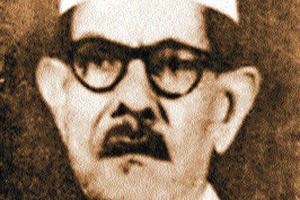
Remembering a titan of Hyderabad’s heritage

He played cricket and football for St Stephen’s Delhi with distinction. He did his masters in English as well as Arabic and he topped Punjab University in Persian. And if you are to name a saviour of the cave art of Ajanta and Ellora it is him: Ghulam Yazdani, a Padma Bhushan awardee as well as a recipient of OBE (Order of British Empire). 

Remembering a titan of Hyderabad’s heritage

As the Archaeology Department of Andhra Pradesh marks its 100 years the coming Friday, it is time to remember the man who created the department out of nothing.
If Hyderabad has a vestige of its heritage left, it is thanks to him. Deputed to Hyderabad as a Superintendent in 1914, he brought with him his expertise, energy and accountability. Not for him the claptrap of archaeology department doing the job of cataloguing and executing conservation work, Yazdani was a hands on man who got a road laid between Hyderabad and Bidar to protect the Bahamani heritage of Bidar and also between Toli Masjid and Golconda.
A man of sharp wit, he dismisses the decorative motifs of Toli Masjid as: “The impression made by such buildings overloaded with decorations is like the impression left by the ostentatious and lavish display of personal adornment, generally favoured by lowly persons suddenly become rich.”
For the restoration of the Ellora cave art, he tried to get Luigi Cavenaghi, the man linked to restoration of Leonardo’s Last Supper, to work on the paintings. Unfortunately, he could get only Lorenzo Cecconi, who applied shellac on the paintings, ruining them further. Ghulam Yazdani published a series of photographs and reproductions of the cave art with his explanations.
And by the way, Ghulam Yazdani’s salary was ` 560 per month. And just recently, the Archeology Department found it fit to name its museum after YS Rajasekhara Reddy!

source: http://www.timesofindia.indiatimes.com / The Times of India / Home> Life & Style> People / by Serish Nanisetti, TNN / April 21st, 2014

The French connection

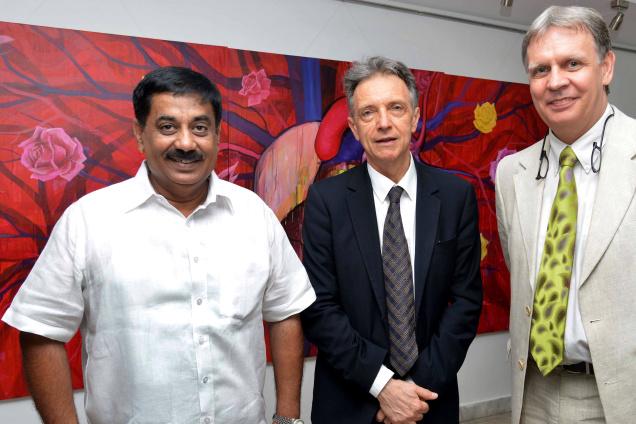
J. Prithvi Reddy, recipient of the Belmondo Medal;General Secretary of Foundation Alliance Franciase, Paris, Jean-Claude Jacq and Jean-Manuel Duhaut./ Photo: Nagara Gopal / The Hindu

Director of Alliance Francaise Hyderabad is happy that the Belmondo Medal has been awarded to a Hyderabadi

Jean-Manuel Duhaut is a happy man. His stay in Hyderabad as the Director of Alliance Française, Hyderabad, which was supposed to end by August this year has been extended. “There are many coincidences in my life about coming and working in India. In 1983 I was to come and teach French in India as a visiting lecturer; then I was first assigned to Hyderabad. Just the day earlier I watched Gandhi film with my students. At that time I knew India but had no idea of a city called Hyderabad.

I looked up the map and could trace my future place of dwelling. Just when I was getting excited about my stint in Hyderabad, I was told that the place which I was supposed to take had got filled in. However my India plans as a lecturer would still be on. I was sent to Delhi,” recollects Jean.

The French language and cultural institute recently wrapped up a function where city-based J. Prithvi Reddy was awarded the prestigious French Belmondo medal that is awarded to people who have made a significant contribution to Alliance Française. This medal was designed by famous sculptor Paul Belmondo, father of the illustrious French actor Jean-Paul Belmondo. “Jean Paul Belmondo is to France what Amitbah Bachchan is to India,” explains Jean.

Prithvi Reddy was awarded the medal for his invaluable contribution and long association with Alliance Française. He helped the centre sustain when it was in a very bad crisis some years ago,” elaborates Jean.

Talking more about his association with teaching, Jean says “I chose teaching over the mandatory military service and that is how I applied for civil services abroad where we teach French at erstwhile French colonies. Many people still mistake us to be a foreign institution, but we are not. We are actually the largest controlled NGO that is only involved in teaching French and establishing a cultural dialogue between the two countries.”

source: http://www.thehindu.com / The Hindu / Home> Features> MetroPlus> Society / by Prabalika M. Borah / Hyderabad – April 10th, 2014

Ugadi Mitr Milan gets under way

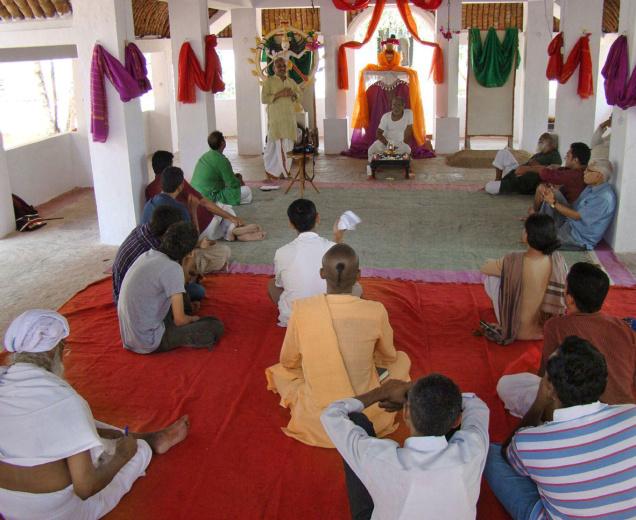
Ugadi Mitr Milan underway at Adilabad. / The Hindu

The annual three-day Ugadi Mitr Milan programme got underway at Kala Ashram, Adilabad on Saturday as activists, professionals and others from different places in the country arrived to participate. The programme essentially features discussions revolving around the composition and organisation of rural communities, including traditional artisans which are on the verge of extinction.

Sunil Deshpande of Sampoorna Bamboo Kendra, Amaravati in Maharashtra initiated the programme with an introduction. Kala Ratna award winner and Kala Ashram founder Guruji Ravinder Sharma spoke at length on different subjects.

Among the participants are a former activist A. Mohan Kumar from Kerala; Dr. K. Madhavi from Boston, USA; Ram Babu of Aahar Kuteer, Begumpet, Hyderabad; educationist K.B. Jinan; Dharmendra Joshi from Ratnagiri Maharashtra. Also attending are writers Kamlesh from New Delhi who had been personal assistant of renowned Socialist Dr. Ram Manohar Lohia and Dhruv Shukla from Bhopal, Muneet from Bangalore, Professor Ganesh from Mumbai, and Lenin from Hyderabad.

source: http://www.thehindu.com / The Hindu / Home> News> National> Andhra Pradesh / by Special Correspondent / Adilabad – March 29th, 2014

‘Utilise garbage to generate electricity’

APJKalamHF29mar2014

A.P.J. Abdul Kalam asks people to take pledge to protect at least one water body in their lifetime

The enormous quantities of conventional waste generated in the country like garbage and fly ash, which is the result of India’s rapid growth story, should be utilised to restore environment rather than deteriorate it, observed former President of India A.P.J. Abdul Kalam.

“Effluents are released from millions of households; mounting garbage is a rich source of energy as the municipal waste can be used to generate electricity. The TIFAC (Technology Information Forecasting and Assessment Council) could convert garbage to fuel. India needs thousands of such power plants in small towns to generate electricity from garbage,” he said.

Mr. Kalam was addressing a gathering on Friday at a two-day national seminar on “100 years of Activated Sludge Process and its application to industrial wastewaters and CETP’s in India”. The seminar is being organised by Jeedimetla Effluent Treatment limited (JETL) in collaboration with Indian Environment Association on the occasion of silver jubilee of JETL.

No toxics in fly ash

Elaborating on the usage of fly ash, he said, “The dumping of fly ash should be avoided and there should be 100 per cent utilisation. Toxicology reports have said there is no toxic in the fly ash, but only nutrients.

Fly ash can be used in green building materials and this can also create employment. It can also be used as manure by the farmers.”

He appealed to each one of the audience to take a pledge to protect at least one water body in their lifetime.

He also appreciated the efforts of the JETL in effectively treating effluent waste.

source: http://www.thehindu.com / The Hindu / Home> News> Cities> Hyderabad / by Staff Reporter / Hyderabad – March 29th, 2014

NATS vows to nurture Telugu children in US into world leaders

North America Telugu Society president Gangadhar Desu talking to The Hindu in Vijayawada on Tuesday. / Photo. Ch. Vijaya Bhaskar / The Hindu

We are bringing out a series of books in English on Telugu people, culture, says its president

There is no dearth of role models for them. Telugu children living in North America have success stories like Microsoft CEO Satya Nadella, Global coordinator of Lead India 2020 Hari Krishna Eppanapally, elected representatives like Upendra J.Chivukula, deputy speaker of New Jersey Assembly and Katragadda Aruna Miller, member of the Maryland House of Delegates, to look up to.

And lucky for them there is the North America Telugu Society (NATS) to nurture them into ‘world leaders’. The society has taken up career assistance programmes for Telugu youth.

NATS is now inviting not only successful Telugus, but successful Indians, to deliver talks. The society is also bringing out a series of books in English on Telugu people, their culture and history to take the initiative forward.

The person behind the initiative is none other than the Vijayawada-born Gangadhar Desu, the CEO of Neighbour Care chain of pharmacy stores who has been elected president of NATS for the next two years. Mr. Gangadhar did his schooling in SKPPV Hindu High School, One Town, and intermediate in K.B.N.College. He did his B.Pharma in Manipal College of Pharmacy and M.Pharma in Long Island, New York. “Satya Nadella is a couple of years senior to me,” he said recalling life on the campus.

Starting his career as a pharmacist Mr. Gangadhar, with a licence to work in any of the North Eastern States of the United States became the head of the Mergers and Acquisitions of Eckerds pharmacy in a short time. He then quit and started his own chain of pharmacy stores.

Diverse cultures

“The Telugu children here are exposed to diverse cultures, but it will be difficult for them to be world leaders unless they learn about their own roots,” Mr. Gangadhar said. The society took over 400 teachers from Andhra Pradesh to the United States to train children in various performance arts last year.

Mr. Gangadhar has high hopes for the Indian children of North America. “Five per cent of the Fortune 500 companies are run by Indians today. This will increase to 10 per cent by 2020. Indians were doing extremely well in politics too.

The Hindu Indians are being wooed by both the Republicans and the Democrats. Tulasi Gabbard of Samoan origin made news when she took oath on the Bhagvad Gita. Tulasi, who grew up in a multi-cultural, multi-religious household is a practising Hindu and yet another role model for the children, Mr. Gangadhar said.

source: http://www.thehindu.com / The Hindu / Home> News> Cities> Vijayawada / by Special Correspondent / Vijayawada – March 13th, 2014

Hyderabad boy Satya Nadella set to become Microsoft CEO

Nadella learnt technology at Microsoft, leadership at Begumpet school.

The third CEO in Microsoft’s 38-year-old history after Bill Gates and Steve Ballmer could be an India-born, two media reports said on Friday, citing sources familiar with the processes of selecting the new leader at the Redmond-based company.

If he is the chosen one, as Bloomberg was the first to report, Satya Nadella , a 22-year Microsoft veteran with leading roles in the Office and Bing search engine teams, will become the most powerful Indian-origin tech executive in the world.

Bloomberg also reported that the board was considering replacing Chairman Bill Gates with Microsoft’s lead Independent Director John Thompson.

People who know him well both professionally and personally say apart from his technological wizadry, what has struck them about Nadella is that he is a great team person. “Satya is extraordinarily humble and a great human being; so almost anybody who knows him has nice things to say about him. That is in contrast to many leaders today who have ‘sharp elbows’,” says Ravi Venkatesan, former chairman of Microsoft India.

The 46-year-old Nadella has not forgotten his roots and is connected deeply to Hyderabad where his parents (his father is a retired IAS officer) live. He and his wife did their schooling at the Hyderabad Public School in Begumpet and visit the city every year. In an earlier interview to an Indian publication, Nadella had talked about the leadership lessons he first learnt while playing for his school cricket team. Once when the team captain saw Nadella bowling quite ordinarily, he himself stepped in to give the team a much-needed breakthrough, and again threw the ball back to Nadella to bowl the next over.

“I will never forget that. What made him do that? Is this what they call leadership? These are the kind of questions I have since reflected on as I approach many of the things I do today leading teams,” Nadella had said.

Nadella, who has an engineering degree in electronics and communication from Manipal Institute of Technology, moved to the US where he earned a master of science degree in computer science from the University of Wisconsin. He is also an MBA from the University of Chicago. He worked at Sun Microsystems before joining Microsoft in 1992. During these nearly 22 years, Nadella has held several positions, including senior VP of R&D for the online services division and VP of the Microsoft business division.

“He is one of the sharpest guys you will meet; he is very technical and very empathetic. He understands an exterior opinion which works in his favour as he is ready to learn from others,” says one of Nadella’s friends, requesting anonymity.

It is probably Nadella’s performance at the company that led to him being appointed as the head of one of the most key segments of the company — cloud and enterprise. According to several sources, Nadella was responsible for bringing the company’s database, Windows server and developer tools, to its Azure cloud.

Under his leadership, Microsoft’s cloud services’ revenue rose to $20.3 billion in June 2013 from $16.6 billion when he took over in 2011.

“He is an extremely well-rounded person; he has worked in the application business; he has worked in the Bing search business, led the server and tool business, and now he is in charge of all online and cloud engineering. More importantly, he is a strong technical person which is a good thing to lead a company like Microsoft,” says Venkatesan whose first engagement with Nadella happened when the latter was heading the Microsoft business division.

“Microsoft’s offerings have touched an entire generation of Indians, and it would be a moment of great pride for us to see an Indian take over such a prestigious post,” says Ravi Gururaj, chairman of Indian IT industry body Nasscom’s product council.

“I am sure it is his performance and delivery at the company that has brought him this far, and we wish him well.”

Microsoft is currently at a crucial point, as the company is moving away from its roots as a software-focused firm and moving towards hardware and internet-based services.

Experts say Nadella would certainly represent a conservative choice for Microsoft. He is a sharp, persuasive individual and can inject fresh life into Microsoft. But others say Nadella will not be the radical agent of change or the inspirational visionary that some investors and outsiders have been hoping for.

source: http://www.business-standard.com / Business Standard / Home> Companies> News / by Itika Sharma Punit & Bibhu Ranjan Mishra / Bangalore – February 01st, 2014

Veteran CPI leader and champion of land struggles passes away

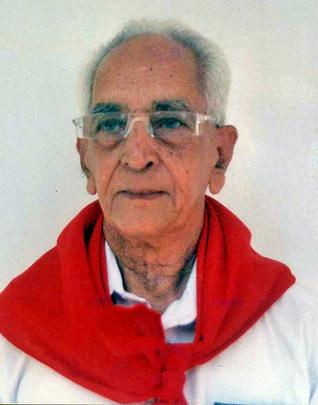
Former three-time MLA of Anakapalle and veteran leader of CPI K. Govinda Rao, who passed away in Hyderabad. / by Special Arrangement / The Hindu

Govinda Rao, in the time of undivided Communist Party of India, was actively involved in several land agitations conducted in the plain and Agency areas of the then combined Visakhapatnam district.

Former MLA of Anakapalle and veteran leader of CPI K. Govinda Rao, who passed away in Hyderabad on Tuesday, was leader of many successful struggles the party launched in this area in the past.

Govinda Rao belonged to the time of undivided Communist Party of India and was actively involved in several land agitations conducted in the plain and Agency areas of the then combined Visakhapatnam district (comprising of the present north coastal Andhra districts). He got nearly 2,000 acres distributed to poor farmers in Cheedika and Rebaka villages in Chintapalli mandal and Kesavaram in Payakaraopeta mandal and led agitations for distribution of mokasa lands in Seetakandi and Nimmagedda areas in Golugonda mandal. His work among the poor helped him to get elected three times form Anakapalle Assembly constituency in 1962, 1967 and 1978. During the agitation for establishing steel plant at Visakhapatnam he resigned as MLA at the party’s direction. Born in Visakhapatnam, Govinda Rao actively participated in students agitations while studying at M.R. College, Vizianagaram. He was arrested and imprisoned at Bellary jail during Quit India movement.

source: http://www.thehindu.com / The Hindu / Home> News> Cities> Visakhapatnam / by Special Correspondent / Visakhapatnam – February 19th, 2014