Monthly Archives: May 2013

Excellence on Tour flagged off in Hyderabad

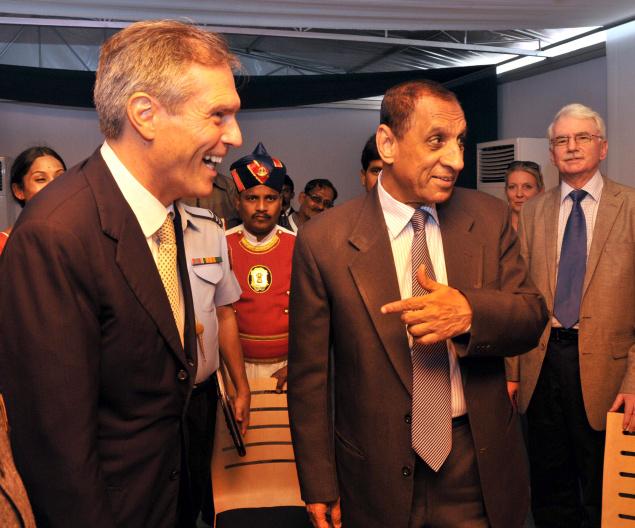
Showcasing Indo-German collaboration: Micheal Steiner (left) , German Ambassador in India, with Governor E. S. L. Narasimhan at the German House for Research and Innovation -Excellence on Tour 2013, in Hyderabad on Friday . - P.V. Sivakumar / The Hindu
Showcasing Indo-German collaboration: Micheal Steiner (left) , German Ambassador in India, with Governor E. S. L. Narasimhan at the German House for Research and Innovation -Excellence on Tour 2013, in Hyderabad on Friday . – P.V. Sivakumar / The Hindu

Hyderabad : 

An eight-day Excellence on Tour, an initiative by the German Government involving a variety of programmes to showcase Indo-German collaboration in science and technology, was flagged off here today.

The event is being organised by the German House for Research and Innovation, New Delhi and supported by the Andhra Pradesh Government.

The event will feature exhibitions, workshops, lectures, symposiums and cultural events. The Indo-German Science Slam will be one of the special attractions, witnessing researchers present their topic of interest in ten minutes.

The German Ambassador to India, Michael Steiner, and AP Governor E.S.L. Narasimhan, inaugurated the event at Muffakham Jah College of Engineering and Technology.

Interactive sessions with students and academicians during the event will cover topics such as molecular biology, non-invasive medical diagnostics, engineering sciences, geophysical research, climate change and astronomy.

The opening day also brings to India the renowned Guntur Bennung, popularly known as Clown Shiven, who has been travelling worldwide as a clown for 33 years.

The German Government has set up the German House for Research and Innovation in five countries, including Sao Paulo (Brazil), Moscow (Russua), New York, Tokyo and more recently in New Delhi. The New Delhi centre has 14 institutions from science and industry as members. Flagging off the event, Michael Steiner said although Indo-German collaboration was increasing in different fields, “we do not know enough about each other.” There was still a “knowledge gap”, he said, adding that such events would help bridge this gap. Narasimhan said technology by its very nature was penetrating and has gone far ahead than its alter ego, science. “We have become addicted to products of technology to entertain us and engross us. As a result the ‘human’ in us is diminished,” he pointed out.

The event will move on later this year to two more Indian cities—Ahmedabad and Kolkata.

source: http://www.thehindu.com / The Hindu / Home> News> National / by the Hindu Bureau – amitmirta@thehindu.co.in / Hyderabad, April 28th, 2013
Ageing Germany woos Indian students, workers

Hyderabad (IANS):

With its labour force likely to decline by 6.5 million people by 2025 because of its ageing population, Germany is looking to attract young students and skilled workforce from India.

German Ambassador to India Michael Steiner Friday said India and Germany can complement each other by exploiting their demographic advantages.

“In 2025, we will have minus 6.3 million workforce, not just engineers and doctors but also skilled workers because we are older society than, for example, India,” he said while launching ‘Excellence on Tour 2013’, a road-show by the German House for Research and Innovation (DWIH), New Delhi to showcase education opportunities for Indian students in Germany.

“India is a young society with millions and millions of students and young people who need to be trained and educated and who need jobs. The average age of Indian population is 25 years while in Germany, the average age is 35 years,” he said.

The ambassador pointed out that Germany with top universities and institutions for vocational training is well equipped to meet the requirements of Indian students. “India has what Germany needs and Germany has what India needs,” he said.

Addressing a huge gathering of students at Muffakham Jah College of Engineering and Technology, Steiner said when Indian Prime Minister Manmohan Singh recently visited Germany, there was an understanding between the two countries that they should exploit the demographic advantages they have.

The ambassador disagreed that it is brain drain. “This is not brain drain. It is about brain circulation. It is about helping to build the brain,” he said.

To a question by a student whether in the event of a recession, Germany would look after the interests of its own people, the ambassador said the demand was huge in German economy.

“The incline in growth we have is on a very high level. Even if there is relative recession, even if we have a growth rate of two percent less, this would not change the fundamental picture.”

Explaining how Germany transformed its economy through structural reforms, he said it had the strength to shoulder the crisis in Europe and show solidarity with other countries.

He was confident that Europe would get out of the crisis in a year or two and emerge as a strong partner of India. He also predicted that India would end as one of the top economies of the world.

Steiner said what Europe was witnessing was not a Euro crisis but a debt crisis. He said the Euro zone countries took the revolutionary step of introducing common currency 12 years ago but they committed a mistake by not harmonizing their fiscal and economic policies.

“If you have a common currency you must have communal fiscal and economic policy. As we didn’t do that we had to pay the price and we landed up in the debt crisis.”

The eight-day road show is the first since the launch of DWIH in Delhi late last year.

DWIH is a one-stop shop for Indians who want to know about possibilities in education, science and research in Germany. It represents all major German organizations in areas of education, science, technology and innovation.

source: http://www.daijiworld.com / Daiji World / Home> World / by IANS / Hyderabad, April 26th, 2013

NDDB pats Karimnagar Dairy for launching welfare schemes

National Dairy Development Board team inspects functioning of the dairy

The National Dairy Development Board (NDDB) authorities were all praise for the Karimnagar district milk producer company (Karimnagar Dairy) for launching several welfare schemes for the milk producers and also taking measures for increasing the milk production.

The eight-member NDDB team led by S.K. Dalaal is on a three-day tour of the district to inspect the functioning of the dairy activities, procurement of milk from villages, welfare schemes and other expansion programmes.

The NDDB team toured the villages on Thursday and on Friday and had meeting with the Karimnagar Dairy authorities, including chairman Ch. Rajeshwara Rao and managing director V. Hanumantha Reddy.

The NDDB authorities said that Karimnagar Dairy was doing well and there was a lot of scope for the expansion of its activities to meet the demand in the future.

The authorities said that they were also planning for the inclusion of Karimnagar Dairy in the National Dairy Plan to provide funds for the increasing the milk production, sources said.

The Karimnagar Dairy authorities explained to the NDDB team about the growth of the dairy over the last one decade with the farmer-friendly policies and increase of milk production and sales.

The NDDB authorities complimented the Karimnagar Dairy authorities for launching the ‘Paalanidhi’, a social security pension scheme to the milk producers, which was not existing in any dairy of Andhra Pradesh state.


  • NDDB planning to include Karimnagar Dairy in National Dairy Plan to provide funds
  • NDDB praises launching of ‘Paalanidhi’, a pension scheme for milk producers 

source: http://www.thehindu.com / The Hindu / Home> National> Andhra Pradesh / by Staff Reporter / Karimnagar, April 27th, 2013

Hay-granary technology still popular in Krishna

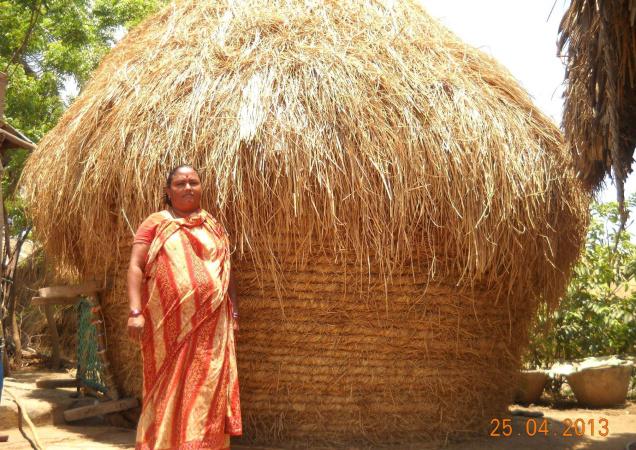
A farmer proudly displays the traditional granary made of spliced hay for storing grains in Kuchipudi in Krishna District. Photo: T. Appala Naidu / The Hindu

Farmers having a land-holding of not less than four-acres are largely dependent on traditional ‘Purri (granary)’ method of storing foodgrains, arguably free from rot and rain affect.

Gone are the days in Krishna district where farmers had to depend on middlemen for selling crop, as they had no godown space to store the produce till it fetched remunerative price. In this traditional farmers’ technology, two-lines of large rope made of spliced hay is tied surrounding a mud-clad space created with gunny bags and the soil for basement.

While constructing the hay rope granary, some farmers use gunny bags to create necessary space, which is simultaneously filled by pouring grains, others make a tight rope tied around a mud wall. “The granary set up in open space would never absorb rainwater and grains are safe from any weather condition” said a woman farmer and entrepreneur M. Vijaya Lakshmi from Kuchipudi.

“It’s a method in which rotting of grains is never reported and even mice cannot gain entry due to its thickness and strength,” added Vijaya Lakshmi, who built 120-bag capacity granary outside her residence by spending Rs.1,500 for labour charges. The strength of the granary depends on how much hay is used in the making of the rope. Irrespective of height or width, each granary serves the purpose for two-years to store grains.

This kind of granary is largely being used to store paddy and blackgram in Krishna district. Unprecedented number of hay granaries welcome the visitor in the villages which are far from mandal headquarters, and which are plagued by poor transportation facilities. Even in Diviseema and Kuchipudi areas village elders said that the farmers in Krishna district used to store grain underground till 1980s.

While small farmers prefer the method of storing grains for their domestic needs, middle and big farmers construct it in business interest, and store the produce till price in market goes up. “This age-old rural technology is a boon for people like me as I have no space inside the house to store the produce,” said Peketi Seetarami Reddy of Kaja village in Movva.

Mr. Reddy, tenant farmer in 23 acres, also buys paddy from his fellow farmers at low prices and stores it for better marketing prices in his 150-bags capacity hay granary. Expert in making hay granary construction, 55-year-old K. Seetaramayya of Arisepalli is happy that the work keeps him busy every January and brings numerous orders. He reveals that he too set up a granary, storing barely 15-bags of paddy for domestic grain storage.

source: http://www.thehindu.com / The Hindu / Home> News> National> Andhra Pradesh / by T. Appala Naidu / Machilipatnam, April 27th, 2013