Monthly Archives: May 2013

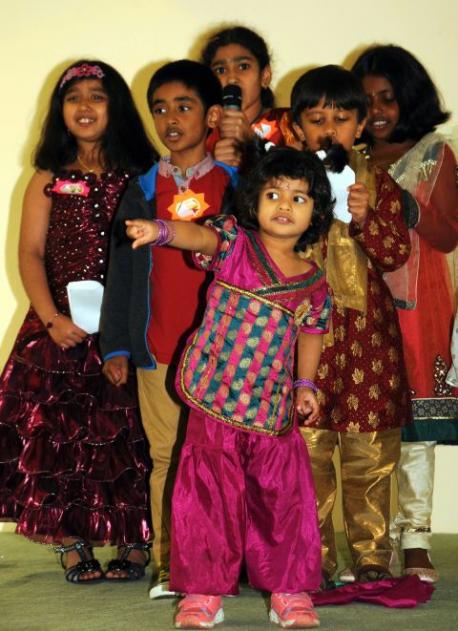
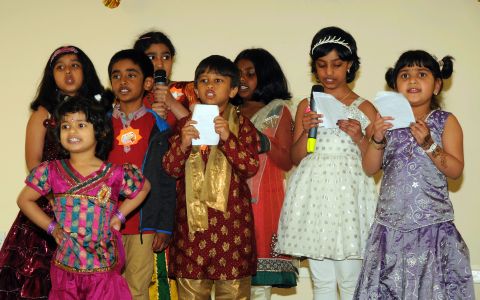
South Indian community in Basingstoke celebrate New Year

Youngsters enjoy the celebrations / Basingstoke Gazette

AN INDIAN New Year festival was celebrated in Basingstoke.

Organised by the Telugu Association of Basingstoke (TAB-UK), which represents those from South India living in the town, the event at Carnival Hall included dancing, singing and games to entertain the children.

A Ugadi tradition was performed at the event, when the yearly horoscopes were read out for each of the 12 lunar signs.

Children from the Telugu School, run by volunteers from TAB-UK at Carnival Hall, sang to the audience.

Those attending the celebration also enjoyed a traditional Indian meal as well as a special dish consisting of six different tastes which symbolise the different elements of life – sadness, happiness, anger, fear, disgust and surprise.

TeluguHF07may2013

Sreeni Vavilala, a committee member for TAB-UK, said: “Around 150 people attended the event – not only from Basingstoke but also from the Midlands and London.

“All the people who attended the event had great fun. This event gave a chance for members of the South Indian community to celebrate the biggest festival in the calendar as a community event.”

source: http://www.basingstokegazette.co.uk / Basingstoke Gazette / Home> News / by Emily Robert, Chief Reporter / May 02nd, 2013

This Andhra village has lessons to teach

Gangadevipalli  (Andhra Pradesh):

If India lives in its villages, then the model it perhaps must follow is Gangadevipalli, a hamlet in Andhra Pradesh’s Warangal district where every house has the bare necessities of life, and more.

From regular power and water supply to a scientific water filtration plant, a community-owned cable TV service and concrete, well-lit roads, Gangadevipalli has been steadily gaining in prosperity thanks to a disciplined and determined community that has also managed to work in harmony towards goals set collectively.

The village, about 200 km north of state capital Hyderabad, has won several awards, including the “Nirmal Gram Puraskar”, for health and hygiene.

Now, the village headman has been invited to Nepal to recount Gangadevipalli’s success story.

“Our village has been hogging the limelight for all the right reasons. I have now been invited to Nepal to explain how we work so cohesively,” headman K. Rajamouli told IANS.

With a population of a little over 1,300, the village has 100 percent adult literacy. The school dropout rate has been zero since 2000.

“The unity of the village and the realisation of the need for community development are at the root of the achievements of Gangadevipalli,” says S.S. Reddy of Bala Vikasa Social Service Society, an NGO that has been working closely with villagers.

The village has over two dozen committees, which manage areas like health and hygiene, the provision of drinking water, cable television and literacy.

Another remarkable achievement for the village is that its married population under the age of 35 does not have more than two children.

The village now boasts 100 percent survival of new-born babies, their inoculation and immunisation, as well as regular vaccination of children below five. The supply of nutritious food to children and pregnant and lactating women, along with regular health check-ups, is also among the unique achievements of the village.

The gender ratio of women and men is almost the same. Each woman is also a member of a self-help group, making a significant contribution to the family income.

Apart from having savings of at least Rs.10,000 each, every family has a life insurance policy, prompting authorities to give the village the “Beema Gram” award.

The farmers’ development panel looks into improvements in agriculture; experts explore ways of increasing productivity as well as reducing farming costs.

But sometimes, even discipline could result in loss: “While farmers all over the state rejoiced after the government announced waiver of agricultural loans for small and marginal farmers, peasants here suffered a loss of over Rs.40 lakh because we had repaid our loans on time,” headman Rajamouli said.

There is also a committee to come to the help of villagers engaged in family disputes. A civil supplies body ensures that no corruption takes place in the supply of essential commodities through ration shops.

The village also enforces a complete ban on the sale of alcohol.

“Drinking may lead to communal disharmony as well as domestic abuse. Hence the sale of liquor has been banned for more than a decade now,” said Kusam Ramaiah, head of the prohibition committee.

The journey to progress has not been smooth sailing, though.

“The essence of our prosperity and development is our unity, and it took years to forge that. There were so many divisions on the basis of caste, religion, political belief, etc, but we did not lose heart,” says S. Kaadambani, the member of a self-help group.

As the village became famous, the residents launched a fresh scheme to garner revenue – visitors are charged Rs.1,600 for a conducted tour with proper guides to explain the progress that the village has witnessed. Government functionaries, members of other gram panchayats, media people and NGO activists from within the country and abroad are among those who have dropped by.

There are at least two visits to this model village each week.

(Anurag Dey can be contacted at anurag.d@ians.in)

source: http://www.newindianexpress.com / The New Indian Express / Home> States> Andhra Pradesh / by Anurag Dey / IANS – Gangadevipalli (AP) / March 30th, 2013
100 years on, Andhra Mahasabha chief forgotten in his own city

Visakhapatnam : 

The centenary celebrations of Andhra Mahasabha – the cultural organization that indirectly kickstarted the movement for a separate Andhra state is around the corner. But there isn’t any plan to celebrate the centenary in a big way in the city. What’s more, not many denizens are aware that it was a native of Visakhapatnam, Sir B N Sarma, who presided over the first Andhra Mahasabha conference in Bapatla on May 26, 1913.

Sir B N Sarma, twice the municipal chairman of Visakhapatnam, rose to become a member of the Imperial Legislative Council and president of the Council of State, was a visionary who envisaged along with stalwarts such as Sir Mocherla Rama Chandra Rao, Nyapathi Subba Rao Panthulu, Desabhaktha Kondavenkatappayya and Bhogaraju Pattabhi Seetharamayya, a Federal India with linguistic provinces.

Prasanna Kumar, former rector of Andhra University, says: “The Andhra Mahasabha was as much a socio-cultural forum as it was political. The founders of Andhra Mahasabha envisaged a pan-Indian federalism, based on linguistic and cultural identity.” Though the idea of Linguistic provinces was brought out in the open in 1917 and a Bill for separate Linguistic provinces introduced in the Imperial Legislative Council by Sir Sarma, it was opposed on the grounds that it would encourage separatist tendencies.

B Sudhakar Reddy, who teaches history at the Andhra University says, “The fact that it was the Telugu political leadership of yesteryears which debated upon the idea of federalism based on linguistic identity is not given due recognition. In fact, the Andhra University was one of the results of this federal movement.”

Analysts say that present day leaders of the region fight shy of acknowledging this face. They point out that the problem with Visakhapatnam was a peculiar one as most of the residents and the politicians are settlers, adding that it was only natural that the top political bosses from Vizag showed no interest in promoting the erstwhile leaders of and from the region.

D N Sinha, a native of Visakhapatnam, observed that the phrase, “A sleepy fishing hamlet barely a 100 years ago,” is often used by people who seem to be unaware of the fact that Vizag was the headquarters of the largest district in British India since 1803 and the de-facto socio-cultural and political centre of entire south Odisha and all of the North Coastal AP. He says, “It is unfortunate that many both wittingly and unwittingly try to paint Visakhapatnam as a city that virtually came out of nothing. More importantly, the efforts of those who made it the City of Destiny have been completely ignored and their names forgotten.”

source: http://www.articles.timesofindia.indiatimes.com / The Times of India / Home> City> Visakhapatnam / TNN / May 02nd, 2013

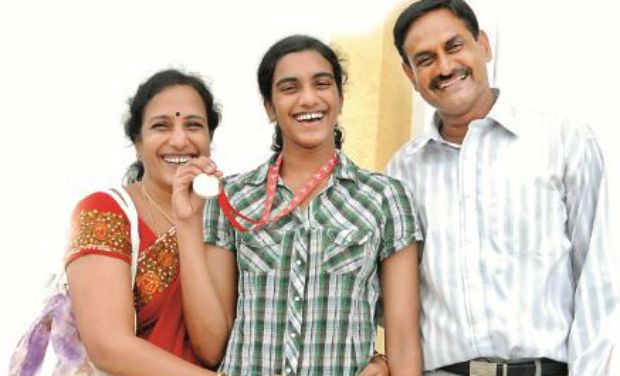
‘OMG…! I’ve won!’: P.V. Sindhu

sindhuHF06may2013

What has been promised for so long was finally delivered on Saturday, when fast-rising Hyderabad badminton star P.V. Sindhu clinched the Malaysia Grand Prix, defeating Juan Gu of Singapore 21-17, 17-21, 21-19 in a fiercely fought final.

“It is a very happy moment for all of us. We have been waiting for this day for so long,” said an ecstatic P.V. Ramana, Sindhu’s father, “This being her first senior title makes it a very special day for us.”

While the match was in progress in Kuala Lumpur, her family had to endure some very tense moments. Her father recounts, “She won the first game but her opponent won the second. Sindhu was then trailing 10-15 in the third game, when we lost the internet connection. We didn’t know what to do. We then got the news that she had won and when we spoke to her, all she could say was, ‘I just stood there, blank, not realising I had won.’ We are all on cloud nine!”

Reflected the same sentiment, Sindhu related, “It was a very taxing match. After I won the first game, Juan fought back really well to win the second. But the third game is one that I will remember for a long time. I was trailing 10-15, and for a moment, I was worried.”

Sindhu then fought back and made it 14-15. She then took the lead, and with Juan snapping at her heels, wrapped up the set 21-19 to win the title.

“I just froze on the court for a couple of minutes. I couldn’t believe I had won. Then it hit me and my first reaction was, ‘Oh my God! I’ve actually won!’”

Sindhu thanked her coach Edwin Iriawan, who had accompanied her to Malaysia, and the support staff for their encouragement. “It has been a great three weeks for me. I played the quarterfinals at Chinese Taipei (Badminton Asia Championships) and the semifinals in New Delhi (India Open Superseries) and now, I have won my first title.”

source: http://www.deccanchronicle.com / Deccan Chronicle / Home> Lifestyle> Offbeat / by Vijay Anand – DC / May 06th, 2013

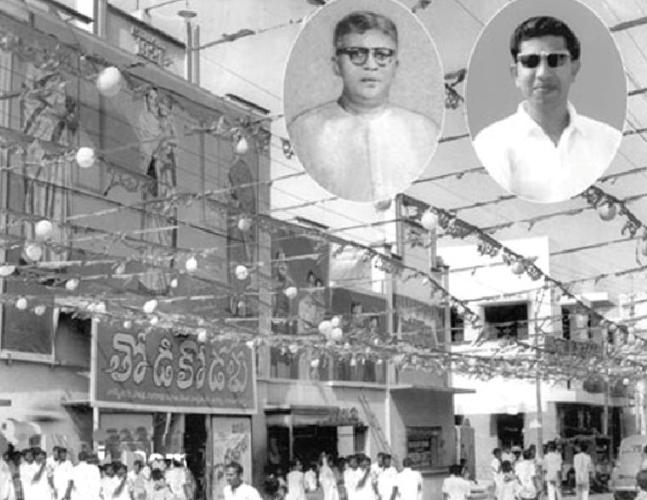
First theater of Andhra Pradesh

firsttheatreHF05may2013

Telugu audiences love for cinema is unconditional and Andhra Pradesh state being filled with more than 2.5k theatres is a proof for it. Telugu film industry holds the record of producing highest number of films in India, exceeding even Bollywood till date.

It even holds the World record as the world’s largest film production facility. Have you ever thought of which was the first theater of Andhra Pradesh? I guess you did it now and here is the answer folk, “Maruthi Talkies”, Vijayawada. Maruthi talkies is first permanent theater in AP, which was built by late Pothina Srinivasa Rao in 1921.

It is the number one center as far as cinema running’s are considered from day one, and it was the central hub during the period of distribution system for films in mid-60’s in AP. Maruthi talkies holds the record of running 100 days shows for films like NTR’s Lavakusa, Krishna’s Gudachari 116, handsome hero Shoban Babu’s first solo hero film Veerebhimanya and many more hit films.

source: http://www.apherald.com / AP Herald.com / Home> Movies / by Cheruku Raja / Wednesday, May 01st, 2013

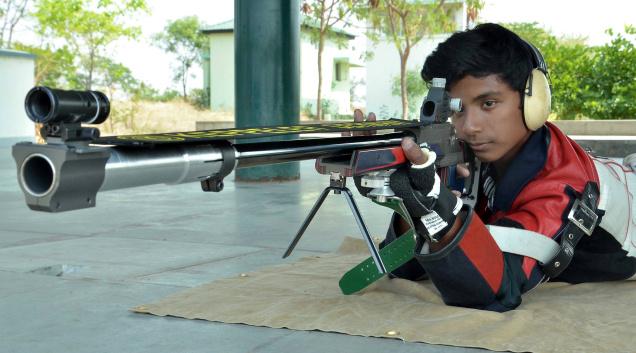
Abedin, at 12, shoots to fame

Young shooter Zain-ul-Abedin who was the cynosure of all eyes in the G. V. Mavlankar shooting championship at Yapral on Friday in Hyderabad. / The Hindu

M.A. Zain-ul-Abedin challenged seasoned campaigners at the All India G.V. Mavlankar Shooting Championship in Yapral and finished third in the qualifying rounds.

At age 12, most kids do not even prefer to be in the vicinity of any shooting range, leave alone compete. But the Class VI student from Nasr School (Gachibowli), M.A. Zain-ul-Abedin, not only challenged seasoned campaigners at the All India G.V. Mavlankar Shooting Championship in Yapral but even finished a remarkable third in the qualifying rounds.

In a way, this shooting prodigy has been into the sport since age 5 as his sisters – Nargis Fatima and Saba Fatima – are also national shooters in air pistol (10 m and 25 m).

Defying all odds as the big bore event is a totally different proposition given the heavy recoil and distance, Abedin threw enough hints of his immense talent in the 300-m big bore competition with a terrific score of 547\600; an effort which will see him compete for the medal on Saturday. This sub-junior national champion in the air pistol category was clearly the cynosure of all eyes at the Lake Line Ranges in Yapral on Friday.

It is an event where even seniors struggle to sustain their concentration as the competition is not only demanding but also implies handling the heavy recoil and distance, apart from firing 60 shots, says Viqar Ahmed Shafeeq, joint secretary, Rifle Association of Andhra Pradesh.

With his sisters and father, A.M. Hussain, constantly guiding him, Abedin is clearly looking for bigger things.

“I am pleased with my performance today. It was certainly not expected, but I was confident of putting up a good show,” said the shy shooter on Friday.

Thanks to the shooting ranges at home, Abedin has the liberty to just go out and keep improving his shooting prowess, taking time off from academics.

“The best part is that he is good in both academics and sport,” says a proud Hussain.

source: http://www.thehindu.com / The Hindu / Home> News> Cities> Hyderabad / by  V.V. Subrahmanyam / April 13th, 2013

Ongole students win national-level contest

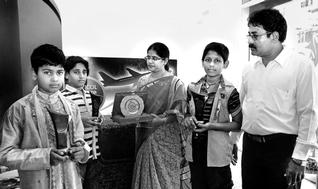
Proud moment:Budding scientists from Gowtham Model School along with school correspodent M.Kondiah and Principal M. Padmaja at Ongole on Wednesday. —Photo: Kommuri Srinivas / The Hindu

 They win trophy, tablet PC and trip to Singapore

The Gowtham Model School (GMS) here has won the national-level Fevicol Science project challenge 2013 held in Mumbai.

Three sixth class students from GMS did Prakasam district and the State proud by projecting innovative water conservation methods during the three-day contest that concluded on April 29,

School correspondent M.Kondaiah told reporters here on Wednesday. ”It is a great achievement by Ongole lads as 1.85 lakh students from 737 schools have taken part in the contest,” he added.

Scientists from the Navi Mumbai Science Foundation acted as judges and spotted the budding scientists in GMS students – M. Guna Snehith, P. Sasi Preetham, and Ch. Karthik, GMS Principal M.Padmaja said.

The students were bubbling with enthusiasm having won a trophy, tablet PC and a foreign trip to Singapore worth Rs. 5 lakh from the Pidilite Industries, makers of Fevicol.

The students’ guide Valli Devasena with a sense of fulfilment said the students were given the topic on the first day. They were allowed to do research on different water conservation techniques and develop working models on the second day. The judges put a barrage of questions to the scientists in the making and adjudged the GMS team as the winners, she added.

The GMS students had made it to the finals by developing a project ‘sustainable village for a population of 10,000’in the junior-level category drawing inspiration from former President A.P.J. Abdul Kalam who had advocated Provision of Urban facilities in Rural Areas (PURA) to find a permanent solution to migration to urban areas and turn villages into engine of growth.

source: http://www.thehindu.com / The Hindu / Home> National> Andhra Pradesh / by Staff Reporter / Ongole, May 02nd, 2013

Hyderabad Metropolitan Development Authority’s unique ‘Adopt a Lake’ plan

Hyderabad :

To preserve and protect lakes, the Hyderabad Metropolitan Development Authority (HMDA) Lake Protection Committee has come with a unique scheme, ‘Adopt a Lake.’

With an objective of involving all stakeholders like individuals/corporates/institutions in lake protection, a Memorandum of Understanding (MoU) for lake adoption would be finalised by the Lake Protection Committee soon. Interested individuals/corporates/institutions have to maintain constant vigil by employing suitable watch and ward team to monitor the encroachments, debris dumping, constructions or tampering of ‘full tank level'(FTL) boundaries. They also have to maintain vigil at all inlets and outlets to keep the lake pollution free.

The interested parties have to submit a detailed proposal to HMDA’s Lake Protection Committee on how the lake could be maintained and upgraded to make it environment-friendly with proper bio-diversity. The HMDA would soon invite Expression Of Interest (EOI) from the different stakeholders to finalise the terms and conditions. of the draft MoU.

source: http://www.articles.timesofindia.indiatimes.com / The Times of India / Home> City> Hyderabad / TNN / May 02nd, 2013

A sparkling exhibition

An exhibition of rare heirloom jewels is being organised in the city from May 11 to 13 at The Taj Krishna.

Being exhibited by Nirav Modi, Modi represents a fine jewellery brand bearing the name of a global diamantaire that combines diamonds and precious stones with the highest level of aestheticism, innovation and craftsmanship.

Its pieces have been sold both at Christie’s and Sotheby’s auction houses. In November 2010, with its exquisite Golconda Lotus Necklace, Nirav became the first Indian to be featured on the cover of the Christies auction catalogue joining the company of immortal jewellers like Bvlgari, Cartier and Harry Winston. More recently in October 2012, the brand set another milestone internationally, through the auction of the Riviere of Perfection neckpiece at Sotheby’s for a stellar 27 crores.

Born into a family of jewellers, Nirav carries forward a rich legacy of knowledge and appreciation for the art of jewellery making. His grandfather traded important diamonds in Mumbai from the 1940’s and his father is still an active diamantaire in Antwerp, Belgium,the rough diamond capital of the world.

Nirav grew up in Antwerp, a city renowned for its diamond trade. However, despite having grown up in Belgium, India and its heritage always presented a strong attraction for the jeweller.

He would visit Mumbai every summer during where he gained invaluable experience at various diamond and jewellery offices throughout the city. Nirav Modi jewellery blends Nirav’s strong sense of design and aesthetics, his family’s legacy, and his roots. The jewellery has been created with a view to match the splendour and tradition upheld by the maharajas.

The Nirav Modi Jewellery collection reflects the rich cultural heritage that the family has cultivated and preserved for over 60 years.

source: http://www.newindianexpress.com / The New Indian Express / Home> Cities> Hyderabad / by Express Features – Hyderabad / May 03rd, 2013

Solar power to light up 20 tribal ashram schools

It is seen as a panacea to the power-cut problem

The Energy and Resources Institute (TERI) a global NGO in collaboration with the Integrated Tribal Development Agency (ITDA) is setting up 1 KV solar power generation plants in 20 tribal ashram schools in the Agency area in the district as a panacea to the power cut problem which is adversely affecting the studies of tribal students.

This has taken up it as a pilot project by spending Rs. 2.75 lakh on each 1 KV plant and TERI expects to complete the project around August. The district administration would eventually cover all the Ashram schools depending on availability of funds.

TERI State Coordinator V.V.K.B.N. Murthy told The Hindu that solar energy based lighting will be a boon to the students in tribal areas and would solve the problem of frequent interruption to power supply. He says that solar power would be a success story in the rural and tribal areas if SHG groups are involved in the implementation of solar projects.

The NGO is introducing solar appliances including home lighting systems, individual lanterns and task lights, etc. in the villages which are under darkness most part of the evening and night, due to long hours of power cuts and also to the hamlets which do not have access to regular power supply. It is engaged in setting of Solar Charging Stations (SCS) in the rural and Agency areas to re-charge solar appliances. So far 100 SSS have been set up and 200 more will be read soon in the State.

TERI is imparting training to entrepreneurs and technicians selected by NGO’s through which the solar lights project is being implemented. The training involves supply, installation and re-charging of solar lights and the operation of solar charging stations. The entrepreneurs are supported by the village residents who pay Rs.10 each per month to the former which takes care of several charging stations and in turn earns his salary.

The objective of SCS is mainly to recharge the batteries which can be used for 4 to 6 hours every day. The stations can charge 50 lights at a time. Solar lamp not only tackles power shortage but also replaces kerosene lamps which are eco-friendly. Every village will have a local entrepreneur who will supply and maintain the solar lamps. Every nine villages will have a technical resource person who will oversee the smooth functioning of the solar charging stations. As many as 43 stations are operating in the district. NGO’s Samskruti, Vikas and Kovel Foundation are in partnership with TERI. Besides, 30 in Srikakulam, 44 in East Godavari district, 9 in Guntur, 12 in Karimnagar and 2 stations in Adilabad are running.

source: http://www.thehindu.com / The Hindu / Home> News> Cities> Visakhapatnam / by Ravi  P. Benjamin / April 14th, 2013