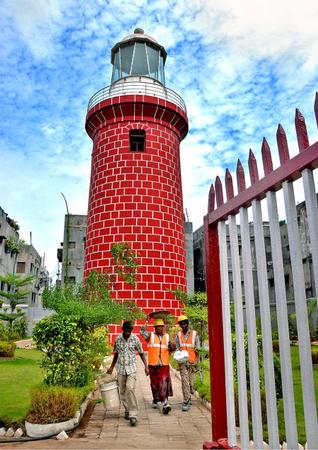
The resored lighthouse on the beach road in Visakhapatnam.PHOTO: C.V. SUBRAHMANYAM
Restored harbour lighthouse sans lantern to be inaugurated tomorrow
The Visakhapatnam Port Trust has taken the lead in restoring the structure of its iconic harbour lighthouse and the restored landmark is set to be inaugurated on Friday.
The restoration of the lighthouse signals the importance the State government is giving to maritime trade. The Government is looking at logistics to play a catalytic role in bringing about double digit growth to the State economy as part of which Visakhapatnam Port plays a key role as a gateway to the East. Under the guidance of well-known conservation architect Vikas Dilawari, the 59-foot round tower with gallery and lantern has been given a makeover. However, the port has not been able to get a lantern and the restored structure would be without a lantern.
The iconic building that was a transit line lighthouse directing the ships into the harbour channel went out of service in 1962. The building was plastered over and the stairs inside had collapsed. The yard had become a garbage dump for the neighbourhood.
Original glory
The Visakha Container Terminal Private Limited took the responsibility of restoring the structure to its original glory and after some painstaking work over the last two years has made it stand out. It has a shining new dome and the gallery is complete with a proper parapet. The structure itself is brick red reflecting its historical value. The yard has been converted into a well-maintained garden.
The restored icon is scheduled to be inaugurated by Visakhapatnam Port Trust Chairman M.T. Krishna Babu.
source: http://www.thehindu.com / The Hindu / Home> News> Cities> Visakhapatnam / by G. S. Subrahmanyam / Visakhapatnam – June 25th, 2015
It is without doubt one of the largest and most imposing colonial buildings not just in the Port City but also Andhra Pradesh and was built in 1910-13 when the British Raj was at its height and Vizag was the headquarters of the largest district in British India. Obviously, the imposing collectorate structure was built to reflect this power and glory of the Raj.
The E-shaped, five-winged castle like stone structure bears a strong Gothic influence and consists of large halls in each wing, with verandas on either side on both the ground floor as well as the first floor. The structure has an impressive porch with an internal spiral staircase leading to a watch tower and base pavilions on either side of the front facade.
Built by the district engineering board, the rubble structure has a tiled roof on the first floor, while the ground floor is Madras terraced, with long steel beams imported from England supporting the roof. Built to inspire awe and yet strictly functional, the stone castle spread over roughly 33,000 sq ft, which till date houses the collectorate of Visakhapatnam district, is by far one of the most beautiful colonial structures built in Andhra Pradesh.
While nobody knows who the actual architect of the impressive building is, Prof VK Giduthuri, associate professor, department of architecture, Andhra University, said the structure combines a blend of the Indian and European styles of architecture. “The arches and the high vaulted ceilings are typically European features. However, the Madras terrace and the open courtyards are clearly indicative of the Indian style of design.”
“It is unique in the sense that the proportions are no doubt grand, but the material used, with the exception of the steel beams, were all locally available. The interiors, though large and airy, are stark and functional,” he added.
Edward Paul, an expert on colonial structures in Visakhapatnam, said the scale and size of the district collectorate of Visakhapatnam was in direct proportion to the size of the then Vizagapatam district. “The old Vizag district was the largest in colonial India and comprised of the modern day districts of Visakhapatnam, Vizianagaram, Srikakulam, Koraput (including Damanjodi), Nowrangpur as well as Rayagada.”
Regarding the misconception that the building took a long time in the making and was constructed between 1865 and 1914, Paul said, “It is clearly mentioned in the Presidency archives records that this was not the case.”
Elaborating on the location of the district collectorate and the layout of the town, Giduthuri said that Sir Patrick Geddes, a noted botanist and amateur town planner and architect, had pointed out that Vizag was quite similar to New Amsterdam in terms of layout. “The administrative centre was located just outside the town overlooking the surf-ridden sea to ensure that things could be conducted away from the madding crowds.”
Fondly recollecting his young days when they would run down the dunes from the collectorate all the way to Beach Road, DN Sinha, an old timer, said: “The entire area between the collectorate and RK Beach in the early 1930s barely had a dozen garden bungalows and we used to run down the dunes all the way to the beach.”
For some not so old timers, the spacious collectorate courtyard was a great place to play cricket. P Krishna, a software engineer based in Bangalore, said, “We used to play cricket inside the courtyard during the summer holidays. It’s a pity that some of the collectors, who came in post 1997, did not take to us too kindly.”
source: http://www.timesofindia.indiatimes.com / The Times of India / Home> City> Visakhapatnam / TNN / June 18th, 2015
A view of the Amaravathi Road from Seethanagaram in Guntur district | Express Photo
Hyderabad :
The Andhra Pradesh government’s decision to name its capital city as Amaravathi has turned the spotlight on the ancient town, bringing in a wave of nostalgia and hope post-bifurcation of the undivided state last year.
The move will also rekindle unity among Andhras, feel observers.
Amaravathi, which means the town that lives forever, was the seat of power of Satavahana rulers and the name has been chosen in view of its historical, spiritual and mythological significance, says Chief Minister N Chandrababu Naidu.
A meeting of the state cabinet, chaired by him last week, passed a resolution in this regard.
Highlighting the glorious past of Amaravathi, Advisor (Communications) to Andhra Pradesh government Parakala Prabhakar said the government would like to build a futuristic city.
“With the capital being named Amaravathi, we look back at our glorious past and move ahead. Post-bifurcation, this holds out hope for the future and promotion of unity among Andhras,” he told PTI.
Tracing the history of Amaravathi, M Somasekhara Rao, a retired history lecturer at Hindu College in Guntur, said, “It is highly appropriate to name the new capital as Amaravathi in view of its significance. It is a good decision. It will rekindle the unity of Andhras,” he said, adding that the name of the city may strike a chord in the South East Asian countries where Buddhism is prevalent.
The state government has “pooled” about 33,000 acres of land from farmers and other land owners in the Vijayawada- Guntur region for raising the modern city of international standards, albeit a “people’s capital” that is convenient for poor as well.
Amaravathi had seen three religions – Hinduism, Buddhism and Jainism – flourishing in the region, Rao, a former General Secretary of Andhra Pradesh History Congress, said.
The name Amaravathi may have come from ‘Aramavati’ (house for ‘aramas’ or monasteries), he said.
Though the naming of the city as Amaravathi has largely been welcomed, the gigantic task of developing the capital stares at the TDP government led by Naidu as the state is now faced with a fiscal deficit of Rs 17,500 crore after losing the crown jewel of Hyderabad to Telangana in bifurcation.
Naidu, who was once the poster boy of IT and reforms in the country, has big dreams for developing the new capital as a world-class city.
The Singapore government is preparing the master plan for the capital for free.
The plan has three components – overall capital region, capital city and seed capital, Naidu had said.
The Singapore government submitted a report on capital region during Naidu’s visit to the city state on March 31, the capital city master plan details would be submitted by May 15 and that on seed capital would be given by June.
The government’s decision to name the capital as Amaravathi has largely been welcomed by all, though Opposition parties hold different views on the issue.
Main opposition YSR Congress had organised protests against allegedly forcible acquisition of land, though it is not opposed to its location.
YSR Congress president YS Jaganmohan Reddy had earlier visited the villages in the proposed capital region and voiced opposition of farmers to part with their lands.
A group of retired officials, who had visited the region, expressed concern over multi-cropped land being taken for building the capital.
According to LSN Prasad, Reader in Economics in the Hindu College in Guntur, the Amaravathi region has been fertile and witnessed robust agriculture activity with the availability of river water.
Observing that multiple crops, including rice and a wide variety of horticulture crops like carrot, are grown in the region, he, however, felt that future generations may lose out on the crops.
source: http://www.newindianexpress.com / The New Indian Express / Home> States> Andhra Pradesh / by PTI / April 05th, 2015
A tribal museum and research centre is all set to come up on the city’s outskirts with the help of central aid very soon. The proposed museum and research center is proposed to be set up over five acres near Yendada at a cost of Rs 10 crore, of which Rs 1 crore has already been released by the central government.
According to sources, the tribal museum will showcase beliefs, customs, culture and lifestyle of various tribes in all the 13 districts of Andhra Pradesh, which comprise nearly 4% of the state’s population. The museum will display typical ornaments, dress, hunting artifacts, musical instruments, utensils and other apparatus used by tribals. The tribal research center will study the inscriptions of various tribes, their culture and way of life.
Currently, Hyderabad houses a tribal museum and research centre and Araku has a tribal museum showcasing their heritage and culture.
“This is a central government funded project. We will monitor the construction of the project and everything will be taken care by the tribal welfare department. Tribal welfare department higher ups are scouting for suitable land for the project,” ITDA project officer Hari Narayan said. AP tribal welfare director M Padma, who recently visited the Port City, visited two sites at Yendada and PM Palem.
According to sources in the revenue department, initially the department asked for two acres and later requested the district administration for five acres but now the director of the tribal welfare department has sent a letter to the district collector seeking 10 acres land. “Providing 10 acres of land in the city is not possible for the district administration because it does not have major chunks of land in the city,” a source pointed out.
“The central government funded project will be taken care of by the state government. We have already shown the department officials land at two places. We are ready to provide them five acres near the NIO site, where we have kept aside a piece of land for the science center,” district collector N Yuvaraj told TOI.
source: http://www.timesofindia.indiatimes.com / The Times of India / Home> City> Visakhapatnam / by Siva G, TNN / April 04th, 2015
As historic Bhadrachalam temple is now part of Telangana, the Andhra Pradesh government has firmed up its decision to celebrate Sri Rama Navami with official honours at Kodanda Rama Swamy Temple at Vontimitta in Kadapa district on the ‘night’ of March 28.
Chief minister N Chandrababu Naidu will offer silk clothes and “Mutyala Thalambralu” to the presiding deity and attend the celestial wedding that night.
It was a practice for the AP government to perform Sri Rama Navami celebrations at the historic Bhadrachalam temple, but as the temple is now in Telangana, the TDP government took the decision to celebrate it in Vontimitta temple, located about 26 km from Kadapa, constructed during the Chola and Vijayanagara reigns, which is about 26 km from Kadapa. Disclosing this to mediapersons at the Secretariat here on Friday, AP endowments minister P Manikyala Rao said, “Since the state has been divided, the government has decided to celebrate Sri Rama Navami at Vontimitta Temple. However, we would be sending silk clothes and mutyala thalambralu to the Bhadrachalam temple as well.”
According to the Minister, the Archaeological Survey of India had notified this temple as an ancient monument. Hence, the government had felt that the place would be a perfect location to celebrate Sri Rama Navami in the truncated State.
source: http://www.newindianexpress.com / The New Indian Express / Home> States> Andhra Pradesh / by Express News Service / February 21st, 2015
A view of fort in Parlakhemundi, adjacent to Patapatnam of Srikakulam district.—Photo: K. Srinivasa Rao
Historic structures are in a dilapidated condition in Kalinga region
Kalinga region spreading over north Andhra region, and parts of Odisha, may be backward economically but rich in heritage and culture. Forts in several places such as Mandasa, Tekkali, Itchapuram, Parlakhemundi, Vizianagaram and Bobbili have become major tourist attractions. They reflect the history of the region which has witnessed many battles, conquers and treaties. Majority of the forts were built between 1700 and 1850 AD and many of them are in a dilapidated condition due to lack of proper maintenance.
According to experts, three major methods were used for the construction of forts in Kalinga region. The first consisted of earthen ramparts. Often they were constructed of the sand which was dug out of the ditch surrounding the fort. Mandasa Raja Damodara Champat Dev constructed the fort in 1710 and it still catches the attention of every one. Gajapati Kings of Eastern Ganga Dynasty built the wonderful fort in Parlakhemundi, which is adjacent town of Patapatnam, Srikakulam district.
Tekkali Zamindar Ramakrishna Jaggadev and his Diwan Venkatapati Naidu ruled the region by staying in the Haveli which was constructed between 1750 and 60. Vizianagaram district also has fabulous places, architectural wonders and forts. Vizianagaram Fort is relatively well maintained as PVG Raju’s family converted it into an educational hub by establishing women’s college and B.Ed. college. The ancient fort in Bobbili has witnessed historic battle between Rajas of Bobbili and Vizianagaram. The fierce war has established the town as a land of heroism, bravery and courage.
Many small forts in Itchapuram, Palakonda and other places are in a dilapidated condition. Indian National Trust for Art and Cultural Heritage convener of Srikakulam Dusi Dharma Rao said the protection of old forts was need of the hour since they were the cultural properties for next generations.
“Majority of the forts are in the hands of respective Raja families. But many of them are not in a position to renovate them by spending lakhs of rupees. We will write to the INTACH higher-ups for financial assistance so that they can be maintained at par with structures of Rajasthan and other States.”
Srikakulam District Tourism Officer N. Narayana Rao said that the department was giving wide publicity for those forts to attract more number of visitors.
source: http://www.thehindu.com / The Hindu / Home> News> National> Andhra Pradesh / by K. Srinivasa Rao / Srikakulam – January 13th, 2015
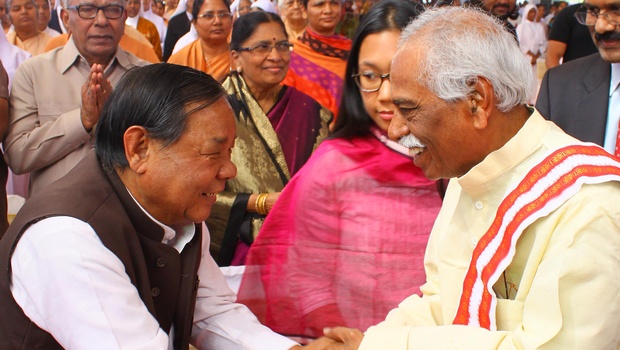
Union minister Bandaru Dattatreya greets former Lok Sabha speaker PA Sangma during the celebration of 300 years of Catholic Faith in AP and Telangana at a function held in Hyderabad on Sunday | NEERAJ MURALI
Hyderabad :
Although the Catholic community in the country is in a minority, it has contributed enormously to the development of the nation on all fronts, former Lok Sabha speaker PA Sangma has said.
To commemorate the 300 years of Catholic faith in Telangana and Andhra Pradesh, a grand ceremony was organised by Catholic Reddy Association (CRA) at Loyola Academy here on Sunday. It was in 1715 that the Telugu Catholic faith had begun when Thumma Hanumantha Reddy of Anantapur was baptised by French Jesuit Fr Le Gac. Addressing a large gathering of Catholics, Sangma said the educational institutions run by the community had produced some of the greatest minds in the country in all fields. “Be it politics, industry or bureaucracy, the people who matter the most to this country are proud products of Catholic educational institutions,” he remarked referring to some top names including BJP leader LK Advani.
He requested the central and state governments to accord minority status to all Catholics and Christians in the country. To take up the issues of community in Parliament, he said, the Christian MPs Forum in Delhi would be revived.
Union minister of state for labour and employment Bandaru Dattareya he would strive to protect minority communities as per the constitutional rights provided to them. “Only when there is harmony between peoples of different faiths can the country surge ahead with development. Each community representing a faith should respect and protect other faiths,” he said.
CRA president Gopu Bala Reddy said the Catholic community believed in service and not in conversion. He sought both AP and Telangana governments to extend SC status to Dalit Christians and Muslims besides providing space for burial grounds and extending old-age pension scheme to Catholic fathers and nuns.
source: http://www.newindianexpress.com / The New Indian Express / Home> States> Andhra Pradesh / by Express News Service / January 12th, 2015
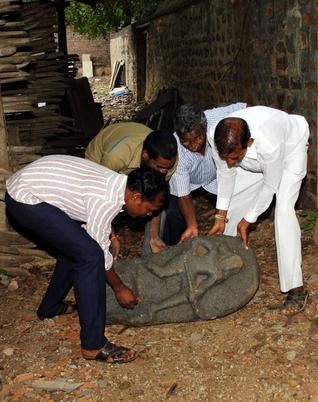
Hero statue being moved to Kanaparthis Museum from Ongole on Monday. Photo: Kommuri Srinivas
Three antique idols and a hero stone belonging to the medieval period have been unearthed, according to State Archaeology department in-charge Assistant Director T. John Kamalakar.
While the hero stone and Narasimha swamy idol were unearthed from the Fort Street here, the idols of Parvathi and Parameswara were recovered from a site near the RISE College on the city outskirts.
“The idols belonged to 12th or 13th century,” John Kamalakar told The Hindu.
They would be preserved for posterity at the State Archaeological Museum, named after Prakasam Pantulu at Kanaparthi.
”The department proposes to develop the museum further with the 14th Finance Commission grants,” he said.
A caretaker of the archaeological resources, G.V. Subba Rao said the artefacts at the museum provided a lot of information about, among other dynasties, the Satavahanas, Eastern Chalukyas, Sangamas and Cholas. “It is for the first time, antique idols are unearthed in the city,” said researchers Jyothi Chandramouli and M.V.S. Sastry.
source: http://www.thehindu.com / The Hindu / Home> News> National> Andhra Pradesh / by S. Murali / Ongole – December 30th, 2014
A new kimberlite pipe has been discovered in the 2,300 sq. km. Kalyandurg’s cluster of Anantapur district, and is named KL-7, and is the seventh such in the area, reports say. The pipe may be a possible diamond bearing kimberlite pipe.
Exploration activity involving aerial surveys and remote sensing, and other analysis in the area was undertaken by experts from National Mineral Development Corporation (NMCD) and Hyderabad based National Geophysical Research Institute (NGRI), after having renewed their prospecting license, reports add.
According to scientists, the discovery unfolded when subsequent drilling was performed at a suspected kimberlite region, revealing the kimberlite pipe near Budik-onda in Anantapur district.
The scientists are further considering a further course of action to undertake additional explorations, reports add.
source: http://www.diamondworld.net / Diamond World / Home> News / by Diamond World News Service / December 26th, 2014 / Ref. 10976
MAJOR LEAP: Chief of Naval Staff Admiral Nirmal Verma inspecting a guard of honour before commissioning INS Shakti (in the background) in Visakhapatnam on Saturday. — Photo: K. R. Deepak
INS Circars, the first Naval establishment in Visakhapatnam, is celebrating its Platinum Jubilee on Friday.
The British had identified Visakhapatnam as an important convoy assembly point for military operation in 1923. However, it was on this day 75 years ago, a small Naval Base was commissioned on December 12, 1939. To cater to the need for expansion, the base was formally established as HMIS Circars on April 12, 1942, according to an official release.
The origin of the name ‘Circars’ relates to the Nizam of Hyderabad, who had ruled this land. The first Naval establishment of the Eastern Seaboard was therefore aptly named ‘Circars’, a befitting title to the Depot Ship.
Commodore K.P. Gopal Rao, MVC, VSM (Retd.), former Commanding Officer INS Circars from January 3, 1974 to January 16, 1976, would be the chief guest at the Platinum Jubilee celebrations.
source: http://www.thehindu.com / The Hindu / Home> News> Cities> Visakhapatnam / by Special Correspondent / Visakhapatnam – December 12th, 2014