Category Archives: Historical Links, Pre-Independence

Turner’s Choultry: A colonial rest house

Visakhapatnam :

Built in the year 1893, the Turner’s Choultry is a stone masonary building 90 feet long and 60 feet wide. It was originally a Chattram or a Traveller’s House built to provide temporary shelter to traders, pilgrims and other travellers visiting the city.

The building is an ashlar fine structure that was built at a cost of Rs 43,000, of which Rs 10,000 was paid by the Maharajah of Vizianagaram, Anand Gajapathi Raju, an equal sum was provided by the Gode family and the remaining was raised from the public.

The site on which the Choultry stands was originally the Enugu Thota (Elephant Lines) of the 104 Regiment and even today the stones to which the elephants were tied can be seen. Close to the Choultry is a huge water tank, next to the Police Barracks, where the elephants bathed.

Built in the name of former district collector, Henry Gribble Turner, the Choultry remained the property of the Visakhapatnam municipality till 1975, after which it passed into the hands of the endowments department.

The building boasts of 24 rooms and a living space, distributed over three courtyards. According to history buff BS Mahesh, the plan of the building is that of a traditional south Indian house with rooms and verandas all around a central courtyard.

“The beauty of the building lies in the simplicity of its plan and the manner in which space is used. The facade is of course beautiful with an arched doorway leading into the central courtyard and the stone pillars give it that imposing look,” said Mahesh. He further added that the tiles used for the roof were pot tiles, which were later replaced by Mangalore tiles.

Civil engineer Narayana Murthy said the structure was built on a raised plinth of more than four feet, which added to the majestic look. “The main structure is over 90 feet in length and 50 feet in breadth and is perfectly rectangular in shape. This apart there are bathrooms that extend the area of the structure. The dressed stone used to build the walls are all cut to the same shape and size and the mortar used to bind the stones is exactly the same in each and every bind. The construction is extremely precise and requires expert stone masonry skills. The thick stone walls built on the raised platform provide balance and strength to the building,” Murthy said.

Even today, the Turner’s Choultry is abuzz with activity and usually hosts weddings, functions, book shows, exhibitions and religious festivals. The endowments department charges a nominal rent of Rs 300 for a small scale wedding at the venue.

source: http://www.timesofindia.indiatimes.com / The Times of India / News Home> City> Visakhapatnam / TNN / August 06th, 2015

Raja Durbar held to continue legacy

Pontiff Sri Vidyamanohar Teertha of Vyasaraja Math conducts Raja Durbar in Anantapur. (Photo: DC)

Anantapur:

A 494-years of spiritual legacy of a saint ruler saved not just the life of Vijayanagar emperor Sri Krishnadevaraya but also a dynasty. The saint was none other than Guru Vyasaraja Swamy, who was mentor for five generations of Vijayanagar kings.

Guru Vyasaraja Swamy had saved Sri Krishnadevarya on 30-01-1521 from Kuhu Dosha (adverse impact on king’s personnel horoscope). The adverse impact of it would have resulted in a snake biting the emperor at his throne.

But, Vyasaraja Swamy burnt the snake with his extreme power as he sat on the simhasan during a particular kuhudosa period. The Vyasaraja math of Sosale celebrates Raja Durbar every day since 1521 to commemorate the incident. Anantapur Vyasaraja Math was venue for grand celebration of incarnation of Saint Vyasaraja Swamy of his 494th year on Sunday.

Emperor Sri Krishnadevaraya offered his throne to the saint, who ruled for 36 minutes in which he passed orders for construction of many tanks and 732 temples of Lord Hanuman in the country.

JNTUA principal K. Prahlada Rao said the durbar has been conducted every day for 494 years by pontiffs of Sri Vyasaraja math, whose period was golden age in south India. Pontiff Sri Vidyamanohar Teertha of Vyasaraja Math conducted Raja Durbar at Anantapur after occupying the Simhasan on Sunday. Speaking on the occasion, Swamiji hoped good rains in Rayalaseema region.

source: http://www.deccanchronicle.com / Deccan Chronicle / Home> Nation> Current Affairs / Deccan Chronicle / August 04th, 2015

Alumni Vow to Bring Back Glory of School

Srikakulam : 

It was time to recall the good old days and catch up with friends for alumni of the 159-year-old NTR High School here Sunday. In a bid to save the institution from fading into history and revive its past glory, the alumni of the school had a meeting on the Friendship Day.

The alumni felt that their alma mater became a victim of corporate education with imposing buildings and land grabbers eyeing the valuable property. The old students decided to join hands to revive their school’s past glory by providing corporate-type education.

District collector Lakshmi Narasimham was the chief guest of the meet. He lauded the resolution taken by the old students, who had already become senior citizens. The collector promised to extend all help from his side and provide all facilities from the government side. He appreciated the alumni for coming forward to develop the school.

The NTR High School was established on Dec 7, 1856. Some of its students became IAS and IPS officers and some others became noted personalities in India. Poet and Kathanilayam founder Kalipatnam Ramarao, actor Raavi Kondala Rao, KV Somayajulu, sports person Khasim Khan and Chilukuri Narayana Rao were some of its students.

Reminiscing, the 90-year-old Govinda Rao, an alumnus, said the school had a hoary past. He vowed to fight back if the school was diverted or demolished. Another alumnus Govind Srinivasa Raman expressed anguish that the present rulers had brought the school to the current status. Retired drawing teacher Ramalingeswara Rao recalled that he had studied and worked in the school. Along with him there were 67 teachers who worked and studied in the school. He regretted that the school strength has come down to 200 now.

source: http://www.newindianexpress.com / The New Indian Express / Home> States> Andhra Pradesh / by Express News Service / August 03rd,  2015

Goddess Gayatri Devi’s footprint discovered


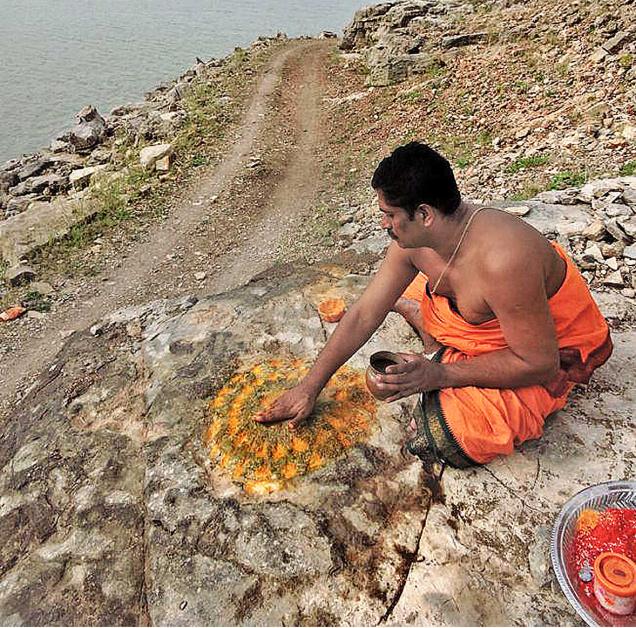
Vedic pandit Telakapalli Raghurama Sarma applying turmeric near Sangameswara Temple in Kurnool district.

A footprint of Sri Gayatri Devi, who, according to scriptures, appeared in the form of Gomatha to sage Viswamitra during his penance in Tretayugam, was discovered in the Viswamitra cave atop a hillock on the banks of Krishna at the Sri Sangameswara temple in Atmakur forest division in Kurnool district.

Quoting the ‘Skanda Puranam’, Telakapalli Raghurama Sarma, Vedic pandit of Sri Sangameswara temple, said he had discovered the footprint, applied turmeric to it and offered prayers to the idol of Sri Rama in the cave.

Recounting history, Sarma said the government had initially proposed the construction of an anicut for the Srisailam project at Siddheswaram in 1948, but subsequently built the dam at Srisailam in 1963. “As many as 100 villages were submerged following the construction of the project,” he added.

As water depleted in the reservoir this year, the footprint surfaced in the cave, Sarma said. On sighting the footprint on a stone near Chajratheertham, the pandit applied turmeric on it improving its visibility.

source: http://www.thehindu.com / The Hindu / Home> National> Telangana / by Special Correspondent / Kurnool – July 12th, 2015

First village museum to come up at Mukkollupadu

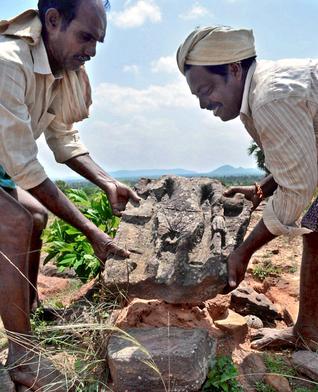
Local residents collecting objects of historical importance at Mokkollupadu.— Photo: T. Appala Naidu

The School of Planning and Architecture (SPA), Vijayawada, in support of the IIT-Mumbai’s Design and Innovation Centre is developing the country’s first village museum at Mukkollupadu of Nuzvid mandal in Krishna district.

The villagers, led by Vijayawada Police Commissioner A.B. Venkateswara Rao, on Sunday collected a range of sculptures and other artefacts lying in and around the village to preserve them at the museum. The historically important remains collected for the museum include those belonging to the period between the 2nd century B.C (Pre-Satavahana period) and the 6th Century AD.

“India’s first participatory village museum will be built and opened for public by the end of August. The villagers have started collection of historical important relics and statues on Sunday,” SPA-V Director Professor N. Sridharan told The Hindu .

“Enthusiasm among the locals to realise the dream of developing the museum is inspiring us,” added Mr. Sridharan and his team.

The Mukkollupadu Panchayat authorities have spared a piece of land for the museum, in which locals have assembled several sculptures found at a burial ground belonging to the Palaeolithic period.

Mr. Venkateswara Rao, who adopted the village, monitored the task of assembling of a few red-stone sculptures at the proposed museum site on Sunday.

“We will be geo-tagging the sculptures and maintaining a data and history of the relics as a part of conservation and promotion of the local history,” Mr. Venkateswara Rao told The Hindu .

The SPA-V experts, who are designing the museum, will also welcome the Nuzvid Veena makers to put their works at the museum to revive the art form from its slow death.

India’s first participatory village museum will be built and opened for public by the end of August.

N. Sridharan / SPA-V Director

source: http://www.thehindu.com / The Hindu / Home> National> Andhra Pradesh / by T. Appala Naidu / Mukkollupadu (Krishna) / July 07th, 2015

Jain memorial being planned at Konakondla

With the State government refusing to spend any funds on researching further into the Jain inscriptions at Konakondla and develop the village into a tourist attraction, the Bharat Varsheeya Digambara Jain Thirthakshetra Committee (BVDJTC) has come forward to develop the same spending crores of rupees.

A congregation of over a hundred people belonging to the Jain community at the village in the Vajrakaruru mandal of the district has decided to build a memorial in the name of Acharya Kondakunda besides the construction of a residential vidyapeeth (a place of learning) to teach, research and propagate his teachings.

Speaking to The Hindu , Mr R.V. Chakravarthi, credited with finding out these Jain religious places almost five decades ago in Konakondla, said that Acharya Kondakunda, who wrote the Jain religious texts — Pachastikayasara, Pravachanasara, Samayasara, Niyamasara and Barasanuvekkha — was also the author of the famous Tamil treatise ‘Tirukkural’, otherwise known to be written by famous Tamil poet Thiruvalluvar.

“Since Kondakunda, also known as Padmanandi, born in this village (Konakondla) was a Digambara, of no less a stature than that of the famous Gomata in Shravanabelagola in Karnataka, he sent his disciple Tiruvalla Nayanar to present the treatise to saints including that of the famous Avvaiyar of Sangam period, who mistook Tiruvalla Nayanar to be the author of the treatise,” said Mr Chakravarthi, speaking to a rapt audience at Konakondla.

The Bharat Varsheeya Digambara Jain Thirthakshetra Committee decides to build a memorial in the name of Acharya Kondakunda besides the construction of a residential vidyapeeth (a place of learning) to teach, research and propagate his teachings at the village

source: http://www.thehindu.com / The Hindu / Home> National> Andhra Pradesh / by V.K. Rakesh Reddy / Anantapur – July 07th, 2015

Grand dame of Vizag takes a trip down memory lane

Duvvuri Lalithamba is no ordinary woman. At 101, she has witnessed the transformation of the Port City from a sleepy town to the smart city of the future. The daughter of Sir Vepa Ramesam, who was the Chief Justice of the Madras Presidency and founder of the Neo-Malthusian Society, Lalithamba bears testimony to almost all the historical events, including the independence movement, bombing of Vizag by the Japanese and sinking of PNS Ghazi off the city’s coast in 1971.

As one of the founders of the Vizagapatam Ladies Club, Lalithamba is credited with organizing theatre and dance performances, including one by Bollywood star of yesteryears, Waheeda Rehman, in the city much before she became a star. In a tete-a-tete with Venkatesh Bayya of TOI, the grand dame of Vizag speaks about the developments that the city has seen in the last eight-and-a-half decades.

What was Vizag like back in the early 1930s?

Though a culturally advanced town blessed with a large population of educated people, Vizag was yet to find its own place on the map. Back then, it was popular with tourists, many of whom were landed gentry from Andhra, Odisha and Tamil Nadu. The locals and the wealthy also contributed to its languid grace and pace.

When and how did it evolve into a city?

It all started with the naval base coming up after the first world war. Then came Andhra University and the establishment of the Visakhapatnam Port Trust. With the city getting electrified in the mid-1930s, my husband DV Ram Murthy, who belonged to a landed family from East Godavari, was one of the first entrepreneurs to set up Lumen Electricals taking advantage of the introduction of electricity. Many people also benefitted from the setting up of the shipyard and Caltex, the present day HPCL. But all this has come at a cost. Vizag was once the summer capital of the Madras Presidency as temperatures never shot up beyond 30 degrees Celsius. But today the greenery is gone. The city has become an industrial hub and far more polluted than it ever was.

Do you remember the Japanese bombing of 1942?

We were living on the main road of the Old Town. Japanese fighter aircraft bombed the port area during the day. The city turned into a fortress, sirens were sounded all the time and the residents subjected to drills. Most of the bungalows and mansions were taken over by the military and Vizag turned into a massive military camp with soldiers from Australia, Canada and New Zealand. There were more anti-aircraft guns than people in some areas. The supply of electricity was restricted. For the first time in my life I witnessed an exodus. Most of the residents left for the neighbouring towns and villages. My husband, however, was asked to stay back to take care of the lighthouse and the electrical equipment in the port. He convinced me to move to Kakinada for a short while but I returned to Vizag and continued to stay with him.

What about the submarine attack by Pakistan in 1971?

That was totally different from the 1942 bombing. We were all taken by surprise. Those days we were living near the beach and heard a massive explosion one day. The window panes were shattered and we knew we were under attack. Later, the Navy said the Pakistani submarine Ghazi had come too close to the port and was sunk by the navy.

Have you witnessed any other cyclones like Hudhud?

We faced a cyclone in the mid-1920s when the entire town was flooded. The backwaters, which now constitute the core port area, literally flooded all of Old Town and other low lying areas. It was scary then, but Hudhud was equally scary, taking the wind speeds into account. I have also heard of an equally scary cyclone in the late 19th century.

Do you carry any baggage of being Vepa Ramesam’s daughter, Sir SV Ram Murthy’s niece and the grandniece of Sir CY Chinthamani? What was your father’s influence on you?

I do not carry any baggage and neither did my father. In fact when India gained independence, he was the first of the knights to get rid of the title. My father taught all of us to make maximum use of our mental faculties and encouraged us to take part in sports. Despite shifting to Madras to practice in the Madras High Court, he always loved Vizag. His father, Rao Sahib Vepa Lakshmi Narsimham, was a judge and the Commissioner Inams of the Madras Presidency. My grandfather’s house on the main road of Old Town originally housed the East India Company Writers. It had four courtyards with barns and stables in the backyard.

What about your contribution to the cultural scene in Visakhapatnam?

Well, I was active at a time when Vizag was undergoing a massive change. It was turning into a modern city and movies were making their presence felt. At the same time, the freedom movement was on and we were all inspired by Gandhi’s ideals and zeal. During this period, the Vizagapatam Ladies Club organised many socio-cultural events and we tried to engage women in social dialogue concerning various issues. I also set up the first self help group for women in the state and collaborated with the Andhra Mahila Sabha to ensure financial independence of women.

How do you describe your life?

Well lived!! As for my body, I have decided to donate it to the KGH for research purposes. I do not wish to be cremated.

source: http://www.timesofindia.indiatimes.com / The Times of India / Home> City> Visakhapatnam / TNN / July 06th, 2015
The living legend of Chodavaram’s Karya Siddhi Vinayaka temple

Visakhapatnam :

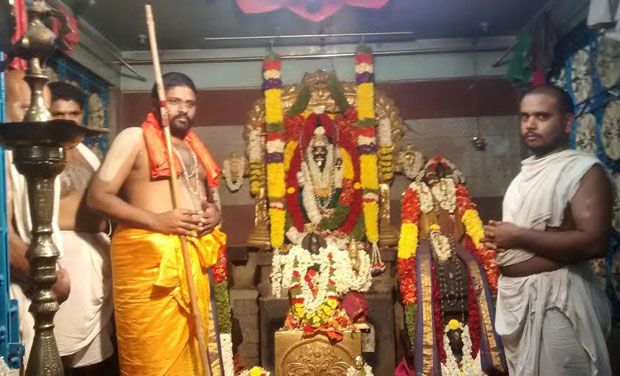
The Karya Siddhi Vinayaka temple at Chodavaram is considered one of the two self-originating Vinayaka temples in AP, the second one being the Kanipakam temple in Chittoor district.

According to archaeological experts, both the temples were constructed roughly during the same time by the Chalukya Cholas (roughly 1200 AD).

The original Vinayaka temple and idol were discovered over 200 years ago at the spot where the present temple was built. According to the village elders, much effort was then put into shifting the idol to a nearby sivalayam. However, they were unable to do so as, according to a well-known local story that has gained mythical proportions, the snout of the Vinayaka was so long that they could not unearth it.

M Jagannadham, a local history buff, native and old timer, said, “The remains of the old temple were unearthed in 1850. However, the idol continued to remain sunk as it could not be propped up. Even today the Mula Virat, Lord Ganesh’s idol, cannot be completely seen. Only the upper portion of the torso can be properly seen and the rest lies buried.”

According to heritage conservationist Rani Sarma, not much may ever be known about the origins of the temple as the new temple built on the old premises has been repaired and reconstructed beyond recognition in the last 200 years. “One cannot go against the beliefs of the people for the Vinayaka here is said to be the Karya Siddhi Vinayaka, one who helps us achieve what we set out to do. It is people who wanted the temple to be built and rebuilt in the name of development and betterment,” she said.

Pointing out that the temple was built during the Chalukya-Chola period she said: “The Eastern Chalukya-Chola period saw a resurgence of Shaivism in the region and hence the large number of Shiva temples.”

Regarding the Swayambhu (self-originating) legend — a term generally used to describe ancient shrines that have been discovered by accident — a senior employee of the state archaeology department said, “How does one explain the remains of a temple unearthed from the ground? Though the general perception is that the shrine came out on its own, not much should be read into it from the archaeological or scientific point of view. It has more to do with the faith of the people.”

“The pity is that there is little or no scope for archaeological studies to be conducted as the temple has been rebuilt many times over the last 200 years. But the fact that the idol is located close to the old fort premises goes to prove that the temple may originally date back at least a 1,000 years,” he added.

The temple priest, Kodamanchili Ganesh, said, “We have been the priests for several generations now. It is true that the temple, which dates back to several hundred years, has been built and rebuilt over the years.” While pointing out that many people did come to research the origins of the temple, he said that keeping in view the fact that it was a live and vibrant place of worship, not much digging and excavation work could be done.

According to Jagannadham, Chodavaram came into existence as an agraharam (a Brahmin hamlet) following a grant by Chalukya Cholas to members of the Brahmin community. “It then developed into a centre of Vedic learning and Shaivite worship and went on to draw the attention of members of the trading class, who also contributed immensely to its growth, making it a major trading centre. A garrison was later built by the Chalukya Cholas to protect their trading interests,” he explained.

The legend: Legend has it that the snout of the Vinayaka is so long that the locals were unable to unearth it. The idol continues to remain sunk even today with only the upper portion of the torso visible to devotees and the rest remaining buried

source: http://www.timesofindia.indiatimes.com / The Times of India / Home> City> Visakhapatnam / by Venkatesh Bayya, TNN / July 04th, 2015

Anglo Indians: Vizag’s first cosmopolitans

The Port City may today be regarded as the most cosmopolitan city of Andhra Pradesh with people of various cultures and religions living together in harmony and while this is generally attributed to the mushrooming of several public sector units, industries and government establishments in the post independence era, the seeds of cosmopolitanism were sowed much before that.

For, even a century prior to independence and long before the port, steel plant or the Indian Navy dropped anchor in Vizag, a pluralistic culture thrived in the city.

It all started with the British landing on Vizag’s shores in the 19th and early 20th century, some of whom married local women when their regiments were posted in Vizag during the First and Second World War.

While most members of the city’s Anglo Indian community are descendants of British soldiers and administrative officials, some of them are also of Australian and Canadian descent. “Anglo-Indians were found from the 19th and early 20th century in Vizag and were concentrated in areas like Soldierpeta, Gnapuram, Suryabagh and Old Town. The first and second generation Anglo Indians were mostly with the armed forces or served as administrative officials. The subsequent generations mostly worked in the ports or railways and followed a fully European way of life,” said city-based historian Edward Paul.

Being literate, the community had one of the most progressive ideologies, denouncing the dowry system, forced arranged marriages and gender bias, and their women were also quite liberated. Culturally active, they influenced almost all aspects of the city, be it education, sports, music and dance, or even the social scene.

Mostly Roman Catholics and a few Protestants too by religion, the community would be found every Saturday and Sunday in churches, which served not just as a platform for religious congregation but also as a forum for socialising and cultural dos. Dressed in fashionable clothes and high-heels, they would dance, play music and exchange pleasantries in the churches. The Port Gymkhana Club, Railway Institute and Town Hall were other places for socializing and partying.

Almost all Anglo-Indians had penchant for music and thanks to them Vizag had a lively social scene, good live bands and guitarists, while most houses had pianos. Thanks to their penchant for socializing they were also instrumental in setting up many clubs. They also made good sportsperson and were into hockey, football,bicycling and athletics.

The fun-food-drink loving Anglo Indians were an industrious lot too and did not look down upon any job. An old-timer of Vizag, Sohan Hatangadi, who has seen the community at close quarters, reminisced, “My neighbour Michael Buckley would clean the streets in front of his house every day using his own brooms. He would lay the pavement in his area with tar and stone.”

One of their major contribution was towards education and saw them set up many English medium schools. “As far as education is concerned, the oldest school in Vizag, St Aloysius Anglo Indian School catered to the boys, while the girls studied in St Joseph’s Convent. Even though not too academically inclined, they preferred to be financially independent soon after turning 18 years old. Women were mostly into teaching and nursing, while men, with their knowledge of English, would get clerical jobs or work in the railways, customs or port workshops,” said Owen Perera, an old timer belonging to the community.

During Christmas, the homes and narrow by-lanes of the Old Town area (Vizag in those days was limited to the Old Town area) would come alive with decorated stars,Christmas trees and lamps. Aromas of freshly-baked cakes and melodious yuletide music would waft from every Anglo-Indian household. Easter was another important festival.

With a spurt in migration to Australia, UK and other countries since the late 1960s and 70s, when there were around 200-plus families in Vizag, today barely 15-20 families (the elderly ones) are left in Vizag with life more about nostalgia for the good-old days while for some its about waiting for the younger generation’s homecoming from abroad during Christmas.

source: http://www.timesofindia.indiatimes.com / The Times of India / Home> City> Visakhapatnam / by Sulogna Mehta, TNN / June 25th, 2015

It stands tall again

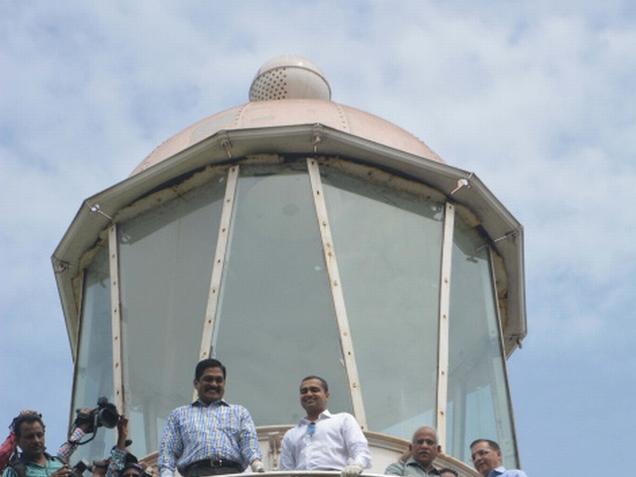
The old Light House has been restored and thrown open for public. Photo:C.V.Subrahmanyam

The iconic structure was established in 1903 to guide ships.

Setting a new benchmark in restoration of heritage structures in the city the Visakhapatnam Port Trust and the Visakha Container Terminal Pvt Ltd restored the old Lighthouse at Flagstaff on the Beach Road and the iconic building was thrown open to public on Friday.

The iconic structure which was a source of inspiration for the seafarers is a landmark that is the pride of the Port City standing testimony to the rich marine traditions of the region. This would probably be the first historical monument whose restoration has been taken up in a proper manner. “It is the first text-book restoration work in the city,” convenor INTACH PV Prasad said thanking the Port and the VCTPL for taking keen interest in the restoration work.

“We are proud to be associated with the proper restoration of a genuinely historical monument,” VCTPL managing director Vir Kotak said. We have taken up the work and gladly spent the amounts required for the restoration, he added.

Monuments and their architecture reflect the culture of the earlier generations and any work to preserve our heritage is praiseworthy, Chairman Visakhapatnam Port Trust M T Krishna Babu said lauding the efforts of the VCTPL in restoring the landmark building.

The 59-foot masonry tower was a transit line lighthouse. It was established in 1903 in the present location to help guide the ships into one of the safest natural harbours in the world – the Visakhapatnam Harbour. The dome and lantern of the lighthouse were from the lighthouse at Chantilly or Chintappali some 18 km from Bheemunipatnam. The light house had a gas-fired white diopter light of the 2 order with brightness levels of 45000 candles. It flashed every 20 seconds and was visible from 12 miles in clear weather. During World War II there were two anti-aircraft guns set up next to the lighthouse.

The lighthouse went into disuse in 1962 and after that the building itself went into disrepair. VCT persuaded VPT management to hand it over for restoration and revival. Chairman of VCT and JM Baxi Group of Companies Krishna B. Kotak, an ardent restorationist, brought onboard Mumbai’s conservation architect Vikas Dilawari to oversee the project which began in 2012.

Adding value

VCTPL has made a request to Navy for providing two surface-to-air guns to be installed on the cemented pedestals which were originally made for the purpose.

VCTPL proposes to request GVMC to take up the periodical maintenance and upkeep of the area outside the boundary.

Quotes

We have to thank Krishna Kotak for taking such keen interest in the conservation project.

MT Krishna Babu, Chairman VPT

We have to preserve our past to learn from it and build a strong future.

C Rajendiran, Principal Commissioner of Customs

As a Vizagiite we are proud that the restoration of this monument has been taken up

Monish Row, vice president, Vizagpatnam Chamber of Commerce and Industry

source: http://www.thehindu.com / The Hindu / Home> News> Cities> Visakhapatnam / by G.S. Subrahmanyam / Special Correspondent – / Visakhapatnam – June 27th, 2015