Category Archives: Historical Links, Pre-Independence

After controversial demolition 2 years ago, authorities now feign memory loss on promises made

Visakhapatnam : 

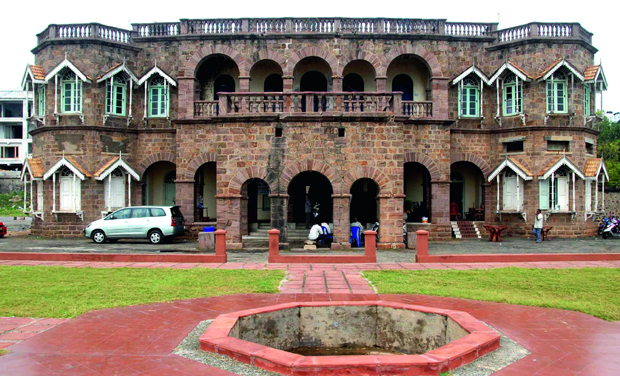
At one time, it was probably the most popular landmark in the Port City. Built to commemorate the coronation of Edward VII in 1914, the Kurupam Market had a lofty gateway and a clock tower. All of a sudden, out of the blue exactly two years ago in the month of November, the structure built by the then zamindar of Kurupam, which at the most needed a few repairs, was knocked down by the GVMC authorities at the orders of the then commissioner MV Satyanarayana. This despite the fact that the structure was listed as a heritage monument by the Vizag chapter of Intach.

The demolition of the structure, which was actually under the control of the endowments department, triggered a blame game. While the endowments department absolved itself of any involvement, GVMC authorities categorically denied any hand in the demolition, which took place in the middle of the night. However, heritage activists put the blame on GVMC. They claimed that Kuppam Market was razed in a demolition drive by the civic body in Old Town during which nearly 30 structures were knocked down.

Though it has been two years now, none of the promises made by then MLA (South) Dronam Raju Srinivas have materialised. “Plans are afoot to build a similar structure in the place of the old one at a cost of Rs 65 lakh,” the MLA had declared soon after the demolition. However, as on today, no such structure has either come or any such move is on the anvil. After the demolition, some landmarks of the heritage structure including the clock and the timber beams were taken away. The clock was last seen inside one of the godowns in the market yard a few days after demolition. Now nobody knows about its whereabouts. Similarly, nobody knows what happened to the timber beams.

Heritage activist Rani Sarma observed, “It is sad to note that so far neither the GVMC nor the endowments department have made any effort to contact heritage experts to re-build a similar structure. The endowments department is simply looking at it merely as a valuable piece of real estate.”

However, convenor of Intach, Vizag chapter, PV Prasad pointed out, “Recently we had a meeting with the present GVMC commissioner Pravin Kumar who offered to rebuild the structure. However, we felt that once a structure is gone, it is gone for ever. It can never be replaced. More importantly, the sum of Rs 65 lakh suggested is a ridiculously inadequate sum to rebuild a similar structure. To rebuild the structure using the same material, it would cost nothing less than Rs 2 to 3 crore. Hence, we suggested to the commissioner that they build large models of structures such as Kurupam Market, Round Bungalow ( former residence of Sarvepalli Radhakrishnan) and the famous Gali Meda of Bheemili which have all been knocked down.”

Prasad claimed that the present GVMC commissioner, the district collector and the present Vuda chairman are keen on preserving the heritage of Vizag and are working on forming a permanent full time conservation committee.

source: http://www.timesofindia.indiatimes.com / The Times of India / News Home> City> Visakhapatnam / by Venkatesh Bayya, TNN / November 29th, 2015
Centenary celebrations of Narasaraopet from Dec. 11

Three-day event to showcase the rich culture and traditions of the town. Narasaraopet is known as the Gateway of Palnadu and had witnessed the rule of various dynasties.

The people of Narasaraopet will get a peek into the hoary past of the municipality during its 100 years’ celebrations beginning on December 11. It is going to be a three-day event that will feature the rich culture and traditions of the town which became a municipality in 1915.

It grew into a vibrant commercial town duly owing its glory to the popularity of the famous Sri Trikoteswara Swamy temple at Kotappakonda which is situated about 11 km from the town.

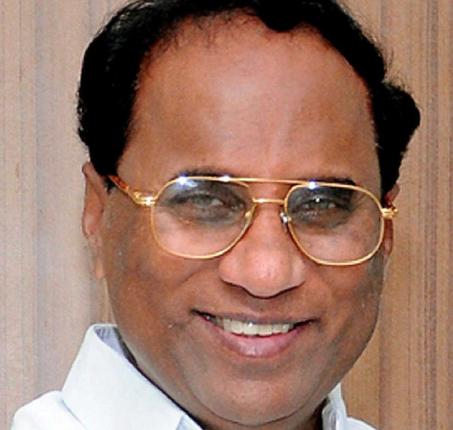
Kodela Sivaprasada Rao

Speaker Kodela Sivaprasada Rao, who was elected MLA from Narasaraopet constituency for five consecutive times from 1983 to 1999 and represents Sattenapalli in the present Legislative Assembly, announced in a press conference here on Thursday that the 100-year fete would be celebrated on a grand note and Chief Minister N. Chandrababu Naidu would inaugurate the event.

Union Ministers M. Venkaiah Naidu and Suresh Prabhu would take part in the festivities on December 12 and Governor E.S.L. Narasimhan would be chief guest in the valedictory function.

According to historians, Narasaraopet was originally known as Atluru and derived its name from landlord Malraju Venkata Narasimha Rao. It was made a municipality on May 18, 1915 and was upgraded to Grade–I municipality on April 28, 1980. It has since achieved rapid strides with a population of 1,17,568 as per 2011 Census.

Narasaraopet and its surroundings are a part of the territory which was ruled by Satavahanas, Ikshvakus, Chalukyas, Cholas and Kakatiyas and the Reddy kings of Kondaveedu.

Speaking to The Hindu , Mr. Sivaprasada Rao said the town is known as the Gateway of Palnadu and had witnessed the rule of various dynasties. The town gave to society many prominent people in different walks of life.

“As MLA I have done my best for development of the town ”, Mr. Sivaprasada Rao said.

source: http://www.thehindu.com / The Hindu / Home> National> Andhra Pradesh / by Staff Reporter / Guntur – November 27th, 2015

Telugu people’s struggles to be chronicled on the screen

Vijayawada  :

With a view to highlight the Telugu culture and heritage, a production house called Bharateeyam Arts – the first banner to come out from Vijayawada post the state’s bifurcation – is planning a movie about Amaravati. The producers say they will donate the proceeds from the screenings to the capital development fund.

Addressing a press meet here on Tuesday, producer V Gopala Krishna said that the film will deal with the political, historical and cultural background of Andhra Pradesh. “The self-respect of five crore people of Andhra Pradesh was hurt by the division of the state. That is the reason why farmers came forward to offer their lands for the capital. The film will deal with the sacrifices made by such people and how the state evolved,” Krishna explained.

He recalled initially mulling a documentary on the same subject, but dropped the idea later. “This will be a full-length feature film with a commercial angle. The cast will be announced soon and shooting will start in four months or so,” the producer said, adding that the film will be made in two parts.

While music director-turned-director RP Patnaik will compose tunes, Suddala Ashok Teja and Krishna Chaitanya Prasad would jointly write the script.

Patnaik expressed happiness to be a part of the project. “Telugu people have a lot of history. This film will start right from the time when we were part of the Madras Presidency to the bifurcation to the present day. It will be based on facts and will not offend anybody,” Patnaik said.

Veteran journalist Turlapaty Kutumba Rao recalled how Telugu people had to leave Madras and how they thought in vain that they could have a permanent capital in Hyderabad. “I have seen the struggle the state and the people have gone through. We thought after 1956 the wandering would end. But we were wrong. With Amaravati it will end. It will be our own capital,” he said.

He appreciated the film’s crew for taking up the project as it would help the future generations to have a point of reference. Peasant leader A Bhavani Prasad was also present.

source: http://www.timesofindia.indiatimes.com / The Times of India / News Home> City> Vijayawada / TNN / October 21st, 2015

The village owes much to a commander

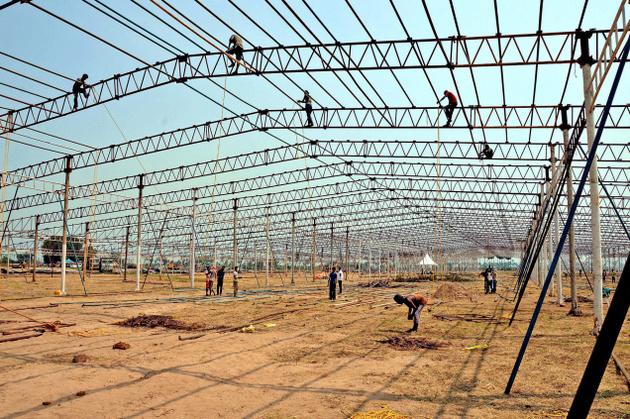
Work in progress for the foundation stone laying ceremony at Uddandarayunipalem in Guntur district on Wednesday. - Photo: T. Vijaya Kumar / The Hindu
Work in progress for the foundation stone laying ceremony at Uddandarayunipalem in Guntur district on Wednesday. – Photo: T. Vijaya Kumar / The Hindu

Like several other villages of Thullur mandal, the history of the village dates back to the reign of Vijayanagara emperor Sri Krishnadevaraya.

This sleepy village was little known to outsiders till the government decided to construct the capital city here. It also received an honourable distinction when the government decided to lay the foundation stone for Amaravati here.

Like several other villages of Thullur mandal, the history of the village dates back to the reign of Vijayanagara emperor Sri Krishnadevaraya. According to legend, Sri Krishnadevarya halted at Thullur on his way to invade Kondapalli Khilla in Krishna district as river Krishna was flowing furiously. His army commander Uddandarayudu also halted here. The village got its name after the emperor’s commander.

CapitalchartANDHRA150ct2015

Prof. Yarlagadda Balagangadhara Rao, in his book Navyandhra Rajadhani Prantha Gramala Charitra, argues that king Kotaketaraju of the Dhurjaya dynasty and ruler of Dharanikota built the village in memory of his father Uddandarayudu. The term ‘Uddanda’ means capable or robust.

Located on the banks of the Krishna, the village has certain unique features. It has the most fertile land and saline-free groundwater. B. Venkateswara Rao, a resident, says the groundwater in neighbouring villages is not as pure as the water available in Uddandarayunipalem. Moreover, the yield from agricultural fields in the village is quite high compared to the neighbouring villages.

Residents recall that the government had constructed a karakatta in 1950 following an agitation. The government began providing power supply in 1964 from Tadepalli. An acre used to cost Rs. 50,000 in 1990. It touched Rs. 9 lakh in 2006. Now an acre costs Rs. 2.30 crore.

Interestingly, the foundation stone for Amaravati will be laid in the field that once belonged to Jujala Chalapati Rao, a B. Tech graduate-turned farmer.

source: http://www.thehindu.com / The Hindu / Home> Nation> Andhra Pradesh / by G.V.R. Subba Rao / Uddandarayunipalem (Guntur Dt.) / October 15th, 2015

First ‘Teloogoo’ translation of Bible happened in Vizagapatam

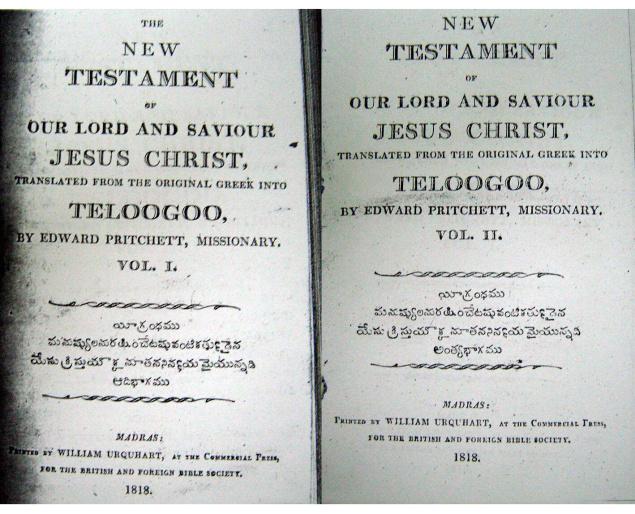
A view of the inside cover page of the New Testament that was first translated and printed in Telugu in 1818.—Photo: Special Arrangement

The world celebrates September 30 as the International Translation Day to commemorate the feast of St. Jerome, who was the first to translate the Bible from Hebrew to Latin.

Coming to translation, Vizagapatam (Visakhapatnam as then called by the British) has a page in the history of this crafty art.

It is in this once sleepy fishing town that the Greek version of the New Testament of Bible was first translated into ‘Teloogoo’ (Telugu, as then spelt by the Englishmen) in the early part of the 19th century.

History records that Rev. Benjamin Schulz was the first to translate parts of the Bible into the native Telugu language in the early part of the 18th century, and the manuscripts were sent to Halle in Germany for printing.

It is unclear as to what had happened to the manuscripts, but they were not printed.

Later, in 1805, two missionaries from the London Missionary Society, George Cran and Augustus de Granges, landed in Vizagapatam, with the task of providing English education to native children and to reproduce the Bible in the native tongue.

They first started a school within a fortnight of their arrival. Their subsequent efforts resulted in starting of an Anglo Vernacular School in 1836, which is still in existence by the name CBM High School.

For accomplishing the second goal, the missionaries took up learning Telugu and in two years mastered the language.

But it was in 1808 that a Maratha Brahmin by name Subba Rayer, who worked as accountant in Tippu Sultan’s army, joined them.

Subba Rayer, a native of Tranquebar (now called Tarangambadi in Tamil Nadu), converted to Christianity and changed his name to Anand Rayer.

An exponent in Telugu and Tamil, Anand Rayer moved to Vizagapatam to assist the missionaries.

In 1808, George Cran passed away and in 1810 Augustus de Granges too died.

But Anand Rayer did not lose hope. By that time, three gospels, namely Matthew, Mark, and Luke, had been completed and were ready for printing.

He took the manuscripts to William Carey at Seerampore in Bengal, who had by then translated the Bible into Bengali.

Though it was only part of the New Testament, the first-ever printed version of the Bible in Telugu was printed in 1812.

Later, Anand Rayer was joined by Rev. Edward Pritchett in Vizagapatam in 1812, and both took up translating the full version of the New Testament. And the first full print of the New Testament in Telugu came out in 1818. The full version was printed in Madras.

According to Mr. Edward Paul of INTACH, who researched on this subject, only three original copies of the first printed Telugu Bible are available now. While one is in the British Library in London, the other two are in United Theological College, Bengaluru, and with a seller of old books in the U.S.

Basing on the contribution made by Anand Rayer, the Bell at London Mission Memorial Church in Visakhapatnam is named after him as ‘Ananda Sunadam’

George Cran and Augustus de Granges paired up with Anand Rayer to translate a part of the New Testament. It was printed in 1812. Later, Anand Rayer teamed up with Rev. Edward Pritchett and printed the full version in 1818

Acknowledging the contribution made by Anand Rayer, the Bell at London Mission Memorial Church in Visakhapatnam is named after him as ‘Ananda Sunadam’

source: http://www.thehindu.com / The Hindu / Home> National> Andhra Pradesh / by Sumit Bhattacharjee / September 30th, 2015

Peek into shared bonhomie

This is a historic day for Australia and India as it coincides with the launch of the first edition of bilateral maritime exercise in the city

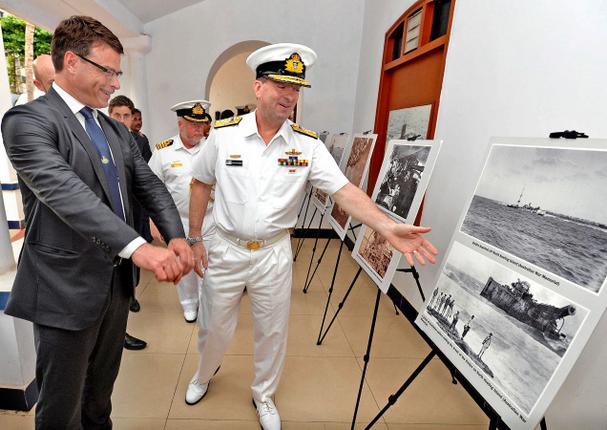
Australian High Commissioner to India Patrick Suckling, accompanied by head of Navy Capability of Australian Navy Rear Admiral Jonathan Mead, goes round the photo exhibition organised by the Australian Government at Visakha Museum in Visakhapatnam on Saturday. —Photo: K.R. Deepak

Some century-old photographs of Madras (now Chennai) that was bombed by German light cruiser SMS Emden showing the broken walls, and exploded and unexploded shells, some pictures of the daring German raider, and some of the wreck of SMS Emden are part of the week-long exhibition at the Visakha Museum on the Beach Road.

The photo exhibition, ‘Centenary of the Emden Spirit: 100 Years of Shared Military History’, organised by the Australian Government and Australian Consulate-General in Chennai was inaugurated by High Commissioner of Australia in India Patrick Suckling in Visakhapatnam on Saturday.

“This is a historic day for Australia and India as it coincides with the launch of the historic first edition of the bilateral maritime exercise AUSINDEX in the city,” Mr Suckling said speaking on the occasion.

Apart from the Emden incident, there are a large number of photographs on the bonhomie shared by Australian and Indian soldiers in different theatres of war during the two World Wars, and the recent interaction during the International Fleet Review in Sydney, among others.

Head of Australia Navy Capability Rear Admiral Jonathan Mead went round the exhibits in the museum and expressed his pleasure at the way they were maintained.

The exhibition focused on Emden as it was the first and the only time Indian city was attacked during the First World War. The German ship was finally defeated and sunk by the Royal Australian Navy ship HMAS Sydney at Cocos Island.

Incidentally, Emden was the first ship sunk by the RAN. This marked the beginning of a shared military history between the two countries. The exhibition will be on till September 23 during the museum’s timings.

source: http://www.thehindu.com / The Hindu / Home> National> Andhra Pradesh / by Special Correspondent / September 13th, 2015

Vizag’s tree-temple, a heritage lover’s delight

Though nobody knows the exact date of the temple's construction, tribals believe that it came into existence naturally. (Representative photo)
Though nobody knows the exact date of the temple’s construction, tribals believe that it came into existence naturally. (Representative photo)

We’ve all heard about tree houses, but what about tree-temples? Well, such a rare heritage tree-temple does exist in our very own Visakhapatnam district in the tribal village of Kasipatnam near Tyda, enroute Araku Valley.

Encapsulated within the centuries old roots of a banyan tree, an even more ancient Shiva temple stands erect, its ageing bricks and tales of locals bearing testimony to it dating back to at least 300-400 years.

Located nearly 110 km from the city amid serene and verdant hills and near a little river, the Kasipatnam Ramalingeshwara Temple draws around 15-20 people daily from nearby villages. According to locals, on festive occasions such as Nagulachavithi, Karthikamasam and Mahasivaratri, hundreds turn up to offer prayers to the siva lingam. Strangely, the thick roots of an ancient banyan tree have locked within it the little temple that has a conical-shaped dome and structure made of small bricks.

The nearly 85-year-old Doddi Ramulamma, who has been looking after the temple since childhood, said, “My family has been serving the temple since it was discovered. My forefathers served the temple and this tradition was passed on from generation to generation. To fulfill the basic requirements of the temple and my family, I sell printed entry tickets (priced Rs 10 per visitor) provided by villagers. My husband, two sons and one daughter are all dead but I have two grandchildren. During Shivaratri and Nagaulachavithi, lots of people from various places come to visit the temple.”

People living here believe that prayers of devotees who visit the temple never go in vain. A popular instance being that of Pitala Govindraju from Gajuwaka. The childless man offered prayers to the temple and soon was blessed with two children. As an act of gratitude, he added new structures to the temple, such as steps and tiles on the interior walls of the sanctum sanctorum.

Though nobody knows the exact date of the temple’s construction, tribals believe that it came into existence naturally. However, some of the little educated among them say it was built more than 400 years ago going by the bricks used in construction and the aged banyan tree, which grew around the temple, pointed out another local Doddi Dharma.

Prior to cyclone Hudhud, the tree was huge and even more sprawling but due to the impact of the cyclone, most of its branches were broken. Though the structure of the ancient temple was resilient enough to withstand the ravages of time and that of the cyclone, it deserves conservation as an archaeological and natural heritage site.

However, the state department of archaeology is clueless about this temple. AP State Department of Archaeology and Museums assistant director K Chitti Babu said, “Such a rare tree-temple deserves protection but we haven’t seen it yet. We will visit the temple at Kasipatnam and try to ascertain its age from statues, deities and inscriptions.”

Meanwhile, Intach (Indian National Trust for Art and Cultural Heritage) member and environment activist Sohan Hatangadi, who had earlier visited the tree-temple, suggested the involvement of APTDC (AP Tourism Development Corporation) and state archaeology department along with locals for preservation of the temple and tree.

“It’s a unique example of a combined natural and manmade heritage site, which is easily 300-400 years old or even more. APTDC should put up signages at the site, while Intach can document the temple. Since it’s a religious place, locals should also be involved in the form of a cooperative to take care of the temple and generate revenue for the family looking after the temple. Also, some cleaning, light fencing around the tree-temple, garbage disposal and parking provisions away from the temple should be made. The side road through the village leading to the temple should also be repaired. One should ensure that the centuries-old heritage site doesn’t turn into a picnic spot for revelers in the name of tourism. Rather, the archaeological and natural heritage site needs to be preserved the best way possible,” suggested Hatangadi.

source: http://www.timesofindia.indiatimes.com / The Times of India / News Home> City> Visakhapatnam / TNN / August 16th, 2015

Gouthu Latchanna Remembered

Visakhapatnam  : 

Rich tributes were paid to freedom fighter Sardar Gouthu Latchanna on his 107th birth anniversary Sunday. State ministers Ganta Srinivasa Rao, Ch Ayyannapatrudu, MLC MVVS Murthi, MLA Vasupalli Ganesh Kumar and several others paid floral tributes to the statue of Latchanna near Green Park hotel.

HRD minister Ganta Srinivasa Rao said that the government would include Latchanna’s biography in school curriculum. Latchanna brought an identity to coastal Andhra Pradesh, he added. Ayyannapatrudu said that Latchanna fought for the uplift of backward classes. “He was a people’s leader and an inspiration for the Gen-Y politicians. The government has been working towards realising his goals,” he added. Ayyannapatrudu also said that Gouthu Latchanna was the only person who earned the title ‘Sardar’.

MLA Velagapudi Ramakrishna Babu, AU vice-chancellor GSN Raju, BC union leaders, AU students and others took part.

Thotapalle Project After Latchanna

Srikakulam: The birth anniversary of Sardar Gouthu Latchanna was celebrated across the district. Labour and Employment minister K Atchannaidu garlanded Latchanna’s statue at Day and Night junction here.

Atchannaidu said that the distinction of putting Srikakulam district on the Indian map belonged to Latchanna. He was responsible for bringing national parties to power in the district.

MP K Rammohan Naidu, ZP chairman Ch Dhanalakshmi, MLA G Lakshmi Devi and TD district president G Sirisha participated.

source: http://www.newindianexpress.com / The New Indian Express / Home> States> Andhra Pradesh / by Express News Service / August 17th, 2015

Rammohan Library geared up to attract students

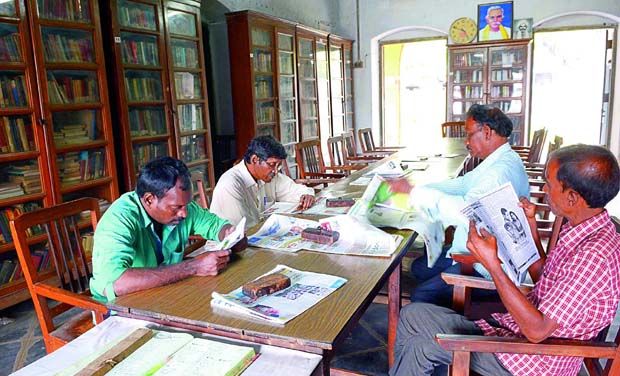
Booklovers at Ramamohan Library in Vijayawada on Wednesday. (Photo: DC)

Vijayawada:

The century-old Rammohan Dharma Pusthaka Bhandagaram, better known as Rammohan Library located near Bandar Locks on MG Road is going through a new phase of upgradation for the youth of Vijayawada.

The library, a two-storied building, built in 1911 is a monument that reflects history of the city and literary works of various authors of the 18th and 19th centuries. However, till recently, the library was left unattended for decades due to lack of financial support. The library at present has over 10,000 books relating to independence, history, science, politics and others written in Telugu, English and Sanksrit languages besides a few Hindi classics.

Ayyanki Venkataramanaiah, who is known as the Architect of Library Movement  in India, helped establishing the library along with Suri Venkata Narasimha Sastry. The duo were the first secretary and president of the trust that runs the library. Speaking to DC, library incharge and trust member Mr Ch. Koteswara Rao,  said that already a set of books relating to engineering subjects were acquired through donations. “Once a good collection is made we would start a separate section for books relating to education where youngsters can come and utilise them,” he said.

“We repaired the building to an extent and refurbished the books that are about to turn into powder. Hopefully, we would get the building protected with fencing soon,” Mr Rao added.

“We also plan to start skill development classes for interested students and already a couple of senior citizens agreed to serve as mentors,” Mr Rao said.

The treasure house is of historical importance for being visited by Mahatma Gandhi, former President V.V. Giri and many freedom fighters. The first floor of the building has an auditorium, where the legendary actress Savithri has performed her first-ever stage play decades ago. Earlier, it was a centre for literary, social and cultural activity in the district but now just around 50 people visit it each day and go through newspapers.

source: http://www.deccanchronicle.com / Deccan Chronicle / Home> Nation> Current Affairs / Deccan Chronicle / August 06th, 2015

Hawa Mahal turns art centre

The ancient building built by Jeypore Kings of Odisha. (Photo: DC)

Visakhapatnam:

One cannot take their eyes away from a masonry building while driving past RK Beach towards fishing harbour, namely ‘Hawa Mahal’, which stands out from the flock of the high-rise apartments. Constructed between 1917 and 1923 on a hillock on the Beach Road, the ‘Hawa Mahal’ in Visakhapatnam was initially intended to be the summer residence of Jeypore Kings of Odisha.

As one-third of Visakhapatnam district fell into Jeypore province under Madras Presidency in 1920s, the Jeypore kings also doubled it as a transit house to catch a train from Visakhapatnam to Madras (now Chennai). The two-storied rectangular structure is still in great shape and hosting several art exhibitions and yoga classes.

Consisting of a series of rooms with open inner verandahs and colonnaded front verandahs in both the floors, the bungalow was stocked with every possible amenity needed and enhanced with bathtubs, Italian marbles, teakwood furniture and wooden railings, many of which were brought from Birmingham, UK. Mayank Kumari Deo of the royal family of Jeypore said, “This was one of the buildings to have the power supply in the 1950s itself through underground cables.”

“After the formation of Andhra Pradesh, a nurses’ training school and first women’s college in Visakhapatnam were run from this premises during the 60s and 70s. Because of the copious amounts of wind flow, the bungalow was named as ‘Hawa Mahal,” she added

Eminent personalities such as the first President of Independent India Dr. Babu Rajendra Prasad, former President Sarvepalli Radha-krishnan and Nobel laureate Bengali poet Rabindranath Tagore stayed in this bungalow.

Former Prime Minister Jawaharlal Nehru stayed at Hawa Mahal when he visited Vizag to inaugurate ‘Jalausha’, the first ship manufactured by the Hindustan Shipyard. The historic heritage building spans over 3.5 acres, including the open space. In 2013, Bollywood veteran Waheeda Rehman visited the building and cherished her old memories associated with the city when her father worked as a judge here pre-Independence.

Mayank Kumari Deo said, “The renovation works are going on a continuous basis and we are very much committed to keeing the heritage significance of the building alive.” “We are providing the building at free cost to the budding artist to conduct exhibitions.”

source: http://www.deccanchronicle.com / Deccan Chronicle / Home> Nation> Current Affairs / Deccan Chronicle / August 06th, 2015