Category Archives: Historical Links, Pre-Independence

Kohinoor controversy stirs British media

Vintage illustration of the State Crown of Queen Mary, Consort of George V, part of the Crown Jewels of England (chromolithograph), 1919. The crown contains 2,200 diamonds, including the famous Koh-i-Noor, Cullinan III and Cullinan IV gems. / Getty Images

British press pick up Indian Solicitor General’s submission before the SC that the heirs of Maharaja Ranjit Singh gave the gem as “voluntary compensation.”

New claims over the Koh-i-Noor diamond make their periodic appearance in the United Kingdom. Most of them flounder and finally sink as they make their way through the law courts — or indeed the court of public opinion, getting a day or two of media light at best. However, the relinquishment of a claim to the much-contested gem is a different matter and a cause for interest, as we just saw.

The Indian Solicitor General’s submission before the Supreme Court that the heirs of Maharaja Ranjit Singh gave the diamond to the British as “voluntary compensation” for the expenses incurred in the Anglo-Sikh wars was widely picked up by the British press, with the leading British parliamentarian of Indian-origin, Keith Vaz, even issuing a statement in support of the Government of India’s “stand.”

A gem of a debate again

The government’s subsequent clarification dissociating itself from the view of its Solicitor General brings the debate over the 106-carat symbol of British colonialism, which at present glints harshly from the crown once worn by the former Queen Mother, back to where it was.

Questions about ownership, authorship, theft and possession in the context of colonialism and today were raised at a recent exhibition at Tate Britain, Artist and Empire, which brought together a vast and unexpected array of works from collections across Britain.

Says Javed Majeed, a historian at King’s College, “The current Koh-i-Noor diamond controversy [comes] at a point in history when the terms “Indian”, “English” and “British” are in crisis again. In India we have a strong Hindu nationalist government which has re-defined what “Indian” means and thrown secularism into disarray. Claims have also been filed in Pakistan to return the diamond to Punjab there, from where it was gifted or taken [depending on your point of view]. In 2000, even the Taliban in Afghanistan asked the Queen to return the gem because of its brief association with that region at one point in time.”

Brexit and monarchy angst

In an era of economic and political uncertainties — in Britain associated with Brexit and what it portends — “anxieties about the future of the monarchy have intensified, and not surprisingly the focus of this worry is the crown itself as an actual object as well as an institution,” Dr. Majeed argues.

“Moreover, Britain’s imperial past surfaces in obvious and sometimes surreptitious ways in all these current debates, from the question of who owns the diamond to ideas of British power in the world should it leave the EU.”

Legacy control and mistrust

Legacy-control and legacy-mistrust can happen on both sides. A senior curator at a prominent British national collection in London told The Hindu that the authorities of the Victoria Memorial Museum in Kolkata refuse to lend their works from their collections to British museums.

The collection includes works by Johan Zoffany, William Hodges and Thomas and William Daniell. “Britain put in several requests to borrow art but they have all been turned down,” the senior curator, who did not wish to be named, said.

Correction

This story has been corrected for a factual error. Changed “Anglo-Maratha” war into “Anglo-Sikh” war

source: http://www.thehindu.com / The Hindu / Home> International / by Parvathi Menon / London – April 20th, 2016
Master plan to restore lost glory of Horsley Hills

Efforts under way to tide over water crisis; long-pending ropeway will be a reality soon, says tourism official

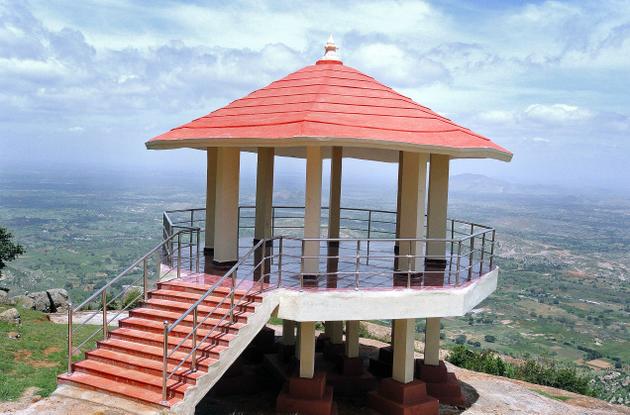
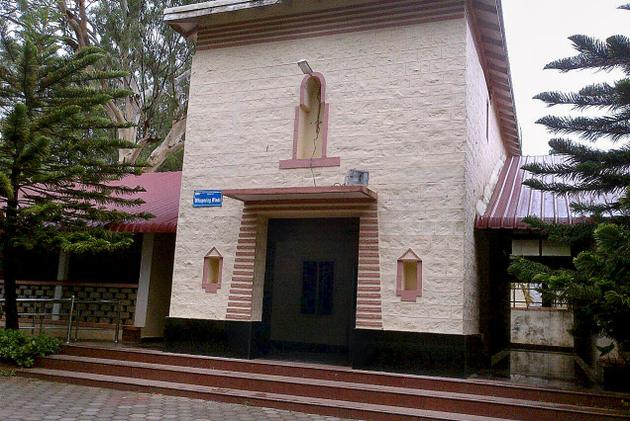
Place to be:The newly-constructed View Point atop Horsley Hills. (Right) The famous Governor’s Bungalow at the hill resort.—Photos: By Arrangement

Horsley Hills, the one and only 160-year-old hill station in Andhra Pradesh, which faced the worst-ever water crisis in 2015, has a ray of hope this year with steady inflow of tourists from all over India, particularly from Tamil Nadu and Karnataka.

The Kadapa District Collector during the British rule, W.D. Horsley, discovered the beauty of the gigantic 4,312-ft.-high hill near Madanapalle in 1857. In a record time of a couple of years, he had transformed it into a hill station. The resort gradually took the name of its discoverer.

GovernorsANDHRA19apr2016

It had served many a British officer and royal family visiting it to beat the oppressive summer heat in South India till Independence.

Later, the hill station faded into oblivion. And it is yet to regain its lost glory. In spite of this, the very mention of Horsley Hills means romance and beauty to nature-lovers and tourists. After the State’s bifurcation in 2014, the hill station has topped the list of thrust areas of the AP Tourism.

The accommodation potential has risen to over 500 tourists from half of the figure. An amount of Rs. 50 lakh was spent to construct tent-model cottages, which would be ready in the next few months.

The annual revenue suddenly shot up to Rs. 3 crore from a few lakhs before 2014.

The hill station has everything to attract tourists such as trampoline, meltdown zone, adventure combo, bull ride, canopy walk, and view points at dizzy heights overlooking steep valleys, mini-zoo park, swimming pools, and, above all, cool climate round the year, which feature has brought it the title ‘Andhra Ooty’.

The Governor’s Bungalow and Forest Bungalow are an added attraction, for they have turned historical monuments.

To meet the water needs of the tourists, the hill station completely depends on water pumped from the foothills.

At present, water is being pumped to the hilltop through pipelines up to a distance of nearly 8 km in eight stages.

The daily average consumption stands at one lakh litres. The consumption could be more in the summer months. In 2015, when groundwater totally dried up, the tourists were forced to return immediately on arrival.

District Tourism Manager D.V. Chandramouli Reddy told The Hindu that the administration was all set to execute a master plan, giving top priority to overcome the water crisis and give wide publicity to attract tourists.

“In fact, the space available on the hill is just two square km, and congestion will be another problem. In the next one decade, Horsley Hills will definitely be one of the best hill stations with global standards. The long-pending ropeway will be a reality soon,” he said.

source: http://www.thehindu.com / The Hindu / Home> National> Andhra Pradesh / byK. Umashanker / Chittoor – April 19th, 2016

From a tiled shed to a stunning edifice

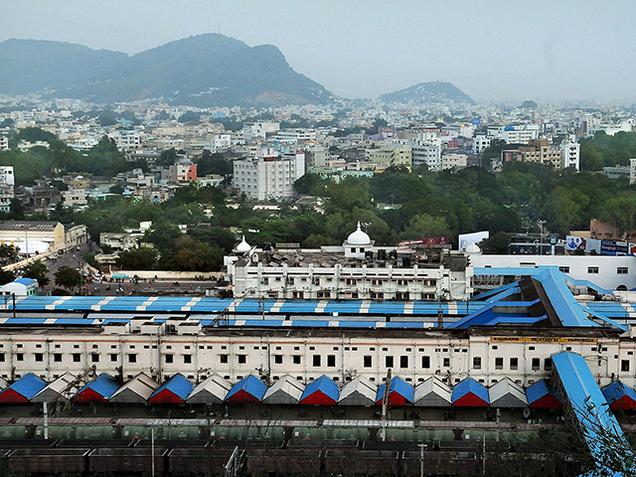
 BezwadaRailwaysANDHRA28mar2016

From the days of meter gauge, semaphore signals, manual hand-operated levers, and steam engines, Vijayawada Railway Station has come a long way

Any vintage picture, with black and white shades, is close to the heart, for it acts as a heart-warming reminder of those wonderful days spent in a leisurely and qualitative manner.

This bird’s eye view of the Bezwada Railway Station of the past era captured by the city’s septuagenarian photographer M.A. Mohan Rao, will make the old-timers turn nostalgic.

This picture, taken from Gandhi Hill (erstwhile Orr Hills) of the 50s, portrays the pristine clean-air-no-pollution Bezwada.

“We don’t see the DRM Office and the Railway Institute. We also don’t see any high-rise buildings,” exclaimed a youngster after taking a look at the photograph.

For the geeks (read digital kids), the nondescript small-town station look of today’s ultra modern railway junction is a pointer that nothing remains constant and change is the spice of life.

“The sound of the trains moving on the Krishna bridge was clearly heard when I was sleeping on the terrace in the 40s at Governorpet,” says octogenarian Turlapati Kutumba Rao, recalling his days when the present railway station was just a small shed.

He remembers the Tongas (horse-pulled carts) and rickshaws pulled by humans waiting for the travellers who alighted from the trains hauled by steam engines.

“Those days, the fare between Bezwada and Gudivada was 25 paise.”

Asked G. Phani, a cricket administrator and a city chronicler, after admiring this period picture: “Do you remember the days when we used to lean out of the train window even though coal particles emanating from the steam locomotive chimney caused discomfort?”

This railway station saw several talented natives leaving to the land of fortune — Chennai — in search of glory, and topping the list was Nandamuri Taraka Rama Rao (NTR), Akkineni Nageswara Rao (ANR), Savitri, Waheeda Rehman, Chandra Mohan, and Murali Mohan.

ANR, who was returning from Tenali to Gudivada after performing a playlet, was spotted by Ghantasala Balaramaiah, a film producer, at the Bezwada Railway Station in 1944 for the role of Lord Rama in his film Sri Sita Rama Jananam.

NTR resigned his well-paid sub-registrar job at Bezwada and boarded a train at this very station to try his luck in the tinsel world.

Rest, as the clichéd adage goes, is history.

From the days of meter gauge, semaphore signals, manual hand-operated levers, and steam engines, the Vijayawada Railway Station has come a long way.

Bezwada – the connecting link 

The Bezwada Railway Station came into being in 1888 when the British wanted to extend the incoming traffic of Southern Mahratta Railways (SMR) towards the East.

The station, with two platforms, was operated from a small shed, and later came under Mangalore tiles in the 20s. The late seventies (1978-79) saw the station moving into a huge building.

In 1889, the Nizam Guaranteed State Railways Company (NGSRC), based at Secunderabad, extended its railway connection up to Bezwada owing to the commercial and trading importance of the coastal town.

Southern Mahratta Railways was merged with Madras Railways, and Madras and Southern Mahratta Railways (MSMR) was opened to the public in 1908 with headquarters at Madras. The Bezwada District, spread from Tondiyarpet to Waltair (Now Visakhapatnam), was part of it and the district transportation superintendent was in-charge of it.

Later, MSMR was amalgamated with Southern Railway in 1951, and South Central Railway was formed in 1966 when Hubli and Vijayawada Divisions of Southern Railway and Sholapur and Secunderabad Divisions of Central Railway were carved out and merged into a new zone.

In 1969, Golconda Express was introduced with an average speed of 58 kmph between Vijayawada and Secunderabad.

The train was considered one of the fastest steam hauled trains in the country those days.

Vijayawada is the pivotal point in the Golden Quadrilateral, connecting the South to the North and East of India.

The 80s saw steady growth of the railway station into a major junction under the stewardship of rail managers like M. Raja Rao (Andhra Loyola alumni) and Nandigama-born J.N. Jagannath.

For want of more area for the expanding station, Mr. Raja Rao took a decision to dismantle the traffic colony and created more open space and also railway mini-stadium.

Last Pushkarams (2004) saw the laying of more platforms and shifting of Tarapet goods shed.

The number of trains (both passenger and freight) that pass through Vijayawada in a day stands at 300-plus, and around two lakh passengers commute daily.

Vijayawada station was accorded A1 status in 2008.

True facts

The first Route Relay Inter-locking (RRI) system of SCR was commissioned at Vijayawada station in 1976

Electric loco shed was inaugurated in 1980 with a capacity to maintain over 100 electric locomotives

The station has 10 platforms, 5 entrance gates with booking counters and two escalators

The seventh platform is the longest one

source: http://www.thehindu.com / The Hindu / Home> News> Cities> Vijayawada / by J.R. Shridharan / March 28th, 2016

Pusapati Ananda Gajapathi Raju no more

Visakhapatnam:

Pusapati Ananda gajapathi Raju, the eldest son of the last Rajah of Vizianagaram, PVG Raju, and hereditary trustee of 108 temples, including the Simhachalam Devasthanam and the MANSAS Trust, Pusapati Ananda Gajapathi Raju (65) died of respiratory problems at a hospital here on Saturday. The head of the royal Pusapati clan, Ananda Gajapathi Raju also served as former state health and education minister and was also elected twice to the Lok Sabha from Vizianagaram constituency.

An MA in economics from Columbia University, Ananda also worked as an journalist with a leading national daily from the south. He is the elder brother of Union civil aviation minister P Ashok Gajapathi Raju. He is survived by his wife and two daughters. His body was taken to Bungalow-7 in Vizianagaram soon after he passed away and the last rites were performed at the cremation grounds in Vizianagaram at 4.30 pm by Ashok Gajapathi Raju.

An avid reader and collector of books, Ananda Gajapathi Raju was considered one of the shining stars in AP politics. However, he invested all his efforts into turning MANSAS into a motivated and well-organised institution.

“His presence will be sorely missed by us all. He was a visionary who turned MANSAS into a proactive organisation and somebody who believed in selfless service,” said one of the members of his extended family.

source: http://www.timesofindia.indiatimes.com / The Times of India / News Home> City> Visakhapatnam / TNN / March 27th, 2016

Dolphin’s Nose a natural wonder of Vizag

Visakhapatnam :

Dolphin’s Nose, one of the natural wonders of the city as well as a sought-after tourist spot, has been named so because it resembles the nose of a dolphin. Some people even claim that a school of dolphins often visits the spot.

The area houses the Sagar Mata temple and the 700-year-old Ishaq Medina Dargah. According to old timers, sailors who used to sail from Vizag would seek blessings at both the places.

“Before the inner channel was constructed, there was a vast stretch of beach land connecting Vizag town to Dolphin’s Nose. However, today if one were to reach the place by road, one would have to go on a roundabout route to reach the hill,” pointed out history buff BS Mahesh.

“Today it is a restricted area and tourists are allowed on only certain stretches of the hill as the rest of it houses navy’s quarters,” he added.

The lighthouse atop the hill was built in the mid 1960s and is equipped with modern cyclone tracking technology. There was another old lighthouse situated on top of the hill way back in the 19th century, which according to heritage expert Edward Paul, was constructed by the Gode family in the 1860s. “Unfortunately, it was completely damaged during the 1874 cyclone following which plans of building a new lighthouse there were abandoned for a long time,” Paul added.

“Traces of the old basement of the old lighthouse still exists in that area. More than that, we know nothing of it. The old lighthouse is also a testimony to the fact that the Godes were an enlightened family who showed a keen interest in sciences. They even built an observatory in Visakhapatnam town which existed till the late 1970s,” Mahesh said.

Meanwhile, Paul pointed out that many legends and stories grew around the hill locally known as Yarada Konda. When asked about the sighting of dolphins near the hill, he said, “One does not know if dolphins can be actually seen near the hill.”

Mahesh, however, pointed out that the famous naval battle between the French and the British was fought near the base of Dolphin’s Nose in the year 1804.

source: http://www.timesofindia.indiatimes.com / The Times of India / News Home> City> Visakhapatnam / by Venkatesh Bayya / TNN / March 17th, 2016

Jodugullapalem a settlement named after twin temples

Visakhapatnam:

Jodugullapalem, a tiny settlement nestled between the Kailasagiri and Seethakonda hills right on the beach, has a vast majority of people belonging to the Vada Balaji community who eke out a living by fishing and building boats. They mainly worship Gangamma Thalli.

The twin shrines of Gangamma Thalli and Koth Ammavaru Thalli were built in 1925 when a group of families migrated from Old Jalaripeta to build a new settlement and named it after the shrines.

S Bhimeswara Rao, the priest of the temple complex, said, “There is also a third shrine that was built to accommodate the Bhulokamatha. The three shrines represent ‘Shakthi’ in a complete and wholesome form. However, this shrine is now in a dilapidated condition.” According to the priest, the temple complex was modernised from 1985 onwards and the Jatara was also revived in the same year. “The Jatara or annual fest was revived after a long hiatus and is held in a grand manner every January,” he added.

Devotees visit the shrine during the Magha Maasa and seek the blessings of the Mother Goddess after taking a holy dip in the sea. There are a number of other shrines in the complex dedicated to the Mother Goddess in various forms. Another unique feature about the temple is that this complex does not have a Brahmin priest.

Rao pointed out, “We have been the priests of this complex right from the beginning. However, we have been trained in the basic scriptures by Brahmin priests who taught us the basic mantras and rituals that need to be conducted. I was trained by a Brahmin scholar from Simhachalam by name Appala Charya, who initiated me into the basic Vedic practices.”

History buff BS Mahesh said, “As the village was populated only by Vada Balajis, the priests had to be drawn from the same community. One must understand that this was quite a common practice in India and many Hindu priests are not actually Brahmins. In the case of Vaishnavaite shrines, the priests are Stana Vaishnavaites.”

Local shrines

1) The complex came into existence in 1925

2) The shrines are tiny and built in a pyramidal style

3) The site is littered with waste thanks to beach goers

source: http://www.timesofindia.indiatimes.com / The Times of India / News Home> City> Visakhapatnam / Venkatesh Bayya / TNN / March 05th, 2016

Buddhist settlement discovered on Seethanagaram hill

Historical remains on Seethanagaram hill.— PHOTO: BY ARRANGEMENT

Archaeologist and CEO of the Cultural Centre of Vijayawada (CEO) E. Nagireddy has discovered a huge Buddhist settlement with traces of stupas, chaityas and viharas on the Seethanagaram hill located on the outskirts of Vijayawada city.

The relics surfaced as part of a survey conducted under the guidance of Mr. Nagireddy.

A rock-cut cistern, once used by the Buddhist monks during the rainy retreat, located next to the recently taken up Ramanuja-Vasudeva temple complex by the Jeeyar Trust provided a clue on the existence of a Buddhist monastery on the right side.

Further probing revealed brick-built viharas datable to 1st century BC to the 2nd century AD. The bricks used in the construction measured 60x28x7 cm. “A rock-cut steps-like path leading to the top of the hillock perhaps helped the monks reach the monastery,” says Mr. Nagireddy.

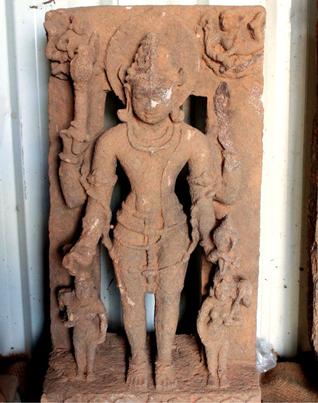
Members of the Trust, while laying a ghat road in the area, also discovered two Vishnu idols carved in khondalite stone and one Govardhana Giridhara idol datable to 6th to 10th century. The idols currently are in the safe custody of the Trust.

Extensive survey planned

Going by the ample possibility of existence of more such Buddhist relics at the site, Mr. Nagireddy has requested the Trust members to safeguard the antiquities that could be exhibited to the public at a later stage.

He said the CCV will take up an extensive survey of the place very soon.

Archaeologists believe that Andhra Pradesh became a Buddhist stronghold due to the active patronisation by the wealthy classes of the Godavari-Krishna delta.

A large number of Buddhist chaityas, viharas and stupas have been unearthed in this State. Some major sites in the area where Buddhist relics have been excavated are Nagarjunakonda, Anupu, Dhulikatta, Aduru, Bhattiprolu and Bavikonda.

source: http://www.thehindu.com / The Hindu / Home> News> Cities> Vijayawada / by P. Sujatha Varma / Vijayawada – March 04th, 2016

A trip down the ages

Rickshaw heritage rides give an opportunity to appreciate our rich past

Heritage walks on the ancient lanes of the city’s Old Town area are like time machines that take you on a journey through the pages of history and give a glimpse of some chapters that make your soul recoil with pain and poetry.

The small group of people, which participated in the rickshaw heritage ride recently, took back with it slices of the rich historical past of the city.

AnitaRaoANDHRA02mar2016

For Anita Rao, an artist, the experience was a trip down the ages — to how the area was a few centuries ago. “The over 250-year-old Queen Mary’s School encouraged and made special arrangement to educate widows and even paid them Rs.15 per month to study in the early 1900s. There were several such stories we learnt about the places that give me a reverence for these structures, which we often take for granted,” she said.

Artist Anita Rao’s sketch of Kurupam Market entrance.—Photo: K.R. Deepak

Intrigued by the fascinating tales of many such structures, some of which no longer exist, Rao made a watercolour sketch of the Kurupam Market entrance, which was demolished a few years ago.

The participants were taken around 10 important heritage places of the locality — Town Hall, Town Hall Lane, Kurupam Market, Old European Cemetery, Queen Victoria’s Pavilion, St. John Church and School, Queen Mary’s School, Ishak Madina Dargah, St. Aloysius School, and Light House. Sandhya Parimala Vijapurapu, a youngster, said that the heritage trail gave an in-depth understanding of the city’s history.

The experience made her realise that heritage was more than old buildings.

“When I hold my camera and shoot the walls of the Town Hall, it gives me a different perspective now after sifting through the multiple layers of historical facts. We saw old chairs piled up in corners of the thick walls of the building, which are now silent spectators of the city’s rapid transition,” she said, and added that the exciting part of the tour was the rickshaw ride that promoted the modest ecological mode of transport. Leading from the front was city-based social and heritage activist Jayshree Hatangadi, who had been conducting these Sunday rickshaw heritage rides for the past few months.

The heritage trail takes participants around in four rickshaws.

“The idea behind doing these rides is also to highlight the issues of preserving heritage sites. For instance, the Town Hall needs to be repaired and its surrounding area cleaned so that it can be a place of display of our heritage and have interesting speakers every month to give a talk or a presentation. Once the locations are cleaned, we can have visitor brochures and guides trained to talk about the history of the place. Even the European Cemetery has a big story to tell. Several tombstones have their life in short beautifully calligraphed,” added Hatangadi.

source: http://www.thehindu.com / The Hindu / Home> Cities> Visakhapatnam / by Nivedita Ganguly / Visakhapatnam – March 02nd, 2016

Sri Rangapuram a noble country seat of the Paravasthus

Visakhapatnam:

Sri Rangapuram, a tiny settlement nestled in Krishnanagar of Maharanipeta area, was once an Inam estate of the noble Paravasthu family, who were Satana Vaishnavaites, scholars of Telugu literature and teachers of Vaishnavaite scriptures.

The Paravasthus had received the Inam prior to their permanent settlement in 1803 and since then, have been residents of Visakhapatnam, though originally they hailed from Nellore district. The Visakhapatnam Paravasthu branch is also an off-shoot of the original branch, the products of which are people like Paravsthu Chinnayya Suri, who played a major role in the modernisation of Telugu language and was also one of the earliest advocates of social reform.

Members of the Visakhapatnam branch of the Pravasthus have been hereditary trustees of several old Vaishnavaite temples in Vizag and even supported a Veda Pathashala. The famous Venkateshwara temple in the Old City is one such temple that received services from the Paravasthus as hereditary trustees. Over the generations, the Paravasthus greatly promoted traditional scriptural education till the 1950s, after which they lacked the financial means to support their spiritual and benefactor duties chiefly due to the Estate and Inam Abolition Act that came into existence in the early 1950s.

Today, the entire area known as Krishnanagar was once part of the Paravasthu estate and because they were ardent Vaishnavaites, the place is named after Lord Krishna. More importantly, a vast majority of the villagers of Sri Rangapuram are Yadavas, who are ardent worshippers of Lord Krishna and extremely devout Vaishnavaites. The Paravasthus also used to hold court and conduct the Krishna Janmastami celebrations with splendour during their hay days. However, the changes post independence forced many of them to suspend their activities and a vast majority of the Paravasthu clan left the country.

History buff BS Mahesh said, “The Paravasthus were totally devoted to the Bhakti movement and promoted the Bhakti ideology. More importantly, they were people who went with the flow of times and were known to be quite flexible and liberal in their stance concerning social reforms, especially widow remarriage. However, today, the family has been long forgotten and even Sri Rangapuram is just an old village within the city.”

“One of the Paravasthus, Paravasthu Ranga Chari, a descendent of the original Inamdar, used to be an active member of the Theosophical Society and would attend the meetings there. His beliefs and views were quite modern, though they completely agreed with what was basically written in the old scriptures. He was a true practitioner of the Dharma Siddhanta,” said PN Rao, an old resident of the area.

source: http://www.timesofindia.indiatimes.com / The Times of India / News Home> City> Visakhapatnam / TNN / February 27th, 2016

St Joseph’s Church uniquely European in feature

Visakhapatnam :

St Joseph’s Church inside the premises of St Joseph’s College for women was built in 1903. The church was originally consecrated as a chapel for the St Joseph’s sisters who used to reside at the abbey in Gnanapuram. It was later converted into a church to accommodate other members of the Christian community.

Gnanapuram originally began as a settlement and was reclaimed by the Roman Catholic Mission which commenced operations in Visakhapatnam in 1847. Slowly, a large colony spread around the area and even today, a vast majority of the residents of Gnanapuram are Christians, chiefly Roman Catholic.

St Joseph’s Abbey in the premises is a unique structure and built in typical Neo-Gothic style with soaring arches and a high roof. The structure (the church) is typically European in architectural style with massive arches supported by columns which in turn supporting the roof. Built entirely of stone, it is uniquely French in style with the tiles and stained glass windows imported from France.

According to heritage expert Edward Paul, the structure is unlike most other churches in South India. “As far as the church is concerned, it is uniquely European in feature and character. There is not a hint of local colonial architectural influence on the church.”

However, regarding the abbey, Edward Paul observed that the colonial influence was quite strong. He pointed out that the second floor or the upper portion of the abbey was tiled with beautiful wood work and added that much of the wood was imported from Burma.

History buff BS Mahesh said, “The abbey is probably the largest in Vizag with three main wings and attached smaller wings. He observed that this was structure much larger than the district collectorate and spread over a combined plinth of 60 to 70 thousand square feet.”

Local residents of Gnanapuram observed that this church and abbey once so beautifully located are now situated in one of the most polluted areas of the city. K Joseph, an engineer and resident of the area, said, “The pollution from the port and the factories around have done much damage to the church and abbey. It is unfortunate that the beautiful stained glass work and the interiors of the church suffer due to severe particulate pollution.”

A former student of St Joseph’s and now housewife B Kameswari said, “When I was in college student in the early 1960s, it used to be a lovely sight. Today, whenever I pass by, I feel sad that all the pollution around has taken a toll on the structure.”

source: http://www.timesofindia.indiatimes.com / The Times of India / News Home> City> Visakhapatnam / TNN / January 14th, 2016