AP Chief Minister N. Chandrababu Naidu on Saturday informed the Assembly that the government has decided to name the airport at Rajahmundry and the proposed All India Institute of Medical Sciences after freedom fighter ‘Andhra Kesari’ Tanguturi Prakasam Pantulu.
source: http://www.deccanchronicle.com / Deccan Chronicle / Home> Nation> Current Affairs / DC / August 24th, 2014
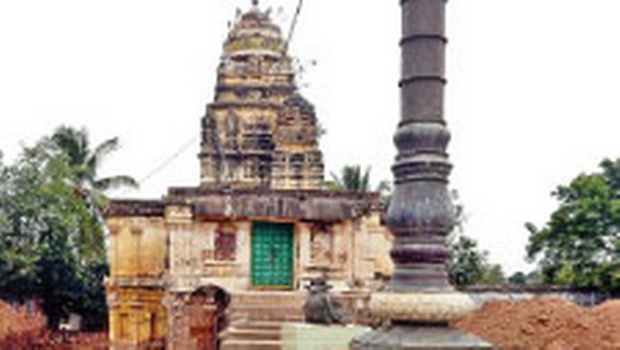
Bhimeswara Temple where the excavation was carried out at Chebrolu in Guntur district | EXPRESS PHOTO
Vijayawada :
In an important excavation executed by the Archaeology Department after finding a wall at Bhimeswara temple at Chebrolu village in Guntur district, the officials have unearthed six railing posts of the Buddhist Stupa and several other precious remains.
It may be recalled that the a brick alignment (wall) was unearthed on August 12 while digging on the southern side of the Bhimeswara Temple premises as a part of the temple renovation works taken up by the Archaeology Department. Following this, a team of officials of the Archaeology Department including assistant director K Chitti Babu, deputy executive engineer Koteswaran and technical assistant B Deepak Joe visited the place on August 16 and decided to explore the site further, anticipating some valuable remains there.
After the excavation, they have found the railing posts depicting Lotus Medallions and a row of animals. They also found a sculpture in which Bodhisattva is seen worshipped by a group of devotees, an image of a mystical animal and a ‘Yaksha’ on these posts.
“We have also found a sculpture in which the devotees are seen worshipping a Stupa by garlanding it, and large bricks (52 x 27 x 8cm size) at the site,” said Chitti Babu and added that an inscription of temple in Telugu-Kannada language has also been found.
“But this inscription belongs to medieval times when Telugu and Kannada languages had one script. A Buddhist pillar has been flattened to make this inscription,” he said.
Chebrolu was a territorial capital at that time. The remains found at the temple might belong to 1st or 2nd century AD, according to the officials.
When asked about taking up further excavation at the site, the officials said that they do not have any such plans right now.
Buddhism flourished during the Satavahana and Ikshvaku dynasties as they have patronised the religion. But the rise of Vishunkundinis (Vaishnavaites), Pallavas (Shaivites) and Eastern Gangas (Shaivites) has helped Hinduism revive itself and so Buddhism disappeared in these areas. The Buddhist sites have turned into Hindu temples.
Meanwhile, the Union government has sanctioned `1.48 crore grants from the 13th Finance Commission for the renovation of Bhimeswara temple, Adikeswara temple, Nageswara temple and Chaturmukha Brahma temple.
A Crucible of Buddhism
Chebrolu is an ancient village located about 17 km from Guntur. It is situated on a large mound, the excavation of which revealed several terracotta figures and Roman coins. Its ancient name was Sambhole (from which ‘Chebrolu’ is derived).
The Brahmalingeswara Chaturmuka Brahma temple has a small shrine situated in the middle of the temple tank. The main deity is a Siva Lingam, which has four images of ‘Brahma’ carved on its sides.
As many as six Stupa posts have been unearthed at the site.
The officials say that they may not take up further excavation at the site.
Remnants of a Buddhist monastery, dating back to pre-Satavahana period, unearthed atop the Bhairavakonda hillock at Vaikuntapuram village in Thullur mandal of Guntur district in March, 2013.
Another Buddhist site, belonging to the 2nd Century AD, unearthed near Pondugula village in March 2013.
BUDDHIST SITES IN GUNTUR, KRISHNA DISTS
Nagarjunakonda
Amaravathi
Bhattiprolu
Nandayapalem
Karlapalem
Bapatla
Garikapadu
Pedamaddur
Takkelapadu
Penumaka
Vaddemanu
Vaikunatapuram
Sitanagaram
Velpur
Madalaguda
Buddham
Ghantasala
Pondugula
Jaggaiahpet
Munjuluru
Ghantasala
source: http://www.newindianexpress.com / The New Indian Express / Home> States> Andhra Pradesh / by P. Laxma Reddy / August 23rd, 2014
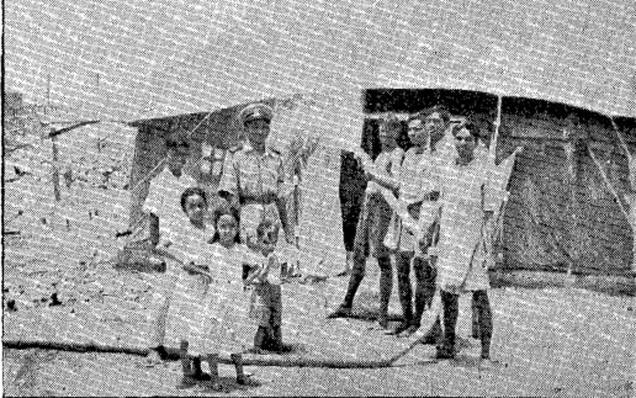
Tents those were used at official quarters in Kurnool in 1953. – Photo: By Arrangement
The capital of Andhra State after its separation from Composite Madras State in 1953 was built in 40 days. The land required for the purpose was acquired in a single day and tents were put up in a week.
The planning and dedication of officers and staff helped the administration secure all records intact and shift them to Kurnool. Kurnool was a sleepy town when the Madras Assembly voted it to be the next capital of Andhra State. Despite the caution by C. Rajagopalachari to Tamil MLAs not to join the voting, five MLAs had voted in support of Kurnool. The most difficult task was accomplished by a team of dedicated officials headed by then Special Collector C. Narasimham, Collector P.V. Madhava Rao, SP B. Kalyan Rao, Chief Engineer Frederic and Superintending Engineer Coil Pillai, while Chief Secretary O. Pulla Reddy monitored the shifting operations from Madras. After deliberations, the officials decided to vacate all district offices suitable for State offices in three to five days and shift them to Nandyal and Banaganapalli. The Collector’s office and District Board (Zilla Parishad) were found suitable for secretariat, District Court for Assembly, SP Office for the office of Inspector General of Police, Secondary Grade School hostel for Legislators residence and executive engineer’s office for Raj Bhavan. For staff quarters, the team decided to acquire land on the city outskirts, which was named as ABC camps later. Within a day, the Special Collector’s team conducted a meeting with the land owners and decided a compensation of Rs 150 per acre for the crop loss. The team put up 600 military tents in the layout after constructing dust-free roads, water lines and toilets. The government placed an order for the tents with the Military stores and sourced them from Pune. A team of 200 Malabar workers were deployed to erect tents. The government also made available Rs 50 lakh from the treasury for meeting the emergency expenditure and carrying out repairs to the Old Buildings.
The government took over Tungabhadra Industries Rest House and one retiring room at the railway station to accommodate the VIPS. A special train was run from Chennai for shifting the furniture, records and another to bring people for the inaugural function on October 2.
source: http://www.thehindu.com / The Hindu / Home> News> National> Andhra Pradesh / by D. Sreenivasulu / Kurnool – August 16th, 2014
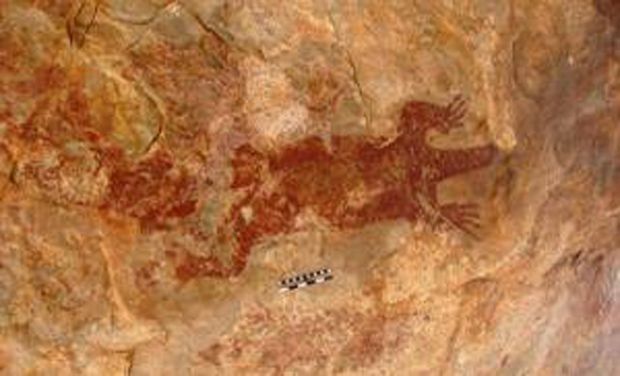
Ancient art on a wall of the Chintakuta rock shelter in Kadapa.
Hyderabad:
The Union government has declared megalithic painted Rock shelters at Chintakunta Village in Kadapa in AP as the monument of national importance.
Chintakunta site belongs to the period of 8,000 BC-1,500 BC. It has 200 rock art paintings including figures of wild animals, geometric designs and human figures.
Rock shelters at Chintakunta are among the 19 sites in the country being taken up by the Archaeological Survey of India for conservation, preservation and maintenance on priority basis.
The site was explored and analysed by Dr Erwin Neumayer of Austria, Dr N. Chandramouli of Pondicherry Central University and P.C. Venkatasubbaiah, Dravidian University, Kuppam.
source: http://www.deccanchronicle.com / Deccan Chronicle / Home> Nation> Current Affairs / DC Correspondent / August 12th, 2014
Commemorating the services of Indian freedom fighters, a special book exhibition was organised by GITAM Knowledge Resource Center (KRC) at GITAM University here Thursday.
Valuable literature available at the GITAM KRC will be kept at display to create awareness about the freedom struggle among the students. The exhibition will be open for two more days.
“Remembering our leaders and their struggle means remembering our history. The books put for display at the expo, which pass on rich historical background, will hopefully inspire the youth,” university vice-chancellor G Subrahmanyam said while inaugurating the event.
Around 500 rare publications, particularly ones like ‘Struggle for Freedom’ by RC Majumdar, ‘Story of the Indian National Army’, ‘Jail Diary’ by C Rajagopalachari, ‘Pakistan or the Partition of India’ by Dr BR Ambedkar, ‘Punjab Freedom Fighter Baba Prithvi Singh Azad’, ‘Nehru-Thoughts’, and books on Mahatma Gandhi were main attractions at the exhibition.
GITAM Institute of Technology principal K Lakshmiprasad and university librarian Nagaratnamani also participated.
source: http://www.newindianexpress.com / The New Indian Express / Home> States> Andhra Pradesh / by Express News Service / August 15th, 2014
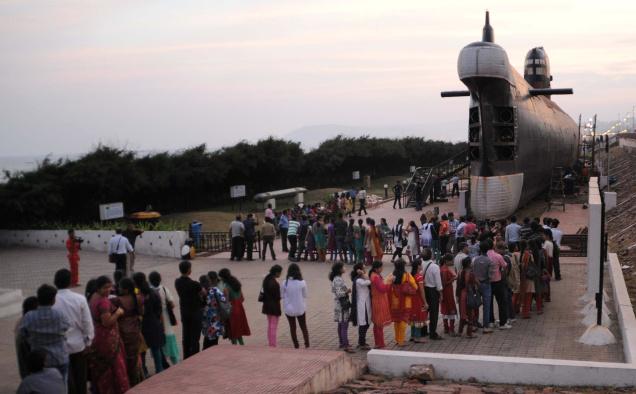
File picture of visitors queuing up to see the Submarine Museum INS Kursura in Visakhapatnam. Photo: C. V. Subrahmanyam / The Hindu
Children below the age of 15 years will be provided free entry to the Kursura Submarine museum on Saturday to mark its 12th Anniversary.
VUDA Vice-Chairman M. V. Satyanarayana said children below 15 years or studying up to Class X in any school would be allowed to visit the museum without entry fee from 2 p.m. to 8 p.m.
The submarine that made India proud in the 1971 Indo-Pakistan war now stands tall at Ramakrishna Beach in Visakhapatnam.
The Soviet-built I-641 Submarine was decommissioned on February 28, 2001.
source: http://www.thehindu.com / The Hindu / Home>News> Cities> Visakhapatnam / Special Correspondent / Visakhapatnam – August 09th, 2014
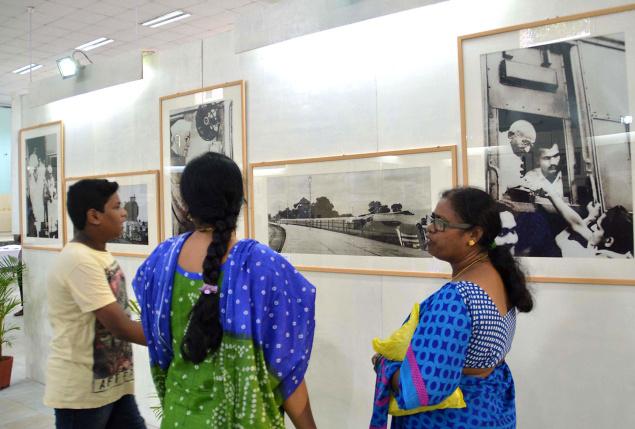
Visitors going round the exhibition of rare photographs depiciting the journey of 160 years of Indian Railways at Sri Srinivasa Kalayana Mandapam in Visakhapatnam on Sunday . Photo:C.V.SUBRAHMANYAM / The Hindu
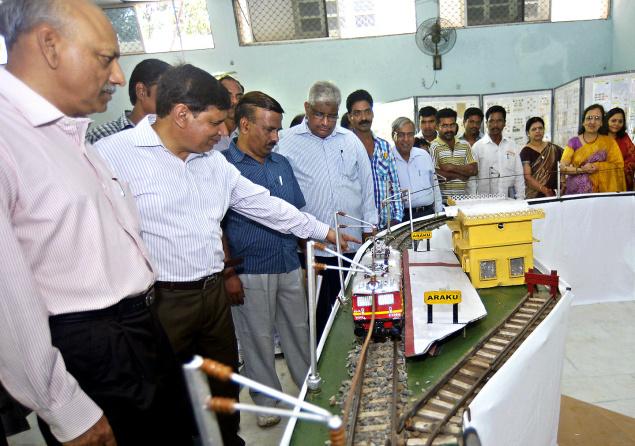
A working model of a train to Araku and some models made of egg shells are among the big attractions. The pictures are sure to revive memories of the pre-Independent era among senior citizens and the majestic steam locomotives would have revived the memories of those who were fortunate enough to have seen them chug in and chug out of the stations.
Mahatma Gandhi alighting a third class wooden coach, Pandit Jawaharlal Nehru in the cabin of a locomotive, a special train carrying refugees, packed with passengers, with many squatting on the roof top, at the time of Partition, a steam engine on a turn table …
These are a few of the hundreds of photographs of historical importance on display at an exhibition that was inaugurated by General Manager of East Coast Railway Rajiv Vishnoi, being organised at Srinivasa Kalyana Mandapam, near the Railway Station to trace the 160-year journey of Indian Railways.
The exhibition is drawing thousands of visitors and people of different age groups are evincing keen interest in seeing the pictures. Many of the visitors were seen capturing the rare photographs on their digital cameras.
The pictures are sure to revive memories of the pre-Independent era among senior citizens and the majestic steam locomotives would have revived the memories of those who were fortunate enough to have seen them chug in and chug out of the stations.
Pictures of some of the royal station buildings such as the Victoria Terminus (1887), the Howrah Railway Station in 1906, the majestic Charbagh (Lucknow), Old Delhi railway station and the Nampally Railway Station provide a peep into the railway history.
A working model of a train to Araku and a model of a locomotive and a few other models done with egg shell by artiste Durga Shankar of Visakhapatnam were a big draw at the expo.
Extended
The exhibition, which was scheduled to conclude on Monday, has been extended by two more days in view of the overwhelming response from the public. The timings, which are from 10 a.m. to 6 p.m., have also been extended by two hours till 8 p.m. on all the days.
source: http://www.thehindu.com / The Hindu / Home> News> Cities> Visakhapatnam / by B. Madhu Gopal / Visakhapatnam – August 04th, 2014
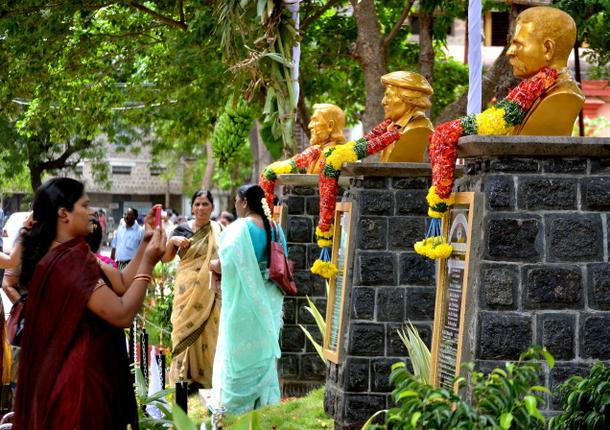
A woman clicks busts of H.G. Wolf, Martin Luther and J.C.F. Heyer installed on the AC College premises in Guntur during 173rd Formation Day celebrations held in Guntur on Thursday. – Photo: T. Vijaya Kumar / The Hindu
AELC’s formation day celebrated with fervour
The 173rd formation day celebrations of Andhra Evangelical Lutheran Church (AELC) were celebrated with gaiety on the premises of Andhra Christian College here on Thursday.
It was on this day back in 1842, a US pastor Rev. John Christian Frederick Heyer set foot in Guntur to establish the church.
Parishes
With the help of then collector, Henry Stokes, Fr. Heyer began to expand the church building new parishes. But it was in the field of education and healthcare, that Fr. Heyer left an indelible mark. Together with Kugler, he established Kugler Hospital.
He began an Anglo Vernacular School which later blossomed into A.C College.
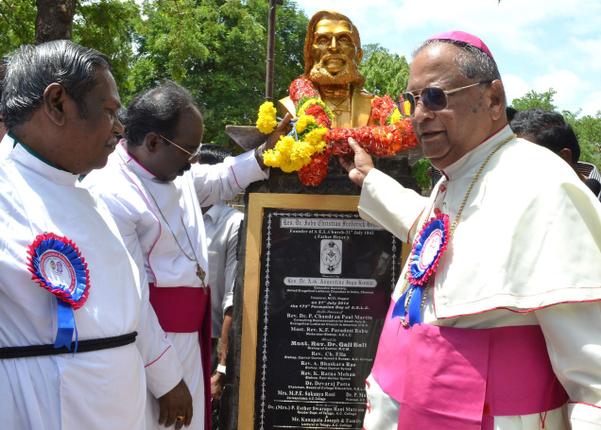
In a fitting tribute, a bust size bronze portrait of Fr. Heyer along with two other portraits of Rev Martin Luther, founder of protestant movement and H. Wolf, another missionary who served in AC College were unveiled on the AC College premises.
Remembering the contributions of missionaries who had pioneered education and health, National Council of Churches in India, Bishop Taranath S. Sagar said that the founding fathers of AELC had God’s love, mercy and compassion which had motivated them to leave all their belongings and set sail to India.
They braved the torrid heat, the tropical infections to work for the glory of God and set up schools, colleges and hospitals.
Executive secretary, UELCI and treasurer of Rev. A.G Augustine Jeyakumar, moderator bishop, AELC K.F Pradesi Babu, Bishop of Guntur Gali Bali, Principal of AC College P. Mutyam were present.
source: http://www.thehindu.com / The Hindu / Home> News> Cities> Vijayawada / by P. Samuel Jonathan / Guntur – August 01st, 2014
ECoR General Manager Rajiv Vishnoi along with DRM Anil Kumar admiring the working model of the Araku train, at the photo exhibition that began in Visakhapatnam on Friday. – Photo: K.R. Deepak / The Hindu
Good response to railway photo exhibition. The working model of a diesel locomotive going on Araku line and the model of a locomotive by egg shell artiste K. Durga Shankar were a big draw at the exhibition. A model of a bio-toilet was also put up at the event.
A photo exhibition of rare pictures, being organised by the Ministry of Railways to commemorate completion of 161 glorious years of Indian Railways, was inaugurated by General Manager of East Coast Railway Rajiv Vishnoi at Sri Srinivasa Kalyana Mandapam on the Station Road here on Friday.
The rare photographs of early steam locomotives, old coaches, Mahatma Gandhi, and other leaders in trains, and a wagon carrying a helicopter are sure to bring back nostalgic memories of who had seen them during their childhood.
The working model of a diesel locomotive going on Araku line and the model of a locomotive by egg shell artiste K. Durga Shankar were a big draw at the exhibition. A model of a bio-toilet was also put up at the event.
Children from various schools evinced keen interest in the photographs as they went round the exhibition.
Divisional Railway Manager Anil Kumar and Senior Divisional Commercial Manager M. Yelvender Yadav were among those who accompanied the General Manager.
The exhibition, which is open to all, will be on till August 4. It will be open from 10 a.m. to 6 p.m. on all days.
source: http://www.thehindu.com / The Hindu / Home> News> Cities> Visakhapatnam / B. Madhu Gopal / Visakhapatnam – August 01st, 2014
The objective of writing history of Andhra Pradesh, covering coastal Andhra, Rayalaseema and Telangana, without seeking government help is “to keep it scientific, secular and free from any bias,” said veteran historian V Ramakrishna on Friday.
He was speaking at a function organized to release the fifth volume of the comprehensive history of Andhra Pradesh. The volume was released by governor E L S Narasimhan who said that the Andhra Pradesh History Congress, which was formed in 1976 and whose members have compiled the voluminous data, should take some help to facilitate its work. “Do not oblige anybody, but do take help because it is a gigantic task and the need of the hour,” he said.
Ramakrishna, who is popularly known as VRK, said that it was in 1998 that the APHC decided to compile and publish the comprehensive History and Culture of Andhra Pradesh in eight volumes which, with time, have been expanded into nine volumes.
The need for the series was felt because no connected, authenticated, chronologically arranged narrative from an inter-disciplinary perspective, incorporating the latest data, is available today. “Writing micro history is difficult. The content of each chapter is verified at various levels for its authenticity. I want to pay tribute to the contributing historians because they have written, not for money, but their dedication towards the cause of history,” he informed the audience.
The members of the editorial board of the history series include K S Kameswara Rao, A Satyanarayan and G Venkata Ramayya while the general editor is V Ramakrishna. The fifth volume has been edited by R Soma Reddy.
According to speakers at the function, the present volume is on Late Medieval Andhra Pradesh covering the period between 1324 and 1724, a period that witnessed the rise of larger regional state powers such as the kingdom of Vijayanagara and the Bahmanis.
Consequent upon the constant flux of people of different languages, faiths, cultures and professions and the establishment of foreign settlements, a liberal spirit of tolerance developed, which was furthered by the prevalence of Sufi and Bhakti cults. One of the most significant features of the times was the evolution of composite Dakhni Deccani culture, along with the rise of the Deccani Urdu language.
source: http://www.timesofindia.indiatimes.com / The Times of India / Home> City> Hyderabad / TNN / July 19th, 2014