Category Archives: Historical Links, Pre-Independence

Dutch sites in Krishna, Guntur to get new lease of life


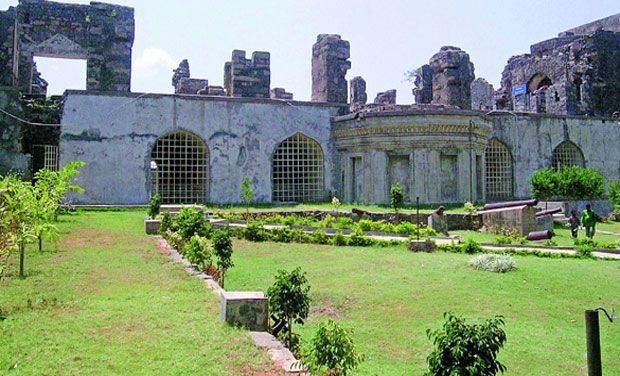
The Dutch fort at Bandarkota village near Machilipatnam in Krishna district. - Photo : T. Appala Naidu / The Hindu
The Dutch fort at Bandarkota village near Machilipatnam in Krishna district. – Photo : T. Appala Naidu / The Hindu

Govt. to take up conservation measures after documentation of monuments by Archaeology Dept.

The Dutch engineering marvels in Krishna and Guntur districts will soon get a new lease of life, with the Department of Archaeology and Museums (Andhra Pradesh) deciding to document them. The government, after assessing the scientific documentation, will initiate conservation measures.

It is learnt that the land within the limits of several Dutch cemeteries along the coastline of Krishna and Guntur districts are owned by the local communities. “The study will begin within a month. A detailed inspection and study will be taken up on Dutch cemeteries in Krishna and Gutur districts,” Department of Archaeology and Museums Assistant Director S. Bangaraiah said.

The government will initiate steps to conserve the listed Dutch sites based on the existing condition of the constructions. Officials will also cover the Dutch sites being conserved by the Archaeological Survey of India (ASI).

In the early 16th century, the Dutch had established factories in Machilipatnam. The Dutch cemetery within the limits of Machilipatnam municipality was occupied by locals at Bandarkota. The fort in Bandarkota village under ASI conservation is related to times of the Dutch, French and the British in India.

Capt. Albert Harvey’s book Ten Years in India reveals that the fort had an arsenal store meant for supply to troops of the Hyderabad and Nagpur subsidiary forces as well as the whole of the northern division of the Army. However, the 1864 cyclone depopulated Bandarkota village, ruining the beauty of the Dutch constructions.

source: http://www.thehindu.com / The Hindu / Home> News> Cities> Vijayawada / by T. Appala Naidu / Machilipatnam – December 02nd, 2014
Navy gets AP nod for Badangi airstrip

Visakhapatnam  :

The Indian Navy has finally got a no-objection certificate (NOC) from the AP government to set up a diversionary airfield at Badangi near Bobbili in Vizianagaram that houses a World War II airstrip, Eastern Naval Command (ENC) chief vice Admiral Satish Soni said here on Wednesday.

The historic Badangi airstrip, which was used by the Royal Air Force during the Second World War to move its troops across the region, will now house the Indian Navy’s fighter aircraft fleet and will also be used for training pilots on the new aircraft being acquired by the Navy. Sources said the cost of developing a naval fighter plane base at Badangi might cost around Rs 200 crore to Rs 300 crore.

Speaking to media persons onboard INS Shivalik on Wednesday on the eve of Navy Day, the ENC chief said that following the state government’s approval, the proposal for acquisition of Badangi airstrip has now been sent to the Naval Headquarters at New Delhi.

Pointing out that the Navy wants the project to be put on fast track, he said the Navy would forward the proposal to the defence ministry and from there it would go to the ministry of finance. “With the induction of advanced aircraft like P8I and MIG 29K, pilots need more intensive training, which is why Badangi has been identified as the base for fighter aircraft and pilot training,” he said.

The airstrip, constructed during World War II by Mackenzie Company over 221 acres, was one of the biggest RAF bases in British India and had a control tower, separate underground armament depot and many underground bunkers, besides staff quarters and a natural pond for fire fighting. All those structures were demolished except the runway. In those days, the RAF squadron at Badangi housed supermarine Spitfire fighters, Hawker Hurricane fighters, Avro Lancaster Bombers, B-57 Canberra reconnaissance and transport aircraft. After it was shut down in 1946 after the war, Food Corporation of India used it for some time to store paddy and wheat.

Today a chunk of the 221 acres is encroached by farmers, the Indian Navy needs a total of around 1,000 acres to set up its base, Soni said, pointing out that they may go for a 4,000-4,500 ft runway to cater to their needs. He said some kind of compensation would be worked out for the farmers currently cultivating nuts, paddy, and sugarcane at the airstrip site.

On the Naval Alternate Operations Base (NAOB) at Rambilli in Visakhapatnam district, the ENC chief said it would be completed in 2018 with some works already having started and others in progress. Talking about losses suffered by ENC due to Cyclone Hudhud, Soni said Rs 200 crore had been sanctioned for restoration works, which would be taken up one by one.

The ENC chief said the International Fleet Review (IFR) to be conducted from February 3 to 9, 2016, in Vizag would see 100 ships and delegates of 79 navies of various countries participate and would be reviewed by the Indian President.

source: http://www.thehindu.com / The Hindu / Home> City> Visakhapatnam / TNN / December 04th, 2014

Expo on lost Kalamkari textile in city

Kolkata :

They had originated and proliferated in India, possibly in Tanjore, in the late 16th or early 17th century under the patronage of the Mughal emperors. But, with the passage of time, Kalamkari paintings on textiles faded into oblivion.

Thousands of miles away, a museum in France on the Swiss border has preserved some of the oldest specimens of Kalamkari paintings on textiles. These are very rare to find even in museums within the country.

For a fortnight starting on Wednesday, the textile gallery of the Indian Museum will showcase the world famous ‘Tapis Moghol’ — some of the most elaborate designs replete with mysterious animals, birds, foliage and flowers — that hold the key to many stories of the times. The ‘Tapis Moghol’, that dates back to the late 16th or early 17th century, has been preserved for the world at the En Musea De L’Impression Sur Etoffes De Mulhouse or the Museum of Printed Textiles at Mulhouse, France.

Kalamkari paintings in its earliest form were motifs painted on large wall hangings that were used to decorate the altar behind the deity. Kalamkari, though, is not a lost art form in the sense that it is still practised in both the painted and block printed versions. But, we have lost most of the original designs that were popular when it was used as an altar backdrop in South Indian temples.

“A gentleman called Funffrock, who was an employee of the French East India Company, was posted in Tanjore. The Frenchman was immensely interested in the traditional art form and got a cotton cloth, measuring eight feet by eight feet, done up with rich intricate designs that showcased the best motifs of that time. With time, this became the focal exhibit, around which the other collections of the period grew. The exhibition will give the city a glimpse of the Funffrock collection,” explained Ruby Palchowdhury, spokesperson of the Crafts Council of West Bengal, which is a wing of the Crafts Council of India and is funded by the Centre.

Textile and culture ministries and the Alliance Francaise have funded the expo that will have 25 panels to show off design details and the stories underneath. The exhibition has been curated by ethnic historian Lotika Varadarajan.

source: http://www.timesofindia.indiatimes.com / The Times of India / Home> City> Kolkata / by Jhumli Mukherjee Pandey, TNN / November 16th, 2014

Services of Abul Kalam Azad recalled

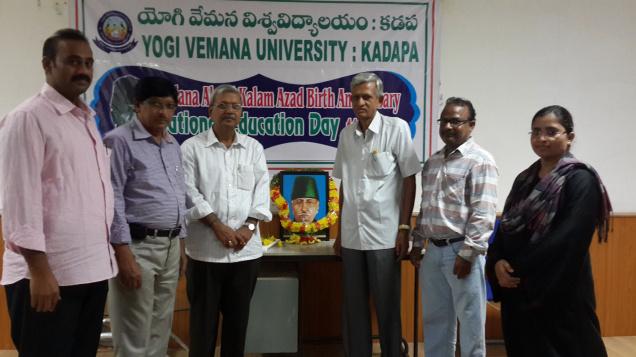
Yogi Vemana University Vice-Chancellor B. Syamasundar and faculty members paying tributes to Abul Kalam Azad in Kadapa on Tuesday. / Photo: By Arrangement / The Hindu

The invaluable contribution of India’s first Education Minister Maulana Abul Kalam Azad for expansion of reach of education to masses and improvement of its quality was recalled on the occasion of his birth anniversary on Tuesday.

Participating in the National Education Day observed in this connection, educationists and other dignitaries paid rich tributes to the man who played an instrumental role in the establishment of the University Grants Commission and the Indian Institutes of Technology. Addressing the faculty and students of Sri Padmavati Mahila Viswa Vidyalayam (SPMVV) at Tirupati, School Guru Eduserve’s Project Manager Prabhakaran predicted a rise in number of courses offered online and said that the online mode of education would facilitate expansion of learning to the grass-root level rather than the face-to-face mode of instruction. The programme was held by SPMVV’s Department of Communication and Journalism.

In a separate event, the members of Muslim Joint Action Committee (MJAC) paid homage to Maulana Abul Kalam Mr. Azad and recollected his contributions to the country. Yogi Vemana University (YVU) Vice-Chancellor B. Syamasundar garlanded Mr. Azad’s portrait in a function held at Kadapa. On the occasion, Mr. Syamasundar pointed out that Azad had rightly accorded more priority to education policy than the industrial policy. YVU Registrar C. Sambasiva Reddy said Azad had strove for national integration and tolerance to all religions. Coordinator of History and Archaeology Ramabrahmam explained Mr. Azad’s role in the independence movement and his support to reservations.

Paying tributes to Mr. Azad at the Congress office, District Congress Committee president Shaik Nazeer Ahmed said Azad had strived for the poor, weaker and downtrodden sections.

At Chittoor, the district administration celebrated the birth anniversary of Azad in a grand manner with the participation of a big number of students, teachers and officials. Mayor Katari Anuradha flagged off the rally with about one thousand students at Gandhi Circle and it passed through arterial junctions culminating at Ambedkar Bhavan.

source: http://www.thehindu.com / The Hindu / Home> News> National> Andhra Pradesh / by Andhra Pradesh Bureau / Tirupati-Kadapa-Chittoor, November 12th, 2014

New look for Kondapalli Fort

A view of the Kondapalli fort, 20 km away from Vijayawada.

VIJAYAWADA: 

The historic Kondapalli fort, 20 km from Vijayawada city, is getting a facelift so that more tourists are attracted towards it. The archaeology department took up the renovation of the 14th century fort, built by king Prolaya Vema Reddy. However, due to denial of permission from the forest department, the Andhra Pradesh Tourism Development Corporation officials are said have failed to provide basic amenities at the fort.

Archaeology officials have completed a major part of the renovation work, including administering chemical treatment to Ranimahal, Nartanasala and jail khana. Some walls that had collapsed have been rebuilt, while other walls and arches repaired and given a fresh coat of water to prevent rainwater seepage. Deputy executive engineer, archaeology department, S. Koteswaran said that granite has been laid along the pathways for the convenience of tourists and the damaged arches repaired. The Central government has sanctioned funds from the 13th Finance Commission for renovation of the fort. Officials plan to complete the renovation work within the budget of Rs 3 crore.

Meanwhile, the APTDC is working on attracting more tourists to Kondapalli fort by providing basic amenities and developing a craft bazaar to market the world famous Kondapalli toys and other handicrafts of the district.However, the APTDC has been unable to implement its plans as the forest department has denied permission for construction activity near the fort, citing protection of reserve forest, said APTDC divisional manager T. Baboji. “Kondapalli has immense tourism potential.

Being Kartika masam, thousands of people are visiting the fort on weekends to participate in Vanamahotsavam,” he said. Most of the visitors complain of lack of basic amenities at the site and appeal to the authorities to provide minimum facilities.

source: http://www.deccanchronicle.com / Deccan Chronicle / Home> Nation> Current Affairs / by DC Correspondent / November 02nd, 2014

Heritage school faces demolition threat

Visakhapatnam :

Heritage activists from the Indian National Trust for Art and Cultural Heritage (Intach) are apprehensive that the century-old Queen Mary’s Government High School (QMGHS) in Old Town would be pulled down citing reasons like natural calamities in the near future. During a recent visit to the school, in the aftermath of Cyclone Hudhud, education department officials from Hyderabad had suggested bringing down a portion of the school instead of wasting money on repair.

Though the cyclone partially damaged the old building, especially the roof and wooden staircases, heritage activists feel the structure is quite sturdy and can be easily restored with the help of some repairs and renovations instead of demolishing it and replacing with new constructions.

“Recently, officials from the education department in Hyderabad visited the school. It has come to our knowledge that after seeing the damages caused by Hudhud, the officials publicly expressed their intention to replace the damaged heritage structure with new constructions. However, despite being one of the oldest buildings of Vizag, the lime and mortar structure is quite sturdy and can withstand the ravages of time. It only needs some repair and renovation of the roof and staircases,” Intach’s Vizag chapter convener P V Prasad said.

According to government sources, some months ago a sum of Rs 32 lakh was sanctioned by the state education department for construction of a new school building in the existing premises but the funds were later diverted to other “needy” schools. The century-old school has a strength of 1,300 students and around 60 teachers, besides 15 non-teaching staff. The building, which now houses the school, was earlier a medical school and before that housed the Old Collectorate in the early 19th century.

When contacted, school staffers admitted that while there was some talk of carrying out construction work in the premises, they said they are not aware of the detailed plan.

source: http://www.timesofindia.indiatimes.com / The Times of India / Home> City> Visakhapatnam /  TNN / October 29th, 2014

Protect Telugu cultural heritage: Bharani

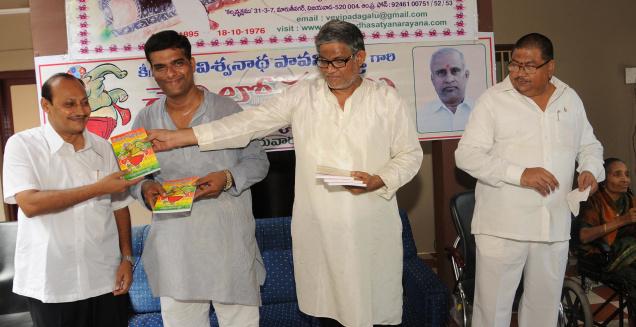
Writer and actor Tanikella Bharani releasing a book 'Chevilo Poolu' written by Viswanadha Pavani Sastry, in Vijayawada on Tuesday. Photo: Ch. Vijaya Bhaskar
Writer and actor Tanikella Bharani releasing a book ‘Chevilo Poolu’ written by Viswanadha Pavani Sastry, in Vijayawada on Tuesday. Photo: Ch. Vijaya Bhaskar

Noted writer-cum-actor Tanikella Bharani expressed anguish over the Telugus’ “lack of interest in protecting their own cultural heritage”. Releasing a book written by writer and Viswanadha Satyanarayana’s son, Pavana Sastry, here on Tuesday, Mr Bharani pointed to the way the British converted the birth place of famous English playwright Shakespeare in Stratford-upon-Avon into a heritage museum. The birthplace of great music composer Ludwig Van Beethoven in Bonn was also made into a museum.

The Telugus abroad are also working to protect their native heritage. The tomb of C.P. Brown who compiled a Telugu and English dictionary located in London was being maintained by members of the Telugu Association of London (TAL).

But the same could not be said about Telugu writers and artistes in the State, Mr Bharani said. The need to convert the house of great Telugu writer Viswanadha Satyanarayana into a heritage museum was being stressed since 1999, but no one had taken any initiative for the last 15 years.

Mr Bharani recalled how the paintings of Damerala Rama Rao at the gallery in Rajahmundry were all shifted to a corner by the watchman so that he could use the hall to perform obsequies to his father on one rainy day. The watchman was performing obsequies not only to his own father but to the heritage of the Telugus also, he quipped.

The heritage museums created in the memory of Kandukuri Veeresalingam and Gurajjada Appa Rao were only marginally good when compared to such places abroad. He said, Viswanadha Satyanarayana was a great doyen of Telugu literature and all in the country should be proud to be born in the same nation as him. He recalled how the descendants of another great Harikatha artiste were using the house that was called a museum for selling coffee powder.

The writer’s grandsons Satyanarayana and Manohar said that they would use the house to promote Telugu literature. A photo exhibition and other articles that belonged to the writers would also be put on display at the house, they said.

source: http://www.thehindu.com / The Hindu / Home> News> Cities> Vijayawada / by Special Correspondent / Vijayawada – October 22nd, 2014

Cyclone memorial cries for attention

Structure built to remember 30,000 who died in cyclone

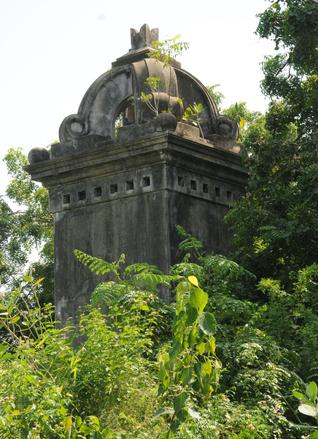
A view of cylcone victims memorial constructed during British rule at Gilakaladindi near Machilipatnam in Krishna District of Andhra Pradesh. Photo: Ch. Vijaya Bhaskar / The Hindu

People tend to recollect harrowing times of Diviseema uppena, a cyclone that devastated Machilipatnam, whenever a cyclone hits the State. But, here is a cyclone memorial which has faded in the memories of times gone by.

Great tragedy

Close to 30,000 people were swept away by the giant ocean wave over Machilipatnam town on the night of the cyclone of November 1, 1864. Following the great tragedy, Manuel Fruvall had constructed the memorial in the memory of his brother’s family and 30,000 people of this tiny town who died in the cyclone, at Bandarkota village near here.

A plaque put up outside the this monument says that the memorial was constructed in remembrance of Anthony and Maria Fruvall, their sons Peter Manuel and Daniel and their daughter Honey and her children Joseph and Georgiana and 30,000 people who were swept into the eternity by the ocean.

In 1860s, the total population of the town was around 60,000. In remembrance of then Machilipatnam Chief Magistrate G. Thornhill, who strove to control post-cyclone deaths due to spread of several diseases, Mr. Fravell also dedicated the memorial to him, says amateur Historian Md. Silar.

Many people of the town do not even know where the monument is located there. But, fishermen community in the vicinity recollected that thousands were killed in 1864 cyclone.

Many demanded that the government come up with a plan to restore and preserve the memorial.

Mr. Silar says that the monument commemorates the fate of thousands of people.

The memorial withstood vagaries of nature. But, now stands testimony to negligence by government machinery.

Dilapidated monument

The dilapidated monument is surrounded by the bushes and trees. “Our repeated appeals to the District Collector and authorities concerned to protect the heritage fell on deaf ears,” he adds.

source: http://www.thehindu.com / The Hindu / Home> News> Cities> Vijayawada / by G. V. R. Subba Rao / Machilipatnam – October 16th, 2014

Treasure hunt at ancient temples in Guntur district

Archaeological Department Assistant Director K. Chittibabu inspecting the site where a five-member gang was arrested at the Lord Shiva Temple at Kethavaram in Guntur district. - Photo: By arrangement
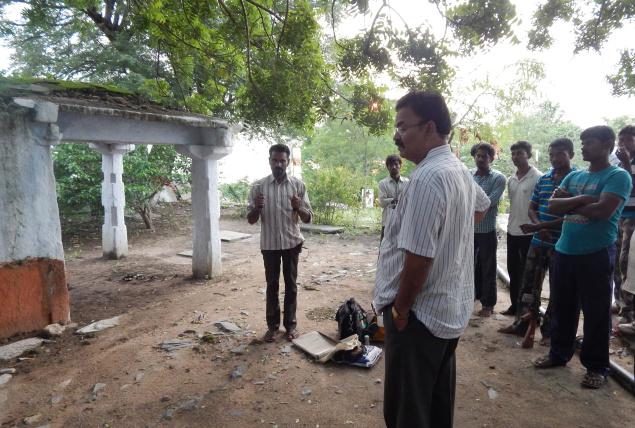
Archaeological Department Assistant Director K. Chittibabu inspecting the site where a five-member gang was arrested at the Lord Shiva Temple at Kethavaram in Guntur district. – Photo: By arrangement

Monuments in the submergence area of Pulichintala project have become a haven for them. The prime accused — D. Ramakrishna along with his associates — D. Venkateswar Naik, B. Somla Naik, Narasimha Naik and K. Ramesh Naik started scouting for the trove from a tribal fort and reached the ancient Lord Shiva temple at Kethavaram village.

Ancient temples located at villages that come under the submergence area of Pulichintala project in Guntur district have become a haven for treasure hunters.

Treasure hunters are thronging these temples with latest gadgets to locate “hidden” treasures. Police are on tenterhooks with the hunters making their presence felt in the district. Police intensified patrolling to keep a tab on them. In order to confirm whether any troves are present in villages at Kethavaram, Kolluru and Gollapeta that are set to submerge once Pulichintala project is completed, the district police roped in senior officials from the Archaeological and Museums department for a detailed inspection of the spot.

The police also wrote a letter to the Endowments Department seeking its intervention and allay fears of people. A few days ago, the Piduguralla police nabbed five persons for allegedly attempting to find out a treasure trove using a long-range detector brought from Bulgaria.

The prime accused — D. Ramakrishna along with his associates — D. Venkateswar Naik, B. Somla Naik, Narasimha Naik and K. Ramesh Naik started scouting for the trove from a tribal fort and reached the ancient Lord Shiva temple at Kethavaram village of Bellampally mandal in Guntur. Based on signals received from the detector, the gang members searched for the trove which they anticipated contains gold and silver coins.

Acting on a tip-off, the police rushed to the spot and nabbed the gang members. “It has become a nuisance for us for the last few months. To verify the gang’s claim, we took the help of officials from Archaeological and Museums department and confirmed that there are no traces of treasure troves,” explained Piduguralla Town Circle Inspector Y. Sridhar Reddy.

The hunt for treasure troves began when the main idols in these old temples were shifted to other places after administration declared Kethavaram, Kolluru, Gollapet and other areas as submergence villages, he said. When contacted, Archaeological and Museums Department Assistant Director K. Chittibabu, who visited the spot, confirmed that no traces of treasure troves were found.

“We advised the police to seek the assistance of Mines and Geology Department to know more about the detector used by the gang” he added.

source: http://www.thehindu.com / The Hindu / Home> News> Cities> Vijayawada / by M. Srinivas / Vijayawada – October 08th, 2014

Kadapa airport to be thrown open on Oct. 14

The long-abandoned air strip in Kadapa that has been given a facelift and developed into an airport will be brought into operation in a week.

Arrangements are being made for the inauguration of Kadapa airport by Chief Minister N. Chandrababu Naidu on October 14. Union Minister for Civil Aviation P. Ashok Gajapathi Raju will take part in the inauguration.

History

Kadapa aerodrome was constructed in 1953 on a 229-acre site. Vayudoot operated services from Kadapa to Hyderabad in the 1980s. The aerodrome built on a 229-acre stretch was subsequently used by Chief Ministers for making transit halt of the Government helicopters and for refuelling.

About 15 light and microlight aircraft and helicopters landed in Kadapa aerodrome and took off in Air Race India Show organised by Aeronautical Society of India in 2003, as a prelude to the first centenary of aviation history created on December 17, 1903, when the Wright Brothers flew the first-ever powered flight. It was an enthralling experience for the massive audience to watch light and microlight aircraft and helicopters land and take off over a three-hour period, 11 years ago.

The YSR government had entered into a MoU in March 2007 for developing the aerodrome into an airport and allocated an additional 440 acres, located about 10 km from Kadapa town.

In accordance with the MoU, the government had offered to supply drinking water and power free of cost for five years.

It also granted property tax exemption for land used for the airport, navigation and related purposes and the airport staff colony, besides granting exemption from Kadapa Municipal Corporation taxes.

Under the Build, Operate and Transfer (BOT) basis, a new two km. Runway was completed at a cost of Rs. 21 crore.

In addition, a 11-km long compound wall was constructed with an outlay of Rs. 24 crore. In the second phase, an Air Traffic Control (ATC) building, passenger terminal, parking bays and internal roads were built at a cost of Rs. 13 crore.

Officials are holding discussions with some air travel agencies such as Spice Jet.

source: http://www.thehindu.com / The Hindu / Home> News> National> Andhra Pradesh / by M. V. Subrahmanyam / Kadapa – October 07th, 2014